 Cross-Cultural Adaptation and Psychometric Evaluation of the Daydream Frequency Scale
Abstract
This study aimed to perform a cross-cultural adaptation of the Daydream Frequency Scale (DDFS) for the Brazilian context. A convenience sample of 269 individuals (83% women) aged between 18 and 61 years (mean=27; SD=11) who responded to the DDFS, a scale of mind wandering (MEWS), psychopathological symptoms (ASRS and DASS-21) and self-control (MSCS). A committee of judges indicated excellent levels of content validity. Confirmatory factor analysis (CFA) showed that the scale maintained a unidimensional structure [χ2(66)=671.488; p<.001; CFI=.995; RMSEA=.035; p<.001; 90% CI=[.023, .047]; TLI=.994; SRMR=.047], with items exhibiting good psychometric indicators as evaluated by IRT. The DDFS was positive correlation with mind wandering, ADHD symptoms and symptoms of anxiety, depression and stress, and negative correlation with self-control. These findings support the adaptation of the DDFS for the Brazilian context and provide evidence of validity based on content, internal structure, and relations to theoretically related external variables. They may contribute to a better understanding of daydreaming and its relation to psychopathological symptoms, as well as foster cross-cultural comparisons of daydreaming.
Keywords:
Daydream; mind wandering; stimulus-independent and task-unrelated thoughts
Resumo
Este estudo teve como objetivo realizar uma adaptação transcultural da Escala de Frequência de Sonhar Acordado (DDFS) para o contexto brasileiro. Uma amostra por conveniência com 269 indivíduos (83% mulheres) com idades entre 18 e 61 anos (média=27; DP=11) que responderam à DDFS, uma escala de divagação mental (MEWS), sintomas psicopatológicos (ASRS e DASS-21) e autocontrole (MSCS). Um comitê de juízes indicou excelentes níveis de validade de conteúdo. Uma análise fatorial confirmatória (AFC) mostrou que a escala manteve uma estrutura unidimensional [X2(66)=671.488; p<0.001; CFI=0.995; RMSEA=0.035; p<0.001; (CI 90%=0.023-0.047); TLI=0.994; SRMR=0.047], com itens apresentando bons indicadores psicométricos avaliados pela TRI. A DDFS apresentou correlação positiva com a divagação mental, sintomas de TDAH e sintomas de ansiedade, depressão e estresse, bem como correlação negativa com autocontrole. Esses resultados dão suporte à adaptação da DDFS para o contexto brasileiro e indicam evidências de validade baseadas no conteúdo, na estrutura interna e na relação com variáveis externas teoricamente relacionadas e podem contribuir para a compreensão do sonhar acordado e sua relação com sintomas psicopatológicos, além de fomentar comparações transculturais sobre o sonhar acordado.
Palavras-chave:
Devaneio; divagação mental; pensamentos independentes de estímulos e não relacionados à tarefa
Resumen
Este estudio tuvo como objetivo realizar una adaptación transcultural de la Escala de Frecuencia de Ensueño (DDFS) para el contexto brasileño. Se utilizó una muestra por conveniência de 269 personas (83% mujeres) de entre 18 y 61 años (media=27; DE=11) que respondieron a la DDFS, una escala de divagación mental (MEWS), síntomas psicopatológicos (ASRS y DASS-21) y autocontrol (MSCS). Un panel de jueces indicó excelentes niveles de validez de contenido. Un análisis factorial confirmatorio (AFC) mostró que la escala mantuvo una estructura unidimensional [χ2(66)=671.488; p<0.001; CFI=0.995; RMSEA=0.035; p<0.001; IC 90%=0.023-0.047; TLI=0.994; SRMR=0.047], con ítems que presentaron buenos indicadores psicométricos evaluados mediante la TRI. La DDFS mostró correlación positiva con la divagación mental, los síntomas de TDAH y los síntomas de ansiedad, depresión y estrés, así como una correlación negativa con el autocontrol. Estos resultados respaldan la adaptación de la DDFS para el contexto brasileño e indican evidencias de validez basadas en el contenido, en la estructura interna y en la relación con variables externas teóricamente relacionadas. Además, pueden contribuir a la comprensión del soñar despierto y su relación con los síntomas psicopatológicos, así como fomentar comparaciones transculturales sobre el soñar despierto.
Palabras clave:
Ensueño; mente divagando; pensamientos independientes del estímulo y no relacionados con la tarea
Introduction
While participating in a meeting, driving to work, or performing other common daily tasks, it is common to notice that the mind wanders, focusing on thoughts unrelated to the present moment (Peloso et al., 2024; Zanesco et al., 2025). These Stimulus-Independent and Task-Unrelated Thoughts (SITUTs) are characterized as a common process (Ciaramelli & Treves, 2019; Killingsworth & Gilbert, 2010; Stawarczyk et al., 2011) related to Default Mode Network (DMN) (Kam et al., 2022; Kucyi et al., 2023) and potentially beneficial, such as their association with creativity (Agnoli et al., 2018; Luchini et al., 2025; Yamaoka & Yukawa, 2020), and their role in preparing for the future (Girardeau et al., 2023; Stawarczyk et al., 2011). However, when excessive, these SITUTs are associated with negative emotional states and lower psychological well-being (Fell, 2024; Stawarczyk et al., 2012), showing a connection with unhappiness (Killingsworth & Gilbert, 2010), Attention Deficit Hyperactivity Disorder (ADHD) (Bozhilova et al., 2018; Figueiredo et al., 2018; Martz et al., 2023), and Major Depressive Disorder (MDD) (Chaieb et al., 2022).
Despite a growing interest in the topic in the literature, there are still divergences regarding the most appropriate vocabulary, with the use of different terminologies as synonyms being common (daydreaming, mind wandering, SIT, TUT, spontaneous cognition, spontaneous thought, and fantasy proneness) (Peloso et al., 2024; Smallwood & Schooler, 2015; Theodor-Katz & Soffer-Dudek, 2025). The increasing amount of data on the relationship between mind wandering and human well-being has driven research into this topic within the Brazilian context, including cross-cultural adaptations of the Mind Excessively Wandering Scale (MEWS) (Figueiredo et al., 2018) and the Mind Wandering Questionnaire (MWQ) (Peloso et al., 2024) into Brazilian Portuguese. These transcultural adaptations enrich research, contributing to a more comprehensive and contextualized understanding of this phenomenon in transcultural studies. However, these instruments aim to investigate the intensity, negative outcomes, or characteristics of mind wandering (Figueiredo et al., 2018; Peloso et al., 2024). Daydream Frequency Scale (DDFS; Giambra (1993) was developed to analyze the incidence of SITUTs across different ages and genders. And was adapted to other cultures (Guillemin et al., 1993; Kajimura & Nomura, 2016; Linares Gutiérrez et al., 2019; Stawarczyk et al., 2012). The existence of this self-report method enabled further research using its application, allowing the investigation of mind wandering frequency across various groups and contexts. Despite this, there is still no scale in Brazil that measures the frequency of daily daydreaming.
The DDFS was investigated by Giambra (1993) as the first part of the Imaginary Process Inventory (Singer & Antrobus, 1963) to assess the influence of aging on daydreaming and has become the most widely used retrospective measure of mind wandering/daydreaming (Martz et al., 2023; Stawarczyk et al., 2012). In addition, the DDFS is also sensitive to aging, and it was used to investigate differences in daydreaming experiences across cultures, serving as a useful tool for studying this phenomenon globally (Martinon et al., 2019). The intensity and frequency with which mind wandering occurs is the main evaluation criterion to determine any impairment entailed by its excess (Figueiredo et al., 2018). In this sense, the DDFS is important as it allows, through self-report, the measurement of how frequently an individual engages in daydreaming. Therefore, the cross-cultural adaptation of this scale into Brazilian Portuguese is promising, as it stimulates a growing body of research on mind wandering frequency in the Brazilian context, providing a better understanding of this phenomenon and its implications. For example, the literature suggests that SITUTs are related to ADHD symptoms (Bozhilova et al., 2018; Figueiredo et al., 2018; Martz et al., 2023), and are common during psychological distress (Conte et al., 2023), thus, the adaptation of the DDFS can contribute to investigating the extended phenotype of ADHD, and the relationship between mind wandering and psychopathological symptoms, in clinical research.
This study aimed to conduct a transcultural adaptation of the DDFS as an instrument to assess daydreaming phenomena for Brazilian Portuguese, contributing to the availability of an instrument that evaluates SITUSs. It is not known whether the DDFS maintains its unidimensional structure and adequate psychometric properties in the Brazilian context. First, we explored the content validity of semantic adaptation for the Brazilian context. Then we tested throughout the confirmatory approach the factor structure. Because other studies found unidimensional structure (Giambra, 1980; Stawarczyk et al., 2012), we expected the same pattern in the Brazilian sample, followed by verifying its reliability using McDonald’s omega. After that, we explored the quality of items, via Item Response Theory (IRT), because no data is available, this is the first attempt to evaluate DDFS at the item level. Finally, we verified the validity based on the relationship with other variables. Regarding convergent validity, because daydreaming has a close definition with mind wandering (Callard et al., 2013; Smallwood & Schooler, 2015; Theodor-Katz & Soffer-Dudek, 2025) we expected a strong positive correlation between DDFS and MWES as concurrent validity. Furthermore, because there is some evidence that SITUTs are prevalent in ADHD samples (Bozhilova et al., 2018; Figueiredo et al., 2018; Martz et al., 2023), and also, have some relationship with psychological distress (Conte et al., 2023), we expected a positive correlation from weak to moderated with ASRS and DASS-21. Finally, because there is some experimental evidence that cognitive control shows some relationship with failures in controlling thoughts (Hawkins et al., 2022; Kornacka et al., 2023; Taatgen et al., 2021) we expected a moderated negative correlation with self-control, especially with inhibition factor, but not with initiation factor measured by MSCS.
Methods
Participants
Participants were 269 individuals of both sexes (female=83%), aged between 18 and 61 years (mean=27; SD=11), composing a convenience sample, who were invited via social media (WhatsApp, Instagram, etc.). Among them, 203 individuals (75%) were single, 43 (16%) were married, 9 (3.3%) were divorced, and 14 (5.2%) reported other marital statuses. In terms of race, 124 participants identified as white (46%), 29 as black (11%), 5 as Asian (1.9%), 2 as indigenous (0.7%), and 109 as mixed race (41%). Table 1 presents descriptive statistics for scores for each instrument.
Instruments
Daydream Frequency Scale (DDFS): developed by Singer and Antrobus (1963) it is a self-report that in 12 items assesses the frequency with which individuals of different ages and genders experience SITUTs. Participants responded to a five-point Likert scale ranging from “A” to “E” about experiences such as “When I am not paying attention to a task, book, or TV, I tend to daydream”. Each response alternative corresponds to a greater experience of SITUTs in daily life. In the original study, reliability was 0.9 (Giambra, 1980, 1993). DDFS was the object of transcultural adaptation to the Brazilian context.
Mind Excessively Wandering Scale (MEWS): Originally developed by Mowlem et al. (2019) and adapted to the Brazilian context by Figueiredo et al. (2018), this 12-item self-report instrument assesses the intensity and negative outcomes associated with mind wandering (“I have difficulty controlling my thoughts”) through a 4-point Likert scale ranging from 0 (not at all or rarely) to 3 (almost all the time or constantly). In this study, reliability was 0.94 throughout McDonald’s omega.
Adult Self-Report Scale (ASRS): An 18-item scale that addresses the symptoms of criterion A of attention-deficit/hyperactivity disorder according to the DSM, modified for the context of adult life through a Likert scale with 5 frequency options (never to very often) asses symptoms of inattention (“How often do you make careless mistakes when you have to work on a boring or difficult project?”) and hyperactivity (“How often do you find yourself talking too much in social situations?”). This scale was originally developed by Kessler et al. (2005) and cross-culturally adapted for Brazil by Mattos et al. (2006). This study estimated reliability at 0.89 for inattention and 0.84 for hyperactivity throughout McDonald’s omega.
Depression Anxiety Stress Scale (DASS-21): Developed by Lovibond and Lovibond (1995) and cross-culturally adapted to Brazilian Portuguese by Martins et al. (2019), the DASS-21 was developed to investigate the prevalence of depression (“I felt that I had nothing to look forward to”), anxiety (“I was aware of dryness of my mouth”) and stress (“I tended to over-react to situations”) in individuals through a 4-point Likert scale, ranging from 0 (not applicable at all) to 3 (very applicable or most of the time). In the current study, reliability was 0.89 for depression, 0.83 for anxiety, and 0.82 for stress.
Multidimensional Self-Control Scale (MSCS): developed by Nilsen et al. (2020) and adapted to the Brazilian context by Dos Santos et al. (2025), using 29 items on a Likert scale from 1 (strongly disagree) to 5 (strongly agree) to assesses self-control as a hierarchical three-level multidimensional construct. Six first-order factors procrastination (“I postpone things”), impulse control (“I am easily disturbed by my impulses”), attention control (“It is hard for me to concentrate”), emotional control (“When I feel sad, I try to think about something positive”), goal orientation (“I focus daily on my long-term goals”) and self-control strategies (“I try to conquer the fear if I do something scary”), second-order factors as inhibition and initiation, and third-order as self-control. McDonald’s omega ranged from 0.73 for emotional control to 0.85 for attention control.
Procedures
The cross-cultural adaptation process followed the literature guidelines (Borsa et al., 2012), not pre-registered. The original author was contacted to consent to the adaptation process, who confirmed the consent and stated that the scale is not copyrighted. In the initial phase, different translators conducted two independent translations of the original instrument into Brazilian Portuguese to compare and identify any discrepancies or ambiguities in the wording. In the subsequent phase, with the assistance of neutral judges, a synthesis of the two translations was made, forming a consensus version. This synthesis was then sent for two back-translations by a separate set of translators, who are native English speakers proficient in Portuguese, to verify whether the synthesis accurately reflected the original version’s content, ensuring the translation’s consistency. In the fourth phase, the preliminary synthesis was evaluated by a committee of five experts (three with PhDs in psychology, one in Psychiatry, and one with a master’s degree in psychology). All have experience in psychological assessment and instrument adaptation, two of them with clinical experience in the assessment of mind wandering in a clinical setting, who assessed the clarity, pertinence, and theoretical relevance of the items, assigning ratings from 1 to 5. These ratings were used to calculate the Content Validity Coefficient (CVC), with a cut-off score of 0.7 determining whether an item had sufficient content validity (Cassepp-Borges et al., 2010). This step aimed to verify the semantic adequacy of the items in the Portuguese language to produce the preliminary version of the instrument (DiStefano, 2016).
After obtaining the Institutional Review Board approval (CAAE: 80657724.4.0000.5020), and it is in accordance with the Helsinki Declaration. An online platform was developed and disseminated through social media channels (WhatsApp, Instagram, etc.). Data collection took place between July and December 2024. This platform provided detailed information about the study’s objectives, and volunteers confirmed their participation by signing informed consent forms. Responses were restricted to those over 18 who provided complete answers to the DDFS questionnaire. A total of 361 people accessed the link; however, 92 did not begin answering the questionnaires. No time limit was applied to responses. On average, participants required 30 minutes to complete the preliminary version of the DDFS, the MEWS, ASRS, DASS-21, and MSCS, as well as a sociodemographic questionnaire, in the same order, without randomization or time limit. The answers to the instruments were systematized according to the respective standardized guidelines and gathered in an electronic spreadsheet. Confirmatory Factor Analysis (CFA) was conducted using the results of the adapted version using Robust Weighted Least Squares (DWLS) estimation using lavaan package (Rosseel, 2012; Rosseel et al., 2025), to test the unidimensional factor structure. The model’s goodness of fit was verified using the Root Mean-Square Error of Approximation (RMSEA), Comparative Fit Index (CFI), Tucker-Lewis Index (TLI), and Standardized Root Mean Square Residual (SRMR). The criteria suggested by DiStefano (2016) were used as a parameter to analyze the model’s fitness. Additionally, internal consistency was assessed using McDonald’s omega to verify the instrument’s reliability indicators, with a cut-off score above 0.7 considered acceptable for indicating reliability.
After that, we applied Item Response Theory (IRT) using Samejima’s Gradual Response Model (GRM), which assesses the relationship between latent variables and the responses to the instrument’s items. GRM was performed using the ltm package (Rizopoulos, 2006), to investigate the metric quality of the items in the Brazilian version, this being the first investigation of the DDFS at this level. Finally, validity evidence based on relationships with other variables was explored through Pearson correlation analysis (r). Based on the theoretical ground, we expected to find a positive and strong relationship between daydreaming (DDFS) and mind wandering (MEWS), and a moderated correlation with attention deficit symptoms (ASRS), as well weak correlation with anxiety, depression, and stress symptoms (DASS-21), as evidence of convergence validity. On the other hand, as divergent validity, we expected a negative relationship with self-control, especially with the third-order factor attention control, and second-order factor inhibition. The datasets generated during and/or analyzed during the current study are available from the corresponding author on reasonable request.
Results
Results for content validity show that judge panels found a high level of agreement concerning clarity (CVC≥0.93), pertinence (CVC≥0.97), and theoretical relevance (CVC≥0.98). In Table 2 readers can find CVC for each item of DDFS. Confirmatory Factor Analysis (CFA) showed goodness of fitness for a unidimensional model [X2(66)=671.488; p<0.001; CFI=0.995; RMSEA=0.035; p<0.001; (CI 90%=0.023-0.047); TLI=0.994; SRMR=0.047]. Absolute fitness indexes, which assess the model’s residuals relative to the population expectations, were appropriate (SRMR). Comparative indexes that assess the model relative to maintained assumptions (TLI and CFI) indicate the model is acceptable. The reliability of the DDFS was tested using McDonald’s omega and was 0.93 attesting to the reliability of the DDFS for its Brazilian version.
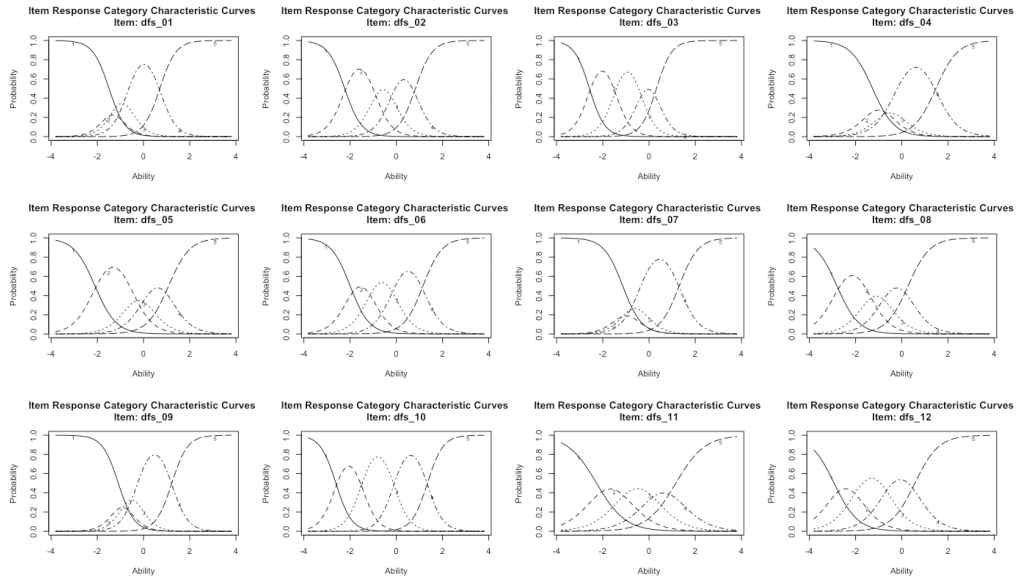
Based on the item discrimination analysis (Table 3), the most discriminating item was item 3 (“As regards daydreaming, I would characterize myself as someone who”). Samejima’s IRT model shows that some item characteristic curves show a clear ability to differentiate between the response levels of the scale. Still, other items don’t show the same pattern (items 1, 4, 7, and 9) (Figure 1).
Category Characteristic Curves for each item of DDFS. The numbers on each graph represent the response options (A to E). The horizontal axis represents the value of the latent variable, and the vertical axis represents the probability of selecting each of the five response options.
Means, standard deviations, location (threshold), and discrimination parameters for each DDFS item
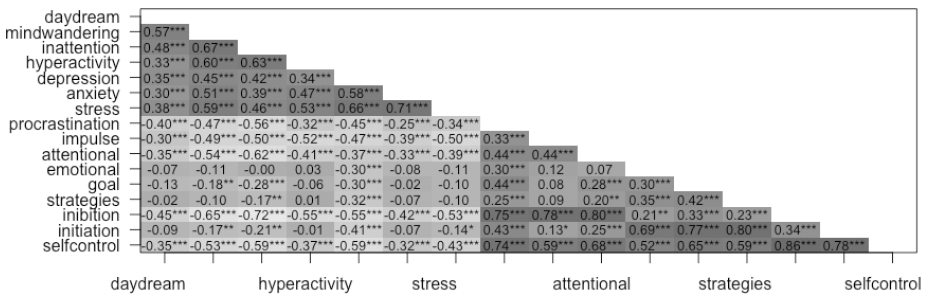
As expected, a strong positive correlation was observed between daydreaming and mind wandering (Figure 2). A moderated positive correlation was found between daydreaming and symptoms of inattention and impulsivity from ADHD. Also, daydreaming shows a weak positive correlation with other symptoms of distress, like depression, anxiety, and stress. On the other hand, as expected, we found a moderated negative correlation between self-control and inhibition factor. Also, results show a weak negative correlation with first-order factors, impulse control, attentional control, and procrastination, but not with emotional control, goals orientation, and self-control strategies. This set of results indicates DDFS validity based on the relationship with external variables.
Pearson correlation plot between daydreaming (DDFS), mind wandering (MEWS), ADHD symptoms (ASRS-18), distress symptoms (DASS-21) and self control factors (MSCS). Note:*p<0.05; **p<0.01; ***p<0.001.
Discussion
The objective of the present study was to conduct the transcultural adaptation process of the Daydream Frequency Scale (DDFS) for the Brazilian context. Procedures recommended by Borsa et al. (2012) were followed. Additionally, the psychometric properties of the scale were examined, with the purpose of verifying the factor structure, items properties of the Brazilian version of the DDFS and exploring its associations with variables that are either positively or negatively correlated with the construct, such as mind wandering, inattention, depression, anxiety, stress, and inhibition. These findings are expected to advance the understanding of daydreaming as a phenomenon, shedding light on its implications and contributing to a more comprehensive view of its impact across diverse contexts. Following the translation and back-translation procedures that aimed to ensure semantic and cultural equivalence for each item of the scale - a crucial step given that many words in one language lack direct equivalents in another (Pedroso et al., 2004) - the Content Validity Coefficient (CVC) was calculated for each DDFS item.
The CVC revealed a high consensus among the expert committee regarding the clarity, relevance, and theoretical adequacy of the 12 questions and items response options, written in varied formulations but adhering to a Likert scale format that measures the frequency of daydreaming across different contexts, ranging from ‘more frequent’ to ‘less frequent’. This consensus was based on a reference value of (0.7) (Cassepp-Borges et al., 2010), as a solid indicator of content validity for psychological instruments. Furthermore, Confirmatory Factor Analysis (CFA) revealed goodness fitness indices for a unidimensional model, consistent with the original instrument (Giambra, 1980, 1993), and theoretical framework. Although the studies by Stawarczyk et al. (2012) and Kajimura and Nomura (2016) corroborated a unidimensional structure, Linares Gutiérrez et al. (2019) founded that a two-factor model better explained the data. Although all authors first conducted an exploratory analysis, using the principal components method, and subsequently conducted a confirmatory analysis, they found different results. Such divergences may be due to the estimation methods applied by computer programs used. In our study, we chose to use a robust estimator (DWLS), observing a unidimensional solution. This model showed excellent reliability results with adequate consistency according as proposed by Nunnally and Bernstein (1978) and Pasquali (2017) for clinical investigation. These findings suggest that the Brazilian version of the DDFS preserves the proposed construct structure, providing evidence for its validity within the Brazilian context.
IRT analyses, obtained through the Samejima model show that items 3 and 10 have high discriminative power. In other words, these items are the ones that most differentiate individuals’ daydreaming propensity. A more detailed analysis of the thresholds for the different response options of the items suggests that items 1, 4, 7 and 9 present options that were least used by respondents. Although this is not an uncommon situation (Baker, 2001), these items share the same response option pattern (infrequently, once a week, once a day, a few times during the day and many different times during the day). It is possible that a change in the response options could contribute to improving the scale. To the best of our knowledge, this is the first study to report information based on IRT.
Then, correlations with external variables were tested. First, correlations between daydream and mind wandering where high witch may be indicating strong evidence of concurrent validity (Nunnally & Bernstein, 1978). In a Japanese sample, Kajimura and Nomura (2016) observed moderate correlations between daydream and mind wandering. In another study, Stawarczyk et al. (2012) evaluated the relationship with the frequency of SITUTs, also observing a moderate correlation. Furthermore, we observed correlations with ADHD symptoms, especially with inattention symptoms. Numerous studies have shown a strong relationship between mind wandering and ADHD (Bozhilova et al., 2018; Figueiredo et al., 2018; Martz et al., 2023).
Although we observed this pattern, a closer look reveals that the correlations observed for ADHD symptoms are stronger between MEWS scores than DDFS scores. In the study, Kajimura and Nomura (2016), the researchers interpreted that DDFS scores reflect the propensity for spontaneous thoughts, while mind wandering specifically reflects the propensity for wandering. These results converge with those observed in the present study, in which DDFS scores showed negative correlations with self-control, especially with inhibition, while the negative correlations with mind wandering were higher. This pattern may suggest that a fundamental component that differentiates both phenomena is that daydreaming presents more deliberative characteristics, while mind wandering may reflect unintentional process. Finally, our results indicated a weak relationship between daydreaming and symptoms of anxiety, depression and stress. These results are in line with those observed in the literature (Kajimura & Nomura, 2016; Stawarczyk et al., 2012).
Conclusions
The aims of this study were to present evidence for transcultural adaptation of the Daydream Frequency Scale in Brazilian Portuguese, confirming its factor structure and assessing the quality of items, and showing validity evidence throughout his relationship with other variables. This is the first study to investigate the metric quality of DDFS using IRT. We believe that general objectives have been achieved, but some limitations deserve to be highlighted. First, the sample was constituted by convenience, and with an online application. Although many studies indicate that there are no differences between the traditional pencil-and-paper method and the online method, given that online survey does not allow the control of variables that may interfere with the evaluation results, new studies need to be conducted to attest to the invariance of these methods. Second, the observed correlations were based on symptom assessments in the general population. Studies with clinical populations may help to better understand how failures in self-control mechanisms explain the differences between spontaneous daydream and uncontrolled mind wandering. Individuals diagnosed with ADHD can help elucidate how these failures contribute to the emergence of mind wandering, when compared to non-clinical groups, and educational settings. Longitudinal studies can help understand how the process of cortical development and maturation may be associated with higher or lower levels of daydreaming throughout lifespan. Furthermore, experimental studies, in which participants are required to perform monitoring tasks considered boring while being monitored with neuroimaging techniques, can contribute to identifying neural mechanisms associated with the onset of mind wandering.
DATA AVAILABILITY STATEMENT
The research data are not available.
References
-
Agnoli, S., Vanucci, M., Pelagatti, C., & Corazza, G. E. (2018). Exploring the Link Between Mind Wandering, Mindfulness, and Creativity: A Multidimensional Approach. Creativity Research Journal, 30(1), 41-53. https://doi.org/10.1080/10400419.2018.1411423
» https://doi.org/10.1080/10400419.2018.1411423 -
Baker, F. B. (2001). The Basics of Item Response Theory. ERIC Clearinghouse on Assessment and Evaluation. https://doi.org/10.1111/j.1365-2362.2010.02362.x
» https://doi.org/10.1111/j.1365-2362.2010.02362.x -
Borsa, J. C., Damásio, B. F., & Bandeira, D. R. (2012). Adaptação e validação de instrumentos psicológicos entre culturas: Algumas considerações [Adaptation and validation of psychological instruments across cultures: Some considerations]. Paidéia (Ribeirão Preto), 22(53), 423-432. https://doi.org/10.1590/S0103-863X2012000300014
» https://doi.org/10.1590/S0103-863X2012000300014 -
Bozhilova, N. S., Michelini, G., Kuntsi, J., & Asherson, P. (2018). Mind wandering perspective on attention-deficit/hyperactivity disorder. Neuroscience & Biobehavioral Reviews, 92, 464-476. https://doi.org/10.1016/j.neubiorev.2018.07.010
» https://doi.org/10.1016/j.neubiorev.2018.07.010 -
Callard, F., Smallwood, J., Golchert, J., & Margulies, D. S. (2013). The era of the wandering mind? Twenty-first century research on self-generated mental activity. Frontiers in Psychology, 4. https://doi.org/10.3389/fpsyg.2013.00891
» https://doi.org/10.3389/fpsyg.2013.00891 - Cassepp-Borges, V., Balbinotti, M. A. A., & Teodoro, M. L. M. (2010). Tradução e validação de conteúdo: Uma proposta para a adaptação de instrumentos [Translation and content validation: A proposal for instrument adaptation]. In L. Pasquali (Ed.), Instrumentação psicológica: Fundamentos e práticas (p. 506-520). Artmed.
-
Chaieb, L., Hoppe, C., & Fell, J. (2022). Mind wandering and depression: A status report. Neuroscience & Biobehavioral Reviews, 133, 104505. https://doi.org/10.1016/j.neubiorev.2021.12.028
» https://doi.org/10.1016/j.neubiorev.2021.12.028 -
Ciaramelli, E., & Treves, A. (2019). A Mind Free to Wander: Neural and Computational Constraints on Spontaneous Thought. Frontiers in Psychology, 10, 39. https://doi.org/10.3389/fpsyg.2019.00039
» https://doi.org/10.3389/fpsyg.2019.00039 -
Conte, G., Arigliani, E., Martinelli, M., Di Noia, S., Chiarotti, F., & Cardona, F. (2023). Daydreaming and psychopathology in adolescence: An exploratory study. Early Intervention in Psychiatry, 17(3), 263-271. https://doi.org/10.1111/eip.13323
» https://doi.org/10.1111/eip.13323 -
DiStefano, C. (2016). Examining fit with structural equation models. Em K. Schweizer & C. DiStefano (Eds.), Principles and Methods of Test Construction: Standards and Recent Advances (pp. 166-193). Hogrefe Publishing. http://www.hogrefe.com/program/principles-and-methods-of-test-construction.html?catId=185
» http://www.hogrefe.com/program/principles-and-methods-of-test-construction.html?catId=185 -
Dos Santos, G., Braule Pinto, A. L. D. C., Nunes, D. M., Ginani, G. E., & Da Silva-Sauer, L. (2025). Psychometric Properties of the Cross-Cultural Adaptation of the Multidimensional Self-Control Scale (MSCS) to Brazilian Portuguese. PsyArXiv. https://doi.org/10.31234/osf.io/26n85_v1
» https://doi.org/10.31234/osf.io/26n85_v1 -
Fell, J. (2024). Mind wandering, poor sleep, and negative affect: A threefold vicious cycle? Frontiers in Human Neuroscience, 18, 1441565. https://doi.org/10.3389/fnhum.2024.1441565
» https://doi.org/10.3389/fnhum.2024.1441565 -
Figueiredo, T., Erthal, P., Fortes, D., Asherson, P., & Mattos, P. (2018). Transcultural adaptation to Portuguese of the Mind Excessively Wandering Scale (MEWS) for evaluation of thought activity. Trends in Psychiatry and Psychotherapy, 40(4), 337-341. https://doi.org/10.1590/2237-6089-2017-0117
» https://doi.org/10.1590/2237-6089-2017-0117 -
Giambra, L. M. (1980). A factor analysis of the items of the imaginal processes inventory. Journal of Clinical Psychology, 36(2), 383-409. https://doi.org/10.1002/jclp.6120360203
» https://doi.org/10.1002/jclp.6120360203 -
Giambra, L. M. (1993). The influence of aging on spontaneous shifts of attention from external stimuli to the contents of consciousness. Experimental Gerontology, 28(4-5), 485-492. https://doi.org/10.1016/0531-5565(93)90073-M
» https://doi.org/10.1016/0531-5565(93)90073-M -
Girardeau, J. C., Ledru, R., Gaston-Bellegarde, A., Blondé, P., Sperduti, M., & Piolino, P. (2023). The benefits of mind wandering on a naturalistic prospective memory task. Scientific Reports, 13(1), 11432. https://doi.org/10.1038/s41598-023-37996-z
» https://doi.org/10.1038/s41598-023-37996-z -
Guillemin, F., Bombardier, C., & Beaton, D. (1993). Cross-cultural adaptation of health-related quality of life measures: Literature review and proposed guidelines. Journal of Clinical Epidemiology, 46(12), 1417-1432. https://doi.org/10.1016/0895-4356(93)90142-N
» https://doi.org/10.1016/0895-4356(93)90142-N -
Hawkins, G. E., Mittner, M., Forstmann, B. U., & Heathcote, A. (2022). Self-reported mind wandering reflects executive control and selective attention. Psychonomic Bulletin & Review, 29(6), 2167-2180. https://doi.org/10.3758/s13423-022-02110-3
» https://doi.org/10.3758/s13423-022-02110-3 -
Kajimura, S., & Nomura, M. (2016). Development of Japanese versions of the Daydream Frequency Scale and the Mind Wandering Questionnaire. The Japanese Journal of Psychology, 87(1), 79-88. https://doi.org/10.4992/jjpsy.87.14223
» https://doi.org/10.4992/jjpsy.87.14223 -
Kam, J. W. Y., Mittner, M., & Knight, R. T. (2022). Mind-wandering: Mechanistic insights from lesion, tDCS, and iEEG. Trends in Cognitive Sciences, 26(3), 268-282. https://doi.org/10.1016/j.tics.2021.12.005
» https://doi.org/10.1016/j.tics.2021.12.005 -
Kane, M. J., & McVay, J. C. (2012). What Mind Wandering Reveals About Executive-Control Abilities and Failures. Current Directions in Psychological Science, 21(5), 348-354. https://doi.org/10.1177/0963721412454875
» https://doi.org/10.1177/0963721412454875 -
Kessler, R. C., Adler, L., Ames, M., Demler, O., Faraone, S., Hiripi, E., Howes, M. J., Jin, R., Secnik, K., Spencer, T., Ustun, T. B., & Walters, E. E. (2005). The World Health Organization adult ADHD self-report scale (ASRS): A short screening scale for use in the general population. Psychological Medicine, 35(2), 245-256. https://doi.org/10.1017/S0033291704002892
» https://doi.org/10.1017/S0033291704002892 -
Killingsworth, M. A., & Gilbert, D. T. (2010). A Wandering Mind Is an Unhappy Mind. Science, 330(6006), 932-932. https://doi.org/10.1126/science.1192439
» https://doi.org/10.1126/science.1192439 -
Kornacka, M., Skorupski, M. S., & Krejtz, I. (2023). Maladaptive task-unrelated thoughts: Self-control failure or avoidant behavior? Preliminary evidence from an experience sampling study. Frontiers in Psychiatry, 14, 1037443. https://doi.org/10.3389/fpsyt.2023.1037443
» https://doi.org/10.3389/fpsyt.2023.1037443 -
Kucyi, A., Kam, J. W. Y., Andrews-Hanna, J. R., Christoff, K., & Whitfield-Gabrieli, S. (2023). Recent advances in the neuroscience of spontaneous and off-task thought: Implications for mental health. Nature Mental Health, 1(11), 827-840. https://doi.org/10.1038/s44220-023-00133-w
» https://doi.org/10.1038/s44220-023-00133-w -
Linares Gutiérrez, D., Pfeifer, E., Schmidt, S., & Wittmann, M. (2019). Meditation Experience and Mindfulness Are Associated with Reduced Self-Reported Mind-Wandering in Meditators - A German Version of the Daydreaming Frequency Scale. Psych, 1(1), 193-206. https://doi.org/10.3390/psych1010014
» https://doi.org/10.3390/psych1010014 - Lovibond, S. H., & Lovibond, P. F. (1995). Manual for the Depression Anxiety Stress Scales (2nd ed.). Sydney Psychology Foundation of Australia.
-
Luchini, S. A., Volle, E., & Beaty, R. E. (2025). The role of the default mode network in creativity. Current Opinion in Behavioral Sciences, 65, 101551. https://doi.org/10.1016/j.cobeha.2025.101551
» https://doi.org/10.1016/j.cobeha.2025.101551 -
Martinon, L. M., Smallwood, J., Hamilton, C., & Riby, L. M. (2019). Frogs’ legs versus roast beef: How culture can influence mind-wandering episodes across the lifespan. Europe’s Journal of Psychology, 15(2), 211-239. https://doi.org/10.5964/ejop.v15i2.1597
» https://doi.org/10.5964/ejop.v15i2.1597 -
Martins, B. G., Silva, W. R. D., Maroco, J., & Campos, J. A. D. B. (2019). Escala de Depressão, Ansiedade e Estresse: Propriedades psicométricas e prevalência das afetividades [Depression, Anxiety and Stress Scale: Psychometric properties and prevalence of affectivities]. Jornal Brasileiro de Psiquiatria, 68(1), 32-41. https://doi.org/10.1590/0047-2085000000222
» https://doi.org/10.1590/0047-2085000000222 -
Martz, E., Weiner, L., Bonnefond, A., & Weibel, S. (2023). Disentangling racing thoughts from mind wandering in adult attention deficit hyperactivity disorder. Frontiers in Psychology, 14, 1166602. https://doi.org/10.3389/fpsyg.2023.1166602
» https://doi.org/10.3389/fpsyg.2023.1166602 -
Mattos, P., Segenreich, D., Saboya, E., Louzã, M., Dias, G., & Romano, M. (2006). Adaptação transcultural para o português da escala Adult Self-Report Scale para avaliação do transtorno de déficit de atenção/hiperatividade (TDAH) em adultos [Cross-cultural adaptation into Portuguese of the Adult Self-Report Scale for assessing attention deficit/hyperactivity disorder (ADHD) in adults]. Archives of Clinical Psychiatry (São Paulo), 33(4), 188-194. https://doi.org/10.1590/S0101-60832006000400004
» https://doi.org/10.1590/S0101-60832006000400004 -
McMillan, R. L., Kaufman, S. B., & Singer, J. L. (2013). Ode to positive constructive daydreaming. Frontiers in Psychology, 4. https://doi.org/10.3389/fpsyg.2013.00626
» https://doi.org/10.3389/fpsyg.2013.00626 -
Mittner, M., Hawkins, G. E., Boekel, W., & Forstmann, B. U. (2016). A Neural Model of Mind Wandering. Trends in Cognitive Sciences, 20(8), 570-578. https://doi.org/10.1016/j.tics.2016.06.004
» https://doi.org/10.1016/j.tics.2016.06.004 -
Mowlem, F. D., Skirrow, C., Reid, P., Maltezos, S., Nijjar, S. K., Merwood, A., Barker, E., Cooper, R., Kuntsi, J., & Asherson, P. (2019). Validation of the Mind Excessively Wandering Scale and the Relationship of Mind Wandering to Impairment in Adult ADHD. Journal of Attention Disorders, 23(6), 624-634. https://doi.org/10.1177/1087054716651927
» https://doi.org/10.1177/1087054716651927 -
Nilsen, F. A., Bang, H., Boe, O., Martinsen, Ø. L., Lang-Ree, O. C., & Røysamb, E. (2020). The Multidimensional Self-Control Scale (MSCS): Development and validation. Psychological Assessment, 32(11), 1057-1074. https://doi.org/10.1037/pas0000950
» https://doi.org/10.1037/pas0000950 - Nunnally, J. C., & Bernstein, I. H. (1978). Psychometric theory (J. C. Nunnally & I. H. Bernstein, Orgs.). McGraw-Hill New York.
- Pasquali, L. (2017). Psicometria: Teoria dos testes na psicologia e na educação. Editora Vozes.
-
Pedroso, R. S., Oliveira, M. D. S., Araujo, R. B., & Moraes, J. F. D. (2004). Tradução, equivalência semântica e adaptação cultural do Marijuana Expectancy Questionnaire (MEQ) [Translation, semantic equivalence and cultural adaptation of the Marijuana Expectancy Questionnaire (MEQ)]. Psico-USF, 9(2), 129-136. https://doi.org/10.1590/S1413-82712004000200003
» https://doi.org/10.1590/S1413-82712004000200003 -
Peloso, F. C., Zibetti, M. R., Nardi, A. E., & Catelan, R. F. (2024). Cross-cultural adaptation of the Mind-Wandering Questionnaire (MWQ) for Brazilian Portuguese and evidence of its validity. Brazilian Journal of Psychiatry. https://doi.org/10.47626/1516-4446-2023-3312
» https://doi.org/10.47626/1516-4446-2023-3312 - Rizopoulos, D. (2006). Itm: An R package for latent variable modeling and item response theory analyses. Journal of Statistical Software, 17(5), 1-25.
-
Rosseel, Y. (2012). lavaan: An R Package for Structural Equation Modeling. Journal of Statistical Software, 48(2). https://doi.org/10.18637/jss.v048.i02
» https://doi.org/10.18637/jss.v048.i02 -
Rosseel, Y., Jorgensen, T. D., & De Wilde, L. (2025). lavaan: Latent Variable Analysis (Version 0.6-20) Rpackage. CRAN. https://CRAN.Rproject.org/package=lavaan
» https://CRAN.Rproject.org/package=lavaan -
Singer, J. L., & Antrobus, J. S. (1963). A Factor-Analytic Study of Daydreaming and Conceptually-Related Cognitive and Personality Variables. Perceptual and Motor Skills, 17(1), 187-209. https://doi.org/10.2466/pms.1963.17.1.187
» https://doi.org/10.2466/pms.1963.17.1.187 -
Smallwood, J., & Schooler, J. W. (2015). The Science of Mind Wandering: Empirically Navigating the Stream of Consciousness. Annual Review of Psychology, 66(1), 487-518. https://doi.org/10.1146/annurev-psych-010814-015331
» https://doi.org/10.1146/annurev-psych-010814-015331 -
Stawarczyk, D., Majerus, S., Maj, M., Van Der Linden, M., & D’Argembeau, A. (2011). Mind-wandering: Phenomenology and function as assessed with a novel experience sampling method. Acta Psychologica, 136(3), 370-381. https://doi.org/10.1016/j.actpsy.2011.01.002
» https://doi.org/10.1016/j.actpsy.2011.01.002 -
Stawarczyk, D., Majerus, S., Van Der Linden, M., & D’Argembeau, A. (2012). Using the Daydreaming Frequency Scale to Investigate the Relationships between Mind-Wandering, Psychological Well-Being, and Present-Moment Awareness. Frontiers in Psychology, 3. https://doi.org/10.3389/fpsyg.2012.00363
» https://doi.org/10.3389/fpsyg.2012.00363 -
Taatgen, N. A., Van Vugt, M. K., Daamen, J., Katidioti, I., Huijser, S., & Borst, J. P. (2021). The resource-availability model of distraction and mind-wandering. Cognitive Systems Research, 68, 84-104. https://doi.org/10.1016/j.cogsys.2021.03.001
» https://doi.org/10.1016/j.cogsys.2021.03.001 -
Theodor-Katz, N., & Soffer-Dudek, N. (2025). Where Is My Mind? The Daydreaming Characteristics Questionnaire, a New Tool to Differentiate Absorptive Daydreaming From Mind-Wandering. Journal of Attention Disorders, 29(7), 515-528. https://doi.org/10.1177/10870547251319081
» https://doi.org/10.1177/10870547251319081 -
Yamaoka, A., & Yukawa, S. (2020). Mind wandering in creative problem-solving: Relationships with divergent thinking and mental health. PLOS ONE, 15(4), e0231946. https://doi.org/10.1371/journal.pone.0231946
» https://doi.org/10.1371/journal.pone.0231946 -
Zanesco, A. P., Denkova, E., & Jha, A. P. (2025). Mind-wandering increases in frequency over time during task performance: An individual-participant meta-analytic review. Psychological Bulletin, 151(2), 217-239. https://doi.org/10.1037/bul0000424
» https://doi.org/10.1037/bul0000424