 Tick fauna of giant anteaters (Myrmecophaga tridactyla) and southern tamanduas (Tamandua tetradactyla) in the Metropolitan Region of Sorocaba, São Paulo, Brazil
ABSTRACT:
The systematic collection of parasites from wild animals provides valuable information, highlighting the relationship between hosts and parasites. The study of ixodofauna in wild animals supports research on the transmission of pathogens that cause diseases in in situ and ex situ situations. Over a three-decade period, from 1994 to 2024, 2,709 ticks attached to giant anteaters (Myrmecophaga tridactyla) and southern tamanduas (Tamandua tetradactyla) were collected from the Metropolitan Region of Sorocaba, São Paulo state, Brazil. Tick collections were performed on free-ranging wild animals, which were immediately maintained under human care at the Sorocaba Zoo, and the carcasses of wild giant anteaters and southern tamanduas were sent to the Zoo and the University of Sorocaba. The ixodids were identified with the aid of taxonomic keys and deposited in two acarological collections. The tick species Amblyomma aureolatum, Amblyomma brasiliense, Amblyomma calcaratum, Amblyomma dubitatum, Amblyomma nodosum, Amblyomma sculptum, Amblyomma tigrinum, Dermacentor nitens, Rhipicephalus microplus and Amblyomma sp. larvae were collected from giant anteaters. Ticks collected from southern tamanduas included A. aureolatum, A. calcaratum, A. dubitatum, A. nodosum, A. sculptum and Amblyomma sp. larvae. Over the three decades of research, the tick species A. sculptum and A. nodosum represented 41.0% and 34.5% of the ticks collected from giant anteaters and southern tamandua, respectively. Over the period of collections, the nomenclature of ticks and the order of anteaters was modified, as were the methods of identification of ixodids, highlighting the importance of updating data on the relationships between ectoparasites and hosts.
INDEX TERMS:
Acari; Pilosa; wild animals; ectoparasites; Brazilian territory
RESUMO:
A coleta sistemática de parasitas em animais selvagens contribui com informações valiosas, destacando a relação entre hospedeiros e parasitas. O estudo da ixodofauna em animais silvestres ampara a investigação sobre a transmissão de patógenos, causadores de enfermidades em situações in situ e ex situ. Durante três décadas, de 1994 a 2024, foram coletados 2.709 carrapatos fixados em tamanduás-bandeiras (Myrmecophaga tridactyla) e tamanduás-mirins (Tamandua tetradactyla) da Região Metropolitana de Sorocaba, estado de São Paulo, Brasil. A coleta de carrapatos foi realizada em animais selvagens de vida livre, que foram imediatamente mantidos sob cuidados humanos no Zoológico de Sorocaba, e em carcaças de tamanduás-bandeiras e tamanduás-mirins que foram enviadas ao Zoológico e à Universidade de Sorocaba. Os ixodídeos foram identificados com auxílio de chaves taxonômicas e depositados em duas coleções acarológicas. As espécies de carrapatos Amblyomma aureolatum, Amblyomma brasiliense, Amblyomma calcaratum, Amblyomma dubitatum, Amblyomma nodosum, Amblyomma sculptum, Amblyomma tigrinum, Dermacentor nitens, Rhipicephalus microplus e larvas de Amblyomma sp. foram coletadas em tamanduás-bandeiras. E nos indivíduos de tamanduás-mirins foram coletadas as espécies de carrapatos A. aureolatum, A. calcaratum, A. dubitatum, A. nodosum, A. sculptum e larvas de Amblyomma sp. Ao longo das três décadas de pesquisas, as espécies de carrapatos A. sculptum e A. nodosum representaram 41,0% e 34,5% dos carrapatos coletados em tamanduá-bandeira e tamanduá-mirim, respectivamente. Ao longo do período das coletas a nomenclatura dos carrapatos e da ordem dos tamanduás foram modificadas, assim como os métodos de identificação dos ixodídeos, evidenciando a importância de atualizar os dados sobre a relação entre ectoparasitas e hospedeiros.
TERMOS DE INDEXAÇÃO:
Acari; Pilosa; animais selvagens; ectoparasitas; território brasileiro
Introduction
Ticks are invertebrate, hematophagous ectoparasites that transmit numerous pathogens that cause serious diseases, directly impacting their hosts (e.g., anemia) and, in extreme cases, causing death (Teixeira et al. 2017). Pathogen transmission occurs during ectoparasites’ blood feeding on their hosts, and ticks are considered the second most important vector group for bioagents in public health (Saraiva et al. 2014).
Globally, approximately 1,000 tick species have been identified, divided into three families: Ixodidae, Argasidae, and Nuttalliellidae (Guglielmone et al. 2010, Dantas-Torres et al. 2019, Barros-Battesti et al. 2024). Ticks parasitize amphibians, reptiles, birds, and mammals, with most hosts being wild animals.
The Ixodidae family is the most important tick group in public health, as it acts as a vector for viruses, bacteria, and protozoa (Pinter et al. 2021). These ixodids are known as “hard ticks” due to the presence of a complete dorsal shield in males and an incomplete one in females and immature forms.
In Brazil, the Ixodidae family is represented by five genera (Amblyomma, Dermacentor, Ixodes, Haemaphysalis, and Rhipicephalus). The genus Amblyomma is of major medical importance and is the most species-rich, with a total of 35 species (Estrada-Peña et al. 2010, Guglielmone et al. 2021, Barros-Battesti et al. 2024, Tojal et al. 2025).
Although some tick species are host-specific, ticks can move between different groups of animals, including domestic, wild, and human hosts. As these hosts get closer, the exchange of tick species occurs more frequently, increasing the incidence of zoonotic pathogen transmission. Therefore, identifying ixodids on wild animals and understanding the parasite-host interaction is of great importance for studying the epidemiology of pathogens that affect both animals and humans (Bastos et al. 2016).
The order Pilosa comprises three genera of Brazilian anteaters - the giant anteater (Myrmecophaga sp.), the southern tamandua (Tamandua sp.), and the silky anteater (Cyclopes sp.) (Miranda 2014, Miranda et al. 2018). These animals have a wide geographic distribution, inhabiting various biomes across the country. They prefer preserved areas and avoid large urban centers, but they are increasingly coming into proximity with domestic animals and humans. According to case studies from the Metropolitan Region of Sorocaba (MRS), vehicle collisions are a primary cause and a major threat to the lives of giant anteaters (Teixeira & Miranda 2012).
The carcasses of free-ranging animals, as well as those of animals rescued from nature, are excellent sources of biological material for scientific research. Other viable sources for ectoparasites from wild animals include zoos, wildlife screening centers (CETAS), and universities, as they also receive animals directly from the natural environment for clinical/surgical care at veterinary hospitals or for necropsy at animal pathology services.
The Metropolitan Region of Sorocaba (MRS) comprises 27 municipalities (total area of approximately 11,611.48 km2) with an estimated population of 2.5 million people, traversed by two major highways and experiencing the greatest agricultural expansion among the main metropolitan regions in Brazil (Santana-Chaves et al. 2021). In the past, the landscape was predominantly composed of the Atlantic Forest biome. However, the area is now characterized by a transition biome between the Atlantic Forest and the Cerrado, popularly known as “Cerradão” (Mota Junior et al. 2020). Wild animals share this space with agricultural expansion, domestic animals, and disorganized urbanization, compounded by biome modifications.
Some authors have already documented the occurrence of ixodids on anteaters in Brazil, for both free-ranging individuals and animals kept under human care. The following tick species have been reported to parasitize the giant anteater (Myrmecophaga tridactyla): Amblyomma aureolatum, Amblyomma auricularium, Amblyomma brasiliense, Amblyomma cajennense sensu lato (s.l.), Amblyomma calcaratum, Amblyomma coelebs, Amblyomma dubitatum, Amblyomma goeldii, Amblyomma humerale, Amblyomma naponense, Amblyomma nodosum, Amblyomma ovale, Amblyomma parvum, Amblyomma pseudoconcolor, Amblyomma sculptum, Amblyomma triste, immatures of Amblyomma sp., Rhipicephalus microplus, and Rhipicephalus sanguineus s.l. (Cutolo et al. 2000, Evans et al. 2000, Labruna et al. 2002, Brum et al. 2003, Guglielmone at al. 2003, Martins et al. 2004, Figueiredo et al. 2010, Garcia et al. 2013, Martins et al. 2015, Muñoz-García et al. 2019, Nascimento et al. 2017, Oliveira et al. 2017, Teixeira et al. 2017, Muñoz-García et al. 2019, Szabó et al. 2019, Martins et al. 2023).
On the southern tamandua (Tamandua tetradactyla), the following tick species have been collected: A. auricularium, A. calcaratum, A. coelebs, A. goeldii, A. humerale, A. naponense, A. nodosum, A. parvum, A. sculptum, R. sanguineus s.l., and immatures of the genus Amblyomma (Labruna et al. 2002, Brum et al. 2003, Guglielmone et al. 2003, Martins et al. 2004, 2015, 2017, 2023, Quadros et al. 2009, Figueiredo et al. 2010, Lavina et al. 2011, Nascimento et al. 2017, Oliveira et al. 2017, Teixeira et al. 2017, Muñoz-García et al. 2019).
In the present study, we present the results and update the information on ticks parasitizing giant anteaters and southern tamanduas, based on three decades of research and collections in the MRS.
Materials and Methods
Ethical approval. This study was not submitted to the Ethics Committee on the Use of Animals (CEUA) of the Sorocaba Zoo, “Parque Zoológico Municipal Quinzinho de Barros” (Quinzinho de Barros Municipal Zoological Park - PZMQB), because the biological samples were obtained from wild animals kept in a zoological collection under legal authorization. According to Article 22 of Ordinance No. 748/2022 of the “Instituto Chico Mendes de Conservação da Biodiversidade” (Chico Mendes Institute for Biodiversity Conservation - ICMBio), the collection and transport of biological samples obtained under ex situ conditions do not require authorization from the “Sistema de Autorização e Informação em Biodiversidade” (Biodiversity Authorization and Information System - SISBIO). Additionally, the institution involved in the collection holds a valid Wildlife Management Authorization (AM No. 8040/2011) issued by the “Secretaria de Meio Ambiente, Infraestrutura e Logística” (Secretary of Environment, Infrastructure, and Logistics - SEMIL).
Tick collections were performed on specimens of giant anteaters (Myrmecophaga tridactyla) and southern tamanduas (Tamandua tetradactyla) that were sent to the Sorocaba Zoo and the “Universidade de Sorocaba” (Uniso). Regarding the origin of the hosts, the vast majority were live animals from the wild and the MRS. However, the study also included animals received and maintained under human care at the Sorocaba Zoo (without contact with domestic animals), as well as wild-animal carcasses with ticks attached that were destined for the PZMQB and Uniso.
The collection period was from 1994 to 2024, resulting in three uninterrupted decades of collections. The hosts were identified by technicians from the PZMQB and professors from Uniso. Ticks were removed manually and carefully during the animal rescue, reception, and management procedures at the institutions. Later, during routine examinations of animals at the zoo and university, ticks were collected, stored in plastic containers with 70% ethanol, and properly identified.
The material was sent to the Laboratory of Ticks and Other Wingless Vectors, “Instituto Oswaldo Cruz” (IOC), Rio de Janeiro/RJ, and to the Laboratory of Parasitic Diseases of the “Departamento de Medicina Veterinária Preventiva e Saúde Animal” (Department of Preventive Veterinary Medicine and Animal Health - VPS) at the “Faculdade de Medicina Veterinária e Zootecnia” (Faculty of Veterinary Medicine and Animal Science - FMVZ) of the “Universidade de São Paulo” (USP), São Paulo/SP. The ticks were identified using a stereomicroscope with the help of dichotomous taxonomic keys (Aragão & Fonseca 1961, Guimarães et al. 2001, Barros-Battesti et al. 2006, Martins et al. 2010, Martins et al. 2024). The material was deposited in the “Coleção de Artrópodes Vetores Ápteros de Importância em Saúde das Comunidades” (Collection of Wingless Arthropod Vectors of Importance in Community Health - CAVAISC) and the “Coleção Nacional de Carrapatos Danilo Gonçalves Saraiva” (National Tick Collection Danilo Gonçalves Saraiva - CNC) of the FMVZ-USP.
Results
Over three decades, from 1994 to 2024, a total of 2,709 tick specimens were collected. These represented nine different species (Amblyomma aureolatum, Amblyomma brasiliense, Amblyomma calcaratum, Amblyomma dubitatum, Amblyomma nodosum, Amblyomma sculptum, Amblyomma tigrinum, Dermacentor nitens, and Rhipicephalus microplus), as well as immature forms of Amblyomma, found on both giant anteaters (Myrmecophaga tridactyla) and southern tamanduas (Tamandua tetradactyla) (Table 1).
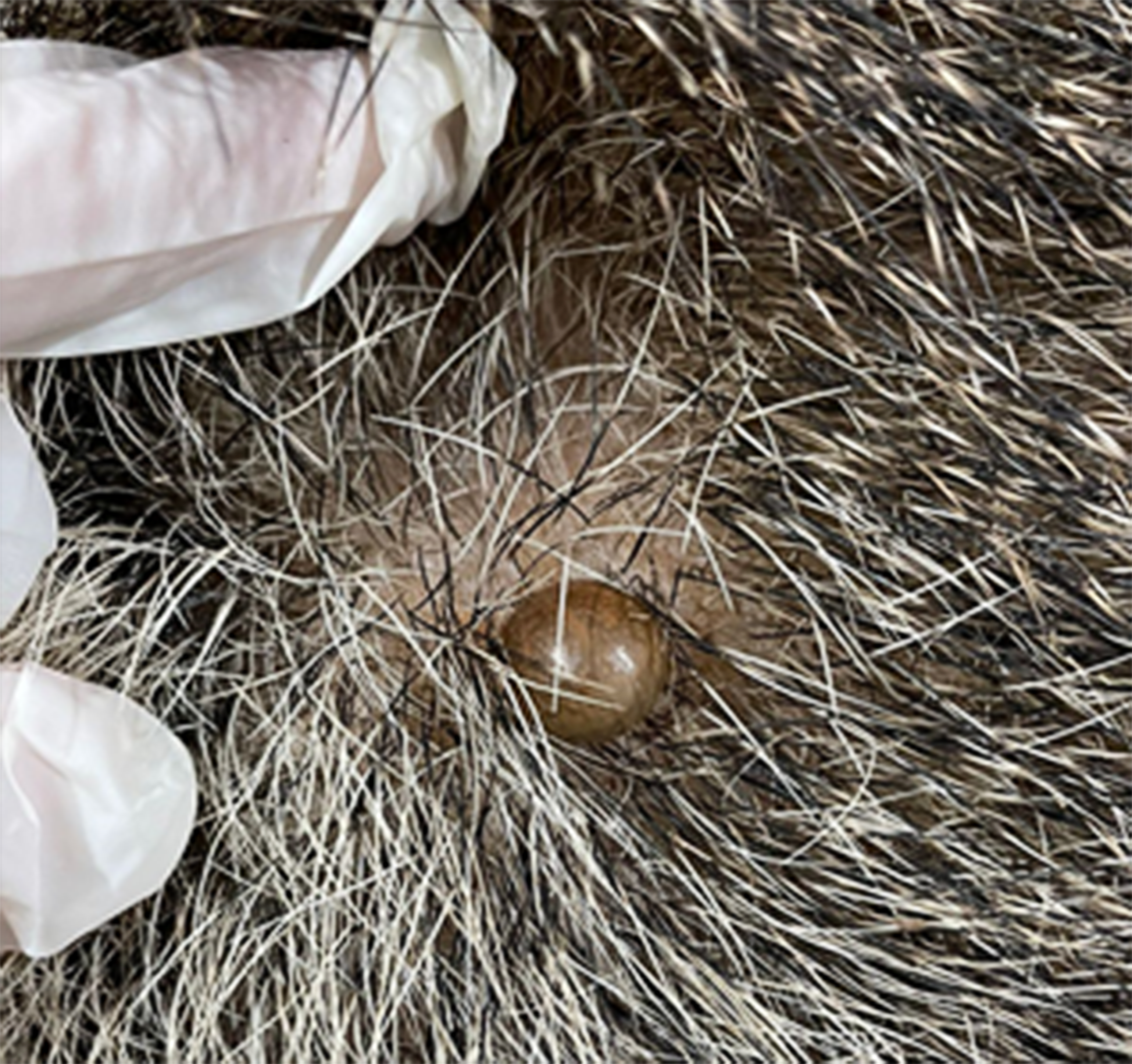
The tick species with the highest prevalence on giant anteaters were A. sculptum, A. calcaratum (Fig. 1), and A. nodosum, representing 41.1%, 36.6%, and 11.8% of the collected ixodids, respectively. On southern tamanduas, A. nodosum (Fig. 2) and A. sculptum were the most prevalent tick species, representing 34.1% and 21.8%, respectively, followed by A. calcaratum (14.0%). The other tick species represented low percentages of the total collected, ranging from 0.1% to 3.6%. Regarding the developmental stage of the ticks, 64.1% were adults and 35.9% were immature. In terms of sex, males accounted for 43.2% and females for 20.9% of the collected ixodids. Finally, in southern tamanduas, larvae of the genus Amblyomma represented 28.7% of the collected ticks (Table 1).
Adult female specimen of Amblyomma calcaratum parasitizing a giant anteater (Myrmecophaga tridactyla) in the Metropolitan Region of Sorocaba, São Paulo, Brazil.
Adult female specimen of Amblyomma nodosum parasitizing a southern tamandua (Tamandua tetradactyla) in the Metropolitan Region of Sorocaba, São Paulo, Brazil.
Discussion
The climatic conditions of the MRS favor the development of the tick life cycle. Despite a noticeable dry season, the region’s rainfall and average temperatures are favorable. Another characteristic of the region is the high concentration of domestic animals, pets, and livestock, combined with the increasing expansion of the urban footprint.
There are no wildlife screening centers in the municipalities near Sorocaba. Therefore, the PZMQB and Uniso, both located in Sorocaba/SP, serve as reference points for receiving and providing care to wild animals. On average, three anteaters are received per year at the Sorocaba Zoo. It is essential to incorporate ectoparasite inspection into the routine management of wild animals, even for deceased individuals, by examining carcasses received or rescued from the environment. This activity does not involve high costs or require advanced technical skills, yet it is rarely practiced in institutions that manage wild animals.
Scarce information on dichotomous taxonomic keys for species diagnosis of the ectoparasite, or even the absence or destruction of part of the gnathosoma, makes species-level identification of ticks difficult or impossible. Due to this fact, in both host species, all collected ixodid larvae were identified at the genus taxonomic level (Amblyomma).
The fact that only adults of Amblyomma calcaratum and Amblyomma nodosum were collected from anteaters in this study is consistent with the literature, which indicates that Myrmecophaga tridactyla and Tamandua tetradactyla are the main hosts for the adult stage of these two tick species. Their immature stages (larvae and nymphs) are found mainly on Passeriformes birds (Barros-Battesti et al. 2024). On the other hand, both immature (nymphs) and adult forms (males and females) of Amblyomma sculptum were found in abundance on both anteater species, especially on the giant anteater, indicating a possible primary importance of this anteater species in the wild cycle of A. sculptum, as recently suggested (Szabó et al. 2019). The presence of Amblyomma larvae in anteaters is consistent with other studies, as parasitism by immature stages of ixodid ticks is common in wild animals (Guimarães et al. 2001, Barros-Battesti et al. 2006).
The giant anteater was the host with the greatest variety of tick species, totaling nine distinct species grouped into three genera (Amblyomma, Dermacentor, and Rhipicephalus). This is possibly due to its habit of making long journeys in search of food, traveling through different biomes. This is different from southern tamandua, which presented five species, all from the genus Amblyomma. The southern tamandua has arboreal habits, preferring to move through the tree canopy in search of arboreal ants and termites and to find greater safety from predators. Another hypothesis for the difference in the number of tick species between hosts may be related to the animals’ body mass. The adult giant anteater weighs an average of 40 kg. In comparison, the southern tamandua weighs an average of 8 kg, which is consistent with literature data on other mammals of the superorder Xenarthra (Kluyber et al. 2016).
Continuing the discussion on tick diversity in wild hosts, we found that ectoparasite species commonly associated with domestic animals are only found on giant anteaters. Specimens of Dermacentor nitens and Rhipicephalus microplus, ticks commonly found on equines and bovines, respectively, were collected attached to giant anteaters. It is likely that the proximity of these hosts facilitates the exchange of ectoparasites (Madder et al. 2012, Labruna & Faccini 2020). On the other hand, individuals of the tick species Amblyomma brasiliense, which are ectoparasites preferably found on wild peccaries (collared peccaries and white-lipped peccaries), were collected on giant anteaters in preserved areas far from large urban centers (Barros-Battesti et al. 2006, 2024). This finding highlights the presence of giant anteaters in different biomes (Atlantic Forest and Cerrado).
The species Amblyomma aureolatum has previously been reported in the literature as parasitizing southern tamandua (Guglielmone et al. 2021). In the present study, we found this tick on a giant anteater for the first time, since A. aureolatum is a proven vector of Brazilian Spotted Fever in the state of São Paulo, together with A. sculptum, given the importance of these two tick species to public health. Anteaters only play the role of transporting ticks from one place to another and are not expected hosts that amplify certain pathogens (e.g., rickettsiae) as far as we know. The tick species Amblyomma dubitatum has been recorded parasitizing giant anteaters, with both adult and immature forms present. However, for the southern tamandua host, only immature forms of A. dubitatum had been reported to date (Guglielmone et al. 2021). In the present study, we collected adult male and female specimens of this tick. The tick Amblyomma tigrinum has been identified parasitizing domestic animals (bovines, equines, swine, and canines) and two groups of wild animals (carnivores and ungulates) in landscapes with preserved green areas (Labruna et al. 2005, Guglielmone et al. 2021). It is worth noting that this study represents the first record of A. tigrinum parasitizing a giant anteater.
Over the course of the tick collection period, the scientific nomenclature for the “star tick” (Amblyomma cajennense) was updated. In the Brazilian Southeast region, it is currently named A. sculptum, with the nomenclature A. cajennense sensu stricto reserved for ticks in the central-northern region of Brazil (Nava et al. 2014, Martins et al. 2016). Another important point is that the taxonomic classification of the host order was also updated, replacing the term Edentata with Pilosa, which did not affect the present research.
The highest prevalence of ticks was found on wild animals from natural environments, whereas animals in zoological collections showed a low parasitic load. The number of ticks attached to hosts is also directly related to the animals’ health status, with a tendency for a higher parasitic load in debilitated animals. This fact reinforces the importance of zoos and triage centers in studying the relationship between ectoparasites and wild hosts.
Different institutions are involved in research projects on ticks in wild animals, including zoos, triage centers, universities, and specialized acarology research laboratories. Each partner has a distinct role: zoos and triage centers are excellent sources of biological material, as they manage various groups of wild animals that serve as hosts for ticks. Research laboratories are essential for ectoparasite diagnosis, and universities play a fundamental role in training professionals and disseminating scientific output. Therefore, partnerships and formal agreements between institutions are welcome to promote quality scientific research on wild animals.
Finally, the states in the Brazilian Southeast region account for the highest levels of scientific production regarding ticks on wild animals. This is due to the concentration of the largest number of zoos, triage centers, and universities with parasitology laboratories, with a particular emphasis on the state of São Paulo.
Conclusions
The species Amblyomma calcaratum, Amblyomma nodosum, and Amblyomma sculptum represented the main ticks found on giant anteaters and southern tamanduas in the Metropolitan Region of Sorocaba (MRS) over the last 30 years. The greater diversity of tick species observed in giant anteaters compared to southern tamanduas may be related to differences in host ecology and body mass: giant anteaters are predominantly terrestrial, whereas southern tamanduas exhibit more arboreal habits. The ticks Amblyomma aureolatum and Amblyomma tigrinum are reported to parasitize giant anteaters for the first time.
Systematic collection of ectoparasites from wild animals sent to zoos, triage centers, and universities is an excellent source of information on the local tick fauna, as the parasitized animals reflect the parasite-host relationship of the region. Studies involving ixodids on wild animals are low-cost, low-complexity activities that, in turn, provide substantial information for public health surveillance.
It is important to emphasize the promotion of partnerships through agreements between institutions, as each entity has distinct characteristics or areas of operation. Zoos and triage centers are excellent sources of biological materials for scientific research. At the same time, laboratories and universities are proficient in ectoparasite identification and possess superior logistics and skilled professionals in their areas of expertise.
Acknowledgments
We would like to thank the Sorocaba Zoo, the “Universidade de Sorocaba”, and the residents of the Sorocaba Zoo for collecting the ectoparasites from the hosts. Our gratitude also goes to Professor Nicolau Maués Serra-Freire, whose legacy of teachings, guidance, and friendship continues to inspire many researchers.
References
-
Aragão H, Fonseca F. Notas de ixodologia. VIII. Lista e chave para os representantes da fauna ixodológica brasileira. Mem Inst Oswaldo Cruz 1961; https://doi.org/10.1590/S0074-02761961000200001
» https://doi.org/10.1590/S0074-02761961000200001 - Barros-Battesti DM, Arzua M, Bechara GH. Carrapatos de importância médico-veterinária da Região Neotropical: um guia ilustrado para identificação de espécies. São Paulo: ICTTD-3, Instituto Butantan; 2006. 223p.
- Barros-Battesti DM, Machado RZ, André MR. Ectoparasitofauna Brasileira de Importância Veterinária. Acarofauna de Importância Veterinária: Parasitiformes - Ixodida, Parte I. Vol. 3. 1. ed. Jaboticabal: CBPV; 2024. 547p.
-
Bastos TSA, Madrid DMC, Faria AM, Freitas TMS, Linhares GFC. Carrapatos em animais silvestres do bioma Cerrado triados pelo CETAS, IBAMA-Goiás. Ciênc Anim Bras 2016; https://doi.org/10.1590/1089-6891v17i236239
» https://doi.org/10.1590/1089-6891v17i236239 -
Brum JGW, Valente ALS, Albano AP, Coimbra MAC, Greque GG. Ixodidae de mamíferos silvestres atendidos no Núcleo de Reabilitação da Fauna Silvestre, UFPEL. Arq Inst Biol 2003; https://doi.org/10.1590/1808-1657v70p2112003
» https://doi.org/10.1590/1808-1657v70p2112003 -
Cutolo AA, Labruna MB, Tonin FB, Sartor IF. Amblyomma calcaratum parasitando tamanduá-bandeira (Myrmecophaga tridactyla) em São Paulo. Arq Bras Med Vet Zootec 2000; https://doi.org/10.1590/S0102-09352000000200012
» https://doi.org/10.1590/S0102-09352000000200012 -
Dantas-Torres F, Martins TF, Muñoz-Leal S, Onofrio VC, Barros-Battesti DM. Ticks (Ixodida: Argasidae, Ixodidae) of Brazil: updated species checklist and taxonomic keys. Ticks Tick Dis 2019; https://doi.org/10.1016/j.ttbdis.2019.06.012
» https://doi.org/10.1016/j.ttbdis.2019.06.012 -
Estrada-Peña A, Mangold AJ, Nava S, Venzal JM, Labruna M, Guglielmone AA. A review of the systematics of the tick family Argasidae (Ixodida). Acarologia 2010; https://doi.org/10.1051/acarologia/20101975
» https://doi.org/10.1051/acarologia/20101975 -
Evans DE, Martins JR, Guglielmone AA. A review of the ticks (Acari, Ixodida) of Brazil, their hosts and geographic distribution - 1. The state of Rio Grande do Sul, southern Brazil. Mem Inst Oswaldo Cruz 2000; https://doi.org/10.1590/S0074-02762000000400003
» https://doi.org/10.1590/S0074-02762000000400003 -
Figueiredo MAP, Santos AAG, Guerra RMSNC. Ectoparasitos de animais silvestres no Maranhão. Pesq Vet Bras 2010; https://doi.org/10.1590/S0100-736X2010001100013
» https://doi.org/10.1590/S0100-736X2010001100013 -
Garcia MV, Silva DC, Almeida RFC, Cunha RC, Matias J, Barros JC, Andreotti R, Szabó MPJ. Environmentally associated ticks (Acari: Ixodidae) in Campo Grande, Mato Grosso do Sul, Brazil. Rev Bras Parasitol Vet 2013; https://doi.org/10.1590/S1984-29612013000100023
» https://doi.org/10.1590/S1984-29612013000100023 -
Guglielmone AA, Estrada-Peña A, Luciani CA, Mangold AJ, Keirans JE. Hosts and distribution of Amblyomma auricularium (Conil 1878) and Amblyomma pseudoconcolor Aragão, 1908 (Acari: Ixodidae). Exp Appl Acarol 2003; https://doi.org/10.1023/A:1024251020035
» https://doi.org/10.1023/A:1024251020035 -
Guglielmone AA, Nava S, Robbins RG. Metastriata group: genus Amblyomma, p.67-209. In: Guglielmone AA, Nava S, Robbins RG. Neotropical Hard Ticks (Acari: Ixodida: Ixodidae): a critical analysis of their taxonomy, distribution, and host relationships. 2021; https://doi.org/10.1007/978-3-030-72353-8_2
» https://doi.org/10.1007/978-3-030-72353-8_2 -
Guglielmone AA, Robbins RG, Apanaskevich DA, Petney TN, Estrada-Peña A, Horak IG, Shao R, Barker SC. The Argasidae, Ixodidae and Nuttalliellidae (Acari: Ixodida) of the world: a list of valid species names. Zootaxa 2010; http://hdl.handle.net/2263/17278
» http://hdl.handle.net/2263/17278 - Guimarães JH, Tucci EC, Barros-Battesti DM. Ectoparasitos de Importância Veterinária. São Paulo: Plêiade, FAPESP; 2001. 218p.
-
Kluyber D, Martins TF, Desbiez AJL, Amorim M, Massocato G, Labruna MB. Ticks (Acari: Ixodidae) infesting armadillos (Cingulata: Dasypodidae) in the Pantanal wetland, Mato Grosso do Sul, Brazil. Syst Appl Acarol 2016; https://doi.org/10.11158/saa.21.8.9
» https://doi.org/10.11158/saa.21.8.9 -
Labruna MB, Faccini JLH. The nonparasitic phase of Dermacentor nitens under field conditions in southeastern Brazil. Rev Bras Parasitol Vet 2020; https://doi.org/10.1590/S1984-29612020090
» https://doi.org/10.1590/S1984-29612020090 -
Labruna MB, Jorge RSP, Sana DA, Jácomo ATA, Kashivakura CAK, Furtado MM, Ferro C, Perez SA, Silveira L, Santos Jr TS, Marques SR, Morato RG, Nava A, Adania CH, Teixeira RHF, Gomes AAB, Conforti VA, Azevedo FCC, Prada CS, Silva JCR, Batista AFV, Marvulo MFV, Morato RLG, Alho CJR, Pinter A, Ferreira PM, Ferreira F, Barros-Battesti DM. Ticks (Acari: Ixodida) on wild carnivores in Brazil. Exp Appl Acarol 2005; https://doi.org/10.1007/s10493-005-2563-1
» https://doi.org/10.1007/s10493-005-2563-1 -
Labruna MB, Paula CD, Lima TF, Sana DA. Ticks (Acari: Ixodidae) on wild animals from the Porto-Primavera hydroelectric power station area, Brazil. Mem Inst Oswaldo Cruz 2002; https://doi.org/10.1590/S0074-02762002000800012
» https://doi.org/10.1590/S0074-02762002000800012 -
Lavina MS, Quadros RM, Carneiro Júnior JA, Veronesi WR, Marquez SMT. Primeiro registro de Amblyomma calcaratum (Acari: Ixodidae) em tamanduá-mirim (Tamandua tetradactyla) no Planalto Catarinense, Brasil. Rev Vet Foco 2011; https://shre.ink/Ak3z
» https://shre.ink/Ak3z -
Madder M, Adehan S, De Deken R, Adehan R, Lokossou R. New foci of Rhipicephalus microplus in West Africa. Exp Appl Acarol 2012; https://doi.org/10.1007/s10493-012-9522-4
» https://doi.org/10.1007/s10493-012-9522-4 -
Martins JR, Medri ÍM, Oliveira CM, Guglielmone AA. Ocorrência de carrapatos em tamanduá-bandeira (Myrmecophaga tridactyla) e tamanduá-mirim (Tamandua tetradactyla) na região do Pantanal Sul Mato-Grossense, Brasil. Ciência Rural 2004; https://doi.org/10.1590/S0103-84782004000100048
» https://doi.org/10.1590/S0103-84782004000100048 -
Martins TF, Barbieri ARM, Costa FB, Terassini FA, Camargo LMA, Peterka CRL, Pacheco RC, Dias RA, Nunes PH, Marcili A, Scofield A, Campos AK, Horta MC, Guilloux AGA, Benatti HR, Ramirez DG, Barros-Battesti DM, Labruna MB. Geographical distribution of Amblyomma cajennense (sensu lato) ticks (Parasitiformes: Ixodidae) in Brazil, with description of the nymph of A. cajennense (sensu stricto). Parasit. Vectors 2016; https://doi.org/10.1186/s13071-016-1460-2
» https://doi.org/10.1186/s13071-016-1460-2 -
Martins TF, Igayara-Souza CA, Sanches TC, Melo MA, Bolochio CE, Nagahama AA, Hidasi HW, Penido GN, Acosta ICL, Muñoz-Leal S, Labruna MB. Diversidade de carrapatos (Acari: Ixodidae) em animais silvestres recebidos pelo Zoológico Municipal de Guarulhos. Ars Vet 2017; https://doi.org/10.15361/2175-0106.2017v33n1p20-25
» https://doi.org/10.15361/2175-0106.2017v33n1p20-25 -
Martins TF, Onofrio VC, Barros-Battesti DM, Labruna MB. Nymphs of the genus Amblyomma (Acari: Ixodidae) of Brazil: descriptions, redescriptions, and identification key. Ticks Tick Dis 2010; https://doi.org/10.1016/j.ttbdis.2010.03.002
» https://doi.org/10.1016/j.ttbdis.2010.03.002 - Martins TF, Onofrio VC, Labruna MB, Guglielmone AA, Barros-Battesti DM. Família Ixodidae da região Neotropical: características gerais, distribuição geográfica, hospedeiros e chaves de identificação das espécies que ocorrem no Brasil, p.99-240. In: Barros-Battesti DM, Machado RZ, André MR. Ectoparasitofauna Brasileira de Importância Veterinária. Acarofauna de Importância Veterinária: Parasitiformes - Ixodida, Parte I. Vol. 3. 1. ed. Jaboticabal: CBPV; 2024.
-
Martins TF, Teixeira RHF, Labruna MB. Ocorrência de carrapatos em animais silvestres recebidos e atendidos pelo Parque Zoológico Municipal Quinzinho de Barros, Sorocaba, São Paulo, Brasil. Braz J Vet Res Anim Sci 2015; https://doi.org/10.11606/issn.1678-4456.v52i4p319-324
» https://doi.org/10.11606/issn.1678-4456.v52i4p319-324 -
Martins TF, Yogui DR, Alves MH, Kluyber D, Massocato G, Labruna MB, Desbiez ALJ. Surveillance of ticks (Acari: Ixodidae) on monitored free-ranging giant anteaters and on road-killed anteaters and armadillos in the State of Mato Grosso do Sul, Midwestern Brazil. Syst Appl Acarol 2023; https://doi.org/10.11158/saa.28.4.1
» https://doi.org/10.11158/saa.28.4.1 -
Miranda FR, Casali DM, Perini FA, Machado FA, Santos FR. Taxonomic review of the genus Cyclopes Gray, 1821 (Xenarthra: Pilosa), with the revalidation and description of new species. Zool J Linn Soc 2018; https://doi.org/10.1093/zoolinnean/zlx079
» https://doi.org/10.1093/zoolinnean/zlx079 - Miranda FR. Cingulata e Pilosa (Tatus, preguiças e tamanduás), p.707-723. In: Cubas ZS, Silva JCR, Catão-Dias JL. Tratado de Animais Selvagens: medicina veterinária. 2ª ed. São Paulo: Roca; 2014.
-
Mota Junior VD, Ribeiro FC, Lima FA, Ribeiro AI. Proteção da biodiversidade, legislação e políticas públicas na região metropolitana de Sorocaba- SP, Brasil, entre 2010 e 2019. Trayec Hum Trasc 2020; https://doi.org/10.25965/trahs.2113
» https://doi.org/10.25965/trahs.2113 -
Muñoz-García CI, Guzmán-Cornejo C, Rendón-Franco E, Villanueva-García C, Sánchez-Montes S, Acosta-Gutiérrez R, Romero-Callejas E, Díaz-López H, Martínez-Carrasco C, Berriatua E. Epidemiological study of ticks collected from the northern tamandua (Tamandua mexicana) and a literature review of ticks of Myrmecophagidae anteaters. Ticks Tick Dis 2019; https://doi.org/10.1016/j.ttbdis.2019.06.005
» https://doi.org/10.1016/j.ttbdis.2019.06.005 -
Nascimento KKG, Veríssimo SMM, Raia VA, Guimarães RCS, Seade GCC, Azevedo ACP, Matos SP, Oliveira JM, Bezerra IA, Martins TF. Ixodofauna de animais silvestres resgatados e atendidos no Jardim Zoológico de Santarém, oeste do estado do Pará, Brasil. Ciência Rural 2017; https://doi.org/10.1590/0103-8478cr20170159
» https://doi.org/10.1590/0103-8478cr20170159 -
Nava S, Beati L, Labruna MB, Cáceres AG, Mangold AJ, Guglielmone AA. Reassessment of the taxonomic status of Amblyomma cajennense (Fabricius, 1787) with the description of three new species, Amblyomma tonelliae n. sp., Amblyomma interandinum n. sp. and Amblyomma patinoi n. sp., and reinstatement of Amblyomma mixtum Koch, 1844, and Amblyomma sculptum Berlese, 1888 (Ixodida: Ixodidae). Ticks Tick Dis 2014; https://doi.org/10.1016/j.ttbdis.2013.11.004
» https://doi.org/10.1016/j.ttbdis.2013.11.004 -
Oliveira GMB, Martins TF, Pereira LCM, Nicola PA, Horta MC. Ocorrência de carrapatos em Tamandua tetradactyla (Linnaeus, 1758) na Caatinga, Nordeste do Brasil. Arq Bras Med Vet Zootec 2017; https://doi.org/10.1590/1678-4162-9362
» https://doi.org/10.1590/1678-4162-9362 -
Pinter A, Sabbo C, Leite R, Spinola R, Angerami R. Informe técnico sobre febre maculosa brasileira. Boletim Epidemiológico Paulista 2021; https://doi.org/10.57148/bepa.2021.v.18.37185
» https://doi.org/10.57148/bepa.2021.v.18.37185 -
Quadros RM, Benedet R, Mazzolli M, Marques SMT. Amblyomma nodosum (Acari: Ixodidae) infesting collared anteater (Tamandua tetradactyla, Linnaeus, 1758) in Urupema, Santa Catarina, Brazil. Biociências 2009; https://shre.ink/Akcz
» https://shre.ink/Akcz -
Santana-Chaves IM, Leonel AL, Anjos LAP, Momm S, Catelan MJ, Frey K. Apontamentos sobre governança e planejamento na Região Metropolitana de Sorocaba (São Paulo - Brasil). Rev Ciênc Soc 2021; https://doi.org/10.47284/2359-2419.2021.31.177206
» https://doi.org/10.47284/2359-2419.2021.31.177206 -
Saraiva GS, Soares HS, Soares JF, Labruna MB. Feeding period required by Amblyomma aureolatum ticks for transmission of Rickettsia rickettsii to vertebrate hosts. Emerg Infect Dis 2014; https://doi.org/10.3201/eid2009.140189
» https://doi.org/10.3201/eid2009.140189 -
Szabó MPJ, Pascoal JO, Martins MM, Ramos VN, Osava CF, Santos ALQ, Yokosawa J, Rezende LM, Tolesano-Pascoli GV, Torga K, Castro MB, Suzin A, Barbieri ARM, Werther K, Silva JMM, Labruna MB. Ticks and Rickettsia on anteaters from Southeast and Central-West Brazil. Ticks Tick Borne Dis 2019; https://doi.org/10.1016/j.ttbdis.2019.01.008
» https://doi.org/10.1016/j.ttbdis.2019.01.008 -
Teixeira RHF, Labruna MB, Martins TF. Ixodídeos coletados parasitando animais selvagens no Zoológico de Sorocaba, Estado de São Paulo, Brasil. Rev Educ Contin Med Vet Zootec CRMV 2017; https://doi.org/10.36440/recmvz.v15i1.36757
» https://doi.org/10.36440/recmvz.v15i1.36757 - Teixeira RHF, Miranda FR. Ixodofauna em tamanduás, p.256-261. In: Miranda F. Manutenção de Tamanduás em Cativeiro. São Carlos: Cubo; 2012.
-
Tojal SD, Labruna MB, Martins TF, Meneguetti DUO, Binder LC, Lima J, Guilherme E, Botelho ALM, Cruz KS, Camargo LMA. New tick records in the western Brazilian Amazon, with notes on rickettsial infection and molecular evidence for Amblyomma crassum in Brazil. Acta Trop 2025; https://doi.org/10.1016/j.actatropica.2025.107829
» https://doi.org/10.1016/j.actatropica.2025.107829
-
Data availability statement
Data on ticks are available in two national reference acarological collections and can be accessed by contacting the collection curators
Edited by
-
Editor-in-Chief
Fabiano José Ferreira de Sant’Ana
Data on ticks are available in two national reference acarological collections and can be accessed by contacting the collection curators