 Formalization and paperwork-related stressors in municipal internal control: Independence and performance
Abstract
This article investigates how organizational formalization relates to conflict and role ambiguity among internal control professionals and how these stressors are associated with internal control independence and job performance in Brazilian municipalities. This is a quantitative cross-sectional study based on an online survey of 280 internal control professionals, conducted between December 2023 and December 2024. Sampling was non-probabilistic, convenience-based, and self-selective. The instrument included a sociodemographic section and validated scales for formalization, conflict and role ambiguity, internal control independence, and job performance, using a seven-point Likert scale, with recoding of the ambiguity scale to align the direction of the scores. The relationships were estimated using structural equation modeling with partial least squares, including assessment of measurement and structural models, discriminant validity using the Fornell-Larcker and HTMT criteria, verification of multicollinearity using the Variance Inflation Factor (VIF), and inference via bootstrapping with 5,000 resamples. The results indicate that greater formalization is associated with lower levels of conflict and ambiguity, and that these stressors are linked to less independence and poorer performance. The study contributes by quantifying, in the municipal context, formalization as a mechanism for clarification and by translating the findings into practical management measures: precisely defining responsibilities, segregating and scaling functions, documenting processes, and ensuring institutional safeguards for technical autonomy. The evidence supports governance policies associated with reducing uncertainty, protecting the control function, and improving the effectiveness of local internal control.
Keywords:
internal control; formalization; role conflict; role ambiguity; independence of internal control
Resumo
Este artigo investiga como a formalização organizacional se relaciona ao conflito e à ambiguidade de papéis entre profissionais de controle interno e como esses estressores se associam à independência do controle interno e ao desempenho no trabalho em municípios brasileiros. Trata-se de um estudo quantitativo de corte transversal, baseado em survey online com 280 profissionais de controle interno, realizada entre dezembro de 2023 e dezembro de 2024. A amostragem foi não probabilística por conveniência com autos seleção. O instrumento contemplou bloco sociodemográfico e escalas validadas para formalização, conflito e ambiguidade de papéis, independência do controle interno e desempenho no trabalho, em escala Likert de sete pontos, com recodificação da ambiguidade para alinhar a direção dos escores. As relações foram estimadas por modelagem de equações estruturais com mínimos quadrados parciais, com avaliação dos modelos de mensuração e estrutural, validade discriminante pelos critérios de Fornell-Larcker e HTMT, verificação de colinearidade por Variance Inflation Factor (VIF) e inferência por bootstrapping com 5 mil reamostragens. Os resultados indicam que maior formalização se associa a menores níveis de conflito e ambiguidade, e que esses estressores se relacionam a menor independência e pior desempenho. O estudo contribui ao quantificar, no contexto municipal, a formalização como mecanismo de clarificação e ao traduzir os achados em medidas práticas de gestão: definir atribuições com precisão, segregar e dimensionar funções, documentar processos e assegurar salvaguardas institucionais para a autonomia técnica. As evidências apoiam políticas de governança associadas à redução de incertezas, à proteção da função de controle e ao aprimoramento da efetividade do controle interno local.
Palavras-chave:
controle interno; formalização; conflito de papéis; ambiguidade de papéis; independência do controle interno
Resumen
Este artículo investiga cómo la formalización organizativa se relaciona con el conflicto y la ambigüedad de roles entre los profesionales del control interno, y cómo estos factores de estrés se asocian con la independencia del control interno y el rendimiento laboral en municipios brasileños. Se trata de un estudio cuantitativo transversal, basado en una encuesta en línea realizada a 280 profesionales del control interno entre diciembre de 2023 y diciembre de 2024. El muestreo fue no probabilístico por conveniencia con autoselección. El instrumento incluyó un bloque sociodemográfico y escalas validadas para la formalización, el conflicto y la ambigüedad de roles, la independencia del control interno y el rendimiento laboral, en una escala Likert de siete puntos, con recodificación de la ambigüedad para alinear la dirección de las puntuaciones. Las relaciones se estimaron mediante modelización de ecuaciones estructurales con mínimos cuadrados parciales, con evaluación de los modelos de medición y estructurales, validez discriminante según los criterios de Fornell-Larcker y HTMT, verificación de colinealidad mediante el factor de inflación de la varianza (VIF) e inferencia mediante bootstrapping con 5000 remuestreos. Los resultados indican que una mayor formalización se asocia con menores niveles de conflicto y ambigüedad, y que estos factores de estrés se relacionan con una menor independencia y un peor rendimiento. El estudio contribuye a cuantificar, en el contexto municipal, la formalización como mecanismo de clarificación y a traducir los hallazgos en medidas prácticas de gestión: definir con precisión las atribuciones, segregar y dimensionar las funciones, documentar los procesos y garantizar salvaguardias institucionales para la autonomía técnica. Las pruebas respaldan políticas de gobernanza asociadas a la reducción de la incertidumbre, a la protección de la función de control y a la mejora de la eficacia del control interno local.
Palabras clave:
control interno; formalización; conflicto de roles; ambigüedad de roles; independencia del control interno
1. INTRODUCTION
Internal control is understood as an articulated set of practices, procedures, functions, and roles adopted by public organizations, supported by general norms, notably the Constituição Federal de 1988 (1988 Federal Constitution), Law No. 4,320/1964, and the Lei de Responsabilidade Fiscal (Fiscal Responsibility Law), which establish guidelines at the macro level, while local governments specify rules and routines for the work of actors in the internal control system at the micro level (Azevedo et al., 2019; Moreno & Miranda, 2013; Pinho & Rodrigues, 2020). In municipal contexts, these parameters coexist with institutional, legal, and operational specificities that condition system implementation, the design of responsibilities, and the distribution of authority across units and positions, making internal formalization a decisive element for the consistency of procedures and the effectiveness of controls (Azevedo et al., 2019; Moreno & Miranda, 2013).
At the normative level, these general guidelines provide legitimacy and direction, but they do not replace the need for local specification of processes, information flows, and accountability criteria, which are defined by subordinate legal acts, manuals, and internal instruments (Adler & Borys, 1996; Jackson & Schuler, 1985). Thus, the quality of formalization concerns not only the existence of documents, but also the ability to translate expectations into clear, coherent, and executable routines that reduce variability in interpretations of each agent’s role (Adler & Borys, 1996).
According to Pinho and Rodrigues (2020), differences in size, organizational design, financial capacity, and cost-benefit assessment lead municipalities to organize the functions performed by internal control professionals in different ways. In these settings, agents are exposed to role stressors (conflict and ambiguity) understood, in light of role theory, as incompatible or insufficiently clear demands that produce psychological strain and influence behavior and well-being at work (Kahn et al., 1964). The lack of consensus regarding duties inherent to the position and the coexistence of divergent expectations from different stakeholders contribute to role ambiguity and role conflict, with potential effects on the agent’s independence and on system effectiveness (Khelil & Khlif, 2022).
In organizational structures in which duties overlap or are communicated in a fragmented way, the same agent may be called upon to guide, monitor, and inspect processes simultaneously, increasing the risk of incompatible demands and conflicting priorities (Jackson & Schuler, 1985; Kahn et al., 1964). When role descriptions lack precision and stability, the likelihood of divergent interpretations regarding the scope of tasks and the autonomy required to perform them increases (Rizzo et al., 1970).
The accounting and management literature documents the presence of these stressors in related areas, such as internal audit in the private sector (Ahmad & Taylor, 2009), internal audit in the public sector (Caillier, 2010; Novriansa & Riyanto, 2016), controllership in the private sector (Palomino & Frezatti, 2016), and controllership in the public and private sectors (Stolle et al., 2021).
It is important to clarify the conceptual distinction between internal control and internal audit. Internal control encompasses the set of processes, structures, and activities implemented by management to ensure the fulfillment of organizational objectives, including preventive, detective, and corrective controls throughout the organization. Internal audit, in turn, is an independent assurance and consulting activity that examines the adequacy and effectiveness of internal controls, in line with the Three Lines Model proposed by the Institute of Internal Auditors (2020), in which internal audit occupies the third line of defense. In the context of this study, respondents include professionals working in municipal internal control units, performing functions ranging from risk management and compliance to internal audit activities proper, reflecting the diversity of institutional arrangements in Brazilian local governments. In Stolle et al. (2021), the authors analyze controllers in both sectors, focusing on the impact of role conflict and role ambiguity on job satisfaction. At the same time, empirical research in the Brazilian context indicates a lack of consensus regarding the formalization of the organizational roles of internal control actors in local governments, revealing a research gap relevant to Public Administration (Bona, 2022). Despite advances, this literature is concentrated largely in organizational contexts different from municipal internal control, where role boundaries tend to be more institutionalized and processes more standardized. This contextual difference reinforces the relevance of examining how formalization operates in local governments, where resource scarcity, personnel turnover, and structural heterogeneity increase internal control professionals’ exposure to simultaneous demands and asymmetric expectations.
In light of this context, the problem investigated emerges from intertwined factors that manifest themselves in the day-to-day operations of municipal units. In many cases, local legislation does not sufficiently specify duties, responsibilities, and requirements of the position or function; the accumulation and simultaneity of tasks assigned to control agents make it difficult to fulfill them on time and with the required quality; role conflict and role ambiguity tend to reduce the independence needed to comply with legal obligations and exercise technical judgment; and organizational environments with high levels of these stressors are associated with declines in individual performance and, consequently, the efficiency of the unit (Caillier, 2010; Fisher, 2001). Taken together, these elements suggest that formalization may play a central role in reducing uncertainty and clarifying expectations (Adler & Borys, 1996).
Against this backdrop and given the scarcity of studies examining the determinants and impacts of role conflict and role ambiguity in internal control in the public sector, this article investigates how formalization relates to these stressors among internal control professionals and to what extent they are associated with internal control independence and job performance in the context of Brazilian municipalities. By documenting how clarity of responsibilities, the adoption of policies and procedures, and the alignment of expectations shape the work of municipal internal control professionals, the study seeks to contribute to strengthening the function, offering theoretical and practical guidance for public managers who intend to strengthen independence and improve performance through organizational design and process standardization. The research question guiding the investigation is: how does organizational formalization influence role conflict and role ambiguity among internal control professionals, and how are these stressors associated with internal control independence and job performance in Brazilian municipalities? The article is organized as follows: the theoretical framework and hypotheses are presented first, followed by the method and data, the results and discussion, and, finally, the implications and conclusions.
2. THEORETICAL MODEL AND RESEARCH HYPOTHESES
This section articulates the theoretical model guiding the study and derives hypotheses H1-H6. The focus is on how organizational formalization relates to role stressors (role conflict and role ambiguity) and how these, in turn, are associated with internal control independence and job performance among internal control professionals in Brazilian local governments.
2.1 Formalization, role conflict, and role ambiguity
Formalization is understood as the set of practices, procedures, standards, job descriptions, and policies that structure organizational behavior (Podsakoff et al., 1986). Within role theory, role conflict refers to incompatible demands imposed on the focal actor, making it impossible to meet all expectations simultaneously (Kahn et al., 1964; Rizzo et al., 1970). Role ambiguity, in turn, results from insufficient information regarding expectations, responsibilities, methods, or performance evaluation criteria (Kahn et al., 1964; Rizzo et al., 1970).
Empirical evidence suggests a negative relationship between formalization and both role stressors. In a sample from a health department, Podsakoff et al. (1986) observed that greater formalization is associated with lower role conflict and role ambiguity because it increases clarity and role definition. Convergent results are reported (Fisher, 2001; Katsikea et al., 2015; Novriansa & Riyanto, 2016; Rizzo et al., 1970). Applied to the public sector in local governments, high levels of formalization tend to delimit roles, provide rules and procedures, and offer clear guidelines for performance, reducing incongruities, incompatibilities, and overload (Azevedo et al., 2019; Moreno & Miranda, 2013). Thus, the likelihood of conflicting functions between the expectations of political actors and the technical requirements of control is reduced. Accordingly, the following is proposed:
H1 - Formalization, as perceived by internal control professionals in Brazilian local governments, is negatively related to role conflict.
Likewise, when clear norms, procedures, and guidelines regarding rights, duties, powers, and responsibilities are absent, role ambiguity tends to increase (Novriansa & Riyanto, 2016). Where formalization is perceived as high, greater clarity is expected regarding duties, responsibilities, scope, and hierarchical position, reducing uncertainty about performance and evaluation. From this argument derives:
H2 - Formalization, as perceived by internal control professionals in Brazilian local governments, is negatively related to role ambiguity.
2.2 Role conflict, role ambiguity, and internal control independence
Internal control independence is a condition for objective and impartial assessments of compliance and performance. It refers to the ability of the unit and its members to act autonomously, reporting inconsistencies to superiors and to external control bodies, supported by adequate structure and authority (Azevedo et al., 2019; Moreno & Miranda, 2013). Adherence to codes of ethics and a proactive stance reinforces this principle (Ahmad & Taylor, 2009).
Regarding role conflict, Ahmad and Taylor (2009) identified a negative relationship with independence among private-sector internal auditors, associated with the duality between auditing and consulting. Among public-sector auditors, Novriansa and Riyanto (2016) did not find significance, possibly because of low levels of conflict. In light of role theory (Kahn et al., 1964), reconciling incompatible demands creates tension and may lead to the prioritization of hierarchical expectations, reducing perceived autonomy and functional independence. Thus, the following is formulated:
H3 - Role conflict, as perceived by internal control professionals in Brazilian local governments, is negatively related to internal control independence.
Role ambiguity, in turn, stems from a lack of clarity and specificity regarding roles, policies, duties, and authority. The absence of structured rules intensifies stress and uncertainty, with the potential to reduce confidence and independence (Ahmad & Taylor, 2009). Evidence in the public and private sectors suggests a negative association between ambiguity and independence (Ahmad & Taylor, 2009; Novriansa & Riyanto, 2016). Accordingly, the following is stated:
H4 - Role ambiguity, as perceived by internal control professionals in Brazilian local governments, is negatively related to internal control independence.
2.3 Role conflict, role ambiguity, and job performance
Job performance refers to an individual’s success in tasks and responsibilities according to organizational standards (Caillier, 2010; Deadrick & Gardner, 1999). A distinction is made between task performance, or fulfillment of prescribed activities, and contextual performance, which refers to cooperative behaviors beyond formal role requirements (Borman & Motowidlo, 1997). Studies indicate a negative association between role conflict and performance, with evidence among managers and external auditors (Fisher, 2001; Marginson & Bui, 2009), although findings for public-sector internal auditors are not always conclusive (Novriansa & Riyanto, 2016). In internal control units of Brazilian local governments, conflicting functions tend to increase pressure, demotivation, and insecurity, compromising performance (Caillier, 2010; Fisher, 2001). It is therefore posited that:
H5 - Role conflict, as perceived by internal control professionals in Brazilian local governments, is negatively related to job performance.
Role ambiguity is also negatively associated with performance because of lower decisional confidence and uncertainty about authority, priorities, and accountability (Burney & Widener, 2007; Caillier, 2010; Fisher, 2001; Kalbers & Cenker, 2008; Novriansa & Riyanto, 2016; Priyangani & Kumarasinghe, 2022). The lack of sufficient information may lead to hesitation and trial-and-error behavior (Rizzo et al., 1970), with less focus on task execution. Accordingly, the following is formulated:
H6 - Role ambiguity, as perceived by internal control professionals in Brazilian local governments, is negatively related to job performance.
The theoretical model proposes formalization as an organizational characteristic associated with lower levels of role stressors (H1-H2). These stressors, in turn, are expected, within the study’s theoretical framework, to be associated with internal control independence (H3-H4) and job performance (H5-H6). Given the cross-sectional design, the estimated relationships are interpreted as associations consistent with the proposed hypotheses, with implications for institutional design and public management (Figure 1).

3. METHODOLOGICAL PROCEDURES
This study adopts an exploratory-descriptive design, a quantitative approach, a cross-sectional horizon, and a survey strategy. This choice seeks to map and explain the relationships among formalization, role conflict and role ambiguity, internal control independence, and job performance in local governments, balancing broad coverage with the testing of theoretical relationships (Cooper & Schindler, 2016; Martins & Theóphilo, 2016).
Data were collected through a structured online questionnaire (Google Forms), with respondent anonymity assured for internal control professionals in Brazilian local governments. The instrument included a sociodemographic section, institutional characteristics of the public entity (local regulation, position, and reporting line of the internal control body), and blocks for the constructs of formalization (Kerr & Jermier, 1978), role conflict and role ambiguity (Rizzo et al., 1970), internal control independence (Alzeban & Gwilliam, 2014; Yusof et al., 2019), and job performance (Fogarty et al., 2000; Fogarty & Kalbers, 2006). A seven-point Likert scale was used (1 = complete disagreement; 7 = complete agreement). Role ambiguity was recoded to maintain the direction of the scores (higher values = greater ambiguity). The items are shown in Table 1.
Table 1 documents the origin and content of each scale, ensuring theoretical traceability and comparability with previous studies. In the case of the job performance construct, the adopted measure captures a self-reported evaluation of one’s own performance, operationalized through items on satisfaction with results and with the execution of procedures. This type of perceptual measure is recurrent in the auditing and control literature and is treated here as a proxy for individual performance, compatible with the survey design and the focus on respondent perception (Fogarty et al., 2000; Fogarty & Kalbers, 2006).
The respondents in this study are professionals who are part of the internal control structure of Brazilian local governments, including personnel linked to formal municipal internal control units, responsible for evaluation, monitoring, compliance, and advisory activities within the internal control system. The recruitment strategy combined official communication channels, such as telephone contacts, institutional email, and the Sistema Eletrônico do Serviço de Informação ao Cidadão (Electronic System for the Citizen Information Service, e-SIC), with dissemination through professional networks, including WhatsApp groups in the internal control field, specialized profiles and groups on LinkedIn, and communities on Facebook (Baltar & Brunet, 2012; Holtom et al., 2022; Wright, 2005). Because the questionnaire was disseminated through multiple channels, especially social media and informal groups, it was not possible to measure precisely the total number of individuals who viewed the invitation or to calculate a formal response rate. All responses were collected through informed consent, with a guarantee of confidentiality and observance of applicable ethical guidelines.
Data collection took place between December 2023 and December 2024 and yielded 280 valid questionnaires. The sample was non-probabilistic, by convenience and self-selection, which is appropriate for exploratory studies in public administration. The minimum required sample size was estimated via G*Power considering f² = 0.15, α = 0.05, power = 0.80, and two predictors, which indicated N ≥ 68 (Ringle et al., 2014); the obtained N exceeds this threshold and tends to increase the stability and power of the analyses (Hair et al., 2017).
The analyses employed partial least squares structural equation modeling (PLS-SEM), which is appropriate for predictive models with multiple constructs and non-normal distribution. The constructs were specified according to the literature and assessed in a measurement model (loadings, composite reliability, average variance extracted, and discriminant validity via Fornell-Larcker and/or HTMT) and a structural model (collinearity via the Variance Inflation Factor (VIF), magnitude and significance of paths, R², f², and Q²), with bootstrapping using 5,000 resamples to estimate parameter precision (Fornell & Larcker, 1981; Hair et al., 2019; Lee et al., 2011). Procedural remedies (anonymity, separate blocks) were adopted to mitigate common method bias.
4. ANALYSIS AND DISCUSSION OF RESULTS
4.1 Respondent profile
Box 2presents the profile of the respondents, indicating a slight predominance of women (50.71%) and a greater concentration in the 35-44 age group (37.14%). Educational attainment is high, with 58.93% holding a specialization degree or MBA. Regarding employment status with the municipality, 79.29% are permanent civil servants. Within internal control, the distribution is 46.07% permanent civil servants, 38.57% appointed positions, 12.86% gratified functions, and 2.50% other, which totals 51.43% when appointed positions and gratified functions are combined. Regarding time in the position or function, 67.50% have served for up to 8 years (1-4: 43.57%; 5-8: 23.93%), suggesting turnover associated with political cycles, with potential effects on the continuity and operational independence of internal control.

The sample is well qualified (with postgraduate education predominating) and is predominantly composed of permanent municipal employees, but the high presence of appointed positions and gratified functions in the internal control structure indicates potential tensions affecting independence and continuity. In terms of structure and practices, 76.79% report directly to the highest municipal authority; 89.29% report the existence of local legislation establishing the internal control structure; and 62.86% state that they perform internal audit activities. These data suggest that the formal existence of structures and routines, by itself, does not ensure stable technical capacity in environments with a high proportion of trust-based appointments.
4.2 Perceptions reported by internal control professionals
Indicators CP6, FORM8, and FORM9 were excluded because their factor loadings were below 0.40 and/or because their retention did not allow AVE to reach the 0.50 threshold. After purification, all loadings were equal to or greater than 0.60 (Formalization: [0.660, 0.862]; Role conflict: [0.643, 0.780]; Role ambiguity: [0.638, 0.838]; Internal control independence: [0.637, 0.779]; Job performance: [0.766, 0.856]).
Reliability was adequate for all constructs, with Cronbach’s alpha (α), rho_A, and composite reliability (CR) equal to or greater than 0.70. Convergent validity was confirmed by average variance extracted (AVE), with values equal to or greater than 0.50 (Table 2).
Factor loadings ≥ 0.60 and α/CR/AVE indices above the thresholds indicate stable and convergent measures, supporting the analysis of the structural model. Discriminant validity was supported both by the Fornell-Larcker criterion and by HTMT values below 0.90 for all pairs of constructs (see Table 3 and Table 4).
The square root of AVE being greater than the correlations indicates that each construct shares more variance with its own indicators than with the others, ensuring discrimination.
HTMT values below 0.90 corroborate discriminant validity, reducing the risk of conceptual overlap among the constructs. Based on 5,000 bootstrap resamples, all relationships were supported at the 1% level (p < 0.01) (see Figure 2 and Table 5).
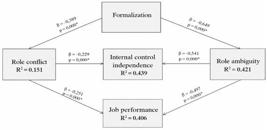
Formalization was negatively associated with Role conflict (β = -0.389; t = 7.355; 95% CI [-0.495, -0.291]) and with Role ambiguity (β = -0.649; t = 18.559; 95% CI [-0.718, -0.583]). Role conflict (β = -0.229; t = 4.073) and Role ambiguity (β = -0.251; t = 4.493) were negatively associated with internal control independence, and both were also associated with lower job performance (Role conflict: β = -0.541; t = 10.935; Role ambiguity: β = -0.497; t = 9.716).
Predictive accuracy was moderate for Role ambiguity (R² = 0.421; Q² = 0.413) and for Role conflict (R² = 0.152; Q² = 0.139), as well as for internal control independence (R² = 0.439; Q² = 0.326) and job performance (R² = 0.406; Q² = 0.310). Regarding effect sizes, a large impact of Formalization on Role ambiguity was observed (f² = 0.729), as well as moderate impacts of Role conflict on job performance (f² = 0.446) and of Role ambiguity on job performance (f² = 0.356). VIF values remained below 3.00 (1.000-1.171), with no indication of multicollinearity.
After rescaling construct scores to 0-100, standardizing direction so that higher scores indicate better performance, and confirming positive outer weights, the Importance-Performance Map Analysis (IPMA) highlighted improvement priorities (see Table 6 and Figure 3).

Role ambiguity shows high importance (in absolute value) and low performance, indicating a priority need regarding clarity of objectives, responsibilities, and authority. For Role conflict, CP8/CP3 stand out (tasks outside the role; pressures to ignore rules). For Formalization, FORM3/FORM4/FORM6 suggest strengthening evaluations, schedules, and documented guidelines. For Role ambiguity, negative importance values of moderate magnitude (-0.141 to -0.095) coexist with low performance scores (16.131-37.917), signaling potential gains from greater clarity regarding authority, objectives, responsibilities, expectations, and time management.
In Role conflict, CP8 (-0.082; 38.988) and CP3 (-0.065; 45.655) combine greater importance in absolute value with lower performance, suggesting attention to tasks not assigned to the role and to situations that induce rule-bending. CP2 (-0.077; 66.786) and CP7 (-0.058; 56.905) indicate human and material resource bottlenecks. In Formalization, importance is high and relatively homogeneous (0.066-0.088), but performance varies: FORM4 (0.082; 43.036), FORM3 (0.067; 44.226), and FORM6 (0.088; 50.476) fall below FORM2, FORM5, and FORM7 (60.238-66.607), which points to priorities in schedules, evaluations, and documented guidelines.
5. DISCUSSION OF RESULTS
Role theory, as developed by Kahn et al. (1964), provides the framework for understanding the coexistence of multiple expectations in Public Administration, where accountability coexists with political-administrative pressures. Role conflict stems from the incompatibility between demands and functions, whereas Role ambiguity emerges from information gaps and poorly defined boundaries between responsibilities and authority, with adverse effects on performance and occupational well-being (Rizzo et al., 1970).
The findings provide statistical support for H1 and H2 and align with the literature associating formal structures with reduced role tensions. The negative association between Formalization and Role conflict corroborates evidence that standardized rules and processes align expectations and are associated with fewer incompatibilities perceived by internal control professionals, in line with Jackson and Schuler (1985) and with results in public-sector contexts reported (Novriansa & Riyanto, 2016).
The stronger negative association with Role ambiguity, with R² = 0.421, converges with Lindermüller et al. (2023) and Novriansa and Riyanto (2016), indicating that written procedures, manuals, and guidelines reduce uncertainty regarding tasks, authority, and standards of execution. At the same time, the literature warns that coercive and excessively prescriptive formalization may produce tensions and reduce adaptability, as discussed (Adler & Borys, 1996). In the Brazilian municipal context, institutional heterogeneity suggests a contingent reading of formalization, also signaled (Ravanello et al., 2021).
H3 and H4 indicate that Role conflict and Role ambiguity are negatively associated with Internal control independence. This result converges with Ahmad and Taylor (2009), Ebrahimi et al. (2023), and Ferrari et al. (2023), who document relationships between role tensions and vulnerabilities in technical autonomy and in the maintenance of professional judgment in the face of managerial pressures. It differs, however, from Novriansa and Riyanto (2016), who did not find a significant relationship between Role conflict and commitment to independence. Differences in measurement instruments, institutional scope, and hierarchical reporting arrangements in local governments may explain this discrepancy, especially in contexts marked by high turnover and trust-based appointments. The perspective of roles as negotiated constructions helps explain how power asymmetries and stakeholder demands may weaken independence even in the presence of formal structures.
Regarding performance, H5 and H6 show negative associations of Role conflict and Role ambiguity with Job performance, consistent with findings (Burney & Widener 2007; Caillier, 2010; Fisher, 2001; Kalbers & Cenker, 2008; Novriansa & Riyanto, 2016; Üngüren & Arslan, 2021; Wu et al., 2019). The literature reports mixed results for Role conflict, including null or conditional effects, as in Gregson et al. (1994), Burney and Widener (2007), and Priyangani and Kumarasinghe (2022), but the evidence observed here is closer to Amenuvor et al. (2023) and Üngüren and Arslan (2021), suggesting that, under overload and resource scarcity, the deleterious effect on performance prevails. In the municipal environment, chronic personnel and material constraints described by Azevedo et al. (2019), Cruz et al. (2016), Bona (2022), and Pinho and Rodrigues (2020) favor defensive responses and the prioritization of friction reduction among stakeholders, as discussed (Khelil & Khlif, 2022).
Recent literature on control and auditing in the public sector also contextualizes the expansion of the internal control role, which has moved from strict inspection toward strategic partnership and value creation functions, increasing demands and the possibility of role tensions. In this sense, Hay and Cordery (2021), Nerantzidis et al. (2022), and George et al. (2021) highlight the need for role clarity and functional autonomy to sustain perceived effectiveness and organizational results. The IPMA findings reinforce this point by identifying, as operational priorities, greater clarity regarding authority, objectives, and responsibilities, the reduction of tasks not assigned to the role, and the strengthening of schedules, evaluations, and documented guidelines.
In sum, the results provide statistical support for the proposed model. Consistent formalization is associated with reductions in Role conflict and Role ambiguity, which in turn are associated with greater Internal control independence and better Job performance. The specific contribution to the Brazilian municipal context is to show that this cycle depends both on structural conditions and on the management of role expectations in politically volatile environments, in which technical autonomy must be preserved in the face of competing pressures.
6. CONCLUSIONS
This study examined, in light of role theory, how formalization shapes role conflict and role ambiguity among internal control professionals and how these stressors are associated with internal control independence and job performance in Brazilian municipalities. Using survey data from 280 internal control professionals and estimation by PLS-SEM, six hypotheses in the model were tested. The results provided support for H1 and H2, indicating that Formalization is negatively associated with Role conflict and Role ambiguity; they provided support for H3 and H4 by showing that lower levels of these stressors are associated with greater internal control independence; and they provided support for H5 and H6 by showing that higher levels of Role conflict and Role ambiguity are associated with poorer job performance. Taken together, the findings answer the research question and offer an integrated view of the role of formalization in the internal control system.
Formalization, operationalized through clear standards, policies, and procedures, functions as a clarifying mechanism that aligns expectations, delimits boundaries of action, and is associated with reduced tensions in the interpretation of duties. By being associated with lower levels of Role conflict and Role ambiguity, it suggests more favorable conditions for autonomous technical decisions, helps protect the control function against interference, and is associated with greater internal control independence. This set of associations is consistent with better job performance, linking role theory and practice in local governments.
Methodologically, the study combines a survey of 280 internal control professionals with PLS-SEM to test the theoretical model, offering a replicable and comparable basis for different municipal realities. In practical terms, it recommends defining duties precisely, ensuring segregation of duties and adequate staffing levels, institutionalizing routines and documentation, and improving communication and negotiation with managers and with external control bodies/Courts of Accounts. It also suggests ensuring independence and institutional protection, providing organizational support, including psychological support when necessary, and promoting continuing education. These elements operate as adaptive mechanisms that stabilize expectations and mitigate role stressors.
Among the limitations, the study highlights the use of perceptual measures, the measurement of formalization centered on written policies and procedures, and the cross-sectional design, restricted to local governments in Brazil. The use of non-probabilistic convenience sampling with self-selection implies self-selection bias, limiting the generalizability of the findings to the broader population of municipal internal control professionals in Brazil. The perceptual and self-reported nature of the measures exposes the results to risks of social desirability and common method variance, although procedural remedies were adopted to mitigate these risks. The cross-sectional design prevents inferences about the temporal direction of the observed relationships, and it is plausible that perceived performance influences perceptions of conflict and ambiguity, implying reciprocity or reverse causality. Future studies should consider triangulation with institutional sources, such as external performance assessments, administrative records, and data from Courts of Accounts, as well as longitudinal designs that make it possible to follow individual and organizational trajectories over time. Future research may also adopt qualitative and longitudinal approaches to capture the experiences and meaning trajectories of internal control professionals, including multiple case studies, participant observation, and narrative interviews. It is also recommended to test mediators and moderators, such as organizational culture, resistance to change, job satisfaction, leadership, and individual characteristics, as well as to assess the effectiveness of adaptive mechanisms, especially communication strategies and institutional pedagogy. Investigations into ceremonialism and its effects on formalization and role stressors may broaden understanding of the phenomenon.
The results provide statistical support for the hypotheses that greater formalization is associated with lower levels of Role conflict and Role ambiguity and that these stressors are associated with lower internal control independence and poorer job performance. The study contributes by quantifying, in the municipal context, formalization as a clarifying mechanism and by translating the findings into practical management measures: defining duties precisely, ensuring segregation of duties and adequate staffing levels, documenting processes, and ensuring institutional safeguards for technical autonomy. The evidence supports governance policies associated with reduced uncertainty, protection of the control function, and improved effectiveness of local internal control. The articulation of these links illuminates paths for the institutional design of municipal internal control units and for results-oriented public governance. The study thus contributes to the field of Public Administration by integrating roles, independence, and performance into an analytical framework applicable to local governments.
ACKNOWLEDGMENTS
The authors thank the reviewers who evaluated this work for their valuable contributions and recommendations, as well as the editorial coordination of Revista de Administração Pública (RAP).
References
-
Adler, P. S., & Borys, B. (1996). Two types of bureaucracy: enabling and coercive. Administrative Science Quarterly, 41(1), 61-89. https://doi.org/10.2307/2393986
» https://doi.org/10.2307/2393986 -
Ahmad, Z., & Taylor, D. (2009). Commitment to independence by internal auditors: the effects of role ambiguity and role conflict. Managerial Auditing Journal, 24(9), 899-925. https://doi.org/10.1108/02686900910994827
» https://doi.org/10.1108/02686900910994827 -
Alzeban, A., & Gwilliam, D. (2014). Factors affecting the internal audit effectiveness: a survey of the Saudi public sector. Journal of International Accounting, Auditing and Taxation, 23(2), 74-86. https://doi.org/10.1016/j.intaccaudtax.2014.06.001
» https://doi.org/10.1016/j.intaccaudtax.2014.06.001 -
Amenuvor, F. E., Mensah, K., Nkukpornu, A., Boateng, H., Akasreku, F., & Owusu-Antwi, K. (2023). Formal salesforce controls and service-sales ambidexterity: the moderating role of salespeople’s grit. Marketing Intelligence & Planning, 41(3), 375-390. https://doi.org/10.1108/mip-11-2022-0501
» https://doi.org/10.1108/mip-11-2022-0501 -
Azevedo, T. K. G. N., Leitão, C. R. S., & Callado, A. A. C. (2019). Functions of municipal comptroller offices: a study among city halls from Pernambuco State. Administratie si Management Public, (32), 139-155. https://ramp.ase.ro/vol32/32-10.pdf
» https://ramp.ase.ro/vol32/32-10.pdf -
Baltar, F., & Brunet, I. (2012). Social research 2.0: virtual snowball sampling method using Facebook. Internet Research, 22(1), 57-74. https://doi.org/10.1108/10662241211199960
» https://doi.org/10.1108/10662241211199960 -
Bona, R. (2022). Sistema de integridad local en Brasil: Análisis de actores internos en pequeñas ciudades de Santa Catarina. Cadernos Gestão Pública e Cidadania, 27(86), 1-20. https://doi.org/10.12660/cgpc.v27n86.82898
» https://doi.org/10.12660/cgpc.v27n86.82898 -
Borman, W. C., & Motowidlo, S. J. (1997). Task performance and contextual performance: the meaning for personnel selection research. Human Performance, 10(2), 99-109. https://doi.org/10.1207/s15327043hup1002_3
» https://doi.org/10.1207/s15327043hup1002_3 -
Burney, L., & Widener, S. K. (2007). Strategic performance measurement systems, job‐relevant information, and managerial behavioral responses—Role stress and performance. Behavioral Research in Accounting, 19(1), 43-69. https://doi.org/10.2308/bria.2007.19.1.43
» https://doi.org/10.2308/bria.2007.19.1.43 -
Caillier, J. G. (2010). Factors affecting job performance in public agencies. Public Performance & Management Review, 34(2), 139-165. https://doi.org/10.2753/pmr1530-9576340201
» https://doi.org/10.2753/pmr1530-9576340201 - Cooper, D. R., & Schindler, P. S. (2016). Métodos de pesquisa em administração (12th ed.). McGraw-Hill Brasil.
-
Cruz, M. C. M. T., Silva, T. A. B., & Spinelli, M. V. (2016). O papel das controladorias locais no cumprimento da Lei de Acesso à Informação pelos municípios brasileiros. Cadernos EBAPE.BR, 14(3), 721-744. https://doi.org/10.1590/1679-395131556
» https://doi.org/10.1590/1679-395131556 -
Deadrick, D. L., & Gardner, D. G. (1999). Performance distributions: measuring employee performance using total quality management principles. Journal of Quality Management, 4(2), 225-241. https://doi.org/10.1016/s1084-8568(99)00014-0
» https://doi.org/10.1016/s1084-8568(99)00014-0 -
Ebrahimi, F., Sarikhani, M., & Rostami, A. (2023). Modeling the factors affecting the internal auditor silence behavior. Managerial Auditing Journal, 38(7), 1053-1081. https://doi.org/10.1108/maj-04-2022-3522
» https://doi.org/10.1108/maj-04-2022-3522 -
Ferrari, A., Cunha, P. R. D., & Boff, M. L. (2023). Estilo de gestão na auditoria interna: influência entre fatores pessoais e conflito de papéis. Revista Contabilidade & Finanças, 34(92), e1710. https://doi.org/10.1590/1808-057x20231710.pt
» https://doi.org/10.1590/1808-057x20231710.pt -
Fisher, R. T. (2001). Role stress, the type A behavior pattern, and external auditor job satisfaction and performance. Behavioral Research in Accounting, 13(1), 143-170. https://doi.org/10.2308/bria.2001.13.1.143
» https://doi.org/10.2308/bria.2001.13.1.143 -
Fogarty, T. J., & Kalbers, L. P. (2006). Internal auditor burnout: An examination of behavioral consequences. In V. Arnold, B. D. Clinton, P. Luckett, R. Roberts, C. Wolfe, & S. Wright (Eds.), Advances in Accounting Behavioral Research (Vol. 9, pp. 51-86). Emerald Group Publishing Limited. https://doi.org/10.1016/S1475-1488(06)09003-X
» https://doi.org/10.1016/S1475-1488(06)09003-X -
Fogarty, T. J., Singh, J., Rhoads, G. K., & Moore, R. K. (2000). Antecedents and consequences of burnout in accounting: beyond the role stress model. Behavioral Research in Accounting, 12, 31-68. https://faculty.weatherhead.case.edu/jxs16/docs/Singh_BRA_2000_ANTECEDENTS%20AND%20CONSEQUENCES%20OF%20BURNOUT.pdf
» https://faculty.weatherhead.case.edu/jxs16/docs/Singh_BRA_2000_ANTECEDENTS%20AND%20CONSEQUENCES%20OF%20BURNOUT.pdf -
Fornell, C., & Larcker, D. F. (1981). Evaluating structural equation models with unobservable variables and measurement error. Journal of Marketing Research, 18(1), 39-50. https://doi.org/10.1177/002224378101800104
» https://doi.org/10.1177/002224378101800104 -
George, B., Pandey, S. K., Steijn, B., Decramer, A., & Audenaert, M. (2021). Red tape, organizational performance, and employee outcomes: meta‐analysis, meta‐regression, and research agenda. Public Administration Review, 81(4), 638-651. https://doi.org/10.1111/puar.13327
» https://doi.org/10.1111/puar.13327 - Gregson, T., Wendell, J., & Aono, J. (1994). Role ambiguity, role conflict, and perceived environmental uncertainty: are the scales measuring separate constructs for accountants? Behavioral Research in Accounting, 6, 144-159.
-
Hair, J. F., Jr., Risher, J. J., Sarstedt, M., & Ringle, C. M. (2019). When to use and how to report the results of PLS-SEM. European Business Review, 31(1), 2-24. https://doi.org/10.1108/ebr-11-2018-0203
» https://doi.org/10.1108/ebr-11-2018-0203 - Hair, J. F., Jr., Sarstedt, M., Ringle, C. M., & Gudergan, S. P. (2017). Advanced issues in partial least squares structural equation modeling Sage.
-
Hay, D., & Cordery, C. J. (2021). Evidence about the value of financial statement audit in the public sector. Public Money & Management, 41(4), 304-314. https://doi.org/10.1080/09540962.2020.1729532
» https://doi.org/10.1080/09540962.2020.1729532 -
Holtom, B., Baruch, Y., Aguinis, H., & Ballinger, G. A. (2022). Survey response rates: trends and a validity assessment framework. Human Relations, 75(8), 1560-1584. https://doi.org/10.1177/00187267211070769
» https://doi.org/10.1177/00187267211070769 -
Institute of Internal Auditors. (2020). The three lines model: An update of the three lines of defense [Position paper]. https://www.theiia.org/globalassets/documents/resources/the-iias-three-lines-model-an-update-of-the-three-lines-of-defense-july-2020/three-lines-model-updated-english.pdf
» https://www.theiia.org/globalassets/documents/resources/the-iias-three-lines-model-an-update-of-the-three-lines-of-defense-july-2020/three-lines-model-updated-english.pdf -
Jackson, S. E., & Schuler, R. S. (1985). A meta-analysis and conceptual critique of research on role ambiguity and role conflict in work settings. Organizational Behavior and Human Decision Processes, 36(1), 16-78. https://doi.org/10.1016/0749-5978(85)90020-2
» https://doi.org/10.1016/0749-5978(85)90020-2 - Kahn, R. L., Wolfe, D. M., Quinn, R. P., Snoek, J. D., & Rosenthal, R. A. (1964). Organizational stress: Studies in role conflict and ambiguity John Wiley & Sons.
-
Kalbers, L. P., & Cenker, W. J. (2008). The impact of exercised responsibility, experience, autonomy, and role ambiguity on job performance in public accounting. Journal of Managerial Issues, 20(3), 327-347. https://www.jstor.org/stable/40604614
» https://www.jstor.org/stable/40604614 -
Katsikea, E., Theodosiou, M., & Morgan, R. E. (2015). Why people quit: explaining employee turnover intentions among export sales managers. International Business Review, 24(3), 367-379. https://doi.org/10.1016/j.ibusrev.2014.08.009
» https://doi.org/10.1016/j.ibusrev.2014.08.009 -
Kerr, S., & Jermier, J. M. (1978). Substitutes for leadership: their meaning and measurement. Organizational Behavior and Human Performance, 22(3), 375-403. https://doi.org/10.1016/0030-5073(78)90023-5
» https://doi.org/10.1016/0030-5073(78)90023-5 -
Khelil, I., & Khlif, H. (2022). Internal auditors’ perceptions of their role as assurance providers: a qualitative study in the Tunisian public sector. Meditari Accountancy Research, 30(1), 121-141. https://doi.org/10.1108/medar-04-2020-0861
» https://doi.org/10.1108/medar-04-2020-0861 -
Lee, L., Petter, S., Fayard, D., & Robinson, S. (2011). On the use of partial least squares path modeling in accounting research. International Journal of Accounting Information Systems, 12(4), 305-328. https://doi.org/10.1016/j.accinf.2011.05.002
» https://doi.org/10.1016/j.accinf.2011.05.002 -
Lindermüller, D., Lindermüller, I., Nitzl, C., & Hirsch, B. (2023). Antecedents of public‐sector auditors’ economic error communication: evidence from Germany. Financial Accountability & Management, 39(3), 593-615. https://doi.org/10.1111/faam.12364
» https://doi.org/10.1111/faam.12364 -
Marginson, D., & Bui, B. (2009). Examining the human cost of multiple role expectations. Behavioral Research in Accounting, 21(1), 59-81. https://doi.org/10.2308/bria.2009.21.1.59
» https://doi.org/10.2308/bria.2009.21.1.59 - Martins, G. A., & Theóphilo, C. R. (2016). Metodologia da investigação científica para ciências sociais aplicadas (3rd ed.). Atlas.
-
Moreno, G. C. L., & Miranda, L. C. (2013). Avaliação dos órgãos de controle interno nos poderes municipais brasileiros: análise a partir dos regulamentos legais. Revista Gestão & Políticas Públicas, 3(2), 345-367. https://doi.org/10.11606/issn.2237-1095.v3i2p345-367
» https://doi.org/10.11606/issn.2237-1095.v3i2p345-367 -
Nerantzidis, M., Pazarskis, M., Drogalas, G., & Galanis, S. (2022). Internal auditing in the public sector: a systematic literature review and future research agenda. Journal of Public Budgeting, Accounting & Financial Management, 34(2), 189-209. https://doi.org/10.1108/jpbafm-02-2020-0015
» https://doi.org/10.1108/jpbafm-02-2020-0015 -
Novriansa, A., & Riyanto, B. (2016). Role conflict and role ambiguity on local government internal auditors: the determinant and impacts. Journal of Indonesian Economy and Business, 31(1), 63-80. https://doi.org/10.22146/jieb.10320
» https://doi.org/10.22146/jieb.10320 -
Palomino, M. N., & Frezatti, F. (2016). Role conflict, role ambiguity and job satisfaction: perceptions of the Brazilian controllers. Revista de Administração (São Paulo), 51(2), 165-181. https://doi.org/10.5700/rausp1232
» https://doi.org/10.5700/rausp1232 -
Pinho, J. G. S., & Rodrigues, R. C. (2020). Controladoria na gestão pública: uma análise das práticas adotadas nos municípios da Região Metropolitana de Fortaleza. Revista de Contabilidade e Controladoria, 11(3), 72-93. https://doi.org/10.5380/rcc.v11i3.71421
» https://doi.org/10.5380/rcc.v11i3.71421 -
Podsakoff, P. M., Williams, L. J., & Todor, W. D. (1986). Effects of organizational formalization on alienation among professionals and nonprofessionals. Academy of Management Journal, 29(4), 820-831. https://doi.org/10.5465/255948
» https://doi.org/10.5465/255948 -
Priyangani, K. H. W. C., & Kumarasinghe, H. P. N. I. (2022). Role conflict, role ambiguity and job performance among supervisors: with special reference to selected apparel companies in Sri Lanka. Wayamba Journal of Management, 13(2), 1-18. https://doi.org/10.4038/wjm.v13i2.7578
» https://doi.org/10.4038/wjm.v13i2.7578 - Ravanello, R. P., Tolotti, C., Soares, A. R., & Gregori, R. (2021). Funções das controladorias municipais: um estudo nos municípios da Associação dos Municípios do Centro do Estado do Rio Grande do Sul (AMCENTRO/RS). Revista Científica da AJES, 10(21), 1-15.
-
Ringle, C. M., Silva, D., & Bido, D. S. (2014). Modelagem de equações estruturais com utilização do SmartPLS. REMark - Revista Brasileira de Marketing, 13(2), 56-73. https://doi.org/10.5585/remark.v13i2.2717
» https://doi.org/10.5585/remark.v13i2.2717 -
Rizzo, J. R., House, R. J., & Lirtzman, S. I. (1970). Role conflict and ambiguity in complex organizations. Administrative Science Quarterly, 15(2), 150-163. https://doi.org/10.2307/2391486
» https://doi.org/10.2307/2391486 -
Stolle, C., Nez, E., & Silva, M. Z. (2021). Polaridade e diferentes efeitos dos conflitos de papel e ambiguidade de função na satisfação no trabalho de controllers no setor público e privado brasileiro. Enfoque: Reflexão Contábil, 40(2), 23-40. https://doi.org/10.4025/enfoque.v40i2.48915
» https://doi.org/10.4025/enfoque.v40i2.48915 -
Üngüren, E., & Arslan, S. (2021). The effect of role ambiguity and role conflict on job performance in the hotel industry: the mediating effect of job satisfaction. Tourism & Management Studies, 17(1), 45-58. https://doi.org/10.18089/tms.2021.170104
» https://doi.org/10.18089/tms.2021.170104 -
Wright, K. B. (2005). Researching internet-based populations: advantages and disadvantages of online survey research, online questionnaire authoring software packages, and web survey services. Journal of Computer-Mediated Communication, 10(3), JCMC1034. https://doi.org/10.1111/j.1083-6101.2005.tb00259.x
» https://doi.org/10.1111/j.1083-6101.2005.tb00259.x -
Wu, G., Hu, Z., & Zheng, J. (2019). Role stress, job burnout, and job performance in construction project managers: the moderating role of career calling. International Journal of Environmental Research and Public Health, 16(13), 2394. https://doi.org/10.3390/ijerph16132394
» https://doi.org/10.3390/ijerph16132394 -
Yusof, N. A. Z. M., Haron, H., Ismail, I., & Chye, O. H. (2019). Independence of internal audit unit influence the internal audit capability of Malaysian public sector organizations. Proceedings of the 2nd Conference on Governance and Integrity KnE Social Sciences, 1230-1253. https://doi.org/10.18502/kss.v3i22.5122
» https://doi.org/10.18502/kss.v3i22.5122
-
RESEARCH DATA AVAILABILITY
All data supporting the results of this study are available in the article itself.
-
ARTIFICIAL INTELLIGENCE USAGE
The ChatGPT tool was used exclusively to support technical and grammatical review, improve textual clarity, and ensure the formal adequacy of the manuscript, without participating in the research design, data analysis, results formulation, or interpretation of conclusions. The authors retain full responsibility for the scientific content of the article.
-
Reviewers:
Saulo Augusto Félix de Araújo Serpa, Universidade de Brasília, Brasília, DF, Brazil; One reviewer did not authorize the disclosure of their identity.
-
Peer review report:
The peer review report is available at https://periodicos.fgv.br/rap/article/view/97069/90457
All data supporting the results of this study are available in the article itself.

 Source: Elaborated by the authors.
 Source: Research data.
 Source: Research data.
 Source: Research data.