 Social representations about sustainable practices in the training of physical education teachers
ABSTRACT
The research sought to identify and analyze the social representations that university students in an undergraduate program in Physical Education in Rio de Janeiro share regarding sustainable practices. To this end, the free word association technique was used as a data collection instrument, and the Social Representations Theory was used as a theoretical framework. The sample consisted of 100 undergraduate students in Physical Education. The results showed that Sustainable Practices are predominantly associated with Health among the students. Furthermore, all Sustainable Practices emerging from the students’ evocations are based on the idea of health. Therefore, the investigation concluded that the social representations of Physical Education students regarding Sustainable Practices are associated with health, as this is the context in which the group finds meaning and through which the elements of Environment and Sustainability manifest themselves.
Keywords:
Education; Teacher Training; Physical Education
RESUMO
A pesquisa buscou identificar e analisar as representações sociais que universitários de um curso de graduação em Educação Física do Rio de Janeiro compartilham sobre as práticas sustentáveis. Para atingir o objetivo empregou-se a técnica de associação livre de palavras como instrumento de coleta de dados e a Teoria das Representações Sociais como referencial teórico. O grupo amostral foi constituído por 100 acadêmicos do curso de graduação em Educação Física. Os resultados observados indicam que as Práticas Sustentáveis estão associadas predominantemente à Saúde para os estudantes. Além disso, todas as Práticas Sustentáveis emergentes das evocações do grupo partem de uma ideia de saúde. Logo, a investigação concluiu que as representações sociais de estudantes de Educação Física sobre Práticas Sustentáveis estão associadas à saúde, pois é nesse contexto que o grupo encontra sentido e é a partir dela que os elementos Meio Ambiente e Sustentabilidade se manifestam.
Palavras-chave:
Educação; Formação de Professores; Educação Física
RESUMEN
La investigación buscó identificar y analizar las representaciones sociales que estudiantes universitarios de una carrera de graduación en Educación Física en Río de Janeiro comparten sobre prácticas sustentables. Se utilizó la técnica de asociación libre de palabras como instrumento de recolección de datos y la Teoría de las Representaciones Sociales como marco teórico. El grupo estuvo constituido por 100 estudiantes de Educación Física. Los resultados observados son que las Prácticas Sostenibles están predominantemente asociadas a la Salud de los estudiantes. Además, todas las Prácticas Sostenibles que surgen de las evocaciones del grupo parten de una idea de salud. Por lo tanto, la investigación concluyó que las representaciones sociales de los estudiantes de Educación Física sobre las Prácticas Sostenibles están asociadas a la salud, pues es en ese contexto que el grupo encuentra significado y a partir de ahí que se manifiestan los elementos de Medio Ambiente y Sostenibilidad.
Palabras clave:
Educación; Formación de Profesores; Educación Física
INTRODUCTION
Arising from the need for a paradigm shift that involves social, philosophical, economic, ethical, ideological, and scientific values, the main purpose of Environmental Education is to lead people to new initiatives, thoughts, and sustainable practices through awareness-raising efforts, aiming at collective decisions (Branco, Royer and Branco, 2018). In other words, Environmental Education is not limited to the environment, but extends to the economy, justice, health, citizenship, and the very survival of humanity on the planet (Kondrat and Maciel, 2013).
However, if on the one hand Environmental Education has been a key topic of political discussions in national and international events in recent decades, on the other hand, its implementation in everyday life and in the school curriculum is still far from generating significant results (Silva, 2013; Souza, 2016).
Regarding the field of education, since the 1990s, Environmental Education has been present in the main official documents that guide Basic Education, aiming at incorporating it in school curricula, such as the National Curriculum Parameters (Parâmetros Curriculares Nacionais - PCNs), the National Curriculum Guidelines (Diretrizes Curriculares Nacionais -DCNs)), and the National Common Core Curriculum (Base Nacional Comum Curricular - BNCC), i.e., it is a topic to be addressed in the school curriculum.
Likewise, according to Branco, Royer and Branco (2018), the PCNs present Environmental Education as a transversal topic (Brasil, 1998) and the BNCC as a contemporary transversal topic (Brasil, 2019b). Similarly, the National Curriculum Guidelines for Environmental Education (Diretrizes Curriculares Nacionais da Educação Ambiental - DCNEA) have defined the approach to Environmental Education in a transversal way and the preservation of the environment as everyone’s responsibility while exercising citizenship with a view to the common good (Brasil, 2012). Moreover, mention should be made of the National Curriculum Guidelines for training Basic Education teachers (Brasil, 2015; 2019a) and the BNCC, that advocates the need for a sustainable society (Brasil, 2017; 2018a).
Particularly with regard to the field of Physical Education, the DCNs for Undergraduate Programs in Physical Education (Bachelor’s Degree and Teaching Licensure) are noteworthy. In article 6, they state that issues pertaining to Environmental Education, as well as sustainable practices (Silva and Freire, 2023), should be addressed as part of the knowledge covered during the initial training of Physical Education undergraduate students (Brasil, 2018b). Accordingly, the BNCC has included Adventure Body Practices/adventure activities in the list of body practices in its various forms of social codification and signification addressed in Physical Education classes for students attending the final years of Elementary School (Brasil, 2017). Furthermore, mention should also be made of the Physical Education World Manifesto, which, according to Lima et al. (2018), ratifies the responsibility of Physical Education professionals toward environmental issues.
Considering the transversal dimension attributed to Environmental Education and sustainability, both in the context of formal education and in the other fields of activity in which Physical Education professionals work, it can be envisage that this field of knowledge is configured as a space that allows for various actions related to environmental and sustainability issues. This is precisely because Physical Education presents itself as a field of knowledge that has movement as the object of study - which, in turn, permeates the different contexts of social realities. From this perspective, according to which educational strategies intend to minimize the negative effects of lifestyles harmful to the environment and to the resources essential to human existence on this planet, the work toward raising awareness or reconnecting with natural spaces emerges as opportune at any time and in any place in contemporary society. In this sense, given its specificities, Adventure Body Practices consist in a sports branch that presents a set of characteristics that greatly promotes the work with environmental issues and sustainability. These Adventure Body Practices, experienced in different natural settings, are characterized by the interaction of practitioners in the distinct segments that compose the different natural milieus, such as those related to the aquatic, terrestrial, and air environments. Despite the limitations and constraints, the various activities that encompass Adventure Body Practices constitute a powerful ally in the work of Environmental Education, in a process whose starting point will be the restructuring of the human being-nature binomial (Paixão, 2017).
From this perspective, it is worth highlighting that only in the late 1990s did initial training in Physical Education expanded the relationship with Environmental Education and sustainable practices by including the course “Adventure Sports” in the curriculum of the programs, when experiences with nature sports were introduced through practical classes (Costa, 2000).
In this context, although the set of the aforementioned official documents essentially elucidates the need for Physical Education professionals, at some point in their training and professional practice, to engage in discussions that favor Environmental Education, a study carried out by Inácio, Moraes and Silveira (2013) found that, among the 43 Brazilian universities investigated, representing different administrative affiliations, only nine offered courses that directly or indirectly related Physical Education to the Environment, and among this tiny number, most of them were elective courses in the program curricula. Taking this into consideration, it can be inferred that having an initial training in Physical Education does not guarantee conscious behavior regarding environmental issues and sustainable practices.
Within this context, knowing how certain social groups behave in the face of specific objects has been a point of discussion in studies whose authors adopt Social Psychology as an epistemological basis. Thus, the Theory of Social Representations (Moscovici, 2012) has served as a theoretical and methodological framework to understand how social groups behave (Lemos and Fernandes, 2022; Jarpa-Arriagada and Cárcamo-Vásquez, 2023; Vinuesa, Campos and Cartea, 2023). In this sense, using this framework can contribute to understanding the social representations that Physical Education students share about sustainable practices.
Considering that social representations correspond to “a type of knowledge socially elaborated and shared, with a practical objective, and which contributes to creating a reality common to a social group” (Jodelet, 2001, p. 22, free translation), understanding the social representations shared by a group of Physical Education students concerning sustainable practices can contribute to understanding what knowledge is shared within the group, what it is anchored in, and in which social practices this knowledge may be reflected (Valencia and Puente, 2018).
Studies in the field of Brazilian Physical Education (Domingues, Kunz and Araújo, 2011; Inácio, Moraes and Silveira, 2013) pointed out that studies relating Physical Education, environment, and sustainable practices are still scarce. Nonetheless, it can be stated that, with the production of research on the subject (Tahara and Darido, 2016; Paixão, 2017; 2018a; 2018b), the approval of the National Common Core Curriculum (Brasil, 2017), which introduced Adventure Body Practices as a thematic unit of Physical Education, the publication of the National Curriculum Guidelines for Undergraduate Programs in Physical Education (Brasil, 2018b), which emphasizes the need for the contextualization of the environment and sustainability in training and, also, the publication of Agenda 2030 (Brasil, 2016), a document in which the commitments to sustainable development are put on the agenda, discussions about this relationship have been expanded in the field of Physical Education teacher education.
Therefore, knowing the social representations of future Physical Education professionals (both teaching-licensure graduates and bachelor’s degree holders) about sustainable practices can constitute a way of identifying some of the possible indications of how this group behaves in relation to humans, sports, physical activity, and nature, from the perspective of sustainability. Thus, this study aimed to identify and analyze the social representations that university students of an undergraduate program in Physical Education in the city of Rio de Janeiro (Brazil) share about sustainable practices.
METHODOLOGY
This is a qualitative study that follows the structuralist perspective of the Theory of Social Representations (Abric, 2000; 2003; Batista and Andrade, 2023), which seeks to identify how the social representations of a particular group are structured in relation to a given object.
The study population consisted of Physical Education undergraduate students (Bachelor’s Degree and Teaching Licensure). Although these are two distinct degrees, the National Curriculum Guidelines for Undergraduate Programs in Physical Education (Brasil, 2018b) determine that these degrees must have knowledge of the environment and sustainability in common. Therefore, the study participants consisted of 100 students from a private institution in the city of Rio de Janeiro (state of Rio de Janeiro, Brazil), attending different terms, of both sexes, aged between 18 and 61 years, who had been enrolled in the program since the first term. It should be noted that the data were collected throughout the first semester of 2023, a period in which students were approached at the time of arrival, departure, and class breaks by members of the study group.
For the collection of the research data, the Free Word Association Technique was applied, which, according to Carmo, Leite and Magalhães Júnior (2017), is a type of investigation in which participants record words in relation to the stimulus caused by an inducing term. In the present investigation, the inducing term was: “Sustainable Practices.” In the test, when the inducing term was presented, each participant was asked to record the first five words that came to mind in relation to the term and then classify them from one to five, one being the most important and five, the least important, respectively.
The data collected in the research were processed with the aid of the free software IRAMUTEC 0.7 alpha 2, which allowed the prototypical and similarity analyses to be performed (Camargo and Justo, 2013). The prototypical analysis transforms the data into a four-box chart showing the most frequently evoked words and the order in which they appeared at the time of the research; the similarity analysis, in turn, generates an illustrative image that represents a similarity tree of the words.
Because it involved human participants, the present research project was presented for consideration by the Research Ethics Committee (REC), to receive the Certificate of Presentation for Ethical Consideration (Certificado de Apresentação para Apreciação Ética - CAAE), and was approved under Opinion No. 4.916.257 of August 19, 2021. In addition, throughout the research process, the guidelines regulated by CONEP Resolution no. 510/16 were respected, and all participants, who took part voluntarily, were informed about the procedures of the investigation through the Informed Consent Form.
RESULTS
We recorded 500 evoked words, which were processed by the IRAMUTEC software, producing 36 semantic groups. According to the data analysis, we observed an average order of evocation (AOE) of 2.79 and an average frequency of 4.20. The semantic groups that presented a frequency of less than three were disregarded for the purposes of the analysis. In Chart 1, we illustrate the four quadrants with the semantic groups that compose the structure of the social representations of the group of students who participated in the research.
In Chart 1, we illustrate the four quadrants (Vèrges, 2002) that indicate the central and peripheral elements around which the social representations about sustainable practices are structured. For Ortiz, Triani and Magalhães Júnior (2023), the first quadrant concentrates the elements promptly evoked with high frequency (F) and lower AOE. According to Abric (2003), from the perspective of the Central Core Theory, the elements that compose the Central Core provide meaning to the social representations of the group under analysis. Thus, considering the words of the first quadrant, we observed that “health” is the most central element for Physical Education students in relation to sustainable practices.
In a previous study, Triani et al. (2021), when investigating the social representations of a group of Physical Education students regarding the relationship between humanity, sports, and nature, also observed “health” as the most central element belonging to the Central Core of the students’ social representations. In this sense, considering that, according to Abric (2003), the elements of the Central Core provide meaning to social representations, a possible hypothesis is that the term “health” has strong representational value for Physical Education. According to Krug et al. (2017), who also identified “health” as one of the most frequent words among Physical Education students, this word is used in the indicative sense of “health promotion.”
For Moscovici (2012), an object is represented based on an anchoring process that implies possible associations of the object being represented with a set of images and ideas already preexisting in the figurative core (Lima and Campos, 2020) of the person represents it. Therefore, it is possible that “health,” a common evoked term in the social representations of Physical Education students (Krug et al., 2017; Triani et al., 2021), is anchored in the Brazilian legislation that places Physical Education as a profession linked to the health area.
According to the Social Representations Theory (Moscovici, 2012), knowledge can be present in two parallel universes, the reified and the consensual. The reified universe is the one in which knowledge that has a scientific basis is present, that is, knowledge with scientific evidence. Thus, when the student evokes the term “health,” it is possible that this associative practice is anchored in Resolution No. 218 of 1997 of the National Health Council, which places Physical Education in the health area. In addition, as social representations permeate communicative processes (Moscovici, 2007), the word “health” can also be very frequent because it is present throughout undergraduate training (Triani et al., 2019; Triani, Novaes and Telles, 2023).
The Intermediate Elements (Sá, 1996) of the structure of the group’s social representations about sustainable practices in Physical Education are illustrated by the second and third quadrants. The second quadrant, also known as the First Periphery (Ortiz, Triani and Magalhães Júnior, 2023), groups words that have high frequency and low AOE, thus being frequently evoked but having little importance for some of the group members. In the quadrant, the most frequent evocation was “outdoors,” and it may indicate that, for students, sustainable practices in Physical Education are associated with outdoor activities. This hypothesis can be reinforced by some elements of the Central Core, such as “nature” and “environment,” which corroborate the idea that sustainable practices in Physical Education are related to nature, the environment, and outdoor activities. From this perspective, it should be noted that Adventure Body Practices provide experiences in different natural settings, mediated by the experience itself, with a purpose in itself, promoting new values and attitudes in the interaction between human beings and nature - and this relationship should be understood as a partnership and not as domination (Marinho and Bruhns, 2006). In particular, these body practices generate new meanings for the relationships of individuals with themselves, with others, and with the world; their subjectivities and imaginaries take shape and are expressed within a socially constructed context (Lavoura, Schwartz and Machado, 2008a).
The third quadrant, referred to by Sá (1996) as Intermediate Elements, is also known as the Contrast Zone. This denomination is mainly related to the fact that some evocations are rarely manifested but are considered to be of great importance to some of the members of the group (Ortiz, Triani and Magalhães Júnior, 2023). This quadrant illustrates “mental health” as the most important evocation and the third most frequent term in the Contrast Zone. Another observed result is the evocation “outdoor exercise” as the second most important term. These two elements present in the third quadrant may reinforce the thesis that sustainable practices in Physical Education are associated with outdoor activities. The adoption of Adventure Body Practices can be associated with personality traits, as participation in these activities can result in new lifestyles, in this case, an adventurous style (Marinho and Bruhns, 2006). Likewise, it is worth noting that studies carried out by Le Breton (2006) demonstrated that, in the connection between bodies and nature, guided by playfulness and deliberate enjoyment, channels are opened up that are capable of potentiating new senses, intensifying humans’ sense of their presence in the world, and expanding the possibility of developing an identity or a new identity. The author adds that in this setting of bodies and nature, practitioners have the possibility of entering other spheres of their existence or even seeing their reality from another perspective (Le Breton, 2006). It should be noted that, when considering the value of human experiences in contact with nature as a privileged space for the construction of subjectivities, Monteiro (2004) addresses the countless possibilities for practitioners to renew their relationships with themselves, with culture, and with otherness, including other subjects and peers. This understanding is based on the premise that experiences with the natural environment provide a re-elaboration of culture, bringing practitioners closer to process of singularization - which, in turn, can lead to new forms of expression of sensitivity, new perceptions and ways of self-affirmation (Monteiro, 2004; Schwartz et al., 2016).
In a study of Physical Education teachers conducted by Osborne and Batista (2010), the authors observed that, for the participants, outdoor activities constitute one of the possibilities offered by Physical Education for sustainable development. Furthermore, in research conducted with Physical Education students on social representations about the environment (Triani et al., 2021), associations between sports practice and the environment were observed. In this sense, considering these previously published studies and the results analyzed here, we note that the topics “environment,” “sustainable development,” and “sustainable practices,” for the group studied, lead to a set of social representations that are manifested in association with physical and/or sports activities in natural environments.
The last quadrant is called the Peripheral System (Sá, 1996). According to Ortiz, Triani and Magalhães Júnior (2023), it is also known as the Second Periphery, in which late-evoked, low-frequency words are arranged. In this quadrant, we highlight the evocations “awareness” and “recycling” as those of greater frequency and greater degree of importance within the peripheral system. Such evidence seems to indicate the presence of a well-established paradigm in Physical Education, which is Education for the environment as a transversal topic of pedagogical practice (Brasil, 1998; 2019b) and teacher training (Brasil, 2019a), often exemplified by the development of alternative materials for the practice of Physical Education using scrap (Osborne and Batista, 2010; Novaes, Triani and Telles, 2020; Scapin et al., 2020). It is worth mentioning that, in the process of environmental awareness, the body is perceived as a receiver and transmitter of information, in a relationship enhanced by contemplation and sharpening of the senses, potentiating certain values and conceptions of lifestyles. It is within this game of sensations, in which the relationship between human beings and nature takes place, that possibilities are opened up for discussions about the valorization and preservation of the environment, raising awareness among practitioners and fostering preservationist attitudes and behaviors (Lavoura, Schwartz and Machado, 2008a).
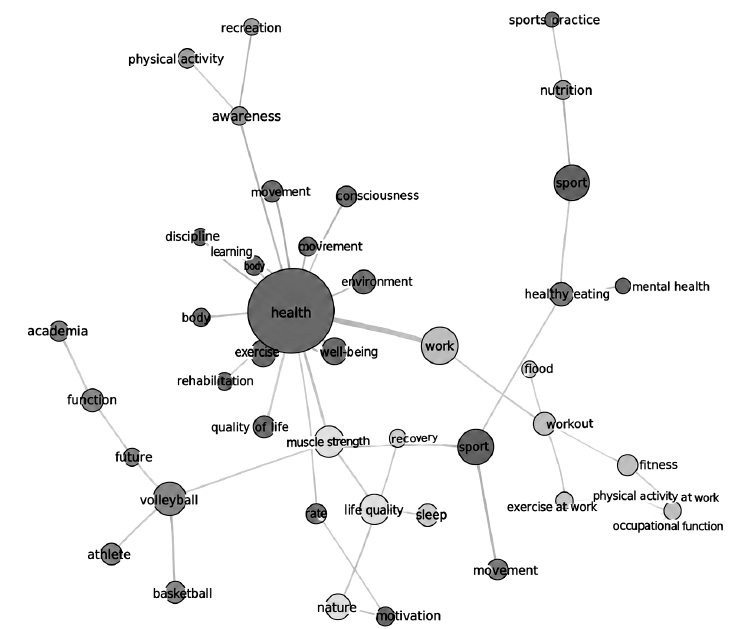
In addition to the prototypical analysis, presented in Chart 1, the data were also processed based on a similarity analysis. For Triani et al. (2021), similarity analysis can be used in research on social representations in order to complement the prototypical analysis. In this sense, it is possible to gain further insight into the connections between the frequency of evocations and their average order of evocation. Thus, understanding the data through similarity analysis can be a way to identify the links between the elements that constitute the peripheral system and the central core. In Figure 1, we illustrate the similarity analysis produced by the IRAMUTEC software, based on data collected from students in the Undergraduate Program in Physical Education.

The use of the maximum similarity tree, for the purpose of analyzing the structure of social representations, can also serve as a complementary strategy for understanding the evocations (Ortiz, Triani and Magalhães Júnior, 2023). In this sense, when the prototypical analysis was carried out (Chart 1), health was not the only element of the Central Core that attributed meaning to the structure of the group’s social representations. However, now, in the similarity analysis (Figure 1), we notice the salience and centrality of the term “health” for the studied group, as it assumes a prominent position in the figure. In other words, by observing the elements considering the combination of the two analyses, we can perceive the importance that the term “health” plays in attributing meaning to and organizing the social representations about sustainable practices.
According to Ortiz, Triani and Magalhães Júnior (2023), in the maximum similarity tree, there are two main elements to be observed: the vertices and the edges. The vertices correspond to the evocations, and the size of their diameter varies according to the frequency with which the term was evoked. In turn, the edges correspond to the index of similarity, which means that the terms were simultaneously evoked, such that the more times two terms are simultaneously evoked, the thicker the edge will be.
Taking this into consideration, we verify that the largest vertex represented in Figure 1 is that of “health.” For Abric (2003), organization is one of the functions of the Central Core; hence, we can observe that the whole structure that composes the possible social representations of the group is organized around health, as if health were a generative core for all other elements. It should be noted that the edge that links “health” to “outdoors” is the thickest in the figure, highlighting the high similarity index between these terms, in addition to a possible understanding that, for students, Sustainable Practices are carried out outdoors, from the perspective of health.
According to Deschamps and Moliner (2009), when referring to the formation of group identities, they state that the social representations shared by a given group can serve to determine their identities. Therefore, the social representations that circulate within a given group can contribute to the identification of their particularities and differences.
For Abric (2003), the Central Core of social representations is what generates meaning and organizes the group’s knowledge about the object. In the case of the present research, the meanings concerning Sustainable Practices are associated and organized according to the notion of “health.” This term seems to play an important role in the identity regulation of Physical Education students (Monteiro, 2017), as it is a keyword for understanding and interpreting the social reality of the group as well as the relationships that are established between its members and their social practices (Silva Junior and Barreto, 2023).
Health as the Central Core allows us to understand the formation of a possible psychosocial identity of the group, so that individuals and groups, through the exercise of communication, manifest behaviors that help identify indications of organization, structure, and social function (Carmino et al., 2013). This organization can be seen in Figure 1, when the path to the vertex “recycling” first passes through “awareness,” but always starting from health as the guiding element.
FINAL CONSIDERATIONS
In this research, we sought to identify and analyze the social representations about Sustainable Practices shared by university students of an undergraduate program in Physical Education. In this sense, based on a structuralist approach to the Social Representations Theory, we were able to grasp the influence that the health element has on the setting of Physical Education as a field of knowledge and intervention. In previous research (Krug et al., 2017; Triani et al., 2021), although the evocation word differs, Physical Education students always seem to evoke the term “health,” an answer that amounts to a rather universal principle. This pattern was also observed in the present study, making health the most central element among students of Physical Education students in relation to sustainable practices.
Considering our data, the social representations of Physical Education academics regarding sustainable practices are strongly associated with health, and the elements “environment” and “sustainability” are manifested from this notion. From this perspective, which points to educational strategies to minimize the negative effects of human beings’ self-perception and actions on the environment, it is imperative to conceive Environmental Education and Sustainable Practices, making it opportune to include Physical Education in these discussions as a way of addressing these topics in Primary Education.
Considering official documents, such as the BNCC, which establishes Adventure Body Practices as part of the curriculum of school Physical Education, the basis for work on Environmental Education and Sustainable Practices has been strengthened, along with the other curricular components that fall within the different levels of Primary Education, thus favoring interdisciplinary educational practices. Likewise, the close link between health and sustainable practices in the social representations of Physical Education students can provide possible indications on how social practices have been taking place in relation to the environment and, therefore, can inform the development of pedagogical guidelines for a critical Environmental Education through Physical Education.
As a pedagogical direction for a critical Environmental Education through Physical Education, we suggest problematizing the idea of body as separate from nature in the classroom. In addition, we suggest questioning hegemonic models of “healthy body” that promote environmental exploitation with ecological impacts, environmental degradation, and the use of disposable equipment. Furthermore, we suggest involving students, through sport and Adventure Body Practices, in natural environments, considering that the literature (Brasil, 2017; Triani et al., 2021; Triani et al., 2023) has shown that the more pro-environment practitioners are, the lower the impacts of environmental degradation.
Moreover, it is necessary that educational actions be developed in the initial and continuing education of Physical Education students, seeking to reflect on the importance of discussing Environmental Education practices and activities in the school context. These actions may be based on the curriculum guidelines of Physical Education programs that provide for the inclusion of environment and sustainability as areas of knowledge necessary for the training of Physical Education teachers.
Without incurring the risk of being carried away by the false pretense and/or naivety of believing that only the school will encourage the development of awareness among future generations regarding environmental issues, it is imperative to affirm that responsibility also falls on governments, the industrial sector, and the mode of production and consumption adopted thus far, which have often been degrading to the environment. Undoubtedly, education is still one of the most important means of addressing environmental issues and sustainable practices; nevertheless, this has not been the case within the context of Primary Education, at least not sufficiently. This situation leads us to question whether the initiatives proposed by legal documents - such as PCNs, DCNs and, as it seems, BNCC - have been ineffective in guiding an Environmental Education capable of developing people with a critical understanding of environmental issues, particularly with regarding to conceiving, acting, and fighting for the environment in the national context.
References
- ABRIC, Jean-Claude. A abordagem estrutural das representações sociais. In: MOREIRA, Antonia Silva Paredes; OLIVEIRA, Denize Cristina de (org.). Estudos interdisciplinares de representação social. 2. ed. Goiânia: Ed. AB, 2000. p. 27-37.
- ABRIC, Jean-Claude. Abordagem estrutural das representações sociais: desenvolvimentos recentes. In: CAMPOS, Pedro Humberto; LOUREIRO, Marcos Corrêa (org.). Representações sociais e práticas educativas. Goiânia: Ed. da UCG, 2003. p. 37-58.
-
BATISTA, Carlos; ANDRADE, Márcia Siqueira. Concepções, historicidade e abordagens da teoria das representações sociais. Contribuciones a Las Ciencias Sociales, v. 16, n. 11, p. 24760-24776, 2023. https://doi.org/10.55905/revconv.16n.11-001
» https://doi.org/https://doi.org/10.55905/revconv.16n.11-001 -
BRANCO, Emerson Pereira; ROYER, Marcia Royer; BRANCO, Alessandra Batista de Godoi. A abordagem da educação ambiental nos PCNs, nas DCNs e na BNCC. Nuances: Estudos sobre Educação, Presidente Prudente, v. 29, n. 1, p. 185-203, 2018. https://doi.org/10.32930/nuances.v29i1.5526
» https://doi.org/https://doi.org/10.32930/nuances.v29i1.5526 - BRASIL. Parâmetros Curriculares Nacionais: terceiro e quarto ciclos do Ensino Fundamental: temas transversais. Brasília: MEC/SEF, 1998. 436 p.
-
BRASIL. Resolução n. 2, de 15 de junho de 2012. Estabelece as Diretrizes Curriculares Nacionais para a Educação Ambiental. Diário Oficial da União, Brasília, Seção 1, p. 70, 18 June 2012. Available at: https://abmes.org.br/legislacoes/detalhe/1230/resolucao-cne-cp-n-2 Accessed on: July 21, 2023.
» https://abmes.org.br/legislacoes/detalhe/1230/resolucao-cne-cp-n-2 -
BRASIL. Resolução CNE/CP n. 2, de 1 de julho de 2015. Brasília, 2015. Available at: https://abmes.org.br/legislacoes/detalhe/1750/resolucao-cne-cp-n-2 Accessed on: July 21, 2023.
» https://abmes.org.br/legislacoes/detalhe/1750/resolucao-cne-cp-n-2 - BRASIL. Transformando nosso mundo: a Agenda 2030 para o Desenvolvimento Sustentável. Brasil, 2016. v. 15.
- BRASIL. Base Nacional Comum Curricular. Brasília: Ministério da Educação, 2017.
- BRASIL. Base Nacional Comum Curricular. Brasília: Ministério da Educação, 2018a.
- BRASIL. Resolução n. 6, de 18 de dezembro de 2018. Brasília: Ministério da Educação, 2018b.
-
BRASIL. Resolução CNE/CP n. 2, de 20 de dezembro de 2019. Brasília, 2019a. Available at: https://abmes.org.br/legislacoes/detalhe/2982/resol Accessed on: July 21, 2023.
» https://abmes.org.br/legislacoes/detalhe/2982/resol - BRASIL. Temas contemporâneos transversais na BNCC: contexto histórico e pressupostos pedagógicos. Brasília, DF: Ministério da Educação, 2019b.
-
CAMARGO, Brígido Vizeu; JUSTO, Ana Maria. IRAMUTEQ: um software gratuito para análise de dados textuais. Temas em Psicologia, Ribeirão Preto, v. 21, n. 2, p. 513-518, 2013. https://doi.org/10.9788/TP2013.2-16
» https://doi.org/https://doi.org/10.9788/TP2013.2-16 - CARMINO, Leoncio; TORRES, Ana Raquel Rosas; LIMA, Marcus Eugênio Oliveira; PEREIRA, Macos Emanoel. Psicologia social: temas e teorias. 2. ed. Brasília, DF: Technopolitik, 2013.
- CARMO, Tania; LEITE, Joyce; MAGALHÃES JÚNIOR, Carlos Alberto de Oliveira. Aspectos metodológicos em representações sociais: um olhar para as pesquisas no contexto educacional. In: TRIANI, Felipe da Silva; MAGALHÃES JÚNIOR, Carlos Alberto de Oliveira; NOVIKOFF, Cristina (org.). Representações sociais e educação: contextos e perspectivas. Rio de Janeiro; 2017. p. 77-112.
- COSTA, Vera. Esportes de aventura e risco na montanha: um mergulho no imaginário. São Paulo: Manole, 2000.
- DESCHAMPS, Jean-Claude; MOLINER, Pascal. As representações identitárias: a identidade em psicologia social. Petrópolis: Vozes, 2009.
-
DOMINGUES, Soraya Corrêa; KUNZ, Eleonor; ARAÚJO, Lísia Costa. Educação ambiental e educação física: possibilidades para a formação de professores. Revista Brasileira de Ciências do Esporte, Florianópolis, v. 33, n. 3, p. 559-571, 2011. https://doi.org/10.1590/S0101-32892011000300003
» https://doi.org/https://doi.org/10.1590/S0101-32892011000300003 -
INÁCIO, Humberto Luís de Deus; MORAES, Thais Messias; SILVEIRA, Amanda. Educação física e educação ambiental: refletindo sobre a formação e atuação docente. Conexões, Campinas, v. 11, n. 4, p. 1-13, 2013. https://doi.org/10.20396/conex.v11i4.8637587
» https://doi.org/https://doi.org/10.20396/conex.v11i4.8637587 -
JARPA-ARRIAGADA, Carmen Gloria; CÁRCAMO-VÁSQUEZ, Héctor. Estudiantes primeira generación em educación superior: representaciones sociales de los docentes universitários sobre la implicación estudantil. Revista Brasileira de Educação, Rio de Janeiro, v. 28, e280124, 2023. https://doi.org/10.1590/S1413-24782023280124
» https://doi.org/https://doi.org/10.1590/S1413-24782023280124 - JODELET, Denise. Representações sociais: um domínio em expansão. In: JODELET, Denise. As representações sociais. Rio de Janeiro: Ed. UERJ, 2001. p. 14-44.
-
KONDRAT, Hebert; MACIEL, Maria Delourdes. Educação ambiental para a escola básica: contribuições para o desenvolvimento da cidadania e da sustentabilidade. Revista Brasileira de Educação, Rio de Janeiro, v. 18, n. 55, p. 825-848, 2013. https://doi.org/10.1590/S1413-24782013000400002
» https://doi.org/https://doi.org/10.1590/S1413-24782013000400002 -
KRUG, Hugo Norberto; CONCEIÇÃO, Victor Julierme Santos da; TELLES, Cassiano; KRUG, Rodrigo de Rosso; FLORES, Patric Paludett; KRUG, Marilia de Rosso. O curso de licenciatura em Educação Física nas representações sociais de estudantes em formação. Debates em Educação, Tabuleiro do Martins, v. 9, n. 17, p. 129-153, 2017. https://doi.org/10.28998/2175-6600.2017v9n17p129
» https://doi.org/https://doi.org/10.28998/2175-6600.2017v9n17p129 -
LAVOURA, Tiago Nicola; SCHWARTZ, Gisele Maria; MACHADO, Afonso Antonio. Aspectos emocionais da prática de atividades de aventura na natureza: a (re)educação dos sentidos. Revista Brasileira de Educação Física e Esporte, São Paulo, v. 22, n. 2, p. 119-27, abr./jun. 2008a. https://doi.org/10.1590/S1807-55092008000200003
» https://doi.org/https://doi.org/10.1590/S1807-55092008000200003 - LAVOURA, Tiago Nicola; SCHWARTZ, Gisele Maria; MACHADO, Afonso Antonio. Emoções, aventura e natureza: análise dos relatos verbais de praticantes dos esportes de aventura. Licere, Belo Horizonte, v. 11, n. 1, abr. 2008b.
- LE BRETON, David. Risco e lazer na natureza. In: MARINHO, Alcyane; BRUHNS, Heloísa (org.). Viagens, lazer e esporte: o espaço da natureza. Barueri: Manole, 2006. p. 94-117.
-
LEMOS, Érica Fernanda Ursulino; FERNANDES, Janaína da Silva Gonçalves. Escolas públicas e particular: representações sociais de professores. Revista Brasileira de Educação, Rio de Janeiro, v. 27, e270110, 2022. https://doi.org/10.1590/S1413-24782022270110
» https://doi.org/https://doi.org/10.1590/S1413-24782022270110 - LIMA, Marcio da Silva Xavier de; TRIANI, Felipe da Silva; SEIXAS FILHO, José Teixeira de; MOREIRA, Jorge Felipe Fonseca. Esportes de aventura: algumas possibilidades na região da Barra de Guaratiba no Rio de Janeiro. Semioses, Rio de Janeiro, v. 12, p. 36-54, 2018.
-
LIMA, Rita de Cássia; CAMPOS, Pedro Humberto. Núcleo figurativo da representação social: contribuições para a educação. Educação em Revista, Belo Horizonte, v. 36, e206886, 2020. https://doi.org/10.1590/0102-4698206886
» https://doi.org/https://doi.org/10.1590/0102-4698206886 - MARINHO, Alcyane; BRUHNS, Heloísa (org.). Viagens, lazer e esporte: o espaço da natureza. São Paulo: Manole, 2006.
-
MONTEIRO, Marcos Vinicius Pereira. A construção identitária nas aulas de educação física. Revista Brasileira de Educação, Rio de Janeiro, v. 22, n. 69, p. 339-359, 2017. https://doi.org/10.1590/S1413-24782017226918
» https://doi.org/https://doi.org/10.1590/S1413-24782017226918 - MONTEIRO, Sandoval Vilaverde. Subjetividade, amizade e montanhismo: potencialidades das experiências de lazer e aventura na natureza. Motrivivência, Florianópolis, v. 16, n. 22, p. 71-91, 2004.
- MOSCOVICI, Serge. Representações sociais: investigações em psicologia social. Petrópolis: Vozes, 2007.
- MOSCOVICI, Serge. A psicanálise, sua imagem, seu público. Petrópolis: Vozes, 2012.
- NOVAES, Renato Cavalcanti; TRIANI, Felipe da Silva; TELLES, Silvio de Cássio Costa. A educação física na base nacional comum curricular: desconstruindo o discurso neoliberal. Humanidades & Inovação, Palmas, v. 7, n. 10, p. 70-84, 2020.
- ORTIZ, Adriano; TRIANI, Felipe da Silva; MAGALHÃES JÚNIOR, Carlos Alberto de Oliveira. Representações sociais: uma teoria, muitos caminhos. In: MAGALHÃES JÚNIOR, Carlos Alberto de Oliveira; BATISTA, Michel (org.). Metodologia da pesquisa em educação e ensino de ciências. 2. ed. Ponta Grossa: Atena, 2023. p. 103-119.
-
OSBORNE, Renata; BATISTA, Washington Adolfo. Educação física na década da educação para o desenvolvimento sustentável. Motriz, Rio Claro, v. 16, n. 1, p. 28-36, 2010. https://doi.org/10.5016/1980-6574.2010v16n1p28
» https://doi.org/https://doi.org/10.5016/1980-6574.2010v16n1p28 -
PAIXÃO, Jairo Antonio. Esporte de aventura como conteúdo possível nas aulas de educação física escolar. Motrivivência, Florianópolis, v. 29, n. 50, p. 170-182, 2017. https://doi.org/10.5007/2175-8042.2017v29n50p170
» https://doi.org/https://doi.org/10.5007/2175-8042.2017v29n50p170 -
PAIXÃO, Jairo Antonio. Educação ambiental na educação básica: elementos para se pensar o trabalho da dimensão ambiental nas aulas de educação física. Horizontes, v. 36, n. 1, p. 196-207, Jan./Apr. 2018a. https://doi.org/10.24933/horizontes.v36i1.484
» https://doi.org/https://doi.org/10.24933/horizontes.v36i1.484 - PAIXÃO, Jairo Antonio. Esportes de aventura no currículo da educação física escolar: possibilidades de intervenção. Viçosa: Ed. UFV, 2018b.
- SÁ, Celso Pereira de. Núcleo central das representações sociais. Petrópolis: Vozes, 1996.
-
SCAPIN, Gislei Jose; CAMARGO, Maria Cecília; SOUZA, Maristela da Silva; COSTA, Leandra Costa da; CHARÃO, Carine Marques. A construção de material pedagógico para o ensino do jogo e o processo educativo na educação física crítico-superadora. Motrivivência, Florianópolis, v. 32, n. 61, p. 1-20, 2020. https://doi.org/10.5007/2175-8042.2020e61616
» https://doi.org/https://doi.org/10.5007/2175-8042.2020e61616 -
SCHWARTZ, Gisele Maria; PEREIRA, Leonardo Madeira; FIGUEIREDO, Juliana de Paula; CHRISTOFOLETTI, Danielle Ferreira; DIAS, Viviane Kawano. Estratégias de participação da mulher nos esportes de aventura. Revista Brasileira de Ciências do Esporte, Florianópolis, v. 38, n. 2, p. 156-162, 2016. https://doi.org/10.1016/j.rbce.2015.11.007
» https://doi.org/https://doi.org/10.1016/j.rbce.2015.11.007 -
SILVA, Ana Tereza Reis. Currículo e representações sociais de homem e natureza: implicações à prática pedagógica. Revista Brasileira de Educação, Rio de Janeiro, v. 18, n. 55, p. 861-878, 2013. https://doi.org/10.1590/S1413-24782013000400004
» https://doi.org/https://doi.org/10.1590/S1413-24782013000400004 -
SILVA, Nilton Oliveira da; FREIRE, Fátima de Souza. Teaching for sustainability in Brazilian higher education from the perspective of the Sustainable Development Goals. Revista Brasileira de Educação, Rio de Janeiro, v. 28, e280080, 2023. https://doi.org/10.1590/S1413-24782023280080
» https://doi.org/https://doi.org/10.1590/S1413-24782023280080 -
SILVA JUNIOR, Germinio José; BARRETO, Denise Aparecida Brito. Representações sociais na atualidade digital e contingente. Debates em Educação, Maceió, v. 15, n. 37, e16143, 2023. https://doi.org/10.28998/2175-6600.2023v15n37pe16143
» https://doi.org/https://doi.org/10.28998/2175-6600.2023v15n37pe16143 -
SOUZA, Vanessa Marcondes. Para o mercado ou para a cidadania? A educação ambiental nas instituições públicas de ensino superior no Brasil. Revista Brasileira de Educação, Rio de Janeiro, v. 21, n. 64, p. 121-142, 2016. https://doi.org/10.1590/S1413-24782016216407
» https://doi.org/https://doi.org/10.1590/S1413-24782016216407 -
TAHARA, Alexander Klein; DARIDO, Suraya Cristina. Práticas corporais de aventura em aulas de educação física na escola. Conexões, Campinas, v. 14, n. 2, p. 113-136, 2016. https://doi.org/10.20396/conex.v14i2.8646059
» https://doi.org/https://doi.org/10.20396/conex.v14i2.8646059 -
TRIANI, Felipe da Silva; BARROS, Glhevysson dos Santos; MAGALHÃES JÚNIOR, Carlos Alberto de Oliveira; TELLES, Silvio de Cassio da Costa. As representações sociais de bacharelandos sobre ser profissional de Educação Física. Revista da Educação Física, Maringá, v. 30, e3032, 2019. https://doi.org/10.4025/jphyseduc.v30i1.3032
» https://doi.org/https://doi.org/10.4025/jphyseduc.v30i1.3032 -
TRIANI, Felipe da Silva; NOVAES, Renato Cavalcanti; MAGALHÃES JÚNIOR, Carlos Alberto de Oliveira; PAIXÃO, Jairo Antonio; TELLES, Silvio de Cassio Costa. Representações sociais de alunos do ensino fundamental sobre as práticas corporais de aventura como conteúdo nas aulas de educação física. Cenas Educacionais, Caetité, v. 6, e16316, 2023. https://doi.org/10.5281/zenodo.14179440
» https://doi.org/https://doi.org/10.5281/zenodo.14179440 -
TRIANI, Felipe da Silva; NOVAES, Renato Cavalcanti; TELLES, Silvio de Cássio Costa. As representações sociais da educação física na formação docente. Debates em Educação, Maceió, v. 15, n. 37, e14840, 2023. https://doi.org/10.28998/2175-6600.2023v15n37pe14840
» https://doi.org/https://doi.org/10.28998/2175-6600.2023v15n37pe14840 -
TRIANI, Felipe da Silva; SOUZA, Anna Carolina Carvalho; MAGALHÃES JÚNIOR, Carlos Alberto de Oliveira; TELLES, Silvio de Cassio Costa. Representações sociais de graduandos em educação física sobre meio ambiente e a relação homem, esporte e natureza. Revista Brasileira de Estudos Pedagógicos, Brasília, v. 102, n. 260, p. 205-217, 2021. https://doi.org/10.24109/2176-6681.rbep.102.i260.4133
» https://doi.org/https://doi.org/10.24109/2176-6681.rbep.102.i260.4133 -
VALENCIA, Gustavo Alonso González; PUENTE, Solbey Morillo. Representaciones sobre el desarrollo del pensamiento crítico em maestros em formación. Revista Brasileira de Educação, Rio de Janeiro, v. 23, e230086, 2018. https://doi.org/10.1590/S1413-24782018230086
» https://doi.org/https://doi.org/10.1590/S1413-24782018230086 - VÈRGES, Pierre. Conjunto de programas que permitem a análise de evocações: EVOC: manual. Versão 5. Aix en Provence, 2002.
-
VINUESA, Antonio García; CAMPOS, Marília Andrade Torales; CARTEA, Pablo Angél Meira. La representación social del cambio climático em estudiantes universitarios brasileños: un estudio exploratorio-descriptivo en el marco de una investigación internacional. Revista Brasileira de Educação, Rio de Janeiro, v. 28, e280041, 2023. https://doi.org/10.1590/S1413-24782023280041
» https://doi.org/https://doi.org/10.1590/S1413-24782023280041

 Source: Prepared by the authors.