 Expectancy–value beliefs as predictors of positive–valence emotions and their variation across academic tracks in high school Physics
Abstract
Achievement emotions influence motivation, engagement, and performance, yet less is known about how expectancy–value beliefs jointly relate to positive-valence emotions in high-school Physics classes. This study aimed to (1) examine how task value and expectancy of success predict positive-valence emotions, and (2) explore differences in task value across academic tracks. The sample consisted of 333 Physics students aged 15–18 (Mage = 16.5, SD = 0.96, 42.6% female) from Maldonado, Uruguay. Hierarchical regression analyses with cluster-robust standard errors at the academic-track level indicated that task value and expectancy were significant predictors of positive-valence emotions, with semi-partial coefficients indicating that both expectancy and task value made unique contributions. Exploratory non-parametric comparisons suggested differences in task value across academic tracks, with higher perceived value in scientific–technological and biosciences programs than in arts, design or general tracks. Findings support expectancy–value theory by highlighting the joint role of task value and expectancy of success in adolescents’ positive emotional experiences in Physics classes and underscore the relevance of aligning both classroom practice and curriculum design with students’ motivational beliefs.
Keywords:
Emotions; Motivation; Task Value; Physics Education; Secondary School
Resumo
As emoções de realização influenciam a motivação, o engajamento e o desempenho, mas ainda se sabe pouco sobre como crenças de expectativa–valor se relacionam com emoções positivas em Física do ensino médio. Este estudo buscou (1) examinar como o valor da tarefa e a expectativa de sucesso predizem emoções de valência positiva e (2) explorar diferenças no valor da tarefa entre trajetórias acadêmicas. A amostra foi composta por 333 estudantes de Física, com idades entre 15 e 18 (Midade = 16,5; DP = 0,96; 42,6% mulheres), de Maldonado, Uruguai. Por meio de regressão hierárquica com erros-padrão robustos por trajetória acadêmica, verificou-se que valor da tarefa e expectativa foram preditores significativos das emoções de valência positiva, e os coeficientes semiparciais indicaram contribuições únicas de ambas as variáveis. Comparações não paramétricas exploratórias sugeriram diferenças no valor da tarefa entre trajetórias, com maior valor percebido nos programas científicotecnológicos e de biociências do que nas trajetórias de artes, design ou geral. Os resultados apoiam a teoria da expectativa–valor ao evidenciar o papel conjunto do valor da tarefa e da expectativa de sucesso nas experiências emocionais de valência positiva dos adolescentes nas aulas de Física e ressaltam a relevância de alinhar tanto a prática em sala de aula quanto o desenho curricular às crenças motivacionais dos estudantes. Palavras-chave: Emoções, Motivação, Valor da Tarefa, Ensino de Física, Ensino Médio.
Palavras-chave:
Emoções; Motivação; Valor da Tarefa; Ensino de Física; Ensino Médio
1. Introduction
Task value and expectancy of success are two central constructs in motivational psychology that have been shown to help explain students’ engagement, emotional experiences, and academic performance. Task value refers to the interest, importance, and utility that students attribute to academic tasks, while expectancy of success reflects their beliefs about how well they will perform [1]. Research has consistently shown that these constructs predict emotional and behavioral outcomes in academic [2, 3], and contemporary longitudinal evidence further indicates that academic buoyancy and resilience are closely tied to positive-valence emotions in high [4]. Complementing this work, higher task value has also been associated with improved academic performance and reduced depressive symptoms among early adolescents, underscoring the emotional significance of these motivational [5]. Studies using intensive, real-time assessments of students’ daily experiences also confirm that discrete achievement emotions vary dynamically with their goals and motivation [6]. At the same time, an emerging body of work has begun to examine their joint effects on achievement emotions and achievement-related outcomes. For instance, Seo et al. [7] showed that expectancy and task value synergistically predict achievement-related outcomes in adolescents, suggesting that their combined influence is greater than the sum of their individual effects, and a recent comprehensive review highlighted that expectancy beliefs and task value jointly shape both cognitive and emotional processes in learning, reinforcing their centrality in predicting academic outcomes [8] (pp. 617–644). Consistent with this broader pattern, Berweger et al. [9] demonstrated that expectancy-value appraisals jointly influence students’ emotional experiences in online learning environments, highlighting both within- and between-person associations. Similarly, Song and Chung [10] reexamined the interaction between expectancy and task value in academic contexts, providing evidence that their synergistic effects can shape motivational processes and related emotional outcomes. Beyond these findings, intervention studies have shown that changing perceived utility and performance expectations can modify students’ affective and motivational responses [11, 12].
Over the past four decades, expectancy-value theory has evolved to incorporate developmental, social cognitive, and sociocultural dimensions that highlight contextual influences on students’ motivation and learning [13]. Situated expectancy-value theory further explains how engagement dimensions and task value interact to shape adolescents’ academic trajectories [14] (pp. 57–76). This contextual sensitivity is crucial, as international evidence suggests that the predictive strength of motivational beliefs on science engagement is not universal and can vary significantly across different cultural and economic settings [15]. Within this evolving framework, adolescence is a particularly sensitive and critical period for examining these associations, as it is a formative stage marked by rapid cognitive, social, and emotional changes, as well as heightened reactivity to academic stressors and performance feedback [16, 17]. At the same time, cumulative psychosocial risks and school-related difficulties can increase vulnerability to depressive symptoms, underscoring the importance of early identification of students at risk [18]. Despite the centrality of these processes during adolescence, most existing studies focus on university populations or on general learning outcomes rather than on adolescents’ emotional experiences in specific subjects, and there is still limited evidence on how expectancy–value processes relate to achievement emotions in Latin American high school contexts.
In the case of Uruguay, the upper-secondary school comprises two coexisting subsystems: “Secondary Education” and “Technical–Professional Education”. In the last three years of “Secondary Education”, the first year follows a broad “general” curriculum; thereafter, students choose among academic tracks (e.g., Biological, Scientific), which in the final year may bifurcate into more specific itineraries (e.g., Scientific splits into Engineering and Architecture). In the technical–professional subsystem, students select from multiple occupationally oriented tracks (e.g., Sports and Recreation, Carpentry, Electromechanics) starting in the antepenultimate year. For analytic clarity in this study, we grouped the different tracks from both subsystems into three categories – Biosciences, Scientific–Technological, and Arts and Design – and students enrolled in the antepenultimate year of “Secondary Education” were labeled as “General Path”. This diversified tracking structure, together with the cognitive and emotional transformations of adolescence and the specific demands of science education, provides a valuable context for examining how perceptions of task value differ across curricular pathways and student profiles. The present study therefore aims to (1) examine the joint contribution of task value and expectancy of success in predicting achievement emotions, and (2) explore whether perceptions of task value differ across academic tracks in Uruguayan high school.
2. Method
2.1. Participants
The initial sample included 340 adolescents aged 15 to 18 years (M = 16.5, SD = 0.96, 42.6% female) from the Maldonado department in Uruguay. Participants were enrolled in Physics courses across 34 groups from five institutions, both public (18 groups) and private schools (16 groups). After identifying outliers using three methods – z-scores for univariate outliers, scatterplots for bivariate outliers, and Mahalanobis distance for multivariate outliers – a total of seven outliers were removed from the dataset. The final sample consisted of 333 students. Although the sample is not nationally representative, it includes adolescents from diverse socioeconomic backgrounds. This heterogeneity offers context-sensitive insights that may be informative for similar educational settings.
2.2. Instruments
2.2.1. Task value
Task value was assessed with the intrinsic value dimension of the Motivated Strategies for Learning Questionnaire (MSLQ) adapted for Uruguayan students [19]. The six items capture students’ perceived interest and importance of the learning content in the course, and are rated on a 7-point Likert-type scale. Internal consistency in this sample was excellent (α = 0.92).
2.2.2. Expectancy of success
To develop the expectancy of success instrument, we initially compiled 10 items: three from Hulleman et al. [12] and seven others obtained directly from Carol Brown and Julia Dietrich via email communication. Following item analyses conducted in a prior pilot administration, the instrument retained two items from Wigfield and Eccles [1], adapted by Dietrich et al. [11], and two from Hulleman et al. [12], which originally served as ad hoc measures of expectancy and performance expectations, respectively. The resulting instrument consisted of a unidimensional four-item scale with a 7-point Likert response format, which demonstrated very good internal consistency (α = 0.83) in our sample.
2.2.3. Positive-valence emotions
A 32-item shortened class-related Achievement Emotions Questionnaire (AEQ), based on Fierro-Suero et al. [20], was adapted for administration to Uruguayan youth [21] using Argentinian translations [22, 23], given the cultural proximity between the two countries, and yielded a three-factor structure that closely matched Pekrun’s tridimensional model [24]. In the present study, we used the 12-item positive-valence factor (four items each for enjoyment, hope, and pride), rated on a 5-point Likert-type scale; internal consistency for this composite score was excellent (α = 0.91).
The decision to use only the first factor of the shortened AEQ as our operational indicator of achievement emotions in this study was based on both empirical and theoretical considerations. Empirically, this factor accounted for the largest proportion of explained variance among the three factors derived from the EFA and mirrored the cluster of positive-valence emotions identified by Paoloni et al. [22]. Thus, it offered a concise yet robust representation of achievement emotions for the purposes of this study. Theoretically, these emotions are not only positively valenced and moderately to highly activating, but are also the group most consistently linked to enhanced motivation, cognitive engagement, and higher academic achievement in previous studies [25, 26]. From a control–value and expectancy–value perspective, they tend to emerge when students simultaneously perceive high control/expectancy and attach substantial value to academic activities [9]. Accordingly, we intentionally prioritized those emotional states most directly involved in motivational enhancement in relation to students’ task value and expectancy beliefs. Nevertheless, we acknowledge that this focus necessarily narrows the emotional spectrum under consideration. According to the control-value theory [24], both positive and negative valence achievement emotions play essential roles in shaping academic engagement and learning outcomes. These aversive emotions, although not directly analyzed in this study, exert meaningful influences on attention, persistence, and self-regulation, particularly in demanding academic contexts such as Physics. Our operationalization should therefore be understood as a theoretically informed, yet necessarily partial, representation of students’ achievement emotions.
2.3. Procedure
Data collection was conducted during regular class hours with the consent of schools, students, and, for underage participants, parents or legal guardians. The study adhered to ethical guidelines and was approved by the Research Ethics Committee, ensuring participants’ confidentiality and voluntary participation. The instruments were administered in a computerized format and completed within approximately 30 minutes. One of the researchers was present to address any questions or concerns during the data collection process.
2.4. Data analysis
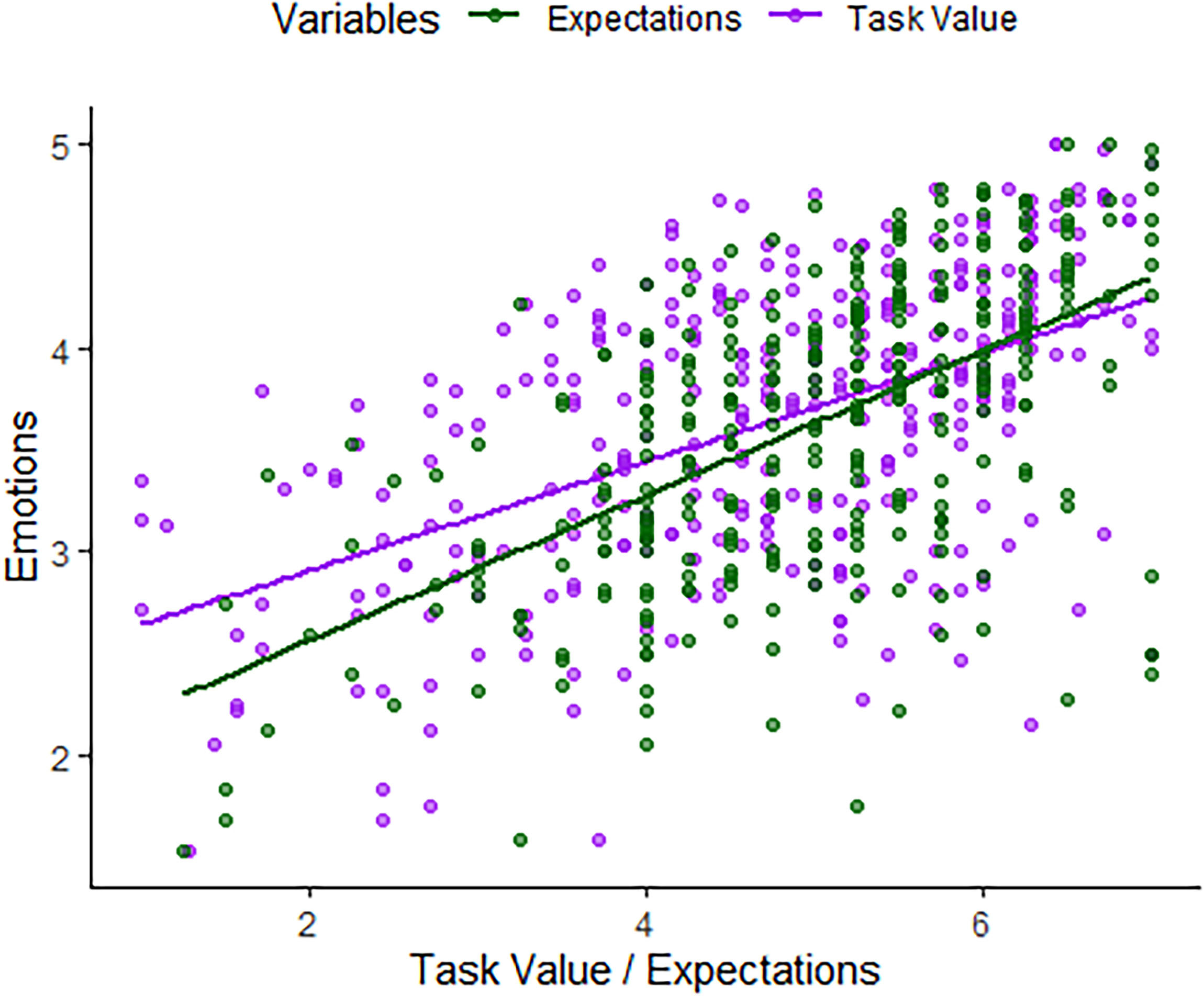
All analyses were conducted using RStudio. Given that students were nested within four academic tracks, we first estimated an empty random-intercept model to quantify clustering at the track level. The intraclass correlation coefficient was ICC = 0.081 (Design Effect = 7.639). Consequently, all regressions were re-estimated with cluster-robust standard errors at the track level using the CR2 small-sample correction for clustered data. We implemented hierarchical regression and reported ΔR2 and semi-partial effects to quantify incremental validity. As a preliminary step, we also examined whether the positive-valence emotions factor was measured equivalently across academic tracks using a multi-group confirmatory factor analysis. A configural model with freely estimated loadings showed overall acceptable incremental fit, with CFI = 0.984 and TLI = 0.980, although RMSEA (0.107) and SRMR (0.093) were elevated. Constraining factor loadings to equality across tracks led to a small decrease in fit (CFI = 0.971, TLI = 0.969; RMSEA = 0.133;SRMR = 0.114; ΔCFI = 0.013), which we interpret as evidence for only approximate, rather than strict, metric invariance. For comparisons of task value across academic tracks, inspection of group-wise distributions indicated notable deviations from normality and heterogeneous variances, so the non-parametric Kruskal–Wallis test was used. Figure 1 displays the preliminary ordinary least squares (OLS) relationship between predictors and positive-valence emotions; however, all inferential claims in the text are based on the CR2-adjusted models. Given these measurement and distributional limitations, comparisons involving academic track and gender are treated as exploratory and should be interpreted with caution.
Preliminary OLS associations of task value and expectancy of success with positive-valence emotions.
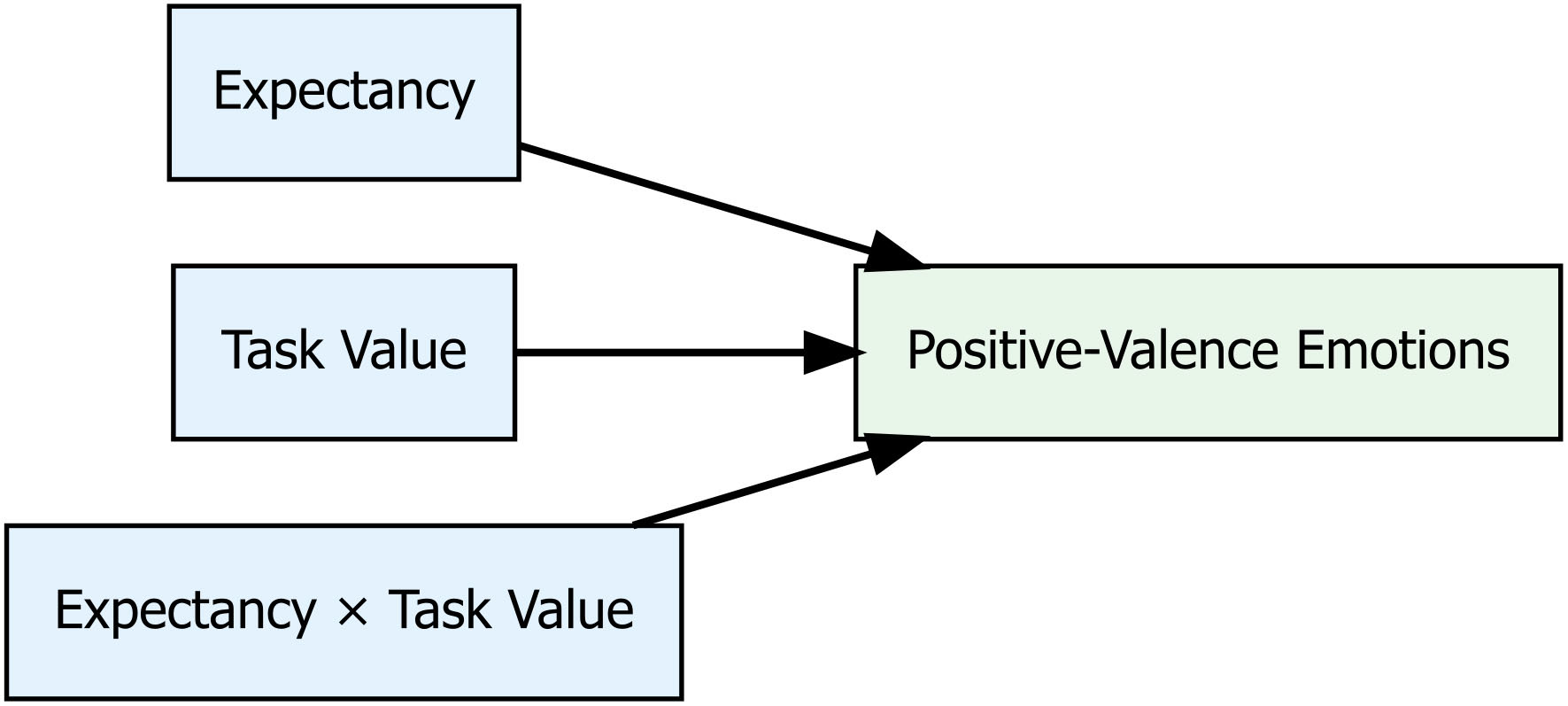
To provide an overview of the analytic specification, Figure 2 presents the hypothesized path model guiding the study, with expectancy of success, task value, and their interaction predicting positive-valence emotions, controlling for gender and academic track. Together with the preliminary OLS associations shown in Figure 1, this diagram provides a compact map of the relationships tested.
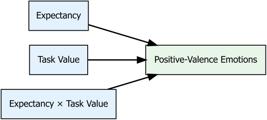
Hypothesized path model of expectancy–value predictors of positive-valence emotions. Note. Gender and academic track were included as covariates in all regression models but are not depicted in the figure for clarity.
3. Results
3.1. Predictive power of task value and expectancy of success
Consistent with our focus on the incremental contribution of motivational beliefs over background characteristics, Block 1 (covariates: gender and track) explained R2 = 0.059. Adding expectancy and task value in Block 2 increased explained variance to R2 = 0.595 (ΔR2 = 0.536). Including the interaction expectancy × task value in Block 3 yielded R2 = 0.600 (ΔR2 = 0.005). With CR2 inference, both expectancy of success (p = 0.002) and task value (p < 0.001) were significant positive predictors, and the interaction expectancy × task value was small but significant (p = 0.041). In the full model, standardized effects were positive for both predictors (expectancy: β = 0.432; task value: β = 0.427) with corresponding unstandardized coefficients and 95% CIs (expectancy: B = 0.305, 95% CI [0.244, 0.366]; task value: B = 0.254, 95% CI [0.202, 0.305]). Semi-partial contributions were quantified using the LMG metric [27], which decomposes the total R2 into each predictor’s average incremental share across all possible entry orders; these values indicated unique effects of expectancy of success = 0.286, task value = 0.277, their interaction = 0.013, track = 0.023, and gender = 0.001.
Model diagnostics for the final regression model indicated no evidence of problematic multicollinearity (VIF = 1.56; Tolerance = 0.64), with both indices well within commonly recommended thresholds. Residual-versus-fitted and normal Q–Q plots (included in the Supplementary Materials) did not reveal major deviations from linearity, homoscedasticity, or normality at the level of the model residuals, and a studentized Breusch–Pagan test did not detect substantial heteroscedasticity, BP(7) = 7.01, p = 0.428. Taken together, these diagnostics indicated that the main assumptions of the linear model were reasonably satisfied.
3.2. Differences in task value by academic orientation
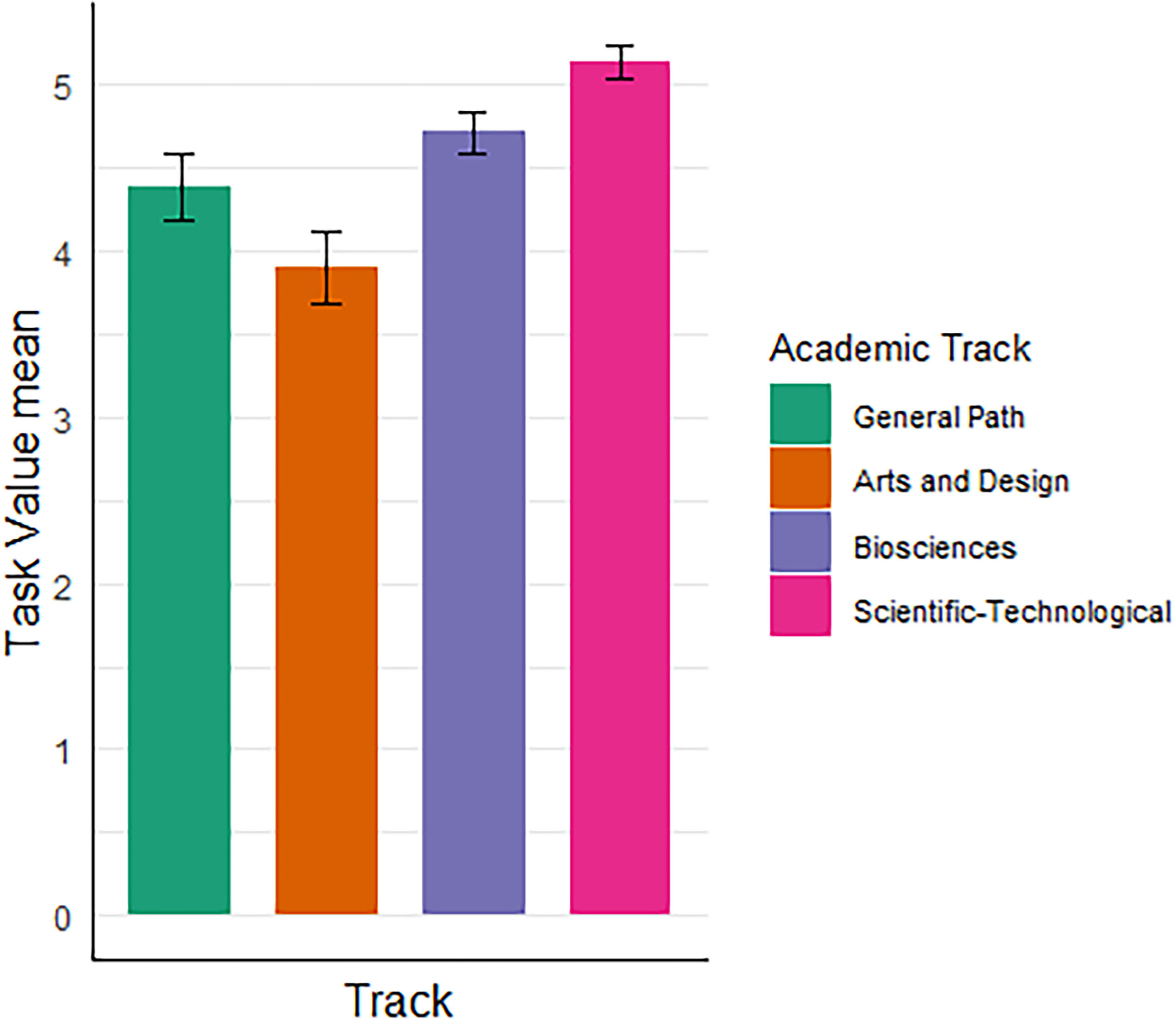
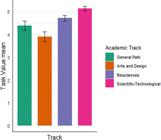
Differences in task value across academic tracks were examined using the Kruskal–Wallis test, which revealed significant differences, χ2(3) = 27.6, p < 0.001, ε2 = 0.083, indicating a small to moderate effect size. Figure 3 displays the mean task value scores for each academic track. As shown in the figure, task value scores differed across tracks. Post hoc analyses with the Dwass–Steel–Critchlow–Fligner procedure revealed significant pairwise differences in task value between students in the Scientific–Technological track and those in Arts and Design (W = 6.86, p < 0.001) and the General Path (W = 4.42, p = 0.010). Additionally, significant differences were observed between students in Biosciences and those in Arts and Design (W = 4.42, p = 0.010). No other pairwise comparisons reached statistical significance.
4. Discussion
Overall, the findings support expectancy–value theory, emphasizing the joint influence of task value and expectancy of success on adolescents’ positive emotional experiences in Physics classes. Both constructs emerged as significant predictors of positive-valence emotions (enjoyment, pride, and hope), reinforcing theoretical models that connect motivation with affective outcomes [1, 24] and accounting for substantial incremental variance in positive-valence emotions beyond covariates. Semi-partial contributions indicated comparable unique effects of expectancy and task value, aligning with the interpretation that strengthening either students’ confidence in success or the perceived relevance of tasks can similarly promote positive emotional engagement; the interaction term made only a minimal additional contribution, in line with Meyer et al.’s observation that multiplicative expectancy–value terms explained little additional variance beyond additive main effects [28].
In our sample, students in scientific–technological and biosciences tracks tended to perceive greater relevance and utility in their coursework, consistent with viewing Physics as more directly connected to future academic and career opportunities, compared to students in arts and design programs and those without a clearly defined academic track, who showed lower task value scores. Although these group contrasts are exploratory and based on only approximate measurement invariance, they align with evidence from both expectancy-value and social cognitive frameworks suggesting that students’ motivational profiles often follow and are reinforced by their curricular choices [13, 29, 30], and that perceived relevance and future utility are central for fostering emotional investment in learning [12]. This pattern highlights a potential need for targeted interventions to enhance engagement and promote positive emotional outcomes among students in less science-oriented pathways. With respect to gender, effects were negligible, suggesting that, in this sample, boys and girls reported broadly similar levels of task value once expectancy beliefs and academic track were taken into account. Given that evidence for measurement invariance across academic tracks was only approximate and the design does not permit strong causal inference, these differential patterns by gender and academic track should be interpreted with caution.
4.1. Educational and practical implications
This study offers applied insights for classroom teaching, curriculum design, and educational policymaking. The strong predictive value of task value and expectancy beliefs for positive-valence emotions suggests that pedagogical initiatives in high school should foster students’ belief in their capacity to succeed and the meaningfulness of what they learn.
In Physics instruction, educators can raise perceived task value by explicitly linking course content to real-life applications and diverse career paths, including those beyond the scientific-technological domain. For students without a defined academic orientation, who exhibited lower emotional and motivational engagement, structured reflection activities, relevance writing assignments, or interest-enhancement strategies may increase the perceived value of the subject matter. Concretely, a lesson might begin with a brief utility statement that illustrates how the day’s core concept in Physics relates to everyday decisions and several possible study or career paths. Teachers can then invite students to write a short reflection on why this topic could matter for their goals and provide simple, low-stakes feedback that highlights partial progress and possibilities for improvement. During problem-solving activities, offering a small set of equivalent problem formats – such as a contextualized scenario, a more symbolic exercise, or one that uses graphical data – can preserve cognitive demand while giving students some choice. Over time, gradually reducing the amount of scaffolding in worked examples helps shift responsibility to students in a manageable way as their confidence grows. To monitor emotional change with minimal burden, teachers can collect single-item ratings of enjoyment, interest, and confidence at key moments, for example immediately after relevance-writing activities and just before and after feedback cycles, and then summarize these data weekly at the class level to inform subsequent adjustments. Although our analyses focused on emotional outcomes, such interventions are also likely to have implications for academic performance. Network analyses of expectancy–value constructs from other samples indicate that strengthening expectancy beliefs may be particularly effective for improving academic achievement, as these beliefs show stronger links to performance outcomes than utility values [31].
Aligning instruction with students’ interests and perceived task value is not only a matter of classroom practice, but also a central concern for curriculum design and educational policy. In systems where curricular reforms seek to standardize learning experiences, decisions about how much to differentiate content and pathways inevitably have motivational consequences. In the Uruguayan context, for example, recent debates about a “common curricular framework” that would integrate subject areas and reduce the specificity of academic tracks illustrate the tension between increasing curricular uniformity and preserving track-specific opportunities to connect learning activities with students’ interests. From a motivational perspective, these results call for some caution: curricular integration that substantially reduces track-specific content may unintentionally undermine opportunities for students to experience physics as personally meaningful and useful. Consequently, if broader and more uniform curricular structures are adopted, they should be accompanied by deliberate strategies – such as flexible elective options and contextually relevant projects – to ensure that students can still perceive physics as meaningful for their current goals and future plans.
4.2. Limitations and future directions
This study relied on self-reported data, which may introduce social desirability bias [32, 33]. The cross-sectional, self-report design limits causal inference and may inflate associations through common-method variance, so generalizations should be tempered. In addition, we did not include direct indicators of academic performance, so the present findings pertain exclusively to motivational and emotional variables. Future research should therefore explore longitudinal designs to establish causality and incorporate additional variables, such as teaching quality, peer influences, objective indicators of academic performance, and socio-emotional skills, to deepen the understanding of these relationships. To enhance ecological validity and causal leverage, subsequent studies should also integrate multi-informant data (e.g., teacher ratings), behavioral/performance indicators, and/or experience-sampling approaches. Regarding the task value measure, we note potential cultural and developmental considerations when applying the MSLQ-UY to Uruguayan adolescents (see Supplementary Materials). Although internal consistency was excellent (α = 0.92), the latent representation and some item contents may not fully reflect how task value is construed in this population. Accordingly, interpretations should be made with caution, and future work should explore age-appropriate, context-sensitive adaptations – such as localized item refinement, exploratory structural equation modeling (e.g., ESEM), and alternative specifications within the MSLQ-UY framework – to strengthen measurement validity. Finally, comparisons across gender and academic tracks are flagged as exploratory because only limited tests of measurement invariance were conducted, and these indicated approximate rather than strict invariance.
Acknowledgments
We gratefully acknowledge the schools and students who participated in the study. We also thank the researchers who kindly provided additional information beyond their published work – Paola Paoloni, Javier Sánchez-Rosas, Julia Dietrich, and Carol Brown – which was valuable input for the development of this study.
This study was conducted as part of the first author’s master’s thesis project, which receives financial support from the Programa de Iniciación a la Investigación of the Comisión Sectorial de Investigación Científica (CSIC), Universidad de la República (Uruguay).
Supplementary Material
The following online material is available for this article.
Appendix A
Appendix B
Data Availability
The datasets generated and analyzed during the current study are available from the corresponding author upon reasonable request.
References
- [1] A. Wigfield and J.S. Eccles, Contemporary educational psychology 25, 68 (2000).
- [2] P. Pintrich and E. De Groot, Journal of Educational Psychology 82, 33 (1990).
- [3] D.H. Schunk and M.K. DiBenedetto, Contemporary educational psychology 60, 101832 (2020).
- [4] D. Putwain, L. Nicholson, R. Pekrun, S. Becker and H.W. Marsh, Learning and Instruction 83, 101699. (2023).
- [5] X. Li, E. Huebner and L. Tian, School Psychology 36, 167 (2021).
- [6] T. Goetz, F. Sticca, R. Pekrun, K. Murayama and A.J. Elliot, Learning and Instruction 72, 101203 (2021).
- [7] E. Seo, Y. Lee, R.S. Steingut, E.C. Alfaro and K. Lee, Learning and Individual Differences 107, 102578. (2024).
- [8] E.Q. Rosenzweig, A. Wigfield and J.S. Eccles, in: The Cambridge Handbook of Motivation and Learning (Cambridge University Press, Cambridge, 2019).
- [9] B. Berweger, S. Born and J. Dietrich, Learning and Instruction 77, 101546 (2022).
- [10] J. Song and Y. Chung, Learning and Individual Differences 78, 101839 (2020).
- [11] J. Dietrich, J. Viljaranta, J. Moeller and B. Kracke, Learning and Instruction 47, 53 (2017).
- [12] C.S. Hulleman, O. Godes, B.L. Hendricks and J.M. Harackiewicz, Journal of Educational Psychology 102, 880 (2010).
- [13] J.S. Eccles and A. Wigfield, Contemporary Educational Psychology 61, 101859 (2020).
- [14] J.R. Gladstone, A. Wigfield and J.S. Eccles, in: Handbook of research on student engagement (Springer International Publishing, Cham, 2022).
- [15] N. Kahraman, HAYEF Journal of Hasan Ali Yücel Faculty of Education 18, 499 (2021).
- [16] N.H. Bailen, L.M. Green and R.J. Thompson, Emotion Review 11, 63 (2019).
-
[17] WORLD HEALTH ORGANIZATION, Adolescent mental health (2025), available from: https://www.who.int/news-room/fact-sheets/detail/adolescent-mental-health
» https://www.who.int/news-room/fact-sheets/detail/adolescent-mental-health - [18] T. Rocha, H. Fisher, A. Caye, L. Anselmi, L. Arseneault, F. Barros, A. Caspi, A. Danese, H. Gonçalves, H. Harrington et al., Journal of the American Academy of Child & Adolescent Psychiatry 60, 262 (2021).
- [19] K. Curione, V. Gründler, L. Píriz and J.A. Huertas, Revista Evaluar 17, 1 (2017).
- [20] S. Fierro-Suero, B.J. Almagro and P. Sáenz-López, International Journal of Environmental Research and Public Health 17, 4560 (2020).
- [21] A.J. Casas and V. Ortuño, in: 16th European Conference on Psychological Assessment (ECPA 2025) (Barcelona, 2025).
- [22] P.V.R. Paoloni, A.B. Vaja and V.L. Muñoz, Electronic Journal of Research in Educational Psychology 12, 671 (2014).
- [23] J. Sánchez-Rosas, Revista Evaluar 15, 41. (2015).
- [24] R. Pekrun, Educational psychology review 18, 315 (2006).
- [25] A.A. Hayat, K. Shateri, M. Amini and N. Shokrpour, BMC Medical Education 20, 76 (2020).
- [26] R. Pekrun, S. Lichtenfeld, H.W. Marsh, K. Murayama and T. Goetz, Child Development 88, 1653 (2017).
- [27] R.H. Lindeman, P.F. Merenda and R.Z. Gold, Introduction to bivariate and multivariate analysis (Scott, Foresman & Co, Glenview, 1980).
- [28] J. Meyer, J. Fleckenstein and O. Köller, Contemporary Educational Psychology 58, 268 (2019).
- [29] R.W. Lent and S.D. Brown, Journal of Vocational Behavior 115, 103316 (2019).
- [30] R.W. Lent, S.D. Brown and G. Hackett, Journal of Vocational Behavior 45, 79 (1994).
- [31] X. Tang, H. Lee, S. Wan, H. Gaspard and K. Salmela-Aro, AERA Open 8, 1 (2022).
- [32] C.A. Latkin, C. Edwards, M.A. Davey-Rothwell and K.E. Tobin, Addictive Behaviors 73, 133 (2017).
- [33] T.F. van de Mortel, Australian Journal of Advanced Nursing 25, 40 (2008).
Edited by
-
Editor-in-Chief:
Marcello Ferreira https://orcid.org/0000-0003-4945-3169