
 Art and literature: students’ involvement for human formation and the development of medical skills
ABSTRACT
Introduction: the arts are capable of stimulating students to use their imagination, which allows them to develop new perspectives and critical and creative thinking, which are important for solving problems in professional practice. In addition to obtaining technical knowledge, the arts encourage an ethical and professional attitude based on listening, sensitivity, empathy, and commitment. A good doctor-patient relationship is based on deep humanism on the part of the professional, resulting in a better collection of the clinical history and leading to more assertive, effective, and rational management.
Objective: to assess medical students’ artistic and literary involvement and interest at a higher education institution and their opinion on the importance of this involvement during their undergraduate studies for human formation and the development of medical skills.
Methods: this is a cross-sectional descriptive study carried out in 2022.2 in Fortaleza-CE, using a questionnaire designed specifically for this purpose. The study complies with ethical standards under CAAE 38707720.0.0000.5049.
Results: of the 200 participants in the survey, 92.5% believe that art and literature are important in medical training. However, only 38.5% showed an interest in taking part in an extracurricular group addressing the study of the arts. It was observed that approximately 60% of the students involved in some kind of artistic activity stopped as a result of starting the course. Moreover, 56.5% believe that studying medicine makes it impossible for them to get involved in artistic and literary activities due to the lack of time or disposition as a result of the routine imposed by the medical degree.
Conclusion: although a considerable proportion of medical students agree with the importance of the arts and literature in medical training, many are still unwilling to experience this during the learning process, and greater encouragement of this involvement is essential, given the importance of the arts and literature in the human formation of doctors.
Keywords:
Art; Literature; Teaching; Physician’s Role; Human Development
RESUMO
Introdução: As artes são capazes de estimular os alunos a usarem a própria imaginação, o que proporciona o desenvolvimento de novas perspectivas e o pensamento crítico e criativo, importantes na resolução de problemas no exercício profissional. Para além da obtenção de conhecimento técnico, as artes favorecem uma postura ética e profissional, pautada na escuta, na sensibilidade, na empatia e no compromisso. Uma boa relação médico-paciente deve-se a um profundo humanismo do profissional, resultando em uma melhor coleta da história clínica e levando-o a realizar manejos mais assertivos, eficazes e racionais.
Objetivo: Este estudo teve como objetivo avaliar o envolvimento e o interesse artístico e literário dos estudantes de Medicina de uma instituição de ensino superior e a opinião deles sobre a importância desse envolvimento durante a graduação para a formação humana e o desenvolvimento de habilidades médicas.
Método: Trata-se de um estudo do tipo descritivo transversal, realizado no segundo semestre de 2022, na cidade de Fortaleza, capital do Ceará, por meio de um questionário elaborado especificamente para esse fim. O trabalho segue os aspectos éticos com o CAAE nº 38707720.0.0000.5049.
Resultado: Dentre os 200 participantes da pesquisa, 92,5% acreditam que arte e literatura são importantes na formação médica. Entretanto, apenas 38,5% demonstraram interesse em participar de grupo extracurricular que aborde o estudo das artes. Observou-se que aproximadamente 60% dos estudantes que desenvolviam alguma atividade artística a interromperam em decorrência do início do curso. Além disso, 56,5% acreditam que cursar Medicina os impossibilita de se envolver em atividades artísticas e literárias devido à falta de tempo ou de disposição em decorrência da rotina imposta pela graduação médica.
Conclusão: Apesar de uma considerável parte dos estudantes de Medicina concordar com a importância das artes e da literatura na formação médica, muitos ainda não estão dispostos a experienciar isso durante o processo de aprendizagem, sendo essencial um maior incentivo desse envolvimento, tendo em vista a importância das artes e da literatura na formação humana do médico.
Palavras-chave:
Arte; Literatura; Ensino; Papel do Médico; Desenvolvimento Humano
INTRODUCTION
Since its origin, Medicine has been an important part of humanity, like the arts, philosophy and history, having distanced itself from these areas as a result of scientific and technological advances, which inevitably generated a distancing also within the educational sphere1),(2.
In this context, it is worth remembering that medical practice has not only existed since primordial times, but also the word “medicine” is derived from Latin, which means “the art of healing”. This fact is consistently debated in the treatise on medical art, being one of the 52 works that comprise the Hippocratic Corpus or Hippocratic Collection, a set of scientific manuscripts from the Greek world dating from a period that extends from the fifth century BCE3.
This work, whose authorship has not been completely defined, states that medicine should be seen as the medical art, with the doctor being its artisan. This is based on the fact that medicine is a knowledge that is taught and transmitted, having a defined and proper visible form. It focuses on the reason for diseases, their natural process and their treatment. Thus, it cannot be denied that something is art, when it can be thought, spoken, observed and practiced3. Also in this sense, it is important to point out that, according to Hippocrates, the medical art encompasses three important points, which would be the disease, the patient and the physician4.
Regarding the arts as a whole, they are able to encourage students to use their imagination, supporting the development of new perspectives and critical and creative thinking, which are important in solving problems in professional practice1),(5.
In this sense, the improvement of critical thinking made possible by art is essential in medical reasoning, as it helps in decisions that require clinical and scientific judgment, in a rational manner, bringing the ability to look clearly from various viewpoints6),(7.
Artistic activities have the power to improve important skills in the learning process, such as observation, expression, social interaction, attention and persistence, being a significant form of cognitive stimulation, in addition to strengthening student practices, stimulating more effective communication and a more confident posture1.
In addition to obtaining technical knowledge, the arts favor an ethical and professional posture, based on listening, sensitivity, empathy and commitment1),(8),(9. This fact is explained by the stimuli present in artistic involvement, which sharpen the senses, such as sight and hearing, essential in the construction of a good relationship between doctor and patient1.
In her work entitled “The Wheel of Life”, psychiatrist Elisabeth Kübler-Ross (in memoriam) emphasize that, although medicine has limits, this fact can often be circumvented by a doctor who acts with compassion, sensitivity, zeal, tenderness, kindness, love, understanding and desire to help10.
A good doctor-patient relationship is due to the professional’s deep humanism, resulting in a better collection of the clinical history and leading them to perform more assertive, effective and rational management. This approach to the patient makes them more confident to trust the conducts and adhere to the appropriate treatment11. The participation of the arts in medical education helps in the development of this communication that needs to be established between doctor and patient12.
The different arts can contribute to the doctor’s human formation. As an example, it can be thought that literary involvement with novels and poetry is capable of awakening wisdom by stimulating a look at human experiences (12)-(15.
In this context, the relevance of the present study is perceived, which proposes focusing on a topic that is still little addressed in Brazilian medical education. For that purpose, the objective is to evaluate the involvement and artistic and literary interest of medical students attending a Higher Education institution and their opinion on the importance of this involvement during their undergraduate course for human formation and the development of medical skills.
METHOD
Study Design
This is a cross-sectional descriptive study, and the data survey was carried out in the second half of 2022 through a previously prepared questionnaire, for subsequent statistical analysis of the obtained data.
Location, Population and Sample
The research included medical students, from all semesters of the undergraduate course, from a private Higher Education institution in the city of Fortaleza, state of Ceará, Brazil, which offers several higher education courses in the most diverse areas, being recognized for its quality in the Ministry of Education evaluations.
Initially, a pilot study was carried out in July 2022 with a questionnaire developed specifically for this research, which will be described below. This tool was applied to twenty students, chosen by convenience, with the objective of statistically stipulating the final sample size. For the sample calculation, a prevalence of 55% was considered, according to a pilot study carried out specifically for this purpose with (n) = 20, in addition to a significance level of 5% and test power of 80%, reaching a sample (n) of seventy-nine participants. Eighty students were approached to cover possible losses. The EpiInfo software, v 7.3.2.1, CDC, Atlanta, was used for the calculation.
Inclusion and Exclusion Criteria
As inclusion criteria, students regularly enrolled in the medical course were considered for the study. The exclusion criteria included those who were not part of the institution’s student body or who were not available to participate in the study. Thus, students from other educational institutions, who did not belong to the medical course, who were not actively enrolled during the study or who did not want to participate in the research were disregarded.
Data Collection and Variables
After approval of the initial project by the educational institution, the research surveyed the medical students’ artistic and literary involvement profile. The application of the Free and Informed Consent Form (FICF) was ratified before the students answered the questionnaire16.
A tool developed for this study was used, consisting of objective and subjective questions that included information such as: identification (initials of the name, course semester, age, gender); involvement in artistic and literary activities in the past; involvement in artistic and literary activities in the present; type of artistic involvement (reading, writing, photography, drawing, painting, sewing, dance, theater, singing, musical instruments, among others); profile, behaviors and interests (family influence, visits to museums and tourist and historical sites, going to bookstores, participation in book clubs, going to the movies, among others); compatibility between medical graduation and the practice of artistic activities; importance of the arts in medical training.
The research was introduced to the students in the classroom, at a previously scheduled time, and they were presented with the questionnaire prepared in Google Forms®, available online by a link or QR code, via WhatsApp®.
Data collection ended at the end of the 2022 school term, in December, when the statistical analysis of the obtained information started.
Statistical analysis
The categorical quantitative results were presented as percentages and counts, and the numerical results were presented as measures of central tendency. Kolmogorov-Smirnov normality tests were performed for numerical variables. The data obtained in the collection were tabulated and analyzed using the SAS 9.4 M7 software, SAS Inc. The research followed the ethical precepts under CAAE number 38707720.0.0000.5049.
RESULTS
The developed questionnaire was applied to a total of 200 students. The mean age of the participants was 24.6 years, with age ranging from 20 to 28 years. The participation of the female sex corresponded to 76.5%, contrasting with 23.5% of males. As discussed below (Graph 1), 55% of the students were attending the first to the sixth semester, with the other 45% students attending the seventh to the twelfth semester.

Regarding the development of artistic and literary activities in the past, only 21.5% of the students answered that they had never been involved. The other 78.5% showed a distribution as illustrated below (Graph 2), so it was possible to select more than one option. Among those who had artistic involvement, approximately 60% of them demonstrated that they had interrupted it as a result of the start of medical school.

Regarding the habit of reading, 72% of the students showed they practice it, of which 26.5% read more than 5 books a year and 45.5% fewer than 5 books a year, in contrast to the 28% who do not usually read. The following shows the literary genres and topics most frequently chosen by the participants (Graph 3), so it was possible to select more than one option.

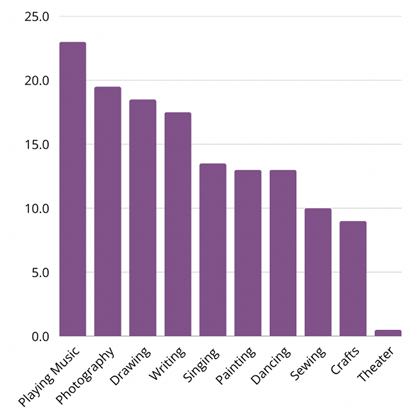
Among all participants, 86% answered “yes” to the question “do you consider yourself a person who likes the arts?” and 48.5% demonstrated that they had the influence of a family member on their artistic interest. Regarding contact with the different types of art, 86.5% reported that they go to museums or historical tourist attractions on trips; 76.5% said they frequented bookstores; 23.5% said they participated in a book club at some point in their lives; 37.5% affirmed they went to the movies monthly; 90.5% said they liked listening to music and 42% said they listen to music while studying. Graph 4 below shows the artistic activities practiced by the students during the period of development of the present study, so it was possible to select more than one option.

The students were asked about the importance of the arts and literature in medical education, so that 92.5% of them answered that they believe they are relevant in this context. Among the participants, 38.5% showed interest in participating in an extracurricular group that addressed the study of the arts. It was observed that 56.5% believe that studying medicine makes it impossible for them to get involved in artistic and literary activities due to lack of time or willingness due to the routine imposed by the medical course.
The students were asked to answer, subjectively, why they think that way about the importance of the arts and literature in the context of medical education. Below, some answers are highlighted, concealing the participants’ identity by using pseudonyms that represent great Brazilian writers. It is confirmed that the participants wrote these answers individually and personally, without theoretical influence of the present study.
“Due to the skills that the arts develop: perception of the other, sensitivity, detailed look, manual skills, broadening of the worldview and, especially, because the arts favor mental health” (Rachel de Queiroz).
“So that we can see medicine not only in a pragmatic and objective way, but as something that places us as part of the environment in which we live, of nature, and something that helps us discover our life purposes” (Carlos Drummond de Andrade).
“I have always believed that art and imagination should be part of the academic training so we can comprehend and understand the other as a whole, taking into account habits, cultures, lifestyle. Art is part of the construction of the human being, of science, therefore, it is important for medical training” (Clarice Lispector).
“The arts and literature are part of the cultural wealth of any person, and, added to medicine, they can bring better development of reasoning and description of clinical histories” (José de Alencar).
“High-quality medical training needs to go beyond the clinical content, that is, it also requires human, socializing, cultural aspects, to better deal with human beings, in a more sensitive way. Art awakens feelings, emotions, values that are essential for a person, both personally and professionally” (Cecília Meireles).
“According to Schopenhauer, art, by depriving the subject of their unsatisfied desires, makes them happy. To illustrate that, he said that music expresses emotions through sounds; it is magnanimous. Therefore, I believe that the arts are food for the soul, they are transcendent. Without them, we are deprived of what makes us human: subjectivity. Thus, we need to be human to take care of others and, without the arts, this is very difficult” (Machado de Assis).
“For autonomy as a human being, artistic experiences are fundamental because they invite us to exercise critical positioning and keep our sensitive capacity sharp. Through art, we can reach the fine flower of our humanity, be more tolerant and pleasant to live with. As doctors, we can approach ethics from the perspective of a critical position in the face of reality and not let ourselves be restrained and guided, without reflection, by morality, or by the majority” (Cora Coralina).
DISCUSSION
The participation of internship students was clearly lower, representing only 8.5% of the participants, which may be a reflection of the difficulty in having access to these students, who are no longer living within the academic environment of the institution due to internships, but may also mean these students’ lower interest in participating in the research.
It was observed that females represented 76.5% of the total number of the study participants, which does not necessarily mean that males have less interest in artistic activities but demonstrates greater collaboration of the female sex in participating in the research. Within this context, it is also worth mentioning that, according to the Federal Council of Medicine, in the medical demography of Brazil in 2020, women already represented the majority in undergraduate medical courses, which may also have an impact on the greater participation of women in the research17.
The mean age of the participants was 24.6 years, and it is interesting to note that, according to the aforementioned demographic census, medicine is an increasingly younger profession, so that, in 2019, 36.3% of medical graduates in Brazil were up to 24 years of age17.
In one of the questions of the questionnaire, it was possible to observe that most of the interviewees (48.0%) interrupted artistic activities developed before entering medical school, with the justification of the beginning of the course. Thus, the need to break the paradigm that medicine is incompatible with other artistic activities is perceived.
There is a direct relationship between entering medical school and mental health impairment. This is due to factors associated with stress, which can negatively influence the students’ physical and mental well-being, such as the academic pressure for excellence and the extensive workload, in addition to greater access to psychotropic substances. In this sense, a prevalence of 50% of some mental disorder was reported in this population, with depressive disorder being the most frequent one. The need to encourage physical and artistic activities is emphasized, with the objective of better quality of life18.
Regarding literature, it was observed that a significant part of the students (72%) have the habit of reading works that are not from the medical area. It is known that reading does not serve only as entertainment and academic use, but also for the construction of an intellectual and critical capacity, thus bringing a broad worldview19. By establishing the link between this supposition and medicine, the formation of critical thinking helps in the development of clinical reasoning and decision-making for each patient, because it allows them to see the same situation from different perspectives7.
The physician who is constantly faced with dilemmas involving life and death, often separated by a thin line, finds in literature an important source of learning, which stimulates sensitivity, curiosity and a look at what is essential, in addition to providing mental health20. Also from this perspective, literature is a bridge for the development of empathy, as it not only enables immersion in several human experiences, but also awakens patience, tolerance, and the ability to deal with limitations and unpredictable situations21.
In this study, 86% of the participants demonstrated that they liked the arts. However, there are few who usually practice it on a daily basis, requiring greater stimulus, either from the educational institution or from the family, so that art is present in their routine, in its most diverse forms.
Participation in artistic shows, for instance, can help students explore their own feelings and develop new ways of thinking. Additionally, it helps to build their self-confidence, which is important for personal development and is an essential basis for interacting with patients12),(22. The involvement of medical students with works of art enables the development of visual thinking strategies, which help to improve clinical reasoning capacity, making learning pleasant and meaningful23.
The humanization of medicine is a condition of success for the health professional, going beyond the educational obligation. In this regard, the doctor’s contact with the arts reinforces their vocational identity, and it is an aid in the creation of this identity for the physician in training. Through them, it is easier to deal with the limitations inherent to the human condition, to embrace pain and death, without losing enthusiasm for the profession24.
Regarding the importance of the arts and literature for medical education, although 92.5% of the students showed that they believed in the relevance of this relationship, only 38.5% of the total participants showed interest in participating in an extracurricular group focused on artistic activities. It is perceived there is a gap between the number of students who note the importance of the arts and literature in the student development of the doctor and the number of students willing to experience this during their training.
It is known that art, in general, encompasses the use of precepts and techniques for an optimal performance, being a means to achieve a final result. From this perspective, together with the physician’s technical-scientific knowledge, it becomes a form of expression and embracement, and it is not possible to separate medicine from care, science and art itself4.
Thus, some questions arise: would it be the responsibility of the educational institution to promote this artistic involvement? What could be done to awaken in this audience greater interest in arts and literature? In a systematic review of the literature on the use of the arts in medical education, after analyzing 28 articles that addressed visual arts, literature, theater and cinema, it was observed that, in fact, the students were satisfied with the use of strategies based on artistic activities. However, this research indicates that most studies are qualitative and short, and it is not possible to measure the quantitative and longitudinal impact of the incorporation of the arts into the medical curriculum25.
Regarding the art of medicine, the abovementioned work, it states that it is up to medicine to remove the suffering of the sick by curing diseases with the potential to cure, to reduce such suffering in diseases that cannot be cured, and not to treat patients completely affected by incurable diseases, and it is important to be aware of the technical impotence of medicine in these cases3. In this sense, it is worth noting that the practice of medicine with humanity is an essential bridge for the alleviation of suffering, and it is the doctor’s role to diagnose, care, know and love4.
The literature demonstrates, in several different ways, the importance of the arts for the human formation of physicians, but this approach is still scarce in practice. Thus, institutional commitment is necessary so that it is possible to implement what currently remains in the field of theory.
FINAL CONSIDERATIONS
Although a considerable number of the medical students included in the present study agree on the importance of the arts and literature in medical education, many are still not willing to experience this during the learning process. Moreover, it is noted that more than half of the participants consider the scarcity of time and the routine of the medical course to be impediments to artistic experiences.
Thus, the importance of stimulating artistic activities during medical graduation is observed, considering the benefits they provide. In this sense, educational institutions can improve the human formation of their students by encouraging participation in extracurricular activities aimed at this sphere.
In short, technical experience alone is not enough when dealing with a patient and their illness; it is necessary for the medical professional to look at the suffering and vulnerability inherent to the human being, with sensitivity, patience, empathy and competence.
References
- 1 Mairot LT, Costa BB, Heringer TP, Borges RC, Moura EP. As artes na educação médica: revisão sistemática da literatura. Rev Bras Educ Med. 2019;43(4):54-64.
- 2 Lazarus PA, Rosslyn FM. The arts in medicine: setting up and evaluating a new special study module at Leicester Warwick Medical School. Br J Med Educ. 2003;37:553-9.
- 3 Rebollo RA. Considerações sobre o estabelecimento da medicina no tratado hipocrático Sobre a arte médica. Sci Stud. 2003;1(3):275-97.
- 4 Orsini M, Oliveira AB, Leite MAA, Silveira VC, Reis CHM, Souza JA de, et al. O resgate do cuidar na medicina e o real valor do médico no Brasil. Rev Neurocienc. 2013;21(1):155-61.
- 5 Shankar PR, Piryani RM, Upadhyay-Dhungel K. Student feedback on the use of paintings in Sparshanam, the Medical Humanities module at KIST Medical College, Nepal. BMC Med Educ. 2011;11(9):1-7.
- 6 Almeida AL, Portella DL. A avaliação do pensamento crítico: uma abordagem a estudantes de medicina brasileiros. Res Soc Dev. 2021;10(12):1-12.
- 7 Croskerry P. Perspectives on diagnostic failure and patient safety. Healthc Q. 2012;15:50-6.
- 8 Jones DS. A complete medical education includes the arts and humanities. AMA J Ethics. 2014;16(8):636-41.
- 9 Schwartz AW, Abramson JS, Wjnowich I, Accordino R, Ronan EJ, Rifkin MR. Evaluating the impact of the humanities in medical education. Mt Sinai J Med. 2009;76(4):372-80.
- 10 Kübler-Ross E. A roda da vida. Rio de Janeiro: Sextante; 2017.
- 11 Jones D, Dunes G, Pessôa R, Sousa W. Medicina com artes. Teresópolis: Unifeso; São Paulo: Pontocom; 2018.
- 12 Perry M, Maffulli N, Wilson S, Morrissey D. The effectiveness of arts‐based interventions in medical education: a literature review. Med Educ. 2011;45(2):141-8.
- 13 Bonebakker V. Literature & medicine: humanities at the heart of health care: a hospital-based reading and discussion program developed by the Maine Humanities Council. Acad Med. 2003;78(10):963-7.
- 14 Kirklin D, Meakin R, Singh S, Lloyd M. Living with and dying from cancer: a humanities special study module. Med Humanit. 2000;26(1):51-4.
- 15 Matharu K. Using indigenous Australian drama to break cultural barriers in healthcare relationships. Med Humanit . 2009;35(1):47-53.
- 16 Brasil. Resolução nº 466, de 12 de dezembro de 2012. Aprova as diretrizes e normas regulamentadoras de pesquisas envolvendo seres humanos. Brasília, DF: Ministério da Saúde, Conselho Nacional de Saúde, Comissão Nacional de Ética em Pesquisa; 2012.
- 17 Scheffer M, Guerra A, Cassenote A, Guilloux AG, Brandão AP, Miotto BA. Demografia médica no Brasil 2020. São Paulo: FMUSP, CFM; 2020. 312 p.
- 18 Sol EG, Campor Junior A, Abelha L, Lovisi GM, Brasil MA. Avaliação do comportamento suicida em estudantes de Medicina. J Bras Psiquiatr. 2022;71(2):83-91.
- 19 Arana AR, Klebis AB. A Importância do Incentivo à Leitura para o Processo de Formação do Aluno. XII Congresso Nacional de Educação - EDUCERE. Paraná: Pontifícia Universidade Católica do Paraná; 2015.
- 20 Bastos RJ. Construção e validação de portal para incentivo do estudo da literatura entre acadêmicos de medicina [dissertação]. Fortaleza: Centro Universitário Christus; 2022.
- 21 Medeiros MS, Barreto DM, Bastos RS. Antalogias do ELAM. Fortaleza: EdUnichristus; 2021. v. 1.
- 22 Willson S. Essay: what can the arts bring to medical training? The Lancet. 2006;368:S15-6.
- 23 Heyn R, Familiari G. Visual thinking strategy in the medical curriculum: training the “clinical eye” in classrooms and art museums. Ital J Anat Embryol. 2015;120(1):235.
- 24 Blasco PG. É possível humanizar a medicina? Reflexões a propósito do uso do cinema na educação médica. Mundo Saúde. 2010;34(3):357-67.
- 25 Mairot LT. As artes na educação médica: revisão sistemática da literatura [dissertação]. Belo Horizonte: Universidade José do Rosário Vellano; 2018.

 Source: Prepared by the authors (2023).
 Source: Prepared by the authors (2023).
 Source: Prepared by the authors (2023).
 Source: Prepared by the authors (2023).