 Validade Educacional de um Simulador de Baixo Custo para Treinamento de Punção Lombar
ABSTRACT
Introduction: Lumbar puncture is an essential diagnostic and therapeutic procedure, yet novice learners often face limited supervised practice opportunities, especially in resource-constrained settings. Low-cost simulators may expand access to safe procedural training, but require validation before curricular integration.
Objective: This prospective study assessed the face, content, and construct validity of a low-cost, 3D-printed lumbar puncture simulator.
Methods: Forty-seven participants (13 anesthesiology/neurology physicians; 34 medical students) performed three simulated lumbar punctures following standardized instruction. Performances were video-recorded and evaluated using operational criteria encompassing antiseptic preparation, landmark identification, midline needle technique, stylet handling, and cerebrospinal fluid confirmation; participants also completed post-simulation Likert-based perception surveys.
Results: Both groups rated the simulator highly for realism, anatomical fidelity, and educational usefulness (median scores 4-5), demonstrating strong face and content validity. Students exhibited significant reductions in procedure duration across attempts, suggesting improved procedural efficiency, whereas experts performed efficiently throughout. No significant between-group differences in puncture attempts or global performance scores were observed, indicating partial construct validity.
Conclusion: This low-cost lumbar puncture simulator demonstrated high perceived realism and educational value and facilitated efficiency gains among novices. Although construct validity was only partially supported, the model represents a feasible, accessible tool for procedural training where commercial simulators are unavailable.
Keywords:
Lumbar Puncture; Simulation Training; Education, Medical, Undergraduate
RESUMO
Introdução: A punção lombar é um procedimento diagnóstico e terapêutico essencial, mas alunos iniciantes frequentemente têm poucas oportunidades de prática supervisionada, especialmente em contextos com recursos limitados. Simuladores de baixo custo podem ampliar o acesso ao treinamento seguro de procedimentos, mas requerem validação antes de sua integração curricular.
Objetivo: Este estudo prospectivo avaliou a validade de face, conteúdo e construto de um simulador de punção lombar de baixo custo, impresso em 3D.
Método: Quarenta e sete participantes (13 médicos anestesiologistas/neurologistas; 34 estudantes de medicina) realizaram três punções lombares simuladas após instrução padronizada. As execuções foram gravadas em vídeo e avaliadas com base em critérios operacionais envolvendo preparo antisséptico, identificação de marcos anatômicos, técnica de agulha na linha média, manuseio do mandril e confirmação do líquido cefalorraquidiano; os participantes também completaram questionários de percepção em escala Likert após a simulação.
Resultados: Ambos os grupos atribuíram altas pontuações ao simulador quanto ao realismo, fidelidade anatômica e utilidade educacional (medianas 4-5), demonstrando forte validade de face e conteúdo. Estudantes apresentaram reduções significativas no tempo de execução ao longo das tentativas, indicando aquisição de habilidade, enquanto especialistas mantiveram desempenho eficiente em todas as repetições. Não foram observadas diferenças significativas entre os grupos no número de tentativas de punção ou nas pontuações globais de desempenho, indicando validade de construto parcial.
Conclusão: O simulador de punção lombar de baixo custo demonstrou alto realismo percebido e valor educacional, além de promover ganhos de eficiência entre iniciantes. Embora a validade de construto tenha sido apenas parcialmente confirmada, o modelo representa uma ferramenta viável e acessível para treinamento procedimental em contextos em que simuladores comerciais não estão disponíveis.
Palavras-chave:
Punção Lombar; Treinamento por Simulação; Educação Médica de Graduação
INTRODUCTION
Lumbar puncture is a fundamental diagnostic and therapeutic procedure performed across multiple medical specialties, including emergency medicine, neurology, internal medicine, pediatrics, and anesthesiology. Proficiency in this technique is essential for evaluating central nervous system infections, inflammatory and demyelinating diseases, subarachnoid hemorrhage, and for administering intrathecal medications. Its safe execution requires precise anatomical understanding, procedural planning, sterile technique, and refined needle control to access the subarachnoid space without complications1.
Traditional training approaches for lumbar puncture are based on observation followed by supervised performance on patients. However, limited clinical opportunities, variability in case exposure, and ethical concerns regarding novice learners practicing on real patients create barriers to achieving competency through apprenticeship-based learning alone. This challenge is particularly relevant in early stages of medical training, where learners frequently lack prior procedural experience and confidence2.
Simulation-based medical education provides a structured, ethical, and safe environment for developing procedural skills prior to patient contact. Task trainers for lumbar puncture support the repetitive practice of key technical elements such as anatomical landmark identification, needle handling, trajectory control, and recognition of cerebrospinal fluid return. These training advantages align with competency-based medical education frameworks, which emphasize deliberate practice, performance assessment, and progressive skill acquisition3.
For a simulator to be incorporated into formal training programs, evidence supporting its educational value is required. In simulation research, validity frameworks assess whether an instructional tool appropriately represents the procedure and can support meaningful learning outcomes. Face validity reflects the perceived realism of the simulator and fidelity to clinical practice. Content validity evaluates whether the model includes essential anatomical and procedural features for effective training. Construct validity determines whether the simulator can discriminate between users with differing levels of experience, indicating its ability to assess or develop competence4.
Low-cost synthetic simulators are particularly valuable in resource-constrained educational settings, where access to commercial or high-fidelity simulators may be limited. Locally developed simulators may expand training access, but require empirical validation before their use in structured curricula5),(6.
The aim of this study was to evaluate the face, content, and construct validity of a newly developed, non-organic simulator designed for lumbar puncture training. The development of the simulator was guided by principles of simulation-based medical education, particularly the concepts of deliberate practice, functional task alignment, and progressive skill acquisition. Rather than prioritizing high technological fidelity, the model was intentionally designed to reproduce the critical procedural components required for lumbar puncture performance, allowing repeated practice of key psychomotor and cognitive steps. This approach aligns with evidence suggesting that functional fidelity and opportunity for repetition may be more relevant to learning than technological complexity alone. We hypothesized that the simulator would demonstrate high realism and educational usefulness, and that performance would differ between novice learners and physicians experienced with lumbar puncture, thereby supporting its adoption into procedural training programs.
METHODS
Study design and participants
This prospective validation study was conducted at the Simulation Laboratory of the Department of Surgery, Federal University of Santa Catarina School of Medicine. Participants were recruited by personal invitation, forming a convenience sample. Invitations were extended directly by the investigators to eligible individuals from the institution’s medical staff and students. Participants were stratified according to prior experience with lumbar puncture: a physician group, composed of anesthesiologists, neurologists, and residents in anesthesiology or neurology, and a student group, consisting of medical students without previous hands-on experience with the procedure. A total of 47 individuals participated, including 13 physicians and 34 students. The study was approved by the Human Research Ethics Committee of the Federal University of Santa Catarina (Certificate of Ethical Review Submission No. 57871122.6.0000.012), and all participants provided written informed consent prior to participation.
The simulator
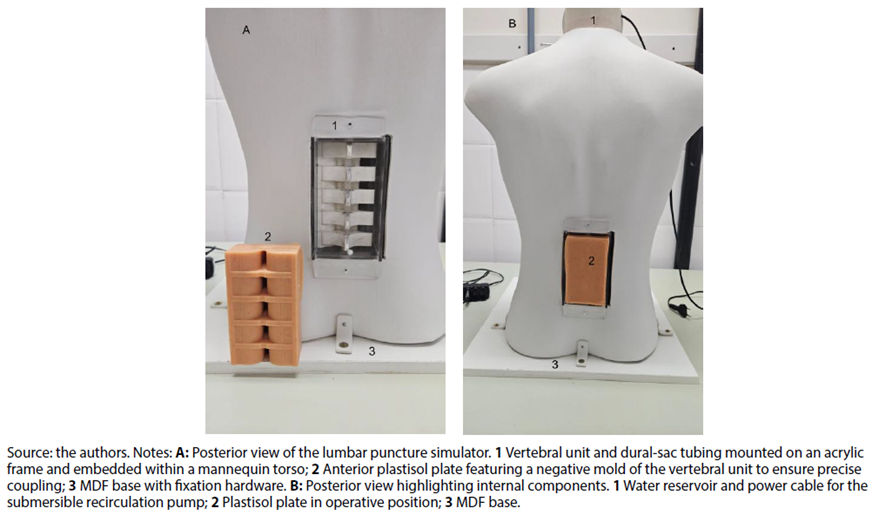
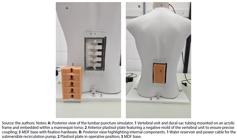
The simulator consisted of a base platform, a three-dimensional synthetic lumbar spine model, a dural sac and cerebrospinal fluid circulation system, and a soft-tissue layer representing skin and subcutaneous tissue, all housed within a modified commercial display mannequin torso.
The base was constructed from medium-density fiberboard (MDF) measuring 30 × 25 × 1.5 cm, serving as a stable support for the assembly. A 3D-printed rectangular polylactic acid (PLA) bracket measuring 12 × 1 cm was used to secure the mannequin torso to the base. Four brackets were employed-attached to the anterior, posterior, right, and left surfaces of the torso-and were fastened with screws to both the base platform and the mannequin, providing structural stability to the simulator assembly.
The lumbar puncture simulator used in this study was an original anthropomorphic 3D-printed model developed specifically for this project. The simulator’s vertebral component consisted of individual PLA vertebrae, printed on a desktop 3D printer and assembled in sequence to reproduce the anatomical arrangement of the lumbar spine. The assembled structure measured 14.5 × 8 × 8 cm. The vertebrae were modeled from adult anatomical references and designed according to published morphometric dimensions of lumbar vertebrae and intervertebral discs. To facilitate fabrication, the models were simplified while preserving key anatomical landmarks-including the spinous processes, laminae, and interlaminar spaces-essential for accurate performance of lumbar puncture.
A 204-caliber silicone tube (inner diameter 6 mm, outer diameter 12 mm) was inserted along the vertebral canal to simulate the dural sac. One end of the tube was connected to a water reservoir, and the other to a small electric submersible circulation pump commonly used in domestic aquariums (Bomba SP- 500, Guangdong Boyu Group Co., Ltd, Guangdong, China. To reproduce physiological cerebrospinal fluid pressure, the reservoir was positioned at the top of the mannequin torso, approximately 10 cm above the puncture site, allowing a stable hydrostatic column to generate realistic CSF reflux.
A viscoelastic plastisol plate (Plastisol SoftTM, Atomy Soluções Inteligentes Ltda, Santo André, Brazil) was molded and positioned over the spinous processes to simulate skin and subcutaneous tissues, providing realistic resistance during needle advancement and facilitating palpation of anatomical landmarks.
All components were mounted internally within the mannequin torso, preserving external anatomical contours and allowing learners to palpate surface landmarks in a clinically realistic manner. The simulator is reusable, low-cost, and does not incorporate electronic force-feedback systems or motion-tracking technology.
Study procedures
Prior to the experiment, all participants received standardized instruction consisting of a demonstration video covering lumbar spinal anatomy, sterile technique, and the procedural steps of lumbar puncture. Following the video, the lead investigator performed a live demonstration of the procedure on the simulator, emphasizing key anatomical landmarks and the correct sequence of technical steps. Participants then completed three lumbar puncture attempts in a single session. All attempts were video-recorded from a fixed angle that allowed visualization of hand positioning and needle trajectory while preserving participant anonymity. No real-time coaching or feedback was provided during the attempts; however, novice participants were permitted to independently rehearse key procedural steps between attempts.
Face and content validity, and usability ratings
Immediately after completing the attempts, participants completed questionnaires using 5-point Likert scales (1 = strongly disagree; 5 = strongly agree). The face validity items evaluated anatomical realism, tactile feedback, and similarity to clinical maneuvers. Students additionally rated appearance and texture. Content validity assessed the educational relevance of the simulator, its appropriateness for practicing lumbar puncture, and the adequacy of anatomical structure representation. The usability and utility items examined clarity of instructions, ease of handling, organization of practice activities, applicability to different training contexts, and potential integration into educational programs (Frame 1).
Outcome measures
Primary outcomes included participant perceptions of simulator realism, educational usefulness, and usability, performance scores, procedure duration, and the number of puncture attempts.
Video performance assessment
Video performance was evaluated using a structured checklist with operational definitions for each procedural step of lumbar puncture. Preparation and antisepsis were assessed by the participant’s ability to select all required materials, perform hand hygiene, wear sterile gloves correctly, apply antiseptic solution starting at the puncture site and moving outward in a continuous outward motion, maintaining sterile technique, and maintain sterility. Incomplete organization of materials, breaches in technique with recovery, or absence of antisepsis resulted in lower scores. Identification of the intervertebral space required palpation of anatomical landmarks and correct localization of the L3-L4 or L4-L5 interspace, with uncertainty or incorrect level selection considered partially adequate and absence of landmarking scored as omitted. Sterile field placement was evaluated by proper draping and maintenance of sterility, with partial but corrected breaches scored as partially adequate and failure to drape or uncorrected contamination scored as omitted. The median approach technique was scored on proper needle handling, midline insertion, controlled advancement, and recognition of tactile resistance changes, with inadequate angle control, repeated redirections, or poor stability indicating partial performance and failure to attempt a midline approach considered omitted. Stylet removal was assessed by correct timing-removing the stylet only upon suspected entry into the subarachnoid space-while premature or repeated removal without compromising the procedure was considered partially correct and absent or inappropriate removal scored as omitted. Finally, observation of cerebrospinal fluid (CSF) reflux required correct identification of simulated reflux with stable hand control and aseptic technique; delayed or imperfect recognition was scored as partially adequate, and failure to assess reflux or misinterpretation resulted in an omitted score. Each criterion was scored as 2 = adequate, 1 = partially adequate/incorrect, or 0 = omitted.
Statistical analysis
Demographic characteristics were summarized using descriptive statistics, with means and standard deviations for continuous variables and absolute frequencies for categorical variables. Likert-scale responses for face validity, content validity, and usability were summarized as medians with interquartile ranges (25th-75th percentiles). Likert-scale responses for face validity, content validity, and usability were summarized as medians with interquartile ranges (25th-75th percentiles). No between-group comparisons were performed, as these measures reflect subjective perceptions of realism and educational usefulness rather than performance, and were therefore not intended to discriminate between levels of expertise.
Continuous performance outcomes-procedure duration, number of puncture attempts, and performance score-were analyzed across the three successive attempts and between expert and novice groups. For within-participant evolution across attempts, the Friedman test was applied, including only participants with complete data for all three attempts within each group. Significant omnibus results were followed by Holm-corrected Wilcoxon signed-rank tests for post-hoc comparisons. Between-group differences at each attempt were analyzed using the Mann-Whitney U test. Descriptive statistics (mean, median, standard deviation, and quartiles) were generated for each group and attempt. All tests were two-tailed, and statistical significance was set at p < 0.05.
Sample size calculation
Sample size was determined a priori to detect construct validity based on performance differences between groups. Assuming a large effect size (0.8 SD), α = 0.05, β = 0.20 (80% power), a two-tailed Mann-Whitney test, and a 3:1 allocation ratio of students to physicians, the required sample was 34 students and 13 physicians. Calculations were performed using G*Power 3.17.
RESULTS
Participants
A total of 47 individuals participated in the study, including 13 physicians or residents in anesthesiology or neurology (expert group) and 34 medical students (novice group). Demographic characteristics are summarized in Table 1. The mean age was 33.5 years among experts and 25.6 years among students, with balanced gender distribution and predominance of right-handed participants.
Face and content validity, and usability ratings
Both experts and students assigned high scores to the simulator across face validity, content validity, and usability domains. Median ratings ranged between 4 and 5 on the five-point Likert scale, with narrow interquartile ranges, indicating strong agreement among participants. These findings support that the simulator was perceived as realistic, educationally useful, and easy to use (Table 2).
Procedure duration
A significant reduction in procedure duration was observed across attempts among students (Friedman χ² = 11.92; df = 2; p = 0.026), whereas no significant change occurred among experts (χ² = 2.04; p = 0.36). Post-hoc pairwise comparisons among students showed shorter procedure times between attempt 1 and attempt 2 (p = 0.015) and between attempt 1 and attempt 3 (p = 0.039), with no difference between attempts 2 and 3 (p = 0.85). Among experts, no pairwise differences were significant. Between-group comparisons at each attempt did not reveal statistically significant differences (p > 0.48 for all comparisons) (Table 3).
Number of punctures
The number of puncture attempts differed significantly across attempts among students (Friedman χ² = 8.63; p = 0.013), but not among experts (χ² = 0.25; p = 0.88). However, pairwise comparisons among students did not remain significant after Holm correction (p > 0.20 for all comparisons). No significant between-group differences were observed at any attempt (p > 0.61) (Table 3).
Performance Score
No significant differences in performance scores across attempts were found for either students (Friedman χ² = 1.55; p = 0.46) or experts (χ² = 2; p = 0.37). Pairwise comparisons did not reveal consistent improvements, and performance scores remained high and stable in both groups. Between-group differences in performance scores were not statistically significant for any attempt (p > 0.06) (Table 3).
DISCUSSION
This study evaluated the face, content, and construct validity of a low-cost, non-organic simulator designed for lumbar puncture training. Both experts and medical students rated the simulator highly in terms of anatomical realism, tactile fidelity, and educational usefulness, supporting face and content validity. The simulator was perceived as intuitive and feasible for incorporation into training settings, further supporting its usability.
With respect to performance, experts consistently demonstrated faster procedure times and fewer puncture attempts than students, as expected based on prior clinical experience. Students exhibited a significant reduction in procedure duration across attempts, suggesting improved procedural efficiency, which represents an early component of skill acquisition, although not sufficient alone to define competence. However, performance scores remained high and stable in both groups, and no significant differences were detected between experts and novices in this metric. These findings suggest a partial construct validity signal-the simulator allowed novices to improve in efficiency and experts to perform efficiently from the outset, but global rating scores were insufficiently sensitive to discriminate performance levels across groups.
Simulation-based training has become an essential component of modern medical curricula, especially for invasive procedures such as lumbar puncture, where patient safety and ethical considerations limit opportunities for inexperienced learners to practice during early clinical exposure3. Low-cost models such as the one developed in this study may expand access to deliberate practice in resource-constrained environments, reducing dependence on expensive commercial simulators while preserving key anatomical and procedural features5.
The design of this simulator was guided by established educational principles in simulation-based training. Specifically, the model emphasizes functional fidelity, allowing learners to engage in repeated practice of critical procedural components, and deliberate practice, through structured repetition without risk to patients. These principles are consistent with competency-based medical education frameworks and support progressive skill acquisition even in low-resource environments8),(9.
This simulator focuses on anatomical realism, tactile feedback, and CSF reflux simulation rather than electronic feedback systems10. This design approach aligns with evidence suggesting that functional fidelity and opportunity for repetitive practice may be more relevant to skill acquisition than technological sophistication alone9.
An additional finding of interest was the more conservative content validity ratings assigned by expert participants, particularly regarding tactile feedback. This likely reflects their prior clinical experience and more nuanced expectations of tissue resistance and procedural feel. By contrast, novice learners may rely more on global structural and visual cues when evaluating the simulator. Such differences in perception have been described in simulation-based education and suggest that expert feedback may be particularly valuable in identifying areas for refinement, while novice perceptions may better reflect usability and accessibility9),(11. These findings support the interpretation that the simulator is especially suited for early-stage training, where acquisition of fundamental procedural steps is prioritized over fine tactile discrimination.
This study has several limitations. The global rating scale, although structured and scored by blinded evaluators, remains a subjective assessment tool and may lack the granularity to detect subtle differences in performance between novices and experts. The high performance scores observed across groups suggest a potential ceiling effect, likely reflecting limited discriminatory resolution of the checklist. More granular assessment tools may be required to capture qualitative differences in technique and decision-making. In addition, all procedures were performed in a single session, preventing assessment of skill retention or transfer to clinical performance. While novices improved in procedural time, more sensitive or objective measures-such as force tracking, motion analysis, or structured error coding-may better capture incremental skill acquisition. Another important limitation is that, although the sample included students from different stages of medical training, the study design did not allow evaluation of the effect of academic progression on procedural performance. Nevertheless, it is important to emphasize that none of the students had been previously exposed to simulation-based training in lumbar puncture, nor had they observed, assisted, or performed the procedure clinically before participating. This uniformity in prior experience strengthens internal validity in the comparison between novices and experts but limits conclusions regarding the natural evolution of lumbar puncture skills across the undergraduate curriculum. We acknowledge that the expert group comprised both residents and specialists, which may have introduced heterogeneity; however, all participants had prior clinical experience with lumbar puncture, supporting their classification as experienced operators. Furthermore, perception-based measures are inherently subjective and should be interpreted with caution; however, they were specifically employed to assess face and content validity, which are traditionally grounded in users’ perceptions of realism and educational relevance, as described in contemporary simulation validity frameworks4.
Future research should investigate distributed practice across multiple sessions, evaluate retention, examine transfer to clinical performance, and explore objective quantitative metrics. Comparative studies with commercial trainers may also clarify relative educational value and cost-effectiveness. Integration of this simulator into structured procedural training curricula could facilitate broader access to lumbar puncture skill acquisition during medical school.
CONCLUSION
This study provides evidence supporting the face and content validity of a novel low-cost lumbar puncture simulator and demonstrates its ability to promote procedural improvement among novice learners. Although construct validity was only partially supported, the simulator demonstrated high perceived realism and educational usefulness, supporting its potential role as a feasible and accessible adjunct for procedural training, particularly in cost-conscious educational environments.
References
-
1 Jane L, Wray A. Lumbar Puncture. In: StatPearls [Internet]. Treasure Island (FL): StatPearls Publishing; 2025. Available from: https://www.ncbi.nlm.nih.gov/books/NBK557553/
» https://www.ncbi.nlm.nih.gov/books/NBK557553/ -
2 Lenchus J. End of the “See One, Do One, Teach One” Era: The Next Generation of Invasive Bedside Procedural Instruction. Journal of Osteopathic Medicine. 2010;110(6):340-6. doi:10.7556/jaoa.2010.110.6.340
» https://doi.org/10.7556/jaoa.2010.110.6.340 -
3 Gaubert S, Blet A, Dib F, Ceccaldi PF, Brock T, Calixte M, et al. Positive effects of lumbar puncture simulation training for medical students in clinical practice. BMC Medical Education. 2021 Jan 6;21(1):18. doi:10.1186/s12909-020-02452-3
» https://doi.org/10.1186/s12909-020-02452-3 -
4 Harris DJ, Bird JM, Smart PA, Wilson MR, Vine SJ. A Framework for the Testing and Validation of Simulated Environments in Experimentation and Training. Front Psychol. 2020 Mar 31;11. doi:10.3389/fpsyg.2020.00605
» https://doi.org/10.3389/fpsyg.2020.00605 -
5 Sharma D, Agrawal V, Bajaj J, Agarwal P. Low-cost simulation systems for surgical training: a narrative review. J Surg Simul. 2020 Mar;33-52. doi:10.1102/2051-7726.2020.0005
» https://doi.org/10.1102/2051-7726.2020.0005 -
6 Robinson SJA, Ritchie AMA, Pacilli M, Nestel D, McLeod E, Nataraja RM. Simulation-Based Education of Health Workers in Low- and Middle-Income Countries: A Systematic Review. GLOB HEALTH SCI PRACT. 2024 Dec 20;12(6):e2400187. doi:10.9745/GHSP-D-24-00187
» https://doi.org/10.9745/GHSP-D-24-00187 -
7 Faul F, Erdfelder E, Buchner A, Lang AG. Statistical power analyses using G*Power 3.1: Tests for correlation and regression analyses. Behavior Research Methods. 2009;41(4):1149-60. doi:10.3758/BRM.41.4.1149
» https://doi.org/10.3758/BRM.41.4.1149 -
8 McGaghie WC, Issenberg SB, Cohen ER, Barsuk JH, Wayne DB. Does simulation-based medical education with deliberate practice yield better results than traditional clinical education? A meta-analytic comparative review of the evidence. Acad Med. 2011 Jun;86(6):706-11. doi:10.1097/ACM.0b013e318217e119
» https://doi.org/10.1097/ACM.0b013e318217e119 -
9 Massoth C, Röder H, Ohlenburg H, Hessler M, Zarbock A, Pöpping DM, et al. High-fidelity is not superior to low-fidelity simulation but leads to overconfidence in medical students. BMC Medical Education . 2019 Jan 21;19(1):29. doi:10.1186/s12909-019-1464-7
» https://doi.org/10.1186/s12909-019-1464-7 -
10 Lejus-Bourdeau C, Pousset F, Magne C, Bazin O, Grillot N, Pichenot V. Low-cost versus high-fidelity pediatric simulators for difficult airway management training: a randomized study in continuing medical education. Brazilian Journal of Anesthesiology (English Edition). 2023 May 1;73(3):250-7. doi:10.1016/j.bjane.2021.05.006
» https://doi.org/10.1016/j.bjane.2021.05.006 -
11 Hamstra SJ, Brydges R, Hatala R, Zendejas B, Cook DA. Reconsidering fidelity in simulation-based training. Acad Med . 2014 Mar;89(3):387-92. doi:10.1097/ACM.0000000000000130
» https://doi.org/10.1097/ACM.0000000000000130
Research data is only available upon request.