 Neural model for calculating the bearing capacity of driven and bored piles
Abstract
Predicting the pile’s bearing capacity still represents a significant challenge in Geotechnical Engineering, since it requires the knowledge of soil parameters and the soil-pile interaction mechanism during and after foundation execution. This study developed a model based on multilayer perceptron Artificial Neural Networks (ANN) with the Levenberg-Marquardt training algorithm to predict the bearing capacity of driven and bored piles. For this purpose, results from Standard Penetration Tests (SPT) and static load tests performed on 343 piles were compiled. The input variables adopted for the model were: pile diameter and length, penetration resistance (NSPT), and soil type. Different models were then trained and validated with the aid of MATLAB® software. Comparison of the results obtained allowed the selection of the best-performing neural model. The coefficient of determination (R2) and the root mean square error (RMSE) in the validation phase were 0.96 and 0.02, respectively. These values were satisfactory, given the phenomenon’s complexity. The case study, which sought to analyze the generalization capacity and applicability of the neural model, showed that the model presented a better performance than the semi-empirical methods of Aoki-Velloso (1975) and Décourt-Quaresma (1978). These results suggest that the multilayer perceptron ANN is a promising tool for predicting the bearing capacity of piles. This work contributes by providing a neural model trained with a comprehensive dataset representative of diverse soil conditions in Brazil, covering both driven and bored piles, and by making its parameters available for practical application in geotechnical design, a step often overlooked in previous studies.
Keywords:
piles; bearing capacity; multilayer perceptrons.
1. Introduction
Predicting the bearing capacity of piles is a significant challenge for Geotechnical Engineering, given the need to estimate soil parameters through geotechnical tests and correlations and knowledge of the soil-pile interaction mechanism during the installation and after the foundation is completed.
Load tests (static or dynamic) are the most reliable tools for the geotechnical design of piles, as they provide a direct assessment of load transfer to the soil and settlements by testing the foundations at full scale. When properly interpreted, load tests are the field procedures that best reflect the actual behavior of piles, compared to theoretical models or semi-empirical methods used to estimate bearing capacity. However, due to the additional costs involved, they are not always performed during the design phase, and theoretical or semi-empirical methods are often preferred for estimating pile foundation capacity (Souza et al. 2015; Figueiredo et al., 2016; Delazzeri et al., 2018; Probst et al., 2018; Amann et al., 2018; Silva, 2020; Gomes et al., 2021).
Faced with the challenges of obtaining soil resistance, cohesion, and friction angle parameters for formulating theoretical methods, the solution adopted by the designer, in many cases, is to resort to semi-empirical methods, which use the results of the static Cone Penetration Test (CPT) or Standard Penetration Test (SPT), for calculating the bearing capacity of different pile foundations, considering the particularities of their execution process (soil types, pile geometry and length, installation method, presence of groundwater, pile depth and bearing layer, etc.)
Comparative studies have shown that there is a large dispersion between the results estimated by these methods and those obtained through load tests (static and/or dynamic) for continuous flight auger, precast concrete piles and micropile (Delazzeri et al., 2018; Probst et al., 2018; Silva, 2020; Pereira et al., 2020; Gomes et al., 2021). In many cases, the conservatism practiced by semi-empirical methods conduce to elaborating deep foundation designs that are more robust than necessary, leading to oversizing, which increases the work costs due to the excess of material and labor.
Given the need to improve the results obtained by theoretical and semi-empirical methods, other modern calculation methods have gained ground in Geotechnical Engineering, demonstrating great prognostic potential with more accurate predictions, such as Artificial Neural Networks (ANN), especially those of the perceptron multilayer type. The presence of hidden layers and the high degree of connectivity of this type of neural network makes it more attractive, as it allows the understanding of the complex behavior of several multivariate phenomena (Tizpa et al., 2014; Moayedi et al., 2020).
The first study in the literature using ANN to predict pile behavior concerning bearing capacity dates back to 1995. Chan et al. (1995) used ANN to predict the bearing capacity of circular-section-driven piles. In the following years, several studies demonstrated the feasibility of using ANN to predict bearing capacity, although most of these studies were limited to driven piles. These studies demonstrated the accuracy of neural models when comparing them with load tests and theoretical and semi-empirical methods (Maizir, 2017; Benali, 2017; et al., 2018; Maizir and Suryanita, 2018; Delazzeri et al., 2018; Pham et al., 2020a, 2020b; Kardani et al., 2020; Gomes et al., 2021; Gomes, 2022; Jesus et al., 2022; Amâncio et al., 2022; Nguyen et al., 2023; Nath et al., 2025).
Despite recent advances in the application of artificial neural networks (ANNs) to geotechnical engineering, many published studies still present significant gaps regarding model transparency and reproducibility. Essential information such as network architecture, activation functions, synaptic weights, and training procedures is often not disclosed, making independent validation and replication of results difficult. Additionally, there is a recurring use of limited or non-representative datasets that do not reflect the diversity of soil types found in Brazil, which undermines the models' ability to generalize to different geotechnical conditions. These factors, taken together, limit both the reliability and the practical applicability of ANNs in foundation design projects.
Based on the considerations above, this article presents a calculation model using multilayer perceptron to predict the bearing capacity of driven and bored piles for the different soils in the Brazilian territory, providing, in the end, the parameters to validate the model in dimensioning these foundations.
2. Methodology
2.1 Database
The database used in this article consists of a compilation of 343 records of piles tested under compression. Of these, 321 come from the study by Lobo (2005). The database was complemented with 22 static and dynamic load test results, together with associated percussion drillings. These complementary data were obtained from different types of piles, including precast concrete, continuous flight auger, bored, and metal, found in the studies by Souza et al. (2015), Cardoso Neto (2016), and Jesus (2021), in addition to data provided by a company in the state of Bahia. The choice to strictly increase the database of Lobo (2005) derived by the need to ensure data treatment homogeneity.
Of the 343 piles, 95 were subjected to failure during the load tests. Of these, 20 were precast concrete, 23 were metal, 31 were continuous flight auger, and 21 were bored. Regarding instrumentation, it was not possible to identify whether the piles from the Lobo (2005) database were instrumented, since the database does not include this information. None of the complementary piles, obtained from other studies and from the company in the state of Bahia, were instrumented.
a) Characterization of piles
The piles that comprise this article’s database were grouped according to their execution: 173 bored (50.44%) and 170 driven (49.56%). Table 1 indicates the geometric characteristics of the piles used.
b) Geotechnical characterization
The simulations for this study considered only the predominant soils (sand, silt, and clay). This decision was based on the fact that the Décourt-Quaresma method (1978) uses a similar classification (sand, sandy silt, clayey silt, and clay) to calculate the bearing capacity of piles. In addition, many studies that used neural models to predict the bearing capacity did not consider the soil type but obtained promising results (Maizir and Suryanita, 2018; Pham et al., 2020a; Gomes et al., 2021; Jesus et al., 2022). Studies that considered soil type chose to use only the granulometric classification (sand, silt, and clay) to simplify the models and reduce the number of variables (Delazzeri et al., 2018).
The analysis of the percussion survey reports showed the predominance of clayey soil (47.84%), followed by silty soil (27.21%) and sandy soil (24.95%), for the joint analysis of all the piles.
2.2 Input and output variables adopted in the model
2.2.1 Pile geometry
The diameter (D) and the length (L) represented the geometry of the pile. In continuous flight auger, a predominance of diameters ranging from 30 to 59 cm was observed. The most frequent diameter for the other bored piles was between 20 and 49 cm. In the case of driven piles, precast concrete piles prevailed in diameters between 20 and 40 cm, while metal piles predominated with diameters between 12 and 17 cm.
Regarding the lengths of the piles, the most commonly lengths found for continuous flight auger varied between 10 and 20 m. To the other bored piles, most representative lengths concentrated between 6 to 12 m and 18 to 21 m. In the context of driven piles, it was observed that precast concrete piles presented predominant lengths between 7 and 15 m. Metal piles more frequently displayed lengths between 15 and 18 m and 21 and 24 m.
2.2.2 Type of piles
The classification of pile types and their respective values was based on the works of Silveira (2014), Araújo (2015), and Amâncio et al. (2022) (Table 2).
2.2.3 Penetration Resistance Index (NSPT)
The penetration resistance index (NSPT) was adopted as an input variable because it considers soil resistance (Décourt et al., 1996). Two different methods have obtained the NSPT along the shaft of the pile: NL1 based on the semi-empirical method of Aoki-Velloso (1975) and NL2 based on Décourt-Quaresma (1978). Whereby:
a. NL1 is equal to the sum of the NSPT along the pile shaft since the resistance is calculated for each meter;
b. NL2 is the average of the NSPT along the pile shaft, disregarding the NSPT included in the calculation of the tip resistance.
Two different methods were adopted to obtain the NSPT at the tip of the pile: Np1 based on the semi-empirical method of Aoki-Velloso (1975) and Np2 according to the Décourt-Quaresma method (1978).
a. Np1 is equal to the NSPT immediately below the pile tip.
b. Np2 is the average of the NSPT immediately below, the upper and the lower of the pile tip.
It should be noted that the NSPT values were extracted from the Standard Penetration Test and were limited to: 3 ≤ NSPT ≤ 50 under the criteria adopted by Décourt-Quaresma (1978).
2.2.4 Stratigraphy factors of soil types (clay, silt and sand)
Soil stratigraphy was considered an input variable in the models for predicting bearing capacity through factors.
a) Soil type along the pile shaft
The input variables representing the soil type along the pile shaft are the coefficients: kLar, kLsil, and kLarg, calculated using equations 1, 2, and 3, considering only the predominant soil (sand, silt, or clay), even if the layer contains more than one type of soil. These coefficients consider two factors: the thickness and resistance of each type of soil layer to prevent only one parameter from defining the behavior, if it has a high value.
Where: DLar = thickness of the sand layer along the shaft of the pile;
ΔLsil = thickness of the silt layer along the pile shaft;
ΔLarg = thickness of the clay layer along the shaft of the pile;
L = pile length (m);
NLar = index of resistance to penetration of the sand layer along the pile shaft;
NLsil = index of resistance to penetration of the silt layer along the pile shaft;
NLarg = index of resistance to penetration of the clay layer along the shaft of the pile;
NLacum = penetration resistance index accumulated along the pile shaft.
b) Type of soil at the tip of the pile
Table 3 classification considers the type of soil at the base of the pile, using the parameter kp, which analyzes only the predominant soil (sand, silt, or clay). This classification is valid since the Décourt-Quaresma method (1978) presents a similar classification: sand, sandy silt, clayey silt, and clay only.
2.2.5 Output variable of the neural model
The same methodology proposed by Lobo (2005) obtained the bearing capacity (Qr), and the output variable to construct the neural model. In this method, Qr was determined from the analysis of the load-settlement curves, following the procedure established by NBR 6122 (ABNT, 2022) and using the extrapolation (when necessary) of the load-settlement curve by the van der Veen method (1953), adapted by Aoki (1976).
The bearing capacity (Qr) for continuous flight auger varies predominantly between 1320 kN and 2850 kN. The loads concentrate in the 44 kN to 2204 kN range for bored piles. Precast concrete piles have a predominant bearing capacity between 20 and 843 kN. Steel piles exhibit two ranges of load concentration: between 190 kN and 375 kN and between 1485 kN and 1670 kN.
2.3 Model settings
Different configurations were established for the neural bearing capacity models (M - Qr) to analyze the contribution of the adopted input variables according to two criteria:
1) Influence of the NSPT calculation (along the shaft and at the tip of the pile) in the neural models, based on the simulation of NL and Np calculation criteria adopted by the semi-empirical methods used in this research.
2) Influence of soil type stratigraphy factors on neural models.
All configurations considered criterion 1, based on the combinations of input variables NL1 , NL2 , Np1, and Np2. For the configurations that also considered criterion 2, the input variables kLar , kLsil , kLarg, and kp were introduced, analyzing the influence of the variable representing the soil type in the neural models.
2.4 Training parameters
The momentum (α = 0.8) and learning rate (η = 0.01) parameters were defined to control the adjustment of synaptic weights (wij) in the training of neural models (Araújo et al., 2015; Dantas Neto et al., 2017; Amâncio et al., 2022).
The number of neurons in the input layer corresponded to the model’s input variables in neural network architectures. An intermediate layer was used, with the number of neurons ranging from 1 to 2x + 1, as recommended by Kolmogorov (1957 apud Hecht-Nielsen, 1987). The output layer had only one neuron for all models.
The training was adjusted to avoid overtraining, interrupting it when the error decreased consecutively by six times, according to the Mathworks standard in MATLAB®. If the error did not increase for six consecutive epochs, training was interrupted after 100 iterations, with the weights being reset 50 times at each epoch to avoid a local minimum. The analysis selected the network with the lowest mean squared error (MSE) in validation (Neejad and Jaksa, 2017; Nacarato, 2018).
The Coefficient of Determination (R2) and the Root Mean Square Error (RMSE) evaluated the models’ efficiency (Pham et al., 2020; Gomes et al., 2021; Amâncio et al., 2022; Carvalho et al., 2023).
2.5 Training and validation
The modeling used MATLAB® software and multilayer perceptron (MLP) neural networks with a Levenberg-Marquardt learning algorithm. This algorithm accelerates the convergence of synaptic weight adjustment with a reduced number of iterations. The activation function in the intermediate units was the sigmoid, which is typical for problems of this complexity, and a linear function at the output (Dantas Neto et al., 2016; Araújo et al., 2016; Delazzeri et al., 2018; Proni et al., 2020).
The input and output variables were normalized between 0.15 and 0.85 before training to avoid the influence of one parameter over the other and to ensure that all variables received equal attention during training (Majeed et al., 2013; Jebur et al., 2017).
The modeling was divided into two stages: training and validation. The data were randomly subdivided in MATLAB®, with 70% used for training and 30% for validation (Table 4), following similar work practices (Carvalho et al., 2023).
3. Results and discussions
3.1 Best-performing architecture and configuration
Table 5 presents the R2 and RMSE for the validation phase of the best performing neural model for each architecture “A:x:n:y,” in which: x is the number of input variables, n is the number of neurons in the intermediate layer, and y is the number of output variables.
Where: M11 - Qr uses the NSPT from the Aoki-Velloso (1975) method without considering the soil type; M12 - Qr applies the same method but considering for the soil along the shaft and at the pile tip; M21 - Qr uses the NSPT based on the Décourt-Quaresma (1978) method without considering the soil type; and M22 - Qr applies the same method, considering the soil along the shaft and at the pile tip.
The best performing neural model for predicting bearing capacity obtains NL and Np according to the Aoki-Velloso method (1975); it has a single neuron in the intermediate layer and five input parameters. This model (M11 - Qr) does not consider the type of soil in which the pile is embedded.
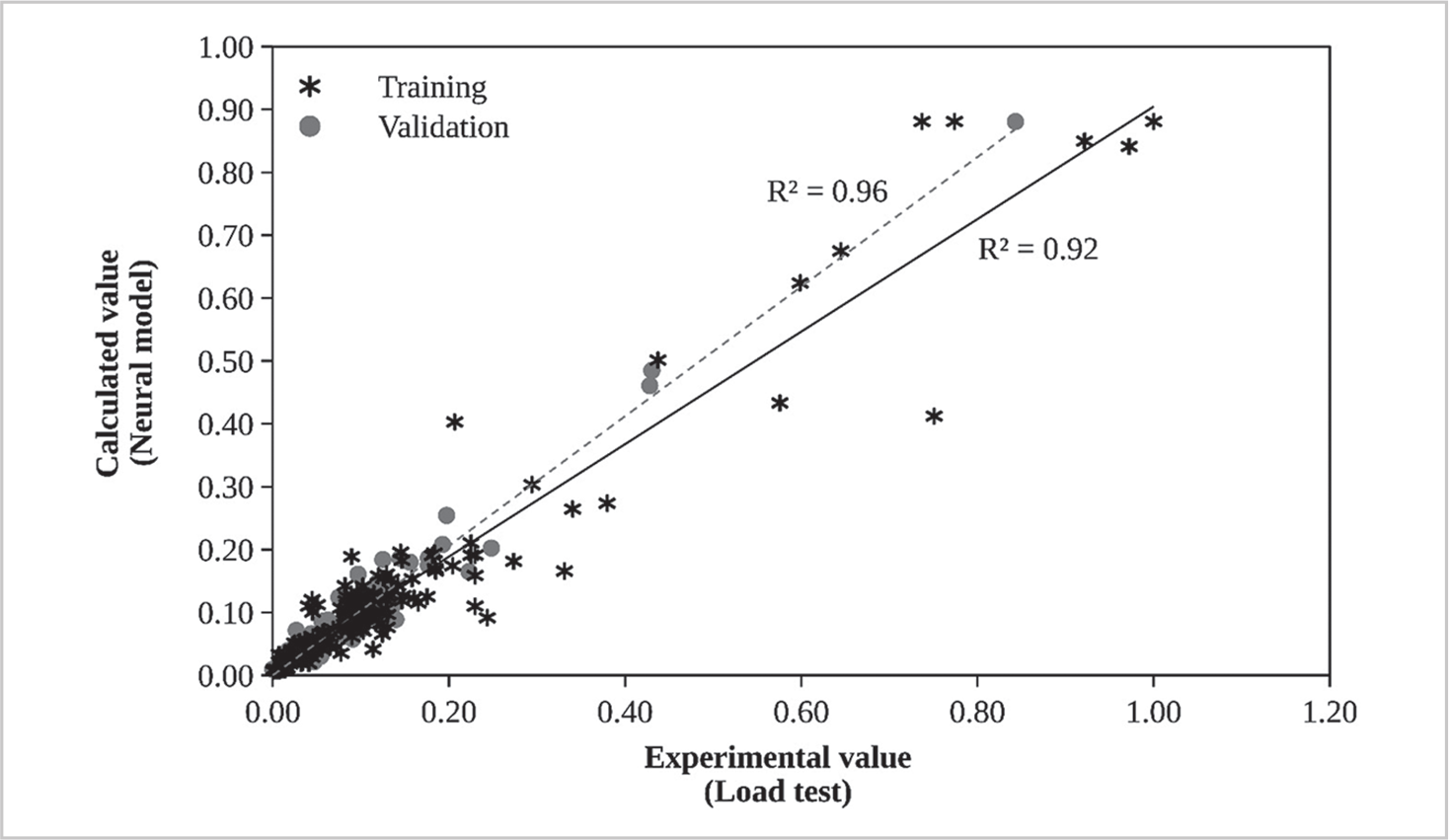
Figure 1 shows a scatter plot comparing the experimental values and the values predicted by the neural model M11- Qr for load capacity (Qr). The training data exhibit a coefficient of determination of R2 = 0.92, while the validation data show R2 = 0.96, indicating a strong correlation in both datasets. Most points are concentrated near the 1:1 line, with slight dispersion at higher load values.
The evaluation of statistical metrics revealed that the neural model obtained satisfactory results, with R2 of 0.96. This evaluation is in agreement with the conclusions of previous studies, such as Maizir (2017), Delazzeri et al. (2018), Maizir and Suryanita (2018), Pham et al. (2020a), Pham et al. (2020b), Kardani et al. (2020), Gomes et al. (2021) and Amâncio et al. (2022). Regarding to the RMSE, the neural model presented an acceptable value, following the results of previous studies conducted by Kardani et al. (2020) and Amâncio et al. (2022), who found RMSE values between 0.08 kN and 0.177 kN.
Understanding the role of input variables in ANN modeling involved Principal Component Analysis (PCA), with the input variables D (33.3%), L (24.6%), T (15.7%), NL (9.6%), and Np (8.3%) contributing 91.5% to the explanation of data variability. The input variables kLar (5.3%), ksil (1.9%), karg (1.0%), and kp (0.3%) demonstrated less explanatory power, as they contributed to a lesser degree in explaining the variability of the data.
It is crucial to point out that the soil stratigraphic profile played a secondary role in the modeling, possibly due to the simplification of soil types into only three main categories (sand, silt, and clay), which may have limited the capacity of the neural model to capture nuances associated to soil variability, since only the predominant fraction of each soil was considered.
According to studies in literature, both authors who incorporated variables related to soil stratigraphy and those who disregarded them in the modeling were able to develop neural models, which offer satisfactory results in predicting the bearing capacity of piles. These models demonstrate more accurate predictions compared to theoretical approaches and/or semi-empirical methods (Maizir, 2017; Benali et al., 2018; Maizir and Suryanita, 2018; Pham et al., 2020a, 2020b; Kardani et al., 2020; Pessoa et al., 2021; Gomes et al., 2021).
It is important to interpret these results with caution, since it is widely recognized that the bearing capacity performance of a foundation system is intrinsically related to the geotechnical characteristics of the soil layers that the foundation element is in contact. Geology and geotechnical formation play a substantial role in determining the bearing behavior of a foundation.
3.2 Neural model parameters
Equation 4 displays the parameters of the neural models to calculate the bearing capacity of precast concrete, continuous flight auger, bored piles, and metal piles. To predict the bearing capacity of the piles, through the equation, it is necessary to normalize the input variables in the range of 0.15 to 0.85. As we observe the equation, it should be pointed out that the neural model incorporates five input variables: D, L, T, NL1, and Np1 to calculate the bearing capacity (Qr).
Where: D = Pile diameter (m); L = pile length (m); T = Type of pile; NL1 = NSPT along the shaft (sum) based on the Aoki-Velloso method (1975); Np1 = NSPT of the tip based on the Aoki-Velloso method (1975).
3.3 Case study
The case study verified the generalization capacity of the developed neural model. This analysis incorporated an additional data set that was not used in the training and validation phase of the neural models. The piles were dimensioned based on the neural model and the semi-empirical methods of Aoki-Velloso (1975), Décourt-Quaresma (1978), modified by Décourt et al. (1996), and then comparing the results with the experimental values from the load tests.
Table 6 summarizes the piles analyzed and their respective bearing capacity obtained from the load tests. The data for precast, continuous flight auger, bored pile, and steel piles derived from the studies of Marchezini (2013), Paludeto (2022), Eichelberger (2022), and Polido et al. (2019), respectively.
The precast CC08 pile was driven in the region of Brasília-DF, in predominantly clayey soil, and subjected to dynamic load tests. The continuous flight auger was bored in the region of Campinas-SP, in predominantly sandy soil, and subjected to static load tests. The bored pile was driven in the experimental field located in the city of Cruz Alta, in the northwest of the state of Rio Grande do Sul, in predominantly clayey-silty soil and submitted to static load tests. The steel piles, with laminated profile HP 250 x 62, were driven in the region of Vitória-ES, in predominantly sandy soil, and subjected to static load tests.
Figure 2 shows the bearing capacity values (Qr) obtained by the neural model and the load test. The analysis demonstrates a strong correlation between the results of the neural model results and the load test values for the precast concrete piles and continuous flight auger. The neural model tended to overestimate the bearing capacity value for the other piles.
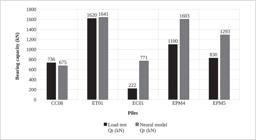
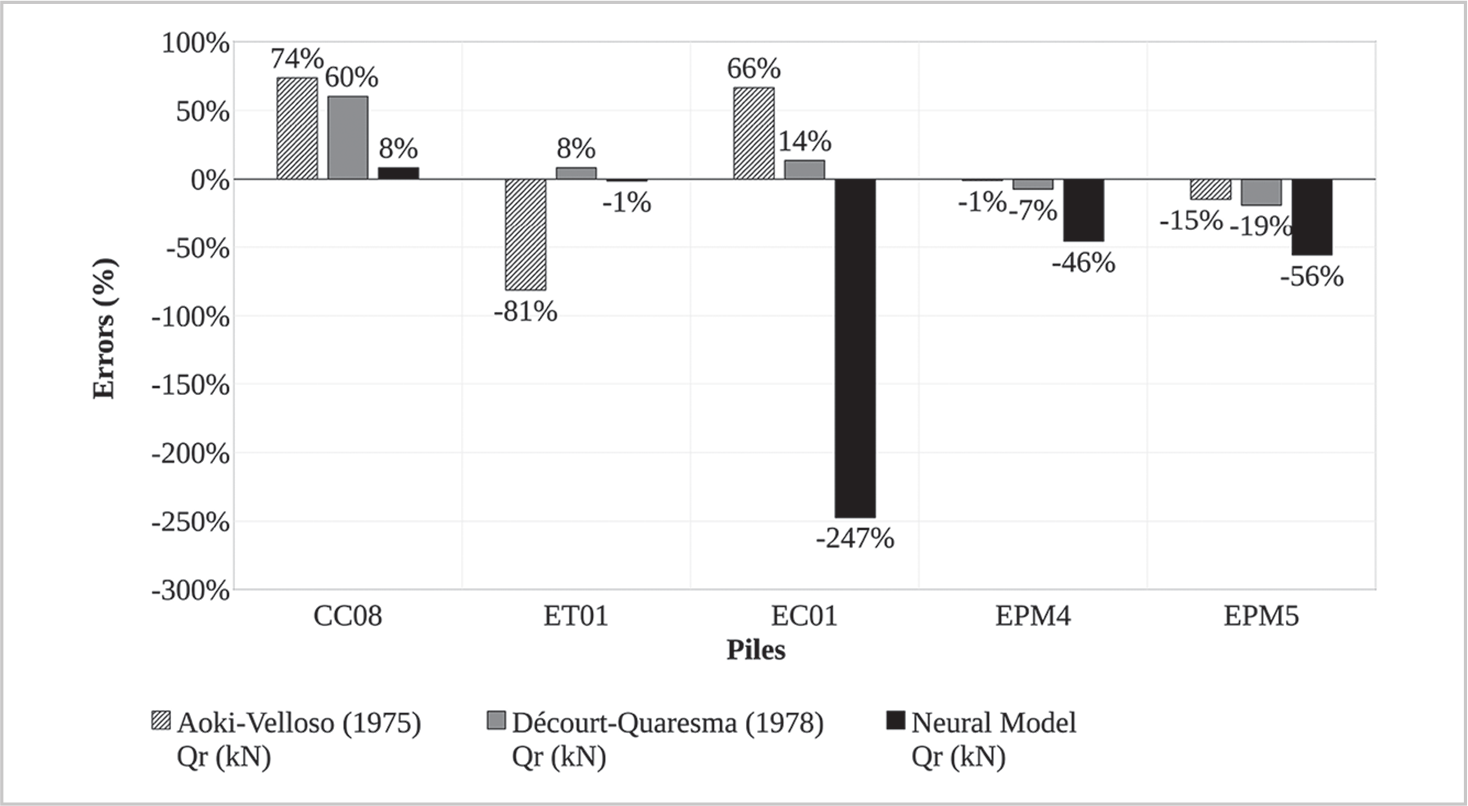
Figure 3 shows the percentage difference between the experimental results (load tests) of the bearing capacity (Qr) and the values obtained by the neural model and semi-empirical methods. The results show that, for the precast pile CC08 and the continuous flight auger ET01, the neural model demonstrated superior performance in predicting the bearing capacity compared to the semi-empirical methods of Aoki-Velloso (1975) and Décourt-Quaresma (1978). The values obtained by the neural model in these cases were very close to the results of the load test tests, with errors of 8% and -1%, respectively.
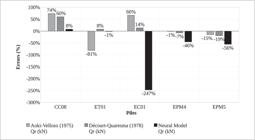
Bearing capacity of piles: percentage error concerning experimental values of the neural network and semi-empirical methods.
For the EC01 bored pile, the neural model showed significantly lower performance than the semi-empirical methods, overestimating the result by -247%. In the case of the EPM4 and EPM5 steel piles, the neural model had a lower performance than the semi-empirical methods, presenting errors of -46% and -56%, respectively.
It can also be observed in Figure 3 that, for pile CC08, the neural network predicts a slightly higher bearing capacity than that obtained from the load test. This discrepancy does not imply that the model provides more accurate results than reality, but can be explained by the variability inherent in load tests (due to soil heterogeneity, construction conditions, and instrumentation) and by the way the neural model generalizes patterns from the training dataset.
Overall, the neural model showed promise in predicting the bearing capacity for the studied precast concrete piles and continuous flight auger, with a performance superior to that of the semi-empirical methods. It is essential to highlight that the database used to train and validate the model was composed predominantly of precast concrete piles and continuous flight auger, representing approximately 72% of the piles, which may have influenced the results.
3.4 Neural model limitations
The developed neural model has limitations related to its applicability and generalization capacity due to the characteristics of the data used for training and validation. These limitations can be grouped into four main aspects: pile type, geometric characteristics, soil type, and bearing capacity range.
The model applies to precast concrete piles, steel piles, continuous flight auger, and bored piles, with the following dimensions: precast concrete piles (diameter 20 - 40 cm, length 7 - 15 m), steel piles (diameter 12 - 17 cm, length 15 - 24 m), continuous helix piles (diameter 30 - 59 cm, length 10 - 20 m) and bored piles (diameter 20 - 49 cm, length 6 - 21 m). Regarding the soil, the drilling reports indicated a predominance of clayey soil (47.84%), followed by silty (27.21%) and sandy (24.95%). These observations suggested that the model is less representative of piles in sandy and silty soils. Regarding the bearing capacity, the model is limited to the following ranges: continuous helix (1320 - 2850 kN), bored (44 - 2204 kN), precast concrete (20 - 843 kN), and metal (190 - 1670 kN). Piles with characteristics outside these ranges may lead to inaccuracies in bearing capacity predictions.
4. Conclusions
The developed neural model presented satisfactory results, with R2 above 0.96 and RMSE of 0.02. According to previous studies, these value ranges are adequate. The geometric parameters (diameter, length) and the penetration resistance indexes (NL and Np) were the input variables that most impacted the modeling. Soil type had little impact on the modeling, possibly due to the predominance of piles based on clayey soil in the database, and the simplification of the soil types into sand, silt, and clay may have limited the ability of the neural models to identify details of behavior related to soil variability.
The case study indicated that the bearing capacity values obtained by the model for precast concrete piles and continuous flight auger were close to the experimental values from the load tests. Furthermore, the models were more effective than the semi-empirical methods of Aoki-Velloso (1975) and Décourt-Quaresma (1978). This performance can derive from the significant number of these types of piles used in the modeling.
Acknowledgments
The authors would like to thank the State University of Feira de Santana, the Postgraduate Program in Civil and Environmental Engineering (PPGECEA), and the Bahia State Research Support Foundation (FAPESB) for the encouragement and financial support offered to the research.
-
Funding information
Research Support Foundation of the State of Bahia (FAPESB), under the project ‘Use of Artificial Neural Networks (ANN) for Prediction Bearing Capacity of Deep Foundations’ (Project ID No. 2988/2022).
Data availability
The authors state that this manuscript is based on the Master’s Dissertation of Juliele Nascimento Jesus, entitled “Neural Models for Prediction Bearing Capacity of Driven, Bored, and Continuous Flight Auger Piles”, presented in 2024 at the State University of Feira de Santana, in the Graduate Program in Civil and Environmental Engineering (PPGECEA-UEFS), with all data available at the following link: http://www.ppgecea.uefs.br/arquivos/File/dissertacoes/2024/Juliele_Nascimento_Jesus_vf.pdf
References
- ASSOCIAÇÃO BRASILEIRA DE NORMAS TÉCNICAS. NBR 6122: projeto e execução de fundações. Rio de Janeiro, 2022, 126 p.
- AMÂNCIO, L. B.; DANTAS NETO, S. A.; CUNHA, R. P. Estimative of shaft and tip bearing capacities of single piles using multilayer perceptrons. Soils and Rocks, v. 45, n. 3, p. 1-14, 2022.
- AMANN, K. A. P.; KUBOYAMA, C.T.; SILVA, C. O. Metodologia para a avaliação estatística da aplicabilidade de métodos semi-empíricos de cálculo da capacidade resistente última de estacas. In: CONGRESSO NACIONAL DE GEOTECNIA. 2018. Ponta Delgada, Açores. [Anais...]. 2018.
- AOKI, N.; VELLOSO, D. A. An approximate method to estimate the bearing capacity of piles. In: PANAMERICAN CONFERENCE ON SOIL MECHANICS AND FOUNDATION ENGINEERING, 5, 1975. Buenos Aires. Anais [...]. Buenos Aires, 1975. p. 367-376.
- ARAÚJO, C. B. C. Aplicação das redes neurais artificiais do tipo perceptron na estimativa de recalques em estacas. 2015. 203 f. Dissertação (Mestrado em Engenharia Civil - Geotecnia) - Centro de Tecnologia, Universidade Federal do Ceará, Fortaleza, 2015.
- ARAÚJO, C. B. C.; DANTAS NETO, S. A.; SOUZA FILHO, F. A. Streamflow forecasting for the dam Orós/CE from hydrometeorological data using perceptrons. Revista Brasileira de Meteorologia, v. 30, n. 1, p. 37-46, 2015.
- BENALI, A.; NECHNECH, A.; BOUKHATEM, B.; HUSSEIN, M N; KARRY, M. Neural networks and principle component analysis approaches to predict pile capacity in sand. Matec Web of Conferences, v. 149, n. 02025, p. 1-4, 2018.
- CARDOSO NETO, J. Estudo da capacidade de carga das estacas hélice contínua em um edifício residencial com 23 pavimentos em Feira de Santana, BA. 2016. 122 f. Trabalho de Conclusão de Curso (Graduação em Engenharia Civil) - Universidade Estadual de Feira de Santana, Feira de Santana, BA, 2016.
- CARVALHO, S.; SALES, M.; CAVALCANTE, A. Systematic literature review and mapping of the prediction of pile capacities. Soils and Rocks, v. 46, n. 3, p. 1-12, 2023.
- CHAN, W. T.; CHOW, Y. K.; LIU, L. F. Neural network: an alternative to pile driving formulas. Computers and Geotechnics, v. 17, n. 2, p. 135-156, 1995.
- DANTAS NETO, S. A.; SILVEIRA, M. V.; ANJOS, G. J. M.; MOURA, A. S. Modelo de previsão de recalques em estacas hélice contínua, metálicas e escavadas através de redes neurais artificiais. Geotecnia, n. 136, p. 27-47, 2016.
- DÉCOURT, L.; ALBIERO, J.; CINTRA, J. Análise e projeto de fundações profundas. In: HACHICH, A. et al. (org.). Fundações: teoria e prática. São Paulo: Editora PINI, 1996. v. 2, p. 265-327.
- DÉCOURT, L.; QUARESMA, A. R. Capacidade de carga de estacas a partir de valores de SPT. In: CONGRESSO BRASILEIRO DE MECÂNICA DOS SOLOS E ENGENHARIA DE FUNDAÇÕES, 6, 1978. Rio de Janeiro. Anais [...]. Rio de Janeiro, 1978. p. 45-53.
- DELAZZERI, M. L. C.; GADÉA, A. S. M.; NAGAHAMA, K. J.; SÃO MATEUS, M. S. C. Aplicação de redes neurais artificiais na determinação da capacidade de carga de estacas pré-moldadas de concreto armado. 2018. In: CONGRESSO BRASILEIRO DE MECÂNICA DOS SOLOS E ENGENHARIA GEOTÉCNICA GEOTECNIA E DESENVOLVIMENTO URBANO, 19, 2018. Salvador. [Anais].... Salvador: COBRAMSEG, 2018.
- EICHELBERGER, L. V. Avaliação da capacidade de carga geotécnica em estacas a partir dos métodos semi empíricos e provas de carga estáticas. 2022. 108 f. Dissertação (Mestrado em Engenharia Civil) - Universidade Federal de Santa Maria, Santa Maria, RS, 2022.
- FIGUEIREDO, L. C.; CUNHA, R. P.; CONCIANI, W.; MARCHEZINI, S. F.; BEZERRA, N. M. M. Análise comparativa do método de previsão de capacidade de carga para estacas de lobo (2005) com os métodos semi empíricos para solo do plano piloto de Brasília. 2016. In: CONGRESSO BRASILEIRO DE MECÂNICA DOS SOLOS E ENGENHARIA GEOTÉCNICA, 18, 2016. Belo Horizonte. [Anais...]. Belo Horizonte: COMBRAMSEG, 2016.
- GOMES, Y. F. Aprendizado de máquinas para estimar a capacidade de carga em estacas pré-moldadas de concreto. 2022. 107 f. Dissertação (Mestrado em Engenharia Civil) - Instituto Tecnológico de Aeronáutica, São José dos Campos, 2022.
- GOMES, Y. F.; VERRI, F.; RIBEIRO, D. Use of machine learning techniques for predicting the bearing capacity of piles. Soils and Rocks, v. 44, n. 4, p. 1-14, 2021.
- HECHT-NIELSEN, R. Kolmogorov’s mapping neural network existence theorem. In: PROCEEDINGS OF THE INTERNATIONAL CONFERENCE ON NEURAL NETWORKS, 1987. San Diego. Proceedings […]. San Diego. v. 3, p. 11-14.
- JEBUR, A. A.; ATHERTON, W.; AL KHADDAR, R. M.; LOFFILL, E. Piles in Sandy Soil: a numerical study and experimental validation. Procedia Engineering, v. 196, p. 60-67, 2017.
- JESUS, J. N. Capacidade de carga do sistema solo-estaca: análise das soluções teóricas e semiempíricas com base no ensaio de carregamento dinâmico para uma obra no município de Feira de Santana, BA. 2021. 132 f. Trabalho de Conclusão de Curso (Graduação em Engenharia Civil) - Universidade Estadual de Feira de Santana, Feira de Santana, BA, 2021.
- JESUS, J. N. Modelos neuronais para o cálculo da capacidade de carga em estacas cravadas, escavadas e hélice contínua. 2024. 155 p. Dissertação (Mestrado em Engenharia Civil e Ambiental) - Universidade Estadual de Feira de Santana (UEFS), Feira de Santana - BA, 2024.
- JESUS, J. N.; SÃO MATEUS, M. S. C.; GADÉA, A. S. M. Predicting bearing capacity of precast concrete piles using SPT and Artificial Neural Network. In: CILAMCE - 2022 IBERO-LATIN-AMERICAN CONGRESS ON COMPUTATIONAL METHODS IN ENGINEERING, 43, 2022. Foz do Iguaçu. Anais [...]. Foz do Iguaçu: ABMEC, 2022.
- KARDANI, N.; ZHOU, A.; NAZEM, M.; SHEN, S. Estimation of bearing capacity of piles in cohesionless soil using optimised machine learning approaches. Geotechnical and Geological Engineering, v. 38, n. 2, p. 2271-2291, 2020.
- LOBO, B. O. Método de previsão de capacidade de carga de estacas: aplicação dos conceitos de energia do ensaio SPT. 2005. 139 f. Dissertação (Mestrado em Engenharia Civil) - Universidade Federal do Rio Grande do Sul - UFRGS, Porto Alegre, 2005.
- MAIZIR, H. Evaluation of shaft bearing capacity of single driven pile using neural network. In: INTERNATIONAL MULTICONFERENCE OF ENGINEERS AND COMPUTER SCIENTISTS, 25, 2017. Hong Kong. Proceedings[...]. Hong Kong: International Association of Engineers, 2017. p. 15-17.
- MAIZIR, H.; SURYANITA, R. Evaluation of axial pile bearing capacity based on pile driving analyzer (PDA) test using Neural Network. Iop Conference Series: Earth and Environmental Science, v. 106, n. 012037, p. 1-6, 2018.
- MAJEED, A. H.; MAHMOOD, K. R.; JEBUR, A. A. Simulation of hyperbolic stress-strain parameters of soils using artificial neural networks. In: INTERNATIONAL CONFERENCE ON GEOTECHNICAL ENGINEERING, 23, 2013. Tunisia. Proceedings […]. Hammamet, Tunisia. 2013. p. 105-115.
- MARCHEZINI, S. F. Comparação entre métodos estáticos e dinâmicos de previsão de capacidade de carga em estacas assentes em solo tropical. 2013. 171 f. Dissertação (Mestrado em Geotecnia) - Universidade de Brasília, Brasília, 2013.
- MATLAB. Version: R2022a. Documentation: improve neural network generalization and avoid overfitting, Mathworks, 2022.
- MOAYEDI, H.; MOSALLANEZHAD, M.; RASHID, A. S. A.; JUSOH, W. A. W.; MUAZU, M. A. A systematic review and meta-analysis of artificial neural network application in geotechnical engineering: theory and applications. Neural Computing and Applications, v. 32, n. 2, p. 495-518, 2020.
- NACARATO, R. L. Investigação de falha em transformadores de potência pela análise dos gases dissolvidos no óleo isolante utilizando simulação em redes neurais artificiais. 2018. 82 f. Dissertação (Mestrado em Engenharia Mecânica) - Universidade Santa Cecília, Santos, SP, 2018.
- NEEJAD, F. P.; JAKSA, M. B. Load-settlement behavior modeling of single piles using artificial neural networks and CPT data. Computers and Geotechnics, v. 89, n.12, p. 9-21, 2017.
- NGUYEN, TRONG-HA; NGUYEN, KIEU-VINH THI; HO, VIET-CHUONG; NGUYEN, DUY-DUAN. Efficient hybrid machine learning model for calculating load-bearing capacity of driven piles. Asian Journal Of Civil Engineering, v. 25, n. 1, p. 883-893, 2023.
- NHAT, L. V.; ANH, T. N.; VAN, H. T. V. Ultimate bearing capacity of bored piles in clayey sand determined using artificial neural networks. Transportation Infrastructure Geotechnology. v. 12, n. 132, 2025.
- PALUDETO, T. M. L. Desempenho de estacas tipo hélice contínua por meio de provas de carga estática instrumentada e simulação numérica. 2022. 207 f. Dissertação (Mestrado em Engenharia Civil) - Universidade Estadual de Campinas, Campinas, 2022.
- PEREIRA, A. B.; PORTO, T. B.; GOMES, R. C.; SANTOS, R. L. R.; RABELO, J. M. G. Forecasting bearing capacity performance with semi-empirical and theoretical methods applied to precast concrete piles founded on sandy clay in the region of Uberlândia, MG, Brazil. REM - International Engineering Journal, v. 73, n. 4, p. 463-475, 2020.
- PESSOA, A. D.; SOUSA, G. C. L.; ARAUJO, R. C.; ANJOS, G. J. M. Artificial neural network model for predicting bearing capacity of driven piles. Research, Society and Development, v. 10, n. 1, p. 1-20, 2021.
- PHAM, T. A.; LY, H.; TRAN, V. Q.; VAN GIAP, L.; VU, H. T.; DUONG, H. Prediction of pile axial bearing capacity using artificial neural network and random forest. Applied Sciences, v. 10, n. 5, p. 1871, 2020a.
- PHAM, T. A.; TRAN, V. Q.; VU, H. T.; LY, H. Design deep neural network architecture using a genetic algorithm for estimation of pile bearing capacity. Plos One, v. 15, n. 12, p. 1-25, 2020b.
- POLIDO, U. F.; ALMEIDA, R. C. M. B.; ALLEDI, C. T. D. B.; ALBUQUERQUE, P. J. R.; LEMOS, S. G. F. P. Capacidade de carga geotécnica de estacas de perfil metálico com base em provas de carga à compressão. In: SEMINÁRIO DE ENGENHARIA DE FUNDAÇÕES ESPECIAIS E GEOTECNIA (SEFE), 9, 2019. São Paulo. Anais[...]. São Paulo: ABMS, 2019.
- PROBST, C. A.; AGUIAR, M. F. P.; MENDES, G. C. M.; OLIVEIRA, F. H. L. Análise comparativa de métodos de determinação da capacidade de carga em estacas hélice contínua com ensaios de prova de carga estática realizados em Uberaba-MG. In: CONGRESSO BRASILEIRO DE MECÂNICA DOS SOLOS E ENGENHARIA GEOTÉCNICA, 19, 2018. Salvador. Anais [...]. Salvador, BA: ABMS, 2018.
- PRONI, C.; HANEDA, R. N.; FILLETTI, É. R. Desenvolvimento de redes neurais artificiais para análise do fluxo de permeado de uma bebida à base de açaí no processo de microfiltração tangencial. C.Q.D. - Revista Eletrônica Paulista de Matemática, v. 17, p. 189-205, 2020.
- SILVA, R. R. C. Análise de métodos de previsão de capacidade de carga em estaca raiz a partir do comportamento em ensaios de carregamento estático e dinâmico. Revista Tecnologia, v. 41, n. 2, p. 1-14, 2020.
- SILVEIRA, M. V. Modelo neuronal para previsão de recalques em estacas hélice contínua, metálica e escavada. Dissertação (Mestrado em Engenharia Civil) - Universidade Federal do Ceará, Fortaleza, 2014.
- SOUZA, N. S.; SÃO MATEUS, M. S. C.; SILVA, J. C. B.; ARAGÃO, H.; RAMOS, J. M. Capacidade de carga de fundações profundas em estacas pré-moldadas de concreto: estudo de caso em obra de edifício no município de Feira de Santana, BA. In: CONGRESSO BRASILEIRO DO CONCRETO - SIMPÓSIO SOBRE ESTRUTURAS DE FUNDAÇÕES: ASPECTOS ESTRUTURAIS E GEOTÉCNICOS, 57, 2015. Bonito, MS. Anais [...]. Mato Grosso do Sul: Congresso Brasileiro do Concreto, 2015.
- TIZPA, P.; CHENARI, R. J.; FARD, M. K.; MACHADO, S. L. ANN prediction of some geotechnical properties of soil from their index parameters. Arabian Journal of Geosciences, v. 8, n. 5, p. 2911-2920, 2014.
Edited by
-
Associate Editor
Humberto Varum