
 Enteral nutrition volume as a Quality Indicator in Nutritional Therapy in wards
ABSTRACT
Objective: To assess the compliance with the Nutrition Therapy Quality Indicator “prescribed versus infused volume”.
Method: Secondary data analysis, performed in four adult wards (clinical and surgical) of a Brazilian university hospital. Data were prospectively collected in two sequential periods - between June and November 2017 (cohort 1) and from May 2018 to May 2019 (cohort 2). The difference between the prescribed and infused diet volume was assessed using the Wilcoxon test; and to measure the relationship between the difference and the mean difference of the prescribed and infused volumes, the method suggested by Bland and Altman was applied.
Results: A total of 494 patients were included. It was observed that patients received, on average, less enteral nutrition than prescribed (-601.3±430ml/day), which represented approximately 46% less diet; only 17.7% of patients were able to reach the target for this indicator (infusion of ≥80% of the prescribed volume). Furthermore, no patients received the entire prescribed volume during the established period.
Conclusion: The volume of diet infused was substantially lower than that prescribed, resulting in low compliance of the indicator monitored in the wards.
Descriptors:
Quality Indicators; Health Care; Enteral Nutrition; Nursing; Patients' Rooms; Hospitalization; Patient Safety
RESUMO
Objetivo: Avaliar a conformidade do Indicador de Qualidade em Terapia Nutricional “volume prescrito versus infundido”.
Método: Análise secundária de dados, realizada em quatro enfermarias adultas (clínica e cirúrgica) de um hospital universitário brasileiro. Os dados foram coletados prospectivamente em dois períodos sequenciais - entre junho e novembro de 2017 (coorte 1) e de maio de 2018 a maio de 2019 (coorte 2). A diferença entre o volume de dieta prescrito e o infundido foi avaliada por meio de teste de Wilcoxon; e para aferir a relação entre a diferença e a média da diferença entre os volumes prescrito e infundido foi empregado o método sugerido por Bland e Altman.
Resultados: Foram incluídos 494 pacientes. Evidenciou-se que os pacientes receberam, em média, menos dieta enteral do que o prescrito (-601,3±430ml/dia), o que representou cerca de 46% a menos de dieta; apenas 17,7% dos pacientes conseguiram atingir a meta para este indicador (infusão de ≥80% do volume prescrito). Ademais, não houve pacientes que receberam a totalidade do volume prescrito durante o período estabelecido.
Conclusão: O volume de dieta infundido foi substancialmente menor que o prescrito, resultando em uma baixa conformidade do indicador monitorado nas enfermarias.
Descritores:
Indicadores de qualidade; Assistência à saúde; Nutrição enteral; Enfermagem; Quartos de Pacientes; Hospitalização; Segurança do Paciente
RESUMEN
Objetivo: Evaluar el cumplimiento del Indicador de Calidad en Terapia Nutricional “volumen prescrito versus infundido”.
Método: Análisis de datos secundarios, realizado en cuatro salas de adultos (clínica y quirúrgica) de un hospital universitario brasileño. Los datos se recopilaron de forma prospectiva en dos períodos secuenciales: entre junio y noviembre de 2017 (cohorte 1) y de mayo de 2018 a mayo de 2019 (cohorte 2). La diferencia entre el volumen de dieta prescrito e infundido se evaluó mediante la prueba de Wilcoxon; y para evaluar la relación entre la diferencia y la diferencia promedio entre los volúmenes prescritos e infundidos se utilizó el método sugerido por Bland y Altman.
Resultados: Se incluyeron 494 pacientes. Se evidenció que los pacientes recibieron, en promedio, menos dieta enteral que la prescrita (-601,3±430ml/día), lo que representó alrededor de un 46% menos de dieta; sólo el 17,7% de los pacientes logró alcanzar el objetivo de este indicador (infusión de ≥80% del volumen prescrito). Además, ningún paciente recibió todo el volumen prescrito durante el periodo establecido.
Conclusión: El volumen de dieta infundida fue sustancialmente menor que el prescrito, resultando en un bajo cumplimiento del indicador monitoreado en las salas de hospitalización.
Descriptores:
Indicadores de Calidad; Atención de Salud; Nutrición Enteral; Enfermería; Habitaciones de Pacientes; Hospitalización; Seguridad del Paciente
INTRODUCTION
Enteral Nutrition Therapy (ENT) is essential to recover or preserve the patient’s nutritional status1,2. However, it may not ensure that nutritional needs are met3, as different conditions influence patients to receive volumes, energy intake and protein supply lower than those prescribed4. In addition to these challenges, patients using ENT are exposed to risks and incidents related to the different stages of the therapy, such as gastrointestinal, metabolic and mechanical complications5,6, which may compromise the adequacy of the prescribed and infused Enteral Nutrition (EN) volume.
To minimize such complications, and to act early on deviations from expectations, entities such as the Brazilian Society of Parenteral and Enteral Nutrition (Sociedade Brasileira de Nutrição Parenteral e Enteral - SBNPE)7 and the International Life Sciences Institute (ILSI) - Brazil8 recommend monitoring of Quality Indicators in Nutritional Therapy (QINT), defined as tools for assessing the effectiveness of the nutritional therapy provided9. However, measuring these QINT is not a common practice in hospital management, due to issues of feasibility and human and financial resources, making it necessary for healthcare institutions to prioritize certain QINT7,9.
Some of the QINT have a direct interface with nursing practices10, which can be explained by recommendation in specific legislation11 so that nursing teams adopt indicators to ensure continuous and safe care. One example, the indicator “prescribed versus infused ENT volume”, monitored by the nursing team, translates the proportion of days in which at least 80% of the prescribed diet volume was administered, with the target set at an infused volume >80% of the prescribed volume8. Besides the clinical importance for therapeutic monitoring, the indicator also allows identifying the factors that impact in the difference between prescribed and infused, so that corrective actions can be implemented by the teams, when necessary9.
Patients who receive ENT volume close to 100% develop fewer infectious complications, maintain the gastrointestinal mucosal integrity, have a shorter hospital stay and are less likely to die. Despite this scientific evidence4,12,13, studies also show discrepancies between prescribed and infused ENT volumes in hospitalized patients. This issue is related to clinical practices and institutional routines that do not prioritize ENT in care practice, which can make it difficult to achieve the goals set by national entities7,9 or the healthcare institution itself. In a study conducted with 144 patients on exclusive ENT, hospitalized in clinical and surgical wards, found that the infused volume was only 65.3% of the prescribed volume14. In another study, 79 adult patients in an Intensive Care Unit (ICU) used ENT exclusively for an average time of 12.3 ± 11.8 days, and 71% of patients reached the indicator target15.
Traditionally, nursing plays an essential role in monitoring QINT, especially in the “prescribed versus infused volume”, since nurses are legally responsible11, for administering and verifying the acceptance of nutrition. Furthermore, nurses should be part of committees to evaluating ENT, based on the monitoring of QINT in healthcare institutions, engaged in the review of processes and identification of strategies that allow for improved practices, in the search for continuous quality in ENT16. In the same way, these professionals will be able to make real improvements that benefit patients, reduce risks, since monitoring these QINT specifically supports nursing care management9.
Given the above, the research question was developed: what is the compliance of the indicator “frequency of days with adequate administration of the prescribed volume versus infused volume of ENT?” And, as objective, to assess the compliance of the QINT “prescribed versus infused volume”.
METHOD
This is a secondary data analysis, reported following the recommendations of the Strengthening the Reporting of Observational Studies in Epidemiology (STROBE) guideline17.
The research setting was four adult hospital wards - two for clinical patients and two for surgical patients - with similar characteristics in number of beds (45 per unit), physical structure and staff, of a Brazilian university hospital, a High-Complexity Reference Center in Nutritional Therapy (NT) 18, which is part of the Unified Health System (Sistema Único de Saúde - SUS).
Data collection was conducted prospectively in two sequential periods - between June and November 2017 (cohort 1)19 and from May 2018 to May 2019 (cohort 2)20 (convenience sampling). The same research procedures were maintained in both collection periods. Before data collection from both cohorts, the research team was trained, and the entire process was directly supervised by an experienced nurse. Interobserver agreement was tested21, with 451 paired observations performed, and considering all items, there was considerable agreement (k > 0.80)22 across all observation pairs.
The institution has a Preparation Center for enteral diets. An open ENT system was routinely adopted, and the diet was administered intermittently by a gravitational method. An infusion pump was adopted in specific clinical situations, upon medical prescription, following institutional protocols. The multidisciplinary team is familiar with the procedures related to all stages of NT, from prescription to administration and recording of care procedures.
Data from all participants in cohorts 1 and 2 were used, including patients over 18 years of age who required exclusive EN using an enteral tube with the distal tip in the gastric (NGT) or enteral (NET) position, who received enteral nutrition, either by gavage or infusion pump, and who were in the wards selected for the study. Patients with ostomies by gastrostomy or jejunostomy and who were confused and/or disoriented were excluded. It is important to note that, patients who were hospitalized in the same cohort at different times, or patients from cohort 1 who were hospitalized in cohort 2 were not included in this study.
Patients were selected through the hospital's electronic healthcare management system (AGHUse), where all patient information is integrated. A research assistant searched daily for patients using ENT on the list generated from AGHUse, with the aim of including all potentially eligible patients, reducing selection bias. These patients were sequentially monitored daily, from the beginning until discontinuation of EN administration via NGT/NET, transfer (from a care unit or institution), hospital discharge or death. Additionally, daily reviews of medical progress notes, prescriptions, multidisciplinary evaluations, and nursing records related to excretions were performed.
For the present study, the variables that were common in the two original cohorts were evaluated from the previously organized databases, namely: “clinical conditions of patients” (such as underlying diseases, current disease, among others), “percentage of diet administered”, “age”, “sex”, “length of hospital stay”, and “period of diet use”.
The QINT “frequency of days of adequate administration of the prescribed volume versus volume infused in patients on ENT” is defined as “the frequency of days of administration of the adequate infused volume, above 80% of the prescribed goal”9. Its calculation is determined by the equation: [(number of patients on ENT who did not reach the nutritional goal*100)/number of patients on ENT]9, which expresses the result of non-compliance with this indicator. For the purposes of the present study, we adopted the complementary formula, which expresses the result of compliance with the indicator rate [(number of patients on ENT who reached the nutritional goal*100)/number of patients on ENT]. The proportion of ENT infused to patients in relation to the prescribed amount was also investigated, measured using the equation: proportional difference = [(volume of ENT infused*100)/volume of ENT prescribed]. For the purposes of parameterized interpretation, and in accordance with the ILSI-Brazil guideline9, an administered volume of ENT ≥ 80% of the prescribed amount was considered as “target reached,” and < 80% as “target not reached”.
For the present study, the data from both cohorts were gathered in a single database and analyzed using the Statistical Package for Social Sciences for Windows (SPSS®) version 20.0, observing the characteristics and distribution of the variables. The normality of the distribution of numerical variables was tested using the Shapiro-Wilk test. The difference between the prescribed and infused volumes of ENT was assessed using the Wilcoxon test. The relationship between the difference between the prescribed and infused ENT volume was observed according to the method suggested by Bland and Altman23. The significance level adopted was 5% (p ≤ 0.05).
The ethical and methodological aspects were approved by the institution’s Research Ethics Committee (Certificate of Presentation for Ethical Appreciation No. 63247916,5,0000,5327) and all patients included consented to participate in the study. Since this is a secondary data analysis, the responsible researcher authorizes its use for this purpose. The databases do not contain patient information in accordance with the General Data Protection Law.
RESULTS
In this study, 494 patients were assessed for 3,365 days. Of the total number of patients from the two combined cohorts (n = 532), 38 were excluded: 17 patients were hospitalized more than once in the same cohort, 12 patients from cohort 1 were hospitalized again in cohort 2, and 9 participants had their identification data filled out (inclusion form), but did not actually use enteral nutrition or medications through the tube and, therefore, were not included in this analysis.
The minimum age of patients was 18 years old, and the maximum was 104 years, with the majority being elderly (69.4%), male (56.1%) and having completed elementary school (complete or not) (60.1%). The sample was followed for a median of 12 (6-20) days, with a hospital stay of 24 (16-39) days, with one day being the minimum and 507 the maximum number of days of hospitalization. Other patient characteristics are described in Table 1.
Regarding the prescribed volume of ENT, it was identified that the minimum was 150 ml, and the maximum was 3600 ml, with a median of 1380 (IQ: 1080 - 1500) ml. The minimum infused volume was zero and the maximum was 2100 ml, with a median of 690 (IQ: 360 - 1000) ml. When assessing the progression of the prescribed and infused ENT volume (Figure 1) over the days of patient follow-up, it was observed that on none of the days the median infused volume reaches the prescribed volume. Patients received 45.9% less diet than the prescribed volume.

Progression of prescribed and administered volume of nutritional therapy, over days of follow-up. Porto Alegre, Rio Grande do Sul, Brazil, 2024 ENT - Enteral Nutrition Therapy; ml - milliliters.
Regarding the measurement of the QINT “frequency of days of adequate administration of the prescribed volume versus infused volume in patients on ENT”, it was observed that only 17.7% of patients managed to reach the target of ≥ 80% of the prescribed ENT volume. Figure 2 shows the median and interquartile range of the prescribed ENT values in the groups of patients who reached and did not reach the target of ≥ 80% of the QINT. There was no difference in the volume of ENT prescribed between the groups of patients who reached and did not reach the target of ≥ 80% of the QINT (p>0.800). On the other hand, it was identified that the group that reached the target had a lower volume of ENT infused (p<0.000).

Boxplots of prescribed and infused nutritional therapy volume within 24 hours in relation to patients who did or did not reach the target of ≥ 80% of the indicator. Porto Alegre, Rio Grande do Sul, Brazil, 2024. QINT - Quality Indicator in Nutritional Therapy.
It was found that, on average, patients received less ENT volume (-601.3 ±430ml/day) than prescribed. Corroborating this, the Bland-Altman plot shows the details of the relationship between the difference between the prescribed and infused ENT volume (in ml) (Figure 3). The central line represents the average of the differences (601.3 ml), and the lower and upper lines represent the 95% limits between the infused and prescribed volume (-1445.8 to 243.2).
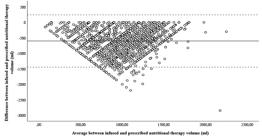
Bland-Altman plot showing the relationship between the mean prescribed and infused ENT volume (in ml) (x-axis) and the difference between the prescribed and infused ENT volume (in ml) (y-axis). NT: Nutritional Therapy; Ml - milliliters.
DISCUSSION
This study identified a large difference between the prescribed and infused volumes over the days of ENT in the wards. It also showed that few patients reached the target volume of infused diet ≥ 80%. It was also observed that when low volumes of ENT are prescribed, it is easier for patients to reach the QINT target.
The ENT infused volume lower than that prescribed has already been identified previously in a study conducted in the same hospital as the present study, but with patients admitted to the ICU. According to the authors, during the 30-day follow-up of 85 patients, the prescribed volume was never reached, and approximately 40% of the prescribed ENT was not infused24. In another study, conducted in a public hospital in Pará, the volume of infused ENT in the ICU was significantly lower than the prescribed volume (-652.5 ± 182.2; p < 0.0001)3. Internationally, in a surgical and trauma ICU in the United States, it was found that the overall percentage of infused EN was 75.3%, with trauma patients achieving higher percentages of EN volume when compared to surgical patients (78.2% vs. 69.9%)25.
Several factors may contribute to the difference between the prescribed and infused ENT volume. The most commonly cited causes in the literature include mechanical issues with the NET/NGT (blockages, partial or total inadvertent removals)5,6, interruptions, whether due to fasting for procedures or surgeries3,26 and gastrointestinal symptoms (intolerance) of the patient23,27. These aspects support the case series showing that both the clinical conditions of the patients and the therapeutic approach used can hinder the achievement of the prescribed ENT volume.
To improve the achievement of the IQTN target of “prescribed and infused volume of ENT”, a group of American researchers developed a protocol to improve the provision of EN for patients in a surgical and trauma ICU. The protocol consists of a combination of multidisciplinary strategies to (a) extend the feeding period for surgical patients, offering EN until the onset of anesthesia; (b) offer EN early to patients (within 48 hours of admission to the unit) and use post-pyloric feeding tubes as the preferred method for EN; and (c) prescribe the daily volume of EN, based on the need for breaks and/or interruptions in the diet. The protocol was implemented over a four-month period for 256 patients in the control group (2,663 days using EN) and 232 patients in the intervention group (2,059 days using EN), and the intervention group better achieved the QINT target (52.7% vs. 65.2%; p < 0.01)25.
Discrepancies between prescribed and infused volumes and the incomplete infusion of enteral nutrition not only worsen patient outcomes1,2,10, but are also associated with resource and investment waste, including enteral nutrition bottles and formulas, and increased costs for hospitals. No studies were found in the hospital that assessed these costs. However, this information has been identified in the literature for different healthcare institutions. In a tertiary hospital in Ceará, over a year, enteral diet waste in the pulmonology and cardiology wards for adult patients occurred 117 times (24.8%) and 42 times (8.9%) respectively. Furthermore, a significant relationship was identified between waste-related factors and the volume dispensed and wasted (p < 0.005), demonstrating that, proportionally, the greater the volume of diets destined for a unit, the greater the volume and/or number of waste events. The direct cost of waste identified in the aforementioned study refers to formulas, modules and bottles, totaling 2,714.12 BRL (in the evaluated year)27. The authors also emphasized that the value of wasted enteral nutrition could have supplied the nutritional needs of approximately 133 patients for a single day of ENT use.
In this study, the QINT target “frequency of days of adequate administration of the prescribed volume versus infused volume in patients on ENT” (≥ 80% of the prescribed) was reached by only 17% of patients, a result significantly lower than that identified in the literature, even in studies developed in other types of healthcare units. The QINT has been little investigated in open care units10, with most studies focusing on ICUs24,26,28-29. In an ICU of a university hospital in João Pessoa/Brazil, in the analysis of 79 medical records of elderly patients, the indicator reached 54.6% of adequacy (target ≥80%)28. In a study conducted in a trauma ICU in Curitiba/Brazil, in the two years investigated, 84% (n=163) and 85% (n=122) of patients managed to reach the indicator target (target >70%)26. At an international level, in a surgical and trauma ICU in the United States, of 187 patients evaluated, 21% managed to reach the indicator (target ≥ 80%)24.
Adequate results of the QINT are observed in some studies with specific populations, suggesting that achieving the IQTN target requires a planned and individualized approach by the multidisciplinary team, considering the actual needs and clinical conditions of patients being assisted, and not only in values recommended by guidelines, which sometimes do not reflect the reality of healthcare in Brazil. In a study with 51 patients with advanced-stage cancer admitted to a palliative care unit in a hospital in Rio de Janeiro/Brazil, the average infused ENT volume during the study period was 795 ml/day, with an average of 9.6 days, and the frequency of days of adequate administration of the prescribed volume versus the infused volume was 92.6% (target ≥ 80%)30.
When comparing prescribed and infused ENT volumes between patients who met or did not reach the IQTN target, the medians of the prescribed volume did not differ. However, there was a statistically significant difference in the volume of infused ENT (p<0.000). Therefore, this suggests that patients evaluated by the study at the hospital where the data collection was performed reach the QINT target “frequency of days of adequate administration of the prescribed versus infused volume in patients on ENT” (≥ 80% of the prescribed) when the volume of infused ENT is lower.
In the hospital investigated in this study, patients in the clinical and surgical wards received a lower volume of ENT than prescribed. It is worth noting that the hospital is a Reference Center for Nutritional Therapy and is required to have a Multidisciplinary Nutritional Therapy Team (MNTT)31. The MNTT must ensure adequate conditions for the indication, prescription, preparation, administration and final evaluation of ENT, with a view to achieving the greatest benefits of the procedure and prevent incidents and risks32. This reality raises the question of whether hospitals that are Reference Centers for ENT, with evaluation and supervision of MNTTs, are also unable to achieve the QINT target “frequency of days of adequate administration of the prescribed versus infused volume in patients on ENT”.
The results of this study contribute to demonstrating that if additional measures are not implemented, the difference between the prescribed and infused volume of ENT will persist over the years. ENT prescription is made based on estimates of nutritional need (equations) that consider patient characteristics and injury factors. The estimate often indicates an energy-protein prescription and diet volume that even a healthy, non-hospitalized individual would struggle to achieve. The literature3,24,25,28-29) has shown that patients do not receive the full amount of the prescribed diet.
This is a pioneering study at the national level, which measured this indicator in adult clinical and surgical wards with a significant number of patients, allowing for generalization of the results. A key strength of this study was the adoption of a cohort study, which allowed a sequential and procedural measurement of the QINT “prescribed versus infused volume of ENT”, since there is a lack of prospective studies in the literature to measure this QINT. It is also noteworthy that this research method is feasible with the reality of Brazilian healthcare services and care routines related to ENT. However, these findings cannot be generalized to the international level, as there are differences in best practices for ENT. Although the data for this study were collected several years ago, they were obtained using a solid research design and methodology for data collection and analysis.
CONCLUSION
There was non-compliance with the QINT “prescribed versus infused volume” in the wards, with only 17.5% of patients reaching the target of ≥80% of the prescribed volume. Furthermore, no patient received the full prescribed volume on any of the monitoring days, resulting in a 45.5% reduction in ENT. In this sample, patients who had been prescribed low volumes of ENT were more likely to reach the investigated QINT target.
This study on a specific QINT provides insights to assess institutional performance regarding care practices in the ENT. This can help nursing teams, hospital managers, and decision-makers to assess the level and variation in the quality of ENT care, as a way of improving patient outcomes and the efficiency of resource allocation.
Acknowledgments:
To the Biostatistics Unit of Dipe (Research Directorate) of the Hospital de Clínicas de Porto Alegre (HCPA). To the Postgraduate Program in Nursing (PPGENF) of the Universidade Federal do Rio Grande do Sul (UFRGS).
REFERENCES
-
1. Singer P, Blaser AR, Berger MM, AlhazzaniW, Calder PC, Casaer MP, et al. ESPEN guideline on clinical nutrition in the intensive care unit. Clin Nutr. 2019;48e79. https://doi.org/10.1016/j.clnu.2018.08.037
» https://doi.org/10.1016/j.clnu.2018.08.037 -
2. Boullata JL, Carrera AL, Harvey L, Escuro AA, Hudson L, Mays A, et al. ASPEN Safe Practices for Enteral Nutrition Therapy. JPEN J Parenter Enteral Nutr. 2017;41(1):15-103. https://doi.org/10.1177/0148607116673053
» https://doi.org/10.1177/0148607116673053 -
3. Barroso ACS, Cavalcantti AS, Marques SSF, Sató ALSA. Comparação entre necessidade, prescrição e infusão de dietas enterais em um hospital público de Belém-PA. BRASPEN J [Internet]. 2019 [cited 2023 Jun 10];34(1):46-51. Available from: https://braspenjournal.org/article/63e15e99a9539544fb548b44/pdf/braspen-34-1-46.pdf
» https://braspenjournal.org/article/63e15e99a9539544fb548b44/pdf/braspen-34-1-46.pdf -
4. De Alencar ES, Muniz LSS, Holanda JLG, Oliveira BDD, Carvalho MCF, Leitão AMM, et al. Enteral nutritional support for patients hospitalized with COVID-19: results from the first wave in a public hospital. Nutrition. 2022;94:111512. https://doi.org/10.1016/j.nut.2021.111512
» https://doi.org/10.1016/j.nut.2021.111512 -
5. Yasuda H, Kondo N, Yamamoto R, Asami S, Abe T, Tsujimoto H et al. Monitoring of gastric residual volume during enteral nutrition. Cochrane Database Syst Rev. 2021;9(9):CD013335. https://doi.org/10.1002/14651858.CD013335.pub2
» https://doi.org/10.1002/14651858.CD013335.pub2 -
6. Ang SY, Lim ML, Ong HS, Chong JNC, Ng XP, Lam M et al. A Descriptive Study of enteral tube feeding among adults in an acute care tertiary hospital-patient selection, characteristics and complications. Clin Nutrit ESPEN. 2020;37:58-64. https://doi.org/10.1016/j.clnesp.2020.03.021
» https://doi.org/10.1016/j.clnesp.2020.03.021 -
7. Waitzberg DL, Enck CR, Miyahira NS, Mourão JRP, Faim MMR, Oliseski M, et al. Projeto Diretrizes. Terapia Nutricional: Indicadores de Qualidade [Internet]. SBNPE/ABN; 2011 [cited 2023 Jun 05]. Available from: https://amb.org.br/files/_BibliotecaAntiga/terapia_nutricional_indicadores_de_qualidade.pdf
» https://amb.org.br/files/_BibliotecaAntiga/terapia_nutricional_indicadores_de_qualidade.pdf - 8. Compromisso com a Qualidade Hospitalar (CQH) Manual de indicadores de enfermagem NAGEH. 2.ed. São Paulo: APM/CREMESP; 2012. 60p.
-
9. Waitzberg DL. Indicadores de qualidade em terapia nutricional [Internet]. São Paulo: ILSI Brasil; 2018 [cited 2023 Jun 05]. 264p. Available from: https://ilsibrasil.org/wp-content/uploads/sites/9/2018/06/Fasci%CC%81culo-10-anos-de-IQTN-no-Brasil2-Final.pdf
» https://ilsibrasil.org/wp-content/uploads/sites/9/2018/06/Fasci%CC%81culo-10-anos-de-IQTN-no-Brasil2-Final.pdf -
10. Stamm B, Beghetto MG. Práticas de enfermagem e Indicadores de qualidade em terapia nutricional enteral: revisão de escopo. Rev Contexto Saúde. 2024;24(48):e14100. https://doi.org/10.21527/2176-7114.2024.48.14100
» https://doi.org/10.21527/2176-7114.2024.48.14100 -
11. Conselho Federal de Enfermagem (COFEN). Anexo norma técnica para atuação da equipe de enfermagem em terapia nutricional 1[Internet]. 2010 [cited 2024 Jul 31]: p. 2-6. Available from: http://www.cofen.gov.br/wp-content/uploads/2014/01/ANEXO-RETIFICACAO.pdf
» http://www.cofen.gov.br/wp-content/uploads/2014/01/ANEXO-RETIFICACAO.pdf -
12. Andreo FO, Nascimento JEA, Arruda WSC, Dock-Nascimento DB. Piora do estado nutricional é preditor de mortalidade para pacientes idosos admitidos em cuidados intensivos. Braspen J [Internet]. 2019 [cited 2023 Jun 05];34(1):64-9. Available from: http://arquivos.braspen.org/journal/jan-fev-mar-2019/artigos/8-AO-Piora-do-estado-nutricional.pdf
» http://arquivos.braspen.org/journal/jan-fev-mar-2019/artigos/8-AO-Piora-do-estado-nutricional.pdf -
13. Lu GY, Xu H, Li JH, Chen JK, Ning YG. Safety and outcome of early enteral nutrition in patients receiving extracorporeal membrane oxygenation. Clin Nutr. 2023;42(9):1711-4. https://doi.org/10.1016/j.clnu.2023.07.021
» https://doi.org/10.1016/j.clnu.2023.07.021 -
14. Machado SKCT, Alves CHS. Aplicação de Indicadores de qualidade em terapia nutricional enteral em um hospital público de Salvador-BA. Braspen J [Internet]. 2018 [cited 2023 Jan 05];33(3):320-5. Available from: http://arquivos.braspen.org/journal/jul-ago-set-2018/14-%20AO%20Aplicacao%20de%20indicadores.pdf
» http://arquivos.braspen.org/journal/jul-ago-set-2018/14-%20AO%20Aplicacao%20de%20indicadores.pdf -
15. Therrier S, Carlos CM, Costa RF, Simino GPR, Barbosa JAG. Avaliação da nutrição enteral em unidade de terapia intensiva. Rev Baiana Enferm. 2021;35:e38558. https://doi.org/10.18471/rbe.v35.38558
» https://doi.org/10.18471/rbe.v35.38558 -
16. Báo ACP, Amestoy SC, Moura GMSS, Trindade LL. Quality indicators: tools for the management of best practices in Health. Rev Bras Enferm. 2019;72(2):360-6. https://doi.org/10.1590/0034-7167-2018-0479
» https://doi.org/10.1590/0034-7167-2018-0479 -
17. Vandenbroucke JP, Elm EV, Altman DG, Gotzsche PC, Mulrow CD, Pocock SJ et al. Strengthening the Reporting of Observational Studies in Epidemiology (STROBE): explanation and elaboration. Ann Intern Med BMJ. 2007;335(7624):806-08. https://doi.org/10.1136/bmj.39335.541782.AD
» https://doi.org/10.1136/bmj.39335.541782.AD -
18. Agência Nacional de Vigilância em Saúde (Anvisa). Portaria nº 120, 14 de abril de 2009. Normas de Classificação e Credenciamento e Habilitação dos Serviços de Assistência de Alta Complexidade em Terapia Nutricional Enteral e Enteral/ Parenteral [Internet]. Diário Oficial União; 2017 [cited 2023 Jan 05];154(183 Seção 1):68-76. Available from: https://bvsms.saude.gov.br/bvs/sas/Links%20finalizados%20SAS%202009/prt0120_14_04_2009.html
» https://bvsms.saude.gov.br/bvs/sas/Links%20finalizados%20SAS%202009/prt0120_14_04_2009.html - 19. Corrêa APA. Efeito de uma intervenção de simulação clínica sobre as práticas de técnicos de enfermagem no cuidado ao paciente em uso de sonda nasoenteral: ensaio clínico [Tese]. Escola de Enfermagem. Universidade Federal do Rio Grande do Sul; 2019.
-
20. Silva SMR. Impacto de uma Campanha de Identidade Visual sobre o processo de administração de dieta por sonda nasoenteral e sobre a segurança do paciente: ensaio clínico aberto [Tese] [Internet]. Escola de Enfermagem. Universidade Federal do Rio Grande do Sul; 2019 [cited 2023 Jan 05]. Available from: https://lume.ufrgs.br/handle/10183/253713
» https://lume.ufrgs.br/handle/10183/253713 -
21. Silva SMR, Corrêa APA, Santarém MD, Assis MCS, Beghetto MG. Interobserver agreement in using a checklist for the safe administration of enteral nutrition. Nutr Hosp. 2021;34:eAPE001525. https://doi.org/10.20960/nh.03578
» https://doi.org/10.20960/nh.03578 -
22. Landis JR, Koch GG. The measurement of observer agreement for categorical data. Biometrics. 1977;33:159-74. https://doi.org/10.2307/2529310
» https://doi.org/10.2307/2529310 -
23. Bland JM, Altman DG. Measuring agreement in method comparison studies. Statistical Methods in Medical Research. 1999;8(2):135-60. https://doi.org/10.1177/096228029900800204
» https://doi.org/10.1177/096228029900800204 -
24. Assis MCS, Silva SMR, Leães DM, Novello CL, Silveira CRM, Mello ED, Beghetto MG. Nutrição enteral: diferenças entre volume, calorias e proteínas prescritos e administrados em adultos. Rev Bras Ter Intensiva. 2010;22(4):346-50. https://doi.org/10.1590/S0103-507X2010000400006
» https://doi.org/10.1590/S0103-507X2010000400006 -
25. McCartt J, Loszko A, Backes K, Cunningham K, Evans S, Draughon M, et al. Improving enteral nutrition delivery in the critically ill trauma and surgical population. J Parenter Enteral Nutr. 2022;46:1191‐7. https://doi.org/10.1002/jpen.2353
» https://doi.org/10.1002/jpen.2353 -
26. Walczewski MRM, Walczewski EAB, Wiggers CE, Rosa BC, Marconato FHC. Fatores que impedem a adequação da oferta nutricional enteral em pacientes críticos. Braspen J. 2019; 34(4):329-35. https://doi.org/10.37111/braspenj.2019344004
» https://doi.org/10.37111/braspenj.2019344004 -
27. Sousa ALO, Melo ANMV. Desperdício de dietas enterais em hospital terciário. Braspen J. 2021;36(1):27-32. https://doi.org/10.37111/braspenj.2021.36.1.03
» https://doi.org/10.37111/braspenj.2021.36.1.03 -
28. Feitosa GAM, Barbosa JM, Alves GAC, Oliveira NCN, Florêncio MVL, Pedrosa IL. Indicadores de qualidade em terapia nutricional enteral: aplicação em idosos internados em uma unidade de terapia intensiva. Rev Bras Geriatr Gerontol. 2020;23(5):e200251. https://doi.org/10.1590/1981-22562020023.200251
» https://doi.org/10.1590/1981-22562020023.200251 -
29. Santos LAN, Marjorie LC, Pistori MÊS, Mezzomo TR. Indicadores de qualidade em terapia nutricional em uma unidade de terapia intensiva de trauma, Curitiba, PR, Brasil. Nutr Clín Diet Hosp. 2018;38(1):149-55. https://doi.org/10.12873/381ThaisRegina
» https://doi.org/10.12873/381ThaisRegina -
30. Souza KF, Costa MF, Santos RS. Indicadores de qualidade da terapia nutricional enteral são ferramentas úteis para o monitoramento em pacientes com câncer avançado em cuidados paliativos? Braspen J. 2020;35(4):402-7. https://doi.org/10.37111/braspenj.2020354012
» https://doi.org/10.37111/braspenj.2020354012 -
31. Agência Nacional de Vigilância Sanitária (Anvisa). Resolução no 503, 27 de maio de 2021. Regulamento Técnico para a Terapia de Nutrição Enteral [Internet]. Diário Oficial da União; 2021 [cited 2023 Mar 24];Seção 1. p. 113-150. Available from: https://bvsms.saude.gov.br/bvs/saudelegis/anvisa/2020/rdc0503_27_05_2021.pdf
» https://bvsms.saude.gov.br/bvs/saudelegis/anvisa/2020/rdc0503_27_05_2021.pdf -
32. Lopes MCBR, Ceniccola GD, Araújo WMC, Akutsu R. Nutrition support team activities can improve enteral nutrition administration in intensive care units. Nutrition. 2019;57:275-81. https://doi.org/10.1016/j.nut.2018.04.017
» https://doi.org/10.1016/j.nut.2018.04.017
Access to the dataset may be obtained upon request to the corresponding author. The data repository contains sensitive patient data, for which permission to share was not requested at the time of data collection.

 Source: Research data, 2024.
 Source: Research data, 2024.
 Source: Research data, 2024.