
 AccuVein® versus traditional clinical methods in successful intravenous catheterization in adults: a randomized trial protocol
ABSTRACT
Objective: To verify the effectiveness of AccuVeinAV300® in the success of peripheral intravenous catheterization in adults with difficult intravenous access, compared to the traditional clinical method.
Method: This is a description of the protocol for a randomized controlled clinical trial in a parallel, non-blinded group. It will be carried out with patients from the medical and surgical clinics of a university hospital. The sample will be determined after a pilot study with 60 patients. Inclusion criteria will be age 18 or above, difficult intravenous access and no clinical deterioration. Participants in the intervention group will undergo peripheral intravenous catheterization with the AccuVeinAV300®, which is a vein viewer with a near-infrared light emitter. For patients in the control group, the procedure will take place using the traditional clinical method, using inspection and palpation. The procedure will be considered successful when the catheter is inserted on the first attempt with blood reflux, as long as it is possible to infuse 10 ml of saline solution without complications. Data collected will include observation of peripheral intravenous catheterization, information collected from the patient, and from medical records. Data analysis will be descriptive, univariate and multiple. RBR-6jm5zht.
Descriptors:
Clinical Trial Protocol; Peripheral Catheterization; Biomedical Technology Control; Nursing; Adult Health
RESUMO
Objetivo: Verificar a efetividade do AccuVeinAV300® no sucesso da cateterização intravenosa periférica em adultos com acesso intravenoso difícil em comparação com o método clínico tradicional.
Método: Trata-se da descrição de protocolo de um ensaio clínico randômico controlado em grupo paralelo e não cego, o qual será realizado com pacientes da clínica médica e cirúrgica de um hospital universitário. A amostra do estudo piloto será de 60 pacientes. Como critérios de inclusão, têm-se: idade a partir de 18 anos, possuir acesso intravenoso difícil e não apresentar deterioração clínica. Os participantes do grupo de intervenção serão submetidos à cateterização intravenosa periférica com o AccuVeinAV300®, um visualizador de veias com emissor de luz próxima ao infravermelha. Para os pacientes do grupo controle, o procedimento ocorrerá a partir do método clínico tradicional, utilizando a inspeção e a palpação. O desfecho principal será o sucesso do procedimento, considerado quando o cateter for inserido na primeira tentativa, com refluxo de sangue e quando for possível infundir 10 ml de solução fisiológica sem complicações. A coleta dos dados ocorrerá a partir da observação da cateterização intravenosa periférica, das informações coletadas do paciente e em prontuário. A análise dos dados será descritiva, univariada e múltipla. Registro número RBR-6jm5zht.
Descritores:
Protocolos clínicos; Cateterismo periférico; Tecnologia biomédica; Enfermagem; Saúde do Adulto
RESUMEN
Objetivo: Comprobar la eficacia de AccuVeinAV300® en el éxito de la cateterización intravenosa periférica en adultos con acceso intravenoso difícil, en comparación con el método clínico tradicional.
Método: Se trata de una descripción del protocolo de un ensayo clínico controlado y aleatorizado en un grupo paralelo no cegado. Se llevará a cabo con pacientes de las clínicas médicas y quirúrgicas de un hospital universitario. La muestra se determinará tras un estudio piloto con 60 pacientes. Los criterios de inclusión son edad igual o superior a 18 años, dificultad de acceso intravenoso y ausencia de deterioro clínico. Los participantes en el grupo de intervención se someterán a un cateterismo intravenoso periférico con el AccuVeinAV300®, que es un visualizador de venas con un emisor de luz infrarroja cercana. Para los pacientes del grupo de control, el procedimiento se llevará a cabo con el método clínico tradicional, mediante inspección y palpación. El resultado principal será el éxito del procedimiento, considerado cuando el profesional inserta al catéter en el primer intento, hay reflujo de sangre, y es posible infundir 10 ml de solución fisiológica sin complicaciones. La recogida de datos se basará en la observación de la cateterización intravenosa periférica, la información recogida del paciente y los registros médicos. El análisis de los datos será descriptivo, univariado y múltiple. RBR-6jm5zht.
Descriptores:
Protocolo de Ensayo Clínico; Control de la Tecnología Biomédica; Enfermería; Salud del Adulto
INTRODUCTION
Peripheral intravenous catheterization (PIC) is the most frequent invasive procedure, with an estimated 60% of hospitalized patients having at least one catheter installed1. Although this is a routine procedure in health services, there is some degree of difficulty or even impossibility for catheter insertion in 10 to 30% of PICs2.
As a result of these difficulties, a greater number of attempts are necessary for the procedure to be successful. Thus, the more times the venous network is puncture, the greater the likelihood of vascular trauma, pain, and stress to the patient, in addition to potential delays in care or diagnoses, tension for health workers, and costs for the institution2-5.
Historically, peripheral catheters have been installed blindly, with no technological support6, with high rates of failure and risk of complications1. Regarding the selection of a vein and the insertion of a device, different investigations have suggested the need to use technologies that allow visualizing the venous network7-9, which are necessary resources for the procedure to be successful, avoiding the use of more invasive devices and limiting complications related to insertion8.
In this context, AccuVein's® near-infrared light can be mentioned as one of the visualization technologies available in the country. This device can identify veins through the deoxyhemoglobin that is present in venous blood, which has a high capacity to absorb light when compared to other body tissues. As a result, the vascular structure absorbs and reflects light differently than adjacent tissues10,11.
Veins absorb more light and reflect less than the tissues near vascular structures, and this difference is registered by the device, which projects it onto the skin; as a result, the vein appears as a dark outline, with no light, while the surrounding area is illuminated with red light10,11.
Regarding its functioning, AccuVeinAV300® uses two low-power lasers (a red one with 642 nm and an infrared one with 785nm), employing the mechanism described earlier to identify peripheral veins. Furthermore, it is a portable device which has been registered with the National Health Surveillance Agency (ANVISA), does not require direct contact with the skin and can be handled by the nursing team after training. It is worth noting that, although effective in detecting superficial veins, the device may not identify vessels deeper than 7 mm 10.
Evidence from clinical trials show that little research was carried out to ascertain the effects of near-infrared light in adults with difficult intravenous access. None of the studies found had a sample that included exclusively this population7,12-14. Participants included in said researches were obese persons submitted to elective surgeries14, obese persons with diabetes13, patients from emergency services12, and those with severe cases of coronavirus7.
It is worth noting that previous clinical trials that used AccuVein's® near-infrared light technology in obese patients submitted to elective surgeries and patients in emergency units found no statistical differences12,14. In these researches, AccuVein's® was compared to the traditional technique of inspecting and palpating the vein. The percentage of success in the first attempt, comparing the intervention and control group, respectively, was 52.8% vs 58.3%, p=0.8114; and the mean time to perform the procedure was 41.5 seconds vs 77 seconds (p=0.12)14 and 119 seconds vs 98 seconds (p=0.24)12.
The researches involving critically ill coronavirus patients and obese and diabetic participants presented different results from those above. They found statistical differences in the success of the first attempt when comparing the intervention and control groups (60.9% vs 15.2%, p0.00113 and 91.9% vs 76.6%, p0.0017); in the mean time to perform the procedure (53.2 seconds vs 94.3 seconds, p0.00113 and 211.4 seconds vs 388.2 seconds7); and in patient satisfaction (7.5 vs 6, p0.0017).
Thus, it stands out that the lack of research on the effects of near-infrared light in patients with difficult intravenous access, in addition to the lack of consensus in previous studies about the use of the device7,12-14, suggests that a clinical trial is needed that can test the effectiveness of this technology in this population. This work will be able to help determine the effects of this technology on the success of CIP and on the time taken to perform the procedure.
Therefore, the overall objective of this study is to ascertain the effectiveness of AccuVeinAV300® in the success of peripheral intravenous catheterization in adults with difficult intravenous access, when compared to the traditional clinical method. Its specific objectives include: to analyze whether the use of AccuVeinAV300® changes the number of attempts necessary for a successful PIC; and to compare how long it takes to achieve a successful PIC using AccuVein AV300® with the time it takes to do so using the traditional method in adults with difficult intravenous access.
Therefore, our null hypothesis (H0) is that the use of AccuVeinAV300® during the PIC of patients with difficult intravenous access does not change the success of the procedure, the number of attempts, or the total time to PIC success, when compared to the traditional method. The alternative hypothesis (H1), in turn is that the use of AccuVeinAV300® during the PIC of patients with difficult intravenous access changes the success rates of the procedure, the number of attempts, or the time necessary to achieve a successful PIC when compared to the traditional method.
METHOD
Type of study
This is the description of a randomized controlled clinical trial (CCT) protocol, in a parallel, unblinded group. Due to the characteristics of the intervention, only of the typist and the statistician will be able to remain masked.
The project is registered in the Brazilian Registry of Clinical Trials (ReBEC) under number RBR-6jm5zht, and follows the Standard Protocol Items: Recommendations for Interventional Trials (SPIRIT)15.
Place of the study
The research will be carried out in a teaching hospital in Petrolina, Pernambuco, in the medical and surgical clinic sectors. This is a medium-sized general institution managed by the Empresa Brasileira de Serviços Hospitalares (EBSERH, the Brazilian Company of Hospital Services). The sectors have 88 beds and admit patients with clinical and surgical conditions that require care from the specialties of neurology, cardiology, rheumatology, nephrology, infectious diseases, hematology, and hemotherapy.
Research population
The study population will include hospitalized patients who have difficult intravenous access.
Eligibility criteria
Patients admitted to the medical and surgical clinic will be selected to participate in the study based on the following inclusion criteria: 18 years old or older patients with difficult intravenous access, who are undergoing elective PIC, during the day, with the objective of administering intravenous solutions or drugs, who do not show signs of clinical deterioration immediately before or during the procedure (NEWS 2 Score)16.
A patient will be considered to have difficult intravenous access if they present at least one of the following criteria: failure to achieve access after two or more attempts at peripheral intravenous access using traditional techniques; physical examination suggestive of difficult intravenous access (for example, absence of visible or palpable veins); and having a declared condition or documented history of difficult intravenous access17.
Intervention and control groups
For the intervention group, the AccuVeinAV300®(10 will be used in the PIC. This device belongs to the hospital where the data collection will be carried out (there is no conflict of interest with the institution). For the proper use of the equipment, it must be placed approximately 18 cm above the surface of the skin, which will allow visualizing the location of the relevant vein. After identifying the appropriate vein for the PIC, the screen of the device should be focused directly above it to perform the intended procedure - for better visualization, the device can be moved away from the skin or brought closer to it10. Thus, the PIC should be performed with the AccuVeinAV300® positioned above the vein selected for catheterization.
The control variable of the intervention will be the use of the traditional method in the PIC of hospitalized adults. This method consists of using ambient lighting and a propaedeutic inspection and palpation techniques to identify the vein.
Peripheral intravenous catheterization procedure
The PIC will be performed as recommended by the Infusion Nurse Society (INS)8 and the National Health Surveillance Agency (ANVISA)18. It is worth remembering that both the evaluation of the venous network and the insertion of the peripheral intravenous catheter must be performed in upper limb veins, and the caliber of the vascular device should be selected according to updated guidelines8,18,19.
The nurse or nursing technicians will be responsible for the PIC. They must apply a tourniquet in the distal region of the arm and start an evaluation of the venous network with the AccuVeinAV300® at a distance of about 18 cm from the skin and at an angle perpendicular to the direction of the vein. The venous network should be evaluated from the distal to the proximal region in the right and left upper limbs. The placement of the tourniquet should be adjusted when the professional identifies the vein to be catheterized, and should be from 10 to 15 cm above the puncture site, with the light positioned above the vein at the recommended distance8,10,18.
After a vein is selected, the device should stay in the position described; then, the skin must be cleaned using an aseptic technique without touch, with a wipe moistened with 2% chlorhexidine digluconate (Rioquímica®). The antiseptic will be applied in a back-and-forth movement for 30 seconds and left to dry naturally.
The skin near the place of catheter insertion will be stretched to stabilize the vessel. Then, the catheter (B Braun introcan Safety®) will be inserted at a 30-to-45-degree angle, with the bevel facing upwards. If one observes that blood entered the catheter chamber, the cannula must be pushed forth into the tunica intima of the vein as the mandrel is removed. Then, the tourniquet must be removed, and a multi-lumen catheter is installed, already filled with a 0.9% sodium chloride solution. Then, a permeability test of the device must be performed, and the AccuVeinAV300® must be turned off. Sterile transparent film should be made available by the institution and used to dress and stabilize the puncture8,18.
In regard to the control group, the professional responsible for the insertion should apply the tourniquet in the distal region of the arm and start to evaluate the venous network using ambient light and propaedeutic methods of inspection and palpation. The evaluation should begin in the distal region and move towards the proximal region in the right and left upper limbs, and the placement of the tourniquet should be adjusted as recommended for the intervention group. After the vein is selected, the other parts of the process, including cleansing of the skin, insertion of the catheter (B Braun introcan Safety®), removal of the tourniquet, multi-lumen catheter placement, permeability test, and stabilization and fixation of the device should be performed as described above.
Primary and secondary outcomes
The primary outcome will be the success of PIC (described as yes or no). The attempt will be considered a success when the peripheral intravenous catheter is inserted in the first attempt without resistance, when there is blood reflux in the cannula of the device, and when 10 ml of physiological solution are infused with no infiltration or other complications20.
The secondary outcomes will be: number of attempts to achieve successful catheterization, which will be described in whole numbers7,20, and total time taken until PIC is successful20, described in seconds and measured using a chronometer. In the intervention group, the time will start to be counted when the light of the AccuVeinAV300® is projected on the skin and end when the procedure's success is confirmed. For the Control group, the time will start being recorded when the professional responsible for the PIC applies the tourniquet above the area that will be inspected or palpated. It will end as soon as the success of the procedure is ensured20.
Sample
The sample size will be determined after the pilot study is carried out. It will include 60 patients 21 from the medical and surgical clinics and follow all CCT steps. This will be done because literature is yet to determine how often AccuVein® leads to successful PIC when compared to the traditional methods in a population with difficult intravenous access.
In addition to help producing estimates to calculate the sample, a pilot study aims to check the viability of a clinical trial and to identify the adjustments necessary for the data collection instruments22. If modifications to the CCT protocol are necessary after the pilot study, these patients will not be included in the final study sample.
Finally, the calculation of the sample size will be conducted using the software Open Source Epidemiological Statistics for Public Health (Open Epi) version 3.0. The equation used will be: n = [EDFF *Np(1-p)]/[(d2/Z21-α/2*(n-1)+p*(1-p)], with N= population size; p= Hypothetical % frequency of the outcome factor in the population; d= confidence limits with a % of 100 (absolute+/-%); and EDFF = design effects. We will consider a loss of 20%, with a 5% significance level, 95% confidence interval and 80% power 21. After the sample size is determined, we will start data collection until we reach the number of participants established by the sample calculation.
Randomization and allocation
The participants of the study will be randomized, that is, randomly separated, into an intervention and a control group. The on-line platform Random will be used to randomize participants in blocks of 10; this stage, plus the masking of the random sequencing, will be carried out by a researcher that is not a part of this study. After the sequence is generated, the researcher will write the number and the group, inserting them in an opaque, sealed envelope. The procedure will be repeated for all sequences generated. These envelopes will be numbered and stored in a locker made available by the hospital.
When data collection begins, the responsible researcher will invite patients who attend to the inclusion criteria to participate in the study. After informed consent, the envelope will be opened, indicating how each participant was allocated in the research.
Data collection
The data for the clinical trial will be collected in approximately eighteen months. This period may vary depending on the sample size defined after the pilot study. Before data collection, the nursing team responsible for the CCT will be trained23. To participate in the training, professionals must have a minimum of one year of experience working in hospitals and work with the insertion of peripheral intravenous catheters. Participation will be voluntary, according to shift and time availability of the professionals interested.
Afterwards, theoretical and practical training sessions will take place24. In the theoretical sessions, the following topics will be discussed: 1)anatomy and physiology of the adult vascular network and classification of superficial veins; 2) the nature of drugs and solutions used in intravenous therapy; 3) difficult intravenous access in adults and near-infrared light as a visualization technology of the peripheral vascular network; and 4) nursing care in the insertion and stabilization of peripheral intravenous catheters 20.
A pre- and a post test will be applied for each theoretical class, in order to identify the evolution of the professionals' learning process. The data found in these sessions will be useful for the practical training, since the researcher will be able to consider the right and wrong answers to monitor the participants during the practice.
Practical training sessions will take place in the hospital auditorium, using simulations 25,26. The following content will be addressed: definition and objectives of the research protocol, materials necessary for PIC, evaluation of difficult intravenous access, evaluation of the venous network with the traditional method and with the use of AccuVeinAV300® infrared lighting, and description of the PIC technique in each research allocation group.
Then, we will schedule a session of bedside training with each professional, so they can perform the PIC using the traditional method and the infrared lighting of the AccuVeinAV300®. A minimum of five PICs is to be conducted using each method: if necessary, more can be carried out, so the participant performs the procedure correctly. Researchers chose this number of catheterizations for each method based on their own experience, since a specific number that would indicate that the skill was acquired could not be found in literature.
Additionally, the researcher will monitor bedside training using two instruments: 1. A venous network assessment instrument. 2. An instrument for the execution of PIC with traditional clinical methods and with AccuVeinAV300®. Professionals will only be considered apt to perform the PIC after being able to perform all items described in the monitoring instruments.
After training, participants will be invited to participate. The invitations will be extended by the main researcher, with the support of the professionals responsible for the PIC. The nursing team will be consulted daily regarding whether a PIC is indicated. If it is, the nursing professional and the researcher will ascertain whether the medication or solution prescribed is in accordance with the conditions of the peripheral venous network.
Later, the researcher will assist the professional in organizing the tray with the necessary materials for the procedure, and both will go to the patient's bed to check whether the eligibility criteria is being respected. The main researcher will evaluate the clinical deterioration, and the nursing professional will evaluate the criteria to determine difficult intravenous access.
If a patient is in accordance with eligibility criteria, the researcher will ask them for consent, which will be documented through the signing of a consent form. Then, the researcher will collect demographic and clinical information, as well as previous and current PIC-related variables (Chart 1).
For questions regarding demographic and clinical variables, the researcher will ask the participant to respond and gather information from the research form. An exception will be made for the BMI, which will be calculated by measuring the weight and height of the participants. To measure BMI, the researcher will use an analog scale available in the sector; this equipment undergoes preventive maintenance by the hospital's clinical engineering team, and will be calibrated before each use.
Regarding the variables related to the previous PIC, the researcher will not only ask the participant for the information, but also collect data from their medical records, given that the institution has an electronic medical record with data on previous hospitalizations. After these steps, the researcher will open the envelope with the allocation of the participant in the research, indicating whether the patient will participate in the intervention group or the control group.
Regardless of the group in which the participant is allocated, the professional responsible for the PIC, before performing the procedure, will explain the purpose, materials and steps of catheterization. The venous network of the patients randomly selected for the control group will be evaluated through the visualization and palpation of the vessel using ambient light. For patients in the experimental group, the evaluation of the venous network will be performed with the infrared illumination of the AccuVeinAV300®. In addition, before the procedure, the researcher, who will be responsible for holding the AccuVeinAV300® during the PIC, will demonstrate the use of the device to the patient.
Each professional may perform up to two catheterization attempts on the same patient. If more attempts are necessary, they will be conducted by another professional. Additionally, a maximum of four attempts to achieve peripheral intravenous access will be done per patient. If the catheterization is not successful after these attempts, a medical evaluation will be requested, in order to change the route of administration of the drug or solution, or to prescribe the use of central venous access.
After a successful PIC, the device will be stabilized using a sterile, transparent polyurethane film, with stabilizing tapes. The PIC will be considered finished when catheterization is successful, or when it cannot be achieved after four attempts.
It is also noteworthy that complications such as vein transfixion, ineffective puncture, infiltration, and hematoma can occur as a result of PIC. When any of these events take place, the situation will be conducted according to the institution's protocol.
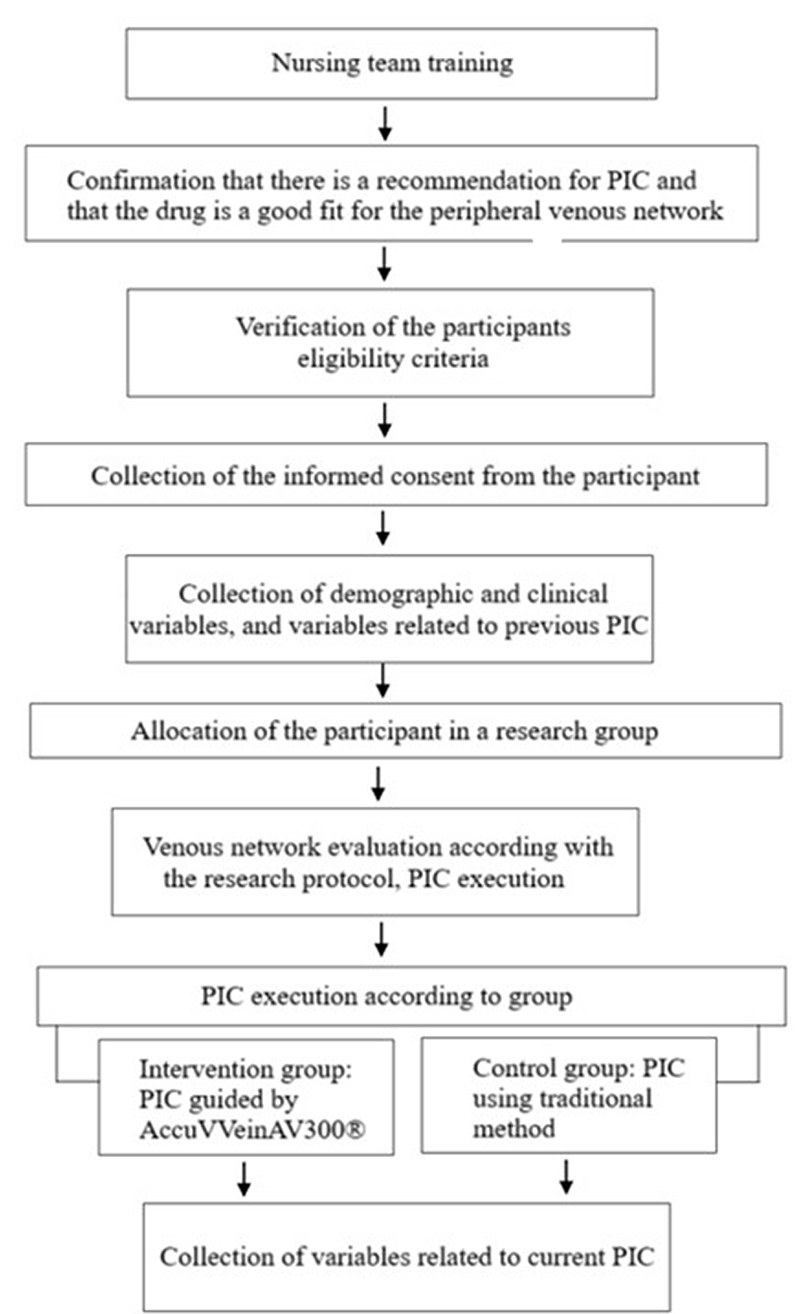
During the procedure, the researcher will collect variables associated to the current PIC, which will be registered by observing the procedure carried out by a nursing professional. To measure the length of the procedure, the researcher will use a chronometer and record the information. The nursing professional responsible for the procedure will also inform the researcher about the characteristics of the catheterized vein (visualization, palpability, mobility, and vein shape) and any new complications that emerge during the intravenous therapy, and the researcher will record the information in the research form. Figure 1 shows the flowchart of data collection.

Data analysis
Data analysis will be descriptive, univariate, and multiple. We will use the statistical software Social Package for the Social Sciences (SPSS), version 22.0, to construct the database and process the collected material. Two independent researchers will type in the data.
Absolute and relative frequencies will be presented for a descriptive analysis of categorical variables; for numerical variables, we will indicate the mean, median, quartiles, maximum and minimum values, as well as standard deviation, according to the distribution. The numerical variables will be submitted to the Shapiro-Wilk normality test to verify the distribution of the data.
In the univariate analysis of qualitative variables, the Chi-square or Fisher's Exact test will be used, with a significance level of 5% and a confidence interval of 95%. For numerical variables with normal distribution, the t-test will be used and, for asymmetric variables, the Mann-Whitney test. As a measure of frequency, the absolute risk will be calculated. In regard to association measures, we will calculate the relative risk and the Odds Ratio. Multiple analysis will be performed using survival analysis, as well as survival curves by the log-rank test, with a significance level of 5% and a confidence interval of 95%.
Ethical aspects
The study is supported by Law No. 14.874/2024 and Resolution No. 466/12, by the National Council of Health, regarding research involving human beings. We will take into consideration the dignity and autonomy of the human person, the social relevance of the study, and the balance between its risks and benefits.
Nevertheless, it is worth noting, in this regard, that the risks posed by this research are minimal, and mostly related to the possibility of the participant feeling uncomfortable with the use of AccuVeinAV300® during a PIC. The benefits of the research involve identifying whether this device can increase the success of PICs and reduce the time taken to perform the procedure.
The nursing workers who perform the CCT will be asked to sign an informed consent. Patient's or their legal representatives will also be asked to sign a consent for data collection.
This trial was approved by the Research Ethics Committee of the Universidade Federal de São Paulo (UNIFESP), under opinion number 6.951.413 and CAAE No. 65905222.6.0000.5505. It is also worth noting that this research has no funding, and the main researcher will bear any costs necessary for its execution. In this regard, it should be noted that there are no conflicts of interest.
The professionals responsible for the intervention and the study participants may, at any time, suspend their authorization to participate in the research. In this case, their autonomy will be immediately respected the data collected up to that point will be stored confidentially, but will not be used in the preparation of the research.
If the intervention shows no benefits regarding its first outcome or the frequency of serious adverse events, the study will be interrupted. A committee will be established to monitor and identify possible adverse events taking place during the research. It will be composed of three health professors with experience in RCT, knowledge in research ethics, and expertise in statistics. These professors are from the following institutions: Universidade do Estado da Bahia (UNEB), Universidade Estadual de Feira de Santana (UEFS), and Universidade Federal de São Paulo (UNIFESP).
After the research is complete, its results will be presented to the institution's managers and employees through the Education and Research Center of the university hospital.
The instruments used during data collection and the database will be stored for five years. After this period, the instruments in paper will be fragmented in order to make it impossible to identify them, and the database with the research information will be deleted.
Limitations
This study has some limitations, the main one being the impossibility of masking patients, nursing staff and researchers, an issue that is common in studies that use equipment. To minimize this limitation, the statistician and the parties responsible for typing in the findings will be blinded. Another important limitation is the fact that the study is being carried out in a single center, which may limit the possibility of generalizing the research results.
Acknowledgements
The present work was carried out with the support of the Universidade do Estado da Bahia (UNEB) through the Support Program for the Training of Teachers and Administrative Technicians, public notice No. 035/2023.
REFERENCES
-
1. Alexandrou E, Ray-Barruel G, Carr PJ, Frost SA, Inwood S, Higgins N, et al. Use of short peripheral intravenous catheters: characteristics, management, and outcomes worldwide. J Hosp Med. 2018;13:e1-7. https://doi.org/10.12788/jhm.3039
» https://doi.org/10.12788/jhm.3039 -
2. Piredda M, Biagioli V, Barrella B, Carpisassi I, Ghinelli R, Giannarelli D, et al. Factors affecting difficult peripheral intravenous cannulation in adults: a prospective observational study. J Clin Nurs. 2017;26:1074-84. https://doi.org/10.1111/jocn.13444
» https://doi.org/10.1111/jocn.13444 -
3. Rodríguez-Calero MA, Blanco-Mavillard I, Morales-Asencio JM, Fernández-Fernández I, Castro-Sánchez E, Pedro-Gómez JE. Defining risk factors associated with difficult peripheral venous Cannulation: a systematic review and meta-analysis. Heart Lung. 2020;49:273-86. https://doi.org/10.1016/j.hrtlng.2020.01.009
» https://doi.org/10.1016/j.hrtlng.2020.01.009 -
4. Shokoohi H, Loesche MA, Duggan NM, Liteplo AS, Huang C, Al Saud AA, et al. Difficult intravenous access as an independent predictor of delayed care and prolonged length of stay in the emergency department. J Am Coll Emerg Physicians Open. 2020;1:1660-68. https://doi.org/10.1002/emp2.12222
» https://doi.org/10.1002/emp2.12222 -
5. Nye M, Sweeny A, Watkins S, Ingold J, Sharwood P. Difficult vascular access in hospitalised patients: delays to treatment, cannulation attempts, and use of ultrasound. Vasc. Access. 2020;6:5-9. https://doi.org/10.1002%2Femp2.12222
» https://doi.org/10.1002%2Femp2.12222 -
6. Hart C, Weathers E. Near-infrared technology for improved PIVC placement: a clinical technology implementation model. Br J Nurs. 2024;33:S10-17. https://doi.org/10.12968/bjon.2024.33.7.S10
» https://doi.org/10.12968/bjon.2024.33.7.S10 -
7. Zhang Z, Wang X, Zhang L, Lou X, Su X, Wang X, et al. Infrared vein imaging for insertion of peripheral intravenous catheter for patients requiring isolation for Severe Acute Respiratory Syndrome Coronavirus 2 Infection: a nonrandomized clinical trial. J Emerg Nurs. 2022;48:159-66. https://doi.org/10.1016/j.jen.2021.10.001
» https://doi.org/10.1016/j.jen.2021.10.001 -
8. Nickel B, Gorski L, Kleidon T, Kyes A, Devries M, Keogh S, et al. Infusion Therapy Standards of Practice, 9th Edition. J Infus Nurs [Internet]. 2024 [cited 2024 Jul 17];47(1S):S1-2. Available from: https://journals.lww.com/journalofinfusionnursing/citation/2024/01001/infusion_therapy_standards_of_practice,_9th.1.aspx
» https://journals.lww.com/journalofinfusionnursing/citation/2024/01001/infusion_therapy_standards_of_practice,_9th.1.aspx -
9. Association for Vascular Access. The use of visualization technology for the insertion of peripheral intravenous catheters [Internet]. Association for Vascular Acess; 2021 [cited 2024 Aug 24]. Available from: https://www.avainfo.org/page/PositionPapers
» https://www.avainfo.org/page/PositionPapers -
10. AccuVein. Guia de utilização AccuVeinAV300® Portuguese [Internet]. New York: AccuVein; 2009 [cited 2024 May 24]. 10p. Available from: https://learn.accuvein.com/assets/cd/ifu/AV300OperatingGuide-pt.pdf
» https://learn.accuvein.com/assets/cd/ifu/AV300OperatingGuide-pt.pdf -
11. Fraifeld A, Thompson JA. Incorporating near infrared light vein visualization technology into peripheral intravenous access protocols. J Infus Nurs. 2023;46:313-9. https://doi.org/10.1097/nan.0000000000000523
» https://doi.org/10.1097/nan.0000000000000523 -
12. Aulagnier J, Hoc C, Mathieu E, Dreyfus JF, Fischler M, Le Guen M. Efficacy of AccuVein to facilitate peripheral intravenous placement in adults presenting to an emergency department: a randomized clinical trial. Acad Emerg Med. 2014;21:858-63. https://doi.org/10.1111/acem.12437
» https://doi.org/10.1111/acem.12437 -
13. Al-Saadi SF, Moonaghi HK, Al-Fayyadh S, Bakhshi M. Effect of near-infrared vein finder technology on success rate of cannulation in obese diabetic patients. Shiraz E Med J [Internet]. 2022 [cited 2024 Apr 22];23(7):e120908. Available from: https://www.researchgate.net/publication/360721019_Effect_of_Near-Infrared_Vein_Finder_Technology_on_Success_Rate_of_Cannulation_in_Obese_Diabetic_Patients
» https://www.researchgate.net/publication/360721019_Effect_of_Near-Infrared_Vein_Finder_Technology_on_Success_Rate_of_Cannulation_in_Obese_Diabetic_Patients -
14. Sriparkdee C, Sawangwong S, Curry P, Tatiyanupunwong S. A randomized controlled trial comparing the AccuVein AV400 device to standard insertion technique for peripheral intravenous cannulation by experienced nurse anesthetists in obese patients undergoing elective surgery. Tham Med J [Internet]. 2016 [cited 2024 Aug 31];16(4):546-52. Available from: https://he02.tci-thaijo.org/index.php/tmj/article/view/73661/0
» https://he02.tci-thaijo.org/index.php/tmj/article/view/73661/0 -
15. Chan AW, Tetzlaff JM, Altman DG, Laupacis A, Gøtzsche PC, Krleža-Jerić K et al. SPIRIT 2013 statement: defining standard protocol items for clinical trials. Ann Intern Med. 2013;38:200-7. https://doi.org/10.7326%2F0003-4819-158-3-201302050-00583
» https://doi.org/10.7326%2F0003-4819-158-3-201302050-00583 -
16. Oliveira APA, Urbanetto J de S, Caregnato RCA. National Early Warning Score 2: transcultural adaptation to Brazilian Portuguese. Rev Gaúcha Enferm. 2020;41:e20190424. https://doi.org/10.1590/1983-1447.2020.20190424
» https://doi.org/10.1590/1983-1447.2020.20190424 -
17. Bahl A, Johnson S, Alsbrooks K, Mares A, Gala S, Hoerauf K. Defining difficult intravenous access (DIVA): a systematic review. J Vasc Access. 2021;24:904-10. https://doi.org/10.1177/11297298211059648
» https://doi.org/10.1177/11297298211059648 -
18. Agência Nacional de Vigilância Sanitária (Anvisa). Nota técnica no 04/2022. Práticas seguras para a prevenção de incidentes envolvendo cateter intravenoso periférico em serviços de saúde [Internet]. Brasília: GVIMS/GGTES/DIRE3/ANVISA; 2022 [cited 2024 Aug 31]. Available from: https://portaldeboaspraticas.iff.fiocruz.br/atencao-recem-nascido/nt4-cateter-intravenoso-anvisa-2022
» https://portaldeboaspraticas.iff.fiocruz.br/atencao-recem-nascido/nt4-cateter-intravenoso-anvisa-2022 -
19. Zingg W, Barton A, Bitmead J, Eggimann P, Pujol M, Simon A, et al. Best practice in the use of peripheral venous catheters: a scoping review and expert consensus. Infect Prev Pract. 2023;5:100271. https://doi.org/10.1016/j.infpip.2023.100271
» https://doi.org/10.1016/j.infpip.2023.100271 - 20. Santos LM. Estudo clínico, randômico e controlado sobre o efeito da transiluminação no sucesso da cateterização intravenosa periférica em crianças [Tese]. São Paulo (SP): Universidade Federal de São Paulo; 2021.
-
21. Papageorgiou SN. On the sample size of clinical trials. J Orthod. 2018;45:210-2. https://doi.org/10.1080/14653125.2018.1501929
» https://doi.org/10.1080/14653125.2018.1501929 -
22. Corley A, Ullman AJ, Marsh N, Larsen EN, Mihala G, Harris PNA, et al. SECUREment bundles to prevent peripheral intravenous catheter failure-the SECURE-PIVC trial: study protocol for a pilot randomized controlled trial. Br J Nurs [Internet]. 2020 [cited 2024 Aug 31];29(19):S40-S46. Available from: https://www.britishjournalofnursing.com/content/canadian-vascular-access-association/securement-bundles-to-prevent-peripheral-intravenous-catheter-failure-the-secure-pivc-trial-study-protocol-for-a-pilot-randomized-controlled-trial
» https://www.britishjournalofnursing.com/content/canadian-vascular-access-association/securement-bundles-to-prevent-peripheral-intravenous-catheter-failure-the-secure-pivc-trial-study-protocol-for-a-pilot-randomized-controlled-trial -
23. Pittiruti M, Van Boxtel T, Scoppettuolo G, Carr P, Konstantinou E, Ortiz Miluy G, et al. European recommendations on the proper indication and use of peripheral venous access devices (the ERPIUP consensus): a WoCoVA project. J Vasc Access. 2023;24:165-82. https://doi.org/10.1177/11297298211023274
» https://doi.org/10.1177/11297298211023274 -
24. Yılmaz H, Yücel ŞÇ, Ergin E, Bağcı H, Khorshid L. Does the use of infrared technology (AccuVein AV-500®) for Peripheral Intravenous Cannulation (PIVC) increase the success rate in nursing students? a randomized controlled trial. Nurse Educ Today. 2022;108:105179. https://doi.org/10.1016/j.nedt.2021.105179
» https://doi.org/10.1016/j.nedt.2021.105179 -
25. Rochlen LR, Putnam E, Levine R, Tait AR. Mixed reality simulation for peripheral intravenous catheter placement training. BMC Med Educ. 2022;22:876. https://doi.org/10.1186/S12909-022-03946-Y
» https://doi.org/10.1186/S12909-022-03946-Y -
26. Arslan S, Kuzu Kurban N, Takmak Ş, Şanlialp Zeyrek A, Öztik S, Şenol H. Effectiveness of simulation-based peripheral intravenous catheterization training for nursing students and hospital nurses: a systematic review and meta-analysis. J Clin Nurs. 2022;31:483-96. https://doi.org/10.1111/jocn.15960
» https://doi.org/10.1111/jocn.15960 -
27. Monteiro DAT, Torre-Monteiro JC, Nicolussi AC, Reis RK, Barbosa MH, Toffano SM, et al. Prevalence of and factors associated with difficult peripheral venipuncture in adult surgical patients. J Vasc Access. 2020;22:112972982093933. https://doi.org/10.1177/1129729820939335
» https://doi.org/10.1177/1129729820939335 -
28. Santos-Costa P, Sousa LB, Van Loon FHJ, Salgueiro-Oliveira A, Parreira P, Vieira M, et al. Translation and validation of the modified a-diva scale to European Portuguese: difficult intravenous access scale for adult patients. Int J Environ Res Public Health. 2020;17(20):1-11. https://doi.org/10.3390%2Fijerph17207552
» https://doi.org/10.3390%2Fijerph17207552
The dataset may be accessed upon request to the corresponding author.

 Source: Created by the authors.