 Hidden diversity of Salvinia (Salviniaceae) revealed by molecular identification in a Neotropical floodplain
Abstract
Salvinia species are important to aquatic ecosystems but challenging to identify in the field due to their morphological similarities. In the upper Paraná River basin, Salvinia auriculata, Salvinia herzogii, and Salvinia minima are among the most abundant aquatic plants. For this reason, this study aimed to confirm the identification of these species using molecular markers ITS (nuclear) and trnL-trnF (chloroplast). Genetic distances, phylogenetic analysis, and molecular delimitation were applied to group sequences into Molecular Operational Taxonomic Units (MOTUs). Results showed that S. auriculata formed a single MOTU, while S. herzogii clustered with S. molesta from GenBank, indicating a new occurrence of S. molesta in the region. One S. minima specimen was confirmed, while another was identified as S. natans, marking the first record of this species in Brazil. The identification of S. herzogii as S. molesta accentuate the challenge of distinguishing these species without the sorophore. The presence of S. natans in sympatry with S. minima is concerning due to its invasive potential. The study highlights the importance of molecular techniques in distinguishing morphologically similar species.
Key words:
aquatic macrophyte; fern; molecular markers; species delimitation
Resumo
As espécies do gênero Salvinia são importantes para os ecossistemas aquáticos, mas a sua identificação em campo é difícil devido às suas semelhanças morfológicas. Na bacia do alto Rio Paraná, Salvinia auriculata, Salvinia herzogii e Salvinia minima estão entre as macrófitas aquáticas mais abundantes. Este estudo teve como objetivo confirmar a identificação dessas espécies utilizando os marcadores moleculares ITS (nuclear) e trnL-trnF (cloroplastidial). Foram analisadas distâncias genéticas, filogenia e delimitação molecular para agrupar as sequências em Unidades Taxonômicas Operacionais Moleculares (MOTUs). Os resultados mostraram que S. auriculata formou um único MOTU, enquanto S. herzogii se agrupou com S. molesta do GenBank, indicando uma nova ocorrência de S. molesta na região. Um espécime de S. minima foi confirmado, enquanto outro foi identificado como S. natans, representando o primeiro registro dessa espécie no Brasil em áreas naturais. A identificação de S. herzogii como S. molesta ressalta o desafio de distinguir essas espécies na ausência do soróforo. A presença de S. natans em simpatria com S. minima é preocupante devido ao seu potencial invasor. O estudo destaca a importância das técnicas moleculares na distinção de espécies morfologicamente semelhantes e no registro de novas ocorrências.
Palavras-chave:
macrófitas aquáticas; samambaias; marcadores moleculares; delimitação de espécies
Introduction
Salvinia (Salviniaceae) is a heterosporous monilophyte with approximately 12 species distributed worldwide, being South America the most diverse region for Salvinia, with about 10 species occurring in Brazil (Mitchell & Thomas 1972; Miranda & Schwartsburd 2019). Salvinia are free-floating aquatic macrophytes with two floating leaves and one submerged leaf per node. The floating leaves are densely covered with trichomes, which make them highly water-repellent, while the submerged leaf bears the reproductive structure known as the sorophore (Nagalingum et al. 2008). The arrangement of sorophore is a key trait for accurately identifying species, although trichome shape and floating leaf morphology can also aid in this task (Nagalingum et al. 2008; Miranda & Schwartsburd 2019).
Trichomes are among the most notable vegetative structures in Salvinia due to their diverse arrangements, shapes, and sizes, making them valuable morphological characters for distinguishing species and forming taxonomic groups (Barthlott et al. 2009; van Valkenburg et al. 2023). One example of this is the Salvinia auriculata complex, which includes four taxa: Salvinia auriculata Aubl., Salvinia biloba Raddi, Salvinia herzogii de la Sota, and Salvinia molesta D. Mitch. (Mitchell & Thomas 1972). These taxa are grouped within the Salvinia auriculata complex because they possess four trichomes fused at the apex, forming a distinctive “eggbeater” shape (Mitchell & Thomas 1972). However, the taxa within this complex exhibit strikingly similar vegetative structures, which can lead to misidentification.
The occurrence of Salvinia species and other macrophytes has been monitored in the upper Paraná River basin, particularly in the upper Paraná River floodplain (planície de inundação do alto Rio Paraná - PIAP) by a long-term Ecological Research Program. During this monitoring, Salvinia herzogii, S. auriculata, and Salvinia minima Baker have frequently been recorded (Souza et al. 2017), but with uncertain identification due to their close morphological similarities. In these environments, Salvinia is one of the most abundant macrophytes (Casatti et al. 2003; Souza et al. 2017), playing significant ecological roles in supporting communities of Ostracod, Protists, and fishes (Pelicice & Agostinho 2006; Alves et al. 2010; Higuti & Martens 2014). Another area adjacent to the PIAP where Salvinia is abundant and ecologically important is the Rosana’s Reservoir (Casatti et al. 2003; Pelicice & Agostinho 2006; Ferrareze et al. 2014). Some studies in this area have not identified Salvinia individuals at the species level (Casatti et al. 2003; Pelicice & Agostinho 2006; Ferrareze et al. 2014), while others refer to Salvinia in the reservoir as S. herzogii (Thomaz et al. 2012; Silveira & Harthman 2024). Despite the ecological importance of this genus in these environments, no studies have been dedicated exclusively to confirm species identities in the region. Additionally, it is rare to find Salvinia individuals with sorophore, which compromises accurate species identification.
Molecular markers have helped in species delimitation for plants with few diagnostic morphological characters, as in the case of Salvinia (Hollingsworth et al. 2011; Perkins 2019). Molecular species delimitation methods test hypotheses based on genetic (species as entities sharing nucleotide sequence similarities) and phylogenetic (species as entities sharing a common ancestor in phylogeny) concepts, resulting in Molecular Operational Taxonomic Units (MOTUs) (Blaxter et al. 2005). For example, the Assemble Species by Automatic Partition (ASAP) method (Puillandre et al. 2021) uses genetic concepts to delimit species based on genetic distance, while the Poisson Tree Processes (PTP) method uses phylogenetic concepts to delimit species based on phylogenetic positioning (Zhang et al. 2013). Both methods have been useful in delineating morphologically similar plant species (Ji et al. 2021; Jiang et al. 2024).
Studies utilizing molecular markers for Salvinia taxonomy and systematics are scarce, as most of them have used Salvinia in a broader context of monilophytes (Hasebe et al. 1995; Pryer 1999; Shen et al. 2018) or as an outgroup for Azolla, a sister-genus of Salvinia (Reid et al. 2006; Metzgar et al. 2007). To our knowledge, only three studies have exclusively used molecular markers to study Salvinia species: two used cpDNA markers to examine phylogenetic relationships within the genus (Nagalingum et al. 2008; Machado et al. 2016), and one used plastome markers to trace the origin of invasive populations of S. molesta in the United States (Holt Jr. et al. 2023). Thus, molecular delimitation methods for distinguishing Salvinia species have not yet been applied, which could provide valuable data for understanding relationships among morphologically similar species and reveal cryptic species.
For Salvinia species occurring in the upper Paraná River basin (S. auriculata, S. herzogii, and S. minima), we suspect that the main problem lies in identifying S. herzogii. According to Miranda & Schwartsburd (2019), S. herzogii closely resembles S. biloba and S. molesta, and they can only be distinguished by subtle differences in leaf incision and submerged leaf length in the absence of sorophore. Furthermore, the close phylogenetic positioning between S. herzogii and S. biloba, and the possibility that one of these species may be the progenitor of S. molesta (Miranda & Schwartsburd 2019; Holt Jr. et al. 2023), could explain the difficulty in morphological delimitation, which may also be reflected at the molecular level. On the other hand, although S. auriculata belongs to the same morphological complex as S. herzogii, S. biloba, and S. molesta, its larger leaf dimensions and the absence of leaf incision are distinguishing traits that allow for its identification even in the absence of sorophore. Likewise, S. minima is characterized by its smaller leaves and an ungulate-like trichome type (four unconnected trichomes at the apex), which differentiates this specie from both S. auriculata and S. herzogii (see Miranda & Schwartsburd 2019 for details on morphological differences among Salvinia species in Brazil).
Therefore, we aim to use the nuclear DNA (nrDNA) Internal Transcribed Spacer (ITS) and cpDNA trnL-trnF markers, both widely used in molecular identification and phylogenetic studies in plants (Hollingsworth et al. 2011; Lucio et al. 2019; Scorsim et al. 2024) to confirm the identification of S. auriculata, S. herzogii, and S. minima in the PIAP and Rosana’s Reservoir, both located in the upper Paraná River basin. This study analyzed genetic distance, phylogenetic positioning, and applies molecular species delimitation tests.
Material and Methods
Salvinia’s samples
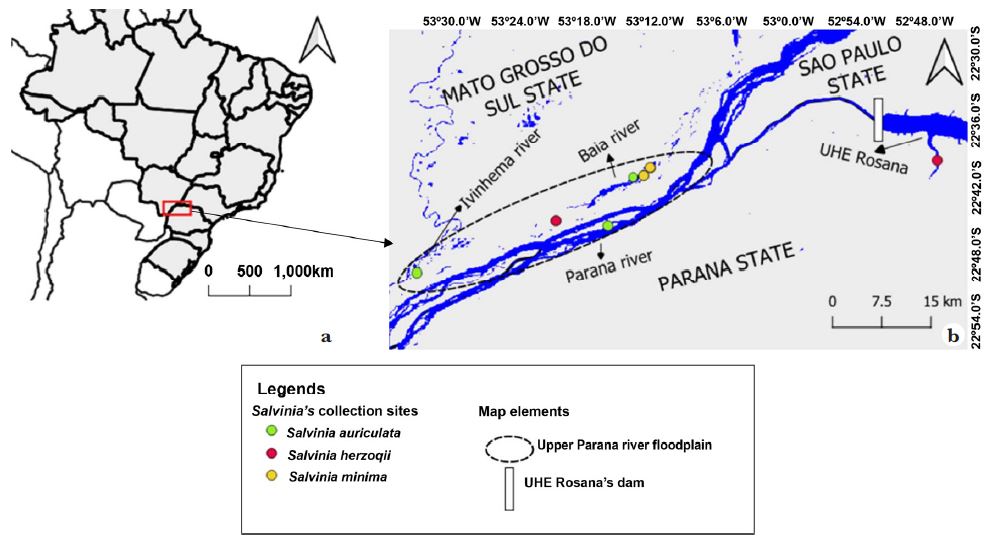
Salvinia specimens were collected in the upper Paraná River floodplain (Planície de inundação do alto Rio Paraná PIAP, 22º38’-22º57’S and 53º05’-53º36’W) located in the boundary between northwest of Paraná state and southeast of Mato Grosso do Sul state, and in the Rosana’s Reservoir (22°36’7”S, 52°52’20”W) localized in São Paulo state, between September 2022 and June 2023 (Fig. 1a-b). The PIAP constitute the Site 6 of the National Long-Term Ecological Research Program (Programa Ecológico de Longa Duração PELD, Site 6), and is the only stretch free of dams of the upper Paraná River basin, extending 230 kilometers, and reaching up to 20 kilometers in width (Agostinho & Zalewski 1996), where the presence of S. auriculata, S. herzogii, and S. minima has been recorded (Souza et al. 2017). The Rosana’s Reservoir is part of a hydroelectric power plant that contains extensive shallow areas along the main channel and tributaries, forming suitable habitats for colonization by aquatic macrophytes, with S. herzogii being the species from this genus present in the area and one of the most abundant among other macrophyte species (Thomaz et al. 2012).
a-b. Map showing the sampled sites of Salvinia specimens in the upper Paraná river floodplain and in the Rosana’s reservoir - a. Brazil; b. sites in the Paraná River floodplain and in the Rosana’s reservoir where the Salvinia’s specimens were collected for the DNA extraction and which PCR was successfully conducted. UHE = Hydroelectric basin. The specimens showed in the map legends refers to the field identification.
In these environments, 9 specimens were collected and identified in the field as S. auriculata, S. herzogii, and S. minima (Tab. 1). Access to the genetic heritage of these specimens was authorized by the National System for the Management of Genetic Heritage and Associated Traditional Knowledge (SisGen - registration number A76372D). The collection of biological material was authorized by the Sistema de Autorização e Informação da Biodiversidade (Biodiversity Information and Authorization Sistem - SISBIO) under 52596-5 license.
Salvinia’s specimens collected in the upper Paraná river floodplain and in the Rosana’s reservoir with their coordinates. The species showed in the table refers to the field identification. ID = Specimens code for genetic analysis; MS = Mato Grosso do Sul state; PR = Parana state.
The Salvinia specimens collected in this study and used for genetic analyses were prepared using standard herbarium techniques: labelled and numbered, then placed between folded newspaper sheets. The drying of pressed materials was conducted in ovens at 50 °C, with periodic checks to ensure complete drying. The specimens were then mounted as herbarium sheets after drying and registered in the State University of Maringá Herbarium (HUEM).
DNA extraction and quantification
For molecular analysis, leaf tissue samples of Salvinia collected in the field were preserved in Falcon tubes with TE buffer at pH 8.0 [Tris-HCl (1M), EDTA (0.5mM)]. Total DNA was extracted using the Promega Wizard® Genomic DNA Extraction Kit according to the manufacturer’s instructions, with liquid nitrogen for mechanical leaf maceration. The concentration of the extracted DNA was estimated using a NanoDrop™ Lite spectrophotometer.
Amplification
In this study, we analyzed the ITS (internal transcribed spacer) and trnL-trnF loci (spacer between the chloroplast genes tRNALeu and tRNAPhe). Both regions were partially amplified using the primers ITS 5a-F (5’-TATCATTTAGAGGAAGGAG-3’) and ITS 4-R (5’-GCATATCAATAAGCGGAGGA-3’) (Baldwin 1992) for ITS, and trn-c-F (5’-GGAAATCGGTAGACGCTACG-3’) and trn-f-R (5’-ATTTGAACTGGTGACACGAG-3’) (Reid et al. 2006) for trnL-trnF. Polymerase chain reaction (PCR) was conducted in a total volume of 25 µL, containing 10 ng of DNA, 1x Tris-KCl reaction buffer [20 mM Tris-HCl (pH 8.4), 50 mM KCl], 1.5 mM MgCl₂, primers (2.5 µM each), dNTPs (0.1 mM each), and 0.5 U Platinum™ Taq DNA Polymerase.
The amplification protocol for the ITS locus consisted of 35 cycles, with denaturation at 94 °C for 30 seconds, annealing at 55 °C for 30 seconds, and polymerization at 72 °C for 1 minute. After the 35 cycles, a final extension was performed at 72 °C for 5 minutes to complete fragment extension. For the trnL-trnF locus, the amplification protocol started with 4 minutes at 92 °C, followed by 40 cycles of denaturation at 94 °C for 15 seconds, annealing at 59 °C for 30 seconds, and polymerization at 72 °C for 2 minutes, with a final extension of 10 minutes at 72 °C to complete fragment extension. PCR products were then analyzed in 1% agarose gel and purified following the protocol by Rosenthal et al. (1993). Sequencing reactions were carried out using the BigDye Terminator kit. Sequencing was performed by a private company using an AB-3500 automated sequencer.
Sequences edition, alignment and genetic distance
The nucleotide sequences of Salvinia from this study were edited using the BioEdit software (Hall 1999). After editing, we included all available Salvinia sequences from GenBank for the ITS (4 sequences) and trnL-trnF (12 sequences) regions in the analyses, and the Salvinia sequences from the work of Machado et al. (2016) that are not available in Genbank but were provided by the authors [see Tab. S1 (available on supplementary material <https://doi.org/10.6084/m9.figshare.29156225.v1>) for details about the sequences used in this work]. All sequences were aligned by the Clustal W implemented in MEGA11 software, where we also calculated the corrected genetic distance using the Kimura 2-parameter (K2P) model (Tamura et al. 2013). Additionally, the Salvinia sequences from this study were submitted to the BLASTn tool on the NCBI platform (<https://www.ncbi.nlm.nih.gov/genbank/>).
Phylogenetic analysis, molecular species delimitation and haplotypic diversity
To evaluate the phylogenetic position of Salvinia species from PIAP and the Rosana reservoir concerning other species within the genus, a gene tree was constructed using the Maximum Likelihood statistical method on the IQTREE online server (<http://iqtree.cibiv.univie.ac.at/>), in which the optimal nucleotide substitution model was also determined. We selected 1,000 ultrafast bootstraps (Minh et al. 2013) to assess branch support. Azolla sequences (JX297320 for ITS and HQ909788 for trnL-trnF) were chosen as outgroups. The resulting topology was visualized and edited on the iTOL online server (<https://itol.embl.de/>).
All Salvinia sequences for the trnL-trnF and ITS markers were employed to perform molecular species delimitation tests, with the resulting clusters grouped into Molecular Operational Taxonomic Units (MOTU). We selected two molecular species delimitation methods which differ in their methodologies to compare their congruences and identify the best-fitting hypothesis for our dataset: Assemble Species by Automatic Partition (ASAP, <https://bioinfo.mnhn.fr/abi/public/asap/asapold.html>) (Puillandre et al. 2021), based on genetic distance; and the Poisson Tree Processes (PTP) method, performed on the server <https://species.h-its.org/ptp/>, a tree-based approach (Zhang et al. 2013). Additionally, to determine whether sequences within the same MOTU exhibit sufficient divergence to be segregated by nucleotide composition, we performed a haplotypic characterization using DnaSP v5 software (Librado & Rozas 2009).
Results
BLASTn and genetic distance
We obtained a fragment of 722 base pairs (bp) for trnL-trnF and 682 bp for ITS after edition and alignment. PCR amplification was more successful for the trnL-trnF marker, with at least two individuals of each Salvinia species collected to be successfully amplified. For ITS, two individuals of S. auriculata and two individuals of S. minima were successfully amplified.
According to BLASTn results, identity percentages generally remained above ~98% for both markers used in the analyzed specimens. The exception was the specimens identified in the field as S. auriculata, which showed maximum identity percentages of ~94% with S. molesta sequences (ITS) and ~94% to ~97% with S. oblongifolia sequences (trnL-trnF). For specimens identified as S. herzogii, both individuals (S6 and S7) showed identity percentages of 99.40% and 98.68%, respectively, with S. molesta sequences for trnL-trnF. Regarding S. minima, individual S8 exhibited high nucleotide similarity with other S. minima sequences in GenBank for both ITS (98.64%) and trnL-trnF (99.15%), while individual S9 showed high nucleotide similarity with S. natans for ITS (99.20%). Photographs of some Salvinia specimens analyzed in this study are available in Figure S1 (available on supplementary material <https://doi.org/10.6084/m9.figshare.29156225.v1>).
Concerning the K2P genetic distance for ITS (Tab. 2), individuals morphologically identified as S. auriculata (S1 and S5) showed values exceeding 15% in relation to other analyzed species and differed from each other by 3.2%. The S. minima individuals (S8 and S9) displayed a genetic distance of 13.8% from each other. The specimen S8 differed by 0.8% from S. minima (DQ522290.1), while specimen S9 had zero genetic distance from S. natans (AF448791).
Genetic distance matrix calculated by Kimura-2-parameter (K2P) model between the sequences of Salvinia from the upper Paraná basin (bold) and other sequences available in Genbank for ITS region.
For trnL-trnF (Tab. 3), the minimum K2P genetic distance between individuals identified as S. auriculata (S1~S5) and the other sequences analyzed in our study is 1.4%, while the distance among S. auriculata individuals ranges from 0 to 1%. Specimens S6 and S7 identified as S. herzogii had zero genetic distance from the three S. molesta sequences in GenBank (EU269688, EU269689, and MW017464) and showed a value of 0.6% compared to the S. herzogii sequence from Machado et al. (2016). The S. minima specimen S2 had a genetic distance of 0.2% and 0.6% with S. minima sequences in GenBank (EU269687 and EU269686) and an unidentified sequence (DQ066503). It is noteworthy that the genetic distance values calculated for trnL-trnF were both intra and interspecifically lower than ITS.
Genetic distance matrix calculated by Kimura-2-parameter (K2P) model between the sequences of Salvinia from the upper Parana basin (bold) and other sequences available in Genbank for trnL-trnF region.
Phylogenetic analysis and molecular delimitation
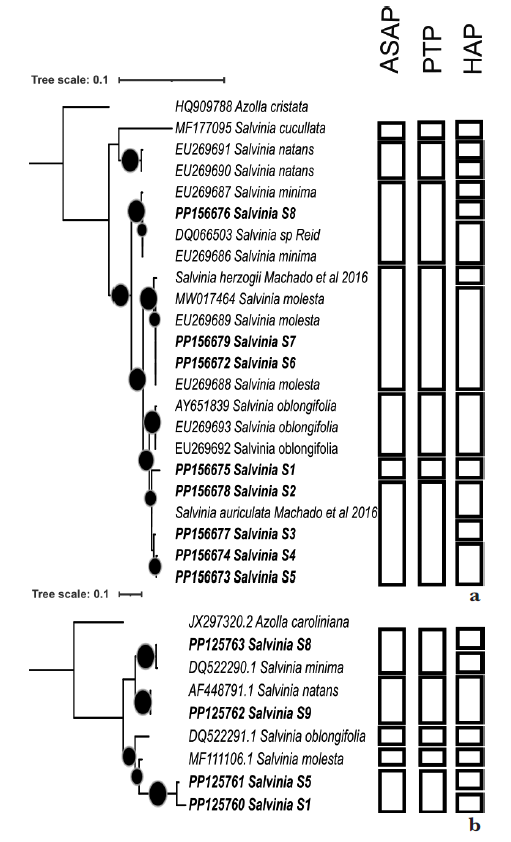
The best nucleotide substitution models were TPM3+F+I and HKY+F+G4, selected for the trnL-trnF and ITS gene trees, respectively (Fig. 2a-b). It is important to note that sequences for S. herzogii and S. cucullata are only represented for the trnL-trnF marker due to data availability in public databases.

a-b. Gene tree and molecular operational taxonomic units built for Salvinia based on trnL-trnF (a) and ITS (b) regions for individuals sampled in the upper Paraná river basin (bold) and other Salvinia sequences available in GenBank. Black circles represent a range of bootstrap values from 70 (minimum circle size) to 100 (maximum circle size). ASAP = Assemble Species by Automatic Partitioning; PTP = Poisson Tree processes; HAP = haplotype.
In the tree based on the trnL-trnF region (Fig. 2a), the S. minima sequences from GenBank and Salvinia S8 were grouped into the same clade and defined as a single MOTU with three haplotypes. The specimens identified in the field as S. herzogii (S6 and S7) were clustered with S. molesta sequences from GenBank and S. herzogii from Machado et al. (2016) into a single MOTU, with S. herzogiiMachado et al. (2016) representing a unique haplotype. Finally, a clade was formed exclusively by the specimens identified in the field as S. auriculata (S1 to S5) and S. auriculata from Machado et al. (2016). In this case, two MOTUs were detected: one consisting of the Salvinia S1 sequence, and the other containing the remaining sequences from the group.
In the gene tree based on the ITS region (Fig. 2b), the sequences from specimens identified in the field as S. minima (S8 and S9) were placed separately. Salvinia S9 and S. natans (AF448791) were clustered together into a single MOTU, sharing the same haplotype. The sequences from Salvinia S8 and S. minima (DQ522290) also formed a single MOTU, but with two unique haplotypes. This suggests that the genetic variation is not sufficient to distinguish them as separate species. Molecular delimitation methods identified S. oblongifolia, S. molesta, and two sequences from specimens identified in the field as S. auriculata (S1 and S5) as distinct MOTUs. Although there is genetic variation between S1 and S5 evidenced by the presence of two unique haplotypes, both molecular delimitation methods grouped them into a single MOTU, indicating that this variation is not enough to treat them as separate species on a molecular level.
Discussion
In this study, we used the nuclear (ITS) and chloroplast (trnL-trnF) molecular markers to identify Salvinia species occurring in the upper Paraná River basin, specifically in the floodplain environments of the upper Paraná River and the Rosana’s reservoir. The results confirmed the field identification of one of the S. minima specimens. However, although there is evidence that the molecular data support the previous identification of the S. auriculata specimens by forming a single MOTU and exhibiting higher genetic distances from other sequences than from each other, it is not possible to confirm their molecular identification, as no other S. auriculata sequences are available in GenBank for comparison. Nonetheless, the results revealed new occurrences, enriching the knowledge about the diversity of this genus in the region. This is because two specimens identified in the field as S. herzogii were molecularly delimited as S. molesta, and one of the specimens identified in the field as S. minima is genetically identical to sequences of S. natans.
Molecular identification
The specimens identified as S. auriculata and the other sequences in this study show the highest genetic distance compared to the intraspecific distance for the species. Thus, although there is no molecular data for S. auriculata available in the database, the high genetic distance in relation to the other groups corroborates the distinction of S. auriculata with the other analyzed species. While S. auriculata is part of a species complex with S. molesta, S. herzogii, and S. biloba, sharing the characteristic eggbeater shaped trichomes, it can be easily distinguished from the others by its larger size and the absence of an incision at the leaf apex (Miranda & Schwartsburd 2019), which facilitates its identification in the field, even in the absence of sorophore. The haplotype diversity found among S. auriculata sequences for cpDNA may indicate that somatic mutations are being fixed in the population (Scorsim et al. 2023; Lucio et al. 2024).
On the other hand, the molecular data did not confirm the field identification of the S. herzogii specimens (S6 and S7), as both sequences were placed within the same MOTU as S. molesta sequences from GenBank. According to Miranda & Schwartsburd (2019), S. biloba, S. molesta, and S. herzogii are very similar in vegetative structures. In S. biloba, the leaf apex of floating leaves has an incision that reaches 1/2 of the leaf length, with short papillae on the abaxial side and 3 or 4 short trichomes at the apex, while the adaxial side is glabrous. Both S. herzogii and S. molesta are somewhat distinct from S. biloba, but vegetatively identical to each other: their leaf apex of floating leaves incision reaches 1/3 of the leaf length, they possess short papillae, and 3 or 4 trichomes fused at the apex. The sorophore is the only feature that allows their distinction (Miranda & Schwartsburd 2019). Therefore, differentiating S. herzogii and S. molesta in the field is virtually impossible in the absence of sorophore.
Even assuming the accuracy of the species identification in genetic databases, the locality of the S. molesta specimens in GenBank (Costa Rica and India; Tab. S1, available on supplementary material <https://doi.org/10.6084/m9.figshare.29156225.v1>) is inconsistent with the current knowledge of the geographical distribution of S. herzogii and S. biloba, both of which are endemic to southeastern Brazil (Miranda & Schwartsburd 2019), whereas S. molesta is an invasive species widely distributed across the globe (Holt Jr. et al. 2023). Thus, there is evidence to confirm the occurrence of S. molesta in the PIAP and in the Rosana’s reservoir. However, it is not possible to assert that all specimens previously identified as S. herzogii are S. molesta due to the lack of collections, especially of individuals with sorophore.
Additionally, the sequences of Salvinia S6 and S7 are genetically identical to other S. molesta sequences in GenBank, despite their geographical distance. This genetic uniformity may be explained by the hypothesis that S. molesta is a hybrid species that reproduces exclusively in vegetative ways, as it does not produce viable spores (Loyal & Grewal 1996). Another issue to consider is that the sequence of the S. herzogii specimen from Machado et al. (2016) forms a distinct haplotype from S. molesta but still belongs to the same MOTU. The morphological similarity, sympatric geographical distribution, and phylogenetic proximity between S. herzogii and S. molesta (Machado et al. 2016; Miranda & Schwartsburd 2019) suggest that a very recent speciation process may have occurred in this group’s evolutionary history, making it difficult to distinguish them both morphologically and molecularly (Holt Jr. et al. 2023). However, it is not possible to confirm the identification of S. herzogii sequence from Machado et al. (2016).
Finally, the molecular delimitation results for the specimens Salvinia S8 and S9, identified in the field as S. minima, provided new insights. While Salvinia S8 was molecularly identified as S. minima for both ITS and trnL-trnF, Salvinia S9 was molecularly delimited as S. natans based on ITS. The confusion in field identification between these species had not been previously addressed because, to our knowledge, this is the first record of S. natans in Brazilian natural areas and occurring in sympatry with S. minima. The commonly used morphological characters to distinguish S. minima from other Salvinia species in the field are the ungulate-type trichomes (four free trichomes at the apex; Miranda & Schwartsburd 2019) and their smaller size. However, S. natans also possesses ungulate type trichomes and similar dimensions to S. minima (Barthlott et al. 2009; Miranda & Schwartsburd 2019; World Flora Online, <https://www.worldfloraonline.org/taxon/wfo-0001117304>), making it relatively difficult to distinguish them in the field.
ITS with more intra-interspecific distance than trnL-trnF
The use of molecular markers, combined with new species delimitation tools, has been instrumental in recognizing species that are difficult to identify based solely on morphological traits (Hollingsworth et al. 2011), as is the case with Salvinia. However, unlike animals where the COI molecular marker serves as an effective DNA barcode, the complex evolutionary history of plants, which involves hybridizations and polyploidy, makes it challenging to establish universal molecular markers (Hollingsworth et al. 2011). In terms of nuclear genome usage, the ITS region is the most employed in molecular studies of aquatic plants (Scorsim et al. 2024) and is widely used in plant molecular phylogenetic studies, molecular discrimination and identification, as well as assessing the genetic variability within populations (Diamante et al. 2020; Scorsim et al. 2023; Lucio et al. 2024).
In the analysis presented, the ITS region of nuclear ribosomal DNA showed higher intra- and interspecific distance values compared to the chloroplast marker trnL-trnF. This indicates that ITS is a better candidate as a DNA barcode for Salvinia than trnL-trnF, as higher intra- and interspecific distance values enhance the discriminatory power of the molecular marker to identify closely related species (Hollingsworth et al. 2011).
Incongruences between cpDNA and nrDNA gene tree
The phylogenetic reconstruction of Salvinia species using ITS and trnL-trnF reveals divergent topologies. On one hand, our trnL-trnF gene tree aligns with previous cpDNA and plastome-based phylogenies, supporting the division of Salvinia into distinct Neotropical and Eurasian clades (Naglagium et al. 2008; Machado et al. 2016; Holt Jr. et al. 2023). Additionally, our findings confirm the lack of phylogenetic support for the Salvinia auriculata complex based on trnL-trnF, since S. auriculata clustered with S. oblongifolia, and S. molesta and S. herzogii formed a separate clade (Machado et al. 2016). On the other hand, our ITS gene tree supports the monophyly of the Salvinia auriculata complex, placing S. auriculata and S. molesta in a distinct clade from S. oblongifolia. Furthermore, Salvinia species did not form biogeographically cohesive clades in the ITS gene tree, as S. minima and S. natans were grouped together.
Due to the biparental inheritance of the nuclear genome, the ITS marker can detect genetic recombination and hybridization events (Grimm & Denk 2008). Consequently, incongruences between nuclear and plastid gene trees are common (Toro-Nuñez et al. 2013; Favro et al. 2022). Possible explanations for these discrepancies include hybridization or incomplete lineage sorting (Wang et al. 2014). The comparison between the ITS and trnL-trnF gene trees suggests that hybridization has played a significant role in the evolutionary history of this genus. However, the limited availability of molecular data for ITS, compared to plastid regions, constrains deeper inferences about the impact of hybridization on Salvinia evolution.
Ecological implications
The use of molecular data revealed that the two individuals of S. herzogii analyzed in the PIAP and Rosana’s reservoir are S. molesta. In the same way, one of the two individuals of S. minima studied in PIAP was molecularly identified as S. natans. These findings suggest that previous known taxonomic diversity of the genus in upper Paraná River has been underestimated, underscoring the importance of using molecular markers to aid in species identification - an approach with significant ecological implications for the genus in this region.
For instance, the presence of S. molesta presents opportunities to study its ecological characteristics. As previously mentioned, this species is considered an aggressive invader in many regions worldwide (Martin et al. 2018; Holt Jr. et al. 2023). Therefore, studying how S. molesta interacts with co-occurring macrophyte species and other aquatic organisms, as well as exploring genetic aspects (such as haplotype diversity) in its native habitat, will provide valuable data for comparing these same ecological and genetic attributes in S. molesta populations from introduced areas. Such studies can help clarify the species invasion mechanisms and improve the development of appropriate management strategies.
However, the presence of S. natans in the PIAP is a concerning new occurrence, as this species is native to Europe and Asia and can be considered exotic (Zutshi & Vass 1971; POWO 2025). Even some Brazilian studies have reported the use of this species from cultivated populations in research centers for experimental purposes (Lima et al. 2016), this is the first study to report its presence in natural areas with support of molecular data. In experimental studies, S. natans seems to be a strong competitor under conditions of high nutrient concentration and elevated temperatures, being a potentially invasive species (Netten et al. 2010; Zhang et al. 2020). Consequently, its presence in the PIAP, a tropical region where temperatures are higher than in its native temperate areas, coupled with the constant anthropogenic pressure in flooded environments that negatively affect ecosystem functions (Moi et al. 2022), makes S. natans a potentially invasive species in the floodplain. Therefore, observational studies are needed to determine if this species occurs in other environments of the upper Paraná River basin or other aquatic ecosystems in Brazil, as well as experimental studies to understand its impacts on the local aquatic community.
In conclusion, this study contributes to the understanding of aquatic plant diversity in the upper Paraná River basin, revealing, through molecular delimitation, new occurrences of S. natans and S. molesta. It is important to highlight that the presence of S. natans is also the first record for Brazil in natural areas, marking a concerning new occurrence of an exotic and potentially invasive species. Among the markers used, the nuclear marker (ITS) can be considered a better DNA barcode than the chloroplast marker (trnL-trnF) for Salvinia, due to its higher intraspecific and interspecific distance. By using both markers, this study also provides the first molecular species delimitation analysis and a comparison between nuclear and plastidial gene tree for the genus, which proved to be a useful method for assisting in field identification of Salvinia and revealing important insights about the importance of hybridization for the genus. Additionally, we provided the first sequencing data for S. auriculata specimens in GenBank for both nuclear and chloroplast markers. Unfortunately, due to difficulties in amplification, it was not possible to obtain trnL-trnF and ITS fragments for all samples, which affects the final conclusions of the phylogenetic analysis. These, along with other sequencing data generated in this study, will be valuable for future investigations into the genetic analysis of Salvinia.
Acknowledgements
The authors thank the Programa Ecológico de Longa Duração da planície de inundação do alto Rio Paraná (PELD-PIAP), for the infrastructure; and the Fundação Coordenação de Aperfeiçoamento de Pessoal de Nível Superior (CAPES), for providing the Adrian Cesar da Silva and Bárbara Scorsim PhD’s scholarship (financing code 001). We are also grateful to the authors of Machado et al. (2016), for kindly providing the Salvinia sequences used in their work.
Data availability statement
The molecular data generated and analyzed during the current study are available in the GenBank repository (<https://www.ncbi.nlm.nih.gov/genbank/>), and the Salvinia specimens sampled can be found in SpeciesLink database (<https://specieslink.net/>). Further data can be obtained through the corresponding author, Adrian Cesar da Silva.
References
- Agostinho AA & Zalewski M (1996) Upper Paraná River floodplain: importance and preservation. Vol. 1. Ed. EDUEM, Maringá. 100p.
-
Alves GM, Velho LFM, Simões NR & Lansac-Tôha FA (2010) Biodiversity of testate amoebae (Arcellinida and Euglyphida) in different habitats of a lake in the Upper Paraná River floodplain. European Journal of Protistology 46: 310-318. DOI: 10.1016/j.ejop.2010.07.001
» https://doi.org/10.1016/j.ejop.2010.07.001 -
Baldwin BG (1992) Phylogenetic utility of the internal transcribed spacers of nuclear ribosomal DNA in plants: an example from the Compositae. Molecular Phylogenetics and Evolution 1: 3-16. DOI: 10.1016/1055-7903(92)90030-K
» https://doi.org/10.1016/1055-7903(92)90030-K -
Barthlott W, Wiersch S, Čolić Z & Koch K (2009) Classification of trichome types within species of the water fern Salvinia, and ontogeny of the egg-beater trichomes. Botany 87: 830-836. DOI: 10.1139/B09-048
» https://doi.org/10.1139/B09-048 -
Blaxter M, Mann J, Chapman T, Thomas F, Whitton C, Floyd R & Abebe E (2005) Defining operational taxonomic units using DNA barcode data. Philosophical Transactions of the Royal Society B: Biological Sciences 360: 1935-1943. DOI: 10.1098/rstb.2005.1725
» https://doi.org/10.1098/rstb.2005.1725 -
Casatti L, Mendes HF & Ferreira KM (2003) Aquatic macrophytes as feeding site for small fishes in the Rosana Reservoir, Paranapanema River, Southeastern Brazil. Brazilian Journal of Biology 63: 213-222. DOI: 10.1590/S1519-69842003000200006
» https://doi.org/10.1590/S1519-69842003000200006 -
Diamante NA, Fabrin TM, Silveira MJ, Oliveira AV, Thomaz SM, Priolli SMAP & Priolli AJ (2020) Molecular analysis of the invasive populations of Urochloa (Poaceae) in a large Neotropical reservoir. Aquatic Botany 161: 103183. DOI: 10.1016/j.aquabot.2019.103183
» https://doi.org/10.1016/j.aquabot.2019.103183 -
Favre A, Paule J & Ebersbach J (2022) Incongruences between nuclear and plastid phylogenies challenge the identification of correlates of diversification in Gentiana in the European Alpine System. Alpine Botany 132: 29-50. DOI: 10.1007/s00035-021-00267-6
» https://doi.org/10.1007/s00035-021-00267-6 -
Ferrareze M, Nogueira MG & Sartore L (2014) Limnology of a lateral lagoon system connected to a Neotropical reservoir (Rosana reservoir, São Paulo/Paraná, Brazil). Acta Scientiarum: Biological Sciences 36: 197-207. DOI: 10.4025/actascibiolsci.v36i2.21491
» https://doi.org/10.4025/actascibiolsci.v36i2.21491 -
Grimm GW & Denk T (2008) ITS evolution in Platanus (Platanaceae): homoeologues, pseudogenes and ancient hybridization. Annals of Botany 101: 403-419. DOI: 10.1093/aob/mcm305
» https://doi.org/10.1093/aob/mcm305 - Hall TA (1999) BioEdit: a user-friendly biological sequence alignment editor and analysis program for Windows 95/98/NT. Nucleic Acids Symposium Series 41: 95-98.
-
Hasebe M, Wolf PG, Pryer KM, Ueda K, Ito M, Sano R, Gastony GJ, Yokoyama J, Manhart JR, Murakami Crane EH, Haufler CH & Hauk WD (1995) Fern phylogeny based on rbcL nucleotide sequences. American Fern Journal 85: 134-181. DOI: 10.2307/1547807
» https://doi.org/10.2307/1547807 -
Higuti J & Martens K (2014) Five new species of Candoninae (Crustacea, Ostracoda) from the alluvial valley of the upper Paraná River (Brazil, South America). European Journal of Taxonomy 106: 1-36. DOI: 10.5852/ejt.2014.106
» https://doi.org/10.5852/ejt.2014.106 -
Hollingsworth PM, Graham SW & Little DP (2011) Choosing and using a plant DNA barcode. PloS one 6: e19254. DOI: 10.1371/journal.pone.0019254
» https://doi.org/10.1371/journal.pone.0019254 -
Holt Jr. SD, Sigel EM, Sutherland BL, Schwartsburd PB & Beck JB (2023) What is Salvinia molesta (Salviniaceae)? Determining the maternal progenitor and genetic diversity of the clonal invasive fern giant salvinia. Biological Invasions 25: 2131-2141. DOI: 10.1007/s10530-023-03028-0
» https://doi.org/10.1007/s10530-023-03028-0 -
Ji Y, Yang J, Landis JB, Wang S, Yang Z & Zhang Y (2021) Deciphering the taxonomic delimitation of Ottelia acuminata (Hydrocharitaceae) using complete plastomes as super-barcodes. Frontiers in Plant Science 12: 681270. DOI: 10.3389/fpls.2021.681270
» https://doi.org/10.3389/fpls.2021.681270 -
Jiang Y, Yang J, Folk RA, Zhao J, Liu J, He Z, Hua Peng, Yang S, Xiang C & Yu X (2024) Species delimitation of tea plants (Camellia sect. Thea) based on super-barcodes. BMC Plant Biology 24: 181. DOI: 10.1186/s12870-024-04882-3
» https://doi.org/10.1186/s12870-024-04882-3 -
Librado P & Rozas J (2009) DnaSP v5: a software for comprehensive analysis of DNA polymorphism data. Bioinformatics 25: 1451-1452. DOI: 10.1093/bioinformatics/btp187
» https://doi.org/10.1093/bioinformatics/btp187 -
Lima LKS, Silva MGC & Vieira MGA (2016) Study of binary and single biosorption by the floating aquatic macrophyte Salvinia natans Brazilian Journal of Chemical Engineering 33: 649-660. DOI: 10.1590/0104-6632.20160333s20150483
» https://doi.org/10.1590/0104-6632.20160333s20150483 -
Loyal DS & Grewal RK (1966) Cytological study on sterility in Salvinia auriculata Aublet with a bearing on its reproductive mechanism. Cytologia 31: 330-338. DOI: 10.1508/cytologia.31.330
» https://doi.org/10.1508/cytologia.31.330 -
Lucio LC, Scorsim B, da Silva AC, de Carvalho JNM, Oliveira AV, Rodrigues KF, Thomaz SM, Prioli SMAP & Prioli AJ (2024) Genetic diversity and occupation strategy of Egeria najas (Hydrocharitaceae) in different habitats along the Upper Paraná River corridor. Aquatic Botany 191: 103729. DOI: 10.1016/j.aquabot.2023.103729
» https://doi.org/10.1016/j.aquabot.2023.103729 -
Lucio LC, Thomaz SM, Prioli SMAP, Boni TA, Oliveira AV & Prioli AJ (2019) Molecular characterization of the invasive aquatic macrophyte Hydrilla verticillata (Hydrocharitaceae) in Brazil. Anais da Academia Brasileira de Ciências 91: e20180494. DOI: 10.1590/0001-3765201920180494
» https://doi.org/10.1590/0001-3765201920180494 - Machado SA, Oliveira AV, Fabrin TMC, Prioli SMAP & Prioli AJ (2016) Molecular characterization of the species Salvinia (Salviniaceae) from the upper Paraná River floodplain. Genetics and Molecular Research 15: 1-11.
-
Martin GD, Coetzee JA, Weyl PS, Parkinson MC & Hill MP (2018) Biological control of Salvinia molesta in South Africa revisited. BioControl 125: 74-80. DOI: 10.1016/j.biocontrol.2018.06.011
» https://doi.org/10.1016/j.biocontrol.2018.06.011 -
Metzgar JS, Schneider H & Pryer KM (2007) Phylogeny and divergence time estimates for the fern genus Azolla (Salviniaceae). International Journal of Plant Sciences 168: 1045-1053. DOI: 10.1086/519007
» https://doi.org/10.1086/519007 -
Minh BQ, Nguyen MAT &Von Haeseler A (2013) Ultrafast approximation for phylogenetic bootstrap. Molecular Biology and Evolution 30: 1188-1195. DOI: 10.1093/molbev/mst024
» https://doi.org/10.1093/molbev/mst024 -
Miranda CV & Schwartsburd PB (2019) Salvinia (Salviniaceae) in southern and southeastern Brazil - including new taxa, new distribution records, and new morphological characters. Brazilian Journal of Botany 42: 171-188. DOI: 10.1007/s40415-019-00522-5
» https://doi.org/10.1007/s40415-019-00522-5 - Mitchell DS & Thomas PA (1972) Ecology of water weeds in the neotropics: an ecological survey of the aquatic weeds Eichhornia crassipedes and Salvinia species, and their natural enemies in the neotropics. UNESCO, Paris. 50p.
-
Moi DA, Lansac-Tôha FM, Romero GQ, Sobral-Souza T, Cardinale BJ, Kratina P, Perkins DM, Mello FT, Jeppesen E, Heino J, Lansac-Tôha FA, Velho LFM & Mormul RP (2022) Human pressure drives biodiversity-multifunctionality relationships in large Neotropical wetlands. Nature Ecology and Evolution 6: 1279-1289. DOI: 10.1038/s41559-022-01827-7
» https://doi.org/10.1038/s41559-022-01827-7 -
Nagalingum NS, Nowak MD & Pryer KM (2008) Assessing phylogenetic relationships in extant heterosporous ferns (Salviniales), with a focus on Pilularia and Salvinia Botanical Journal of the Linnean Society 157: 673-685. DOI: 10.1111/j.1095-8339.2008.00806.x
» https://doi.org/10.1111/j.1095-8339.2008.00806.x -
Netten JJ, Arts GH, Gylstra R, van Nes EH, Scheffer M & Roijackers RM (2010) Effect of temperature and nutrients on the competition between free-floating Salvinia natans and submerged Elodea nuttallii in mesocosms. Fundamental and Applied Limnology 177: 125-132. DOI: 10.1127/1863-9135/2010/0177-0125
» https://doi.org/10.1127/1863-9135/2010/0177-0125 -
Pelicice FM & Agostinho AA (2006) Feeding ecology of fishes associated with Egeria spp. patches in a tropical reservoir, Ecology of Freshwater Fish 15: 10-19. DOI: 10.1111/j.1600-0633.2005.00121.x
» https://doi.org/10.1111/j.1600-0633.2005.00121.x -
Perkins AJ (2019) Molecular phylogenetics and species delimitation in annual species of Hydrocotyle (Araliaceae) from South Western Australia. Molecular Phylogenetics and Evolution 134: 129-141. DOI: 10.1016/j.ympev.2019.02.011
» https://doi.org/10.1016/j.ympev.2019.02.011 -
POWO (2025) Plants of the World Online. Facilitated by the Royal Botanic Gardens, Kew. Available at <https://powo.science.kew.org/taxon/urn:lsid:ipni.org:names:17219920-1#distributions>. Access in March 2025.
» https://powo.science.kew.org/taxon/urn:lsid:ipni.org:names:17219920-1#distributions -
Pryer KM (1999) Phylogeny of marsileaceous ferns and relationships of the fossil Hydropteris pinnata reconsidered. International Journal of Plant Sciences 160: 931-954. DOI: 10.1086/314177
» https://doi.org/10.1086/314177 -
Puillandre N, Brouillet S & Achaz G (2021) ASAP: assemble species by automatic partitioning. Molecular Ecology Resources 21: 609-620. DOI: 10.1111/1755-0998.13281
» https://doi.org/10.1111/1755-0998.13281 - Quandt D, Müller K, Stech M, Frahm JP, Frey W, Hilu KW & Borsch T (2004) Molecular evolution of the chloroplast trnL-F region in land plants. Monographs in Systematic Botany from the Missouri Botanical Garden: 98 13-37.
-
Reid JD, Plunkett GM & Peters GA (2006) Phylogenetic relationships in the heterosporous fern genus Azolla (Azollaceae) based on DNA sequence data from three noncoding regions. International Journal of Plant Sciences 167: 529-538. DOI: 10.1086/501071
» https://doi.org/10.1086/501071 -
Rosenthal A, Coutelle O & Craxton M (1993) Large-scale production of DNA sequencing templates by microtitre format PCR. Nucleic Acids Research 21: 173174. DOI: 10.1093/nar/21.1.173
» https://doi.org/10.1093/nar/21.1.173 -
Scorsim B, Silva AC, Ramos LI, Passere MD, Thomaz SM & Oliveira AV (2024) Molecular markers in genetic studies of aquatic macrophytes: a systematic review. Hydrobiologia 851: 3809-3820. DOI: 10.1007/s10750-024-05556-9
» https://doi.org/10.1007/s10750-024-05556-9 -
Scorsim B, Diamante NA, Fabrin TMC, Silveira MJ, Thomaz SM & Oliveira AV (2023). Urochloa arrecta: an African invasive Poaceae in Brazil with low genetic diversity. Biological Invasions 25: 863-872. DOI: 10.1007/s10530-022-02952-x
» https://doi.org/10.1007/s10530-022-02952-x -
Shen H, Jin D, Shu JP, Zhou XL, Lei M, Wei R, Shang H, Wei H-J, Zhang R, Liu L, Gu F-Y, Zhang X-C & Yan Y-H (2018) Large-scale phylogenomic analysis resolves a backbone phylogeny in ferns. GigaScience 7: 1-11. DOI: 10.1093/gigascience/gix116
» https://doi.org/10.1093/gigascience/gix116 -
Silveira M & Harthman VC (2024) Biotic resistance at different spatial scales did not inhibit the colonization success of an exotic submerged aquatic plant. Preprint submited on 24 April 2024. DOI: 10.21203/rs.3.rs-4248767/v1
» https://doi.org/10.21203/rs.3.rs-4248767/v1 -
Souza DC, Cunha ER, Murillo RDA, Silveira MJ, Pulzatto MM, Dainez-Filho MS, Lolis LA & Thomaz SM (2017) Species inventory of aquatic macrophytes in the last undammed stretch of the Upper Paraná River, Brazil. Acta Limnologica Brasiliensia 29: e115. DOI: 10.1590/S2179-975X6017
» https://doi.org/10.1590/S2179-975X6017 -
Tamura K, Stecher G, Peterson D, Filipski A & Kumar S (2013) MEGA6: molecular evolutionary genetics analysis version 6.0. Molecular Biology and Evolution 30: 2725-2729. DOI: 10.1093/molbev/mst197
» https://doi.org/10.1093/molbev/mst197 -
Thomaz SM, Silveira MJ & Michelan TS (2012) The colonization success of an exotic Poaceae is related to native macrophyte richness, wind disturbance and riparian vegetation. Aquatic Sciences 74: 809-815. DOI: 10.1007/s00027-012-0264-5
» https://doi.org/10.1007/s00027-012-0264-5 -
Toro-Núñez O, Mort ME, Ruiz-Ponce E & Al-Shehbaz IA (2013) Phylogenetic relationships of Mathewsia and Schizopetalon (Brassicaceae) inferred from nrDNA and cpDNA regions: taxonomic and evolutionary insights from an Atacama Desert endemic lineage. Taxon 62: 343-356. DOI: 10.12705/622.4
» https://doi.org/10.12705/622.4 -
Wang W, Li H & Chen Z (2014) Analysis of plastid and nuclear DNA data in plant phylogenetics - evaluation and improvement. Science China Life Sciences 57: 280-286. DOI: 10.1007/s11427-014-4620-7
» https://doi.org/10.1007/s11427-014-4620-7 -
WFO (2024) Salvinia natans (L.) All. Available at <http://www.worldfloraonline.org/taxon/wfo-0001117304>. Access in August 2024.
» http://www.worldfloraonline.org/taxon/wfo-0001117304 -
Zhang J, Kapli P, Pavlidis P & Stamatakis A (2013) A general species delimitation method with applications to phylogenetic placements. Bioinformatics 29: 2869-2876. DOI: 10.1093/bioinformatics/btt499
» https://doi.org/10.1093/bioinformatics/btt499 -
Zhang LM, Yao SM, Jin Y, Song MH, Lei NF, Chen JS & Yu FH (2020) Effects of clonal fragmentation and nutrient availability on the competitive ability of the floating plant Salvinia natans Folia Geobotanica 55: 63-71. DOI: 10.1007/s12224-020-09365-5
» https://doi.org/10.1007/s12224-020-09365-5 -
Zutshi DP & Vass KK (1971) Ecology and production of Salvinia natans Hoffim; in Kashmir. Hydrobiologia 38: 303-320. DOI: 10.1007/BF00036841
» https://doi.org/10.1007/BF00036841