 Weed species as key alternative hosts of Bemisia tabaci MEAM1: links with leaf traits and colonization patterns
ABSTRACT:
Whitefly Bemisia tabaci Middle East-Asia Minor 1 (MEAM1) (Hemiptera: Aleyrodidae) is a highly polyphagous insect responsible for severe losses in numerous agricultural crops. To increase our understanding of interactions between B. tabaci MEAM1 and plants in agricultural landscapes, the present study sought to identify preferred hosts by comparing 15 common weed species and four cultivated plants (tomato, bell pepper, maize, and cotton) in free-choice and no-choice tests. Additionally, a possible correlation between physical and morphological plant traits and insect colonization behavior was found. Positive correlations were verified between the oviposition index and trichome density, and between the number of adults and yellow intensity index (b*). Negative correlations were observed between the number of adults and luminosity (L*) and green intensity (a*) indices. In the free choice test, the species Solanum lycopersicum were the most infested on average across the evaluation periods, differing from all other plant species. In the same test, S. lycopersicum, Emilia sonchifolia, and Senna obtusifolia showed the highest oviposition rates. In the no-choice test, Euphorbia heterophylla, Galinsoga parviflora, and Spermacoce latifolia had the highest mean numbers of eggs and nymphs per cm2. Our results show evidence of the expressive potential of weed species frequently found in Brazilian agricultural fields, such as E. sonchifolia, S. obtusifolia, and E. heterophylla, as alternative hosts of B. tabaci MEAM1.
Keywords:
alternative hosts; antixenosis; invasive plant species; whitefly
Introduction
Considered one of the most invasive pests worldwide, the whitefly Bemisia tabaci (Gennadius, 1889) (Hemiptera: Aleyrodidae) comprises a complex of at least 44 morphologically identical cryptic species (Kanakala and Ghanim, 2019). Among these species is the Middle East-Asia Minor 1 (MEAM1 or B biotype), which stands out on account of its worldwide distribution and significant annual economic losses caused in several crops (De Barro et al., 2011; Li et al., 2021).
Bemisia tabaci MEAM1 is highly polyphagous and can infest an extensive list of plant species, including soybeans, cotton, tomato, brassicas, cucurbits, weeds, and ornamental species (De Barro et al., 2011). Considering the challenges associated with B. tabaci MEAM1 management in the field, the broad host range poses a significant challenge for the population dynamics of this pest in agricultural sites (Naranjo et al., 2010). Additionally, the high reproductive rate and short developmental period of B. tabaci can lead to population outbreaks and make field management difficult (Oliveira et al., 2001). In this context, weed species can serve as alternative hosts for the whitefly, giving the opportunity to maintain the insect population throughout the year and making it possible for this pest to migrate among plants and different crop systems (Chu et al., 1995; Gachoka et al., 2005; Sacilotto et al., 2024). In addition, these plants can harbor plant pathogens (especially viruses) transmitted by the whitefly to cultivated plants (Barreto et al., 2013; Prajapat et al., 2014; Krause-Sakate et al., 2020). The identification of alternative hosts that contribute to the presence of B. tabaci MEAM1 in agricultural fields is of great importance to prevent economic losses attributable to this pest.
Host selection by phytophagous insects involves a series of external stimuli that affect insect's perception, such as visual and olfactory cues, followed by a contact phase governed by a set of visual, physical, and chemical cues (Smith, 2005; Stout, 2014). In this regard, analysis of physical-morphological traits and their correlations with whitefly preference still needs further investigation. These factors stimulate new studies aiming to deepen knowledge of interactions between B. tabaci MEAM1 and cultivated and weed plant species. The objectives of the present study were to assess B. tabaci MEAM1's preferences for feeding and oviposition on plants of 15 weed species and four cultivated species of economic importance in Brazilian agricultural fields to identify possible correlations with the colonization behavior of the insect.
Materials and Methods
Selected weed species
Fifteen species of common weeds in crops of economic importance in Brazil were selected (Table 1). The seeds of these plants were donated by Professor Caio Carbonari from the Departamento de Proteção Vegetal, of Universidade Estadual Paulista (UNESP), campus Botucatu, São Paulo state, Brazil. Four cultivated species were also evaluated, including tomato (Solanum lycopersicum L. - cv. Santa Clara), cotton (Gossypium hirsutum L. - cv. FMT 707), corn (Zea mays L. - cv. 30F53 VYHR), and bell pepper (Capsicum annuum L. - cv. Cascadura Ikeda).
Description of the weed species evaluated in the trials with Bemisia tabaci Middle East-Asia Minor 1.
Stock colony of Bemisia tabaci MEAM1
The colony was kept in a greenhouse (2.5 × 2.5 × 2.0 m), with the sides and roof partially enclosed with glass and covered with an anti-aphid screen. Bemisia tabaci MEAM1 were reared on soybean [Glycine max (L) Merrill] and collard greens (Brassica oleracea var. acephala L.), and the plants were kept in 2.5 L plastic pots. Any deteriorated plants were replaced by healthy ones as needed.
The insects used in the tests were analyzed and identified by amplification of the microsatellite and mtCOI regions from total DNA extracted from individual whiteflies, using a modified Chelex protocol (Walsh et al., 1991). Therefore, whitefly adults were macerated and homogenized in 50 μL Chelex 10 % solution in a 200 µL Eppendorf tube. The tube was mixed for a few seconds and then incubated at 99 for 20 min. Next, the supernatant was collected and used as a template for Polymerase Chain Reaction (PCR) amplification. The DNA samples were first subjected to an initial round of PCR amplification using the Bem23 primer pair Bem23F (5’-CGGAGCTTGCGCCTTAGTC-3’) and Bem23R (5’-CGGCTTTATCATAGCTCTCGT-3’), which differentiates MEAM1 and Mediterranean based on the microsatellite locus of approximately 200 and 400 bp for each species, respectively (De Barro et al., 2003; Bel-Kadhi et al., 2008; Santos et al., 2023).
Adult attractiveness and oviposition test
The preference for infestation and oviposition by adults of B. tabaci MEAM1 in the selected plant species was evaluated through free-choice assays carried out in a greenhouse at the Laboratório de Resistência de Plantas a Insetos e Plantas Inseticidas (LARESPI) of the Departamento de Proteção Vegetal in the Faculdade de Ciências Agronômicas (UNESP/FCA) (22°50’43" S, 48°26’05" W, altitude 810 m), as described in previous studies (Domingos et al., 2018; Santos et al., 2021). For that, one plant of each plant species was sown and cultivated in pots (1 L) containing Carolina Soil® substrate and kept in a greenhouse free from insect infestation.
Plants of each species, each with four to six fully developed leaves, were randomly arranged in a circular pattern inside a metallic cage (3.0 × 3.0 × 2.5 m) with the sides covered in anti-aphid mesh and the ceiling formed by plastic film and shade. Subsequently, 50 pairs of B. tabaci MEAM1 per plant species were released close to the center and equidistant between the pots (a total of 2,000 insects per cage). To prevent contact between plants, the pots were spaced approximately 30 cm apart.
The number of adults present on each plant species was quantified at 24, 48, and 72 h after infestation with the aid of a mirror positioned close to the abaxial face of the leaves. After the last quantification (72 h), all leaves were collected from the plants for laboratory evaluation, where eggs were counted for each whole plant. Next, the leaf areas of the plants were measured using a LI 3000A meter (LI-COR® Inc.) to standardize egg counts in eggs per cm2 (Baldin et al., 2005). It was randomized blocks designed with 19 treatments (plant species) and ten replications. Each cage, containing 20 pots with one plant of each species, constituted a replication.
The preference-performance index (PPI) was calculated to integrate female oviposition preference with offspring performance using the following formula: , based on our and the biological data from Sacilotto et al. (2024).
In this equation, the number of eggs laid represents female oviposition preference, egg viability corresponds to the proportion of eggs that successfully hatched, and developmental time refers to the mean duration (days) from egg to adult emergence. Higher PPI values denote more suitable hosts, reflecting both maternal choice and progeny fitness.
Colorimetric analysis
After replanting the selected plant species, plants at a phenological stage like that used in the test described above had two leaves collected from the middle portion of each plant. Three distinct regions of the adaxial face of each leaf were evaluated using the Commission Internationale de l’Éclairage (CIELAB) color space (Colorimeter Minolta Color Reader), determining the parameters L* luminosity (0 indicates black and 100 indicates white) and the chromatic coordinates a* and b* (+a indicates red and –a indicates green; +b indicates yellow and –b indicates blue) (Konica Minolta, 1998).
Four plants per species (n = 8 leaves/species) were evaluated in a completely randomized design, with 19 treatments (species) and eight replications.
Trichome analysis
The trichomes in the structures of the plant species were evaluated along the abaxial face of eight leaves/leaflets of the middle third of each plant from each species. For this, the trichomes in an area of 25 mm2 beside the midrib were quantified and classified as glandular or non-glandular and as describe by Channarayappa et al. (1992), with the aid of a stereoscopic microscope. A completely randomized design was adopted, with 19 treatments and eight replications (eight leaves/leaflets per species).
Oviposition and colonization no-choice test
For this test, metallic cages (35 cm in diameter and 70 cm in height) covered with voile fabric were used to individualize each plant pot. When the plants had four-to-six fully expanded leaves, 50 adult pairs of B. tabaci MEAM1 were released inside each cage. Fifteen days after release, all the leaves were collected from the plants for evaluation in the laboratory with the aid of the stereoscopic microscope (Leica EZ4 model), and the eggs and nymphs were counted for each plant species on the abaxial side of the leaves. As with the free-choice test, the leaf areas of the evaluated plants were measured in order to determine the number of eggs and nymphs per cm2. Each plot consisted of a pot containing the evaluated plant species and the insect adults, in a completely randomized design with ten replications.
Statistical analysis
The data were analyzed using an analysis of variance with the F test. The normality of the data was verified using the Shapiro-Wilk test, and the homogeneity using the Bartlett test. When treatment effects were significant at the 5 % level, the means were compared in the Scott-Knott using the statistical environment R (R Core Team, 2024).
Spearman's correlation coefficients were calculated between the density of trichomes and the density of eggs in the plant species at the end of the free-choice test; and between the number of adults (after 24 h of infestation of the free-choice assay) and the colorimetric parameters (L*, a* and b*). The coefficients were obtained using the PROC Corr-SAS package (Statistical Analysis System, 2001).
Results
Adult attractiveness and oviposition test
There was a significant difference across all evaluation periods (24, 48, and 72 h) in the number of insects under the plants (Table 2). After 24 h of infestation, S. lycopersicum showed the highest number of B. tabaci MEAM1 adults (225.10), followed by three weed species Senna obtusifolia (L.), Euphorbia heterophylla (L.), and Emilia sonchifolia (L. DC.), which presented means of 150.30-172.20 insects per plant. The species least attractive to adults of B. tabaci in the first evaluation period were Spermacoce latifolia (Aubl.), Amaranthus viridis (L.), Richardia brasiliensis (G.), Digitaria insularis (L. Fedde), Commelina benghalensis (L.), Z. mays, Raphanus raphanistrum (L.), Galinsoga parviflora (Cav.), Conyza canadensis (L. Cronq.), Bidens pilosa (L.), G. hirsutum, and Ipomoea grandifolia (Damm. O’Donell.), which differed from those mentioned above, with means varying between 3.20 and 70.10 adults. Solanum lycopersicum (300.20 insects), S. obtusifolia (206.30), E. sonchifolia (188.10), and E. heterophylla (168.10) remained the most attractive species to insects after 48 h of release, differing from the other plants (3.00-75.40). In the last evaluation (72 h), the highest means of whitefly adults were again observed in S. lycopersicum (320.90 insects), S. obtusifolia (189.80), E. sonchifolia (178.60), and E. heterophylla (134.30), which differed from the other plant species evaluated. Considering the mean across the three evaluation periods, S. lycopersicum differed from the other species, attracting the largest number of B. tabaci adults (282.06). In addition to tomato, S. obtusifolia, E. sonchifolia, and E. heterophylla showed high levels of infestation, with means varying between 151.57 and 189.43 insects per plant. Among the least infested, the species S. latifolia (2.93), A. viridis (3.13), R. brasiliensis (3.20), D. insularis (8.70), Z. mays (13.03), R. raphanistrum (16.63), G. parviflora (18.13), C. benghalensis (19.70), C. canadensis (21.73), G. hirsutum (36.93), and B. pilosa (40.37) stood out, with the lowest means of insects on the plants.
Means (± standard error) of adults and eggs of Bemisia tabaci Middle East-Asia Minor 1 in plants of 15 weed species and four cultivated species, in a free-choice test in a greenhouse.
As regards the oviposition in the plants after 72 h of infestation, S. lycopersicum, E. sonchifolia, and S. obtusifolia showed the highest oviposition rates (16.58-22.52 eggs per cm2), differing from most other species, especially R. brasiliensis, Z. mays and A. viridis, which presented means lower than 1.00 egg per cm (Table 2)
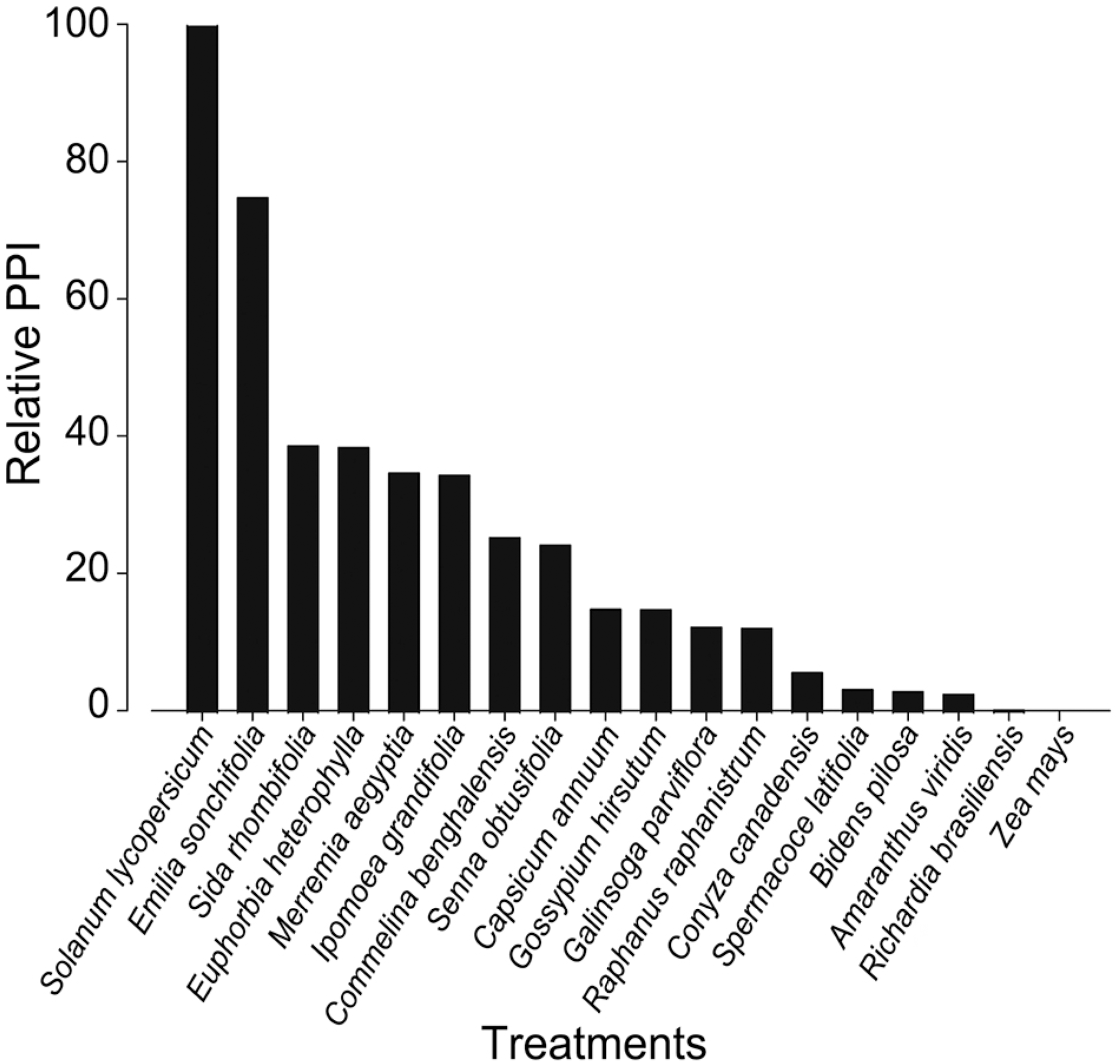
The PPI varied markedly among host plants. Solanum lycopersicum exhibited the highest PPI value, followed by E. sonchifolia, Sida rhombifolia L., and E. heterophylla. Intermediate values were observed for Merremia aegyptia L. Urb., I. grandifolia, C. benghalensis, and S. obtusifolia. In contrast, Z. mays, R. brasiliensis, A. viridis, and B. pilosa showed the lowest PPI values, indicating poor suitability as hosts. Overall, results demonstrate that host suitability for oviposition and offspring development is highly variable across tested plant species (Figure 1).
Relative preference-performance index (PPI) of Bemisia tabaci Middle East-Asia Minor 1 on different weed species.
Colorimetric analysis
Plant species differed significantly in all colorimetric parameters analyzed (Table 3). As regards luminosity (L*), the species G. parviflora stood out with the highest mean (44.35), followed by C. benghalensis (43.89), C. canadensis (43.85), M. aegyptia (43.36), E. sonchifolia (43.03), R. raphanistrum (43.29), and R. brasiliensis (42.80). These species differed from E. heterophylla, which had the lowest mean luminosity (35.71). Considering the a* parameter (green-red), E. sonchifolia, S. lycopersicum, and G. parviflora showed the most negative indices (higher intensity of green), differing from most species. The highest values of a* (tending to red) were observed in G. hirsutum (–10.89), S. rhombifolia (–11.43), E. heterophylla (–11.96), and S. latifolia (–12.06). The highest values for the b* (tending to yellow) were found in G. parviflora (27.42) and S. lycopersicum (27.32), M. aegyptia (27.25), E. sonchifolia (26.90), and I. grandifolia (25.75). The lowest rates for b* parameter (blue-yellow) were found in S. rhombifolia (15.35) and G. hirsutum (16.41).
Means (± standard error) of the parameters of the colorimetric analysis performed on the adaxial face of the leaves of plants of 15 weed species and four cultivated species.
There was significant correlation between the number of adults after 24 h of infestation and all colorimetric parameters evaluated. Correlations were negative for L* (r = –0.23) and a* (r = –0.19), and positive for b* (r = 0.20) (Table 4).
Spearman correlation coefficients obtained between the number of eggs of Bemisia tabaci Middle East-Asia Minor 1 after 72 h and the number of trichomes, and number of adults after 24 h, and colorimetric indices of plants of 15 weed species and four cultivated from free-choice assay.
Trichome analysis
A significant difference was observed among the plant species evaluated in trichome density (Table 5). Among the evaluated species, there was no presence of trichomes on the leaf blade of the abaxial face of the I. grandifolia, M. aegyptia, D. insularis, Z. mays, G. hirsutum, C. annuum, and S. obtusifolia. Among the species with trichomes, S. lycopersicum (134.50), S. latifolia (85.00), and C. canadensis (73.63) had the highest densities per 25 mm2, differing from the other plant species. The species with the lowest trichomes densities were R. raphanistrum, B. pilosa, E. sonchifolia, and R. brasiliensis, with means ranging from 1.13 to 6.50.
Means (± standard error) of trichomes of selected plant species and respective classifications.
As regards the trichomes classification, S. latifolia, R. brasiliensis, and S. rhombifolia presented only trichomes non-glandular (V and VIII, respectively), while the other species had two (R. raphanistrum: II, V) or more, with A. viridis displaying seven types (I, II, II, IV, VI, VI, VII) (Table 5).
In addition, positive correlation was observed between the density of eggs and the density of trichomes per 25 mm2 in the free-choice test (r = 0.17) (Table 4).
Oviposition and colonization no-choice test
There was a significant difference among the plant species in the number of eggs and nymphs per cm2 (Table 6). The species E. heterophylla had the highest oviposition rate (42.35 eggs), followed by G. parviflora (29.20), S. latifolia (27.05), and R. raphanistrum (22.59). The least oviposited plants in the trial were C. annuum and Z. mays, which presented means ranging from 0.24 to 1.35 eggs per cm2. As for nymphs infestation per cm2, the highest means were observed in plants of E. heterophylla (22.70), S. latifolia (16.65) and G. parviflora (11.57). The lowest rates were observed in Z. mays, A. viridis, M. aegyptia, and C. annuum (0.27 to 2.89 nymphs per cm2).
Means (± standard error) of eggs and nymphs of Bemisia tabaci Middle East-Asia Minor 1 in plants of 15 weed species and four cultivated species, in a no-choice test in a greenhouse.
Discussion
The assessments carried out in this study revealed significant differences in the attractiveness and oviposition of B. tabaci MEAM1 in plants of different weed and cultivated species, as well as variable colonization rates under no-choice conditions.
In the free-choice test, S. lycopersicum was found to be a highly attractive plant species to B. tabaci MEAM1, differing from all other species in the second, third, and mean of the evaluations. Emilia sonchifolia, S. obtusifolia, and E. heterophylla were also highlighted as attractive species. With respect to E. heterophylla, Sottoriva et al. (2014) found significantly higher infestation in plants of this species compared to six other weed species and one cultivated plant (soybean). Their study found that over three evaluation periods similar to those of the present study, E. heterophylla surpassed soybean infestation and had the highest number of eggs per cm2. In the present study, E. heterophylla also showed a higher number of adults of B. tabaci, ranking among the most infested during the evaluation periods in a free-choice test, like to observed with tomato. This species stood out even more in the no-choice test, where it had the highest mean number of eggs and nymphs per cm2 among all the evaluated species. Other authors observed a higher incidence of B. tabaci MEAM1 eggs and nymphs in E. heterophylla among weed species found in cotton fields in the midwestern region of Brazil (Rodrigues and Silva, 2018). Among the evaluated species, C. benghalensis, Conyza spp., E. heterophylla, Ipomoea spp., R. brasiliensis, and S. latifolia were considered alternative hosts for the insect. Of these species, E. heterophylla was the most prominent in the free-choice and no-choice assays of the present study, followed by S. latifolia, which also showed high densities of eggs and nymphs in the no-choice assay.
Evaluating the density of eggs and nymphs of B. tabaci MEAM1 on weeds present in Florida, Smith et al. (2014) observed higher rates in S. obtusifolia and in plants of the genus Emilia. In the free-choice test performed in the present study, S. obtusifolia and E. sonchifolia stood out as the most infested and with the highest number of eggs after tomato, corroborating the results of those authors. In another study evaluating weeds as alternative hosts for B. tabaci, Barman et al. (2021) included Ipomoea quamoclit (L.), I. cordatotriloba (Denn.), Sida spinosa (L.), and E. heterophylla as suitable hosts for the insect. Among the whitefly's unfavorable hosts, the species R. raphanistrum, Amaranthus palmeri (S.) Wats, and Richardia scabra (L.) stood out in Barman's study. Our study corroborated these results, in which R. raphanistrum, and species of the Amaranthus and Richardia genera also emerged as unattractive hosts to B. tabaci MEAM1. Overall, the findings demonstrate a strong preference by Bemisia tabaci MEAM1 adults for weed species such as E. sonchifolia, S. obtusifolia, and E. heterophylla, and reinforce the need for effective management of these plants as a complementary strategy in integrated pest management (IPM) of agricultural areas, especially where this whitefly is present.
The PPI revealed clear differences in the suitability of host plants for B. tabaci MEAM1. Solanum lycopersicum displayed the highest PPI value, consistent with the study by Sacilotto et al. (2024), which confirmed tomato as one of the most favorable hosts, with short developmental time and high nymphal viability. Similarly, E. sonchifolia, S. rhombifolia, and E. heterophylla also exhibited relatively high PPI values, in agreement with their reported high susceptibility and ability to sustain whitefly populations. In contrast, species such as Z. mays, R. brasiliensis, and B. pilosa showed the lowest PPI values, reflecting their poor suitability, as demonstrated in the study by the extended developmental times and reduced nymphal survival on these hosts.
Overall, the PPI results reinforce the view that certain weeds, such as E. sonchifolia, I. grandifolia, and C. benghalensis, can serve as important reservoirs for B. tabaci MEAM1 populations, enabling the persistence of the pest even in the absence of cultivated hosts. This highlights the importance of weed management in IPM programs, since susceptible weed species can act as alternative hosts.
Given the variations in insect preference for different plant species, it should be noted that the process of identifying and selecting a host plant by the insect involves a series of external stimuli, including visual, morphological, olfactory and gustatory cues (Smith, 2005). In this sense, the color of the plant tissue, the presence of secondary compounds and the density of trichomes can play an important role in the insect's host selection behavior.
In the case of the whitefly, there is strong dependence on visual stimuli for the orientation and movement of the insect (Mound, 1962; Isaacs et al., 1999). Color is considered the first important factor involved in host selection, according to van Lenteren and Noldus (1990). Considering the sessile habit during most of the nymphal period of B. tabaci, the choice of a suitable host for oviposition is fundamental to successful insect colonization (Novaes et al., 2020). In the present study, significant correlations were found between the number of adults in the free-choice test (24 h) and the three colorimetric parameters evaluated in the plants (L*, a* and b*).
The correlation between the number of insects and luminosity was negative in this study, indicating a greater preference of adults of B. tabaci MEAM1 for plants with darker leaves (lower L* values). The species E. heterophylla, which presented the lowest light index, was among the most infested plants in the free-choice evaluations and stood out on account of the highest means of eggs and nymphs per cm2 in the no-choice test. However, tomato and the species S. obtusifolia and E. sonchifolia, which were the most infested in the free-choice trial, showed intermediate values of L*. In a study evaluating cucumber genotypes, Novaes et al. (2020) found no significant correlation between this parameter and the presence of B. tabaci MEAM1 adults. Similarly, in a preference study comparing different cabbage genotypes and the same whitefly species, no significant effect of luminosity on insect selection behavior was found (Domingos et al., 2018). It is likely, therefore, that in studies in which genotypes of the same plant species are evaluated, smaller variations in the luminosity of the plant tissue should be observed in relation to studies involving different plant species, as in the present case.
As regards the chromatic coordinates evaluated in this study, there was negative correlation between the number of adults and the a* index, indicating a preference of B. tabaci MEAM1 for plant species with a greater intensity of green. Among the evaluated species, tomato and E. sonchifolia showed the highest green intensities, standing above the most infested species. This green (intensity) trend was observed by Prado et al. (2016) who, in an evaluation of the active cotton germplasm bank for resistance to B. tabaci MEAM1, found that the genotype IAC PV 010-175, the most attractive host plant, had the highest green intensity.
Although significant correlations were observed between the abundance of B. tabaci adults and the colorimetric indices (L*, a*, and b*), the correlation coefficients were weak. This suggests that the overall spectral balance of reflected light may play a more important role in insect behavior than individual color components. Furthermore, the potential influence of plant-derived volatile and non-volatile compounds should not be overlooked, as these compounds are likely to exert a stronger effect on insect behavior once a host plant has been selected.
Solanum lycopersicum and E. sonchifolia also showed higher levels of b*, confirming that B. tabaci MEAM1 also shows attraction to yellowish substrates, as documented by Berlinger (1980). Like the results obtained in the present study, Domingos et al. (2018) found a preference for B. tabaci MEAM1 for kale genotypes with leaves with higher intensities of green and yellow, also corroborating previous work on the subject (van Lenteren and Noldus, 1990).
In addition to colorimetric factors, trichomes on leaves can strongly influence colonization by B. tabaci (Silva et al., 2014; Domingos et al., 2018). In this study, a positive correlation was found between the density of trichomes on the leaves of plant species and the density of B. tabaci MEAM1 eggs. Tomato plants showed the highest preference for adults and oviposition in the free-choice test and had the highest trichomes density. The species S. latifolia, with a high density of trichomes, was among the least selected by adults of B. tabaci MEAM1 in the free-choice test, although it presented high means of eggs and nymphs per cm2 in the no-choice test. Biochemical studies indicate the occurrence of several secondary compounds in the Rubiaceae plant family, such as phenolic compounds, flavonoids, tannins, triterpenes and alkaloids (Cosmoski et al., 2015; Martins and Nunez, 2015), which may be related to changes in colonization behavior and the lower preference of adults of B. tabaci MEAM1 for S. latifolia (a member of the Rubiaceae plant family) in a free-choice test.
There are several hypotheses regarding the role of trichomes in host plant selection and colonization by whiteflies. In one of them, it is suggested that the insect's preference for ovipositing at the base of the trichomes is associated with an adaptive advantage over the attack of natural enemies, as well as a possible favorable microclimate in leaves with high densities of non-glandular trichomes (Butter and Vir, 1989; Chu et al., 1995; Heinz and Zalom, 1995; Torres et al., 2012; Miyazaki et al., 2013). In this regard, a positive correlation between plant susceptibility and trichome presence was observed in studies on crops such as soybean, cotton, tomato and eggplant (Heinz and Zalom, 1995; Silva et al., 2012; Hasanuzzaman et al., 2016; Oliveira et al., 2021). On the other hand, reports in the literature point to a negative correlation between the total density of trichomes and the oviposition of B. tabaci (Oriani and Vendramim, 2010; Taggar and Gill, 2012), indicating that the isolated analysis of this morphological factor may be questionable as regards the classification of susceptibility and/or resistance of plants to the whitefly (Muigai et al., 2003).
In addition to quantifying these structures, other factors related to trichomes appear to influence B. tabaci colonization, such as angle, length, and type (Lambert et al., 1995; Valle et al., 2012). Glandular trichomes can release allelochemicals that deter oviposition and may also keep the insect attached to the leaf surface through exudates (Fancelli et al., 2005; Oriani and Vendramim, 2010). In this study, A. viridis showed greater variability in glandular trichomes (types IV, VI and VII) and lower averages adult and egg counts in free-choice assessments, which confirm the negative role of this type of structure in whitefly colonization.
In general, the results of this study reveal the potential of certain weed species, commonly found in Brazilian crops, to serve as alternative hosts of B. tabaci MEAM1. Invasive species such as E. sonchifolia, S. obtusifolia, and E. heterophylla proved highly attractive to the insect, with infestation levels approaching those observed with cultivated insect host species, such as tomato.
Although certain species did not attract significant numbers of B. tabaci under free-choice conditions, they showed high rates of insect colonization under confined conditions (no choice), as verified by G. parviflora and S. latifolia. Under this condition, E. heterophylla also stood out as the species with the highest eggs and nymphs density. Interestingly, E. heterophylla has been identified as a host of the begomovirus Tomato severe rugose virus (ToSRV) in central-western Brazil (Barreto et al., 2013). This condition indicates the need to manage this invasive species in areas in the states of Goiás, Distrito Federal, Minas Gerais, and São Paulo where tomato production occurs, and ToSRV is the predominant begomovirus (Inoue-Nagata et al., 2016). Given this finding, it is important to emphasize that, in agricultural scenarios where preferential hosts are as absent and during off-season periods, weeds can help maintain pest populations in the cultivation area, thereby contributing to the continuity of the insect cycle.
In regions with high population densities of whitefly the year round, it is important to focus on the presence of the weed species highlighted above. In addition to serving as attractive hosts for the whitefly, a number of invasive species play an important role in the dissemination of viruses transmitted by the insect, making it appropriate to adopt strategies to eradicate these plants (Gilbertson et al., 2011). Monitoring and control of these species are recommended to reduce favorable conditions for the insect and possible sources of inoculum, thus contributing to the management of B. tabaci MEAM1 populations and their associated diseases in the field.
Data availability statement
Data will be made available upon request to the authors.
Acknowledgments
We thank the Conselho Nacional de Desenvolvimento Científico e Tecnológico (CNPq) for granting a master's scholarship to the first author (process n°131658/2020-4) and the productivity scholarship in research to the sixth author (process n°304323/2218-5), and the Fundação de Amparo à Pesquisa do Estado de São Paulo (FAPESP) for partially funding this research (process n°2021/03987-7). We also thank the Coordenação de Aperfeiçoamento de Pessoal de Nível Superior (CAPES) - Finance Code 001. This study is part of the Master's thesis of the first author.
References
-
Baldin ELL, Vendramim JD, Lourenção AL. 2005. Resistance of Tomato Genotypes to the Whitefly Bemisia tabaci (Gennadius) Biotype B (Hemiptera: Aleyrodidae). Neotropical Entomology 34: 435-441 (in Portuguese, with abstract in English). https://doi.org/10.1590/S1519-566X2005000300012
» https://doi.org/10.1590/S1519-566X2005000300012 -
Barman AK, Roberts PM, Prostko EP, Toews MD. 2021. Seasonal occurrence and reproductive suitability of weed hosts for sweetpotato whitefly, Bemisia tabaci (Hemiptera: Aleyrodidae), in South Georgia. Journal of Entomological Science 57: 1-11. https://doi.org/10.18474/JES20-94
» https://doi.org/10.18474/JES20-94 -
Barreto SS, Hallwass M, Aquino OM, Inoue-Nagata AK. 2013. A study of weeds as potential inoculum sources for a tomato-infecting begomovirus in central Brazil. Phytopathology 103: 436-444. https://doi.org/10.1094/PHYTO-07-12-0174-R
» https://doi.org/10.1094/PHYTO-07-12-0174-R - Bel-Kadhi MS, Onillon JC, Cenis JL. 2008. Molecular characterization of Bemisia tabaci biotypes in southern Tunisia. Tunisian Journal of Plant Protection 3: 79-85.
-
Berlinger MJ. 1980. A yellow sticky trap for whiteflies: Trialeurodes vaporariorum and Bemisia tabaci (Aleyrodidae). Entomologia Experimentalis et Applicata 27: 98-102. https://doi.org/10.1111/j.1570-7458.1980.tb02952.x
» https://doi.org/10.1111/j.1570-7458.1980.tb02952.x -
Butter NS, Vir BK 1989. Morphological basis of resistance in cotton to the whitefly Bemisia tabaci Phytoparasitica 17: 251-261. https://doi.org/10.1007/BF02980754
» https://doi.org/10.1007/BF02980754 -
Channarayappa C, Shivashankar G, Muniyappa V, Frist RH. 1992. Resistance of Lycopersicon species to Bemisia tabaci, a tomato leaf curl virus vector. Canadian Journal of Botany 70: 2184-2192. https://doi.org/10.1139/b92-270
» https://doi.org/10.1139/b92-270 -
Chu CC, Henneberry TJ, Cohen AC. 1995. Bemesia argentifolii (Homoptera: Aleyrodidae): host preference and factors affecting oviposition and feeding site preference. Environmental Entomology 24: 354-360. https://doi.org/10.1093/ee/24.2.354
» https://doi.org/10.1093/ee/24.2.354 -
Cosmoski ACOF, Roel AR, Porto KRA, Coelho RM, Honer MR, Motti PR. 2015. Phytochemistry and larvicidal activity of Spermacoce latifolia Aubl. (Rubiaceae) in the control of Aedes aegypti L. (Culicidae). Bioscience Journal 31: 1512-1518. https://doi.org/10.14393/BJ-v31n5a2015-26333
» https://doi.org/10.14393/BJ-v31n5a2015-26333 -
De Barro PJ, Scott KD, Graham GC, Lange CL, Schutze MK. 2003. Isolation and characterization of microsatellite loci in Bemisia tabaci Molecular Ecology Notes 3: 40-43. https://doi.org/10.1046/j.1471-8286.2003.00344.x
» https://doi.org/10.1046/j.1471-8286.2003.00344.x -
De Barro PJ, Liu SS, Boykin LM, Dinsdale AB. 2011. Bemisia tabaci: a statement of species status. Annual Review of Entomology 56: 1-19. https://doi.org/10.1146/annurev-ento-112408-085504
» https://doi.org/10.1146/annurev-ento-112408-085504 -
Domingos GM, Baldin ELL, Canassa VF, Silva IF, Lourenção AL. 2018. Resistance of collard green genotypes to Bemisia tabaci biotype B: characterization of antixenosis. Neotropical Entomology 47: 560-568. https://doi.org/10.1007/s13744-018-0588-5
» https://doi.org/10.1007/s13744-018-0588-5 -
Fancelli M, Vendramim JD, Frighetto RTS, Lourenção AL. 2005. Glandular exudate of tomato genotypes and development of Bemisia tabaci (Genn.) (Sternorryncha: Aleyrodidae) biotype B. Neotropical Entomology 34: 659-665 (in Portuguese, with abstract in English). https://doi.org/10.1590/S1519-566X2005000400017
» https://doi.org/10.1590/S1519-566X2005000400017 -
Gachoka KK, Obeng-Ofori D, Danquah EY. 2005. Host suitability of two Ghanaian biotypes of Bemisia tabaci (Homoptera: Aleyrodidae) on five common tropical weeds. International Journal of Tropical Insect Science 25: 236-244. https://doi.org/10.1079/IJT200583
» https://doi.org/10.1079/IJT200583 -
Gilbertson RL, Rojas M, Natwick E. 2011. Development of integrated pest management (IPM) strategies for whitefly (Bemisia tabaci)-transmissible geminiviruses. p. 323-356. In: Thompson WMO. ed. The whitefly, Bemisia tabaci (Homoptera: Aleyrodidae) interaction with geminivirus-infected host plants. Springer, Dordrecht, Netherlands. https://doi.org/10.1007/978-94-007-1524-0_12
» https://doi.org/10.1007/978-94-007-1524-0_12 -
Hasanuzzaman ATM, Islam MN, Zhang Y, Zhang C-Y, Liu T-X. 2016. Leaf morphological characters can be a factor for intra-varietal preference of whitefly Bemisia tabaci (Hemiptera: Aleyrodidae) among eggplant varieties. PLoS One 11: e0153880. https://doi.org/10.1371/journal.pone.0153880
» https://doi.org/10.1371/journal.pone.0153880 -
Heinz KM, Zalom FG. 1995. Variation in trichome-based resistance to Bemisia argentifolii (Homoptera: Aleyrodidae) oviposition on tomato. Journal of Economic Entomology 88: 1494-1502. https://doi.org/10.1093/jee/88.5.1494
» https://doi.org/10.1093/jee/88.5.1494 -
Inoue-Nagata AK, Lima MF, Gilbertson RL. 2016. A review of geminivirus diseases in vegetables and other crops in Brazil: current status and approaches for management. Horticultura Brasileira 34: 8-18. https://doi.org/10.1590/S0102-053620160000100002
» https://doi.org/10.1590/S0102-053620160000100002 -
Isaacs R, Willis MA, Byrne DN. 1999. Modulation of whitefly take-off and flight orientation by wind speed and visual cues. Physiological Entomology 24: 311-318. https://doi.org/10.1046/j.1365-3032.1999.00144.x
» https://doi.org/10.1046/j.1365-3032.1999.00144.x -
Kanakala S, Ghanim M. 2019. Global genetic diversity and geographical distribution of Bemisia tabaci and its bacterial endosymbionts. PLoS One 14: e0213946. https://doi.org/10.1371/journal.pone.0213946
» https://doi.org/10.1371/journal.pone.0213946 -
Konica Minolta. 1998. Precise color communication: color control from perception to instrumentation. Konica Minolta, Japan. Available at: https://www.konicaminolta.com/instruments/knowledge/color/pdf/color_communication.pdf [Accessed Aug 11, 2025]
» https://www.konicaminolta.com/instruments/knowledge/color/pdf/color_communication.pdf -
Krause-Sakate R, Watanabe LFM, Gorayeb ES, Silva FB, Alvarez DDL, Bello VH, et al. 2020. Population dynamics of whiteflies and associated viruses in South America: research progress and perspectives. Insects 11: 847. https://doi.org/10.3390/insects11120847
» https://doi.org/10.3390/insects11120847 -
Lambert AL, McPherson RM, Espeliei KE. 1995. Soybean host plant resistance mechanisms that alter abundance of whiteflies (Homoptera: Aleyrodidae). Environmental Entomology 24: 1381-1386. https://doi.org/10.1093/ee/24.6.1381
» https://doi.org/10.1093/ee/24.6.1381 -
Li Y, Mbata GN, Punnuri S, Simmons AM, Shapiro-Ilan DI. 2021. Bemisia tabaci on vegetables in the southern United States: incidence, impact, and management. Insects 12: 198. https://doi.org/10.3390/insects12030198
» https://doi.org/10.3390/insects12030198 -
Martins D, Nunez CV. 2015. Secondary metabolites from Rubiaceae species. Molecules 20: 13422-13495. https://doi.org/10.3390/molecules200713422
» https://doi.org/10.3390/molecules200713422 -
Miyazaki J, Stiller WN, Wilson LJ. 2013. Identification of host plant resistance to silverleaf whitefly in cotton: implications for breeding. Field Crops Research 154: 145-152. https://doi.org/10.1016/j.fcr.2013.08.001
» https://doi.org/10.1016/j.fcr.2013.08.001 -
Mound LA. 1962. Studies on the olfaction and colour sensitivity of Bemisia tabaci (Genn.) (Homoptera, Aleyrodidae). Entomologia Experimentalis et Applicata 5: 99-104. https://doi.org/10.1111/j.1570-7458.1962.tb00571.x
» https://doi.org/10.1111/j.1570-7458.1962.tb00571.x -
Muigai SG, Bassett MJ, Schuster DJ, Scott JW. 2003. Greenhouse and field screening of wild Lycopersicon germplasm for resistance to the whitefly Bemisia argentifolii Phytoparasitica 31: 27-38. https://doi.org/10.1007/BF02979764
» https://doi.org/10.1007/BF02979764 -
Naranjo SE, Castle SJ, Barro PJ, Liu SS. 2010. Population dynamics, demography, dispersal and spread of Bemisia tabaci p. 185-226. In: Stansly PA, Naranjo SE. eds. Bemisia: bionomics and management of a global pest. Springer, Dordrecht, Netherlands. https://doi.org/10.1007/978-90-481-2460-2_6
» https://doi.org/10.1007/978-90-481-2460-2_6 -
Novaes NS, Lourenção AL, Bentivenha JPF, Baldin ELL, Melo AMT. 2020. Characterization and potential mechanisms of resistance of cucumber genotypes to Bemisia tabaci (Hemiptera: Aleyrodidae). Phytoparasitica 48: 643-657. https://doi.org/10.1007/s12600-020-00826-3
» https://doi.org/10.1007/s12600-020-00826-3 -
Oliveira MRV, Henneberry TJ, Anderson P. 2001. History, current status, and collaborative research projects for Bemisia tabaci Crop Protection 20: 709-723. https://doi.org/10.1016/S0261-2194(01)00108-9
» https://doi.org/10.1016/S0261-2194(01)00108-9 -
Oliveira CES, Hoffmann LV, Toscano LC, Queiroz MS, Zoz T, Witt TW. 2021. Resistance of cotton genotypes to silverleaf whitefly (Bemisia tabaci [GENNADIUS] Biotype B). International Journal of Tropical Insect Science 41: 1697-1707. https://doi.org/10.1007/s42690-020-00373-8
» https://doi.org/10.1007/s42690-020-00373-8 -
Oriani MAG, Vendramim JD. 2010. Influence of trichomes on attractiveness and ovipositional preference of Bemisia tabaci (Genn.) B biotype (Hemiptera: Aleyrodidae) on tomato genotypes. Neotropical Entomology 39: 1002-1007. https://doi.org/10.1590/S1519-566X2010000600024
» https://doi.org/10.1590/S1519-566X2010000600024 -
Prado JC, Peñaflor MFGV, Cia E, Vieira SS, Silva KI, Carlini-Garcia LA, et al. 2016. Resistance of cotton genotypes with different leaf colour and trichome density to Bemisia tabaci biotype B. Journal of Applied Entomology 140: 405-413. https://doi.org/10.1111/jen.12274
» https://doi.org/10.1111/jen.12274 -
Prajapat R, Marwal A, Gaur RK. 2014. Begomovirus associated with alternative host weeds: a critical appraisal. Archives of Phytopathology and Plant Protection 47: 157-170. https://doi.org/10.1080/03235408.2013.805497
» https://doi.org/10.1080/03235408.2013.805497 -
Rodrigues S, Silva AF. 2018. Weeds associated with cotton crop and hosting whitefly. Arquivos do Instituto Biológico 85: e0242017. https://doi.org/10.1590/1808-1657000242017
» https://doi.org/10.1590/1808-1657000242017 -
Sacilotto MG, Souza FSF, Baldin ELL, Carbonari CA, Lourenção AL. 2024. Comparison of the performance of Bemisia tabaci MEAM1 (Hemiptera: Aleyrodidae) on weed and cultivated plant species. Arthropod-Plant Interactions 18: 55-63. https://doi.org/10.1007/s11829-023-09994-5
» https://doi.org/10.1007/s11829-023-09994-5 -
Santos TL, Baldin ELL, Ribeiro LP, Souza CM, Soares MCE, Fanela TLM, et al. 2021. Resistance sources and antixenotic factors in Brazilian bean genotypes against Bemisia tabaci Neotropical Entomology 50: 129-144. https://doi.org/10.1007/s13744-020-00821-7
» https://doi.org/10.1007/s13744-020-00821-7 -
Santos MC, Santana AS, Schulz GP, Cabral IR, Santos TLB, Lourenção AL, et al. 2023. Preference of Bemisia tabaci MED (Hemiptera: Aleyrodidae) among morphologically and physically distinct tomato genotypes. Phytoparasitica 51: 1025-1039. https://doi.org/10.1007/s12600-023-01100-y
» https://doi.org/10.1007/s12600-023-01100-y -
Silva JPGF, Baldin ELL, Souza ES, Lourenção AL. 2012. Assessing Bemisia tabaci (Genn.) biotype B resistance in soybean genotypes: antixenosis and antibiosis. Chilean Journal of Agricultural Research 72: 516. http://dx.doi.org/10.4067/S0718-58392012000400009
» http://dx.doi.org/10.4067/S0718-58392012000400009 -
Silva JPGF, Baldin ELL, Canassa VF, Souza ES, Lourenção AL. 2014. Assessing antixenosis of soybean entries against Piezodorus guildinii (Hemiptera: Pentatomidae). Arthropod-Plant Interactions 8: 349-359. https://doi.org/10.1007/s11829-014-9316-1
» https://doi.org/10.1007/s11829-014-9316-1 -
Smith CM. 2005. Plant Resistance to Arthropods: Molecular and Conventional Approaches. Springer, Dordrecht, Netherlands. https://doi.org/10.1007/1-4020-3702-3
» https://doi.org/10.1007/1-4020-3702-3 -
Smith HA, Nagle CA, Evans GA. 2014. Densities of eggs and nymphs and percent parasitism of Bemisia tabaci (Hemiptera: Aleyrodidae) on common weeds in west central Florida. Insects 5: 860-876. http://dx.doi.org/10.3390/insects5040860
» http://dx.doi.org/10.3390/insects5040860 -
Sottoriva LDM, Lourenção AL, Colombo CA. 2014. Performance of Bemisia tabaci (Genn.) biotype B (Hemiptera: Aleyrodidae) on weeds. Neotropical Entomology 43: 574-581. http://dx.doi.org/10.1007/s13744-014-0238-5
» http://dx.doi.org/10.1007/s13744-014-0238-5 -
Stout MJ. 2014. Host-plant resistance in pest management. p. 1-21. In: Abrol DP. ed. Integrated pest management - Current concepts and ecological perspective. Academic Press, New York, NY. https://doi.org/10.1016/B978-0-12-398529-3.00002-6
» https://doi.org/10.1016/B978-0-12-398529-3.00002-6 -
Taggar GK, Gill RS. 2012. Preference of whitefly, Bemisia tabaci, towards black gram genotypes: role of morphological leaf characteristics. Phytoparasitica 40: 461-474. http://dx.doi.org/10.1007/s12600-012-0247-z
» http://dx.doi.org/10.1007/s12600-012-0247-z -
Torres LC, Souza B, Lourenção AL, Costa MB, Amaral BB, Carbonell SAM, et al. 2012. Resistance of bean genotypes to Bemisia tabaci biotype B. Bragantia 71: 346-354 (in Portuguese, with abstract in English). https://doi.org/10.1590/S0006-87052012005000031
» https://doi.org/10.1590/S0006-87052012005000031 -
Valle GE, Lourenção AL, Pinheiro JB. 2012. Adult attractiveness and oviposition preference of Bemisia tabaci biotype B in soybean genotypes with different trichome density. Journal of Pest Science 85: 431-442. http://dx.doi.org/10.1007/s10340-012-0443-0
» http://dx.doi.org/10.1007/s10340-012-0443-0 -
van Lenteren JC, Noldus LPJJ. 1990. Whitefly-plant relationships: behavioural and ecological aspects. p. 47-89. In: Gerling D. ed. Whiteflies: their bionomics, pest status and management. Intercept, Wimborne, UK. Available at: https://research.wur.nl/en/publications/whitefly-plant-relationships-behavioural-and-ecological-aspects?utm_source=chatgpt.com [Accessed Aug 11, 2025]
» https://research.wur.nl/en/publications/whitefly-plant-relationships-behavioural-and-ecological-aspects?utm_source=chatgpt.com - Walsh PS, Metzger DA, Higuchi R. 1991. Chelex 100 as a medium for simple extraction of DNA for PCR-based typing from forensic material. Biotechniques 10: 506-513.
Edited by
-
Edited by:
Eliseu José Guedes Pereira https://orcid.org/0000-0002-8957-6465