 Chemosensory plasticity in a subterranean termite: Pickpocket and TRP channel genes show caste-biased expression in Odontotermes formosanus
ABSTRACT:
A wide array of chemosensory genes have been discovered in insects to navigate the wide range of chemicals through olfactory mechanisms. However, the chemosensory system of termites remains poorly understood at the molecular and genetic levels. Several gene families play a role in this system, still the pickpocket receptor (PPK) and transient receptor potential (TRP) channel genes have yet to be thoroughly investigated. Odontotermes formosanus is a notably destructive insect pest, inflicting significant harm on crops, wood, and man-made structures. This study aims to explore transcriptomic data from worker termites to elucidate the PPKs and TRP channels in O. formosanus. We identified five candidate genes: OforPPK and TRPs (OforTRPAPyx, OforTRPAPain, OforTRPA, and OforTRPM). Multiple sequence alignments were conducted to clarify the phylogenetic relationship of the PPKs among termites and other insect species. Furthermore, reverse transcription-quantitative polymerase chain reaction (RT-qPCR) analysis revealed caste-specific expression patterns, with significantly higher expression levels in the worker caste compared to the soldier caste. The pronounced expression of OforPPK and OforTRPs genes in various castes suggests their involvement in the social behavior of termites. These genes are likely engaged in processing mechanical and chemical sensory inputs, playing a pivotal role in the sensory physiology of insects. This research enhances our understanding of molecular mechanisms underlying the olfactory sensory system in termites and establishes a foundation for identifying potential targets for developing environmentally safe termite insecticides and pest control strategies.
Keywords:
chemosensory system; termites; social behavior; pest control methods
Introduction
The subterranean termite, Odontotermes formosanus (Shiraki), is prevalent in Southeast Asia, including China, India, Burma, Japan, Vietnam, and Thailand (Huang et al., 2000). In addition to damaging farms and crops, O. formosanus poses a risk to earthen dikes by excavating massive subterranean caverns, which can lead to the collapse of these structures and dams (Huang et al. (2006). Termites are highly destructive pests that consume a variety of non-cellulosic materials (Xinwei et al., 2015; Yazhao et al., 2018; LiJun et al., 2019). With their wide geographical distribution and complex feeding habits, the negative impacts of these termites can vary significantly. The serious consequences of their activity may result in structural collapses and endanger human lives, leading to irreversible harm (Fangyao et al., 1995). Odontotermes formosanus workers primarily feed on bark and roots, thriving under moist conditions (Huang et al., 2006). Due to well-camouflaged nests of O. formosanus, it is often difficult to detect the damage they cause until significant destruction has occurred. This species has the capacity to cause harm to over 100 plant species (Qiuying et al., 2005).
In insects, antennae serve as the primary olfactory organs responsible for detecting and processing chemical signals. The antennal sensilla of insects can detect chemical signals from other species, natural enemies, and host plants, which can aid in mate selection, host location, and predator detection (Ninkovic et al., 2021). The complex interactions that depend on chemical signals among social insects play a significant role in chemosensory genomics. In addition to managing their colonies, social insects must interact with many individuals (Kulmuni et al., 2013). Researchers have provided compelling evidence demonstrating that Cataglyphis niger ants distinguish their nestmates by hydrocarbons (Lahav et al., 1999).
The chemosensory gene families in insects have been the subject of extensive research, focusing primarily on odorant binding proteins (OBPs), chemosensory proteins (CSPs), ionotropic receptors (IRs), odorant receptors (ORs), gustatory receptors (GRs), and sensory neuron membrane proteins (SNMPs). However, few studies have focused on termites. In our previous research, we identified 42 genes with chemosensory families (Kaleem Ullah et al., 2023). Notably, insect pickpocket receptor and transient receptor potential channels have not been well characterized in O. formosanus. In the present study, we identified one insect PPK and four TRP channels in worker termites. We conducted RT-qPCR on both soldiers and workers to investigate the caste-specific gene expression patterns within termites. Using the information we gathered, we investigate how certain olfactory genes (PPKs and TRPs channels) may influence olfactory processing. Additionally, we examine the potential roles of these genes in various aspects of O. formosanus workers’ social behavior, including nestmate discrimination, host seeking, mate selection, gustation, and physiological activity.
Materials and Methods
Sampling Odontotermes formosanus
With the assistance of Nanning Institute of Termite Control in Nanning (108°17’27" E, 22°48’57" N, altitude 90 m), located in Guangxi Province, China, three distinct colonies of the Odontotermes formosanus Shiraki were collected. Following this collection, three biological replicates were obtained, each consisting of ten healthy workers and soldier castes of termites (whole bodies), which were not subjected to any treatment. The termites were immediately frozen in liquid nitrogen and subsequently preserved at –80 °C for the purpose of conducting RT-qPCR.
RNA synthesis from O. formosanus samples
Invitrogen Life Technologies TRIzol Reagent (Invitrogen) was used to extract total RNA following the manufacturer's intructions. The concentration of total RNA was measured using a NanoDrop-2000 (Thermo Scientific). Further, the RNA integrity was assessed using the RNA Nano 6000 Assay Kit with the Bioanalyzer 2100 System (Agilent Technologies).
Screening Identification of PPK receptor and TRP channels
We analyzed our recent data uploaded to the NCBI SRA database associated with BioProject PRJNA1021793. The details of the transcriptome assembly have been previously published by Kaleem Ullah et al. (2023). Candidate PPKs and TRPs are identified by keyword searches, alongside functional annotation discoveries. To independently verify each putative gene encoding PPKs and TRPs, we utilized the BLASTx and tBLASTn software available through the National Centre for Biotechnology Information (NCBI) (http://blast.ncbi.nlm.nih.gov/Blast.cgi). To determine the open reading frames (ORFs) of all PPK and TRP channel genes, we employed the ORF finder tool (http://www.ncbi.nlm.nih.gov/gorf/gorf.html). The NCBI predicts that potential PPK and TRP channels will process conserved domains (https://www.ncbi.nlm.nih.gov/Structure/cdd/wrpsb.cgi). Subsequently, we used SignalP 4.1 to assess potential signal peptides (https://services.healthtech.dtu.dk/services/SignalP-4.1).
Analysis of sequences and evolutionary trees coupled with motif locations and domain structures
The NCBI-BLAST programe was used to locate homologous genes from various insect species that pertain to the specifically identified PPK and TRP channel genes, demonstrating similarities with known genes (http://blast.ncbi.nlm.nih.gov). The amino acid sequences of numerous putative PPKs and TRPs were then organized using ClustalW, facilitating multiple sequence alignments in a scientifically structured manner (https://www.ebi.ac.uk/Tools/msa/clustalo) via MEGA 11 software (Tamura et al., 2021). Sequences from several different insect species were selected to construct a phylogenetic tree in MEGA 11 (Tamura et al., 2021), based on maximum similarity by the Blastp match results from NCBI. This tree was employed to explore the phylogenetic relationships among PPKs and TRPs, generated using the neighbor-joining method, with bootstrap support from 1,000 repetitions and a p-distance model.
Sequences and authenticity by RT-qPCR
The RT-qPCR technique was employed to investigate the expression patterns of OforPPK and OforTRPs, utilizing a Roche Real-time Light cycler 96 detection system. A set of gene-specific primers was generated for the RT-qPCR analysis (Table 1). The components of the RT-qPCR samples included: 2 × Syber Green PCR Master Mix (10 µL), 0.05 LM–1 of each gene-specific primer, 1 µL of cDNA, and 8 µL disinfected with ultrapure water (Aidlab). An initial denaturation phase was performed at 95 °C for 3 min, followed by 40 cycles of 95 °C for 10 s and 55 °C for 30 s. A melting curve, which displayed a single gene-specific peak, was employed to validate the sensitivity of each primer set. The resulting linear standard curve was then utilized to calculate the efficiency of amplification (E-value) by using the formula (E = 10−1/slope), achieving an effectiveness rate exceeding 90 %. The reference gene β-actin was used to normalize the expression levels of the target gene and address variability across samples (Jacobs et al., 2005). After completing each RT-qPCR reaction with three biological replicates and three technical replicates for each transcript, the 2−∆∆CT method (Livak and Schmittgen, 2001) was aplied to assess the CT values.
The primers employed in the reverse transcription - quantitative polymerase chain reaction (RT-qPCR) for the identification of candidate pickpocket receptor (OforPPK) and transient receptor potential channel (OforTRPs) channels genes in O. formosanus.
Statistical analysis
The data analysis was performed using Statistical Package for the Social Sciences (SPSS, version 22.0) (SPSS, Inc). The statistical methods employed include Analysis of Variance (ANOVA) and Tukey's HSD test, with the results considered significant when p < 0.05.
Results
Putative pickpocket receptor PPK gene
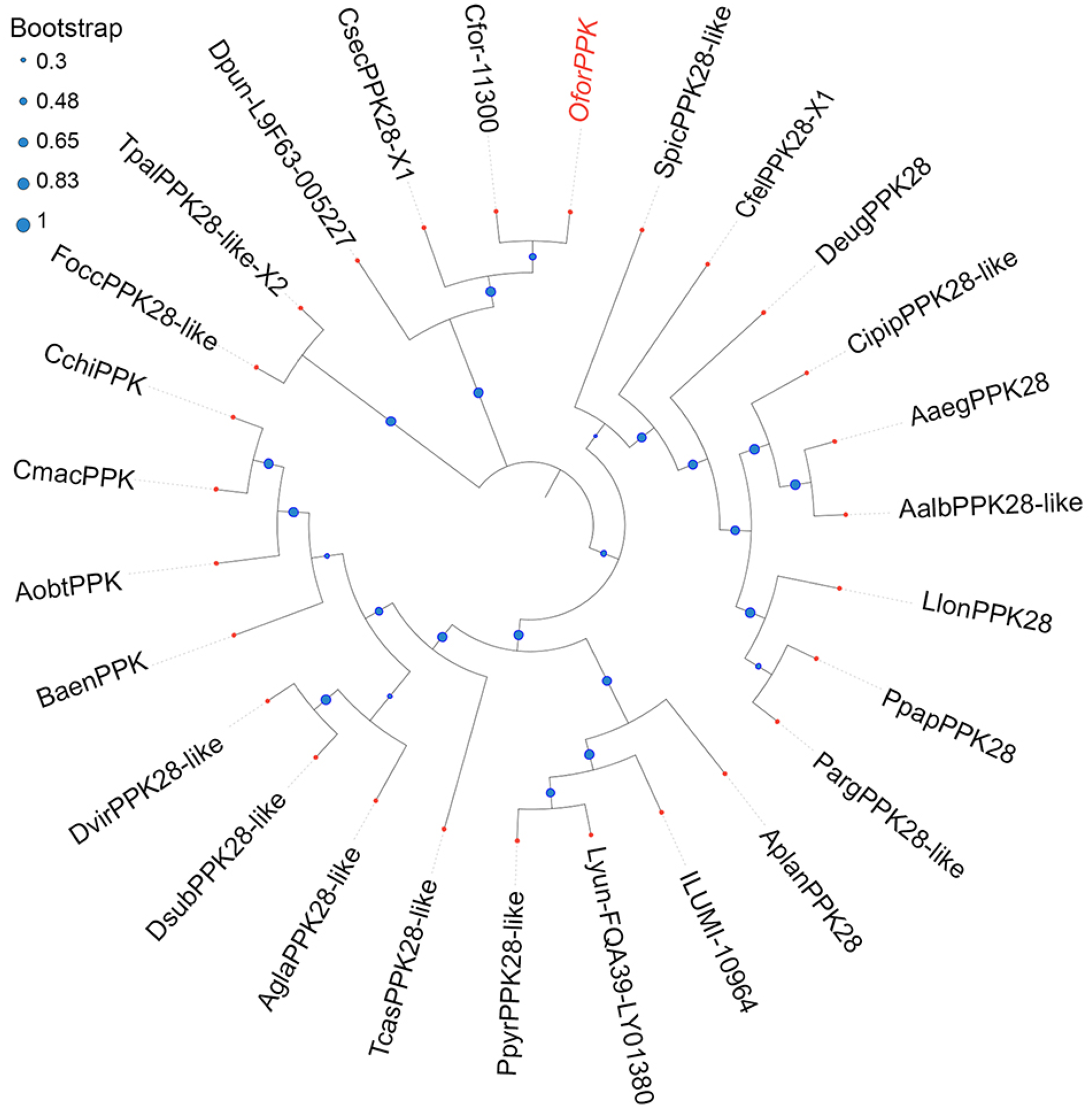
One pickpocket receptor PPK gene has been identified in the transcriptomic assembly, designated as OforPPK (GenBank accession number-PV416808). The OforPPK gene comprises a complete coding sequence, featuring both codons and the full conserved domain of amiloride-sensitive sodium channel family protein (ASC family), with accession number pfam00858. Phylogenetic analysis of the identified OforPPK from O. formosanus reveals three distinct clades alongside homologous orthologs from various insect orders (Figure 1). Upon aligning OforPPK with CforPPK, a homologous alignment of the amino acids is evident. Notably, OforPPK exhibits similarities to the pickpocket receptor of Coptotermes formosanus CforPPK (Cfor-1130), which belongs to another termite species (Figure 1). The domain structure predictions indicate the presence of the conserved domain characteristic of the ASC family (accession pfam00858) (Figure 2).
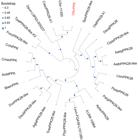
The phylogenetic tree displays the identified OforPPK alongside the pickpocket receptors (PPKs) from several insect species. The identified OforPPK is highlighted in red color. The putative OforPPK phylogenetic tree was generated using sequences from the subsequent insect species: Cryptotermes secundus, Coptotermes formosanus, Brassicogethes aeneus, Photinus pyralis, Diploptera punctate, Acanthoscelides obtectus, Callosobruchus chinensis, Phlebotomus argentipes, Ignelater luminosus, Lutzomyia longipalpis, Agrilus planipennis, Callosobruchus maculatus, Diabrotica virgifera virgifera, Lamprigera yunnana, Thrips palmi, Phlebotomus papatasi, Anoplophora glabripennis, Diorhabda sublineata, Ctenocephalides felis, Schistocerca piceifrons, Tribolium castaneum, Frankliniella occidentalis, Aedes albopictus, Aedes aegypti, Culex pipiens pallens, and Drosophila eugracilis. GenBank accession numbers for all PPKs are: CsecPPK28-X1; XP_023715586.1, Cfor-11300; GFG36219.1, BaenPPK; CAH0564379.1, PpyrPPK28-like; XP_031354497.1, Dpun-L9F63-005227; KAJ9578498.1, AobtPPK; CAH1966970.1, CchiPPK; CAH7721361.1, PargPPK28-like; XP_059622426.1, ILUMI-10964; KAF2895210.1, LlonPPK28; XP_055691516.1, AplanPPK28; XP_018335267.1, CmacPPK; VEN51994.1, DvirPPK28-like; XP_028141320.1, Lyun-FQA39-LY01380; KAF5270642.1, TpalPPK28-like-X2; XP_034256548.1, PpapPPK28; XP_055703731.1, AglaPPK28-like; XP_018568328.1, DsubPPK28-like; XP_056638388.1, CfelPPK28-X1; XP_026472957.1, SpicPPK28-like; XP_047108620.1; TcasPPK28-like; XP_972346.1, FoccPPK28-like; XP_052125406.1, AalbPPK28-like; XP_019536370.2, AaegPPK28; XP_021711114.1, CpipPPK28-like; XP_039443657.1, DeugPPK28; and XP_017063341.1.
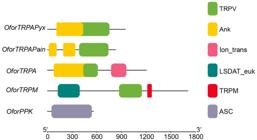
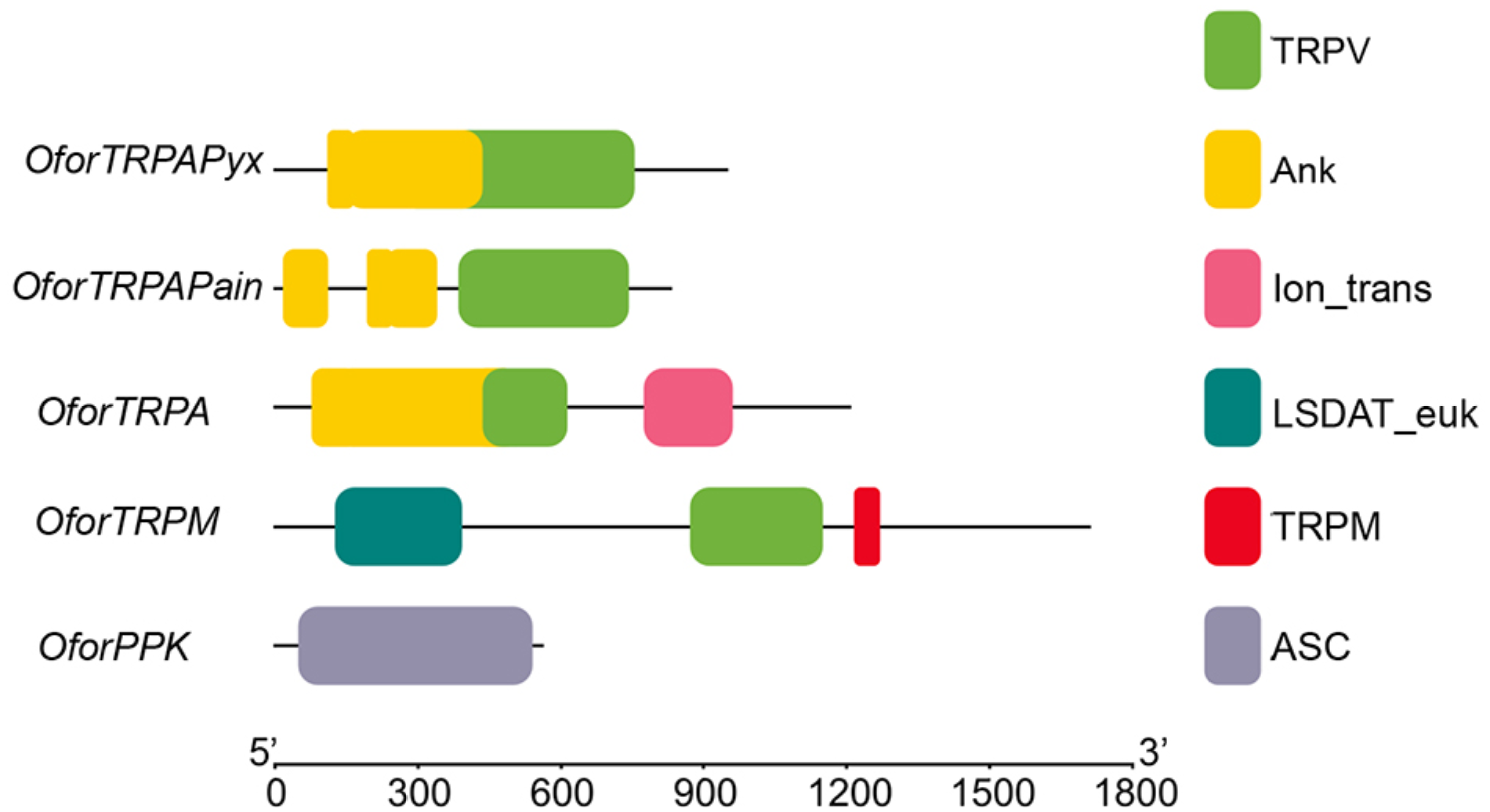
Gene (domain) structures of transient receptor potential channel (OforTRPs) and pickpocket receptor (OforPPK). Different colors indicate the presence of different domains in OforTRPs and OforPPK across the amino acid (aa) length from 5’ to 3’ end (0-1800 aa).
Putative transient receptor potential (TRPs)
Four TRPs genes have been identified in the transcriptomic assembly after screening. These genes have been designated as OforTRPAPyx (GenBank accession number-PV416809), OforTRPAPain (GenBank accession number-PV416810), OforTRPA (GenBank accession number-PV416811), and OforTRPM (GenBank accession number-PV416812). All OforTRPs possess a complete coding sequence, including both codons and a fully conserved domain. OforTRPAPyx contains the PHA03095 superfamily, the TRPV superfamily, and the Ank_5 domains, with all domains fully intact except for the PHA03095 superfamily at the C-terminus. OforTRPAPain features complete Ank_2, Ank_4, and TRPV superfamily, although it is incomplete at the N-terminus. OforTRPA includes a complete Ank_2, the Ion_trans superfamily, and an incomplete PHA03095 superfamily, alongside the TRPV superfamily, both positioned at the C-terminus. OforTRPM has a complete domain of LSDAT_euk and TRPM_tetra; however, the TRPV superfamily has an incomplete domain at the N-terminus. Blastp match results with homologous orthologs indicate that the identified OforTRPs exhibit the highest identity with C. formosanus (93.81 %), followed by Zootermopsis nevadensis (Hagen, 1874) (88.92 %), and C. formosanus again (80.20 %), with the lowest identity observed with C. formosanus (55.28 %) (Table 2).
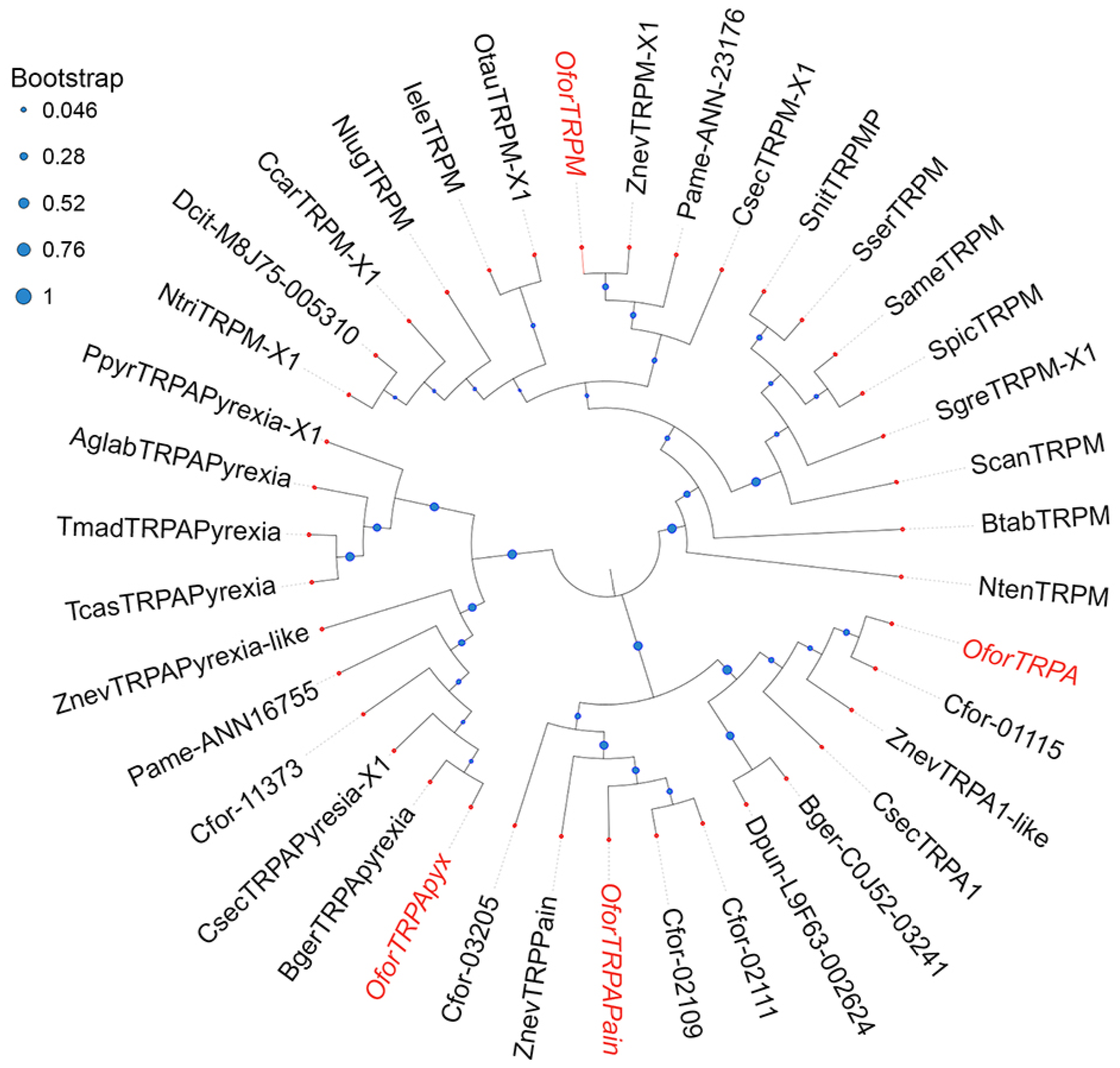
The phylogenetic tree of the identified OforTRPs illustrates the various clades and their homologous orthologs insects across different orders. Notably, OforTRPs exhibit similarities with several termite species (Figure 3). Specifically, OforTRPAPyx and OforTRPA are closely related to C. formosanus Cfor-11373 and Cfor-01115, respectively. Additionally, OforTRPAPain and OforTRPM are associated with Z. nevadensis, C. formosanus and Cryptotermes secundus respectively.
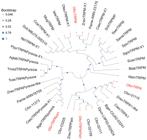
The phylogenetic tree displays the identified OforTRPs alongside the transient receptor potential channel (TRPs) from several insect species. The identified OforTRPs are highlighted in red color. The putative OforTRPs phylogenetic tree was generated using sequences from the subsequent insect species: Coptotermes formosanus, Cryptotermes secundus, Zootermopsis nevadensis, Periplaneta americana, Blattella germanica, Photinus pyralis, Anoplophora glabripennis, Tribolium castaneum, Tribolium madens, Diploptera punctate, Schistocerca gregaria, Schistocerca nitens, Schistocerca serialis, Schistocerca americana, Schistocerca piceifrons, Schistocerca cancellata, Chrysoperla carnea, Bemisia tabaci, Nilaparvata lugens, Neocloeon triangulifer, Ischnura elegans, Diaphorina citri, Onthophagus Taurus, and Nesidiocoris tenuis. GenBank accession numbers for all TRPs are: Cfor-11373; GFG28480.1, CsecTRPAPyresia-X1; XP_023718298.1, ZnevTRPAPyrexia-like; XP_021941613.1, Pame- ANN_16755; KAJ4436624.1, BgerTRPAPyrexia; PSN45985.1, PpyrTRPAPyrexia-X1; XP_031337505.1, AglabTRPAPyrexia; XP_023313055.1, TcasTRPAPyrexia; EFA07512.1, TmadTRPAPyrexia; XP_044264514.1, Cfor-02111; GFG36703.1, ZnevTRPPain; XP_021919361.1, Cfor-02109; GFG36699.1, Cfor-03205; GFG31632.1, Cfor-01115; GFG35013.1, CsecTRPA1; XP_023725424.1, ZnevTRPA1-like; XP_021919133.1, Bger- C0J52-03241; PSN50828.1, Dpun-L9F63-002624; KAJ9585594.1, ZnevTRPM-X1; XP_021919466.1, CsecTRPM-X1; XP_023710445.1, Pame-ANN-23176; KAJ4434614.1, SgreTRPM-X1; XP_049864466.1, SgreTRPM-X1; XP_049864466.1, SnitTRPMP; XP_049813711.1, SserTRPM; XP_049962002.1, SameTRPM; XP_046998098.1, SpicTRPM; XP_047116036.1, ScanTRPM; XP_049786241.1, CcarTRPM-X1; XP_044737219.1, BtabTRPM; WMY99269.1, NlugTRPM; AOR81476.1, NtriTRPM-X1; XP_059478663.1, IeleTRPM; XP_046402887.1, Dcit-M8J75-005310; KAI5710047.1, OtauTRPM-X1; XP_022904186.1, NtenTRPM; and BES91248.1.
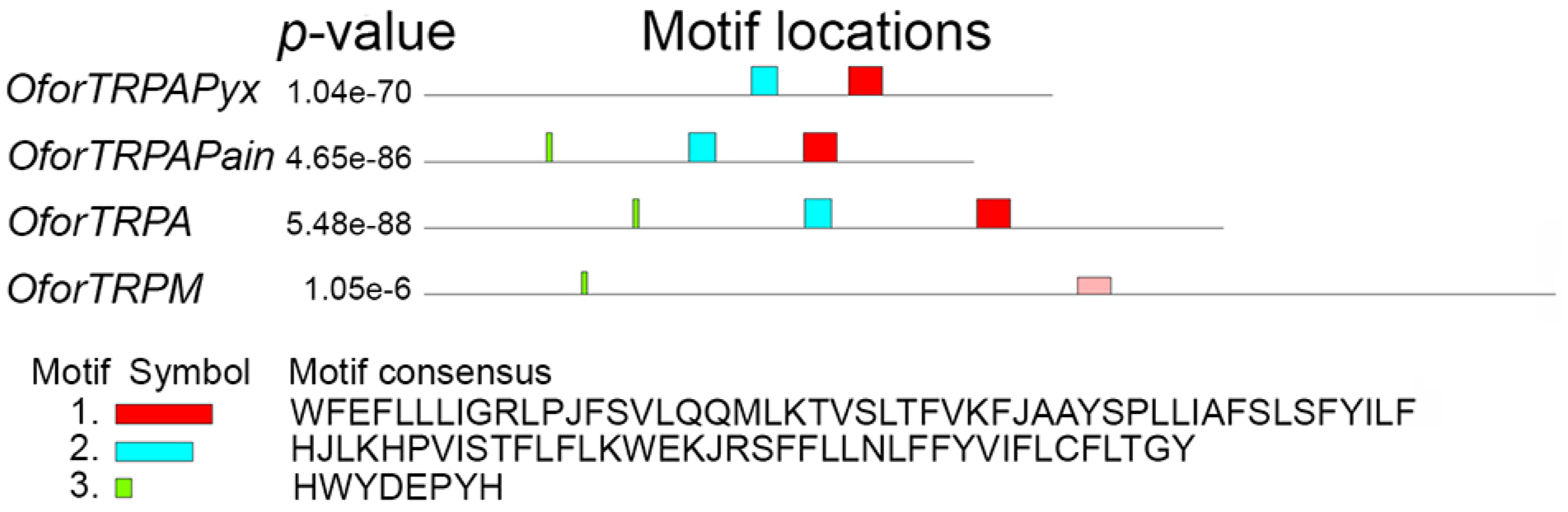
The prediction of domain structure reveals the presence of various domains in all OforTRPs and OforPPK across the amino acid sequence from 5’ to 3’ end (Figure 2). Additionally, the motif locations underscore the existence of conserved motifs in different OforTRPs, as indicated by the p-values (Figure 4).
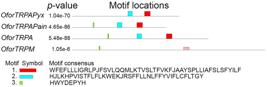
Motif locations of OforTRPs. Boxes and distinct colors represent conserved motifs with different p-values.
Expression profiles of putative pickpocket receptors along with transient receptor potential channels
To analyze the expression patterns of OforPPK and the four OforTRPs, we employed RT-qPCR (Figure 5). Whole bodies of both soldier and worker termites were analyzed to validate relative expression patterns. The mRNA expression level of OforPPK was markedly higher (**p < 0.01, ***p ≤ 0.001) in the worker caste compared to the soldier caste. Similarly, the expression profiles of all TRPs, including OforTRPAPyx, OforTRPAPain, OforTRPA, and OforTRPM, were significantly high in workers as compared to soldiers, based on the analysis of the whole bodies of the soldier caste of O. formosanus.
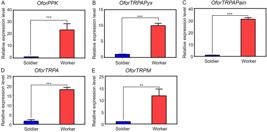
The relative level of mRNA expression for the respective candidate OforPPK and OforTRPs, in O. formosanus workers and soldiers whole body. Fold changes of OforPPK and all OforTRPs are relative to soldier castes corresponding genes in O. formosanus. The total stars signifies the variation in p-values at a significance level, specifically, **p < 0.01, ***p ≤ 0.001.
Discussion
PPK proteins in insects preform several essential functions, including the recognition of mechanical and chemical sensory inputs (Latorre-Estivalis et al., 2021). The PPK family belongs to the Degenerin/Epithelial Sodium Channel (DEG/ENaC) gene superfamily, which was initially identified while researchers investigated the genetic mechanisms underlying mechanosensory pathways in Caenorhabditis elegans (Maupas, 1900) (García-Añoveros et al., 1995). Insects possess a unique gene family, known as the PPK family, encoding receptor proteins associated with chemosensory processes. However, this family has received comparatively less research attention. Numerous PPKs are crucial for detecting various stimuli, including water, salts, osmotic potential, pheromones, and mechanical features of the environment (Liu et al., 2003; Zhong et al., 2010; Thistle et al., 2012; Pontes et al., 2017; Matthews et al., 2019; Masagué et al., 2020).
Insects utilize proteins from the TRP (transient receptor potential) class to detect and respond to environmental changes, making these proteins integral to their sensory physiology. Additionally, this protein holds promising potential for the development of novel insecticides (Su et al., 2018). In this context, there exists a group of cationic channels known as TRP superfamily proteins, characterized by six transmembrane domains that facilitate the passage of calcium ions. These proteins are involved in a variety of cellular processes (Venkatachalam and Montell, 2007). Members of this superfamily, found in all animals, can be activated through numerous mechanisms and play vital roles in sensory physiology, including vision, taste, hearing, gravity perception, touch, smell, humidity detection, and the sensing of temperature and osmotic pressure (Montell, 2005; Venkatachalam and Montell, 2007). In insects, these channels significantly influence both behavioral and physiological functions (Montell, 2005; Chouquet et al., 2009; Fowler and Montell, 2013; Zermoglio et al., 2015).
We have analyzed the transcriptomic data and identified one pickpocket receptor (OforPPK) and four TRP channels in O. formosanus. Previous research has found PPKs in various insect orders, including Diptera, Lepidoptera, Coleoptera, Hymenoptera, Phthiraptera, Hemiptera, Blattodea (not including O. formosanus), and Orthoptera. However, O. formosanus had not been studied before. The OforPPK evolutionary relationship indicates closeness among C. formosanus, C. secundus, Diploptera punctate (Eschscholtz, 1822), and other insects (Latorre-Estivalis et al., 2021). Phylogenetic studies can enhance our understanding of gene conservation, classification, and diversification, helping researchers relate the functional roles of Drosophila (model organism) to other insects (Latorre-Estivalis et al., 2021). Our findings suggest that altered gene expression levels may indicate adaptation or functional gene loss, and the transcriptome of gene activity reflects a substantial decrease of tissue-specific genes by 40 % of the examined tissues as aging occurs, demonstrating a deterioration of tissue identity over time (Santos et al., 2023). Most PPKs are associated with insects, indicating that further phylogenetic and functional analyses could aid in pest management strategies against insects that cause damage and compromise both public health and the economy (Latorre-Estivalis et al., 2021). Key functions of insect PPKs include mechano-sensation and chemo-sensation, the two most crucial functions (Liu et al., 2020). Among the 26 species in which PPKs have been identified, the Drosophila genome contains 31 PPKs, which are organized in seven distinct subfamilies in Drosophila melanogaster Meigen, 1830 (Latorre-Estivalis et al., 2021). PPK28, belonging to the DEG/ENaC family, detects water (Cameron et al., 2010; Chen et al., 2010) and is crucial for low osmolarity sensitivity (Liman et al., 2014). Drosophila shows a preference for low-salt foods as adults, similar to mammals. Nonetheless, while PPK11 and PPK19 are present in the taste-sensing terminal tissues of larvae and support low-salt detection throughout the larval stage (Liu et al., 2003), they are not functionally expressed in adults regarding salt sensitivity (Zhang et al., 2013).
PPK25 enhances ligand-induced currents downstream of specific olfactory receptors. When PPK25 is either knocked out or overexpressed in D. melanogaster, it can diminish or amplify the physiological perception of Or47b olfactory receptor neurons (ORNs) (Ng et al., 2019). This suggests that this PPK functions to amplify signals rather than acting as a sensory receptor across various classes of neurons (Schmidt and Benton, 2020). Beyond sensory systems, the two PPKs (PPK11 and PPK16) also regulate homeostatic plasticity by modulating presynaptic membrane voltage at the neuromuscular junction (Younger et al., 2013). The PPK subfamily is crucial for pheromone-guided sexual activity (Joseph and Carlson, 2015; Kohl et al., 2015). The functions of pickpocket genes encompass the modulation of courtship behavior (Jacob and Hedwig, 2016), rhythmic locomotion (Ainsley et al., 2003), pheromone detection (Lu et al., 2012), and liquid evacuation in the larval trachea (Lee et al., 2017). Additionally, PPKs are in genomic regions associated with variations in song rhythm in Laupala (Shaw and Lesnick, 2009). Their expression in the abdominal ganglia of Gryllus bimaculatus De Geer, 1773, suggests to researchers that rhythmic regulation, sound perception, and wing movements – essential to mating – may be influenced by the extended pickpocket gene family seen in cricket genomes (Ylla et al., 2021).
The TRP superfamily proteins help insects in sensing environmental changes and regulating sensory physiology (Zhang et al., 2024), presenting potential targets for insecticide development (Nesterov et al., 2015). While molecular studies on TRP channels in agricultural pests are limited, considerable research has focused on D. melanogaster (Su et al., 2018). In this study, we identified four TRPs in O. formosanus, which can be further categorized into the seven subfamilies categorized by their structure and phylogeny. Our notes show that the TRPs identified in O. formosanus belong to the TRPA subfamily, including Pyrexia, Pain, and TRPA categories. Additionally, one TRP belongs to the TRPM subfamily.
To address the challenge of identifying microenvironments conducive to insect growth and reproduction (Barbagallo and Garrity, 2015; Bellemer, 2015), Drosophila possesses four TRPA channels: TRPA1, Pain, Pyrexia, and Water witch. Except Water witch (Wtrw), these four TRPA channels play a role in thermosensation and are also acknowledged as thermoTRPs (Bellemer, 2015). Similar to our results, the TRPA family has been identified in both D. melanogaster and Bactrocera dorsalis (Hendel, 1912), alongside a gene coding TRPAPyx (Su et al., 2018). The TRPA subfamily members are involved in detecting temperature, compounds, and humidity. The diversity of TRPA members may correlate directly with the complexity of each insect's lifestyle. For instance, a notable increase in Pain and TRPA5 channels has led to the identification of 27 TRPs in Solenopsis invicta Buren, 1972, surpassing the counts seen in most insects (Peng et al., 2015). TRP amplification and decrease in insects might suggest that this superfamily evolved in response to life histories and particular habitats; nevertheless, additional research is required to validate this idea (Su et al., 2018). Multiple pain channels were found in Blattella germanica Linnaeus, 1767 and Z. nevadensis. In Pieris rapae (Linnaeus, 1758), only one pain channel is found (Mao et al., 2020).
In Drosophila, Malpighian tubules express the TRPM channel, which is responsible for eliminating Mg2+ from the hemolymph. Loss-of-function mutations in this channel lead to hypermagnesemia, resulting in slowed larval development and halted prepupal development. Additionally, a magnesium-rich diet exacerbates these symptoms (Hofmann et al., 2010). The TRPM channel is unique among TRP channels due to its association with potentially lethal mutant phenotypes, whereas other TRP channels primarily influence sensory perception and behavior. Given that Lepidopteran and Coleopteran diets are notably high in Mg2+ content, targeting the TRPM channel presents a promising strategy for insecticide development (Salgado, 2017). Furthermore, TRPA Pain plays a key role in the mechanosensation, particularly in response to intense stimuli (Tracey et al., 2003). Notably, TRPA1 has been implicated in acute heat sensitivity (Fowler and Montell, 2013; Barbagallo and Garrity, 2015). While the two isoforms of TRPA1, designated B and C, do not respond to temperature, allyl isothiocyanate activates all forms of TRPA1 (Bellemer, 2015).
All TRPs identified in this study are expressed at higher levels in workers compared to soldiers. The expression profiles of chemosensory genes may offer insights into various physiological and functional implications (Kaleem Ullah et al., 2023). PPKs and TRPs are located throughout the bodies of insects (Su et al., 2018; Mao et al., 2020), but sensory organs, such as antennae and maxillary palps, are the primary sites of chemosensory genes expression. The increased expression of OforTRPs suggests potential functional and behavioral roles in insect sensory physiology.
In our study, we observed that OforPPK is expressed in the different castes, specifically soldiers and workers. The higher expression levels of OforPPK in worker castes indicate that it has more significant functional and physiological implications for these individuals. Previous research has confirmed that genes associated with chemosensation have relatively high expression levels in various castes and different organs (Mitaka et al., 2016; Sun et al., 2019; Suzuki et al., 2023). For instance, the high transcription levels of PrPyx in Pieris rapae were detected in the gut, brain, and antennae, highlighting the elevated expression levels of two isoforms of Pyx. In Drosophila, Johnston's organ of the antennae, which is associated with the Pyx channel, plays a role in controlling anti-gravitaxis tendencies (Sun et al., 2009). Additionally, PrPain was found to be broadly distributed across outer sensory tissues, such as mouthparts, legs, and wings, pointing to its potential role in chemical, thermal, and mechanical nociception (Tracey et al., 2003; Mao et al., 2020). Furthermore, studies suggest higher mRNA levels found in the brain, ovaries, and guts may indicate that the Pain channel has expanded roles regulating various physiological functions (Mao et al., 2020). The BdorPain is believed to participate in signaling pathways in B. dorsalis (Su et al., 2018). In Pieris rapae, PrTRPA1 expression was noted in the antennae, mouthparts, wings, and legs. However, the high expression of TRPA5 in the non-sensory organs suggests a functional basis for further studies (Fowler and Montell, 2013; Mao et al., 2020). Moreover, TRPM is crucial for balancing Mg2+ and Zn2+ levels. Drosophila melanogaster lacking this channel exhibit shorter Malpighian tubules, demonstrating the extended role of TRPM, as mutations can lead to pupal death (Hofmann et al., 2010). In B. dorsalis, the high expression levels of TRPM in various external organs and Malpighian tubules indicate its role in environmental responses and maintaining homeostasis for Mg2+ and Zn2+ (Georgiev et al., 2010; Turner et al., 2016; Su et al., 2018; Mao et al., 2020).
In this study, we identified one pickpocket receptor and four transient receptor potential channels within the transcriptome of O. formosanus. We analyzed these genes to explore their phylogenetic relationships, conserved motif locations, and domain structures. Furthermore, we performed RT-qPCR to examine caste-specific expression profiles among soldiers and workers. The elevated expression of OforPPK in the worker caste compared to the soldier caste may suggest that this gene plays a role in sensory perception in O. formosanus. Similarly, the high expression of all OforTRPs following the same pattern as OforPPK also indicates that these genes are involved in various behavioral and physiological processes, including environmental cue detection, ion transport regulation, contributions to insect immunity, and sensory physiology. OforPPK and OforTRPs represent potential targets for the development of new insecticides specifically for O. formosanus; however, further research is necessary. These findings will enhance our understanding of the chemosensory system in subterranean termites and will serve as a foundation for future molecular and functional studies aimed at eco-friendly and environmentally safe termite control.
Data availability statement
The data supporting the findings of this study are available in the manuscript.
Acknowledgments
This project was funded by the Ongoing Research Funding program, (ORF-2025-112), King Saud University, Riyadh, Saudi Arabia and the Guangxi Innovation Team of National Modern Agricultural Technology System (nycytxgxcxtd-2023-10-3). We are grateful to Bao Jia and Sheng Liang from the Institute of Termites Control, Nanning, for their technical support during the study.
References
-
Ainsley JA, Pettus JM, Bosenko D, Gerstein CE, Zinkevich N, Anderson MG, et al. 2003. Enhanced locomotion caused by loss of the Drosophila DEG/ENaC protein Pickpocket1. Current Biology 13: 1557-1563. https://doi.org/10.1016/s0960-9822(03)00596-7
» https://doi.org/10.1016/s0960-9822(03)00596-7 -
Barbagallo B, Garrity PA. 2015. Temperature sensation in Drosophila Current Opinion in Neurobiology 34: 8-13. https://doi.org/10.1016/j.conb.2015.01.002
» https://doi.org/10.1016/j.conb.2015.01.002 -
Bellemer A. 2015. Thermotaxis, circadian rhythms, and TRP channels in Drosophila Temperature 2: 227-243. https://doi.org/10.1080/23328940.2015.1004972
» https://doi.org/10.1080/23328940.2015.1004972 -
Cameron P, Hiroi M, Ngai J, Scott K. 2010. The molecular basis for water taste in Drosophila Nature 465: 91-95. https://doi.org/10.1038/nature09011
» https://doi.org/10.1038/nature09011 -
Chen Z, Wang Q, Wang Z. 2010. The amiloride-sensitive epithelial Na+ channel PPK28 is essential for Drosophila gustatory water reception. Journal of Neuroscience 30: 6247-6252. https://doi.org/10.1523/JNEUROSCI.0627-10.2010
» https://doi.org/10.1523/JNEUROSCI.0627-10.2010 -
Chouquet B, Debernard S, Bozzolan F, Solvar M, Maïbèche-Coisné M, Lucas P. 2009. A TRP channel is expressed in Spodoptera littoralis antennae and is potentially involved in insect olfactory transduction. Insect Molecular Biology 18: 213-222. https://doi.org/10.1111/j.1365-2583.2008.00857.x
» https://doi.org/10.1111/j.1365-2583.2008.00857.x - Fangyao Z, Shen L, Defang F. 1995. Studies on Sunialpha 5FL against termites-Laboratory tests of soil treatment. Pesticides 34: 18-20.
-
Fowler MA, Montell C. 2013. Drosophila TRP channels and animal behavior. Life Sciences 92: 394-403. https://doi.org/10.1016/j.lfs.2012.07.029
» https://doi.org/10.1016/j.lfs.2012.07.029 -
García-Añoveros J, Ma C, Chalfie M. 1995. Regulation of Caenorhabditis elegans degenerin proteins by a putative extracellular domain. Current Biology 5: 441-448. https://doi.org/10.1016/s0960-9822(95)00085-6
» https://doi.org/10.1016/s0960-9822(95)00085-6 -
Georgiev P, Okkenhaug H, Drews A, Wright D, Lambert S, Flick M, et al. 2010. TRPM channels mediate zinc homeostasis and cellular growth during Drosophila larval development. Cell Metabolism 12: 386-397. https://doi.org/10.1016/j.cmet.2010.08.012
» https://doi.org/10.1016/j.cmet.2010.08.012 -
Hofmann T, Chubanov V, Chen X, Dietz AS, Gudermann T, Montell C. 2010. Drosophila TRPM channel is essential for the control of extracellular magnesium levels. PLOS One 5: e10519. https://doi.org/10.1371/journal.pone.0010519
» https://doi.org/10.1371/journal.pone.0010519 - Huang F, Zhang SM, Pei ZM. 2000. Fauna Sinica, Insecta: Isoptera. Science Press, Beijing, China.
- Huang Q-Y, Lei C-L, Xue D. 2006. Field evaluation of a fipronil bait against subterranean termite Odontotermes formosanus (Isoptera: Termitidae). Journal of Economic Entomology 99: 455-461.
-
Jacob PF, Hedwig B. 2016. Acoustic signalling for mate attraction in crickets: abdominal ganglia control the timing of the calling song pattern. Behavioural Brain Research 309: 51-66. https://doi.org/10.1016/j.bbr.2016.04.025
» https://doi.org/10.1016/j.bbr.2016.04.025 -
Jacobs SP, Liggins AP, Zhou JJ, Pickett JA, Jin X, Field LM. 2005. OS-D-like genes and their expression in aphids (Hemiptera: Aphididae). Insect Molecular Biology 14: 423-432. https://doi.org/10.1111/j.1365-2583.2005.00573.x
» https://doi.org/10.1111/j.1365-2583.2005.00573.x -
Joseph RM, Carlson JR, 2015. Drosophila chemoreceptors: a molecular interface between the chemical world and the brain. Trends in Genetics 31: 683-695. https://doi.org/10.1016/j.tig.2015.09.005
» https://doi.org/10.1016/j.tig.2015.09.005 -
Kaleem Ullah RM, Jia B, Liang S, Sikandar A, Gao F, Wu H. 2023. Uncovering the chemosensory system of a subterranean termite, Odontotermes formosanus (Shiraki) (Isoptera: Termitidae): revealing the chemosensory genes and gene expression patterns. Insects 14: 883. https://doi.org/10.3390/insects14110883
» https://doi.org/10.3390/insects14110883 -
Kohl J, Huoviala P, Jefferis GS. 2015. Pheromone processing in Drosophila Current Opinion In Neurobiology 34: 149-157. https://doi.org/10.1016/j.conb.2015.06.009
» https://doi.org/10.1016/j.conb.2015.06.009 -
Kulmuni J, Wurm Y, Pamilo P. 2013. Comparative genomics of chemosensory protein genes reveals rapid evolution and positive selection in ant-specific duplicates. Heredity 110: 538-547. https://doi.org/10.1038/hdy.2012.122
» https://doi.org/10.1038/hdy.2012.122 -
Lahav S, Soroker V, Hefetz A, Vander Meer RK. 1999. Direct behavioral evidence for hydrocarbons as ant recognition discriminators. Naturwissenschaften 86: 246-249. https://doi.org/10.1007/s001140050609
» https://doi.org/10.1007/s001140050609 -
Latorre-Estivalis JM, Almeida FC, Pontes G, Dopazo H, Barrozo RB, Lorenzo MG. 2021. Evolution of the insect PPK gene family. Genome Biology and Evolution 13: evab185. https://doi.org/10.1093/gbe/evab185
» https://doi.org/10.1093/gbe/evab185 -
Lee MJ, Sung HY, Jo H, Kim H-W, Choi MS, Kwon JY, et al. 2017. Ionotropic receptor 76b is required for gustatory aversion to excessive Na+ in Drosophila Molecules and Cells 40: 787-795. https://doi.org/10.14348/molcells.2017.0160
» https://doi.org/10.14348/molcells.2017.0160 - LiJun X, JiaXin X, BaoZhong J, ShuWen L, Yi W, Jin M, et al. 2019. Studies on the anatomical structures of labial gland in Odontotermes formosanus Journal of Environmental Entomology 41: 914-921
-
Liman ER, Zhang YV, Montell C. 2014. Peripheral coding of taste. Neuron 81: 984-1000. https://doi.org/10.1016/j.neuron.2014.02.022
» https://doi.org/10.1016/j.neuron.2014.02.022 -
Liu L, Leonard AS, Motto DG, Feller MA, Price MP, Johnson WA, et al. 2003. Contribution of Drosophila DEG/ENaC genes to salt taste. Neuron 39: 133-146. https://doi.org/10.1016/s0896-6273(03)00394-5
» https://doi.org/10.1016/s0896-6273(03)00394-5 -
Liu T, Wang Y, Tian Y, Zhang J, Zhao J, Guo A. 2020. The receptor channel formed by PPK25, PPK29 and PPK23 can sense the Drosophila female pheromone 7,11-heptacosadiene. Genes, Brain and Behavior 19: e12529. https://doi.org/10.1111/gbb.12529
» https://doi.org/10.1111/gbb.12529 -
Livak KJ, Schmittgen TD. 2001. Analysis of Relative Gene Expression Data Using Real-Time Quantitative PCR and the 2−ΔΔCT Method. Methods 25: 402-408. https://doi.org/10.1006/meth.2001.1262
» https://doi.org/10.1006/meth.2001.1262 -
Lu B, LaMora A, Sun Y, Welsh MJ, Ben-Shahar Y. 2012. PPK23-Dependent chemosensory functions contribute to courtship behavior in Drosophila melanogaster PLOS Genetics 8: e1002587. https://doi.org/10.1371/journal.pgen.1002587
» https://doi.org/10.1371/journal.pgen.1002587 -
Mao F, Lu W-J, Yang Y, Qiao X, Ye G-Y, Huang J. 2020. Identification, characterization and expression analysis of TRP Channel genes in the vegetable pest, Pieris rapae Insects 11: 192. https://doi.org/10.3390/insects11030192
» https://doi.org/10.3390/insects11030192 -
Masagué S, Cano A, Asparch Y, Barrozo RB, Minoli S. 2020. Sensory discrimination between aversive salty and bitter tastes in an haematophagous insect. European Journal of Neuroscience 51: 1867-1880. https://doi.org/10.1111/ejn.14702
» https://doi.org/10.1111/ejn.14702 -
Matthews BJ, Younger MA, Vosshall LB. 2019. The ion channel PPK301 controls freshwater egg-laying in the mosquito Aedes aegypti eLife 8: e43963. https://doi.org/10.7554/eLife.43963
» https://doi.org/10.7554/eLife.43963 -
Mitaka Y, Kobayashi K, Mikheyev A, Tin MMY, Watanabe Y, Matsuura K. 2016. Caste-specific and sex-specific expression of chemoreceptor genes in a termite. PLOS One 11: e0146125. https://doi.org/10.1371/journal.pone.0146125
» https://doi.org/10.1371/journal.pone.0146125 -
Montell C. 2005. Drosophila TRP channels. Pflügers Archiv 451: 19-28. https://doi.org/10.1007/s00424-005-1426-2
» https://doi.org/10.1007/s00424-005-1426-2 -
Nesterov A, Spalthoff C, Kandasamy R, Katana R, Rankl NB, Andrés M, et al. 2015. TRP channels in insect stretch receptors as insecticide targets. Neuron 86: 665-671. https://doi.org/10.1016/j.neuron.2015.04.001
» https://doi.org/10.1016/j.neuron.2015.04.001 -
Ng R, Salem SS, Wu S-T, Wu M, Lin H-H, Shepherd AK, et al. 2019. Amplification of Drosophila olfactory responses by a DEG/ENaC channel. Neuron 104: 947-959. https://doi.org/10.1016/j.neuron.2019.08.041
» https://doi.org/10.1016/j.neuron.2019.08.041 -
Ninkovic V, Markovic D, Rensing M. 2021. Plant volatiles as cues and signals in plant communication. Plant, Cell & Environment 44: 1030-1043. https://doi.org/10.1111/pce.13910
» https://doi.org/10.1111/pce.13910 -
Peng G, Shi, X, Kadowaki T. 2015. Evolution of TRP channels inferred by their classification in diverse animal species. Molecular Phylogenetics and Evolution. 84: 145-157. https://doi.org/10.1016/j.ympev.2014.06.016
» https://doi.org/10.1016/j.ympev.2014.06.016 -
Pontes G, Pereira MH, Barrozo RB. 2017. Salt controls feeding decisions in a blood-sucking insect. Journal of Insect Physiology 98: 93-100. https://doi.org/10.1016/j.jinsphys.2016.12.002
» https://doi.org/10.1016/j.jinsphys.2016.12.002 -
Qiuying H, Chaoliang L, Dong X. 2005. Food choice of the underground termite, Odontotermes formosanus Scientia Silvae Sinicae 5: 91-95 (in Chinese, with abstract in English). https://doi.org/10.11707/j.1001-7488.20050515
» https://doi.org/10.11707/j.1001-7488.20050515 -
Salgado VL. 2017. Insect TRP channels as targets for insecticides and repellents. Journal of Pesticide Science 42: 1-6. https://doi.org/10.1584/jpestics.D16-104
» https://doi.org/10.1584/jpestics.D16-104 -
Santos GA, Chatsirisupachai K, Avelar RA, Magalhães JP. 2023. Transcriptomic analysis reveals a tissue-specific loss of identity during ageing and cancer. BMC Genomics 24: 644. https://doi.org/10.1186/s12864-023-09756-w
» https://doi.org/10.1186/s12864-023-09756-w -
Schmidt HR, Benton R. 2020. Molecular mechanisms of olfactory detection in insects: beyond receptors. Open Biology 10: 200252. https://doi.org/10.1098/rsob.200252
» https://doi.org/10.1098/rsob.200252 -
Shaw KL, Lesnick SC. 2009. Genomic linkage of male song and female acoustic preference QTL underlying a rapid species radiation. Proceedings of the National Academy of Sciences 106: 9737-9742. https://doi.org/10.1073/pnas.0900229106
» https://doi.org/10.1073/pnas.0900229106 -
Su H-A, Bai X, Zeng T, Lu Y-Y, Qi Y-X. 2018. Identification, characterization and expression analysis of transient receptor potential channel genes in the oriental fruit fly, Bactrocera dorsalis BMC Genomics 19: 674. https://doi.org/10.1186/s12864-018-5053-7
» https://doi.org/10.1186/s12864-018-5053-7 -
Sun P, Yu S, Merchant A, Lei C, Zhou X, Huang Q. 2019. Downregulation of Orco and 5-HTT alters nestmate discrimination in the subterranean termite Odontotermes formosanus (Shiraki). Frontiers in Physiology 10: 714. https://doi.org/10.3389/fphys.2019.00714
» https://doi.org/10.3389/fphys.2019.00714 -
Sun Y, Liu L, Ben-Shahar Y, Jacobs JS, Eberl DF, Welsh MJ. 2009. TRPA channels distinguish gravity sensing from hearing in Johnston's organ. Proceedings of the National Academy of Sciences 106: 13606-13611. https://doi.org/10.1073/pnas.0906377106
» https://doi.org/10.1073/pnas.0906377106 -
Suzuki RH, Hanada T, Hayashi Y, Shigenobu S, Maekawa K, Hojo MK. 2023. Gene expression profiles of chemosensory genes of termite soldier and worker antennae. Insect Molecular Biology 32: 424-435. https://doi.org/10.1111/imb.1284
» https://doi.org/10.1111/imb.1284 -
Tamura K, Stecher, G, Kumar S. 2021. MEGA11: molecular evolutionary genetics analysis version 11. Molecular Biology and Evolution 38: 3022-3027. https://doi.org/10.1093/molbev/msab120
» https://doi.org/10.1093/molbev/msab120 -
Thistle R, Cameron P, Ghorayshi A, Dennison L, Scott K. 2012. Contact chemoreceptors mediate male-male repulsion and male-female attraction during Drosophila courtship. Cell 149: 1140-1151. https://doi.org/10.1016/j.cell.2012.03.045
» https://doi.org/10.1016/j.cell.2012.03.045 -
Tracey WD, Wilson RI, Laurent G, Benzer S. 2003. Painless, a Drosophila gene essential for nociception. Cell. 113: 261-273. https://doi.org/10.1016/s0092-8674(03)00272-1
» https://doi.org/10.1016/s0092-8674(03)00272-1 -
Turner HN, Armengol K, Patel AA, Himmel NJ, Sullivan L, Iyer SC, et al. 2016. The TRP channels PKD2, NOMPC, and TRPM act in cold-sensing neurons to mediate unique aversive behaviors to noxious cold in Drosophila Current Biology 26: 3116-3128. https://doi.org/10.1016/j.cub.2016.09.038
» https://doi.org/10.1016/j.cub.2016.09.038 -
Venkatachalam K, Montell C. 2007. TRP channels. Annual Review of Biochemistry 76: 387-417. https://doi.org/10.1146/annurev.biochem.75.103004.142819
» https://doi.org/10.1146/annurev.biochem.75.103004.142819 -
Xinwei Z, Baozhong J, Shuwen L, Dandan C, Jinjin Y, Jiajia L, et al. 2015. Research progress inanatomic structures of digestive system and symbiotes in termites. Journal of Nanjing Forestry University 39: 155-161 (in Chinese, with abstract in English). https://doi.org/10.3969/j.issn.1000-2006.2015.01.028
» https://doi.org/10.3969/j.issn.1000-2006.2015.01.028 -
Yazhao W, Baozhong J, Shuwen L, Lijun X, Mingxia J, Yi W. 2018. Induction Feeding activity of fungus garden of Odontotermes formosanus (Isoptera: Termitidae) to foragers. Scientia Silvae Sinicae 54: 117-123 (in Chinese, with abstract in English). https://doi.org/10.11707/j.1001-7488.20180813
» https://doi.org/10.11707/j.1001-7488.20180813 -
Ylla G, Nakamura T, Itoh T, Kajitani R, Toyoda A, Tomonari S, et al. 2021. Insights into the genomic evolution of insects from cricket genomes. Communications Biology 4: 733. https://doi.org/10.1038/s42003-021-02197-9
» https://doi.org/10.1038/s42003-021-02197-9 -
Younger MA, Müller M, Tong A, Pym EC, Davis GW. 2013. A presynaptic ENaC channel drives homeostatic plasticity. Neuron 79: 1183-1196. https://doi.org/10.1016/j.neuron.2013.06.048
» https://doi.org/10.1016/j.neuron.2013.06.048 -
Zermoglio PF, Latorre-Estivalis JM, Crespo JE, Lorenzo MG, Lazzari CR. 2015. Thermosensation and the TRPV channel in Rhodnius prolixus Journal of Insect Physiology 81: 145-156. https://doi.org/10.1016/j.jinsphys.2015.07.014
» https://doi.org/10.1016/j.jinsphys.2015.07.014 -
Zhang YV, Ni J, Montell C. 2013. The molecular basis for attractive salt-taste coding in Drosophila Science 340: 1334-1338. https://doi.org/10.1126/science.1234133
» https://doi.org/10.1126/science.1234133 -
Zhang Y, Liu H, Cao S, Li B, Liu Y, Wang G. 2024. Identification of transient receptor potential channel genes and functional characterization of TRPA1 in Spodoptera frugiperda Journal of Integrative Agriculture 23: 1994-2005. https://doi.org/10.1016/j.jia.2023.09.023
» https://doi.org/10.1016/j.jia.2023.09.023 -
Zhong L, Hwang RY, Tracey WD. 2010. Pickpocket is a DEG/ENaC protein required for mechanical nociception in Drosophila larvae. Current Biology 20: 429-434. https://doi.org/10.1016/j.cub.2009.12.057
» https://doi.org/10.1016/j.cub.2009.12.057
Edited by
-
Edited by:
Alberto Soares Corrêa https://orcid.org/0000-0002-3788-7480