 Integrated water, nutrient, and mulch management enhances yield efficiency and quality in globe artichoke
ABSTRACT:
The effect of two variables interacting on crops has been the focus of most agronomic research. This study looked into how three factors interact to affect artichokes. The purpose of this study was to investigate how mulching, fertilizer, and irrigation affected artichoke yield (Ya) and quality characteristics between 2019 and 2020. Three mulching treatments, three fertilization levels, and three irrigation levels were combined to yield 27 study conditions. To carry out fertilization and irrigation processes in a controlled manner, the study recommended the use of drip irrigation systems. For the 2019-2020 study years, the Ya values were a minimum of 20.7-30.5 t ha–1 and a maximum of 48.6-50 t ha–1, respectively. Comparing the greatest artichoke head Ya data from 2019-2020 with those from other study subjects revealed Ya losses ranging from 2.7 to 57.4 and 4.0 to 39.2, respectively. The irrigation water (IW) levels ranged from a minimum of 240.0 to 246.0 mm and a maximum of 480.0 to 492.0 mm. The lowest and highest ET values ranged from 228.5-340.8 and 530.0-552.0 mm, respectively. When the interactions of irrigation-fertilization-mulching triple factors with Ya and quality losses in semi-arid climate conditions are evaluated, I75F75M1 (I75 = 75 % irrigation; F75 = 75 % fertigation; M1 = black mulching material) can be recommended.
Keywords:
drip irrigation; factor interaction; irrigation planning; ky factor; plant nutrition
Introduction
Artichoke (Cynara scolymus L.), indigenous to the Mediterranean region, is abundant in both wild and cultivated varieties in Turkey, which lies within this basin. It is farmed and produced in Turkey, mirroring global trends, with production increasing every year (Öztürk et al., 2020). World artichoke output for 2019, 2020, and 2021 was recorded at 1,583,584 t, 1,519,336 t, and 1.551.288 t, respectively. In these years, artichoke production in Turkey was recorded at 39,071 t, 39,280 t, and 40.114 t, respectively (FAO, 2023).
The artichoke variety Bayrampaşa is suitable for both canned and fresh consumption, and is grown mainly in the Marmara region, Istanbul, and Bursa districts. (Demirci et al., 2023). In several studies conducted in Turkey, it has been observed that various curtailed irrigation practices have significant effects on artichoke yield (Ya) (Öztürk et al., 2020). A study on artichokes highlighted the importance of using irrigation technologies that conserve water by increasing water usage and irrigation efficiency (Deligios et al., 2019). In recent years, artichoke growers have been applying high doses of nitrogen, phosphorus, and potassium (NPK) fertilizers to accelerate plant growth and maximize economic Ya (Ismail et al., 2022; Salata et al., 2022; Lombardo et al., 2022).
Producers have long used mulching as a cultural practice and know that it provides significant benefits to the soil and plants. Many different materials are used for mulching, but polyethylene (plastic) has recently become the material of choice. Dark-colored mulches contribute much more to the growth and Ya of the plant due to the appropriate temperature, humidity, and reflection of sunlight from the mulch in the root zone of the plant (Abdalla et al., 2019; Goldberger et al., 2019).
This study was undertaken because of the lack of research on the interplay among irrigation, fertilization, and mulching in artichoke, despite the proliferation of studies on irrigation and fertilization alone.
Materials and Methods
Experimental area and conditions
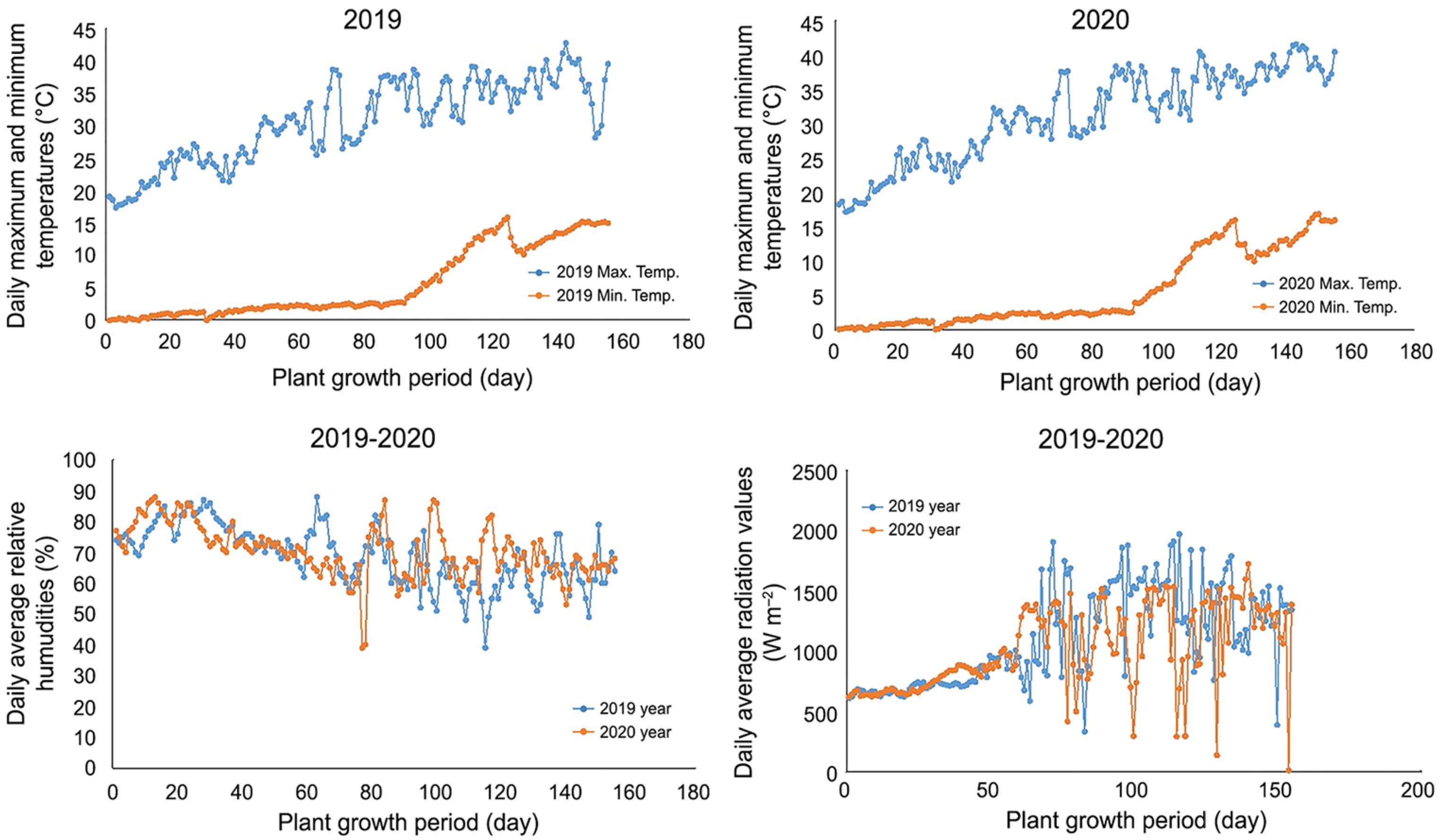
The Marmara Region of Bursa province, located at 40°15’09" N, 29°38’43" E, at an altitude of 225 m above mean sea level, was the study's site in 2019 and 2020. The Yenişehir region experiences a semi-arid climate in summer and moderate precipitation in winter. The minimum and maximum temperatures in the research region for two years were documented as 5.6-30.8 and 5.7-31.7 °C, respectively. The associated rainfall measurements were recorded as 92.0 and 47.3 mm, as illustrated in Figure 1. According to the MEVBIS (2021a), the mean relative humidity for 2019 and 2020 was 69.5 and 72.4 %, as depicted in Figure 1. The meteorological station located 6 km away from the trial area provided the minimum and maximum radiation values. The minimum and maximum solar radiation values were determined to be 335-1542 and 139-1983 W m–2, respectively (Figure 1), as stated in the MEVBIS (2021b). The climate values of the research area in both experimental years are shown in Tables 1 and 2. One month prior to the planting of artichoke shoots in the research area, soil samples were collected from various locations and depths. The mean pH values for the 0-0.90 m soil profile were 7.85 and 8.18, respectively (Table 3). The IW sourced from a well in the trial area was analyzed prior to the commencement of the research, revealing that it fell within the C2S1 quality classification. Waters with a C2S1 classification, which have low sodium and moderate electrical conductivity, can be used for irrigation in a variety of vegetable crops (Table 4). IW of quality class C2S1 can be used for many artichoke cultivars (Ismail et al., 2022). As a base fertilizer, 0.5 t ha–1 20-20-20 fertilizer was incorporated into the soil 20 days before the artichoke seedlings were planted. Against artichoke pests, chlorpyrifos-ethyl was used as a chemical pesticide.
Maximum (Max.) and minimum temperature (Temp.) values (°C), daily average relative humidities (%) and daily average radiation values (W m–2) in 2019 and 2020.
Some climate characteristics of the research area and monthly artichoke head diameter growth in 2019.
Some climate characteristics of the research area and monthly artichoke head diameter growth in 2020.
The relationship between the yield response factor (ky) value of artichokes and the amount of water during the study years.
Experimental treatments: irrigation, fertigation, and mulching
The study implemented three distinct irrigation levels and three fertilization levels, applied in a controlled manner across various treatment groups. IW was sourced from a well drilled in the field utilizing a sump pump. The well depth from which the water was sourced was18 m, with the pump operating at 12 m of water. With a flow rate of 16 m3 h–1, the sump pump efficiently provided the trial area with the water it needed. Plots were planted with artichoke seedlings spaced 0.50 m within and 1 m between rows. The preferred emitter spacing in the lateral pipes was 0.30 m, with each emitter delivering a flow rate of 4 L h–1. To determine water quantities, it was essential to assess soil moisture content before and after irrigation. Moisture levels were evaluated using the gravimetric method, focusing on the 0-0.90 m soil depth, depending on the artichoke's root length. The water balance equation yielded the most precise estimate of evapotranspiration (ET); therefore, calculations were conducted using Eq. (1).
Equation (1) defines the variables I, Rf, P, Dp, ET, and ΔS, corresponding to the IW amount during the period (mm), surface runoff (mm), total rainfall (mm), deep drainage (mm), evapotranspiration (mm), and soil water content (mm) at the beginning and end of the period, accordingly. The significance of deep drainage (Dp) was overlooked. Artichoke roots and water were unable to penetrate soil depths exceeding 120 cm. The calculation of surface runoff (Rf) is presented in Eq. (2):
In the equation, surface runoff is denoted by Rf, precipitation by P, infiltration by Dp, and evaporation by E. The runoff coefficient was found to be 0.50 for level agricultural regions with inclinations ranging from 0-5 % and clay silt loam soils in accordance with the rational technique (Q = C..i..A). The wet area ratio was determined using Eq. (3), as the spacing between plant rows exceeded the spacing between drippers.
The symbols P, Sd, and Sl in Eq. (3) refer to the wetted area ratio (%), dripper spacing (m), and lateral spacing (m), respectively.
In Eq. (4), the symbols FC, WP, Ry, ɣt, D, and P stand for field capacity (%), wilting point (%), the portion of the usable water storage capacity that is permitted to be consumed (%), soil volume weight (g cm–3), and wet soil depth (mm), respectively.
The symbols Ya, Ym, ETa, and ETm refer to the actual yield (t ha–1), maximum yield (t ha–1), actual evapotranspiration (mm), and maximum evapotranspiration (mm), respectively, in Eq. (5). The yield response factor (ky) expresses the relative yield reductions that occur in yield in response to relative reductions in plant water consumption.
Three different irrigation levels (I100, I75, I50) were applied in the study. In I100, the plant's IW need was fully met. In I75 and I50, IW was applied at 50 % and 75 % of full irrigation, respectively. Three different fertigation levels were applied: F100, F75, and F50. At the F1 level, the full amount of NPK fertilizer required by the artichoke was applied to the plant, while at the F2 and F3 levels, 50 % and 75 % of the full amount was applied, respectively. Therefore, fertigation levels F100, F75, and F50 were selected. Nitrogen (N) fertilizers were applied in three distinct stages. N fertilizer was applied as ammonium nitrate (33 %) during the first week of planting artichoke seedlings, at a rate of 0.4 t ha–1 for the F1 treatment. During the second and third stages, ammonium nitrate fertilizer (33 %) was applied at a rate of 0.4 t ha–1 for the F1 treatment during head formation and close to harvest. In F2 and F3, the same type of fertilizer was applied at rates of 30 and 0.2 t ha–1, respectively, across three periods. Phosphorus (P) and potassium (K) fertilizers were applied immediately after planting for all treatments. In the F1 treatment, P fertilizer was applied as P2O5 at a rate of 0.2 t ha–1, while K fertilizer was applied as K2O at the same rate of 0.2 t ha–1. In the F2 and F3 treatments, P and K fertilizers were applied at rates of 0.15 t ha–1. For the Bayrampaşa variety during the plant production period, it is advised to apply 11.2-22.4 kg of N as fosfat, and 0.4 t ha–1 of K as fosfat (Gürel and Bıyıklı, 2023). Three distinct mulching treatments were implemented as the third factor in the study. These treatments were polyethylene (PE) black mulch (M1), PE transparent mulch (M2), and no mulch (M0) (Bogucka and Jankowski, 2020; Bogucka et al., 2021). Twenty-seven application topics were created for irrigation, fertigation, and mulching (Table 6).
In the Marmara Region, where the study was carried out, artichoke seedlings are planted in the ground in spring and fall. Due to higher artichoke unit pricing, the research revealed a preference for the spring season. March 01, 2019, and March 02, 2020, were the planting dates.
The components of the drip irrigation system used in the study were correctly selected. The plants in the plots were arranged at a height of 0.50 m above the row and a spacing of 1.00 m between the rows. Each plot had 35 plants, arranged in five rows of seven plants each. Within each plot, plants were harvested from plots containing of 15 plants. The study consisted of 27 treatments (plots) created by combining three factors. The study was conducted in three repetitions (blocks). Combination treatments of irrigation, fertilization, and mulching were conducted systematically using a drip irrigation system.
The distance from the fleshy part at the bottom to the top of the artichoke leaves, before they are peeled, is called the head length. The diameter of the fleshy part remaining at the bottom after the artichoke leaves are peeled is called the head diameter. The head length and diameter of the artichokes were measured with a caliper and a ruler, and the average of the measures was computed. The artichokes from the harvest plots were chopped into tiny pieces and baked at 65 °C to determine dry weight. (Öztürk Erdem et al., 2020). In addition to yielding parameters, water-soluble carbohydrate (WSC), protein, fat, pH, vitamin C (ascorbic acid) content, phenolic content, antioxidant capacity, iron (Fe), sodium (Na), zinc (Zn), phosphorus (P), potassium (K), calcium (Ca), magnesium (Mg), and copper (Cu) contents were found.
Determination of the water-soluble dry matter amount in artichoke (100 g–1)
The peeled artichoke leaves were chopped, mixed with water, and then strained through coarse filter paper. The water-soluble dry matter content, determined by refractomety at 20 °C with a digital refractometer (RA-500 model, KEM brand), was calculated as 100 g–1 (Allahdadi and Bahreininejad, 2019; Gürel and Bıyıklı, 2023).
pH values
The peeled artichoke leaves were crushed into a puree. The samples were pureed at focus temperature, and pH values were measured with a Sevencompact pH/Ion Mettler Toledo pH meter (Allahdadi and Bahreininejad, 2019; Gürel and Bıyıklı, 2023).
Water-soluble carbohydrate (%)
After drying of cut artichoke fruits in an oven at 65 °C for 48 h, the samples were weighed using a digital scale. Dried artichoke samples were milled to 1 mm for chemical analysis. WSC was quantified using near-infrared spectroscopy. The method has been elucidated by Jafari et al. (2003) and Allahdadi and Bahreininejad (2019).
Determination of protein (%)
Artichoke samples were analyzed for protein following the Kjeldahl method. In the Kjeldahl method, 50 g samples were processed through combustion, distillation, and titration stages, and the calculation was initiated. The artichoke's protein content (%) was calculated by multiplying its N content percentage by 6.25 (Allahdadi and Bahreininejad, 2019; Gürel and Bıyıklı, 2023).
Determination of fat composition by Soxhlet extraction device (%)
The oil content of artichoke samples was determined by Soxhlet extraction. The oil xtracted from artichoke samples was calculated by using the equation below (Hewavitharana et al., 2020).
Calculation:
% Fat = sample weight (g) – sample weight at the end of the test (g)
% Fat = (weight of the balloon (g) + weight of the oil remaining in the balloon (g) / weight of the sample (g) × 100
Determination of Vitamin C (ascorbic acid)
Vitamin C levels in artichoke samples were determined spectrophotometrically (Shimadzu IU-1800) according to El-Hadidy et al. (2022). The samples’ vitamin C content was expressed as mg 100 g–1 (Deligios et al., 2019; Lombardo et al., 2022).
Determination of total phenolic content in artichoke heads
The phenolic content of the artichoke was determined by treating the samples with Folin-Ciocalteu reagent, saturated Na2CO3 solution, and gallic acid in ethyl alcohol, and measuring the absorbance at 725 nm using a spectrophotometer (Hewavitharana et al., 2020; Gürel and Bıyıklı, 2023).
Determination of antioxidant capacity
Antioxidants capacity was assessed using previously established methods. The antioxidant capacity values for artichoke samples were determined from the calibration curves using the equations derived, expressed as μmol Trolox equivalent (TE) g–1. The R2 values of the curves were 0.98 and 0.99 for the α-diphenyl-α-picrylhydrazyl (DPPH) free radical scavenging methods, respectively (Hewavitharana et al., 2020; Gürel and Bıyıklı, 2023).
Determination of the chemical analysis of fruit samples
The Kjeldahl technique and a Shimadzu UV-1208 spectrophotometer were used to measure the samples’ total P concentration. An atomic absorption spectrophotometer was used to determine the fruit's concentrations of Ca, Na, K, Mg, Zn, Fe, and Cu (Varian AA240FS) (Wierzbowska et al., 2021).
Experimental design and statistical analysis
The study was designed to be carried out in three separate blocks or three times. In a three-factor trial, values must be compared. The MINITAB 17 program was used to do a three-way Analysis of Variance on the physical and chemical characteristics of artichokes. The relationship among the three factors — irrigation, fertigation, and mulching — was examined using post-hoc testing.
Results
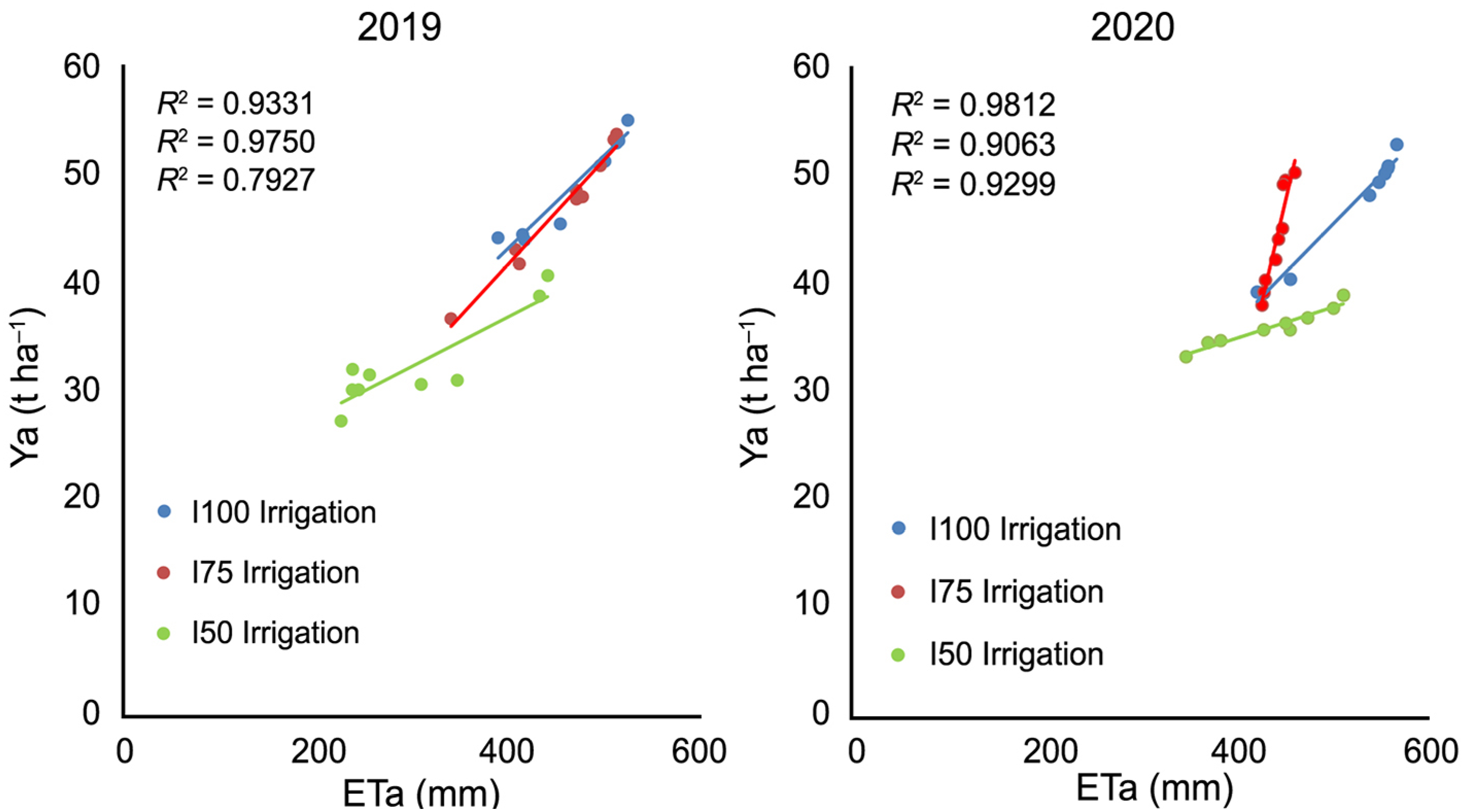
The irrigation factor is more effective in influencing artichokes characteristics compared than fertilization and mulching. Soil moisture levels were assessed using the gravimetric method, and irrigation was applied one week after planting artichoke seedlings. The trial years facilitated the calculation of the minimum and maximum IW amounts, which ranged from 240.0 to 480.0 mm and 246.0 to 492.0 mm, respectively (Table 5). According to Table 5, the trial years’ lowest and maximum ET readings were 228.5-530.0 and 340.8-552.0 mm, respectively. The relationship between ET and Ya during the research years and IW levels is depicted in Figure 2. Higher yields are correlated with more IW (Ya). Plant water consumption (PWC) and Ya values were shown to be linearly related. Additionally, during the plant growth period, temperature and humidity affected ET values. The drip irrigation method was employed to assess optimal irrigation timing and factors influencing water Ya and production. The I100F100M1 treatment exhibited the highest PWC values in both years of the study, whereas the lowest PWC value was recorded for the I50F50M0 treatment (Table 5). In other words, the highest ET value was obtained from the subject where irrigation-fertilization was fully applied and M1 was used. In contrast, the lowest ET value was obtained from the M0 subject, which received 50 % irrigation and fertilization with no mulch.
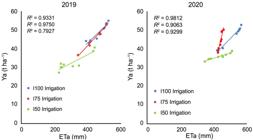
The relationship between evapotranspiration (ETa) with yield (Ya) for 2019 and 2020 years. I = irrigation (%).
Considering that the soils in which the experiment was carried out were alkaline in character (7.85-8.18) and the IW was in the C2S1 quality class, it was observed that as the irrigation level decreased, chemical fertilizers remained in the soil and damaged its texture and structure (Tables 3 and 4). Chemical fertilizers, because they contain chemicals, have caused the soil's clod structure to break down. This is very dangerous for soil health.
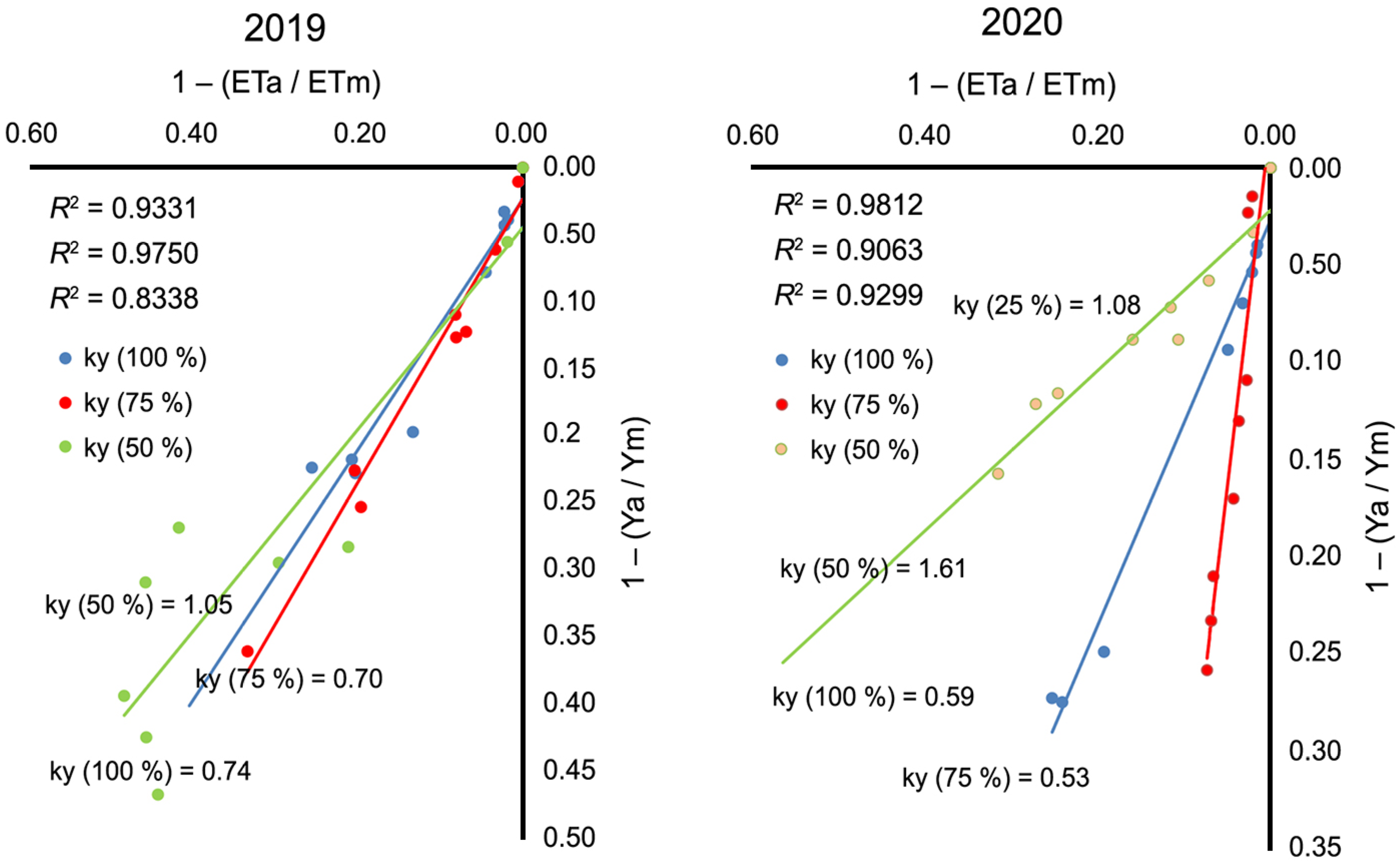
Crop ky values for irrigation subjects I100, I75, and I50 were calculated as 0.74-0.70-1.05 and 0.59-0.53-1.61 for both trial years, respectively. As the IW amount decreased, the ky value increased. The proximity of the ky values in the I100 and I75 treatments permitted irrigation at the I75 level with minimal Ya reduction (Figure 3). In water management, crop ky values are essential because they show how plant Ya reacts to different IW levels.
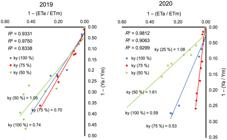
The relationship between relative yield (Ya) decrease and relative evapotranspiration (ETa) deficit for the experimental years (2019 and 2020). ETm = maximum evapotranspiration; Ym = maximum yield; ky = yield response factor.
The Ya values during the research years ranged from 48.6 to 50.2 t ha–1 and from 20.7 to 30.5 t ha–1, respectively (Tables 7 and 8). In 2019, Ya values demonstrated significance at the 1 % level when assessed individually for irrigation, fertilization, and mulching factors, as well as in the context of their triple interactions. The findings indicated insignificance regarding blocks. In 2020, irrigation and fertigation were identified as significant factors at the 1 % level, whereas the interactions with mulching, irrigation, and fertilization were deemed insignificant. The maximum Ya in both years was obtained from I100F100M1. Irrigation and fertilization were fully applied, and M1 was used. Considering the Yas for mulching, the maximum Ya was obtained with M1, followed by M2 and M0. Similarly, the lowest Ya was obtained from I50F50M0 in both years. In this subject, irrigation, and fertigation were applied at 50 %, and M0 was not used (Table 5). The highest values were recorded for the I100F100M1 treatment in both years. In contrast, the lowest values were observed with the I50F50M0 treatment for head length, diameter, main head weight, side head weight, and number of heads per plant (NHPP) (Tables 7 and 8). When evaluating 75 % and 100 % restricted irrigation treatments in terms of Ya loss and water savings, they provided significant advantages for the product. However, there were significant reductions in Ya between the 50 % and 100 % treatments. This also applies to the 66 % and 100 % treatments. Thus, the irrigation levels I100, I75, I50, and I25 were selected. When evaluating 75 % and 100 % fertigation applications in terms of Ya loss, they are known to provide significant advantages to the product. However, there are significant reductions in Ya between 100 % and 50 % applications. This also applies to 66 % and 100 % applications. The study found that the triple interaction among mulching, fertigation, and irrigation, and their combined effect on Ya, were significant at the 1 % level in both years. The major and secondary head weights, head length, diameter, and NHPP were significant at the 1 % level for both irrigation and fertigation in both years. Furthermore, with relation to mulching in the first year, all values were significant at the 1 % level, except for the NHPP. As regards mulching in the second year, all variables were again significant at the 1 % level, except for secondary head weight and the NHPP. As the amount of IW rose, an inverse relationship between the dry matter content and water amount was observed. With the least fertilizer and irrigation, I50F50M1 and I50F50M0 had the highest dry matter Ya. Conversely, I50F75M2 showed the highest dry matter Ya in the second year (see to Tables 7 and 8). In both trial years, the irrigation dry matter content values were significant at the 1 % level. In the first year, fertigation was significant at the 1 % level, and in the second year, it was significant at the 5 % level. Other physical parameters were classified into distinct statistical groups, even though the dry matter ratios and the NHPP for both years were within the same statistical class.
The effect of some production inputs on the yield (Ya) and quality values of artichokes in 2019.
The effect of some production inputs on the yield (Ya) and quality values of artichokes in 2020.
Irrigation and fertigation were significant at the 1 % level, in an analysis of artichoke quality indicators, including pH, lipid, protein, ascorbic acid, total phenolic compounds, and antioxidant capacity in both years. In the first year, the assessment of pH, ascorbic acid, total phenolic compounds, and antioxidant capacity values showed that mulching was significant at the 1 % level. Additionally, in the second year, ascorbic acid and antioxidant capacity values also demonstrated significance at the 1 % level when assessed in relation to mulching. In the first trial year, the total sugar and water-soluble carbohydrate values were classified within a single statistical category. Similarly, in the second year, the water-soluble carbohydrate, pH, protein, and total phenolic content values also fell within a single statistical category. Additional quality parameters of artichokes were categorized into various statistical classes. The evaluation of total sugar, soluble carbohydrates, fat, and protein contents in artichokes during the first year revealed no significant interaction among irrigation, fertigation, and mulching factors. In the second year, an evaluation of all quality parameters, excluding total sugar, related to the triple interaction of irrigation, fertigation, and mulching factors revealed no significant correlation (Tables 9 and 10).
The effect of some production inputs on the yield and quality values of artichokes in 2020.
In terms of irrigation and fertigation, the analysis of the Na, P, K, Ca, Zn, Fe, and Mg content of artichokes showed a significant association of 1 % in both years. Zn, K, P, and Na concentrations were evaluated in connection to mulching, and the results showed a strong association for both years at the 1 % level. The quality criteria in the first year were not noteworthy, according to the examination of the irrigation, fertigation, and mulching variables as regards their triple interaction. Except K and Fe, all quality measures showed negligible correlations in the second year. Zn values were classified into a single statistical class in the first year, whereas values for other nutritional components were distributed across several statistical classes. All nutrient element levels were categorized into separate statistical groups in the second year (Tables 11 and 12).
Discussion
In a three-year study on artichoke, it was reported that the total amount of water applied at 7, 14, and 21-day intervals was 599, 616, and 616 mm for I7 treatment, 391,398, and 398 mm for I14 treatment, and 248, 255, and 255 mm for I14 treatment (Salata et al., 2022). In another study on artichokes, the total IW amount was calculated at 3,150 m3 ha–1 due to differences in quality and IW application. Furthermore, it was found that the seasonal water volumes applied during two growth cycles were 3,300 and 3,000 m3 ha–1, respectively (Gagliardi et al., 2019). Additionally, the seasonally applied water volumes during the two growing cycles were 3,300 and 3,000 m3 ha–1, respectively. Minimum and maximum ET values in the trial years ranged from 228.5 to 530.0 and from 340.8 to 552.0 mm, respectively. The trial years’ results aligned with the PWC amount and IW figures from prior years (Gagliardi et al., 2019; Salata et al., 2022).
For both trial years, the ky factor values for irrigation subjects I100, I75, and I50 were determined to be 0.59, 0.53, and 1.61 and 0.74, 0.70, and 1.05, respectively. The ky factor values for the different irrigation levels during the experimental years are displayed in Figure 3. The seasonal water-yield relationship factor value and the ky values determined in this study coincide with those reported in a prior study carried out in the Marmara Region of Turkey (Ruttanaprasert et al., 2016). According to earlier research in Turkey, the ky value ranged from 1 to 1.50 throughout the growing season. Figure 3 shows that the average ky was 0.91 in the second year and 0.83 in the first. Because of the enormous rainfall observed in both years, the figures are less than one.
In the research years, the Ya values ranged from 20.7 to 30.5 t ha–1 and 48.6 to 50.2 t ha–1, respectively. No significant losses were observed in the subjects’ artichoke head length, head diameter, and NHPP across both research years. The reason for this is that there is sufficient natural rainfall during the artichoke1s growing period and that evaporation is low, especially since temperatures in the second year were lower than in previous years. The research findings align with earlier studies regarding the quality parameters of artichoke (Öztürk et al., 2020; Tartoura et al., 2021; Lombardo et al., 2022). The results of the present study are consistent with earlier investigations into quality parameters of artichoke (Öztürk et al., 2020; Tartoura et al., 2021; Ismail et al., 2022; Dima et al., 2023).
When the study's results on the Na, P, K, Ca, Zn, Fe, and Mg content of artichokes were analyzed, it was found that the I100F100 treatment — in which fertilization and irrigation were fully implemented — had the highest values. As with the other parameters, the maximum values were obtained from M1, followed by M2. The lowest value was obtained from the subject M0. The findings of our current study align with previous research on the impact of three factors on the Ya and some parameters of artichokes (Jiménez-Moreno et al., 2019: Siadat-Jamian et al., 2019; Wierzbowska et al., 2021; Zeipina et al., 2022; Salata et al., 2022; Ismail et al., 2022; Dima et al., 2023; Tortosa-Diaz et al., 2025).
In Turkey, no studies have examined the effect of the triple-factor interaction among irrigation-fertilization-mulching on the artichoke. Therefore, it was conducted as an original study. In the study, when I100F100 treatments were compared with I75F75 treatments, a slight decrease was observed in Ya and quality values. Artichoke plants showed different responses to irrigation levels across phenological periods. In this case, it was possible to apply limited irrigation in specific phenological periods of artichoke. In conditions of water scarcity, it is possible to contribute to sustainable agriculture, especially by conserving water (Siadat-Jamian et al., 2019; Dima et al., 2023; Tortosa-Diaz et al., 2025).
For this purpose, M1 should be preferred over M0 and M2 material in terms of irrigation and fertilization for I75F75 treatments. M1 is preferred over other mulch materials because it absorbs more sunlight, thereby maintaining soil temperature, controlling weeds, and increasing water retention capacity, thereby encouraging early crop ripening (Zangoueinejad et al., 2018). The results of the study showed that mulching increased artichoke Ya and quality, similar to those found in previous studies (Romero-Muñoz et al., 2024).
Data Availability Statement
The author does not have permission to share data.
References
-
Abdalla RM, Attalah SY, Badawy IFM, Aboalmajd SA. 2019. Effect of plastic mulching on strawberry fruit yield and quality. Assiut Journal of Agricultural Sciences 50: 126-141. https://doi.org/10.21608/ajas.2019.69810
» https://doi.org/10.21608/ajas.2019.69810 -
Allahdadi M, Bahreininejad B. 2019. Effects of water stress on growth parameters and forage quality of globe artichoke (Cynara cardunculus var. scolymus L.). Iran Agricultural Research 38: 101-110. https://doi.org/10.22099/iar.2020.34908.1364
» https://doi.org/10.22099/iar.2020.34908.1364 -
Bogucka B, Jankowski K. 2020. Jerusalem Artichoke: Quality response to potassium fertilization and irrigation in Poland. Agronomy 10: 1518. https://doi.org/10.3390/agronomy10101518
» https://doi.org/10.3390/agronomy10101518 -
Bogucka B, Agnieszka Pszczółkowska A, Okorski A, Jankowski K. 2021. The effects of potassium fertilization and irrigation on the yield and health status of Jerusalem artichoke (Helianthus tuberosus L.). Agronomy 11: 234. https://doi.org/10.3390/agronomy11020234
» https://doi.org/10.3390/agronomy11020234 -
Deligios PA, Chergia AP, Sanna G, Solinas S, Todde G, Narvarte L, et al. 2019. Climate change adaptation and water saving by innovative irrigation management applied on open field globe artichoke. Science of the Total Environment 649: 461-472. https://doi.org/10.1016/j.scitotenv.2018.08.349
» https://doi.org/10.1016/j.scitotenv.2018.08.349 -
Demirci M, Kara K, Karsli MA. 2023. Determination of quality and nutrient content of artichoke by-products ensilaged with barley and molasses. Journal of Animal and Feed Sciences 32: 324-330. https://doi.org/10.22358/jafs/159346/2023
» https://doi.org/10.22358/jafs/159346/2023 -
Dima M, Diaconu A, Paraschivu, Cotuna O, Sărăţeanu V, Bonciu E, et al. 2023. The impact of cultivation system on nutritional quality of Jerusalem artichoke tubers cultivated in semiarid marginal areas. Notulae Botanicae Horti Agrobotanici Cluj-Napoca 51: 13210. https://doi.org/10.15835/nbha51213210
» https://doi.org/10.15835/nbha51213210 -
Duman İ, Nas Y. 2020. Determination of change in yield and quality properties of canned artichoke (Cynara scolymus L.) production from seed. Journal of Ege University Faculty of Agriculture Special issue: 1-7 (in Turkish, with abstract in English). https://doi.org/10.20289/zfdergi.703747
» https://doi.org/10.20289/zfdergi.703747 -
El-Hadidy GS, Elmeshad W, Abdelgaleel M, Ali M. 2022. Extraction, identification, and quantification of bioactive compounds from globe artichoke (Cynara cardunculus var. scolymus Sains Malaysiana 51: 2843-2855. https://doi.org/10.17576/jsm-2022-5109-09
» https://doi.org/10.17576/jsm-2022-5109-09 -
Food and Agriculture Organization [FAO]. 2023. Value of Agricultural. 2020. Available at: https://www.fao.org/faostat/en/#data/QV [Accessed Aug 02, 2025]
» https://www.fao.org/faostat/en/#data/QV -
Gagliardi A, Giuliani MM, Carucci F, Francavilla M, Gatta G. 2019. Effects of the irrigation with treated wastewaters on the proximate composition, mineral, and polyphenolic profile of the globe artichoke heads [Cynara cardunculus (L.)]. Agronomy 10: 53. https://doi.org/10.3390/agronomy10010053
» https://doi.org/10.3390/agronomy10010053 -
Goldberger JR, Devetter LW, Dentzman KE. 2019. Polyethylene and biodegradable plastic mulches for strawberry production in the United States: experiences and opinions of growers in three regions. HortTechnology 29: 619-628. https://doi.org/10.21273/HORTTECH04393-19
» https://doi.org/10.21273/HORTTECH04393-19 -
Gürel S, Bıyıklı M. 2023. The investigation of agricultural status of registered functional plant artichoke (Cynara cardunculus var. scolymus L.) of Hasanağa region plantations in Bursa province. Journal of Agriculture Faculty of Ege University 60: 647-663 (in Turkish, with abstract in English). https://doi.org/10.20289/zfdergi.128094
» https://doi.org/10.20289/zfdergi.128094 -
Hewavitharana GG, Perera DN, Navaratne SB, Wickramasinghe I. 2020. Extraction methods of fat from food samples and preparation of fatty acid methyl esters for gas chromatography: a review. Arabian Journal of Chemistry 13: 6865-6875. https://doi.org/10.1016/j.arabjc.2020.06.039
» https://doi.org/10.1016/j.arabjc.2020.06.039 -
Ismail SA, Ibrahim NM, Abd-Elatif AA, Eid TA. 2022. Rationalization of water use and fertilization of globe artichoke using magnetic water irrigation. Journal of Plant Production 13: 719-731. https://doi.org/10.21608/jpp.2022.154932.1152
» https://doi.org/10.21608/jpp.2022.154932.1152 -
Jafari A, Connolly V, Frolich A, Walsh J. 2003. A note on estimation of quality parameters in perennial ryegrass by near infrared reflectance spectroscopy. Irish Journal of Agricultural and Food Research 42: 293-299. https://www.jstor.org/stable/25562497
» https://www.jstor.org/stable/25562497 -
Jiménez-Moreno N, Cimminelli MJ, Volpe F, Ansó R, Esparza I, Mármol I, et al. 2019. Phenolic composition of artichoke waste and its antioxidant capacity on differentiated caco-2 cells. Nutrients 11: 1723. https://doi.org/10.3390/nu11081723
» https://doi.org/10.3390/nu11081723 -
Lombardo S, Scavo A, Pandino G, Cantone M, Mauromicale G. 2022. Improvement in the cynaropicrin, caffeoylquinic acid and flavonoid content of globe artichokes with gibberellic acid treatment. Plants 11: 1845. https://doi.org/10.3390/plants11141845
» https://doi.org/10.3390/plants11141845 -
Meteorolojik Veri Bilgi Satiş Ve Sunum Sistemi [MEVBIS]. 2021a. The annual report of meteorological station. Bursa, Turkey (in Turkish). Available at: https://mevbis.mgm.gov.tr/mevbis/ui/index.html#/Workspace [Accessed Jan 20, 2023]
» https://mevbis.mgm.gov.tr/mevbis/ui/index.html#/Workspace -
Meteorolojik Veri Bilgi Satiş Ve Sunum Sistemi [MEVBIS]. 2021b. Meteorological Station of greenhouse application Area, Yenişehir-Bursa, Turkey (in Turkish). Available at: www.mgm.gov.tr/verideğerlendirme/il-ve-ilceler-istatistic.aspx?k [Accessed Aug 02, 2025]
» www.mgm.gov.tr/verideğerlendirme/il-ve-ilceler-istatistic.aspx?k -
Öztürk B, Zengin M, Gökmen Yilmaz F. 2020. Effects of potassium and zinc fertilization on the yield and yield components of artichoke. Journal of Tekirdag Agricultural Faculty 17: 180-190 (in Turkish, with abstract in English). https://doi.org/10.33462/jotaf.605673
» https://doi.org/10.33462/jotaf.605673 -
Romero-Muñoz M, Gálvez A, Martínez-Melgarejo PA, Del Amor FM, Albacete A, López-Marín J. 2024. The use of hydromulching increases yield and quality of drought-stressed artichokes (Cynara cardunculus subsp. scolymus L. (Heigi)) by improving soil properties and plant hormone homeostasis. Plant Stress 11: 100308. https://doi.org/10.1016/j.stress.2023.100308
» https://doi.org/10.1016/j.stress.2023.100308 -
Ruttanaprasert R, Jogloy S, Vorasoot N, Kesmala T, Kanwar RS, Holbrook CC, et al. 2016. Effects of water stress on total biomass, tuber yield, harvest index and water use efficiency in Jerusalem artichoke 166: 130-138. https://doi.org/10.1016/j.agwat.2015.12.022
» https://doi.org/10.1016/j.agwat.2015.12.022 -
Siadat-Jamian S, Aghaalikhani M, Soufizadeh S, Mokhtassi-Bidgoli A. 2019. Qualitative and quantitative response of artichoke to irrigation treatments and planting densities. Scientia Horticulturae 253: 422-428. https://doi.org/10.1016/j.scienta.2019.04.038
» https://doi.org/10.1016/j.scienta.2019.04.038 -
Salata A, Lombardo S, Pandino G, Mauromicale G, Buczkowska H, Nurzy´nska-Wierdak R. 2022. Biomass yield and polyphenol compounds profile in globe artichoke as affected by irrigation frequency and drying temperature. Industrial Crops & Products 176: 114375. https://doi.org/10.1016/j.indcrop.2021.114375
» https://doi.org/10.1016/j.indcrop.2021.114375 -
Tortosa-Diaz L, Saura-Martinez J, Taboada-Rodriguez A, Martinez-Hernandez GB, Lopez-Gomez A, Marin-Inlesta F. 2025. Influence of industrial processing of artichoke and by-products on the bioactive and nutritional compounds. Food Engineering Reviews 17: 384-407. https://doi.org/10.1007/s12393-024-09391-5
» https://doi.org/10.1007/s12393-024-09391-5 -
Tartoura EA, Seif El-Deen UM, EL-Adawy AY. 2021. Effect of irrigation intervals and foliar applications with some nano-fertilizers on growth and productivity of globe artichoke plant: B-yield and its quality. Journal of Plant Production 12: 217-224. https://doi.org/10.21608/jpp.2021.154344
» https://doi.org/10.21608/jpp.2021.154344 -
Wierzbowska J, Cwalina-Ambroziak B, Bogucka B. 2021. The effect of nitrogen fertilization on yield and macronutrient concentrations in three cultivars of Jerusalem artichoke (Helianthus tuberosus L.). Agronomy 11: 2161. https://doi.org/10.3390/agronomy11112161
» https://doi.org/10.3390/agronomy11112161 -
Zangoueinejad R, Kazemeini SA, Ghadiri H, Javanmardi J. 2018. Effects of non-living mulches and metribuzin on yield and yield components of tomato (Lycopersicon escolentum cv. CH). Iran Agricultural Resseach 37: 43-48. https://doi.org/10.22099/iar.2018.4678
» https://doi.org/10.22099/iar.2018.4678 -
Zeipina S, Alsina I, Lepse L. 2022. Influence of agroecological factors on biologically active compounds in globe artichoke heads. Agronomy Research 20: 881-892. https://doi.org/10.15159/AR.22.069
» https://doi.org/10.15159/AR.22.069
Edited by
-
Edited by:
Sérgio Tonetto de Freitas https://orcid.org/0000-0001-9579-7304