 From rivers to museums: 28S rDNA as a tool for molecular identification of Amazon palaemonids prawns
Abstract
Morphological identification of Palaemonidae prawns often proves challenging due to the overlap in their characteristics. In this study, we evaluated the utility of 28S ribosomal DNA (rDNA) sequences as a molecular tool for accurately identifying prawns within this family. Specimens were sourced from scientific collections in the Brazilian Amazon, and sequences obtained from these samples were prioritized for constructing a reference sequence database. The efficacy of the 28S rDNA was then assessed by analyzing sequences within the reference database and applying it to identify samples from the Amazonas and Tapajós rivers. Our species delimitation analyses provided accurate molecular identification, revealing the potential of 28S rDNA sequences in addressing taxonomic inconsistencies. Notably, the results uncovered misclassifications among some specimens deposited in scientific collections, emphasizing the importance of molecular tools in refining Palaemonidae taxonomy in the Amazon.
Key words
Museum Collections; Ribosomal Markers; Species Identification; Tropical Crustaceans
INTRODUCTION
The family Palaemonidae Rafinesque, 1815 comprises prawns widespread throughout tropical and temperate regions of all continents (Magalhães et al. 2016, De Grave et al. 2015), totaling about 1100 valid species distributed into 227 genera (DecaNet 2025). In the Brazilian Amazon, the diversity of Palaemonids has been well documented ever since the first taxonomic surveys in the 50’s (Holthuis 1951, 1952). In particular, the genera Macrobrachium (Bate 1868), Palaemon (Weber 1795), and Pseudopalaemon (Sollaud 1911) stand out because of their higher number of species, respectively (Kensley & Walker 1982, Barros & Pimentel 2001, Iketani et al. 2011, Maciel et al. 2011, Pileggi et al. 2013, Pimentel & Magalhães 2014, Dos Santos et al. 2018, Carvalho et al. 2014, 2020).
Furthermore, phenotype plasticity is a common trait reported in Macrobrachium and Palaemon because both genera include species that occupy habitats of distinct environmental conditions (Taddei et al. 2017). This feature accounts for their intraspecific variability, besides favoring the genetic divergence among populations as described in M. amazonicum (Heller 1862) (Vergamini et al. 2011), M. jelskii (Miers 1878) (Vera-Silva et al. 2016), and some species of Palaemon (Carvalho et al. 2017, 2020). On the other hand, Pseudopalaemon is an endemic genus from freshwater habitats in South America, being closely associated with aquatic systems (clear, white, and black waters) from the Amazon region and occupying microhabitats such as flooded areas and aquatic macrophytes (Magalhães 1986, Pimentel & Magalhães 2014). However, recent multigene phylogenetic analyses revealed that Pseudopalaemon is now formally considered a junior synonym of Macrobrachium (Mota et al. 2025a).
Actually, the literature about the morphological identification and taxonomy of Palaemonidae is rich and updated (Pileggi & Mantelatto 2012, Vera-Silva et al. 2017, Carvalho et al. 2014, 2017, 2020, Dos Santos et al. 2018, Mota et al. 2025a, and many others). Nonetheless, the identification of species based only on morphology is often complex because of their highly conserved interspecific traits along with a remarkable intraspecific variation according to differences in habitat, behavior, and reproductive stages (Vera-Silva et al. 2017).
In addition, a precise identification of specimens deposited in scientific collections represents one of the first and most important steps in biological studies since this material is used to further comparative analyses of organisms. All material and the information available in scientific collections compose a valuable reference dataset, often evaluated by experts. However, as highlighted by Fearing et al. (2025), the associated collection metadata can contain inaccuracies or missing information, underscoring the need for robust methods to assess their confidence and reliability rather than inherently assuring accuracy. In order to complement morphological studies, molecular analyses have proved to be essential in resolving species delimitation conflicts and phylogenetic relationships. Accordingly, the sequencing of a mitochondrial DNA portion from the cytochrome C oxidase subunit I (COI) gene became popular as a tool for species identification after the DNA barcode initiative (Hebert et al. 2003).
While extensive molecular work using traditional markers like COI has significantly advanced the understanding of Macrobrachium species (Liu et al. 2007, Pileggi & Mantelatto 2010, Matzen da Silva et al. 2011, Vergamini et al. 2011, Pileggi et al. 2014, Vera-Silva et al. 2016, Mantelatto et al. 2022, and numerous others), molecular characterization for Palaemon (Carvalho et al. 2014, Jordán-Hernández et al. 2019, Carvalho et al. 2020, Fanning et al. 2024) and especially for Pseudopalaemon has been comparatively limited. Studies involving Pseudopalaemon often present DNA sequences as secondary findings within broader research on Macrobrachium or Palaemon (Botello & Álvarez 2013, Carvalho et al. 2017), and only recently have there more comprehensive molecular analyses (Mota et al. 2025a). This disparity creates a significant knowledge gap, particularly in establishing robust molecular identification tools and clarifying taxonomic uncertainties concerning Palaemon and the Macrobrachium group, especially given the recent reevaluation of Pseudopalaemon.
Given these challenges and the potential limitations of COI in some crustacean groups, such as the overestimation of species due to heteroplasmy or pseudogenes (Lopez et al. 1994, Sorenson & Quinn 1998, Bensasson et al. 2001), with pseudogenes specifically reported in Palaemonidae species like M. ferreirai (Robe et al. 2012) and M. amazonicum (Iketani et al. 2021). Therefore, the analyses of nuclear markers can be particularly useful to support the results based on mitochondrial DNA (mtDNA) markers in phylogenetic or species delimitation studies (Sonnenberg et al. 2007).
In the case of the Palaemonid prawn, the 28S ribosomal RNA gene from the nuclear genome (28S rDNA) represents a potential marker to infer phylogenetic relationships and to delimitate species. For instance, Chen et al. (2009) compared the tree topologies obtained from 16S (mtDNA) and 28S rRNA sequences in species of Macrobrachium from Taiwan, revealing a higher confidence in the latter than that based on 16S sequences. Wowor et al. (2009), using a multilocus approach (16S and COI mitochondrial genes and 18S, 28S, and Histone H3 nuclear genes) in Macrobrachium representatives from Asia, were able to build gene trees to determine their phylogenetic interrelationships and correlate the origin of species according to their habitats and modes of life. In addition, studies based on 28S rDNA and 16S mtDNA carried out by Castelin et al. (2017) in Macrobrachium prawns from the Indo-Pacific revealed that specimens of M. australe (Guérin-Méneville 1838) encompassed two taxa, including a cryptic form previously identified as M. ustulatum (Nobili 1899), but regarded as a junior synonym of M. australe.
Considering that body variation and the scarcity of distinctive morphological traits represent a challenge for the proper identification of Palaemonid prawns by curators, the inclusion of additional molecular markers represents a potential tool to distinguish species in this group. The main aim of this study was to establish a reference database for DNA barcode identification and subsequently assess its effectiveness by testing it with samples of unknown origin collected from the Amazon and Tapajós rivers in Santarém, Pará, Brazil.
MATERIALS AND METHODS
Sampling
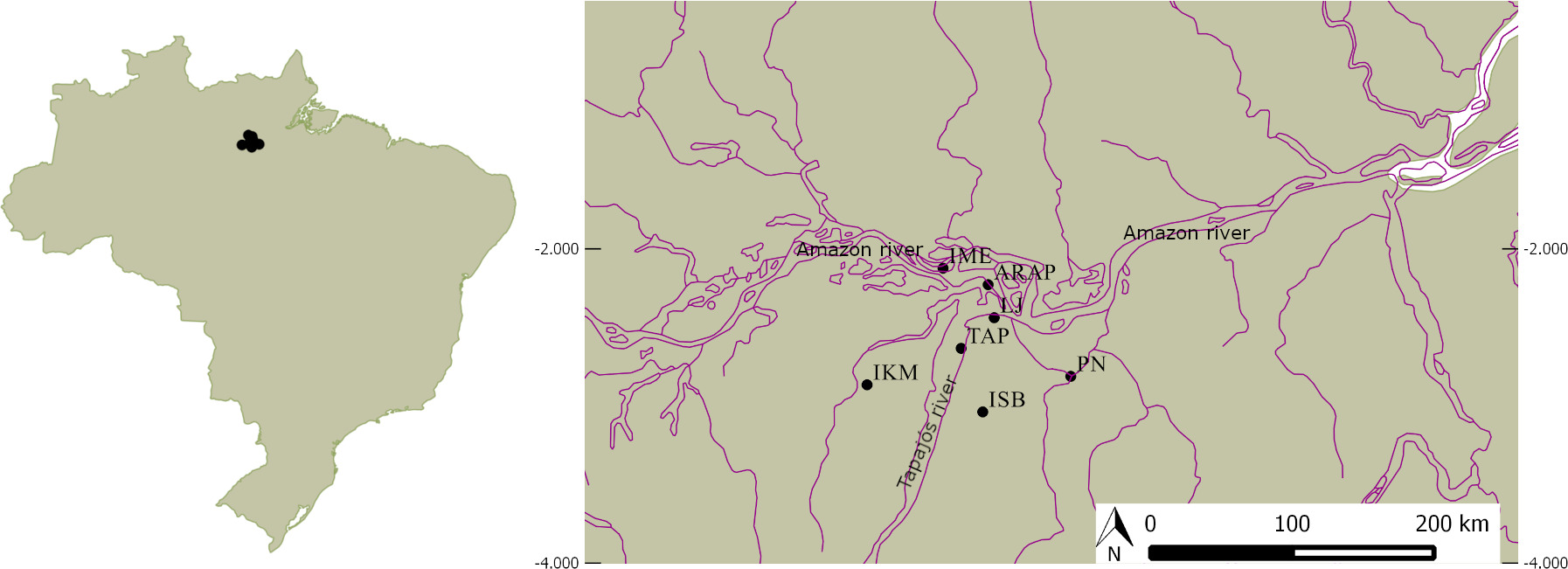
The collection of specimens was carried out in the confluence of the Amazonas and Tapajós rivers close to the municipality of Santarém, in the western portion of the state of Pará in northern Brazil (Figure 1). Furthermore, we also analyzed stored samples of Macrobrachium (33 specimens from eight species) and Palaemon (seven specimens from two species) donated by scientific collections from distinct institutions in northern Brazil, as follows: Institute of Scientific and Technological Researches from the State of Amapá (IEPA), National Institute of Researches in Amazon (INPA) and Emílio Goeldi Museum (MPEG) (Table I). Finally, samples of M. amazonicum, M. acanthurus (Wiegmann 1836), and M. carcinus (Linnée 1758) available in the tissue collection from the Laboratory of Education and Evolution Professor Horacio Schneider (LEDEVO) at Federal University of Western Pará (UFOPA) were also included.
List of Palaemonidae shrimp species used in the present study. Laboratory collection: LEDEVO - Professor Horacio Schneider Education and Evolution Laboratory. Scientific Collections: IEPA- Amapá Institute of Scientific and Technological Research; INPA - National Institute of Researches in Amazon; MPEG - Emílio Goeldi Museum. The acronyms refer to the names of the institutions in Portuguese.
Molecular data
The total DNA was isolated using the extraction protocol based on ammonium acetate with slight modifications (Bruford et al. 1992). When isolation of DNA samples was not successful by this method, we used the QIAamp® DNA Micro kit (Qiagen) according to the manufacturer’s instructions. The target DNA sequence was amplified via PCR (Polymerase Chain Reaction) using 4.0 µL of dNTPs (1.25 mM), 2.5 µL of MgCl2, 2.0 µL of buffer solution (10x), 0.25 µL of each primer (10 µM), 0.1 µL of Taq polymerase (5 U/µL), 2.0 µL of template DNA, and ultrapure water to a final volume of 25 µL.
For the amplification of 28S rDNA sequences, we used the primers 28S A (5’-GACCCGTCTTGAAGCACG-3’) and 28S B (5’-TCGGAAGGAACCAGCTAC-3’) (Whiting et al. 1997). Each PCR encompassed a first denaturation step at 94°C for 3 min, followed by 35 cycles (30 s of denaturation at 94°C, 30 s of annealing at 51°C, and extension at 72°C for 1 min) plus a final extension step at 72°C for 5 min. After DNA isolation and amplification via PCR, the samples were visualized after electrophoresis in 1% agarose gel stained with GelRed (Biotium). The amplified fragments were purified and sequenced in an ABI 3500 (Applied Biosystems) automatic sequencer using a Big Dye 3.1 kit (Applied Biosystems) according to the manufacturer’s instructions.
Data analysis
The sequences were visualized, edited (when necessary), and automatically aligned using the software CodonCode Aligner v. 8.0.2 (CodonCode Corporation) and organized into two datasets: (1) specimens from scientific collections (Table I) and samples of M. amazonicum, M. acanthurus, and M. carcinus from the tissue collection at LEDEVO and (2) recently collected samples (Figure 1) and single representatives from the previous tissue bank. The decision to separate the sequences into distinct datasets was taken to evaluate the reliability of identification in the samples available in scientific collections and to double-check the efficiency of 28S rRNA sequences for species identification. Duplicate sequences from both datasets were removed using the online tool ElimDupes (available at: https://www.hiv.lanl.gov/content/sequence/elimdupesv2/elimdupes.html). In addition, hypervariable regions and non-aligned gaps were excluded using the online software GBLOCKS v. 0.91b (Castresana 2000, Talavera & Castresana 2007).
The dataset from scientific collections (bank 1) was used to build a Neighbor-Joining (NJ) phylogenetic tree, while the significance of clusters was estimated using a bootstrap test based on 1000 pseudoreplicates (Felsenstein 1985). The evolutionary distances were calculated based on the Kimura-2-parameter (K2P) method (Kimura 1980). All analyses were performed in the software MEGA X (Kumar et al. 2018). A DNA sample from the genus Euryrhynchus was included as an outgroup due to its consistently basal phylogenetic position relative to the remaining Palaemonidae, as indicated by De Grave et al. (2015).
To identify the species in the recently collected samples, we started by selecting a single representative from each species according to the analyses from bank 1 and unique samples from creeks as estimated using ElimDupes. Three methods of species delimitation were subsequently carried out: Barcode gap, GMYC – General Mixed Yule Coalescent (Pons et al. 2006), and PTP – Poisson Tree Processes (Zhang et al. 2013). The barcode gap analysis was performed using the software ABGD - Automatic Barcode Gap Discovery (Puillandre et al. 2012) according to the following parameters: Pmin 1/4 0.001 and Pmax 1/4 0.1; steps 1/4 10; NBins 1/4 20; Relative gap 1/4 1 and Jukes-Cantor (JC69) evolutionary model.
The trees used as input in the GMYC approach were obtained in the software Beast v.2.3.1 (Bouckaert et al. 2014), including 10 million steps sampled at every 1,000 generations, a burn-in of 10% under three distinct priors (Yule, Constant coalescent, and Relaxed clock). The software TRACER v. 1.6 was used to evaluate the convergence of trees, assuming values of ESS (effective sample size) above 200. The GMYC was run in the package Splits (Species Limits by Threshold Statistics) (Ezard et al. 2009), available in the software R. At last, the PTP – Poisson Tree Processes (Zhang et al. 2013) was carried out using as input a Maximum Likelihood (ML) phylogenetic tree obtained in RaxML, provided by the web server CIPRES Science Gateway v. 3.3 (Miller et al. 2010), with bootstrap values based on 100 pseudoreplicates.
RESULTS
Molecular analysis of specimens from scientific collections
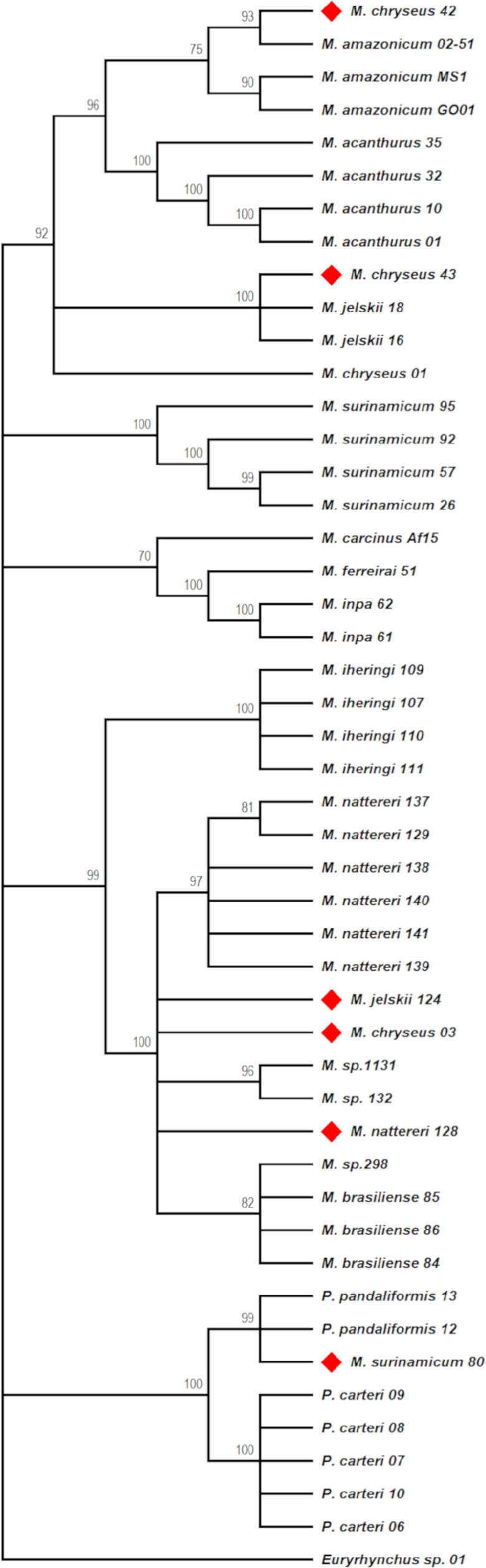
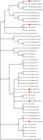
The dataset comprised 48 sequences of 383 base pairs (bp) from 14 species. The phylogenetic tree revealed well-defined clades for the genus Palaemon. For the genus Macrobrachium, while the overall genus-level clade showed moderate support (57%, Figure 2), most species-defining derived clades exhibited strong support, except for M. nattereri and M. brasiliense. The intergeneric genetic divergence was higher between Palaemon and Macrobrachium (15,98 to 24,38%).
Collection sites of new specimens of shrimp of the family Palaemonidae used in the present study.
The Macrobrachium samples with intraspecific variation were represented by M. brasiliense and M. amazonicum. For M. brasiliense, genetic divergence was 2.54%, while M. amazonicum showed 0.9% variation considering only samples from the Amazon basin. When samples collected in the states of Goiás and Mato Grosso do Sul (Central Brazil) were included, the intraspecific divergence in M. amazonicum reached 3.3%. The lowest value of interspecific variation was observed between M. nattereri and M. brasiliense (1.61%), followed by M. ferreirai x M. inpa (3.01%). The highest genetic differentiation was detected between M. carcinus and M. iheringi (20.11%). The estimated interspecific differentiation between P. carteri and P. pandaliformis was equal to 6.33%. The genetic divergence between M. chryseus 01 (identification confirmed by 16S rDNA sequencing; BLAST 98.84% similarity to sequence from Carvalho et al. 2017) and the other species of Macrobrachium ranged from 7.93% (M. amazonicum) to 18.31% (M. surinamicum).
The specimens from scientific collections lacking species-level identification - Macrobrachium sp. 2-98 (voucher 856 – IEPA), M. sp. 1-131, and Macrobrachium sp.1-132 (voucher 869 – IEPA) were genetically assigned to M. brasiliense, with distance values ranging from 0.0 to 1.39%. Furthermore, the tree topology revealed six nominal species that diverged from their expected clusters, indicating putative cases of morphological misidentification (Table II). In fact, the sample referred to as M. chryseus 42 (voucher 765 – MPEG) grouped along with M. amazonicum with a genetic distance value of 0.94%. On the other hand, M. chryseus 43 (voucher 765 – MPEG) proved to be closely related to M. jelskii with 0.46% of genetic divergence. In addition, M. jelskii 124 (voucher 619 – IEPA), M. nattereri 128 (voucher 612 – IEPA), and M. chryseus 03 (voucher 749 – MPEG) were recovered within the cluster composed of M. brasiliense, with values of genetic distance between 0.0 and 1.61%. Similarly, the sample identified as M. surinamicum 80 (voucher 595 – IEPA) was genetically identical to P. pandaliformis (Table II). The estimated genetic divergence for all species can be viewed in the supplementary files.
List of specimens showing discrepancies between molecular and morphological identifications as reported in scientific collections. IEPA: Amapá Institute of Scientific and Technological Research; MPEG: Emílio Goeldi Museum. The acronyms refer to the names of the institutions in Portuguese.
Molecular analysis of samples collected in creeks and species delimitation
A total of 154 samples collected from creeks were sequenced in the present study, resulting in 27 haplotypes (Supplementary Material - Table SI). This dataset, along with the 15 sequences of specimens from scientific collections with congruent molecular and morphological identification (bank 1), composed a final dataset formed by 42 sequences of up to 444 bp.
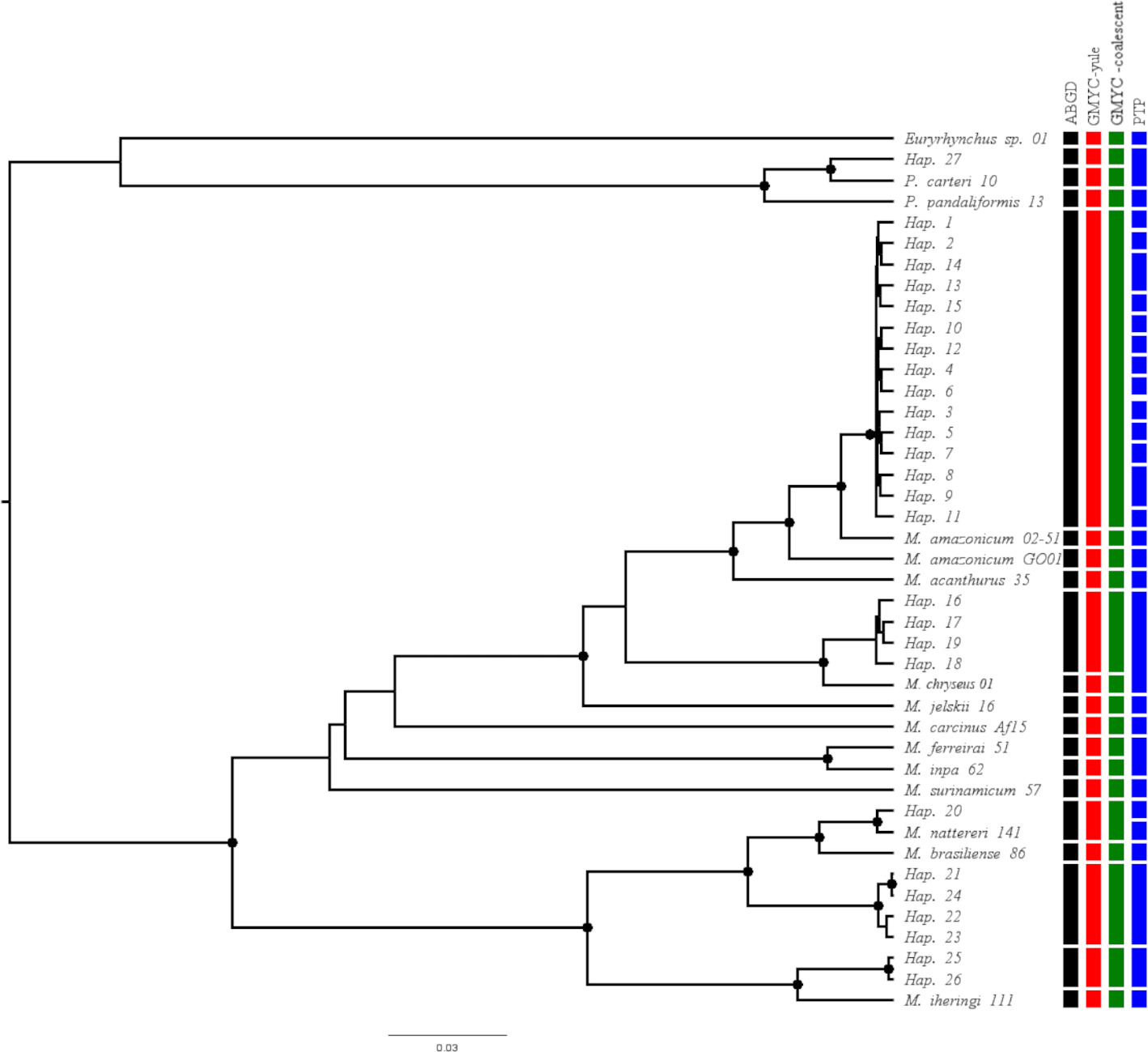
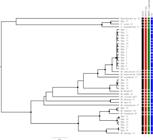
According to the distance-based ABGD species delimitation method, 21 groups (putative species) were identified using the initial threshold. After recursive partitions, the number of groups ranged from 20 to 21 potential species. The GMYC method partitioned the dataset into 20 species of similar identification for two of the used priors (Yule and Constant coalescent). Finally, the PTP approach delimited 39 potential species being 16 of them characterized by support values of 50%. Comparatively, ABGD and GMYC discriminated the same potential species (Figure 3).
Neighbor-Joining tree based on 28S rDNA sequences using Kimura-2-parameter (K2P) for species of Macrobrachium and Palaemon deposited in the scientific collections of IEPA (Amapá Institute of Scientific and Technological Research), INPA (National Institute of Researches in Amazon), and MPEG (Emílio Goeldi Museum). The acronyms refer to the names of the institutions in Portuguese. The numbers on branches indicate the bootstrap values (only values above 70 are shown). Red diamonds highlight putative cases of incorrect morphological identification.
Based on the clusters generated from species delimitation algorithms, the haplotypes 1 to 15 encompassed a single species close to M. amazonicum 02-51 in two out of the three methods (ABGD and GMYC). Inversely, these haplotypes were differentiated from each other by PTP, resulting in 13 putative species. In addition, the samples of M. amazonicum 02-51 from Juruti and M. amazonicum GO01 from Goiás are also separated.
The haplotypes 16 and 19 composed a highly supported clade by the three methods, being closely related to M. chryseus 01. The PTP indicated that these five samples should correspond to M. chryseus, while these haplotypes would belong to M. amazonensis or M. bouvieri based on the ABDG and GMYC methods.
The haplotype 20 was identified as belonging to M. nattereri by ABGD and GMYC, while PTP placed this sample as a distinct species closely related to M. brasiliense and M. nattereri. The haplotypes 21, 22, 23, and 24 formed a group of high support values along with M. brasiliense and M. nattereri by the three algorithms, being thus identified as Macrobrachium sp. On the other hand, the haplotypes 25 and 26 were recovered as a highly supported cluster with sequences of M. iheringi, independently of the method used. The haplotype 27 was identified as P. carteri by PTP, while ABGD and GMYC results indicated it should belong to a distinct species.
DISCUSSION
The molecular identification based on DNA barcodes has been successfully applied in crustaceans (Lefébure et al. 2006, Raupach et al. 2015, Matzen da Silva et al. 2011, Costa et al. 2007). In the case of the family Palaemonidae, COI data from 93 species proved to be efficient for their molecular identification in most cases in spite of the lack of a clear barcode gap (Robe et al. 2012). Similarly, the analyses of 28S rDNA sequences revealed no barcode gap among samples, but the present methodology allowed identifying the samples based on the correspondence between sequences inferred from distinct species delimitation algorithms. As a matter of fact, even potential cases of morphological misidentification of specimens from scientific collections were indicated.
Molecular analysis of specimens from scientific collections
Natural history collections are essential for genetic studies because they preserve specimens representing biological diversity across space and time. Sequencing the DNA of these samples allows for the confirmation of identifications, the correction of morphological classification errors (such as in the case of cryptic species), and the integration of molecular and morphological data. Moreover, museum specimens provide access to populations that are extinct or difficult to collect, enabling evolutionary, phylogeographic, and conservation research (Puillandre et al. 2012). However, to ensure these benefits, data accuracy is crucial. Incorrect morphological identifications of deposited specimens can trigger a cascade of errors, and if the DNA of these samples is sequenced, incorrect results are perpetuated and amplified in online databases such as GenBank and BOLD. In this context, analyzing DNA sequences can not only confirm identifications but also reveal potential errors, as demonstrated in the present study involving 28S rDNA sequences from major collections of the Brazilian Amazon.
The results of our analysis revealed incongruencies in six samples previously identified by morphological traits (Table II). While M. chryseus 01 identification was genetically confirmed (as detailed in Results), the molecular data for other samples initially assigned morphologically as Pseudopalaemon chryseus 03, 42 and 43 (now M. chryseus) showed clustering with distinct Macrobrachium species (M. amazonicum, M. brasiliense, and M. jelskii). These findings are fully consistent with the recent taxonomic revision by Mota et al. (2025a), which formally recognized Pseudopalaemon as a junior synonym of Macrobrachium. As demonstrated by Mota et al. (2025a) and corroborated by our phylogenetic inferences, species formerly placed in Pseudopalaemon are not monophyletic and are entirely nested within Macrobrachium. This collectively underscores significant historical misidentifications and the limitations of solely morphological characterization, supporting the re-evaluation of specific taxonomic boundaries within the genus.
The inherent difficulties in morphological identification probably contributed significantly to the observed incongruencies. Notably, specimens identified as M. chryseus may correspond to juvenile or immature individuals, which is known to hinder precise identification. Furthermore, the historical scarcity of studies focusing on species previously grouped under Pseudopalaemon (De Oliveira et al. 2017, Mota et al. 2025b) likely contributed to taxonomic challenges that are now reflected within the broader Macrobrachium genus. Similarly, the complexities in morphologically identifying juveniles, coupled with the noted external similarities between closely related species such as M. amazonicum and M. jelskii (Guerra et al. 2014, Vera-Silva et al. 2017, Dos Santos et al. 2018), M. brasiliense and M. nattereri (Rossi et al. 2020), and Palaemon species like P. carteri and P. yuna (Carvalho et al. 2014, García-Dávila et al. 2005), collectively explain the remaining incongruent identifications (Table II).
Molecular analysis of samples collected in creeks and species delimitation
The tree topology (Figure 3) showed a lack of consensus among the species delimitation methods. While ABGD and GMYC (Yule and Constant coalescent) discriminated 20 groups, the PTP algorithm identified 30 potential species. The highest divergence was observed in the delimitation of samples clustered along with M. amazonicum, inasmuch as ABGD and GMYC converged to a large cluster composed of a single species, whereas PTP discriminated 13 putative species. Zhang et al. (2013) point out that PTP might overestimate the number of species when the amount of sampled taxa is uneven, a common issue in groups characterized by subtle variation. In this case, the increased partition of species indicated by PTP seems unlikely since most of the haplotypes were sampled from a single locality (Tucumatuba Creek).
The sequence of M. amazonicum from Juruti was recovered as a clade closely related to the large group composed of haplotypes 1 to 15. Species delimitation algorithms indicate that these samples are genetically close, displaying a genetic divergence of 3.3% relative to M. amazonicum from Goiás and Mato Grosso do Sul, where M. amazonicum is now recognized as M. pantanalense (Dos Santos et al. 2013, Lima et al. 2025). Previous molecular studies based on mtDNA (Vergamini et al. 2011, Iketani et al. 2021) had already identified three main lineages (inner Amazon region, coastal areas along the Amazon, and Pantanal wetlands). Recently, Lima et al. (2025), using SNP markers, not only confirmed the status of M. pantanalense as a distinct species from M. amazonicum but also provided evidence for a putative process of ongoing speciation among the Amazonian lineages of M. amazonicum, reinforcing the need for additional studies in these populations, as previously suggested by Dos Santos et al. (2013).
The 28S rDNA sequences allowed identifying the haplotype 20 as M. nattereri and the samples Macrobrachium sp. 2-98, Macrobrachium sp. 1-131, and Macrobrachium sp. 1-132 from scientific collections as M. brasiliense. On the other hand, four unique samples (haplotypes 21, 22, 23, and 24) were closely related to M. nattereri and M. brasiliense. In fact, phylogenetic analyses have already shown a close evolutionary relationship between both species, forming a clade along with M. ferreirai, M. inpa, M. depressimanum (Pereira 1993), and M. aracamuni (Rodríguez 1982) (Pileggi & Mantelatto 2010). Along the Brazilian Amazon, M. depressimanum has been recorded only in the states of Acre, Amazonas, and Rondônia (Pileggi et al. 2013), while M. aracamuni is supposed to be restricted to the state of Amazonas (Mantelatto et al. 2008). Therefore, we suggest that these haplotypes could belong to related species not included in the reference dataset (such as M. depressimanum or M. aracamuni), thus extending the distribution range of any of these species. Alternatively, these unique haplotypes could represent new, undescribed species.
The samples of the genus Palaemon were low (two species), and only a specimen (haplotype 27) was closely related to P. carteri, being named as Palaemon sp. Indeed, the abundance of Palaemon in the wild is reduced, while M. amazonicum might represent up to 80% of macrocrustacean biomass in wetlands and flooded areas of the Amazon (Odinetz-Collart & Enriconi 1993). Therefore, the present results corroborate previous reports, as about 20% of the collected samples referred to Palaemon.
Based on molecular data, Carvalho et al. (2014) stated that populations of P. carteri are restricted to the eastern Amazon, while the populations from the central and western Amazon are represented by P. ivonicus (Holthuis 1950), P. yuna, and P. mercedae (Pereira 1986). Moreover, these authors revealed that the samples from central and western Amazon previously identified as P. carteri by morphological studies (Odinetz-Collart & Enriconi 1993, García-Dávila & Magalhães 2003, García-Dávila et al. 2005) actually corresponded to either P. ivonicus or P. yuna. Later, Carvalho et al. (2020) reported genetic structure among populations of P. carteri throughout the Amazon region. Considering this information and some ecological aspects, such as the hydrological system (white water environments), the haplotype 27 could not be identified at the species level.
The application of the 28S rDNA nuclear gene was efficient in discriminating the prawn species from our database. The use of this gene in combination with other nuclear (Littlewood 1994, Taylor et al. 2007, Hirai et al. 2013) or mitochondrial (Page et al. 2008, Landstorfer & Schubart 2010, Castelin et al. 2017, Wood et al. 2019, Bloom et al. 2019) markers has been helpful to the reconstruction of both phylogenies and taxa delimitation. Hirai et al. (2013) carried out an evaluation combining ITS2 and 28S nuclear regions as a molecular tool for the identification of North Pacific copepod crustaceans and concluded that this region is easily amplified and sufficiently variable to identify distinct species. Other reports have also successfully used 28S rDNA to identify fungi (Pinnoi et al. 2007), trematodes (Hernández-Mena et al. 2016, Orelis-Ribeiro et al. 2017), wasps (Campbell et al. 1994), myriapods (Gai et al. 2006), Niphargus crustaceans (Gai et al. 2006, Hekmatara et al. 2013), and krill species 28S rDNA evolution in the Eumalacostraca and the phylogenetic position of krill (Jarman et al. 2000).
Nonetheless, the reduced coverage of sequenced species, particularly within the genus Palaemon, represents a limiting factor, since some haplotypes could only be identified at the genus level. Moreover, the clade composed of haplotypes 25 and 26 plus M. iheringi represented an unexpected result. The freshwater prawn M. iheringi is endemic to Brazil, whose distribution seems to be restricted to the states of Espírito Santo, Rio de Janeiro, Minas Gerais, São Paulo, and Paraná (southeastern and southern Brazil), with no records for the Amazon region (Pileggi et al. 2013). The samples of this species derived from scientific collection are identified as originating from the Mapaoni River, a tributary of the left margin of the Jari River, in the Tumucumaque hills, in the State of Amapá (northern Brazil). In addition, molecular phylogenetic inferences revealed that M. iheringi would be closely related to M. candango (Mantelatto et al. 2021) (Pileggi & Mantelatto 2010) and M. potiuna (Müller 1880) (Rossi et al. 2020), species with no occurrence along the Amazon basin. Based on this information, it is possible that the present identification of samples as M. iheringi was performed incorrectly. Thus, this clade may also represent a new species of Macrobrachium.
It should be pointed out that haplotypes 16, 17, 18, and 19 clustered along with the sample identified as M. chryseus 01 based on the PTP approach, but they were placed as a distinct species by ABGD and GMYC algorithms. Based on distribution data (Pileggi et al. 2013, Pimentel & Magalhães 2014), only M. chryseus is recognized for the collection site of these haplotypes (São Benedito creek - Tapajós River and Mentai stream - Arapiuns River), indicating potential cryptic diversity requiring further investigation.
On the other hand, previous studies on distribution and species records (e.g., Kemenes et al. 2010, Montoya et al. 2014, Magalhães et al. 2018) already recommended more detailed investigations into the occurrence of putative new species, which at the time were referred to as Pseudopalaemon, from localities such as the Jaú River (Amazon), the Iriri River (Xingú River basin, Pará), and the Cinaruco River (Orinoco River basin, Venezuela). With the recent synonymization of Pseudopalaemon with Macrobrachium (Mota et al. 2025a), these suggestions now apply to potential new species within Macrobrachium. The genus Pseudopalaemon, now Macrobrachium, comprised seven species; of these, only three (now M. amazonensis, M. bouvieri, and M. chryseus) have DNA sequences for the 16S rRNA, Histone H3, 18S rRNA (Mota et al. 2025a), and 28S genes (M. chryseus only, from this study). Most likely, this scenario is related to the difficulties in obtaining samples from this group, associated with their small size and similarities with Macrobrachium juveniles (De Oliveira et al. 2017, Magalhães et al. 2018, Mota et al. 2025b), thus hindering reliable morphological identification.
Pimentel & Magalhães (2014), for example, reported new records of Palaemonid species in the states of Amapá and Pará based on scientific collections from the Amazon, but their morphological analyses diverged from the molecular data presented herein. The specimens from the collections identified as MPEG 749 and MPEG 765, previously identified as Pseudopalaemon chryseus by these authors, have now been genetically identified as other species of the genus Macrobrachium. Such incongruencies highlight that cases of incorrect identification deposited in scientific collections can result in taxonomic uncertainties, leading to misleading records regarding occurrence and distribution. Therefore, a detailed morphological analysis, combined with reliable molecular data, is necessary to support the classification of this group of prawns.
CONCLUSIONS
The present study successfully validates 28S rDNA sequences as a reliable molecular marker for Palaemonidae, effectively revealing genetic variation and intrafamilial relationships. Our analyses identified significant taxonomic inconsistencies, including morphological misidentifications within scientific collections, and indicated the potential for undescribed species. Consequently, we recommend expanding 28S sequencing to additional vouchers and a broader range of Palaemonid specimens to enhance taxonomic resolution and identification reliability.
Acknowledgements
We wish to express our gratitude to the Coordenação de Aperfeiçoamento de Pessoal de Nível Superior (CAPES) for providing a Master’s scholarship to DMA, as well as to the Graduate Program in Natural Resources of the Amazon (PGRNA) for their financial support towards field expedition expenses. We also thank the Laboratory of Genetics and Biodiversity (LGBIO) at UFOPA and Prof. Luis Reginaldo Ribeiro Rodrigues for the availability of the DNA sequencing facility. Additionally, we extend our appreciation to the Fundação Amazônia de Amparo a Estudos e Pesquisas (FAPESPA) (ICAAF Nº 002/2018) for their financial assistance. Special thanks are also extended to the curators of the scientific collections, Célio Magalhães (INPA), Inácia Vieira (IEPA), and Cleverson Santos (MPEG), for their invaluable contributions of specimens that greatly contributed to the completion of this study. Finally, we are grateful to the anonymous reviewers for their valuable comments and suggestions that improved this manuscript. The samples for this study were collected legally under permit number 45139-1 issued by the Biodiversity Authorization and Information System (Sistema de Autorização e Informação em Biodiversidade - SISBIO). This research is registered in the National System for the Management of Genetic Resources and Associated Traditional Knowledge (Sistema Nacional de Gestão do Patrimônio Genético e do Conhecimento Tradicional Associado - SISGEN) under number A676085. We would like to thank the entire editorial office team for their dedication during the final editing process of this work, especially Raylla Rodrigues, who served as our point of contact with the team.
References
- BARROS MP & PIMENTEL FR. 2001. A Fauna de Decapoda (Crustacea) do Estado do Pará, Brasil: lista preliminar de espécies. Boletim Museu Paraense Emílio Goeldi. Ser Zool 17: 15-41.
- BENSASSON D, ZHANG DX, HARTL DL & HEWITT GM. 2001. Mitochondrial pseudogenes: evolution’s misplaced witnesses. Trends Ecol Evol 16(6): 314-321.
- BLOOM ET, MCCALL BL, SCHUSTER GA & BLANTON RE. 2019. Systematics and description of a new species of Faxonius Ortmann, 1905 (Decapoda: Astacidea: Cambaridae) from the Red River system of Kentucky and Tennessee, USA. J Crustacean Biol 39: 40-53.
- BOTELLO A & ÁLVAREZ F. 2013. Phylogenetic relationships among the freshwater genera of palaemonid shrimps (Crustacea: Decapoda) from Mexico: evidence of multiple invasions? Lat Am J Aquat Res 41(4): 773-780.
- BOUCKAERT R, HELED J, KÜHNERT D, VAUGHAN T, WU CH, XIE D, SUCHARD MA, RAMBAUT A & DRUMMOND AJ. 2014. BEAST 2: a software platform for Bayesian evolutionary analysis. PLoS Comput Biol 10(4): e1003537.
- BRUFORD MW, HANOTTE O, BROOKFIELD JFY & BURKE T. 1992. Single locus and multilocus DNA fingerprinting. In: Molecular Genetic Analysis of Populations: a Practical Approach. London: Oxford University Press, p. 225-269.
- CAMPBELL BC, STEFFEN-CAMPBELL JD & WERREN JH. 1994. Phylogeny of the Nasonia species complex (Hymenoptera: Pteromalidae) inferred from an internal transcribed spacer (ITS2) and 28S rDNA sequences. Insect Mol Biol 2: 225-237.
- CARVALHO FL, DE GRAVE S & MANTELATTO FL. 2017. An integrative approach to the evolution of shrimps of the genus Palaemon (Decapoda, Palaemonidae). Zool Scr 46: 473-485.
- CARVALHO FL, MAGALHÃES C & MANTELATTO FL. 2014. Molecular and morphological differentiation between two Miocene-divergent lineages of Amazonian shrimps, with the description of a new species (Decapoda, Palaemonidae, Palaemon). Zookeys 457: 79-108.
- CARVALHO FL, MAGALHÃES C & MANTELATTO FL. 2020. A molecular and morphological approach on the taxonomic status of the Brazilian species of Palaemon (Decapoda, Palaemonidae). Zool Scr 49: 101-116.
- CASTELIN M, MAZANCOURT V, MARQUET G, ZIMMERMAN G & KEITH P. 2017. Genetic and morphological evidence for cryptic species in Macrobrachium australe and resurrection of M. ustulatum (Crustacea, Palaemonidae). Eur J Taxon 289: 1-27.
- CASTRESANA J. 2000. Selection of conserved blocks from multiple alignments for their use in phylogenetic analysis. Mol Biol Evol 17(4): 540-552.
- CHEN RT, TSAI CF & TZENG WN. 2009. 16S and 28S rDNA Sequences in Phylogenetic Analyses of Freshwater Prawns (Macrobrachium Bate, 1868) from Taiwan. J Crustacean Biol 29(3): 400-412.
- COSTA FO, DEWAARD JR, BOUTILLIER J, RATNASINGHAM S, DOOH RT, HAJIBABAEI M & HEBERT PDN. 2007. Biological identifications through DNA barcodes: the case of the Crustacea. Can J Fish Aquat Sci 64(2): 272-295.
-
DECANET. 2025. Available at: https://www.decanet.info DOI: 10.14284/600.
» https://www.decanet.info - DE GRAVE S, FRANSEN CHJM & PAGE TJ. 2015. Let’s be pals again: major systematic changes in Palaemonidae (Crustacea: Decapoda). PeerJ 3: e1167.
- DE OLIVEIRA LJF, SANT’ANNA BS & HATTORI GY. 2017. Reproductive potential of four freshwater prawn species in the Amazon region. Invertebr Reprod Dev 61(4): 290-296.
- DOS SANTOS A, HAYD L & ANGER K. 2013. A new species of Macrobrachium Spence Bate, 1868 (Decapoda, Palaemonidae), M. pantanalense, from the Pantanal, Brazil. Zootaxa 3700(4): 534-546.
- DOS SANTOS MAL, DE CASTRO PM & MAGALHÃES C. 2018. Freshwater shrimps (Crustacea, Decapoda, Caridea, Dendrobranchiata) from Roraima, Brazil: Species composition, distribution, and new records. Check List 14: 21-35.
- EZARD T, FUJISAWA T & BARRACLOUGH TG. 2009. splits: SPecies’ LImits by Threshold Statistics. R package version 1.0-14/r31.
- FANNING DD, WICKSTEN MK & SCHULZE A. 2024. Taxonomic and genetic diversity in Palaemon species (Decapoda: Caridea: Palaemonidae) of the northern Gulf of Mexico. Diversity 16(9): 543.
- FEARING A ET AL. 2025. Assessing confidence in zoological specimen collection metadata for use in scientific studies. J Nat Conserv 84: 126815.
- FELSENSTEIN J. 1985. Confidence limits on phylogenies: An approach using the bootstrap. Evolution 39(4): 783-791.
- GAI YH, SONG DX, SUN HY & ZHOU KY. 2006. Myriapod monophyly and relationships among myriapod classes based on nearly complete 28S and 18S rDNA sequences. Zool Sci 23(12): 1101-1108.
- GARCÍA-DÁVILA CR & MAGALHÃES C. 2003. Revisão Taxonômica dos Camarões de Água Doce. Acta Amazon 33(4): 663-686.
- GARCÍA-DÁVILA CR, MAGALHÃES C & GUERRERO JCH. 2005. Morphometric variability in populations of Palaemonetes spp. (Crustacea, Decapoda, Palaemonidae) from the Peruvian and Brazilian Amazon Basin. Iheringia Ser Zool 95(3): 327-334.
- GUERRA AL, LIMA AVB, LUCATO JÚNIOR RV, CHIACHIO MC, TADDEI FG & CASTIGLIONI L. 2014. Genetic variability and phylogenetic aspects in species of the genus Macrobrachium Genet Mol Res 13: 3646-3655.
- HEBERT PDN, CYWINSKA A, BALL SL & JEREMY R. 2003. Biological identifications through DNA barcodes. Proc Biol Sci 270(1512): 313-321.
- HEKMATARA M, ZAKŠEK V, HEIDARI BALADEHI M & FIŠER C. 2013. Two new species of Niphargus (Crustacea: Amphipoda) from Iran. J Nat Hist 47(21-22): 1421-1449.
- HERNÁNDEZ-MENA DI, LYNGGAARD C, MENDOZA-GARFIAS B & PÉREZ-PONCE DE LEÓN G. 2016. A new species of Auriculostoma (Trematoda: Allocreadiidae) from the intestine of Brycon guatemalensis (Characiformes: Bryconidae) from the Usumacinta River basin, Mexico, based on morphology and 28S rDNA sequences, with a key to species of the genus. Zootaxa 4196(2): 261-277.
- HIRAI J, SHIMODE S & TSUDA A. 2013. Evaluation of ITS2-28S as a molecular marker for identification of calanoid copepods in the subtropical western North Pacific. J Plankton Res 35: 644-656.
- HOLTHUIS LB. 1951. A General Revision of the Palaemonidae (Crustacea Decapoda Natantia) of the Americas. I. The Subfamilies Euryrhynchinae and Pontoniinae. Occasional Paper Allan Hancock Foundation 11: 1-332.
- HOLTHUIS LB. 1952. A general revision of the Palaemonidae (Crustacea Decapoda Natantia) of the Americas. II. The subfamily Palaemonidae. Occasional Paper Allan Hancock Foundation 12: 1-369.
- IKETANI G, PIMENTEL L, SILVA-OLIVEIRA G, MACIEL C, VALENTI W, SCHNEIDER H & SAMPAIO I. 2011. The history of the introduction of the giant river prawn, Macrobrachium cf. rosenbergii (decapoda, palaemonidae), in Brazil: New insights from molecular data. Genet Mol Biol 34: 142-151.
- IKETANI G, PIMENTEL L, TORRES ES, RÊGO PS & SAMPAIO I. 2021. Mitochondrial heteroplasmy and pseudogenes in the freshwater prawn, Macrobrachium amazonicum (Heller, 1862): DNA barcoding and phylogeographic implications. Mitochondrial DNA Part A 32: 1-11.
- JARMAN SN, NICOL S, ELLIOTT NG & MCMINN A. 2000. 28S rDNA evolution in the Eumalacostraca and the phylogenetic position of krill. Mol Phylogenet Evol 17: 26-36.
- JORDÁN-HERNÁNDEZ M, RODRÍGUEZ-ALMARÁZ G & FAVELA-LARA S. 2019. Delimitation of sympatric Palaemon (Decapoda, Palaemonidae) species of the Laguna Madre, Mexico. Zool Scr 48: 667-678.
- KEMENES A, RIDER FORSBERG B, MAGALHÃES C & DOS ANJOS H. 2010. Environmental factors influencing the community structure of shrimps and crabs (Crustacea: Decapoda) in headwater streams of the Rio Jaú, Central Amazon, Brazil. Panam J Aquat Sci 5: 36-46.
- KENSLEY B & WALKER I. 1982. Palaemonid shrimps from the Amazon Basin, Brazil (Crustacea: Decapoda: Natantia). Smithson Contrib Zool: 1-28.
- KIMURA M. 1980. A simple method for estimating evolutionary rate of base substitutions through comparative studies of nucleotide sequences. J Mol Evol 16: 111-120.
- KUMAR S, STECHER G, LI M, KNYAZ C & TAMURA K. 2018. MEGA X: Molecular Evolutionary Genetics Analysis across computing platforms. Mol Biol Evol 35(6): 1547-1549.
- LANDSTORFER RB & SCHUBART CD. 2010. A phylogeny of Pacific fiddler crabs of the subgenus Minuca (Crustacea, Brachyura, Ocypodidae: Uca) with the description of a new species from a tropical gulf in Pacific Costa Rica. J Zool Syst Evol Res 48: 213-218.
- LEFÉBURE T, DOUADY CJ, GOUY M & GIBERT J. 2006. Relationship between morphological taxonomy and molecular divergence within Crustacea: Proposal of a molecular threshold to help species delimitation. Mol Phylogenet Evol 40(2): 435-447.
- LIMA GM ET AL. 2025. Structure and genetic diversity of Macrobrachium amazonicum complex. Sci Rep 15: 31815.
- LITTLEWOOD DTJ. 1994. Molecular phylogenetics of cupped oysters based on partial 28S rRNA gene sequences. Mol Phylogenet Evol 3: 221-229.
- LIU MY, CAI YX & TZENG CS. 2007. Molecular systematics of the freshwater prawn genus Macrobrachium Bate, 1868 (Crustacea: Decapoda: Palaemonidae) inferred from mtDNA sequences, with emphasis on east Asian species. Zool Stud 46(3): 272-289.
- LOPEZ JV, YUHKI N, MASUDA R, MODI W & O’BRIEN SJ. 1994. Numt, a recent transfer and tandem amplification of mitochondrial DNA to the nuclear genome of the domestic cat. J Mol Evol 39: 174-190.
-
MACIEL CR, QUADROS ML, ABRUNHOSA F, BASTOS S, SCHNEIDER H & SAMPAIO I. 2011. Occurrence of the Indo-Pacific freshwater prawn Macrobrachium equidens Dana 1852 (Decapoda, Palaemonidae) on the coast of Brazilian Amazonia, with notes on its reproductive biology. An Acad Bras Cienc 83: 533-544. DOI: 10.1590/S0001-37652011000200013.
» https://doi.org/10.1590/S0001-37652011000200013 - MAGALHÃES C. 1986. The larval development of palaemonid shrimps from the Amazon region reared in the laboratory. V. The abbreviated development of Pseudopalaemon chryseus Kensley & Walker, 1982 (CRUSTACEA: DECAPODA: PALAEMONIDAE). Acta Amazon 16: 95-124.
- MAGALHÃES C, CAMPOS MR, COLLINS PA & MANTELATTO FL. 2016. Diversity, Distribution, and Conservation of Freshwater Crabs and Shrimps in South America. In: A Global Overview of the Conservation of Freshwater Decapod Crustaceans, 1st ed., Cham, Switzerland: Springer International Publishing, p. 303-322.
- MAGALHÃES C, ROBLES R, SOUZA-CARVALHO EA, CARVALHO FL, MALTA JCO & MANTELATTO FL. 2018. Annotated checklist of parasitic and decapod crustaceans from the middle and lower Xingu (Amazon Basin) above and below the Belo Monte dam complex, Pará State, Brazil. P Acad Nat Sci Phila 166: 1-34.
- MANTELATTO FL ET AL. 2022. Checklist of decapod crustaceans from the coast of the São Paulo state (Brazil) supported by integrative molecular and morphological data: V. Dendrobranchiata and Pleocyemata [Achelata, Astacidea, Axiidea, Caridea (Alpheoidea and Processoidea excluded), Gebiidea, Stenopodidea]. Zootaxa 5121: 1-74.
- MANTELATTO FL, PILEGGI LG, SUÁREZ H & MAGALHÃES C. 2008. First record and extension of the known distribution of the inland prawn, Macrobrachium aracamuni Rodríguez, 1982 (Decapoda, Palaemonidae) in Brazil. Crustaceana 81(2): 241-246.
- MATZEN DA SILVA J, CREER S, DOS SANTOS A, COSTA AC, CUNHA MR, COSTA FO & CARVALHO GR. 2011. Systematic and evolutionary insights derived from mtDNA COI barcode diversity in the Decapoda (Crustacea: Malacostraca). PLoS ONE 6(5): e19449.
- MILLER MA, PFEIFFER W & SCHWARTZ T. 2010. Creating the CIPRES Science Gateway for inference of large phylogenetic trees. In: Proceedings of the Gateway Computing Environments Workshop, New Orleans, p. 1-8.
- MONTOYA JV, ARRINGTON DA & WINEMILLER KO. 2014. Seasonal and diel variation of shrimp (Crustacea, Decapoda) on sandbanks of a tropical floodplain river. J Nat Hist 48(9): 557-574.
- MOTA TA, DE GRAVE S & CARVALHO FL. 2025a. Multigene analysis reveals that Pseudopalaemon Sollaud, 1911 is a junior synonym of the widespread genus Macrobrachium Spence Bate, 1868 (Decapoda: Caridea: Palaemonidae). J Crustacean Biol 45(3): ruaf048.
- MOTA TA, DE GRAVE S & CARVALHO FL. 2025b. A review of the biology and taxonomy of freshwater shrimps of the South American genus Pseudopalaemon Sollaud, 1911 (Decapoda: Palaemonidae). Arthropoda 3: 4.
- ODINETZ-COLLART O & ENRICONI A. 1993. Estratégia reprodutiva e alguns aspectos demográficos do camarão Palaemonetes carteri Gordon, 1935 na Amazonia central, Rio Negro. Acta Amazon 23(2-3): 227-243.
- ORELIS-RIBEIRO R, HALANYCH KM, DANG BT, BAKENHASTER MD, ARIAS CR & BULLARD SA. 2017. Two new species of Elopicola (Digenea: Aporocotylidae) from Hawaiian ladyfish, Elops hawaiensis (Eastern Sea), and Atlantic tarpon, Megalops atlanticus (Gulf of Mexico), with a comment on monophyly of elopomorph blood flukes. Parasitol Int 66(3): 305-318.
- PAGE TJ, SHORT JW, HUMPHREY CL, HILLYER MJ & HUGHES JM. 2008. Molecular systematics of the Kakaducarididae (Crustacea: Decapoda: Caridea). Mol Phylogenet Evol 46(3): 1003-1014.
- PILEGGI LG, MAGALHÃES C, BOND-BUCKUP G & MANTELATTO FL. 2013. New records and extension of the known distribution of some freshwater shrimps in Brazil. Rev Mex Biodivers 84(2): 563-574.
- PILEGGI LG & MANTELATTO FL. 2010. Molecular phylogeny of the freshwater prawn genus Macrobrachium (Decapoda, Palaemonidae), with emphasis on the relationships among selected American species. Invertebr Syst 24(2): 194-208.
- PILEGGI LG & MANTELATTO FL. 2012. Taxonomic revision of doubtful Brazilian freshwater shrimp species of genus Macrobrachium (Decapoda, Palaemonidae). Iheringia Ser Zool 102(4): 426-437.
- PILEGGI LG, ROSSI N, WEHRTMANN IS & MANTELATTO FL. 2014. Molecular perspective on the American transisthmian species of Macrobrachium (Caridea, Palaemonidae). Zookeys 457: 109-131.
- PIMENTEL FR & MAGALHÃES C. 2014. Palaemonidae, Euryrhynchidae, and Sergestidae (Crustacea: Decapoda): Records of native species from the states of Amapá and Pará, Brazil, with maps of geographic distribution. Check List 10(6): 1300-1315.
- PINNOI A, JEEWON R, SAKAYAROJ J, HYDE KD & JONES EBG. 2007. Berkleasmium crunisia sp. nov. and its phylogenetic affinities to the Pleosporales based on 18S and 28S rDNA sequence analyses. Mycologia 99(3): 378-384.
- PONS J, BARRACLOUGH TG, GOMEZ-ZURITA J, CARDOSO A, DURAN DP, HAZELL S, KAMOUN S, SUMLIN WD & VOGLER AP. 2006. Sequence-based species delimitation for the DNA taxonomy of undescribed insects. Syst Biol 55(4): 595-609.
- PUILLANDRE N, LAMBERT A, BROUILLET S & ACHAZ G. 2012. ABGD, Automatic Barcode Gap Discovery for primary species delimitation. Mol Ecol 21: 1864-1877.
- RAUPACH MJ ET AL. 2015. The Application of DNA Barcodes for the Identification of Marine Crustaceans from the North Sea and Adjacent Regions. PLoS ONE 10: e0139421.
- ROBE LJ, MACHADO S & BARTHOLOMEI-SANTOS ML. 2012. The DNA Barcoding and the Caveats with Respect to Its Application to Some Species of Palaemonidae (Crustacea, Decapoda). Zool Sci 29(10): 714-724.
- ROSSI N, MAGALHAES C, MESQUITA ER & MANTELATTO FL. 2020. Uncovering a hidden diversity: a new species of freshwater shrimp Macrobrachium (Decapoda: Caridea: Palaemonidae) from Neotropical region (Brazil) revealed by morphological review and mitochondrial genes analyses. Zootaxa 4732: 177-195.
- SONNENBERG R, NOLTE A & TAUTZ D. 2007. An evaluation of LSU rDNA D1-D2 sequences for their use in species identification. Front Zool 4(6): 1-12.
- SORENSON MD & QUINN TW. 1998. Numts: a challenge for avian systematics and population biology. The Auk 115: 214-221.
- TADDEI FG, REIS SS, DAVID FS, SILVA TE, FRANSOZO V & FRANSOZO A. 2017. Population structure, mortality, and recruitment of Macrobrachium amazonicum (Heller, 1862) (Caridea: Palaemonidae) in the eastern Amazon region, Brazil. J Crustacean Biol 37(2): 131-141.
- TALAVERA G & CASTRESANA J. 2007. Improvement of phylogenies after removing divergent and ambiguously aligned blocks from protein sequence alignments. Syst Biol 56(4): 564-577.
- TAYLOR JD, WILLIAMS ST, GLOVER EA & DYAL P. 2007. A molecular phylogeny of heterodont bivalves (Mollusca: Bivalvia: Heterodonta): new analyses of 18S and 28S rRNA genes. Zool Scr 36(6): 587-606.
- VERA-SILVA AL, CARVALHO FL & MANTELATTO FL. 2016. Distribution and Genetic Differentiation of Macrobrachium jelskii (Natantia: Palaemonidae) in Brazil Reveal Evidence of Non-Natural Introduction and Cryptic Allopatric Speciation. J Crustacean Biol 36(3): 373-383.
- VERA-SILVA AL, CARVALHO FL & MANTELATTO FL. 2017. Redescription of the freshwater shrimp Macrobrachium jelskii (Miers, 1877) (Caridea, Palaemonidae). Zootaxa 4269: 44-60.
- VERGAMINI FG, PILEGGI LG & MANTELATTO FL. 2011. Genetic variability of the Amazon River prawn Macrobrachium amazonicum (Decapoda, Caridea, Palaemonidae). Contrib Zool 80: 67-83.
- WHITING MF, CARPENTER JC, WHEELER QD & WHEELER WC. 1997. The Strepsiptera problem: phylogeny of the holometabolous insect orders inferred from 18S and 28S ribosomal DNA sequences and morphology. Syst Biol 46: 1-68.
- WOOD LE, DE GRAVE S & DANIELS SR. 2019. A comparative evolutionary study reveals radically different scales of genetic structuring within two atyid shrimp species (Crustacea: Decapoda: Atyidae). Zool J Linn Soc 186: 200-212.
- WOWOR D, MUTHU V, MEIER R, BALKE M, CAI Y & NG PKL. 2009. Evolution of life history traits in Asian freshwater prawns of the genus Macrobrachium (Crustacea: Decapoda: Palaemonidae) based on multilocus molecular phylogenetic analysis. Mol Phylogenet Evol 52(2): 340-350.
- ZHANG J, KAPLI P, PAVLIDIS P & STAMATAKIS A. 2013. A general species delimitation method with applications to phylogenetic placements. Bioinformatics 29(22): 2869-2876.
Edited by
-
Handling editor
Mirco Solé
All data used in this study, including DNA accession numbers (see Table I), are available within the manuscript or may be requested from the corresponding author via email. All sequences have been made available through the GenBank database.