 Efficacy of Laurus nobilis extract against Hymenolepis nana worm in vitro
ABSTRACT
The worm Hymenolepis nana is a prevalent intestinal parasite of Mus musculus and Rattus norvegicus, distributed throughout. Hymenolepis nana infection continues to provide a challenge for contemporary research groups; they should be excluded and monitored in rat populations due to their effects on animal health. H. nana worms were isolated from infected mice and divided into 6 groups (n=5) and placed in separate Petri dishes containing PBS, incubated at 37°C. Group 1 served as the untreated control group. Groups 2, 3, 4, and 5 were exposed to Laurus nobilis extract at concentrations of 25, 50, 100, and 200 µg/ml, respectively. Group 6 was treated with the reference drug Albendazole at a concentration of 1 ml/ml. After treatment, worm mortality was recorded by noting the time of death at 20, 40, 80, and 120 minutes. Worms were considered dead if they remained motionless for 30 seconds after being gently touched with a surgical needle and the Petri dish was shaken. This was attained (97± 2.5%; 97± 2.5%) after 120 minutes at the 200 µg/ml and albendazole concentrations, respectively. At the same time, the untreated group lasted for long hours without death. The mortality percentage of the H. nana worm adults increased by increasing exposure periods. The mortality percentage showed a strong negative correlation with exposure time, with correlation values of R = −0.97 and P = 0.0001 at a 200 µg/ml concentration, and R = −0.80 and P = 0.0001 at a 100 µg/ml concentration. This study demonstrated that herbal remedies have the potential to contribute to the development of new treatments for parasitic diseases, with their derivatives offering opportunities for enhancing drug production and bioactivity.
Keywords:
Hymenolepis nana; Laurus nobilis; worm; Albendazole
RESUMO
O verme Hymenolepis nana é um parasita intestinal predominante de Mus musculus e Rattus norvegicus, distribuído por toda parte. Infecção por Hymenolepis nana continua a ser um desafio para os grupos de pesquisa contemporâneos; eles devem ser excluídos e monitorados em populações de ratos devido aos seus efeitos na saúde animal. Os vermes H. nana foram isolados de camundongos infectados e divididos em 6 grupos (n=5) e colocados em placas de Petri separadas contendo PBS, incubadas a 37°C. O Grupo 1 serviu como grupo de controle não tratado. Os grupos 2, 3, 4 e 5 foram expostos ao extrato de Laurus nobilis em concentrações de 25, 50, 100 e 200 µg/ml, respectivamente. O grupo 6 foi tratado com o medicamento de referência Albendazole em uma concentração de 1ml/ml. Após o tratamento, a mortalidade dos vermes foi registrada observando-se o tempo de morte aos 20, 40, 80 e 120 minutos. Os vermes eram considerados mortos se permanecessem imóveis por 30 segundos após serem tocados gentilmente com uma agulha cirúrgica e a placa de Petri ser sacudida. A taxa de mortalidade foi alcançada (97±2,5%; 97±2,5%) após 120 minutos nas concentrações de 200 µg/ml e albendazol, respectivamente. Ao mesmo tempo, o grupo não tratado permaneceu por longas horas sem morrer. A porcentagem de mortalidade dos adultos do verme H. nana aumentou com períodos de exposição mais altos. A porcentagem de mortalidade mostrou uma forte correlação negativa com o tempo de exposição, com valores de correlação de R = -0,97 e P = 0,0001 em uma concentração de 200 µg/ml, e R = -0,80 e P = 0,0001 em uma concentração de 100 µg/ml. Este estudo demonstrou que os remédios fitoterápicos têm o potencial de contribuir para o desenvolvimento de novos tratamentos para doenças parasitárias, com seus derivados oferecendo oportunidades para melhorar a produção e a bioatividade dos medicamentos.
Palavras-chave:
Hymenolepis nana; Laurus nobilis; verme; Albendazol
INTRODUCTION
Intestinal parasitic infections are a major cause of illness and death, particularly in developing countries (Kiani et al., 2016). According to the World Health Organization (Report…, 2005), more than 2 billion people globally are persistently infected with at least one gastrointestinal helminth parasite. These infections, classified as 'Neglected Tropical Diseases,' mainly impact the poorest and most disadvantaged communities (Report…, 2005). One such intestinal parasite is Hymenolepis nana, a common tapeworm that infects humans (Thompson, 2015). While H. nana infection is found globally, it is most prevalent in the temperate regions of developing countries, where poor sanitation and hygiene facilitate its transmission, especially among children (Hamid et al., 2015). The infection can significantly impact family units epidemiologically, as the tapeworm can be transmitted directly from person to person and auto-reinfection may occur (Goswami et al., 2011). Although H. nana infections are usually asymptomatic, severe infections can lead to headaches, weakness, anorexia, abdominal pain, and diarrhea (Sirivichayakul et al., 2000). In extreme cases, H. nana infections can cause emaciation and diarrhea, which may be life-threatening. The life cycle of the tapeworm can be either direct (where humans acquire the infection by consuming contaminated food and water) or indirect (involving arthropods as intermediate hosts) (Tasawar et al., 2004). Immunocompromised individuals can experience auto-infection, with eggs produced, hatched, and completing their life cycle within the intestine of a single host (Hamid et al., 2015). Currently, around 80% of the world's pharmaceuticals are derived from natural sources or their derivatives (Li and Vederas, 2009). Therefore, plants are a highly abundant source of bioactive chemical compounds that combat various diseases. Numerous studies have investigated the anthelmintic properties of various plants (Newman and Cragg, 2007). Notably, Semmler et al. have explored the use of plant extracts as remedies for both internal and external parasites due to their biocidal effects (De et al., 2010). Laurus nobilis, commonly known as "sweet bay" is an evergreen tree or large shrub from the Lauraceae family, native to the Mediterranean region (Oliveira et al., 2009). Although numerous studies have investigated the effectiveness of Laurus nobilis in treating diseases and microbial infections, its impact on parasitic infections remains largely unexplored. Moreover, some studies have indicated that L. nobilis has antifungal (Caputo et al., 2017), antiviral, antibacterial (Simić et al., 2004), acaricidal (Mares et al., 2023), and insecticidal properties (Fernandez et al., 2020). The current study was designed to look into the possible role that extracts of L. nobilis leaves might play in anthelmintic activity when tested in vitro.
MATERIALS AND METHODS
The L. nobilis extract was prepared from leaves obtained from spice markets in Riyadh, Saudi Arabia. A taxonomist from the Department of Botany at King Saud University verified the plant's botanical identity (No. 24649). The leaves (100g) were air-dried at 40°C, powdered, and then extracted with 70% methanol for 24 hours at 4°C. The extract was concentrated and evaporated using a rotary vacuum evaporator (Yamato RE300, Japan) at 40°C under reduced pressure. The resulting crude extract was stored at -20°C until used in experiments, as outlined by Yang et al. (2014), producing a thick, sticky residue. For in vitro experiments, the powdered extract was dissolved in distilled water.
The mice were euthanized and dissected, with the intestines placed in Petri dishes containing 0.9% NaCl to facilitate the release of adult worms from the intestinal mucus. The worms were thoroughly washed with saline multiple times. Each adult worm was then examined under a microscope, and any damaged worms were separated. The remaining intact, living adults were selected for the in vitro study.
Living adult H. nana worms, harvested from freshly euthanized mice, were allocated into five groups (n=5) and placed in separate Petri dishes with PBS, incubated at 37°C. Group 1 served as the control, receiving no treatment. Groups 2, 3, and 4 were exposed to Laurus nobilis extract at concentrations of 100, 200, and 400mg/mL, respectively. Group 5 was treated with the reference drug Albendazole at 1mg/mL. The activity and survival of the worms were monitored under a microscope. Worm activity was evaluated based on movement and contractions in the neck area. Worms showing no movement when gently stimulated with a soft brush were transferred to warm PBS (40°C). Complete inactivity upon exposure to the warm solution was considered paralysis. Worm death was confirmed if no physical movement was observed after 30 minutes in the warmer solution (45°C) (Deori and Yadav, 2016). Each experiment was repeated three times for all groups.
A one-way ANOVA was conducted, followed by pairwise comparisons between groups using the Duncan method. Results are presented as means ± standard deviations, with statistical significance set at p ≤ 0.05. Statistical analysis was carried out using the Origin 2018 software, while means and standard deviations were calculated using Microsoft® Excel 2003.
RESULTS
Exposure of Hymenolepis nana worms to the Laurus nobilis extracts produced 100% mortality in the anthelmintic bioassay, especially at 200µg/ml concentration. The mortality % ranged from 14.3-98% after 120 min. The mortality percentage of the H. nana adults decreased by increasing exposure periods. The mortality % was highly negatively correlated with exposure times (y=19.3x+15.5, R²= 0.9356, P=.0001; y=6.3x-5, R² = 0.9599, and P =.0001) at 200 and 100µg/ml concentrations, respectively. The overall results of the current study suggest that the extract of L. nobilis may possess potential anthelmintic properties, which could potentially be employed in worm management. Phytochemical compounds have biological activity. We conclude that the L. nobilis extract has the potential to be useful in managing mice anthelmintic particularly H. nana.
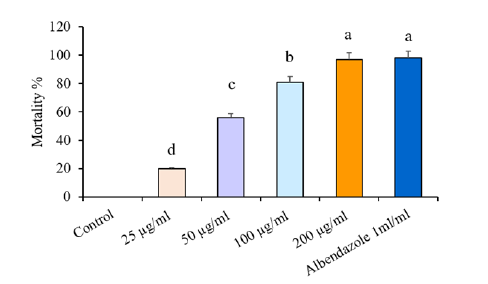
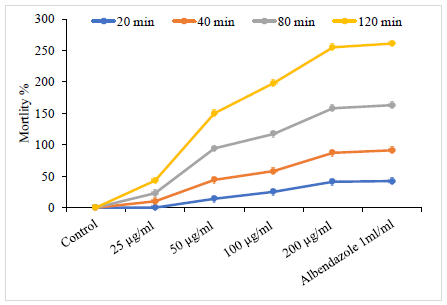
The results revealed notable differences in the mortality rates between the 200 µg/ml concentration at 120 minutes and the 100µg/mL concentration at 20 minutes, as compared to the other mortality rates (Table 1). Additionally, significant differences were observed between the control group and the 200µg/mL concentration at both 20 and 40 minutes. The highest mortality was after 40min at 25, 50, and 100µg/mL concentrations. The lowest mortality was observed after 120 min at all concentrations (Figure 1). Significant differences (P < 0.05) were observed in the mortality percentage of H. nana adults between plant extract concentrations (50, 100, and 200µg/mL) and the 25µg/mL concentration and control group. In general, no significant differences were found among the concentrations, except for the 25 µg/mL concentration (Figure 2).
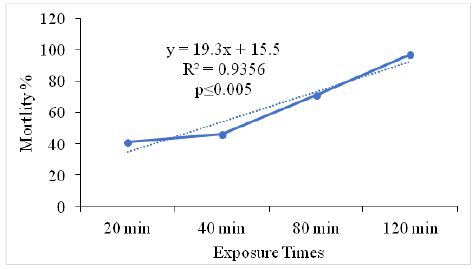
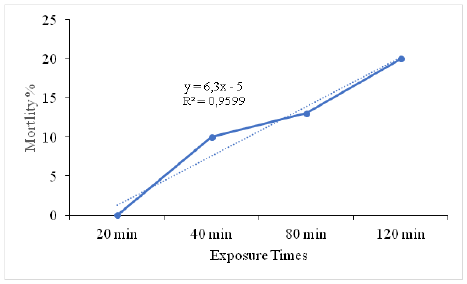
The mortality ratio of the Hymenolepis nana worm increased with increasing exposure periods. The mortality % was highly negatively correlated with exposure times (y = 19.3x + 15.5, R² = 0.9599 and P =.0001) at 200 and 100µg/mL concentrations, respectively (Figure. 3; Figure. 4). Whereas the correlation coefficient at 50µg/mL was moderated negatively (y = 6.3x - 5, R² = 0.9599 and P = 0.0001), and weak negatively at 25µg/mL concentration (R = −0.2 and P = 0.0001). The overall results of the current study suggest that the leaf extract of L. nobilis may possess potential anthelmintic properties, which could potentially be employed in worm management.
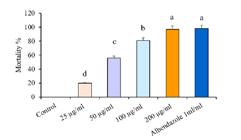
The overall mean (± SE) mortality percentage of Hymenolepis nana adults at different concentrations is presented. Values with distinct lowercase letters are significantly different (p < 0.05), while those with the same lowercase letters show no significant difference (p > 0.05), as determined by Duncan's Multiple Range Test (p < 0.05).
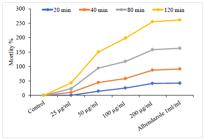
Mortality % of of Hymenolepis nana assayed with Laurus nobilis extracts at various exposure periods (20, 40, 80, and 120 min).
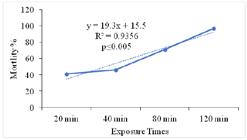
Mean mortality % of Hymenolepis nana adults at 200µg/m concentration for various exposure times.
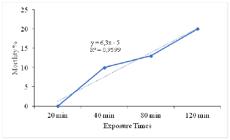
Mean mortality % of Hymenolepis nana adults at 25µg/mL concentration for various exposure times (min).
DISCUSSION
Several studies have highlighted the challenges associated with anthelmintic screening and the longevity of drugs (Geary, 2016; Jiao et al., 2020). A key limitation in controlling helminthic diseases is the ongoing development of anthelmintic resistance globally (Ploeger and Everts, 2018; Vineer et al., 2020). One approach to address this issue is incorporating natural compounds into the management of gastrointestinal parasites. In our study, we observed the mortality rate of adult H. nana worms increased as the exposure duration was extended. A strong negative correlation was observed between the mortality rate and the length of exposure time. This study aligns with numerous others that have confirmed the efficacy of L. nobilis leaves against a variety of parasites. Sebai et al. (2022) demonstrated that the L. nobilis extract exhibited significant in vivo anthelmintic activity, eliminating egg production of Heligmosomoides polygyrus after 7 days of treatment and reducing total worm counts by 79.2%. The plant's high content of linalool was identified as a key factor in eliminating intestinal worms in infected mice (Sebai et al., 2022). In a study conducted by Mares et al., 2024 on the Aspiculuris tetraptera parasite, they observed that L. nobilis leaves extract had a significant effect on the worms, causing their death both in vitro and in vivo. Furthermore, linalool found in Cinnamomum camphora was shown to significantly reduce the number of schistosomulum recovered from mouse skin after infection, leading to a decrease in the worm burden in the infected animals (Batiha et al., 2018). As demonstrated by Mares et al., 2023 in their study, the methanolic extract of L. nobilis leaves can kill Hyalomma dromedarii ticks. Fernandez et al. (2020) discovered that L. nobilis essential oils induced mortality in engorged Rhipicephalus microplus females at a concentration of 200μl/mL. Alimi et al. (2021) found that the ethanolic extract of L. nobilis resulted in 86.2% mortality in engorged female ticks and inhibited egg hatching across all tested concentrations. The leaves of L. nobilis have been used as a medicinal herb and exhibit pharmacological properties, including antibacterial and anti-inflammatory effects (Fang et al., 2005). In a study the results demonstrated that L. nobilis essential oil possesses strong antibacterial effects (Moghtader and Farahmand 2013). The antibacterial activity of L. nobilis essential oil was evaluated against several bacterial species, including E. coli, E. faecalis, and Salmonella Pullorum (Tomar et al., 2020). Both this study and others have highlighted the effective anti-parasitic properties of L. nobilis, suggesting its potential application in parasite control programs.
CONCLUSION
The leaves of L. nobilis contain many phenolic compounds that contribute to the antihelmintic properties of this plant. It has also been shown that the L. nobilis leaf extract is effective in killing Hymenolepis nana worms in vitro. The phenolic compounds are believed to be responsible for these activities. Further research is needed, including more in-depth studies on various types of worms and in vivo studies.
ACKNOWLEDGMENTS
Princess Nourah bint Abdulrahman University Researchers Supporting Project No. (PNURSP2025R401), Princess Nourah bint Abdulrahman University, Riyadh, Saudi Arabia.
REFERENCES
- ALIMI, D.; HAJRI, A.; JALLOULI, S.; SEBAI, H. In vitro acaricidal activity of essential oil and crude extracts of Laurus nobilis,(Lauraceae) grown in Tunisia, against arthropod ectoparasites of livestock and poultry: Hyalomma scupense and Dermanyssus gallinae. Vet. Parasitol., v.298, p.109507, 2021.
- BATIHA, G.E.S.; BESHBISHY, A.A.; TAYEBWA, D.S. et al. Inhibitory effects of Uncaria tomentosa bark, Myrtus communis roots, Origanum vulgare leaves and Cuminum cyminum seeds extracts against the growth of Babesia and Theileria in vitro. Jpn. J. Vet. Parasitol., v.17, p.1-13, 2018.
- CAPUTO, L.; NAZZARO, F.; SOUZA, L.F. et al. Laurus nobilis: Composition of essential oil and its biological activities. Molecules, v.22, p.930, 2017.
- DE, B.F.; BALBINO, J.M.; ZINI, C.A.; RIBEIRO, V.L.S.; BORDIGNON, S.A.; VON POSER, G. Acaricidal activity and chemical composition of the essential oil from three Piper species. Parasitol. Res., v.107, p.243-248, 2010.
- DEORI, K.; YADAV, A.K. Anthelmintic effects of Oroxylum indicum stem bark extract on juvenile and adult stages of Hymenolepis diminuta (Cestoda), an in vitro and in vivo study. Parasitol. Res., v.115, p.1275-1285, 2016.
- FANG, F.; SANG, S.; CHEN, K. et al. Isolation and identification of cytotoxic compounds from Bay leaf (Laurus nobilis). Food Chem., v.93, p.497-501, 2005.
- FERNANDEZ, C.M.M.; ROSA, M.F.; FERNANDEZ, A.C.A.M. et al. Essential oil and fractions isolated of Laurel to control adults and larvae of cattle ticks. Nat. Prod. Res., v.34, p.731-735, 2020.
- GEARY, T.G. Haemonchus contortus: applications in drug discovery. Adv. Parasitol., v.93, p.429-463, 2016.
- GOSWAMI, R.; SINGH, S.M.; KATARIA, M.; SOMVANSHI, R. Clinicopathological studies on spontaneous Hymenolepis diminuta infection in wild and laboratory rats. Braz. J. Vet. Pathol., v.4, p.103-111, 2011.
- HAMID, M.M.A.; ELJACK, I.A.; OSMAN, M.K.M. et al. The prevalence of Hymenolepis nana among preschool children of displacement communities in Khartoum state, Sudan: a cross-sectional study. Travel Med. Infect. Dis., v.13, p.172-177, 2015.
- JIAO, Y.; PRESTON, S.; HOFMANN, A. et al. A perspective on the discovery of selected compounds with anthelmintic activity against the barber's pole worm-where to from here?. Adv. Parasitol., v.108, p.1-45, 2020.
- KIANI, H.; HAGHIGHI, A.; ROSTAMI, A. et al. Prevalence, risk factors and symptoms associated to intestinal parasite infections among patients with gastrointestinal disorders in Nahavand, Western Iran. Rev. Inst. Med. Trop. São Paulo, v.58, p.42, 2016.
- LI, J.W.H.; VEDERAS, J.C. Drug discovery and natural products: end of an era or an endless frontier. Science, v.325, p.161-165, 2009.
- MARES, M.M.; ABDEL-GABER, R.; AL QURAISHY, S. In vitro assessment of the acaricidal activity of Laurus nobilis and Croton tiglium seeds extract against Hyalomma dromedarii ticks. Indian J. Anim. Res., v.57, p.626-631, 2023.
- MARES, M.M.; MURSHED, M.; ALJAWDAH, H.; AL-QURAISHY, S. The assessment of the anthelmintic activity of Laurus nobilis extract in mice naturally infected with aspiculuris tetraptera. Indian J. Anim. Res., v.58, n.1, 2024.
- MOGHTADER, M.; FARAHMAND, A. Evaluation of the antibacterial effects of essential oil from the leaves of Laurus nobilis L. in Kerman Province. J. Microbiol. Antimicrobial., v.5, p.13-17, 2013.
- NEWMAN, D.J.; CRAGG, G.M. Natural products as sources of new drugs over the last 25 years. J. Nat. Prod., v.70, p.461-477, 2007.
- OLIVEIRA, L.M.B.; BEVILAQUA, C.M.L.; COSTA, C.T.C. et al. Anthelmintic activity of Cocos nucifera L. against sheep gastrointestinal nematodes. Vet. Parasitol., v.159, p.55-59, 2009.
- PLOEGER, H.W.; EVERTS, R.R. Alarming levels of anthelmintic resistance against gastrointestinal nematodes in sheep in the Netherlands. Vet. Parasitol., v.262, p.11-15, 2018.
- REPORT of the third global meeting of the partner's for parasite control: deworming for health and development. Geneva: World Health Organization, 2005.
- SEBAI, E.; ABIDI, A.; BENYEDEM, H. et al. Phytochemical profile and anthelmintic effects of Laurus nobilis essential oil against the ovine nematode Haemonchus contortus and the murine helminth model Heligmosomoides polygyrus. Vet. Parasitol., v.312, p.109835, 2022.
- SIMIĆ, A.; SOKOVIĆ, M.D.; RISTIĆ, M. et al. The chemical composition of some Lauraceae essential oils and their antifungal activities. Phytother. Res. Int. J. Devoted Pharmacol. Toxicol. Eval. Nat. Prod. Derivatives, v.18, p.713-717, 2004.
- SIRIVICHAYAKUL, C.; RADOMYOS, P.; PRAEVANIT, R. et al. Hymenolepis nana infection in Thai children. J. Med. Assoc., v.83, p.1035-1038, 2000.
- TASAWAR, Z.; GUL, S.; BHUTTA, M.A.; ARIF, M. Prevalence of hymenolepis nana in human beings in and around Multan-Pakistan. Pak. J. Life Soc. Sci., v.2, p.62-64, 2004.
- THOMPSON, R.C.A. Neglected zoonotic helminths: Hymenolepis nana, Echinococcus canadensis and Ancylostoma ceylanicum. Clin. Microbiol. Infect., v.21, p.426-432, 2015.
- TOMAR, O.; AKARCA, G.; GÖK, V.; RAMADAN, M.F. Composition and antibacterial effects of Laurel (Laurus nobilis L.) leaves essential oil. J. Essent. Oil Bearing Plants, v.23, p.414-421, 2020.
- VINEER, H.R.; MORGAN, E.R.; HERTZBERG, H. et al. Increasing importance of anthelmintic resistance in European livestock: creation and meta-analysis of an open database. Parasite, v.27, p.69, 2020.
- YANG, F.; LONG, E.; WEN, J. et al. Linalool, derived from Cinnamomum camphora (L.) Presl leaf extracts, possesses molluscicidal activity against Oncomelania hupensis and inhibits infection of Schistosoma japonicum. Parasit. Vectors, v.7, p.1-13, 2014.
The research data are available within the article itself.