
 If You Like Portuguese, You Don't Like Mathematics: Investigating Atti-tudes Towards Reading and Attitudes Towards Mathematics of Students in the Final Years of Elementary School
Abstract
This research aims to identify whether there is a correlation between students' attitudes towards reading and mathematics. The participants were 330 students from the Final Years of Elementary School in fifteen rural and urban schools in the municipality of Canaã dos Carajás. The research is of an exploratory quantitative nature. The instruments used were a Scale of Attitudes Towards Reading and a Scale of Attitudes Towards Mathematics, both of the Likert type. Overall, the results indicated a positive and significant correlation between attitudes towards reading and mathematics for 7th, 8th, and 9th-grade students, but not for 6th-grade students. It was also found that attitudes towards mathematics are more variable than attitudes towards reading, which proved to be more consistent. Regarding gender, boys exhibited more positive attitudes towards mathematics, while no significant difference was observed in attitudes towards reading between boys and girls. In terms of location, no statistically significant differences were found in attitudes between students from urban and rural schools. The findings challenge the common belief that students who enjoy reading do not enjoy mathematics, as a positive, albeit weak, correlation was identified between attitudes in these two areas.
Keywords
Linguistic Processes; Educational Psychology; Scale
Resumo
Esta pesquisa teve como objetivo identificar se existe correlação entre as atitudes dos alunos em relação à leitura e à matemática. Os sujeitos da pesquisa foram 330 alunos dos anos finais do ensino fundamental, provenientes de quinze escolas, do campo e da cidade, do município de Canaã dos Carajás. A pesquisa é do tipo quantitativa exploratória. Utilizamos uma Escala de Atitudes em relação à Leitura e uma Escala de Atitudes em relação à Matemática, do tipo Likert. Os resultados, de um modo geral, indicaram uma correlação positiva e significativa entre as atitudes referentes à leitura e à matemática para os alunos do 7º, 8º e 9º anos, mas não para o 6º ano. Também, constatamos que as atitudes em relação à matemática são mais variáveis que as atitudes em relação à leitura, que se mostraram mais consistentes. Quanto ao sexo, os meninos apresentaram atitudes mais positivas em relação à matemática, enquanto não houve diferença significativa nas atitudes em relação à leitura entre meninos e meninas. Sobre a localização, não foram encontradas diferenças estatisticamente significativas nas atitudes entre estudantes de escolas da cidade e do campo. Os achados contestam o senso comum de que estudantes que gostam de leitura não apreciam matemática, uma vez que os resultados mostraram uma correlação positiva, ainda que fraca, entre as atitudes nessas duas áreas.
Palavras-chave
Processos linguísticos; Psicologia da Educação; Escala
1 Introduction
According to Machado (2006), in his reflections on education, widely disseminated slogans such as "mathematics is in everything" and "whoever reads, learns" are questionable. Although attractive in their simplicity, these slogans need more critical analysis to truly make sense in the educational context. The author points out that stating that mathematics is in everything may be true, but without contextualization, it does not help students identify where and how mathematics manifests itself in everyday life. Similarly, the slogan "whoever reads, learns" also ignores that reading, to be effective, requires active involvement, a clear purpose, and comprehension (Machado, 2006).
In addition to what was stated in the previous paragraph, we observe a prevalent common perception that those who like Portuguese do not like mathematics, and vice versa. This frequently reproduced view reflects ideas that end up reinforcing the separation between the disciplines of Mathematics and Portuguese Language. As Lorensatti (2009, p. 90) points out: “[…] traditionally, Mathematics and Portuguese Language do not interact in school. There is a tradition that an individual who is good at Mathematics is not good at Portuguese Language.” This view creates barriers that hinder the connection between the areas, ignoring how important reading and interpretation skills, for example, are for solving mathematical problems and other activities common to mathematics.
Slogans that portray liking as a feeling that repels two important school subjects highlight an idea that emphasizes that attitudes are not merely internal states, but rather forces that directly shape how we face challenges and absorb learning, as pointed out by Klausmeier and Goodway (1977). For these authors, positive attitudes, formed from encouraging experiences and mutual support, are essential to increase motivation, strengthen self-confidence, and sustain effort in difficult situations. On the other hand, they argue that negative attitudes, usually rooted in criticism or past failures, can create significant obstacles to learning, hindering progress and compromising performance.
From Brito's perspective (1996, 2011), over the decades, authors such as Thomas (1863-1947), Znaniecki (1882-1958), Allport (1897-1967), and Klausmeier (1915-2013) have contributed to the understanding of attitudes, highlighting their influence on both individual and collective behavior. In Brazil, the psychologist and educator Márcia Regina Ferreira de Brito has made a significant contribution to the understanding of this concept, especially in the field of mathematics education psychology. This field basically refers to the application of educational psychology to school mathematics, as Brito (2011) points out.
Given the multitude of discussions surrounding the topic of attitudes, for this research we have adopted the definition of attitudes proposed by Brito:
A personal, idiosyncratic disposition, present in all individuals, directed towards objects, events, or people, which takes on different directions and intensities according to the individual's experiences. Furthermore, it presents components of the affective, cognitive, and motor domains. (Brito, 1996, p. 11, our translation).
This definition demonstrates that attitudes are not static elements, but rather dynamic ones; that is, they are continuously shaped by the interaction between individual experiences and the social environment. For example, a student who initially has a negative attitude towards mathematics due to difficulties in the subject may gradually change their stance by experiencing more interactive classes or by achieving success in certain activities. This process shows how attitudes can transform based on new experiences and contexts.
This article aims to analyze the relationship between attitudes towards reading and mathematics among students in the final years of elementary school. We believe it can provide important information to improve the school curriculum, focusing on interdisciplinary approaches that integrate reading and math skills. With further research, it may be possible to deepen analyses, methodologies, and conclusions, in order to strengthen educational strategies and improve student performance.
2 Attitudes
Understanding how attitudes are formed, measured, and related to other concepts is essential for a comprehensive understanding of human behavior. According to Brito (1996), the term attitudes was first used as a psychological concept by W. Thomas and F. Znaniecki in the book The Polish Peasant in Europe and America, published in 1918. Before that, the term was used to refer to body actions, that is, gestures, postures, or physical movements adopted by a person – crossing their arms or smiling – interpreted as direct indicators of behavior.
With its introduction into psychology, the term attitudes took on a cognitive character, encompassing not only external manifestations but also internal processes, such as thoughts, beliefs, and dispositions, broadening the analysis of human behavior. Bandura (1977) emphasized that human behavior is largely influenced by the beliefs that individuals have about their own abilities, highlighting the central role of self-efficacy in motivation and performance.
In Brito's thesis (1996), different definitions of attitudes proposed by various authors are addressed. The author reports both the lack of consensus on the definition of attitudes and the difficulty in distinguishing similar concepts, which are often erroneously treated as synonyms for attitudes. The importance of not confusing attitudes with behavior is also emphasized, highlighting that the former refers to internal, learned events that encompass cognitive and affective aspects, varying in intensity and being directed towards specific objects.
It is common to associate the term attitudes with the idea of behavior, something that an individual should do. However, different interpretations can arise regarding this term, as mentioned by Tortora (2019), who highlights that the word attitude can have several meanings in everyday language, being used by people to express feelings, actions, posture, among others. The author also indicates that common sense interpretations of the idea of attitudes can lead to misunderstandings, diverging from its real meaning. Allport (1935 apud Gil, 2019), in turn, defined attitudes as a neural state of readiness, organized by experiences, which directly influences individuals' responses and which, according to him, is fundamental to understanding how we relate to the world.
The definition proposed by Brito (1996) suggests that attitudes involve three domains: the cognitive, which refers to knowledge about the object of the attitude, is the rational and belief-based aspect associated with the attitude; the affective, which involves feelings and the emotional relationship with the object of the attitude, that is, the emotions and preferences linked to it; and the conative, which concerns the predisposition to act in a certain way in relation to the object.
According to the definitions of Klausmaier and Goodwiem (1977), attitude is used to designate both the nuanced emotional dispositions of individuals and identifiable public entities, which are used to communicate meanings between individuals who speak the same language. This definition reinforces the understanding of attitudes as complex phenomena, which are not limited to individual emotions, but can also be expressed and perceived in a social context. In this way, attitudes also encompass collective expressions of public entities. They reflect personal feelings and thoughts, while also being used by organizations to communicate values. Attitudes facilitate communication between people who speak the same language and are influenced by the cultural and social context.
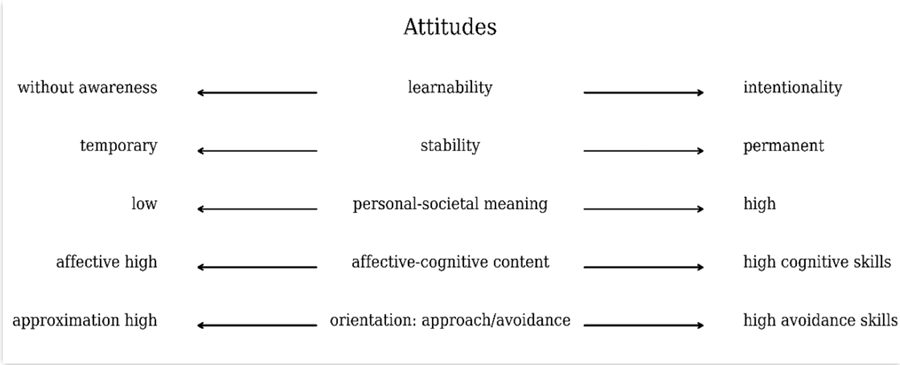
Klausmaier and Goodwiem (1977) state that, due to the complexity of attitudes, they play an important role in the behavior of individuals and groups. The authors present the five defining attributes of attitudes (Figure 1).
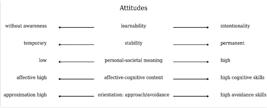
Learnability indicates that all attitudes are learned, intentionally or unintentionally. Intentional learning tends to occur when people recognize that it will contribute to their own well-being, to the group's goals, or to their personal values.
Stability is another important attribute, noting that some attitudes remain virtually the same over time, while others may change or simply disappear.
The personal-societal meaning indicates that attitudes involve relationships between people and between people and things. Actions towards a person affect how the individual feels about themselves and how they influence others.
Regarding the affective-cognitive content of attitudes, cognitive aspects refer to the knowledge and information one has about something, while affective aspects involve the emotions and feelings provoked by a given situation.
Finally, approach-avoidance orientation occurs when an individual has a favorable attitude toward an object or situation, tending to approach it and adopt a positive stance toward it. On the other hand, if the attitude is unfavorable, the tendency is for the person to move away or exhibit negative attitudes toward the object or situation.
To investigate these attitudes systematically and comparably, it is necessary to use psychometrically validated instruments that are sensitive to the affective and cognitive variations of the subjects. In this sense, attitude scales are fundamental to understanding these internal predispositions. Since the 1920s, several scales have been developed for this purpose, such as the Bogardus Social Distance Scale, the Thurstone Scale, the Semantic Differential, and especially the Likert Scale, which is one of the most widely used in research in the field of education (Gil, 2019). In the Likert Scale, respondents rate statements on an ordinal scale, usually from 1 (strongly disagree) to 5 (strongly agree), allowing the degree of agreement or disagreement in relation to certain attitude objects to be measured.
According to Brito (2011), as individuals progress through schooling, they develop beliefs, values, and attitudes regarding different subjects, which vary in intensity. The development of attitudes is directly related to affect, while beliefs and values are more associated with the cognitive component.
Lima (2018) highlights that both positive and negative attitudes can be awakened. The author also emphasizes that competitiveness among students, for example, if not conducted constructively, can contribute to the emergence of negative attitudes, highlighting the importance of a school environment that promotes healthy interactions.
Gonçalez and Brito (2001) emphasize that the acquisition of positive attitudes towards mathematics should be one of the goals of educators, especially for those seeking to go beyond the mere transmission of knowledge. They emphasize the importance of providing students with an environment that promotes the development of a positive self-concept, autonomy in their efforts, and enjoyment in problem-solving.
Research conducted by Ardiles (2007), Santana (2019), Tortora (2019), and Gonçalez and Brito (2001) examined attitudes toward mathematics among teachers and students, highlighting the importance of these attitudes in pedagogical practices and the teaching-learning process. Lack of confidence in one's own ability to learn mathematics can lead to the development of negative attitudes, which, in turn, significantly influence student performance and the pedagogical approach adopted. This occurs because beliefs, such as self-perception of incapacity, shape attitudes and impact motivation and behavior in relation to the subject.
Solé (2014) defines reading as a process of interaction between the reader and the text, in which the reader seeks to satisfy specific objectives. In this context, the reader assumes an active role, processing and examining the text with a defined purpose. To this end, reading strategies become essential tools, assisting in the autonomous and effective comprehension and interpretation of texts. This view is reinforced by Danyluk (2015), who expands on the idea by emphasizing that reading, whether textual or mathematical, occurs when the reader engages meaningfully with the content. Such engagement is based on the human acts of understanding, interpreting, and communicating lived experiences, allowing the reader to expand their perception of themselves, others, and the world.
This active and reflective interaction between reader and text is also highlighted by Solé (2014), who observes that reading, in addition to satisfying specific objectives, can occur unintentionally, as in the case of reading for pleasure, in which the reader's purposes can be more subjective and open. Kleiman (2005) complements this perspective by stating that reading transcends the simple mechanical act of decoding words, configuring itself as a process of meaning construction. In this process, the reader actively interacts with the text, seeking meanings that broaden their worldview.
Thus, the motivation for reading, whether driven by pleasure or learning, can play a fundamental role in shaping positive attitudes toward the act of reading. Furthermore, it contributes decisively to the development of textual comprehension and reader engagement, consolidating reading as a rich and transformative experience.
Quadros and Oliveira (2019) conducted research with students in the 5th, 7th, and 9th grades of elementary school and pointed out negative attitudes toward mathematics as students advance in age and school years. In turn, Lima (2022) explored the attitudes of beginning students in the course, pedagogical strategies, and promoting integrated learning between reading and mathematics.
3 Method
This research was part of the project entitled "Linguistic Approach to Mathematical Literacy: Theory and Pedagogical Practice," coordinated by Professor Dr. Ronaldo Barros Ripardo, and developed by Grupo de Estudos e Pesquisas em Processos Linguísticos em Educação Matemática (Prolem) in partnership, with the support and funding of the Municipal Government of Canaã dos Carajás. The research met the criteria established by Comitê de Ética em Pesquisa (CEP), Universidade Federal do Pará (UFPA), according to Parecer n. 4.339. 214 and Certificado de Apresentação de Apreciação Ética (CAAE) n.36527520.9.0000.0018.
This is a quantitative research study, since it uses statistical methods to analyze numerical data, and it is exploratory in nature, as it investigates a topic that has been little addressed, with the aim of broadening the understanding of issues related to the topic.
According to Gil (2019), this type of study aims to develop, clarify, and modify concepts and ideas to formulate more precise problems or testable hypotheses for research. Thus, our research becomes quantitative and exploratory as it seeks to understand the relationship between attitudes towards reading and mathematics, exploring whether there is an influence between these variables. For example, we raise questions such as: do those who have positive attitudes towards mathematics tend to have negative attitudes towards reading? Is there a relationship between positive attitudes towards reading and mathematics? These questions guide our investigation and will be answered throughout this article, contributing to a deeper understanding of the impact of attitudes on the learning process.
The study included 498 students from the final years of elementary school in the municipality of Canaã dos Carajás, from 15 schools, both rural and urban, out of a total of 5,200 students enrolled in 2022. A proportional stratified sampling method was used to select participants, characterized by selecting a sample from each subgroup of the population considered. These 498 students represent approximately 9.6% of the population and are those who responded to at least one of the instruments used in the field research.
In this article, we work with data from a sample of 330 students from the 6th to the 9th grade, who simultaneously answered the EARL (abbreviation of the nomenclature in Portuguese) and EARM (abbreviation of the nomenclature in Portuguese). To participate in the research, participants needed to be enrolled in 9th grade classes in Elementary School, have signed the Informed Assent Form, have obtained the consent of their guardians through the signing of the Informed Consent Form, and have answered the Attitudes Toward Reading Scale (EARL) and the Attitudes Toward Mathematics Scale (EARM).
The EARM was originally developed by Aiken and later revised by Aiken and Dreger, being translated and adapted by Brito (1996) in his habilitation thesis. The EARL was adapted and validated from the EAR (Brito, 1996) by Lima, Ripardo and Utsumi (2024).
The scales used are of the Likert type, composed of 20 propositions, and present four response options to how people feel about activities involving reading, namely: completely agree, partially agree, partially disagree and completely disagree. Among the statements, 10 are positive and 10 are negative. Items 1, 2, 6, 7, 8, 9, 12, 13, 16, and 17 of the scales reflect negative feelings, while items 3, 4, 5, 10, 11, 14, 15, 18, 19, and 20 express positive feelings.
The following scores were considered for each option of positive and negative responses (Table 1).
The scale scores ranged from 20 to 80 points. A participant was classified as having a more positive or more negative attitude toward reading and mathematics if their score was higher or lower, respectively, than the average obtained by the sample on the instrument.
A pilot application was carried out on April 13, 14, 20, 21, and 22, 2022, in two schools, with the participation of approximately 50 students. As a result, the most appropriate way to apply the instruments was verified, with minor adjustments related to typing errors. The results obtained in this application were considered valid for analysis.
From May 17 to 20, 2022, the two instruments were applied to all subjects defined in the sample. A printed version was given to the students for the application of the EARM and EARL.
After the application of the EARM and EARL, the results were added and converted into scores. For data tabulation and organization, Excel software tools were used, and for statistical testing and data analysis, the Statistical Package for Social Science (SPSS) was used. Analyses were performed using descriptive statistics, such as measures of central tendency, and inferential statistics, such as mean and correlation tests and analysis of variance.
4 Results and discussions
4.1 Attitudes towards reading and mathematics
Attitude scales were applied focusing on two objects: mathematics and reading, based on the EARL and EARM respectively (Table 2).
The average scores achieved by the students are similar on both scales, indicating that the overall results of the participants are concentrated around similar average values (55.51 for EARM and 56.62 for EARL). Regarding standard deviation and variation, they show greater dispersion in EARM (14.227 and 202.403) compared to EARL (11.686 and 136.558). This indicates that the responses in EARM are more varied around the average, while in EARL they are more consistent.
With respect to outliers and robustness, the mean truncated at 5% in both scales is very close to the overall mean, suggesting that the data do not present significant outliers capable of distorting the average values. Regarding skewness, the values are small on both scales, indicating distributions that approach symmetry: EARM (-0.185), that is, a slight negative skewness (greater concentration of high values); EARL (0.106), a slight positive skewness (greater concentration of low values). This suggests that the data are well distributed, with little influence from extremes. The negative kurtosis on both scales (EARM: -0.508, EARL: -0.448) indicates that the distributions are platykurtic, that is, they have flatter tails than the normal distribution. This reflects a lower concentration at the extremes and a more uniform distribution.
In general, the EARM shows greater variability in responses, suggesting that students had more heterogeneous behaviors or perceptions regarding the variables evaluated. As for the EARL, it is more consistent, with less dispersion and values closer to the mean, indicating a more uniform perception or behavior among students. Therefore, both scales show balanced distributions and little influence from extreme values.
The average score obtained by the group (N = 276) was 55 points (SD = 14.005) on the EARM and 57 points on the EARL (SD = 11.733). Since the midpoint of the scales is 50, both averages indicate that the students in the sample have more positive attitudes towards both mathematics and reading. The minimum score achieved on the EARM was 21 points and the maximum was 80 points. On the EARL, the scores were 25 points and 80 points, respectively.
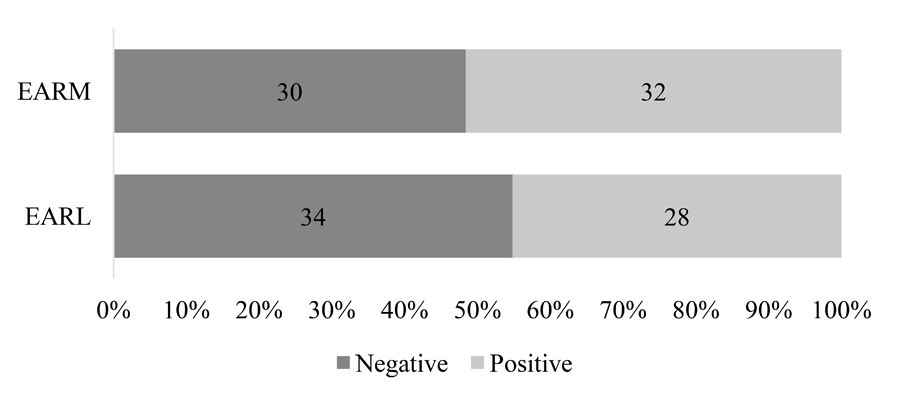
Figure 2 shows the distribution of students regarding attitudes on the EARM and EARL.
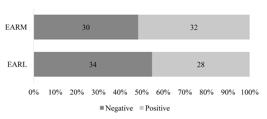
Looking at the individual results, the data in Figure 2 indicate that 48% of the students (N = 157) scored above the group average on the EARM, while 52% (N = 173) scored below the sample average. On the EARL, these percentages are 45% (N = 149) and 55% (N = 181), respectively. The results suggest, therefore, that most participants demonstrated negative attitudes towards both mathematics and reading.
The analysis of the EARL and EARM scores was stratified by grade level, gender of the students, and school location, to verify possible significant differences between the groups that could impact the overall result of the sample. Considering that the data met the statistical assumptions, a one-way ANOVA was performed to assess differences between school grades. The results did not indicate significant differences, both for the EARL (F (3,326) = 0.421, p > 0.05) and for the EARM (F(3,147) = 1.442, p > 0.05). Thus, it is concluded that attitudes towards reading, and mathematics remain consistent regardless of the grade level in which students are enrolled.
The research by Almeida, Barbosa and Mota (2017), developed for the validation of the EARL (ERAS-Br) and carried out with students from the 4th to the 9th grade of elementary school, as well as the study by McKenna, Kear and Ellsworth (1995) on attitudes towards reading, conducted with students from the 1st to the 6th grade of elementary school, identified more positive attitudes in the early grades. However, as the school years progressed, attitudes became more negative.
Pirola, Sander and Silva (2018), in bibliographic research developed with the aim of contributing to the discussion in the field of Psychology of Mathematics Education, stated that, according to a general overview of research, attitudes towards mathematics tend to be more positive in the early years, and become more negative according to the experiences lived.
According to Brito (1996), attitudes are shaped by the individual's experiences and can generate favorable or unfavorable positions in relation to a given object.
A t-test for independent samples was performed with the aim of investigating possible differences in the scores of the EARM and EARL scales between female (n = 160) and male (n = 170) participants. The results indicated a significant difference in EARM scores, with M = 53 (SD = 15.6) for the female group and M = 58 (SD = 12.4) for the male group, a difference considered statistically significant (t(303,466) = -2.968, p < 0.05). Regarding EARL, the averages were M = 56 (SD = 12.3) for the female group and M = 57 (SD = 11.1) for the male group, a difference that was not statistically significant (t (328) = -0.984, p > 0.05). These results suggest that there are distinctions in attitudes towards mathematics between female and male students, but not regarding attitudes related to reading.
McKenna, Kear, and Ellsworth (1995), in research on attitudes toward reading conducted with students from the 1st to the 6th grade of elementary school, identified that males presented more negative attitudes compared to females. These results are consistent with those of de Freitas and Utsumi (2019), who, when investigating attitudes related to mathematics, also found no significant differences between the sexes. Although boys presented slightly higher averages, the variation was not statistically relevant.
A t-test was also performed to investigate differences in EARM and EARL scores between students from rural schools (n = 84) and urban schools (n = 192). For the EARM, the average score for students in rural areas was 55 (SD = 13.9), while that of students in the city was 56 points (SD = 14.4), showing that the difference between the groups is not statistically significant: (t(328) = −0.298, p > 0.05). For the EARL, students from rural schools achieved an average of 56 points (SD = 12.3), and those from the city 57 (SD = 11.4). The t-test also found no statistically significant differences between the groups: (t(328) = −0.536, p > 0.05). These results indicate that there are no relevant differences in attitudes towards mathematics or reading between students from rural and urban areas.
Research conducted by Macêdo (2010) with elementary school students from two rural schools located in the municipality of Agreste identified that students' attitudes towards mathematics were more positive. Regarding attitudes towards reading among students from rural schools, no research focusing directly on this topic was found. However, studies such as that of Bacha et al. (2006), conducted with elementary school students from a public school, indicated that the performance of students residing in the city was slightly higher than that of those residing in rural areas, especially in the final years of elementary school.
The data align with Klausmeier and Goodwin (1977) and Brito (1996), who address the affective and cognitive components of attitudes as elements that shape learning. The affective component, related to feelings and emotions, and the cognitive component, linked to acquired information, help to understand how attitudes can form and influence academic performance. Although the differences between the average EARL and EARM scores in rural and urban areas are not significant, it is important to recognize that this factor may be related to the social and learning contexts experienced by each individual.
4.2 Relationship between attitudes towards reading and mathematics
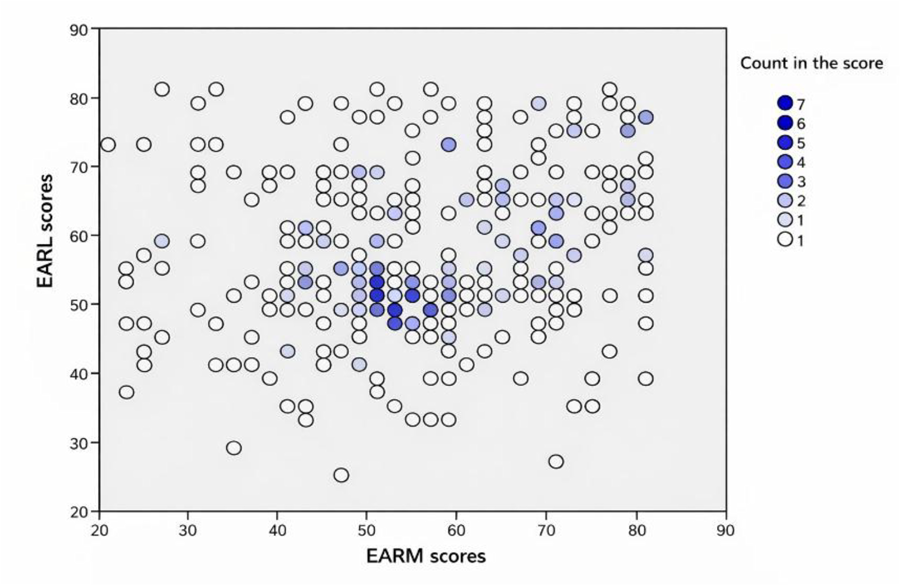
The scatter plot (Figure 3) is an important tool in conducting statistical analyses, as it allows exploring the relationship between continuous variables, such as trends, correlations, and discrepancies in the data, as well as identifying outliers that may affect the analyses. In this research, it was used to investigate the connection between the results of applying EARL and EARM.
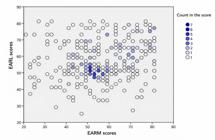
The darkest points on the graph are concentrated in the central range. In the EARL, the highest density occurs between scores 50 and 60. The most frequent scores on the EARM are concentrated in this same range. This may indicate that most students show moderate performance on both scales. The graph also shows that the data are relatively dispersed, indicating that there is no clear and strongly linear relationship between scores on the EARL and EARM. Still, a slight upward trend can be observed, suggesting a weak positive correlation: students with better scores on one scale tend, in general, to have better scores on the other.
Correlation between two variables occurs when there is a linear relationship between them, such that the variation in the values of one predictably implies the variation in the values of the other, since they are not independent. However, this correlation cannot be understood as causality. The best-known tests used to identify the existence or not of a relationship between two variables are Pearson's r, Spearman's ρ, and Kendall's τ. The first is a parametric test, the last two are non-parametric tests and should be used if the parametric assumptions are violated (Dancey; Reidy, 2013; Field, 2009).
In a bivariate correlation analysis, the direction of the relationship can be positive, negative, or zero, and the strength of the magnitude varies from -1 to 1. A correlation is positive if high values in one variable tend to be associated with high values of the other variable and vice versa. If there is no linear relationship between the two variables, it can be said that there is a zero relationship (Dancey; Reidy, 2013; Field, 2009; Miot, 2018). In this context, the strength of the magnitude of the relationship is measured by a statistic called the correlation coefficient, also known as the r coefficient.
In our research, we considered the parameters proposed by Dancey and Reidy (2013) to indicate the strength of the magnitude of the relationship for Pearson's r coefficients. The following intervals indicate a correlation:
Absent: r = 0; Weak: 0 < r ≤ -0.3 or 0 < r ≤ 0.3;
Moderate: -0.4 ≤ r ≤ -0.6 or 0.4 ≤ r ≤ 0.6;
Strong: -0.7 ≤r ≤ -0.9 or 0.7 ≤ r ≤ 9;
Perfect: r = 1.
The correlation we sought to analyze was between the mean EARL score and the mean EARM score.
Thus, based on these data, in addition to these variables being measured using interval scale measures, we used Pearson's product-moment correlation coefficient technique to assess the possible correlation between them, since the data followed a normal distribution (Dancey; Reidy, 2013; Miot, 2018). The results of the test r = 0.207 (N = 330; p < 0.05) revealed a positive and weak correlation, but statistically significant (r = 0.207; N = 330; p < 0.05), suggesting that as the EARL score increases, the EARM score also tends to increase, and vice versa. However, the strength of this relationship is small, explaining approximately 4% of the variance in the sample studied.
From the overall result of the correlation test, we sought to deepen the analysis of the correlation between the variables from the grade level stratum, in other words, whether the grade level variable could influence the correlation observed in the group. For the 6th grade, the result was r = 0.051 (N = 77; p > 0.05); for the 7th grade, r = 0.229 (N = 89; p < 0.05); For the 8th grade, r = 0.250 (N = 90; p < 0.05); and for the 9th grade, r = 0.245 (N = 74; p < 0.05). In summary, a significant and weak positive correlation was also identified from the 7th to the 9th grade. This means that approximately only 6% of the variance in the mean EARL scores is explained by the individual variation in the mean EARM scores. However, no significant correlation was identified between these variables for the 6th grade.
Additionally, we performed a mean test to analyze whether there are differences in the EARM means of students with positive and negative attitudes towards reading. The results showed that the average score of the first group – 59 points (N = 149, SD = 15.3) – was significantly higher than that of the second group – (N = 181, SD = 53) (t(286,951) = 3.977, p < 0.05)). Cohen's d returned a value of 0.44, reflecting a small effect size (Berben; Sereika; Engberg, 2012). In common language, we can say that there is a 62.4% probability that a person randomly selected from one group will have a higher score than a person randomly selected from the other group. Therefore, although not large, the difference is significant enough to be noticed in an educational context where relationships between cognitive and attitudinal areas frequently influence each other.
Thus, based on the assumption mentioned in some literature, as well as the widely held common belief that students who like Portuguese dislike Mathematics, and vice versa, we considered that applying the EARL and EARM would allow us to find answers to this through the results of the bivariate correlation test (Lorensatti, 2009). In this sense, the most likely hypothesis would be to find a negative correlation between the average score on the EARL and the average score on the EARM, that is, r < 0.00. This would mean that high scores on one of the scales would be associated with low scores, and vice versa. However, this hypothesis was not only not confirmed but also pointed to the existence of a positive, albeit weak, correlation.
5 Final considerations
The results of this research challenge the common sense notion that students who enjoy mathematics do not have positive feelings about reading and writing. On the contrary, a positive, albeit weak, correlation was identified between students' attitudes toward reading and mathematics. This shows that, in the context of our research, students with more positive attitudes in one of these areas tend to have equally positive attitudes in the other, as well as those with negative attitudes in one also tend to have negative attitudes in the other, contradicting widely held stereotypes even in academic and school settings. This finding highlights the importance of fostering positive attitudes in both subjects, considering that they can reinforce each other.
The stability of attitudes throughout the school years, evidenced by the absence of significant differences between grades, is also noteworthy. This result contradicts the findings of other research, which pointed to a decline in attitudes in the final years of elementary school, in the case of attitudes toward mathematics. However, in the context of this research, attitudes proved to be relatively constant, with significant correlations only for students in the 7th, 8th, and 9th grades, while for those in the 6th grade this relationship was not statistically significant. This stability over time reinforces the need to investigate contextual factors that may have contributed to this pattern.
The analyses also indicated differences in attitudes toward mathematics between boys and girls, although these differences were not significant for reading. This suggests that cultural and social factors may be impacting girls' relationship with mathematics, an area traditionally marked by gender barriers. These findings highlight the need for educational initiatives that address gender issues, promoting greater equity and support for girls in developing positive attitudes toward mathematics.
Finally, the greater variability in EARM responses compared to EARL highlights the complexity of attitudes toward mathematics, which appear to be more sensitive to external factors. Thus, the results reinforce the importance of integrated educational policies that comprehensively address the affective, cognitive, and social aspects involved in the development of students' attitudes, especially with regard to mathematics and reading.
References
-
ALMEIDA, L. C.; BARBOSA, A. J. G.; MOTA, M. M. P. E. Evidências de Validade da Escala de Atitudes em Relação à Leitura: ERAS-Br. Revista Psico, Campinas, v. 22, n. 3, p. 485-500, set./dez. 2017. Disponível em: https://www.scielo.br/j/pusf/a/JpRzX959CcWy6TFPJkDNRZJ/abstract/?lang=pt Acesso em: 15 fev. 2026.
» https://www.scielo.br/j/pusf/a/JpRzX959CcWy6TFPJkDNRZJ/abstract/?lang=pt -
ARDILES, R. N. Um estudo sobre as concepções, crenças e atitudes dos professores em relação à matemática. 2007. 251 f. Dissertação (Mestrado em Educação) - Faculdade de Educação, Universidade Estadual de Campinas, Campinas, 2007. Disponível em: https://www.psiem.fe.unicamp.br/pf-psiem/ardiles_roselinenascimentode_m.pdf Acesso em: 5 jun. 2024.
» https://www.psiem.fe.unicamp.br/pf-psiem/ardiles_roselinenascimentode_m.pdf -
BACHA, S. M. C. et al. Rendimento escolar de alunos da área rural em escola urbana. Revista CEFAC, São Paulo, v. 8, n. 4, p. 429-440, out./dez. 2006. Disponível em: https://www.scielo.br/j/rcefac/a/dmKX599vdFmxNNhb94HJxNN/ Acesso em: 5 jun. 2023.
» https://www.scielo.br/j/rcefac/a/dmKX599vdFmxNNhb94HJxNN/ -
BANDURA, A. Self-efficacy: toward a unifying theory of behavioral change. Psychological Review, Washington, v. 84, n. 2, p. 191-215, 1977. DOI: https://doi.org/10.1037/0033-295X.84.2.191 Disponível em: https://psycnet.apa.org/record/1977-25733-001 Acesso em: 3 fev. 2023.
» https://doi.org/10.1037/0033-295X.84.2.191» https://psycnet.apa.org/record/1977-25733-001 -
BERBEN, L.; SEREIKA, S. M.; ENGBERG, S. Effect size estimation: methods and examples. International journal of nursing studies, Southampton, v. 49, n. 8, p. 1039-1047, 2012. Disponível em: https://pubmed.ncbi.nlm.nih.gov/22377339/ Acesso em: 10 jul. 2024.
» https://pubmed.ncbi.nlm.nih.gov/22377339/ -
BRITO, M. R. F. Um estudo sobre as atitudes em relação à matemática em estudantes de 1º e 2º graus. 1996. 383 f. Tese (Livre Docência) - Faculdade de Educação, Universidade Estadual de Campinas, Campinas, 1996. Disponível em: https://repositorio.unicamp.br/Acervo/Detalhe/175862 Acesso em: 10 jul. 2023.
» https://repositorio.unicamp.br/Acervo/Detalhe/175862 -
BRITO, M. R. F. Psicologia da educação matemática: um ponto de vista. Educar em Revista, Curitiba, n. especial 1, p. 29-45, 2011. Disponível em: https://www.scielo.br/j/er/a/4FJWJR38XMjMRnPnRSPdQwb/?format=pdf⟨=pt Acesso em: 10 jul. 2023.
» https://www.scielo.br/j/er/a/4FJWJR38XMjMRnPnRSPdQwb/?format=pdf⟨=pt -
DANCEY, C. P.; REIDY, J. Statistics Without Maths for Psychology. 6. ed. Harlow: Pearson Education, 2013. Disponível em: https://professor.pucgoias.edu.br/SiteDocente/admin/arquivosUpload/10095/material/Dancey_Reidy_2006_CAP_04.pdf Acesso em: 3 ago. 2024.
» https://professor.pucgoias.edu.br/SiteDocente/admin/arquivosUpload/10095/material/Dancey_Reidy_2006_CAP_04.pdf - DANYLUK, O. S. Alfabetização matemática: as primeiras manifestações da escrita infantil. 5. ed. Passo Fundo: Ed. Universidade de Passo Fundo, 2015.
-
FIELD, A. Descobrindo estatísticas usando SPSS. 3. ed. Londres: Sage Publications Ltd, 2009. Disponível em: https://edisciplinas.usp.br/pluginfile.php/6423968/mod_resource/content/1/Descobrindo%20a%20Estat%C3%ADstica%20usando%20o%20SPSS.pdf Acesso em: 3 ago. 2024.
» https://edisciplinas.usp.br/pluginfile.php/6423968/mod_resource/content/1/Descobrindo%20a%20Estat%C3%ADstica%20usando%20o%20SPSS.pdf -
FREITAS, M. F. A. B.; UTSUMI, M. C. Atitudes em Relação à Matemática em Estudantes dos Anos Finais do Ensino Fundamental. In: Miriam Cardoso Utsumi (org.). Pesquisas em Psicologia da Educação Matemática: avanços e atualidades. São Carlos: Pedro & João Editores, 2019. p. 139-159. Disponível em: https://www.psiem.fe.unicamp.br/pf-psiem/ebookpsiem-140-160.pdf Acesso em: 3 ago. 2023.
» https://www.psiem.fe.unicamp.br/pf-psiem/ebookpsiem-140-160.pdf -
GIL, A. C. Métodos e técnicas de Pesquisa Social. 7. ed. São Paulo: Atlas, 2019. Disponível em: https://ayanrafael.com/wp-content/uploads/2011/08/gil-a-c-mc3a9todos-e-tc3a9cnicas-de-pesquisa-social-1989.pdf Acesso em: 2 fev. 2023.
» https://ayanrafael.com/wp-content/uploads/2011/08/gil-a-c-mc3a9todos-e-tc3a9cnicas-de-pesquisa-social-1989.pdf - GONÇALEZ, M. H. C. C.; BRITO, M. R. F. A aprendizagem de atitudes positivas em relação à Matemática. In: BRITO, M. R. F (org.). Psicologia da Educação Matemática: teoria e pesquisa. Florianópolis: Insular, 2001. p. 221-234.
- KLAUSMEIER, H. J.; GOODWIN, William. Manual de psicologia educacional: aprendizagem e capacidades humanas. Tradução: Maria Célia T. A. de Abreu. São Paulo: Harper & Row, 1977.
- KLEIMAN, A. B. Preciso "ensinar" o letramento? Não basta ensinar a ler e a escrever? Campinas: Cefiel Unicamp; Brasília: MEC, 2005.
-
LIMA, A. G. C. Atitudes em relação à leitura e desempenho na resolução de problemas de alunos ingressantes do curso de Matemática. 2022. 75 f. Dissertação (Mestrado em Ciências Exatas) - Universidade Federal do Sul e Sudeste do Pará, Programa de Pós-Graduação em Educação em Ciências e Matemática, Marabá, 2022. Disponível em: https://repositorio.unifesspa.edu.br/handle/123456789/2237 Acesso em: 15 set. 2024.
» https://repositorio.unifesspa.edu.br/handle/123456789/2237 -
LIMA, A. G. C. D.; RIPARDO, R. B.; UTSUMI, M. C. Adaptação e validação de uma escala de atitudes em relação à leitura (EARL). Ciência & Educação, Bauru, v. 30, p. 1-16, 2024. Disponível em: https://www.scielo.br/j/ciedu/a/V9HTdxHPHSFGCqLhgKrvvYx/?format=pdf⟨=pt Acesso em: 15 fev. 2026.
» https://www.scielo.br/j/ciedu/a/V9HTdxHPHSFGCqLhgKrvvYx/?format=pdf⟨=pt -
LIMA, F. C. Os enigmas como instrumento para o desenvolvimento de autoconfiança e de atitudes positivas em relação à matemática, 2018. 100 f. Dissertação (Mestrado em área) - Universidade Estadual Paulista, Bauru, 2018. Disponível em: https://repositorio.unesp.br/entities/publication/c0d9402d-047b-41e4-8cc5-d8426122229b Acesso em: 5 jun. 2023.
» https://repositorio.unesp.br/entities/publication/c0d9402d-047b-41e4-8cc5-d8426122229b -
LORENSATTI, E. J. C. Linguagem matemática e Língua Portuguesa: diálogo necessário na resolução de problemas matemáticos. Conjectura: filosofia e educação, Caxias do Sul, v. 14, n. 2, p. 89-99, 2009. Disponível em: https://www.ucs.br/site/midia/arquivos/linguagem.pdf Acesso em: 3 jun. 2023
» https://www.ucs.br/site/midia/arquivos/linguagem.pdf -
MACÊDO, M. C. Concepções de estudantes do campo sobre recursos para aprender matemática. 2010. 183 f. Dissertação (Mestrado em Educação Matemática) - Universidade Federal de Pernambuco, Recife, 2010. Disponível em: https://repositorio.ufpe.br/handle/123456789/3884 Acesso em: 5 dez. 2024.
» https://repositorio.ufpe.br/handle/123456789/3884 - MACHADO, N. J. Educação: projetos e valores. 6. ed. São Paulo: Escrituras, 2006.
- MACHADO, N. J. Matemática e Língua Materna: análise de uma impregnação mútua.6. ed. São Paulo: Cortez, 2011.
-
MCKENNA, M. C.; KEAR, D. J.; ELLSWORTH, A. R. Children's Attitudes toward Reading: A National Survey. Reading Research Quarterly, Hoboken, v. 30, n. 4, p. 934-056, 1995. Disponível em: http://www.jstor.org/stable/748205 Acesso em: 23 nov. 2024.
» http://www.jstor.org/stable/748205 -
MIOT, H. A. Análise de correlação em estudos clínicos e experimentais. Jornal Vascular Brasileiro, São Paulo, v. 17, n. 4, p. 275-279, 2018. Disponível em: https://doi.org/10.1590/1677-5449.174118 Acesso em: 3 ago. 2024.
» https://doi.org/10.1590/1677-5449.174118 -
PIROLA, N. A.; SANDER, G. P.; SILVA, G. A. Transferência dos resultados de pesquisas para o ensino da matemática escolar: contribuições das investigações sobre atitudes em relação à matemática. Bogotá: Universidad de los Andes, 2018. Disponível em: https://funes.uniandes.edu.co/wp-content/uploads/tainacan-items/32454/1170712/Pirola2018Transferencia.pdf Acesso em: 10 maio 2023.
» https://funes.uniandes.edu.co/wp-content/uploads/tainacan-items/32454/1170712/Pirola2018Transferencia.pdf -
QUADROS, V. C.; OLIVEIRA, L. S. Atitudes de alunos do Ensino Fundamental em relação à Matemática. In: CONFERÊNCIA INTERAMERICANA DE EDUCACIÓN MATEMÁTICA, 15., 2019, Medellín. Anais […]. Medellín: Ciem, 2019. p. 1-8. Disponível em: https://conferencia.ciaem-redumate.org/index.php/xvciaem/xv/paper/viewFile/418/256 Acesso em: 15 fev. 2026.
» https://conferencia.ciaem-redumate.org/index.php/xvciaem/xv/paper/viewFile/418/256 -
SANTANA, R. R. F. Um estudo sobre as relações entre o desenvolvimento do pensamento algébrico, as crenças de autoeficácia, as atitudes e o conhecimento especializado de professores pre-service e in-service. 2019. 321 f. Dissertação (Mestrado em Educação para a Ciência) - Faculdade de Ciências, Universidade Estadual Paulista, Bauru, 2019. Disponível em: https://repositorio.unesp.br/items/8642c4a1-16c0-4451-aee6-9747bf680839 Acesso em: 5 abr. 2023.
» https://repositorio.unesp.br/items/8642c4a1-16c0-4451-aee6-9747bf680839 -
SILVA, C. F. da. Atitudes em relação à leitura e desempenho em resolução de problemas de alunos com baixa visão. 2024. 123 f. Dissertação (Mestrado em Educação em Ciências e Matemática) - Universidade Federal do Sul e Sudeste do Pará, Marabá, 2024. Disponível em: https://ri.unifesspa.edu.br//handle/123456789/132 Acesso em 06 de dez. 2024.
» https://ri.unifesspa.edu.br//handle/123456789/132 -
SOLÉ, I. Estratégias de leitura. Tradução de Claudia Schilling. 6. ed. Porto Alegre: Penso, 2014. Disponível em: https://repositorio.unesp.br/items/8642c4a1-16c0-4451-aee6-9747bf680839 Acesso em: 10 jun. 2024.
» https://repositorio.unesp.br/items/8642c4a1-16c0-4451-aee6-9747bf680839 -
TORTORA, E. O lugar da matemática na educação infantil: um estudo sobre as atitudes e crenças de autoeficácia das professoras no trabalho com as crianças. 2019. 222 f. Tese (Doutorado em Educação) - Universidade Estadual Paulista, Bauru, 2019. Disponível em: https://bdtd.ibict.br/vufind/Record/UNSP_fd1febc911aa40c8233165176a507106/Details Acesso em: 10 jun. 2024.
» https://bdtd.ibict.br/vufind/Record/UNSP_fd1febc911aa40c8233165176a507106/Details
-
Data Availability:
The data generated or analyzed during this study are included in the published article.
-
Editor-in-Chief:
Prof. Dr. Roger Miarka
-
Associate Editor:
Profa. Dra. Celi Espasandin Lopes
The data generated or analyzed during this study are included in the published article.

 Source: Adapted and translated by the author from
  Source: research data (2022)
 Source: data resourch (2022)