
 Border careers in context: hybrid cultural identity in the narratives of musicians and chefs in a Brazil-Uruguay border region
Abstract
This article analyzes how the hybridity of Brazilian and Uruguayan cultures is expressed in cultural identity and career development in the Peace Border, in the twin cities of Sant’Ana do Livramento and Rivera. We carried out qualitative research based on ten narrative interviews, complemented by direct observation of the work of musicians and chefs who consider border cultural identity as a defining feature of their careers. As a key outcome, we developed the concept of border careers to refer to professional trajectories characterized by work repertoires grounded in a border identity, that is, an identity shaped by a border culture understood as a hybridity between cultures capable of generating something new. In border careers, professional paths are constructed in an inseparable relationship with the cultural identity of an in-between space, which is neither fixed nor stable but continuously evolving.
Keywords:
hybridity; cultural identity; border culture; careers in context
Resumo
O objetivo deste artigo foi analisar como o hibridismo das culturas brasileira e uruguaia se expressa na identidade cultural e no desenvolvimento de carreiras na Fronteira da Paz, local das cidades-gêmeas Sant’Ana do Livramento e Rivera. Realizamos uma pesquisa qualitativa com dez entrevistas narrativas e, de forma complementar, a observação direta, do trabalho de músicos e chefs gastronômicos que consideram a identidade cultural fronteiriça como característica da carreira. Como principal resultado elaboramos o conceito de carreiras fronteiriças como as trajetórias profissionais caracterizadas por repertórios de trabalho vinculados a uma identidade fronteiriça, isto é, cuja identidade cultural é formada por uma cultura fronteiriça que, por sua vez, se refere a um hibridismo entre culturas capaz de gerar algo novo. Nas carreiras fronteiriças as carreiras se constroem de forma indissociável com a identidade cultural de um entre-lugar, que não é fixo e está em constante transformação.
Palavras-chave:
hibridismo; identidade cultural; cultura fronteiriça; carreiras em contexto.
Resumen
El objetivo de este artículo fue analizar cómo la hibridez de las culturas brasileña y uruguaya se expresa en la identidad cultural y en el desarrollo de las carreras en la Frontera de la Paz, en las ciudades gemelas de Sant’Ana do Livramento y Rivera. Realizamos una investigación cualitativa basada en diez entrevistas narrativas y, adicionalmente, en la observación directa del trabajo de músicos y chefs gastronómicos que consideran la identidad cultural fronteriza como una característica de sus carreras. Como resultado principal, elaboramos el concepto de carreras fronterizas como trayectorias profesionales caracterizadas por repertorios de trabajo vinculados a una identidad fronteriza, es decir, una identidad cultural formada por una cultura de frontera que, a su vez, remite a una hibridez cultural capaz de generar algo nuevo. En las carreras fronterizas, las trayectorias profesionales se construyen de manera indisociable de la identidad cultural de un entre-lugar, que no es fijo y se encuentra en constante transformación.
Palabras clave:
hibridez; identidad cultural; cultura fronteriza; carreras en contexto
INTRODUCTION
Careers are ositions occuied throughout life, influenced by social and contextual relationshis such as an individual’s background, their global interactions, and the society and culture in which they are embedded (Mayrhofer et al., 2007). Careers shae how individuals see themselves and how they are socially erceived (Mayrhofer et al., 2023), which is why several studies maintain that careers are fundamental for the construction of identity and vice versa (Calasans & Davel, 2020; Martin et al., 2024; Torbor et al., 2025). Hall (2020) exlains that identity is shaed by culture and social interactions, being historically constructed and mutable. The author argues that cultural identities may become fragmented, since they are not fixed; they are constructed across history and may change at any moment.
Within this scenario of fragmentation, cultural identity ceases to be homogeneous and assumes hybrid characteristics - resulting from contact between different cultures, for examle among individuals who migrate, carrying elements of their origins such as traditions, histories and languages (Hall, 2020). Canclini (2015) comlements this view by defining hybridisation as the combination of distinct sociocultural ractices that generate new forms of exression of life and work - something articularly evident in geograhical border regions.
Brazil is the only country that borders most South American countries (Almeida & Dorfman, 2017), and one of these borders - between Sant’Ana do Livramento, in Brazil, and Rivera, in Uruguay - is the focus of this study. These cities are classified as twin towns, forming a dry border divided only by an imaginary line, with free daily circulation between both sides (Instituto Brasileiro de Geografia e Estatística [IBGE], 2021). The region is known as the “Border of Peace”, as it is characterised by a ermeable dynamic and intense social interaction, which fosters a binational culture (Almeida & Dorfman, 2017) that connects common and distinct elements of both countries and gives rise to a distinctive border culture. This border cultural identity contains unique symbols and elements of both cities, such as the mixture of languages, customs and artistic manifestations, reresenting a crossing of diversities (Muller et al., 2010).
In this context, we argue that Sant’Ana do Livramento and Rivera resent otential for the develoment of careers linked to the cultural identity of both countries, articularly local artistic exressions such as gastronomy and music, which constitute reresentative career niches - as art may be a manifestation of identity in rofessional activities (Caetano et al., 2017; Calasans & Davel, 2020; Canclini, 2015; Cleveland, 2013). Thus, the general aim of this study is to analyse how the hybridity of Brazilian and Uruguayan cultures is exressed in cultural identity and in career develoment of musicians and gastronomic chefs in the “Border of Peace”.
Several studies have examined hybrid culture in border regions. Caetano et al. (2017), for instance, highlight the artistic otential and identity elements resent between Ponta Porã (Brazil) and Pedro Juan Caballero (Paraguay). Almeida and Dorfman (2017) examine cultural integration between Brazil and Uruguay, focusing on the construction of binational cultural agreements. In the careers field, Akkermans and Kubasch (2017) identify, in a systematic review, the relationshi between career and culture as an emerging trend. In Brazil, Calasans and Davel (2020) discuss the management of creative careers through community cultural identity, analysing the case of a musician in the Itauã neighbourhood of Salvador, based on elements of image, culture and vision attributed by the community.
Although studies exist on the relationshi between identity and career, and on cultural hybridity, research that integrates these themes remains scarce. This article rooses an articulation of the concets of cultural identity from the British-Jamaican sociologist Stuart Hall, hybrid cultures from the Argentine anthroologist Néstor Canclini, and careers within the framework of contemorary authors in organisational studies, in order to understand career develoment in a border region. The roosal to examine twin towns of Brazil and Uruguay offers a Latin American ersective on the develoment of border careers.
CAREERS IN CONTEXT
When careers are understood from a contextual ersective, they aear as situated within historical and dynamic rocesses, marked by rutures, continuities and contingencies (Akkermans & Kubasch, 2017; Mayrhofer et al., 2007, 2023; Van den Groenendaal et al., 2022). The discussion on careers in context is advanced by Mayrhofer et al. (2007), based on four major influencing dimensions: work, origin, global and societyculture. The work context involves economic, cororate and relational factors in the labour market; origin refers to social class, education, family trajectory and living conditions. The global context includes international interactions within rofessional relations. Society and culture encomass social markers such as gender, ethnicity, demograhy and community embeddedness, which shae the ossibilities and constraints of rofessional trajectories.
Mayrhofer et al. (2023) reinforce these dimensions by offering a renewed ersective through three lenses: ontic, satial and temoral. The ontic ersective refers to the secific conditions of the individual who exeriences the career, such as gender, age, rofessional status, sychological needs, exectations, resilience and identities in transformation. This ersective highlights the subjective nature of careers, recognizing that they are ermeated by individual attributes, but also by social markers that may enable or constrain rofessional aths. The satial ersective argues that careers unfold within social and geograhical saces regulated by institutional boundaries, norms, ublic olicies, organisational and national cultures. These saces are inhabited by multile actors, such as families, organisations, rofessional grous and nation states, who shae ossibilities and trajectories. The temoral ersective structures the rofessional trajectory into stages, transitions and events. Intergenerational comarisons, social mobility, migration, and the effects of crises and socio-olitical change illustrate how temorality affects careers.
These dimensions and ersectives are not isolated; within the context of a career there will always be interaction among them (Mayrhofer et al., 2007, 2023). In this research, we emhasise recent studies that analyse social markers and cultures embedded in the contexts of identity-based career trajectories. For examle, Torbor et al. (2025) show how gender, race and field of activity shae career identity in a study conducted with early career women researchers from develoing countries, all reciients of an award for women in science. Although this is a highly qualified grou in the STEM field (science, technology, engineering and mathematics), individuals associated with these ositions are generally resumed to be white men, which tends to eclise the identities of the researchers by those of dominant grous. As a result, they engage in authenticity negotiations, adjusting the exression of their identities to gain legitimacy in scientifically masculinised environments, which frequently imlies silencing ersonal and cultural asects to conform to institutional exectations.
The study by Barros et al. (2021) highlights how gender and a local culture centred on sertanejo music shae the career identity of musicians in the Brazilian state of Minas Gerais. For these artists, music is exerienced as a source of meaning and a way of life, while society labels them as outsiders, imosing a negative “virtual identity” which contrasts with the real identity they construct for themselves. Musicians face family tensions, ranging from suort to ressure to abandon the career, and recarious working conditions, marked by informality, low earnings, cometition and stigmatisation that classifies their activity as leisure. Women recognise that they are gaining ground due to the recent recognition of female sertanejo, led by national singers who challenge historically sexist norms of this field, including those related to women’s roles in song lyrics, reositioning their lace in musical narratives and contributing to identity change within the genre.
There are studies that relate careers to the cultural identity of a country, region or community. Calasans and Davel (2020) demonstrate the influence of community culture on the identity of creative careers. Based on the case of a musician and cultural manager in a neighbourhood of Salvador, in the Brazilian state of Bahia, identity can be seen in how the artist relates to the lace. His songs contain asects of his trajectory ermeated by cultural heritage associated with ancestry, oular culture and religiosity. This cultural asect forms an image that is his ublic signature, already recognised through national awards, which brings him closer to the local audience and reflects how he wishes to be seen and acknowledged.
There are also studies that emhasise how the blending of national cultures influences career identity, such as the study by Martin et al. (2024), which analyses how individuals of Chinese origin build their careers living in Australia and New Zealand. The role of family and age at migration influence these trajectories, fostering autonomy and rofessional clarity when intercultural exerience occurs in childhood. Percetions of multicultural identity ranged from insecurity associated with discrimination, ositive evaluations, and ambivalence. For some, the strategy was to align with Asian values; for others, to align with Western values. Careers thus became a way to comensate for uncertainties associated with immigrant origin, suggesting a ossible vicious cycle between multicultural identity and rofessional identity.
From the study by Prestes and Grisci (2025), we see that the cultures of the country of origin and destination generate movements of territorialisation in the trajectories of immigrant chefs from different countries working in Brazil. When relocating, these rofessionals bring with them culinary knowledge, techniques, styles and cultural bonds, directly influencing restaurant organisation, urban gastronomic scenes and local culinary networks. Culinary territorialisation, however, does not occur without a foundation of tradition: the chef’s work involves both aroriating and re-elaborating elements of their culture of origin and integrating, interreting and re-signifying the culture of the country of destination. In this way, immigrant chefs become caable of grasing references, habits and lifestyles unknown in their contexts of origin and, through this crossing, roducing something new.
It is worth noting that studies in the field of Management addressing national identity in careers tend to focus on the mixing of cultures from two or more countries mainly through cases of exatriation, migration and refuge (Akkermans & Kubasch, 2017; Prestes & Grisci, 2025; Rabenu & Baruch, 2025; Yao & McWha-Hermann, 2025). However, these studies do not use cultural hybridity as a theoretical concet derived from anthroology and sociology. It should also be noted that there are studies of career and multile identities that use the term hybrid careers, but these refer to rofessional athways comosed of multile ties, roles and forms of work (Gander, 2021), such as artist-academics (Lam, 2019); health rofessionals combining clinical and managerial resonsibilities (Bresnen et al., 2018); academic careers and entrereneurial behaviour (Guo et al., 2019). Considering that the national and cultural context of origin (Mayrhofer et al., 2007, 2023) is a decisive context for the emergence and management of careers, we argue that the notion of hybridity between cultures, when influencing an individual’s cultural identity, can broaden understandings that situate the context of careers.
CULTURAL IDENTITY AND HYBRID CULTURES
National identity is reresented by the combination of language, customs, and cultural systems. These are not asects that eole are born with, but are influenced by ethnic, social, geograhical, and historical inequalities (Caetano et al., 2017; Hall, 2020). For Hall (2020), identity is a ositioning that is formed and transformed through cultural reresentations and secific historical contexts; therefore, it is not fixed, but mutable and constantly negotiated.
Hall (2020) distinguishes cultural identity in traditional and modern societies. In traditional society, identity maintained the traditions and symbolisms of the time, whereas in modern society identity is more closely associated with reflections on social ractices. The subject adats and may undergo changes and develo other identities.
In the same line of thought, Canclini (2015) reflects on cultural rocesses that once existed searately and can be modified through the union of new structures, objects, and ractices. Canclini (2015, . 9) understands this mixture as hybridisation: “socio-cultural rocesses in which discrete structures or ractices, that reviously existed searately, combine to generate new structures, objects, and ractices.” Colonialism and globalisation are historical examles of how olitical, economic, social, and cultural forces sought to imose and homogenise societies that already had their own identity ositioning, ultimately roducing hybridisation, that is, new sociocultural structures and ractices that remain in motion and transformation. This idea, shared by Canclini (2015) and Hall (2020), demonstrates that hybridity reveals ower relations that are not merely vertical and imosing, but which generate saces of struggle and agency to roduce something new, articularly in different kinds of cultural manifestations.
Saces of cultural hybridity are common in artistic exressions, as in the study by Marzano (2024) concerning carnival grous in Luanda, Angola, in the first half of the twentieth century, where ractices considered “traditional” and elements associated with “modernity” were dynamically combined amidst Portuguese colonial tensions. Although the colonial ress insisted on reresenting these manifestations as fixed folkloric exressions and as remnants of a disaearing ast, the revellers themselves incororated technical, aesthetic, and erformative innovations, revealing ongoing rocesses of cultural aroriation, negotiation, and reinvention. Rigid colonial categories such as indigenousassimilatedEuroean and traditionalmodern (where “indigenous” classified Africans not assimilated to Euroean culture) failed to cature the comlexity of these ractices, as the carnival grous oerated recisely in the interstitial saces, roducing hybrid forms that destabilised symbolic boundaries and offered alternative ossibilities for identity exression in the colonial city.
Cultural hybridity can also be observed in literature. Drawing on the case of a writer born in China and raised in the United States, Hu and Roberto (2019) show the resence of linguistic and cultural traces of Chinese in her English writing, which is evident in immigration rocesses and, consequently, bilingualism. In the context of linguistic hybridity, translation encounters lexical gas in the target language, roducing divergences and losses of meaning that require effort on the art of the translator.
Canclini (2015) argues that different cultural forms - such as scholarly, oular, and mass cultures - interact and transform the contemorary context. This leads eole to create strategies both to adat to a culturally comlex world and to resist its effects. According to the author, this rocess of hybridity is articularly intense in Latin America, due to the combination of Indigenous, Euroean, and African heritages, as well as the global influence of mass culture.
An examle of resistance is offered by the study of Rincón et al. (2024), concerning an Indigenous grou in the Colombian Amazon facing agricultural modernisation that caused cultural erosion and loss of agrobiodiversity. The community, in artnershi with governmental agencies, imlemented actions to recover, roduce, and conserve native seeds, which have nutritional, medicinal, and ritual functions and become the symbolic core of identity and food sovereignty. More than biological resources, these seeds carry memory and intergenerational knowledge, with women serving as key guardians of this heritage. The creation of local seed networks and the recovery of ancestral knowledge emerge as central strategies to reserve culture, territory, and identity in the face of modernising ressures.
Another examle in which food roduction and consumtion strengthen cultural identity is the case of the Argentine government, suorted by the Hisanic-Creole oulation, which emloyed yerba mate as a strategy of resistance against Euroean ambitions during the colonial eriod. Munizaga et al. (2024) exlain that British trade aimed to imose tea consumtion as a symbol of civilisation, while yerba mate became associated with gauchos and barbarism. However, yerba mate was exorted, commercialised, and used to demonstrate the economic and cultural sovereignty of the Argentine Confederation, and the beverage ceased to be simly a locally consumed lant and became a symbol of a shared culture and ritual across different rovinces. The strengthening of economic ties with other regions of the River Plate (latine region) reinforced a narrative of autonomy and self-affirmation, becoming art of the collective memory and the construction of a nationalregional imaginary and identity.
The latine region is the area of South America that encomasses the River Plate basin, reaching territories of Brazil, Argentina, Paraguay, Uruguay, and Bolivia. The source of the River Plate is in Brazil and its estuary is located between Argentina and Uruguay, where the ama biome redominates, with vast lains that are esecially resent in these three countries. According to Boff and Machado (2023), from this region during the colonial eriod emerges the gaúchogaucho (Portuguese and Sanish sellings), a creole figure originating from the mixture of Iberians with Indigenous eoles, and, to a lesser extent, with Africans.
Between the sixteenth and eighteenth centuries, the gaúcho moved freely across the ama, virtually unaware of border limits and with only loose, fluid identification with the Kingdoms of Portugal and Sain. With the emergence of colonial treaties seeking to draw frontier boundaries, the errant character of the gaúcho began to disaear. This rocess intensified in the era of indeendent nations, when each country sought to adat this figure to its dominant olitical rojects. In Brazil, the Brazilian gaúcho emerged, whose image, insired by the Farrouilha Revolution, was shaed to align with reublicanism and federalism. The myth of the heroic gaúcho, defender of the frontiers, was cultivated in order to distinguish him from the latine gaucho, ortrayed as barbaric. It was above all in Rio Grande do Sul that these myths of gaúcho culture became institutionalised, mainly through the Centros de Tradição Gaúcha (CTGs) (Boff & Machado, 2023, . 29, our translation).
In this sense, it becomes evident that the origin of the gaúchogaucho is transboundary (Boff & Machado, 2023) and its figure was constructed as “brave, macho, boastful; a tye who is always dressed in traditional attire and constantly accomanied by a horse, a barbecue and chimarrão” (Ramil, 2009, . 11, our translation). However, at resent, according to Ramil (2009), only the Brazilian gaúcho has exanded its meaning to refer to someone born in the state of Rio Grande do Sul, unlike in Uruguay and Argentina, where the term gaucho designates only a man from the countryside and not a demonym for the oulation. The author further notes that recisely what marks the identity of all inhabitants of Rio Grande do Sul, as a Brazilian regional tye, is also what makes them foreign, since it links them to neighbouring countries. Indeed, cultural roduction in Sanish from Buenos Aires and Montevideo sometimes becomes a stronger reference than that from Rio de Janeiro and São Paulo for gaúchos from Rio Grande do Sul, esecially those living outside major urban centres. Songs that tell stories of customs, clothing and cuisine that once belonged to a single culture continue to meet in cultural manifestations, even after geoolitical borders were established (Ramil, 2009).
This context illustrates the cultural hybridity resent in Brazil arising from its historical miscegenation and vast territorial exansion (Caetano et al., 2017). In articular, the borders between Brazil, Uruguay and Argentina demonstrate that frontiers are not limited to territorial division, but reresent zones of contact and exchange between different social grous, where boundaries are symbolic and interdeendent (Alencar et al., 2017). In these laces, the term fronteiriço (borderlander) gains rominence, as it is associated with a articular identity and the rivilege of living between two nations (Muller et al., 2010). In everyday life, border regions witness the movement of eole crossing from one country to another to carry out various activities, whether work, trade, study, etc. They take advantage of diversity in gastronomy, entrereneurshi, and the mixture of languages such as ortuñol, all of which lead to the formation of a third culture: the border culture (Ferraro, 2020; Muller et al., 2010; Pimentel, 2021; Sturza, 2019).
In light of the above, it becomes aarent that the theoretical notion of cultural identity can be understood through the hybridisation of cultures, such as the border culture, which in turn may significantly influence the formation of individuals’ careers in these regions.
METHODOLOGICAL PROCEDURES
We conducted exloratory qualitative research using narrative interviews and direct observation. According to Jovchelovitch and Bauer (2003), the aim of the narrative interview is to collect accounts through stories told during the interviews. Particiants recall moments and have the freedom to recount exeriences in a sontaneous and oen manner. The researcher has a re-established guide and may follow it; however, this does not revent asking additional questions when necessary, that is, dearting from the scrit, since this technique is more flexible and shaed according to the course of the interview. Pederson (2013, . 415) argues that although narrative interviews may begin with “tell me your story”, it may be necessary to use “a more descritive initial romt” so that the articiant can understand the context and the imortance of the research. The level of detail used at the start of the interview may vary, but it is imortant to recognise that any resonse is significant, as narrative interviewing involves accomanying articiants’ develoment of their own stories.
Following these recommendations, and based on theoretical notions of cultural identity, hybrid culture and careers in context, we develoed the following questions for the interview guide: (1) Tell me what it is like to live on this Brazil-Uruguay border, including elements of your life and family trajectory; (2) Tell me about your career trajectory, describing your routine, main activities, and the relationshi with the Brazil-Uruguay border culture; (3) Tell me about the main challenges and difficulties of your career; (4) What does it mean to be a borderlander and in what ways does living on the Brazil-Uruguay border shae your work?
Ten narrative interviews were conducted: five with rofessionals from the music sector and five with gastronomic chefs who live and work on the “Border of Peace”. All articiants reside on the Brazilian side, in the city of Sant’Ana do Livramento, and frequently move around the city of Rivera in Uruguay for ersonal and rofessional uroses. They view border cultural identity as a characteristic of their careers. Particiants were located through the contact network of one of the researchers, who is a native of this border region, using the snowball technique, as well as through Instagram, where rofile osts were examined to check whether they made reference to border culture. The interviews were recorded in audio files in locations chosen by the articiants between Aril and May 2023 and lasted on average one hour.
Additionally, direct observation was conducted in the worklaces of one musician and two chefs, during events held on the “Border of Peace”. For the musician observation, one researcher attended an event in May 2023 held in a ub in central Sant’Ana do Livramento. In the title of the musical roject advertised on Instagram, the border theme was exlicit: 1ª Peña Fronteira. For the chef observation, one researcher attended the Binational Enogastronomy Festival Fronte(i)ra in August 2023. The selling of the word fronte(i)ra evokes Portuguese and Sanish simultaneously. One chef was art of the organising committee and resent in the food court; the other was one of the main grillers at the closing barbecue. The aim of the observations was to comlement the interviews, analysing in ractice the references cited, including those on social media, suorted by notes and hotograhic records.
For data analysis, we followed Jovchelovitch and Bauer (2003). After collecting the interviews, we transcribed the recordings as they were soken. Attention at this stage focused not only on the general context of the interview but also on auses, sounds and tone of voice, making the transcrition rich in detail. To ensure better intelligibility of articiants’ seech, the excerts used had their Portuguese corrected, removing linguistic fillers while retaining regional border idiomatic exressions and Sanish. Next, thematic analysis was carried out, which involved a gradual reduction of the text into keywords and arahrases.
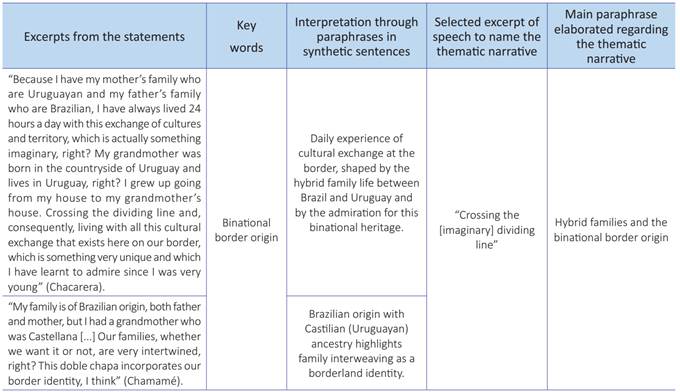
While reading the transcritions, one of the researchers selected excerts from all articiants’ seech that addressed the hybridism of Brazilian and Uruguayan cultures and assigned a keyword to each. The researcher groued statements with the same keyword. The other researcher reviewed the selection, keywords and grouing, and together the authors interreted the selected excerts, synthesising them into arahrases and linking them to the ersective of cultural identity and careers in context. Then, the authors selected the excert and arahrase that best reresented the others and used them to name the thematic narrative. This rocess resulted in eight thematic narratives containing the keywords: binational origin, know-how through family encouragement, ortuñol, gaúcho dress, binational festivals, border gastronomy, border music, and challenges in border careers. Chart 1 resents an examle.
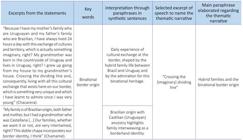
We organised the resentation of the results by outlining the articiants’ rofiles, the context of the Border of Peace, and the thematic narratives, beginning with life and family trajectories on the border and moving on to the more secific asects of the careers of chefs and musicians. The authors sought to describe the narratives in a manner close to the articiants’ own language. We then resent the discussion of the results, which led to the develoment of the concet of border careers as an identity exressed through cultural hybridity for musicians and gastronomic chefs.
PROFILE OF THE INTERVIEWEES
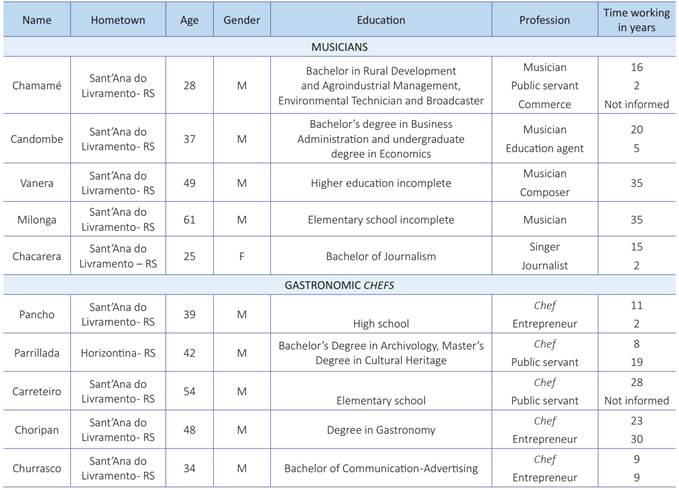
The rofile of the interviewees is resented in Chart 2. To reserve their identities, the musicians were identified using names of musical genres, and the chefs were identified by names of tyical dishes from Uruguay and from Rio Grande do Sul, the Brazilian state where the city of Santana do Livramento is located. During the research, we observed that when referring to Brazilian culture, the interviewees frequently mentioned secific regional elements of Gaúcho culture. This was exected, as Brazil, due to its vast geograhical size, encomasses distinct cultural asects in each state.
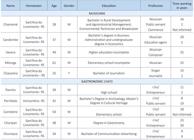
All articiants are Brazilian Gaúchos, with nine being from Sant’Ana do Livramento and one originally from Horizontina, though residing at the border for eight years. One of the interviewees is doble chaa, holding dual nationality. Ages range from 25 to 61, with a redominance of men-only one woman was interviewed. Half have a higher education degree; the others comleted either rimary or secondary education. Only one chef has formal training in gastronomy, and none of the musicians have secific academic training in music. In the case of music, careers tyically began early due to family influence; in gastronomy, they usually emerged after other rofessional exeriences. Most articiants are also active in other areas beyond music or cuisine.
CONTEXT OF THE “BORDER OF PEACE”: THE TWIN CITIES OF SANTANA DO LIVRAMENTO AND RIVERA
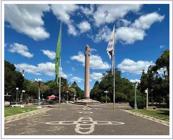
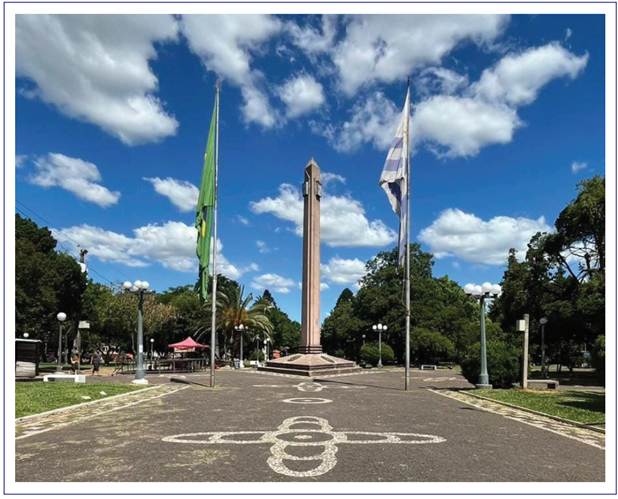
The city of Santana do Livramento, with 84,421 inhabitants, is located in the south-west of the state of Rio Grande do Sul, Brazil, while the city of Rivera, with 84,775 inhabitants, is situated in the north-east of the Deartment of Rivera, Uruguay. They are considered twin cities due to their conurbation and intense circulation of eole and goods, as there are no rivers, walls or any migratory barriers between them. There is, of course, an official immigration office on each side, where individuals must resent themselves should they wish to travel beyond these two municialities, but the movement between the cities is unrestricted: one simly crosses, on foot or by any other means of transort, the imaginary line that searates the territories. The longstanding history of friendly olitical, commercial, social, economic and cultural relations between the two cities and their countries has earned the region the nickname “Border of Peace”. The symbol of division-integration between the cities is the International Park (Figure 1), where each country’s flag stands on its own national soil, and the obelisk marks the imaginary dividing line.
THEMATIC NARRATIVES
“Crossing the [imaginary] dividing line”: hybrid families and the binational border origin
In the Border of Peace, mixed Brazilian and Uruguayan family origins - what we may call hybrid families - are common in the region. Hybridism, which may occur in the arents’ generation, grandarents’ or even further back, results in the everyday habit of crossing the border to visit relatives on either side. When father and mother are of different nationalities, Brazilian and Uruguayan, or vice versa, the child is called doble chaa. Many retain this label only culturally, while others, as in the case of Chacarera, have official dual citizenshi: “if you oen my wallet, I have my Brazilian ID card and my Uruguayan identity card”.
“Because I have my mother’s family who are Uruguayan and my father’s family who are Brazilian, I have always lived 24 hours a day with this exchange of cultures and territory, which is actually something imaginary, right? My grandmother was born in the countryside of Uruguay and lives in Uruguay, right? I grew u going from my house to my grandmother’s house. Crossing the dividing line and, consequently, living with all this cultural exchange that exists here on our border, which is something very unique and which I have learnt to admire since I was very young” (Chacarera).
“My family is of Brazilian origin, both father and mother, but I had a grandmother who was Castellana [...] Our families, whether we want it or not, are very intertwined, right? This doble chaa incororates our border identity, I think” (Chamamé).
Regardless of formal registration, the crossings over the imaginary dividing line - literally and culturally - between the countries, according to the interviewees, begin with the binational family origin, which they value and recognise as a border identity.
“I grew u in this environment”: the labour know-how acquired through family encouragement and living with border culture
Reflecting on the know-how of chef and musician careers led articiants to memories of childhood. The first contact with different musical instruments and with the handling of kitchen utensils tyical of the border region occurred through everyday family life:
“I was influenced by my family… I was a 10-year-old boy, they already layed and sang. When I was 12, my mother gave me a button accordion and I started lessons. Later I was already laying in two invernadas [grous of gaucho dance]. At 17 I started laying at festivals and I never stoed” (Vanera).
“My father reared meals over an oen fire, on a treme, it was very rustic, but it was the most flavourful food I have ever eaten. I have never managed to eat anything like it again, even cooking at home; it does not have that taste, that seasoning from the cuisine my father made” (Carreteiro).
“My whole ubringing was inside the CTG [Centre of Gaucho Traditions], right? So from there I started to develo a taste for music and art. I took art in artistic dance grous, singing cometitions. And I develoed a taste for music, started guitar lessons, and learnt a little about the music and culture of Rio Grande do Sul. Over time, I became more comfortable with the instrument and develoed a taste for comosition” (Candombe).
Many other narratives reinforce that the relationshi with musical art and food sans both life and career, marked by the suort and resence of family and close eole, through gestures and encouragement for discovery: (i) “During childhood, I used to go to my grandfather’s farm and watched him reare the Sunday churrasco (barbecue), and that is how I learnt […] I grew u in this environment” (Churrasco); (ii) “I always liked and had a flair for cooking. I heled my arents from a young age with the housework, so I had to manage. I began to enjoy cooking and develoed my own way of doing things, but you only really gain skills inside a rofessional kitchen, after a lot of exerience” (Pancho); (iii) “When I was about 7 years old, I really started, encouraged by my godmother. At the time, it was something very casual, so I started music lessons and sang the songs I liked” (Chacarera); and (iv) “At around 8 years old I got to know the cultural side through oetry and started reciting. At 13, I began music festivals and I was one of the first singers here in Livramento to win first lace at a nativist festival at such a young age - I was 16 at the time” (Chamamé).
“Here at the border we seak ortuñol”: linguistic hybridity in music and gastronomy
Portuñol is noticeable in the seech of all interviewees. It is worth recalling that they are all Brazilian and received their schooling in Portuguese, yet throughout the interviews their narratives were filled with Sanish words and exressions, blending the two languages. This is one of the cultural elements that forms art of the border way of communicating: “We are on the border and there is no way of avoiding Sanish, is there? Even though what is soken here is not Sanish, but ortuñol” (Vanera). This linguistic hybridity, which is a quotidian way of seaking, also aears in artistic modes of exression:
“We have an accent, we carry certain words, dialects, and then we mix them as well, don’t we? A real mixture in the lyrics that the songwriters here already write in ortuñol” (Milonga).
“We always include in the albums we record one or two songs in Sanish and the songs that are in Portuguese also bring a bit of ortuñol, don’t they? This is a characteristic we have had from the very beginning. It is already art of our own formation, of the border accent” (Candombe).
“When arriving at the ub, I found Candombe and Chamamé. I notice that Chamamé communicates with the audience using words and exressions in ortuñol: Buenas amigos; vamos arar de charlar e cantar; nosotros aqui; entonces gurizada. In addition to the names of the songs and reertoire in ortuñol” (Field diary).
Portuñol, more than simly a way of seaking for border residents, is a way of being, which gives rise to song lyrics, names of dishes and names of festivals, bringing closeness with the local audience, differentiation and a border identity to chefs and musicians.
“Pilcha is stage attire but I also wear it every day”: dress of the gaucho from Rio Grande do Sul and Uruguay
In the state of Rio Grande do Sul, one of its cultural symbols is the traditional clothing worn in the Centros de Tradição Gaúcha (Centres of Gaúcho Tradition), garments similar to those used by men and women during the colonial eriod. In Uruguay, the same tyes of clothing are found, with small variations. Men’s dress consists of bombacha trousers, shirt, neckerchief, leather boots or alargata. Women’s dress consists of the renda dress; blouse and long skirt; or blouse, bombacha and boots or saatilha. Although this tye of attire is more commonly associated with traditional festivals, it can also be seen in daily use in the streets along the border, since on both sides it is connected with rural life. When musicians erform, and even in their everyday life, it is common for them to wear traditional clothing, known as ilcha gaúcha:
“The ilcha is stage attire but I also wear it every day” (Vanera).
“And from the culture of Rio Grande do Sul, I think there is a bit of everything, isn’t there? My clothing, which is also imorted from Argentine and Uruguayan dress, is a mixture of everything” (Chacarera).
The ilcha gaúcha, therefore, refers to the gaúcho from Rio Grande do Sul, but also to the gaucho of the Uruguayan and Argentinian amas. On the other hand, some artists do not consider it necessary to wear these outfits to reresent their border identity: “Even if today I am wearing jeans and I am not accustomed to wearing ilcha, I feel immense ride in being from this land, being a border erson, and exressing this through hositality, customs and traditions” (Chamamé). During the observation at the Gastronomy Festival, we noted that “Parrillada was not wearing traditional clothing, unlike the other colleagues” (Field diary).
“I work from the first [Binational] Festival onwards”: Cultural infrastructure that enables work and encounters between the two countries
One of the career strategies of these rofessionals is to take art in binational events held at the “Border of Peace”, as these occasions symbolise the union between Brazil and Uruguay and celebrate tyical regional food and music. Musical festivals, for examle, constitute an entry oint into musicians’ careers, as in the case of Candombe.
“A grou of friends and I formed the grou Charla de Fronteira. I was 16 years old, the youngest in the grou. We started doing erformances, oening fairs and shows. We did the oening act for Luiz Marenco’s show [a nativist singer of state-wide rominence]” (Candombe).
Chorian was one of the creators of a gastronomic event that highlights a border delicacy and takes lace on the dividing line between the two countries:
“I invented ChoriCeva [the name of the event combining the terms chorián and beer], and I have also worked from the very first edition of the [Binational] Enogastronomy Festival” (Chorian).
The gastronomic events mentioned take lace eriodically and are hosted at one of the symbolic markers of searation (and union) between the cities, the International Park, a ublic square with green sace, featuring an obelisk and the flag of Brazil on one side and that of Uruguay on the other. This location, which is jointly administered by a mixed commission from both countries, brings together traders, organisations, businesseole, local residents and tourists who attend the events and often take hotos between the two flags. The events mentioned by the interviewees sometimes have music as their main feature, and at other times gastronomy. However, both gastronomic elements and music are always resent, comlementing each other. It is also worth emhasising that this cultural infrastructure rioritises border culture and constitutes one of the dislay windows and forms of legitimisation of the work of chefs and musicians within the community.
“There is another country just next door […] dishes, ingredients, seasonings that you can’t find here, but you can find there”: references used by chefs in their gastronomy
Given that the Border of Peace is a land border where residents of both countries have free access to cross to the other side, this becomes highly significant for gastronomy, as it rovides availability and exerience for relacing or obtaining ingredients and diversifying flavours: “For gastronomy it’s excellent, you’ve got another country right next door, haven’t you? You have another culture, both in dishes, ingredients, seasonings, in roducts that you can’t find here but you find there” (Carreteiro).
The culinary style is the comida cameira (country food), which, according to the interviewees, is simle cuisine based on cattle and shee farming, tyical of the ama biome. When listing elements of the border, Carreteiro always tries to reare dishes that reresent the region:
“In the culinary art we try to include something, like chorian and arrilla, which are very oular” (Carreteiro).
“I like to take ingredients from here, you know? To value the local roducer first, and then use these roducts - lamb, walnuts, honey, olive oil, wine and the cheeses we have - and with that make a more elaborate meal” (Chorian).
This mixture of Brazil-Uruguay cultures in gastronomy leads to the creation of new roducts through the cultural references of the border. This can be seen when Parrillada manages to use Uruguayan elements without losing the touch of Brazilian cuisine, resulting in a new roduct emerging from this blend of cultures: “The icanha burger is insired by roasted red eer, things we find in some arrilladas in Uruguay. So there are things I draw on, some tendencies or characteristics of border cuisine from the Uruguayans” (Parrillada).
“We are recognised for this border […] where the very language, musical rhythms and the ama biome blend”: musicians’ references for their artistic erformances
All the musicians interviewed are singers, instrumentalists and comosers. In their narratives, they recognise certain rhythms as belonging to neighbouring countries: “the chamamé, which is stronger in Argentina, Uruguay here with the milonga and the candombe” (Candombe). However, they observe similarities between musical rhythms from Rio Grande do Sul (Brazil), Uruguay and Argentina, and how this cultural feature is reresented in the identity of the border artist:
“When I go to festivities in the Uruguayan countryside, to folklore festivals, eñas, criollas, I see a great similarity with our culture here, with what we live, right? And musically seaking, I think I can have, in my work, a blend of the two strands. Uruguayan music has a great deal of focus on guitarists, guitar solos, milongas. From Argentina, the chacarera, which is a rhythm I really enjoy singing, forms art of my reertoire in several songs” (Chacarera).
“And I also continue with my show, which brings together gaúcha music with Uruguayan and Argentine folklore in the reertoire” (Chacarera).
“The title of the comosition Encandilado (Enchanted) is already in Sanish, isn’t it? Because it is in Portuguese, but it has some terms which are doble chaa. There is Carniceria de Frontera (Border Butchery), it is also a chamamé that we comosed, ortraying the butcheries on the border line between the countries, where we always tend to go at the weekend to buy meat” (Candombe).
In their comositions, the artists write about life on the border, which demonstrates that their identity as musicians is neither solely Brazilian nor solely Uruguayan, but a blend - it is doble chaa, in Candombe’s words. Therefore, it is something new, for which they seek recognition: the border identity within their careers: “Wherever we go, we are recognised for this border, which has no division. Where the very language, the musical rhythms and the ama biome, both from Brazil and from Uruguay, become blended” (Candombe).
“It is a struggle in every sense, you know? […] I sing folklore, this is my show”: challenges intersecting gender, origin, and generation
Chacarera, the only woman among this grou of interviewees, highlighted the gender challenges she faces, alongside her situation as an autonomous artist. The singer notes that she exeriences sexism at various moments:
“Esecially as an indeendent artist, working in a rather limited niche, where there are not many oortunities. I am a woman in a musical genre that is redominantly male, extremely sexist, exclusionary and so on. It is a struggle in every sense, you know? A struggle for sace, for reresentation, it feels as though we always have to rove our worth, rove what we are caable of doing. Many times it seems that it does not matter what I do, it does not matter how cometent I am in my work, how much I achieve, awards, rogrammes. It seems I will never be good enough for this niche, simly because I am a woman” (Chacarera).
For artists whose careers carry the identity of their origin, culture and regional folklore - such as the musical rhythms milonga, chamamé, chacarera, candombe and vanera - the ublic tends to be more local, without reaching a mass audience, and this often becomes a dilemma that may result in lost work oortunities:
“I received around three roosals for shows in large events here in the city where they wanted me to sing other things, not folklore, not regional music. Because, well, they did not like it or did not want it. Obviously, I can sing anything, because besides being a regional artist, I am a singer. But often you end u having to say: look, this is my work, what I do is this, I sing folklore, this is my show. If you want to take this show to an event, I believe it will add a lot. If you do not want it, unfortunately I cannot create a show from scratch with another roosal, not least because that is not what I want to convey to eole” (Chacarera).
Maintaining the tradition of what is folkloric music, also called nativist music, does not mean that its characteristics will not change over time. Earlier generations of artists influence the current generation, but the latter also incororates contemorary elements, which may generate criticism.
“My generation also drank from that source (of artists from Rio Grande do Sul and Uruguay), and it still does today. Many of those I work with now, those I have artnershis with, were the very ones who insired me at the beginning of my career, and the nativist scene fosters that. In 2007, the identity of nativist music was already no longer very different from the genre that Lelé, Adair de Freitas, Luiz Cardoso drew uon. And this changed, it was already a more romantic genre, not so rural. And then my generation mixed it, made a great mix and many times I have been criticised for that” (Chamamé).
Although the careers of chefs and musicians are valued through their exerience of being frontier inhabitants, their narratives are marked by tensions associated with gender, origin and generation which shae their trajectories and identity, involving constant negotiation between tradition and innovation.
BORDER CAREERS AS IDENTITY THROUGH THE EXPRESSION OF CULTURAL HYBRIDISM FOR MUSICIANS AND GASTRONOMIC CHEFS: DISCUSSION OF RESULTS
“For me there is no border here. The border is for those from outside who arrive and say: here is Brazil, here is Uruguay. Because being a border (fronteiriço) means being a mixture of Brazilian and Uruguayan. This mixture is what is beautiful here. In a moment the Brazilian is seaking to the Uruguayan in Sanish, the Uruguayan seaking Portuguese with the Brazilian” (Chorian).
The narrative above by Chorian synthesises the other narratives resented and encasulates the singular context of the Border of Peace. This border between Brazil and Uruguay does not oerate as a limit, but rather as a sace of continuous coexistence between cultural, linguistic and symbolic codes, thereby constituting what Hall (2020) terms identity as ositioning - always relational, negotiated and in transformation. The narratives describe a shared life of hybrid families that circulate between the two neighbouring countries, where national distinctions lose rigidity in everyday life, giving rise to hybrid ractices that exemlify the rocesses of hybridisation discussed by Canclini (2015), in which elements reviously searate combine to generate new cultural forms, in this case the border culture, already evidenced in other studies (Ferraro, 2020; Muller et al., 2010; Pimentel, 2021; Sturza, 2019).
By stating that “being a border (fronteiriço) means being Brazilian and Uruguayan mixed together” and attributing beauty to this mixture, Chorian exresses ride in this identity which does not anchor itself in fixed belongings, but rather in a shared exerience of an in-between lace, marked by territorial and sociocultural ermeability. This way of being translates border identity as an active construction, roduced through the constant encounter between cultures, and one which redefines the very meaning of the border - in many laces around the world associated with division, searation, walls, migration and control - by transforming it from a dividing line into a sace of everyday hybridity, even carrying the adjective “eace” in its oular aellation.
The border culture, learned and exerienced throughout life, is exressed in the coexistence with doble chaa family members, in the orality of ortuñol, in the ilcha gaúcha, in cultural festivals, in shared culinary ractices and in nativist musical reertoires. It oerates simultaneously as a symbolic and structural resource, shaing strategies of action in the regional labour market. The artistic careers of chefs and musicians emerge from this border identity marked by hybrid national cultural matrices, confirming the argument that rofessional trajectories are insearable from the satial, ontological and temoral dimensions (Mayrhofer et al., 2023) that configure their contexts of work, origin, global interactions, society and culture (Mayrhofer et al., 2007).
The cultural examles brought by the narratives, esecially those related to gastronomy and music in Rio Grande do Sul (Brazil), are not entirely distinct from those of Uruguay. They are close, sharing symbolic airs with different names in Portuguese and Sanish - for examle, chimarrão and mate, linguiça and chorizo, churrasco and asado, churrasqueira and arrilla - or even the same name in both countries - for examle, ilcha, bombacha, milonga, chamamé. This reveals the sharing of a common rural way of life (estilo de vida cameiro) that ermeates those who live in the vast Pama biome.
This shared reertoire refers to the historical figure of the cislatine gaucho, descendant of the miscegenation between Portuguese and Sanish colonisers and Indigenous eoles (later also Black oulations), who in the colonial eriod circulated freely across the lains of the River Plate region (which encomasses mainly Rio Grande do Sul, Uruguay and Argentina), tending cattle and ractising rural habits (Boff & Machado, 2023; Munizaga et al., 2024; Ramil, 2009). It is striking to observe that what is today called border culture, marked by interaction between two distinct national cultures, has the same origin: the origin of the countryside. The cislatine gaúcho’s way of life, still resent in the region today, recedes the geoolitical divisions and state boundaries that later came to define Brazil and Uruguay. Thus, border culture is born from this shared ast and reinscribes it in the resent, translated into two countries, esecially through art (Cleveland, 2013), such as in the careers of chefs and musicians.
The findings are in dialogue with studies on cultural hybridity, such as Marzano’s (2024), which illustrates the creation of an “in-between sace” in festivals organised by Indigenous Angolan communities, who were ressured by Euroean cultural assimilation during the colonial eriod. At the same time, the results advance beyond studies in which hybridity emerges as a translational tension, involving lexical gas and losses of meaning (Hu & Roberto, 2019), given that ortuñol is not exerienced as a roblem, noise or difficulty of translation, but as a ositive marker of belonging. It does not need to be corrected or mediated; rather, it is valued as musical aesthetics, as a communicative style and even as a strategy for career differentiation. In the “Border of Peace”, ortuñol emerges as an identity and rofessional resource, incororated sontaneously and celebrated in the erformances of chefs and musicians. The findings also advance in relation to studies in which hybridity aears within a context of erosion and direct threat to the survival of traditional ractices - such as seed cultivation involving actions of resistance (Rincón et al., 2024). In the Brazil-Uruguay border under analysis, cultural hybridity is not exerienced as something that laces one country or the other at risk, but as a historical outcome celebrated by chefs and musicians, including their traditional forms of cultivating food, which become aesthetic and rofessional differentiators.
The findings also dialogue with studies that demonstrate how careers are influenced by context (Akkermans & Kubasch, 2017; Mayrhofer et al., 2007, 2023; Van den Groenendaal et al., 2022), and that territory is not merely a backdro, but a source of cultural identity, legitimacy and economic value, as occurs in artistic careers linked to regional cultural identity (Barros et al., 2021; Calasans & Davel, 2020) and in careers associated with more than one national cultural identity, generally linked to migration (Martin et al., 2024; Prestes & Grisci, 2025; Rabenu & Baruch, 2025). In the case of the chefs and musicians in this study, it is ossible to advance this literature by showing that, in this border zone, cultural identity is constituted from childhood through the everyday hybridity of different national cultures (which share the same historical origin), without formal migratory mobility, but through endular mobility. It is this that becomes borderland music and gastronomy, as work, and enables us to understand what we call a border career.
Border careers are constituted not only through the blending of two national cultures, but through work that results from a ermanent in-between lace, rooted in a hybrid cultural identity. In addition, the free circulation between the twin cities broadens the reertoire of available material and symbolic resources - such as language, ingredients, binational festivals, and a cross-border audience - thereby configuring a rofessional sace that escaes the traditional categories of localnationalglobal careers roosed by Mayrhofer et al. (2007). This scenario of border careers connects the theoretical ersective of careers in context (Mayrhofer et al., 2007, 2023) with that of cultural hybridity (Canclini, 2015), and with that of (a new) cultural identity (Hall, 2020).
The tensions exerienced in the border careers of chefs and musicians were traversed by social markers (Akkermans & Kubasch, 2017; Mayrhofer et al., 2007, 2023), articularly gender, origin and generation. The only woman among the musicians faces difficulties of legitimisation in a field marked by hegemonic masculinity, already extensively observed in career studies (Barros et al., 2021; Torbor et al., 2025). It is worth noting that the nativist musical field (as well as border-region gastronomy) is shaed by a gaúcho identity historically associated with rigid masculinity - “valiant, macho, boastful”, as described by Ramil (2009) - and by a cultural tradition which, according to Boff and Machado (2023), was olitically constructed to exalt the gaúcho as a male hero, a defender of the borders. This structuring imaginary, historically reinforced by the Centres of Gaúcho Tradition (Ferraro, 2020), establishes a symbolic environment that naturalises male centrality and reinforces the exclusion of women, limiting female legitimisation in careers linked to folklore and traditional reertoires.
Regarding origin, the tension does not concern the multicultural setting, as in Martin et al. (2024); it is not about Brazilian or Uruguayan culture, but rather about rural (countryside) culture and urban (mass) culture. Borderland artists oerate within cultural niches that are frequently marginalised by mass-market demands, which requires ongoing negotiations between authenticity and adatability. A similar scenario emerges with regard to generation, when one of the musicians notes that his generation began roducing more romantic songs and not so deely rooted in rural tradition, showing that the hybridisation of cultural references from different eriods continuously reshaes borderland music, fragmenting identity, as roosed by Hall (2020). On the one hand, this brings the music closer to mass culture, but on the other hand, it may lead to the loss of a more conservative audience.
In summary, this study contributes by (1) emirically demonstrating how the hybridity of neighbouring national cultures - border culture - oerates as a structuring and erformative logic within cultural identity - border identity - in the careers of musicians and chefs in a South American border region, and by naming this scenario as border careers. (2) It highlights the secificities of the case of the “Border of Peace”, which distinguish it from other contexts, such as the historical character of the Platine formation that roduced the figure of the gaúcho within the ama biome during the colonial eriod, re-signified by each country after geoolitical divisions; (3) it shows that multicultural identities do not arise solely from formal migration, but may emerge from the historical coexistence of neighbouring cultures engaged in endular mobility; and (4) it demonstrates how rejudices related to social markers, esecially gender, are a result of local historical and cultural constitution, which eretuate secific tensions of legitimacy and recognition in women’s careers.
THEORETICAL IMPLICATIONS
As theoretical imlications, the study contributes by (1) associating the concet of cultural hybridity with that of border culture; (2) associating the concet of cultural identity with that of border identity; and (3) exanding the understanding of careers in context by linking it to cultural hybridity (border culture) and cultural identity (border identity), resulting in the resentation of the concet of border careers. We understand border careers as rofessional trajectories characterised by work reertoires associated with a border identity, that is, whose cultural identity is shaed by a border culture which, in turn, refers to a hybridity between cultures caable of generating something new. In borderland careers, careers are constructed in an insearable manner with the cultural identity of an in-between sace, which is not fixed and is in constant transformation.
PRACTICAL IMPLICATIONS
As ractical imlications, this study offers contributions for ublic olicy rofessionals to recognize workers in border careers as agents of valorization of border culture and identity, and as otential catalysts for strengthening the local labour market and tourism in the region. The findings may also serve as evidence for rofessionals engaged in border careers, articularly those located in the context under analysis, the “Border of Peace”, who seek to aly for ublic calls that finance their work - a recurrent strategy in this tye of career. The study may further contribute to reflections among new generations of artists in border careers by highlighting that the border culture, symbolically reresented by the gaúcho, has Indigenous and also Black roots, even if to a lesser extent, which have often been obscured by colonial narratives of Sanish and Portuguese domination in Latin America.
LIMITATIONS AND FUTURE RESEARCH
This study was limited to interviewing individuals who reside on the Brazilian side of the border and who redominantly seak Portuguese, due to the researchers’ accessibility. We also highlight that the researchers are Brazilian, which brings a secific ersective shaed by their own origin when addressing the hybridity between their country and the neighboring one. Future studies would benefit from comaring the results of this research with chefs and musicians who reside on the Uruguayan side and have Sanish as their first language. Finally, we underline the frequent references to Argentina during the interviews. Although Argentina does not directly border the area, the country is geograhically close to the “Border of Peace.” This reinforces the strong relationshi with the historical figure of the gaúcho cislatino. Therefore, as a suggestion for further research, we roose identifying, jointly, the elements of the gaúcho figure across Brazilian, Uruguayan, and Argentine cultures. Moreover, we recommend further exloration of the difficulties and challenges faced in the careers of female cross-border musicians and chefs, and exanding the field of study to other border careers not necessarily linked to artistic rofessions.
ACKNOWLEDGEMENTS
The authors would like to thank the anonymous reviewers for their thoughtful comments and suggestions that imroved the manuscrit.
REFERÊNCIAS
-
Akkermans, J., & Kubasch, S. (2017). #Trending topics in careers: A review and future research agenda. Career Development International, 22(6), 586-627. https://doi.org/10.1108/CDI-08-2017-0143
» https://doi.org/10.1108/CDI-08-2017-0143 - Alencar, C. N., Costa, M. F., & Costa, N. B. (2017). Discursos, fronteiras e hibridismo Expressão Gráfica Editora.
-
Almeida, R., & Dorfman, A. (2017). Fronteiras Culturais/Fronteras Culturales: Um processo de autonomias e de convergências. Anuário Unbral das Fronteiras Brasileiras, 3, 135-152. https://doi.org/10.21826/2525-913X-2016-3-p.132-152
» https://doi.org/10.21826/2525-913X-2016-3-p.132-152 -
Barros, L. E. V., Cappelle, M. C. A., & Guerra, P. (2021). Carreira outsider: Um estudo sobre o processo de rotulação da carreira de músico. Revista Eletrônica de Ciência Administrativa, 20(1), 194-225. http://dx.doi.org/10.21529/RECADM.2021007
» https://doi.org/10.21529/RECADM.2021007 -
Boff, R. B., & Machado, N. E. L. (2023). O transfronteirismo da cultura gaúcha na região do Prata — Dos changadores às fronteiras culturais. Revista Informação em Cultura, 5(1), 28-49. https://doi.org/10.21708/issn2674-6549.v5i1a11044.2023
» https://doi.org/10.21708/issn2674-6549.v5i1a11044.2023 -
Bresnen, M., Hodgson, D., Bailey, S., Hassard, J., & Hyde, P. (2018). Hybrid managers, career narratives and identity work: A contextual analysis of UK healthcare organizations. Human Relations, 72(8), 1341-1368. https://doi.org/10.1177/0018726718807280
» https://doi.org/10.1177/0018726718807280 -
Caetano, J. E. B., Missio, F. J., & Deffacci, F. A. (2017). Fronteira, música e identidade cultural. Revista Latino-Americana de Estudos em Cultura e Sociedade, 3, 1-25. https://doi.org/10.23899/relacult.v3i3.519
» https://doi.org/10.23899/relacult.v3i3.519 -
Calasans, R. G., & Davel, E. (2020). Gestão de carreiras criativas, identidade e cultura comunitária: Amadeu Alves e a cultura musical Irapuã. Revista Administração em Diálogo, 22(2), 91-114. https://doi.org/10.23925/2178-0080.2020v22i2.43623
» https://doi.org/10.23925/2178-0080.2020v22i2.43623 - Canclini, N. G. (2015). Culturas híbridas: Estratégias para entrar e sair da modernidade Editora USP.
-
Cleveland, K. L. (2013). Black art in Brazil: Expressions of identity University Press of Florida. https://doi.org/10.2307/j.ctvx075nv
» https://doi.org/10.2307/j.ctvx075nv -
Ferraro, E. H. (2020). O conceito “campeiro” na música regional gaúcha: Uma configuração da ordem artístico/cultural. GIS - Gesto, Imagem e Som - Revista de Antropologia, 5(1), e164859. https://doi.org/10.11606/issn.2525-3123.gis.2020.164859
» https://doi.org/10.11606/issn.2525-3123.gis.2020.164859 -
Gander, M. (2021). The hybrid career concept: Creating hybrid career pathways. Career Development International, 26(7), 853-868. https://doi.org/10.1108/CDI-07-2020-0189
» https://doi.org/10.1108/CDI-07-2020-0189 -
Guo, F., Restubog, S. L. D., Cui, L., Zou, B., & Choi, Y. (2019). What determines the entrepreneurial success of academics? Navigating multiple social identities in the hybrid career of academic entrepreneurs. Journal of Vocational Behavior, 112, 241-254. https://doi.org/10.1016/j.jvb.2019.03.003
» https://doi.org/10.1016/j.jvb.2019.03.003 - Hall, S. (2020). A identidade cultural na pós-modernidade Lamparina.
-
Hu, Z., & Roberto, M. T. (2019). Tradução do hibridismo: Análise da versão portuguesa de The Joy Luck Club de Amy Tan. Ilha do Desterro, 72(2), 245-272. http://dx.doi.org/10.5007/2175-8026.2019v72n2p245
» https://doi.org/10.5007/2175-8026.2019v72n2p245 -
Instituto Brasileiro de Geografia e Estatística. (2021). Censo Brasileiro de 2021: Municípios de faixa de fronteira e cidades gêmeas https://www.ibge.gov.br/geociencias/organizacao-do-territorio/estrutura-territorial/24073-municipios-da-faixa-de-fronteira.html
» https://www.ibge.gov.br/geociencias/organizacao-do-territorio/estrutura-territorial/24073-municipios-da-faixa-de-fronteira.html - Jovchelovitch, S., & Bauer, M. W. (2003). Entrevista narrativa. In M. W. Bauer & G. Gaskell (Orgs.), Pesquisa qualitativa com texto, imagem e som: Um manual prático (pp. 90-113). Vozes.
-
Lam, A. (2019). Hybrids, identity and knowledge boundaries: Creative artists between academic and practitioner communities. Human Relations, 73(6), 837-863. https://doi.org/10.1177/ 0018726719846259
» https://doi.org/10.1177/ 0018726719846259 -
Martin, L., Gao, J., Köhler, T., & Zhao, Y. (2024). The interplay of multicultural and career identity development. The International Journal of Human Resource Management, 35(8), 1577-1601. https://doi.org/10.1080/09585192.2024.2317726
» https://doi.org/10.1080/09585192.2024.2317726 -
Marzano, A. (2024). Entre “tradições” e “modernidades”: Agrupamentos carnavalescos de Luanda na primeira metade do século XX. Topoi (Rio de Janeiro), 25, e20220048. http://dx.doi.org/10.1590/2237-101X02505509
» https://doi.org/10.1590/2237-101X02505509 -
Mayrhofer, W., Briscoe, J., Dickmann, M., Hall, D. T., & Parry, E. (2023). Careers: What they are and how to look at them. In W. Mayrhofer, J. Briscoe, M. Dickmann, D. T. Hall, & E. Parry (Eds.), Understanding careers around the globe (pp. 2-8). Edward Elgar Publishing. https://doi.org/10.4337/9781035308415.00006
» https://doi.org/10.4337/9781035308415.00006 - Mayrhofer, W., Meyer, M., & Steyrer, J. (2007). Contextual issues in the study of careers. In H. Gunz & M. Peiperl (Orgs.), Career studies (pp. 215-240). Sage Publications.
-
Muller, K. M., Gerzson, V. R. S., Raddatz, V. L. S., & Soares, M. V. C. (2010). Comunicação e integração latino-americana: A participação da mídia local na construção da cultura e da identidade fronteiriça. Revista Fronteiras, 12(2), 116-125. https://doi.org/10.4013/4673
» https://doi.org/10.4013/4673 -
Munizaga, J. J., Lacoste, P., Skewes, J. C., & Alegría, L. (2024). Yerba mate, patrimonio inmaterial y poder blando en tiempos de Juan Manuel de Rosas (1829-1852). Revista de História (São Paulo), (183), a09423. https://doi.org/10.11606/issn.2316-9141.rh.2024.215337
» https://doi.org/10.11606/issn.2316-9141.rh.2024.215337 -
Pederson, S. N. (2013). To be welcome: A call for narrative interviewing methods in illness contexts. Qualitative Inquiry, 19(6), 411-418. https://doi.org/10.1177/1077800413482099
» https://doi.org/10.1177/1077800413482099 -
Pimentel, F. (2021). Como os brasileiros que vivem em regiões fronteiriças são influenciados culturalmente pelos países vizinhos Sextante. https://sextante.ufrgs.br/reportagens/a-influencia-cultural-dos-paises-vizinhos-nas-zonas-de-fronteiras/
» https://sextante.ufrgs.br/reportagens/a-influencia-cultural-dos-paises-vizinhos-nas-zonas-de-fronteiras/ -
Prestes, V. A., & Grisci, C. L. I. (2025). Trabalho em movimento: A produção de territórios por chefs imigrantes. Revista Economia & Gestão, 25(71), 69-88. https://doi.org/10.5752/P.1984-6606.2025v25n71p69-88
» https://doi.org/10.5752/P.1984-6606.2025v25n71p69-88 -
Rabenu, E., & Baruch, Y. (2025). The shape of careers in the future workplace: Extreme scenarios and their prospect impact. Career Development International, 30(1), 3-27. https://doi.org/10.1108/CDI-10-2023-0376
» https://doi.org/10.1108/CDI-10-2023-0376 - Ramil, V. (2009). A estética do frio: Conferência de Genebra Satolep Livros.
-
Rincón, L. F., Jacanamejoy, M. J., Acevedo, A., Nopsa, J. F. H., & Durán, J. R. (2024). Consolidación de redes locales de semillas y rescate de saberes ancestrales en comunidades del piedemonte amazónico colombiano. Revista NERA, 27(4), e10592. https://doi.org/10.47946/rnera.v27i4.10592
» https://doi.org/10.47946/rnera.v27i4.10592 -
Sturza, E. R. (2019). Portunhol: A intercompreensão em uma língua da fronteira. Revista Iberoamericana de Educación, 81(1), 97-113. https://doi.org/10.35362/rie8113568
» https://doi.org/10.35362/rie8113568 -
Torbor, M., Sarpong, D., Maclean, M., & Fletcher, L. (2025). On the dynamics of intersectional (in)visibility: Women early career researchers negotiating authenticity at work. Human Relations, 79(1), 3-31. https://doi.org/10.1177/00187267251323854
» https://doi.org/10.1177/00187267251323854 -
Van den Groenendaal, S. M. E., Akkermans, J., Fleisher, C., Kooij, D. T. A. M., Poell, R. F., & Freese, C. (2022). A qualitative exploration of solo self-employed workers’ career sustainability. Journal of Vocational Behavior, 134, 103692. https://doi.org/10.1016/j.jvb.2022.103692
» https://doi.org/10.1016/j.jvb.2022.103692 -
Yao, C., & McWha-Hermann, I. (2025). Contextualizing career development: Cultural affordances as the missing link in social cognitive career theory. Journal of Vocational Behavior, 159, 104114. https://doi.org/10.1016/j.jvb.2025.104114
» https://doi.org/10.1016/j.jvb.2025.104114
-
DATA AVAILABILITY
The dataset that suorts the findings of this study is not publicly available
-
ARTIFICIAL INTELLIGENCE USAGE
The artificial intelligence tool ChatGPT was used to translate the manuscrit from Portuguese into English and to assist with the technical and grammatical revision of the text, as well as the standardization of references.
-
FUNDING
This work is being supported by the Federal University of Pama (UNIPAMPA), the Fundação Getulio Vargas (FGV EAESP), and Foundation for Research Suort of the State of Rio Grande do Sul - FAPERGS, rocess 232551-0000814-9.
-
REVIEWERS
Marcelo Afonso Ribeiro, Universidade de São Paulo, São Paulo, SP, Brazil. ORCID: htts:orcid.org0000-0002-0396-7693
-
REVIEWERS
One reviewer did not authorize the disclosure of their identity.
-
PEER REVIEW REPORT
The eer review reort is available at https://periodicos.fgv.br/rap/article/view/97420
Edited by
The dataset that suorts the findings of this study is not publicly available

 Source: Elaborated by the authors.
 Source: Elaborated by the authors.
 Source: Elaborated by the authors.