 Joint angle variations in trotting Criollo horses under two head and neck positions: a pilot study
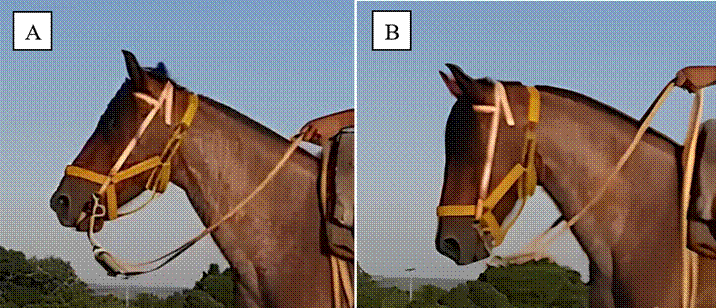
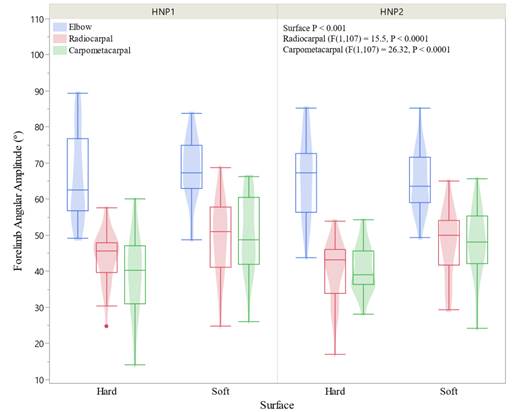
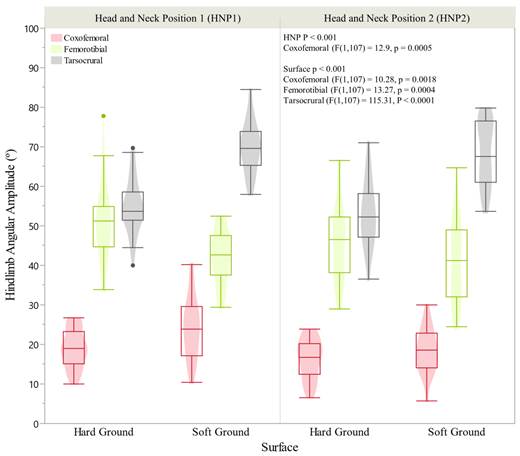
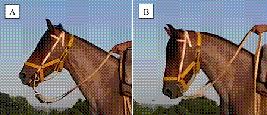
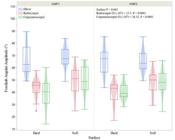
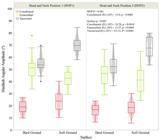
Kinematic analysis offers key insights into equine locomotion by linking body conformation, training, and performance. Despite their socio-economic importance in South America, detailed kinematic data on Criollo horses is scarce. This pilot study examined how head and neck position (HNP) and ground surface influenced limb angular amplitudes during trot in Criollo horses. Videos of 11 adult horses (8.2 ± 2.4 years) were recorded at 120 Hz under two HNP: free rein (HNP1) and flexed at the poll (HNP2), ridden on hard (compacted soil, n = 6) or soft (sand, n = 5) surfaces. Joint angles were measured from anatomical landmarks using Kinovea software, and angle amplitudes analyzed by a Linear Mixed Model (LMM) with Bonferroni correction (P < 0.0027). HNP significantly affected the coxofemoral joint amplitude (mean difference = 3.98º, S.D. ±1.11 P < 0.001), indicating enhanced hindlimb engagement, therefore less amplitude movement, when the poll was flexed. Surface type influenced multiple joints: the radiocarpal and carpometacarpal joints in the thoracic limb showed greater flexion on soft ground (P < 0.001), suggesting impact attenuation. In the pelvic limb, coxofemoral and tarsocrural joints exhibited larger amplitudes on soft surfaces, implying adaptation to instability to maintain propulsion. These findings contributed to optimize training, competition, and rehabilitation in Criollos and other breeds. Larger studies controlling for rider and equipment effects are necessary to confirm these preliminary results.
Key words:
angles; kinematics; Criollo horse; head and neck
 Thumbnail
 Thumbnail
 Thumbnail