 Transferability of microsatellite markers to Syagrus harleyi (Mart.) Becc. (Arecaceae), an endemic species from the Diamantina Plateau, a biodiversity hotspot in northeastern Brazil
ABSTRACT:
Syagrus harleyi is a stemless palm endemic to a small area in the Diamantina Plateau (Bahia, northeastern Brazil), a biodiversity hotspot in South America. The natural range of this species has been intensively affected by landscape fragmentation and fire episodes. In turn, no information about the levels of genetic variation and the evolutionary potential of S. harleyi is available so far. Thus, this study evaluated the cross-amplification of microsatellite (SSR) primers developed from three phylogenetically related palm species to S. harleyi. A total of 30 individuals from three populations were analyzed using 19 heterologous microsatellite loci. Based on 10 polymorphic loci, we identified a mean number of 4.1. alleles per locus and mean values of expected and observed heterozygosity of 0.579 and 0.780, respectively. These results showed that these loci are fully transferable and could be effectively used for genetic diversity assessment of S. harleyi populations focused on their management and conservation.
Key words:
palm tree; endemic species; caatinga; SSR; cross-amplification
RESUMO:
Syagrus harleyi é uma palmeira acaulescente endêmica da Chapada Diamantina (Bahia, Nordeste do Brasil), um hotspot de biodiversidade na América do Sul. A área de ocorrência da espécie tem sido afetada por incêndios e pela fragmentação da paisagem. Porém, sua diversidade genética permanece desconhecida. Este estudo avaliou a transferibilidade de 19 primers de microssatélites (SSR) desenvolvidos para três espécies filogeneticamente próximas a S. harleyi, em 30 indivíduos de três populações. Foram identificados 10 loci polimórficos, com média de 4,1 alelos por locus e heterozigozidade esperada e observada de 0,579 e 0,780, respectivamente. Estes resultados demonstram a eficiência da transferibilidade desses loci o potencial informativo dos mesmos para acessar a diversidade genética em populações de S. harleyi, o que contribuirá para o manejo e a conservação dessa espécie.
Palavras-chave:
palmeira; espécie endêmica; caatinga; SSR; amplificação cruzada
The stemless palm Syagrus harleyi Glassman is endemic to the Caatinga biome (GONÇALVES & AZEVEDO GONÇALVES, 2023), being restricted to the Diamantina Plateau (northern Espinhaço Range), state of Bahia (Northeastern Brazil), an ecoregion referred to as a major biodiversity hotspot in South America (ASSUNÇÃO-SILVA & ASSIS, 2022). Like most palm trees, S. harleyi flowers multiple times a year, representing a crucial species to avoid the collapse of local communities by providing resources for frugivorous and pollinators (BARFOD et al., 2011). Despite its ecological importance, vulnerability, and endemicity (FUNCH et al., 2021), much about the genetic diversity and conservation status of S. harleyi remains unknown. In this regard, studies based on molecular markers, such as Simple Sequence Repeats (SSRs), or microsatellites, have been highly useful for the conservation and management of native organisms as they provide reliable estimates of genetic diversity, population structure, gene flow, and adaptive potential (LAZARINO et al., 2023; MOREIRA, 2022).
Conversely, microsatellite analyses often require the development of species-specific primers, which is an expensive process (FASANELLA et al., 2019), particularly for developing and biodiverse countries such as Brazil. However, cross-amplification using SSR primers developed for closely related species (typically sharing homologies at microsatellite loci) offers a cost-effective alternative for assessing the genetic diversity of understudied groups (SIMPLICIO et al., 2017; FASANELLA et al., 2019). Therefore, considering the vulnerability status and the lack of genetic information on Syagrus harleyi, we tested the transferability of heterologous SSR markers and their suitability in estimating genetic parameters in this species.
Leaflet and inflorescence samples were collected from 30 Syagrus harleyi specimens (Figure 1), with ten individuals sampled from each of three sites along the Diamantina Plateau: Palmeiras (12o26’35.2’’S; 41o29’5.9’’W, 701 m.a.s.l.), Andaraí (12o52’5.1’’S; 41o18’29.7’’W, 522 m.a.s.l.), and Ibicoara (13o24’2.9’’S; 41o14’4.7’’W, 1075 m.a.s.l.) (Figure 2). Exsiccates of all specimens were identified and deposited in the Herbarium of the State University of Southwestern Bahia (HUESB). Leaflet samples were stored at -20 ºC, and afterwards, total DNA was isolated according to ARRUDA et al. (2017).
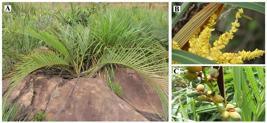
The stemless palm Syagrus harleyi. A wild plant of S. harleyi (A). An inflorescence of S. harleyi (B). Fruits of S. harleyi (C). The photographs were taken during field expeditions in the Diamantina Plateau.
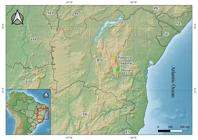
Map showing the collection sites of the 30 samples of Syagrus harleyi along the Diamantina Plateau, state of Bahia (BA), Brazil: Palmeiras (10), Andaraí (10), and Ibicoara (10).
A set of 19 previously published SSR primer pairs was picked out for assessment of their transferability to Syagrus harleyi (Table S1), of which eleven were designed for coconut (Cocos nucifera) (PERERA et al., 1999; RIVERA et al., 1999), six for peach palm (Bactris gasipaes) (BILLOTTE et al., 2004; RODRIGUES et al., 2004), and two for jussara palm (Euterpe edulis) (GAIOTTO et al., 2005) (Table S1). SSR-PCR reactions were performed according to SCHUELKE (2000). All forward primers were labeled at 5’ - ends with 6 - Carboxyfluorescein (6-FAM) fluorescent dye for further genotyping, and gradient PCR was applied to test the amplification efficacy of the cross-genera SSR markers. PCR products were subjected to electrophoresis on 8% polyacrylamide gel to check for amplification and concomitantly select the SSR markers that yielded polymorphic bands.
The selected 6-FAM labeled PCR products were genotyped by capillary electrophoresis on an ABI 3500xL Genetic Analyzer (Applied Biosystems) using the GeneScan™ 500 LIZ™ Size Standard as an internal reference for fragment sizing. Then, the fragment sizes (alleles) were determined with the software Geneious (www.geneious.com). The software Microchecker v. 2.2.0.3 was used to detect the presence of putative null alleles (VAN OOSTERHOUT et al., 2004). Afterwards, the values related to the number of alleles per locus (Na), percentage of polymorphic loci (PLP), expected heterozygosity (He), observed heterozygosity (Ho), inbreeding coefficient (FIS), and deviations from the Hardy-Weinberg equilibrium (HWE) for each marker were estimated in the software GenAlEx (PEAKALL & SMOUSE, 2012).
Out of the 19 SSR primers tested (Table S1), 10 were effectively amplified in DNA samples of Syagrus harleyi (Table 1). The optimal annealing temperature for each one is shown in table 1. These primers yielded reproducible polymorphic bands for all populations and were thus selected for the present analyses. A total of 41 alleles were detected, with a mean and range of 4.1 and 3 - 8 alleles/locus, respectively, with amplicon sizes ranging from 79 to 242 bp (Table 1). The expected heterozygosity (He) ranged from 0.514 to 0.644, with an average of 0.579, while the observed heterozygosity (Ho) ranged from 0.523 to 0.926, with a mean value of 0.780. Except for EE54, values of Ho > He and negative values of the inbreeding coefficient (FIS) were observed for all microsatellite loci (Table 1), indicating an excess of heterozygosity or absence of inbreeding within populations. Also, most loci (six out of ten) showed significant deviations from the HWE in the tested populations (Table 1).
Features and genetic diversity statistics for 10 cross-genera SSR loci evaluated in 30 specimens of Syagrus harleyi.
The successful cross-amplification of 10 SSR loci in Syagrus harleyi with high reproducibility across populations confirms the suitability of these markers for the genetic diversity assessment of this palm species. The high transferability rate reported here may be related to the phylogenetic relationship among species. Accordingly, recent phylogenomic studies in the family Arecaceae reinforced that (i) the genera Syagrus and Cocos are closely related (FRANCISCONI et al., 2023), (ii) the genus Bactris is a member of the tribe Cocoseae along with Syagrus and Cocos (SANTOS DA SILVA et al., 2021), (iii) and the genus Euterpe also belongs to the subfamily Arecoideae (CHEN et al., 2022). Furthermore, successful cross-amplification of SSR markers has been reported in other species of Syagrus, such as S. coronata (SIMPLICIO et al., 2017), S. romanzoffiana (LAINDORF et al., 2019), and S. oleracea (SANTOS et al., 2020).
The He values (0.514 to 0.644) (Table 1) indicated moderate to high genetic diversity, which is important for the long-term maintenance of populations (SIMPLICIO et al., 2017). Besides, nine loci exhibited values of Ho greater than He, and six SSR markers showed significant deviation from HWE (Table 1). A similar pattern was observed in Syagrus coronata, another palm species endemic to northeastern Brazil, where up to five SSR loci significantly deviated from Hardy-Weinberg equilibrium (SIMPLICIO et al., 2023). Therefore, despite the moderate to high genetic diversity recorded in our sampled populations, the presence of HWE deviations suggested that they might be susceptible to admixture or evolutionary forces such as genetic drift or local selection. As the purpose of this study was to identify markers transferable to Syagrus harleyi, further endeavors should employ a larger sample size for each population that was here analyzed, as well as a broader sampling in the range span of this palm, to a deeper examination of the evolutionary processes shaping their genetic diversity and structure.
It is noteworthy to mention that Syagrus harleyi is endemic to a highly overlooked biome that has been facing accelerated processes of deforestation, landscape fragmentation, climatic changes, and recurrent fire episodes. Therefore, our results are promising for a better understanding of the population dynamics of this palm tree. For instance, by including other populations along the natural range of S. harleyi (using the same primer set), it will be possible to estimate levels of gene flow, population structure, and genetic differentiation, thereby providing essential information for the conservation and/or proper management of this palm tree from Diamantina Plateau in Brazil.
ACKNOWLEDGMENTS
The authors are grateful to Conselho Nacional de Desenvolvimento Científico e Tecnológico (CNPq) for supporting Renata Miranda Souza with a scholarship.
REFERENCES
-
ARRUDA, S. R. et al. An optimized protocol for DNA extraction in plants with a high content of secondary metabolites, based on leaves of Mimosa tenuiflora (Willd.) Poir. (Leguminosae). Genetics and Molecular Research, v.16, n.3, p.1-9, 2017. Available from: <Available from: https://www.funpecrp.com.br/gmr/articles/year2017/vol16-3/pdf/gmr-16-03-gmr.16039063_0_0.pdf >. Accessed: Nov. 15, 2024. doi: 10.4238/gmr16039063.
» https://doi.org/10.4238/gmr16039063.» https://www.funpecrp.com.br/gmr/articles/year2017/vol16-3/pdf/gmr-16-03-gmr.16039063_0_0.pdf -
ASSUNÇÃO-SILVA, C. C.; ASSIS, L. C. S. Areas of endemism of Lauraceae: new insights on the biogeographic regionalization of the Espinhaço Range, Brazil. Cladistics, v.38, n.2, p.246-263, 2022. Available from: <Available from: https://onlinelibrary.wiley.com/doi/10.1111/cla.12481 >. Accessed: Oct. 05, 2024. doi: 10.1111/cla.12481.
» https://doi.org/10.1111/cla.12481.» https://onlinelibrary.wiley.com/doi/10.1111/cla.12481 -
BARFOD, A. S. et al. Twenty-five years of progress in understanding pollination mechanisms in palms (Arecaceae). Annals Botany, v.108, n.8, p.1503-1516, 2011. Available from: <Available from: https://academic.oup.com/aob/articleabstract/108/8/1503/160500?redirectedFrom=fulltext&login=false >. Accessed: Sept. 08, 2024. doi: 10.1093/aob/mcr192.
» https://doi.org/10.1093/aob/mcr192.» https://academic.oup.com/aob/articleabstract/108/8/1503/160500?redirectedFrom=fulltext&login=false -
BILLOTTE, N. et al. A new set of microsatellite markers for the peach palm (Bactris gasipaes Kunth); characterization and across-taxa utility within the tribe Cocoeae. Molecular Ecology Notes, v.4, n.4, p.580-582, 2004. Available from: <Available from: https://onlinelibrary.wiley.com/doi/abs/10.1111/j.1471-8286.2004.00741.x >. Accessed: Nov. 12, 2024. doi: 10.1111/j.1471-8286.2004.00741.x.
» https://doi.org/10.1111/j.1471-8286.2004.00741.x.» https://onlinelibrary.wiley.com/doi/abs/10.1111/j.1471-8286.2004.00741.x -
CHEN, D. J. et al. Plastome structure, phylogenomic analyses and molecular dating of Arecaceae. Frontiers in Plant Science, v.13, p.960588, 2022. Available from: <Available from: https://www.frontiersin.org/journals/plant-science/articles/10.3389/fpls.2022.960588/full >. Accessed: Oct. 15, 2024. doi: 10.3389/fpls.2022.960588.
» https://doi.org/10.3389/fpls.2022.960588.» https://www.frontiersin.org/journals/plant-science/articles/10.3389/fpls.2022.960588/full -
LAZARINO, L. C. et al. Is the São Francisco River a historical barrier to gene flow for populations of Melipona mandacaia Smith, 1863 (Hymenoptera: Apidae)? Journal of Insect Conservation, v.27, n.3, p.423-433, 2023. Available from: <Available from: https://link.springer.com/article/10.1007/s10841-023-00466-y >. Accessed: Oct. 18, 2024. doi: 10.1007/s10841-023-00466-y.
» https://doi.org/10.1007/s10841-023-00466-y.» https://link.springer.com/article/10.1007/s10841-023-00466-y - MOREIRA, P. et al. The Evolution of Genetic Studies on Baccharis. In: FERNANDES, G. W, et al. Baccharis: From evolutionary and ecological aspects to social uses and medicinal applications. Springer Cham, 2022. Chap. 3. p.81-101.
-
FASANELLA, M. et al. Preliminary cross-genera transferability of SSRs among threatened South American Cupressaceae. New Zealand Journal of Botany, v.58, n.2, p.153-166, 2019. Available from: <Available from: https://www.tandfonline.com/doi/full/10.1080/0028825X.2019.1685552 >. Accessed: Sept. 03, 2024. doi: 10.1080/0028825X.2019.1685552.
» https://doi.org/10.1080/0028825X.2019.1685552.» https://www.tandfonline.com/doi/full/10.1080/0028825X.2019.1685552 -
FRANCISCONI, A. F. et al. Complete chloroplast genomes of six neotropical palm species, structural comparison, and evolutionary dynamic patterns. Scientific Reports, v.13, p.20635, 2023. Available from: <Available from: https://www.nature.com/articles/s41598-023-44631-4 >. Accessed: Aug. 20, 2024. doi: 10.1038/s41598-023-44631-4.
» https://doi.org/10.1038/s41598-023-44631-4.» https://www.nature.com/articles/s41598-023-44631-4 -
FUNCH, L. S. et al. Floristics, phytosociology and biogeography of capitinga vegetation in a white sand habitat in the Chapada Diamantina Mountains, Brazil. Rodriguésia, v.72, p.072126, 2021. Available from: <Available from: https://www.scielo.br/j/rod/a/b8TyD7yD9NsxCCystwcvD5J/?format=html⟨=en# >. Accessed: Nov. 18, 2025. doi: 10.1590/2175-7860202172126.
» https://doi.org/10.1590/2175-7860202172126.» https://www.scielo.br/j/rod/a/b8TyD7yD9NsxCCystwcvD5J/?format=html⟨=en# -
GAIOTTO, F. A. et al. Microsatellite markers for Heart of Palm - Euterpe edulis and E. oleracea Mart (Arecaceae). Molecular Ecology Notes, v.1 n.1, p.86-88, 2005. Available from: <Available from: https://onlinelibrary.wiley.com/doi/abs/10.1046/j.1471-8278.2001.00036.x >. Accessed: Oct. 04, 2024. doi: 10.1046/j.1471-8278.2001.00036.x.
» https://doi.org/10.1046/j.1471-8278.2001.00036.x.» https://onlinelibrary.wiley.com/doi/abs/10.1046/j.1471-8278.2001.00036.x -
GONÇALVES, C. N.; AZEVEDO GONÇALVES, C. F. A Preliminary checklist of vascular plants endemic to the Chapada Diamantina, Bahia, Brazil, with comments on their extinction threats status. Biodiversidade Brasileira, v.13, n.4, p.1-23, 2023. Available from: <Available from: https://revistaeletronica.icmbio.gov.br/index.php/BioBR/article/view/2264 >. Accessed: Nov. 18, 2025. doi: 10.37002/biodiversidadebrasileira.v13i4.2264.
» https://doi.org/10.37002/biodiversidadebrasileira.v13i4.2264.» https://revistaeletronica.icmbio.gov.br/index.php/BioBR/article/view/2264 -
LAINDORF, B. L. et al. Transfer of microsatellite markers from other Arecaceae species to Syagrus romanzoffiana (Arecaceae). Genetics and Molecular Research, v.18, n.3, p.gmr18183, 2019. Available from: <Available from: https://archives.geneticsmr.com/2019/07/18/transfer-of-microsatellite-markers-from-other-arecaceae-species-to-syagrus-romanzoffiana-arecaceae/ >. Accessed: Nov. 18, 2025. doi: 10.4238/gmr18183.
» https://doi.org/10.4238/gmr18183.» https://archives.geneticsmr.com/2019/07/18/transfer-of-microsatellite-markers-from-other-arecaceae-species-to-syagrus-romanzoffiana-arecaceae/ -
PEAKALL, R.; SMOUSE, P. E. GenAlEx 6.5: genetic analysis in Excel. Population genetic software for teaching and research - an update. Bioinformatics, v.28, n.19, p.2537-2539, 2012. Available from: <Available from: https://academic.oup.com/bioinformatics/article/28/19/2537/288671 >. Accessed: Oct. 25, 2024. doi: 10.1093/bioinformática/bts460.
» https://doi.org/10.1093/bioinformática/bts460.» https://academic.oup.com/bioinformatics/article/28/19/2537/288671 -
PERERA, L. et al. Identification and characterization of microsatellites in coconut (Cocos nucifera L.) and the analysis of coconut populations in Sri Lanka. Molecular Ecology Resources, v.8, n.2, p.344-346, 1999. Available from: <Available from: https://pubmed.ncbi.nlm.nih.gov/10065554/ >. Accessed: Sept. 20, 2024.
» https://pubmed.ncbi.nlm.nih.gov/10065554/ -
RIVERA, R. et al. Isolation and characterization of polymorphic microsatellites in Cocos nucifera L. Genome, v.42, n.4, p.668-675, 1999. Available from: <Available from: https://cdnsciencepub.com/doi/abs/10.1139/g98-170?journalCode=gen >. Accessed: Sept. 25, 2024. doi: 10.1139/g98-170.
» https://doi.org/10.1139/g98-170.» https://cdnsciencepub.com/doi/abs/10.1139/g98-170?journalCode=gen -
RODRIGUES, D. P. et al. Novel microsatellite markers for Bactris gasipaes (Palmae). Molecular Ecology Resources, v.4, n.4, p.575-576, 2004. Available from: <Available from: https://onlinelibrary.wiley.com/doi/abs/10.1111/j.1471-8286.2004.00739.x >. Accessed: Nov. 05, 2024. doi: 10.1111/j.1471-8286.2004.00739.x.
» https://doi.org/10.1111/j.1471-8286.2004.00739.x.» https://onlinelibrary.wiley.com/doi/abs/10.1111/j.1471-8286.2004.00739.x -
SANTOS DA SILVA, R. et al. The plastome sequence of Bactris gasipaes and evolutionary analysis in tribe Cocoseae (Arecaceae). PLoS One, v.16, n.8, e0256373, 2021. Available from: <Available from: https://journals.plos.org/plosone/article?id=10.1371/journal.pone.0256373 >. Accessed: Oct. 10, 2024. doi: 10.1371/journal.pone.0256373.
» https://doi.org/10.1371/journal.pone.0256373.» https://journals.plos.org/plosone/article?id=10.1371/journal.pone.0256373 -
SANTOS, S. K. S. et al. Transferibility of SSR markers, diversity and genetic structure in Syagrus oleracea Brazilian Journal of Development, v.6, n.8, p.59931-59947, 2020. Available from: <Available from: https://ojs.brazilianjournals.com.br/ojs/index.php/BRJD/article/view/15251 >. Accessed: Nov. 12, 2024. doi: 10.34117/bjdv6n8-417.
» https://doi.org/10.34117/bjdv6n8-417.» https://ojs.brazilianjournals.com.br/ojs/index.php/BRJD/article/view/15251 -
SCHUELKE, M. An economic method for the fluorescent labeling of PCR fragments. Nature Biotechnology, v.18, n.2, p.233-234, 2000. Available from: <Available from: https://www.nature.com/articles/nbt0200_233 >. Accessed: Oct. 10, 2024. doi: 10.1038/72708.
» https://doi.org/10.1038/72708.» https://www.nature.com/articles/nbt0200_233 -
SIMPLICIO, R. R. et al. Transferability of microsatellite markers in Syagrus coronata (Mart.) Becc. (Arecaceae), an iconic palm tree from the Brazilian semiarid region. Genetics and Molecular Research, v.16, n.2, gmr16029699, 2017. Available from: <Available from: https://www.geneticsmr.org/articles/transferability-of-microsatellite-markers-in-syagrus-coronata-mart-becc-arecaceae-an-iconic-palm-tree-from-the-brazilian.pdf >. Accessed: Sept. 23, 2024.
» https://www.geneticsmr.org/articles/transferability-of-microsatellite-markers-in-syagrus-coronata-mart-becc-arecaceae-an-iconic-palm-tree-from-the-brazilian.pdf -
SIMPLICIO, R. R. et al. Genetic diversity and geographic expansion in Syagrus coronata (Mart) Becc. (Arecaceae), A highly exploited palm endemic to the Brazilian semiarid region: suggestion for conservation policies. Tropical Plant Biology, v.16, p.276-286, 2023. Available from: <Available from: https://link.springer.com/article/10.1007/s12042-023-09346-w >. Accessed: Oct. 22, 2024. doi: 10.1007/s12042-023-09346-w.
» https://doi.org/10.1007/s12042-023-09346-w.» https://link.springer.com/article/10.1007/s12042-023-09346-w -
VAN-OOSTERHOUT, C. et al. MICRO-CHECKER: software for identifying and correcting genotyping errors in microsatellite data. Molecular Ecology Resources, v.4, n.3, p.535-538, 2004. Available from: <Available from: https://doi.org/10.1111/j.1471-8286.2004.00684.x >. Accessed: Oct. 10, 2024. doi: 10.1111/j.1471- 8286.2004.00684.
» https://doi.org/10.1111/j.1471- 8286.2004.00684.» https://doi.org/10.1111/j.1471-8286.2004.00684.x
-
CR-2025-0171.R2
-
DATA AVAILABILITY
Research data is available in the repository: <https://docs.google.com/document/d/10sb1mJmOjzt-uIG9q3s-7wG76fLKB4wr/edit?usp=sharing&ouid=111170768834321990445&rtpof=true&sd=true>.
-
DECLARATION OF USE OF ARTIFICIAL INTELLIGENCE
This study did not use artificial intelligence.
-
Funding Statement
There was no funding for this publication
Edited by
-
ASSOCIATE EDITOR:
Leandro Souza da Silva (0000-0002-1636-6643)
-
SCIENTIFIC EDITOR:
Carla Andréa Delatorre (0000-0002-1644-3813)
Research data is available in the repository: <https://docs.google.com/document/d/10sb1mJmOjzt-uIG9q3s-7wG76fLKB4wr/edit?usp=sharing&ouid=111170768834321990445&rtpof=true&sd=true>.