 Morphogenic and structural responses of ryegrass cultivars under continuous stocking by beef heifers
ABSTRACT:
Most studies on ryegrass cultivars emphasize forage production and nutritional value, whereas morphophysiological differences, critical for optimizing grazing management, remain poorly understood. This study evaluated the morphogenic and structural responses of different ryegrass cultivars (Lolium multiflorum Lam.) under continuous stocking. The experiment used a randomized block design with repeated measures over time and three replications. Treatments consisted of three ryegrass cultivars: one diploid (Bolt) and two tetraploids (Bill Max and Selva), continuously grazed by beef heifers. Structural characteristics (canopy height, forage allowance, leaf blade allowance, forage mass, and leaf blade mass) and morphogenic characteristics (leaf appearance, expansion, and senescence rates, phyllochron, and leaf lifespan) were evaluated using the marked tiller technique. No differences were observed among the cultivars for the structural characteristics evaluated. However, Bill Max exhibited a shorter phyllochron than Bolt and Selva, indicating lower thermal requirements for leaf emergence, along with higher rates of leaf appearance, expansion, and senescence. These morphogenic differences among ryegrass cultivars underscore the importance of cultivar-specific grazing management strategies. Among the evaluated genotypes, tetraploid Bill Max was distinguished by its shorter phyllochron and greater leaf production efficiency.
Key words:
Lolium multiflorum
; leaf lifespan; phyllochron; leaf appearance rate; ploidy level
RESUMO:
A maioria dos estudos com cultivares de azevém destacam a produção e valor nutricional, deixando uma lacuna no entendimento de suas diferenças morfofisiológicas que são essenciais para otimizar o manejo do pastejo. O objetivo deste estudo foi avaliar as respostas morfogênicas e estruturais de diferentes cultivares de azevém (Lolium multiflorum Lam.) sob lotação contínua. Para realizar a avalição, o experimento foi conduzido em delineamento de blocos casualizados com medidas repetidas no tempo e três repetições. Além disso, os tratamentos consistiram em três cultivares de azevém: uma diploide (Bolt) e duas tetraploides (Bill Max e Selva), pastejadas continuamente por bezerras de corte. E também foram avaliadas as principais características estruturais (altura do dossel, oferta de forragem, oferta de lâminas foliares, massa de forragem e de lâminas foliares) e morfogênicas (taxa de aparecimento, expansão e senescência foliar, filocrono e duração de vida das folhas), por meio da técnica de perfilhos marcados. Os resultados obtidos expõem que as características estruturais não diferiram entre as cultivares e a cultivar Bill Max apresentou um filocrono menor em comparação com as cultivares Bolt e Selva, indicando menor acúmulo térmico necessário para o surgimento de novas folhas. Bill Max também registrou maiores taxas de aparecimento, expansão e senescência foliar. Portanto, as distintas características morfogênicas observadas entre as cultivares de azevém ressaltam a necessidade de estratégias de manejo personalizadas e o genótipo tetraploide Bill Max destaca-se por apresentar um menor filocrono, indicando maior eficiência na emissão de folhas.
Palavras-chave:
Lolium multiflorum
; duração de vida da folha; filocrono; taxa de aparecimento foliar; nível de ploidia
INTRODUCTION
Understanding the ecophysiological characteristics of pasture systems is essential for developing effective grazing management strategies (SILVA et al., 2015). In forage ecosystem, mass and energy flows regulate canopy physiological processes, and variations in growth-controlling factors alter plant structure (GASTAL & LEMAIRE, 2015). Within this framework, characterizing grass morphogenic processes through morphogenesis studies is fundamental for improving pasture management, supporting key decisions such as defining grazing intervals based on leaf lifespan or leaf elongation dynamics.
In southern Brazil, annual ryegrass (Lolium multiflorum Lam.) ranks among the most important forage species used for winter pasture production, with a wide range of cultivars available (CASLER et al., 2007). Breeding programs for this species have consistently aimed to develop genotypes with enhanced productive performance, frequently employing polyploidy induction. This process doubles the chromosome number from diploid (2n = 14 chromosomes) to tetraploid (4n = 28 chromosomes), aiming to improve agronomically relevant traits, such as forage quality, plant size, and resistance to pests and diseases (PEREIRA et al., 2012).
Beyond duplicating genetic material, polyploidy induces significant morphological and structural changes in plants. Tetraploid cultivars typically exhibit larger cell sizes, resulting in wider leaves and thicker stems than their diploid counterparts (GUO et al., 2018). These intrinsic morphological differences suggested potential variations in morphogenic responses among cultivars, including leaf appearance rate, phyllochron, and leaf lifespan, particularly under defoliation pressure from grazing. However, most studies on ryegrass cultivars have focused on forage production, nutritional value, and adaptation (TONETTO et al., 2004; OLIVEIRA et al., 2014), leaving a knowledge gap regarding the morphophysiological mechanisms that underpin cultivar responses to grazing management.
Based on this context, we hypothesized that ryegrass cultivars differ in morphogenic and structural responses to continuous stocking due to genetic differences and inherent growth strategies, with direct implications for canopy dynamics and pasture carrying capacity. Accordingly, this study evaluated the morphogenic and structural characteristics of ryegrass cultivars (Lolium multiflorum Lam.) under continuous stocking of beef heifers.
MATERIALS AND METHODS
The soil is classified as dystrophic Red Argisol (Arenic), according to the Brazilian Soil Classification System. Soil samples from the 0 to 20 cm layer showed the following chemical properties: pH (H2O) 5.1; pH (SMP) 5.6; clay content 26.0%; P 17.5 mg dm³; K 97.3 mg dm³; organic matter (OM) 2.2%; Al 0.2 cmolc dm³; Ca 4.1 cmolc dm³; Mg 1.9 cmolc dm³; effective cation exchange capacity (CEC) 6.5; base saturation 49.3%; and Al saturation 4.0%. According to the Köppen classification, the regional climate is humid subtropical (Cfa).
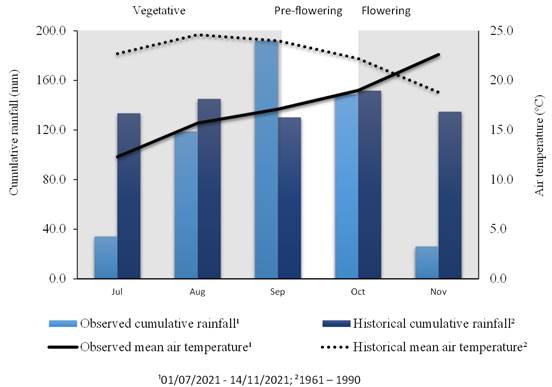
Meteorological data (air temperature and rainfall) were obtained from the UFSM Meteorological Station, located 1.1 km from the experimental area (Figure 1). During the experiment, mean air temperature and cumulative rainfall were 17.3 ºC and 104.0 mm, respectively. Although, these values correspond to reductions of 29.8% in temperature and 33.7% in rainfall compared with historical averages, this climatic variation did not impair forage cultivar development.
Mean air temperature and cumulative rainfall from July 1 to November 14, 2021, and historical averages from 1961 to 1990, in Santa Maria, Rio Grande do Sul, Brazil. Shaded areas indicate the three phenological stages evaluated: vegetative (September 1 - 23), pre-flowering (September 24 - October 21), and flowering (October 22 - November 14).
The 7.2-ha experimental area comprised nine 0.8-ha units in a randomized block design with split plots over time and three replications. The main plots consisted of three ryegrass cultivars: Bolt (diploid), Bill Max (tetraploid), and Selva (tetraploid). Subplots were three phenological stages: vegetative (July 1 - September 23), pre-flowering (September 24 - October 21), and flowering (October 22 - November 14), totaling 137 grazing days. Each replication was the mean number of tillers marked within each experimental unit.
Ryegrass was sown on April 23, 2021, by broadcasting at 25 kg ha-1 for Bolt and 30 kg ha-1 for Bill Max and Selva. Red clover and birdsfoot trefoil were sown in a mixture with the ryegrass cultivars at 6 kg ha-1 each. The legume seeds were inoculated with specific Rhizobium strains, coated with adhesive powder, and treated with calcium carbonate. Based on soil analysis, 217.50 kg ha-1 of NPK fertilizer (13-24-12) was applied at sowing. Liming was not required due to adequate soil acidity levels. Nitrogen topdressing totaled 175 kg ha-1 in three splits, using 27-00-00 fertilizer.
Nine-month-old Braford heifers with initial mean body weight (BW) of 195.0 ± 8.8 kg were used as experimental animals. Pastures were managed under continuous stocking with variable rates, using regulator animals to maintain forage mass between 1200 and 1800 kg DM ha-1 (MOTT, 1984).
Forage mass (FM), expressed as kg ha-1 of dry matter (DM), was estimated using the double sampling technique (WILM et al., 1944), based on 20 visual assessments and five forage cuts performed near ground level. Cut samples were oven-dried at 55 ºC for 72 hours to determine pasture DM content. Botanical and structural composition (leaf blade, stem [leaf sheath + stem], ryegrass inflorescence, dead material, and other species) was quantified by manual separation and expressed as kg DM ha-1. Leaf blade mass (LBM; kg DM ha-1) was derived from this separation. Forage allowance (FA; kg DM ha-1 kg-1 BW ha-1) was calculated according to SOLLENBERGER et al. (2005). Leaf blade allowance (LBA; kg DM ha-1 kg-1 BW ha-1) was calculated using the equation: [(LBY x % leaf blades) - 1100].
Morphogenic and structural traits of the ryegrass cultivars were evaluated using the marked tiller technique (CARRÈRE et al., 1997). In each experimental unit, four representative points were selected. At each point, five ryegrass tillers were marked with colored plastic rings and wooden stakes, totaling 7,200 tillers.
Tillers were monitored every three or four days (twice weekly). Measurements included canopy height, pseudostem height, extended tiller height, and lengths of expanded, expanding, and senescent leaves (all in cm). Expanded leaves were measured from the ligule, and expanding leaves from the ligule of the most recent fully expanded leaf. For senescent leaves, only the green portion of the leaf blade was measured; leaves whose blades were more than 50% senescent were classified as dead. Pseudostem height was the distance from the soil surface to the ligule of the last fully expanded leaf.
Leaf appearance rate (LAR; leaves-1 DD) was the number of leaves produced per tiller divided by the thermal sum accumulated during the evaluation interval. The phyllochron (DD) was the inverse of LAR. Leaf lifespan (LLS; DD) was the product of the average number of green leaves per tiller and the mean phyllochron. Leaf expansion rate (LER; cm-1 DD) was the increase in length of expanding green leaf blades (intact and defoliated). Leaf senescence rate (LSR; cm-1 DD) was the increase in senescent leaf blade length divided by the thermal sum between evaluations, also accounting for intact and defoliated leaves. Thermal sum (TS), expressed as degree-days (DD), was TS = (Tmd - 5 ºC), where Tmd is the mean daily air temperature and 5 ºC is the base temperature for cool-season grass growth.
Statistical analyses used a mixed-effects model with the MIXED procedure in SAS (version 9.2). Ryegrass cultivars, evaluation periods, and their interaction were treated as fixed effects, whereas block and block × cultivar interaction were considered random effects. Block × cultivar interaction was the error term for testing cultivar effects. The Bayesian Information Criterion (BIC) was used to select the best covariance structure for repeated measures over time. Significant fixed effects were compared using Tukey’s test at the 5% significance level, based on least squares means (Lsmeans).
RESULTS
No interaction between cultivar and phenological stage was detected for canopy height (P = 0.7903), forage allowance (P = 0.7332), leaf blade allowance (P = 0.5811), forage mass (P = 0.8695), or leaf blade mass (P = 0.4106). Similarly, none of the morphogenic variables evaluated - phyllochron (P = 0.2538), leaf lifespan (P = 0.5073), leaf appearance rate (P = 0.1842), leaf expansion rate (P = 0.8632), or leaf senescence rate (P = 0.8864) - showed a significant interaction between factors.
Structural characteristics did not differ among cultivars, including canopy height (P = 0.5730), forage allowance (P = 0.4116), forage mass (P = 0.4705), leaf blade allowance (P = 0.2145), and leaf blade mass (P = 0.2102) (Table 1). Likewise, leaf lifespan was similar among cultivars (P = 0.1476; Table 2). By contrast, cultivar effects were observed for several morphogenic traits. Phyllochron (P = 0.0395), leaf appearance rate (0.0100), leaf expansion rate (0.0421), and leaf senescence rate (0.0365) differed significantly among cultivars (Table 2). The tetraploid cultivar Bill Max exhibited a shorter phyllochron than Bolt and Selva, indicating faster leaf appearance. Leaf appearance rate was highest in Bill Max and lowest in Selva, with Bolt showing intermediate values. Bill Max also displayed the highest leaf expansion and senescence rates, whereas Bolt and Selva had the lowest values for both variables.
Phenological stage significantly affected phyllochron (P = 0.0001), as well as leaf appearance (P = 0.0001), expansion (P = 0.0143), and senescence rates (P = 0.0118) (Table 2). Leaf lifespan was not influenced by phenological stage (P = 0.4978). Phyllochron increased progressively across phenological stages, with the lowest values observed during the vegetative stage and the highest at the end of the pasture cycle (Table 2). Conversely, leaf appearance, expansion, and senescence rates followed an inverse trend, with lower values in the vegetative stage and higher values during subsequent stages (Table 2).
DISCUSSION
Continuous stocking effectively maintained forage mass (mean 1427.2 kg DM ha-1) and canopy height (mean 13.6 cm) within ranges that do not restrict animal intake, thereby supporting efficient conversion of forage into animal product, as previously reported (ROMAN et al., 2007; VAZ et al., 2013). In addition, leaf blade mass consistently exceeded 300 kg DM ha-1, a threshold considered adequate to prevent intake limitation in heifers (SILVA et al., 2005).
The progressive increase in phyllochron during later phenological stages indicates a greater requirement for thermal accumulation for leaf appearance, associated with increased pseudostem length and longer distances for leaf elongation within the tiller (LEMAIRE et al., 2008). This response highlights the need for dynamic adjustments in pasture management throughout the growth cycle to maximize the harvest of high-quality forage.
Leaf appearance rate is a key morphogenic parameter in forage grasses (DIFANTE, 2003), since it regulates leaf area development, tiller population density, and the number of leaves per tiller. According to OLIVEIRA et al. (2014), grasses with lower leaf appearance rates are less tolerant of frequent defoliation because leaf removal must occur at a lower rate than leaf appearance to sustain canopy structure. The decline in leaf appearance rate during the pre-flowering and flowering stages across all cultivars reflects a shift in assimilate allocation toward reproductive development, a common physiological response in grasses (DURU & DUCROCQ, 2000).
Among the evaluated cultivars, the tetraploid Bill Max exhibited a shorter phyllochron, along with higher leaf expansion and senescence rates. A shorter phyllochron (106.8 GD) reflects faster leaf appearance, resulting in rapid leaf turnover and enhanced post-defoliation regrowth, traits that may favor its use in stocking systems requiring rapid canopy recovery. The elevated senescence rate observed in this cultivar is consistent with its rapid leaf turnover. Rapid leaf expansion is agronomically advantageous, since it promotes faster canopy closure, reduces soil evaporation, improves water use efficiency (BULTYNCK et al., 2004), and increases competitiveness with weeds through enhanced light interception.
By contrast, the Bolt and Selva cultivars displayed similar morphogenic patterns, with longer phyllochrons and lower leaf expansion and senescence rates. These traits indicate slower growth and a longer leaf lifespan, suggesting better adaptation to management strategies involving less frequent defoliation (SALDANHA et al., 2013). Reduced regrowth capacity in genotypes with long phyllochrons may result from lower photosynthetic efficiency of the remaining leaf area and fewer meristems due to lower tiller density. Consequently, phyllochron emerges as a key trait for guiding cultivar selection and optimizing pasture management under different stocking strategies.
CONCLUSION
This study demonstrated that ryegrass (Lolium multiflorum Lam.) cultivars exhibit distinct morphogenic responses under continuous stocking, where the tetraploid Bill Max presented a 5% shorter phyllochron than the diploid Bolt and tetraploid Selva cultivars, resulting in higher leaf appearance rates and faster post-defoliation recovery. Conversely, Bolt and Selva showed similar patterns characterized by slower growth and longer phyllochrons, indicating lower tolerance to more intensive defoliation and highlighting the need for cultivar-specific management. Ultimately, selecting genotypes with shorter phyllochrons, such as Bill Max, can enhance productivity and sustainability, proving that understanding these morphogenic traits is essential for aligning cultivar selection with specific grazing strategies.
ACKNOWLEDGMENTS
The authors acknowledge the financial and institutional support provided by the Coordenação de Aperfeiçoamento de Pessoal de Nível Superior (CAPES, Finance Code 001), Gentos Brasil and Yara Brasil Fertilizantes.
REFERENCES
-
BULTYNCK, L. et al. From individual leaf elongation to whole shoot leaf area expansion: a comparison of three aegilops and two Triticum species. Annals of Botany, v.94, n.1, p.99-108, 2004. Available from: <Available from: https://doi.org/10.1093/aob/mch110 >. Accessed: Jan. 15, 2025. doi: 10.1093/aob/mch110.
» https://doi.org/10.1093/aob/mch110.» https://doi.org/10.1093/aob/mch110 -
CARRÈRE, P. et al. Tissue turnover within grass-clover mixed swards grazed by sheep. Methodology for calculating growth senescence and intake fluxes. Journal of Applied Ecology, v.34, n.2, p.333-348, 1997. Available from: <https://doi.org/10.2307/2404880>. Accessed: Jan. 15, 2025. doi:10.2307/2404880.
» https://doi.org/Jan. 15, 2025. doi:10.2307/2404880» https://doi.org/10.2307/2404880 -
CASLER, M. D. et al. Cool season grasses for humid areas. In: BARNES R. et al. [Eds.]. Forages The Science of grassland agriculture. Iowa: Blackwell Publishing. v.II, p.211-213, 2007. Available from: <Available from: https://doi.org/10.1002/9781119436669.ch16 >. Accessed: Jan. 15, 2025. doi: 10.1002/9781119436669.ch16.
» https://doi.org/10.1002/9781119436669.ch16.» https://doi.org/10.1002/9781119436669.ch16 - DIFANTE, G. S. Importância da morfogênese no manejo de gramíneas forrageiras. Viçosa: UFV, p.30, 2003.
-
DURU, M.; DUCROCQ, H. Growth and senescence of the successive grass leaves on a tiller. Ontogenic development and effect of temperature. Annals of Botany, v.85, n.5, p.635-643, 2000. Available from: <Available from: https://doi.org/10.1006/anbo.2000.1116 >. Accessed: Jan. 15, 2025. doi: 10.1006/anbo.2000.1116.
» https://doi.org/10.1006/anbo.2000.1116.» https://doi.org/10.1006/anbo.2000.1116 -
GASTAL, F.; LEMAIRE, G. Defoliation, shoot plasticity, sward structure and herbage utilization in pasture: Review of the underlying ecophysiological processes. Agriculture, v.5, n.4, p.1146-1171, 2015. Available from: <Available from: https://www.mdpi.com/2077-0472/5/4/1146 >. Accessed: Jan. 15, 2025. doi: 10.3390/agriculture5041146.
» https://doi.org/10.3390/agriculture5041146.» https://www.mdpi.com/2077-0472/5/4/1146 -
GUO, X. et al. Genomic prediction in tetraploid ryegrass using allele frequencies based on genotyping by sequencing. Frontiers in Plant Science, v.9, p.1165, 2018. Available from: <Available from: https://www.frontiersin.org/journals/plant-science/articles/10.3389/fpls.2018.01165/fu ll>. Accessed: Aug. 05, 2025. doi: 10.3389/fpls.2018.01165.
» https://doi.org/10.3389/fpls.2018.01165.» https://www.frontiersin.org/journals/plant-science/articles/10.3389/fpls.2018.01165/fu -
LEMAIRE, G. et al. Crop species present different qualitative types of response to N deficiency during their vegetative growth. Field Crops Research, v.105, n.3, p.253-265, 2008. Available from: <Available from: https://doi.org/10.1016/j.fcr.2007.10.009 >. Accessed: Jan. 15, 2025. doi: 10.1016/j.fcr.2007.10.009.
» https://doi.org/10.1016/j.fcr.2007.10.009» https://doi.org/10.1016/j.fcr.2007.10.009 -
OLIVEIRA, L. V. et al. Características morfogenéticas de cultivares diploides e tetraploides de azevém (Lolium multiflorum Lam.). Zootecnia Tropical, v.32, n.1, p.45-51, 2014. Available from: <Available from: http://www.scielo.org.ve/pdf/zt/v32n1/art05.pdf >. Accessed: Jan. 15, 2025.
» http://www.scielo.org.ve/pdf/zt/v32n1/art05.pdf -
PEREIRA, R. C. et al. Duplicação cromossômica de gramíneas forrageiras: uma alternativa para programas de melhoramento genético. Ciência Rural, v.42, n.7, p.1278-1285, 2012. Available from: <Available from: https://doi.org/10.1590/S0103-84782012000700023 >. Accessed: Jan. 15, 2025. doi:10.1590/S0103-84782012000700023.
» https://doi.org/10.1590/S0103-84782012000700023» https://doi.org/10.1590/S0103-84782012000700023 -
ROMAN, J. et al. Comportamento ingestivo e desempenho de ovinos em pastagem de azevém anual (Lolium multiflorum Lam.) com diferentes massas de forragem. Revista Brasileira de Zootecnia, v.36, n.4, p.780-788, 2007. Available from: <Available from: https://doi.org/10.1590/S1516-35982007000400005 >. Accessed: Jan 15, 2025. doi: 10.1590/S1516-35982007000400005.
» https://doi.org/10.1590/S1516-35982007000400005.» https://doi.org/10.1590/S1516-35982007000400005 -
SALDANHA, S. et al. Variables morfogenéticas y estruturales de cinco cultivares de Lolium sp. Agrociencia Uruguay, v.17, n.2, p.110-120, 2013. Available from: <Available from: http://www.scielo.edu.uy/pdf/agro/v17n2/v17n2a12.pdf >. Accessed: Jan 15, 2025.
» http://www.scielo.edu.uy/pdf/agro/v17n2/v17n2a12.pdf -
SILVA, M. F. et al. Leaf tissue flows in ryegrass managed under different stocking rates. Acta Scientiarum Animal Sciences, v.37, n.2, p.115-121, 2015. Available from: <Available from: https://doi.org/10.4025/actascianimsci.v37i2.24898 >. Accessed: Jan 15, 2025. doi: 10.4025/actascianimsci.v37i2.24898.
» https://doi.org/10.4025/actascianimsci.v37i2.24898.» https://doi.org/10.4025/actascianimsci.v37i2.24898 -
SILVA, A. C. F. et al. Alternativa de manejo de pastagem hibernal: Níveis de biomassa de lâmina foliar verde. Revista Brasileira de Zootecnia, v.34, n.2, p.472-478, 2005. Available from: <Available from: https://doi.org/10.1590/S1516-35982005000200014 >. Accessed: Jan. 15, 2025. doi: 10.1590/S1516-35982005000200014.
» https://doi.org/10.1590/S1516-35982005000200014.» https://doi.org/10.1590/S1516-35982005000200014 -
SOLLENBERGER, L. E. et al. Reporting forage allowance in grazing experiments. Crop Science, v.45, p.896-900, 2005. Available from: <Available from: https://doi.org/10.2135/cropsci2004.0216 >. Accessed: Jan. 15, 2025. doi: 10.2135/cropsci2004.0216.
» https://doi.org/10.2135/cropsci2004.0216.» https://doi.org/10.2135/cropsci2004.0216 -
TONETTO, C. J. et al. Ganho de peso e características de carcaça de cordeiros terminados em pastagem natural suplementada, pastagem cultivada de azevém (Lolium multiflorum Lam.) e confinamento. Revista Brasileira de Zootecnia, v.33, n.1, p.225-233, 2004. Available from: <Available from: https://doi.org/10.1590/S1516-35982004000100026 >. Accessed: Jan. 15, 2025. doi:10.1590/S1516-35982004000100026.
» https://doi.org/10.1590/S1516-35982004000100026» https://doi.org/10.1590/S1516-35982004000100026 -
VAZ, R. Z. et al. Performance of Braford steers grazing on cultivated pastures and fed or not fed an energy supplement. Revista Brasileira de Zootecnia, v.42, n.2, p.130-136, 2013. Available from: <Available from: https://doi.org/10.1590/S1516-35982013000200008 >. Accessed: Jan. 15, 2025. doi: 10.1590/S1516-35982013000200008.
» https://doi.org/10.1590/S1516-35982013000200008» https://doi.org/10.1590/S1516-35982013000200008 -
WILM, H. G. et al. Estimating forage yield by the double-sampling methods. Journal of American Society of Agronomy, v.36, p.194-203, 1944. Available from: <Available from: https://doi.org/10.2134/agronj1944.00021962003600030003x >. Accessed: Jan. 15, 2025. doi: 10.2134/agronj1944.00021962003600030003x.
» https://doi.org/10.2134/agronj1944.00021962003600030003x.» https://doi.org/10.2134/agronj1944.00021962003600030003x
-
CR-2025-0299.R2
-
BIOETHICS AND BIOSECURITY COMMITTEE APPROVAL
All procedures involving animals were conducted in accordance with established ethical standards. The study protocol was reviewed and approved by the Ethics Committee on the Use of Animals (CEUA) of the Universidade Federal de Santa Maria (protocol no. 8448030821).
-
DATA AVAILABILITY STATEMENT
The data supporting the findings of this study are available from the corresponding author.
-
DECLARATION OF USE OF ARTIFICIAL INTELLIGENCE
The authors declare that no artificial intelligence (AI) tools were to generate the manuscript’s content, including the abstract, keywords, hypotheses, or conclusions.
Edited by
-
ASSOCIATE EDITOR:
Rudi Weiblen (0000-0002-1737-9817)
-
SCIENTIFIC EDITOR:
Denise Baptaglin Montagner (0000-0003-2688-8063)
The data supporting the findings of this study are available from the corresponding author.