
 BRAZIL AND PORTUGAL: AN ANALYSIS OF SOCIAL INCLUSION POLICIES FOR HIGHER EDUCATION
ABSTRACT:
This article examines and analyzes the social inclusion policies in higher education implemented in Brazil and Portugal, based on bibliographic and documentary research. These policies aim to create conditions that enable disadvantaged groups to access, participate in, and successfully complete higher education. The development of these policies has evolved alongside the increasing diversification of the student population entering higher education. The study concludes that the measures implemented in both countries differ significantly. In Brazil, access policies primarily focus on equity, considering socioeconomic background and, more recently, race and ethnicity. In contrast, in Portugal, policies involving some positive discrimination for access to higher education primarily benefit adults already in the labor market, as well as young people from vocational training backgrounds; affirmative actions based on race or ethnicity are yet to be introduced in Portugal. Beyond access, regarding policies aimed at supporting permanence retention, financial assistance is prevalent in both countries.
Keywords:
higher education; affirmative actions; access; permanence; policy
RESUMO:
Este artigo descreve e analisa as políticas de inclusão social ao ensino superior implementadas no Brasil e em Portugal a partir de uma pesquisa bibliográfica e documental. Essas políticas visam promover condições para que grupos mais desfavorecidos possam aceder, frequentar e concluir com sucesso esse grau de ensino. A criação e o desenvolvimento dessas políticas têm evoluído em paralelo à diversificação de públicos que chegam ao ensino superior. Este estudo permite concluir que as medidas implementadas são distintas nos dois países. No caso do acesso, no Brasil predominam iniciativas que buscam a equidade levando em consideração a proveniência socioeconômica e, posteriormente, a cor e a etnia. Já em Portugal, onde ainda não existem ações afirmativas, as medidas que corporizam alguma discriminação positiva no acesso ao ensino superior privilegiam os adultos já inseridos no mercado de trabalho, bem como os jovens provenientes de formações profissionalizantes. Para além do acesso, no caso das políticas que visam apoiar a permanência, em ambos países, os apoios financeiros são mais frequentes.
Palavras-chave:
ensino superior; ações afirmativas; acesso; permanência; políticas
RESUMEN:
Este artículo describe y analiza las políticas de inclusión social en la educación superior implementadas en Brasil y Portugal, basándose en investigaciones bibliográficas y documentales. Estas políticas tienen como objetivo promover condiciones que permitan a los grupos más desfavorecidos acceder, cursar y completar con éxito este nivel educativo. La creación y el desarrollo de estas políticas han evolucionado en paralelo con la diversificación del alumnado que llega a la educación superior. Este estudio permite concluir que las medidas implementadas en ambos países son diferentes. En cuanto al acceso, en Brasil predominan las iniciativas que buscan la equidad, considerando el origen socioeconómico y, posteriormente, el color y la etnia; en Portugal, las medidas que incorporan cierta discriminación positiva en el acceso a la educación superior favorecen a los adultos ya insertos en el mercado laboral, así como a los jóvenes procedentes de la formación profesional; aún no existen acciones afirmativas en Portugal. En cuanto a las políticas que apuntan a apoyar la permanencia, el apoyo financiero es más común en ambos países.
Palabras clave:
educación superior; acciones afirmativas; acceso; permanência; políticas
INTRODUCTION
In recent decades, Portugal and Brazil have experienced significant changes in their higher education systems, as well as in the way for which populations from different regions and social groups enter and remain in this level of education. As higher education systems expand and diversify, enabling broader student access, it becomes urgent to address issues related to the access of students who are socially, culturally, and ethnically minorities, as well as their conditions for success. Public policy actions designated as affirmative action are among the set of measures that aim to promote, in addition to other rights, social inclusion and equity in access to and permanence in higher education.
Social inclusion is a multifaceted concept. It can be understood as the action of providing people who have been and are historically, socially and economically excluded (black people, indigenous people, people with special needs, in situations of social and economic vulnerability, among others) with opportunities and conditions to be incorporated into the society that can enjoy goods and services (Moreira, 2006).
The term “affirmative action” emerged in the second half of the 19th century in the United States of America, in the context of the labor market and in the fight of black people against racism. In Europe, when related to ethnic-racial, religious, or gender issues (the most common), the term “affirmative action” can be considered synonymous with positive action or special measures (Tomei, 2005). However, when the term is related to social issues, it refers to inclusion actions or social action, which are also more common.
Affirmative actions are measures, whether spontaneous or compulsory, public or private, that aim to eliminate discrimination and inequalities that have historically accumulated between social groups and lead to socioeconomic deprivation. They also aim to guarantee equal opportunities and treatment. Affirmative action policies propose a different approach to treating individuals from these groups, aiming to restore them or establish greater equality, which is commonly referred to as equity (Moehlecke, 2004; Tomei, 2005).
The resources and opportunities distributed by affirmative action include, for example, the reservation of places for participation in politics, employment, admission to higher education institutions (HEIs), health services, business opportunities, among others (Feres Júnior et al., 2018). The recipients of affirmative action vary depending on national circumstances, but in general, they relate to racial, ethnic, religious, and gender issues (Tomei, 2005). According to Rawls (2003), one of the goals of affirmative action is to enhance the social and economic mobility of groups marginalized due to historical and material inequalities. Consequently, without a basic level of material support, certain segments of the population would be unable to fully access the rights that are formally guaranteed by law, placing them at a disadvantage compared to others.
In liberal democracies, affirmative action faces criticism primarily from proponents of meritocracy and human equality. Critics often argue that it stigmatizes individuals who would succeed regardless of such policies and contend that the focus should shift from racial criteria to those based on economic need. While economic need (such as income) is a relevant consideration, Feinberg (2000) asserts that this shift in criteria is fundamentally inconsistent. He argues that affirmative action was implemented in response to historical and systemic acts of discrimination against blacks, which have hampered opportunities for all within this group, irrespective of their current economic or social status. It's important to recognize that prioritizing low-income individuals tends to gain more acceptance in society. However, limiting the focus on race as a means of promoting diversity, along with regional factors, type of schooling, and other economic issues, serves to provide racially neutral alternatives that ultimately perpetuate the status quo (Feinberg, 2000; Donahoo, 2008).
This article aims to describe and analyze affirmative actions as well as social inclusion policies in higher education that were implemented in Brazil and Portugal from the late 20th century until 2020. To achieve this, a methodological approach grounded in bibliographic and documentary research is employed. The goal is to identify mutual best practices regarding the implementation of actions that enhance the effectiveness of higher education, ultimately promoting improved access and permanence rates.
After this brief introduction, the text continues with a literature review section on the topic of social actions for inclusion and permanence in higher education. After that, a brief characterization of Brazil and Portugal is carried out from the point of view of their respective socioeconomic and educational characteristics. Next, the evolution of higher education in the countries under analysis and their respective social actions for inclusion are presented, with a summary divided into positive aspects and aspects for reflection on these actions. The text ends with some concluding notes.
INCLUSION AND PERMANENCE IN HIGHER EDUCATION
Higher education systems with high dropout rates are inefficient (Silva, Cabral, Pacheco, 2020). The prospect of having more young individuals attain higher education degrees today offers hope for a future filled with more qualified workers and improved opportunities for social integration and access to the job market. Completing higher education remains a vital pathway to social mobility for those from disadvantaged backgrounds (Dias, Costa, 2015).
Although higher education institutions (HEIs) are located throughout the country and, in general, can receive the vast majority of all those who wish to attend this level of education (the existence of numerus clausus, for example, conditions access to courses and institutions in countries where this practice is in force), not all those who access higher education are in identical circumstances. Furthermore, not all those who could do so access this level of education. In recent decades, both in Brazil and Portugal, the number of students attending and completing higher education has increased significantly (Cerdeira, Araújo, 2021). However, both countries still maintain the objective of increasing the proportion of young people who enter and complete their studies at this level of education.
The enrollment rate for people aged 20 to 24 in higher education2 in 2018 was 29% in Brazil and 38% in Portugal. The Organization for Economic Cooperation and Development (OECD) average was 41% (OECD, 2021). The average higher education completion rate for people aged 25 to 34, also in 2018, was only 21% in Brazil and 35% in Portugal, both below the OECD average of 44% (OECD, 2019a; 2019b). Currently, increased participation in higher education implies diversification (in socioeconomic, ethnic, and racial terms, among others) of the origin of students accessing this education subsystem (Kottmann et al., 2019).
Various personal, familial, and contextual factors influence access to higher education. Contextual factors include the level of development and economic growth, demographic trends, success rates in completing compulsory education, the duration of mandatory schooling, the availability and distribution of higher education institutions (HEIs) across countries, and government spending on education, particularly in higher education (Oliveira; Vieira; Vieira, 2012). Each of these factors is positively associated with access to higher education. In terms of personal and family-related factors, considerations include the socioeconomic constraints faced by families, the educational backgrounds of family members, and the expectations regarding the future benefits of pursuing higher education.
Many studies have revealed that most higher education students in the countries analyzed in this article belong to the dominant group in terms of social, economic, and ethnic backgrounds. Higher education access systems contribute to the persistence of inequalities, as they use previous educational paths as admission factors, which, in turn, are already conditioned by the differences between students (Kottmann et al., 2019).
Once access to higher education has been granted, the next, even more important step is to ensure that students complete their respective degrees within the number of years scheduled for the courses. The issue of dropping out of higher education has been widely discussed in recent years3, as it is a phenomenon with negative repercussions for students and higher education institutions (HEIs), with significant financial implications due to the high investment made by families and the State. Students who drop out of higher education do so for a variety of reasons, which will be discussed below. In many cases, this process leaves its mark, such as on self-esteem, for example, and on the possibility of completing higher education.
Among the main determinants of dropping out of higher education are factors of an individual and institutional nature. Among the individual aspects, the following stand out: lack of information about the course at the time of choosing it; reasons related to illnesses of family members or the students themselves; motivation; financial problems; the need to start working or the birth of children; the fact that the course does not meet expectations; and difficulties in adapting, relating to colleagues or teachers and accessing the institution. From an institutional perspective, aspects such as curricular rigidity stand out, as well as the lack of student assistance policies and financing programs (Tinto, 1993; Castro-Lopez et al., 2021).
Therefore, the existence of student support programs in HEIs, particularly in the first year of the course, to prevent and respond to difficulties of an academic, social, or emotional nature, proves to be an important instrument against dropout (García-Ros et al., 2018). These measures must also be accompanied by others, such as financial support (Clark, Nascimento, Moura Junior, 2020), which, although not sufficient, are necessary for students to remain in higher education (Scher, Oliveira, 2020). Since the problem of dropout is multifaceted, responses must also have this character and seek to meet the diversity of characteristics and needs of students at this level of education.
PORTRAIT OF SOCIOECONOMIC AND EDUCATIONAL INDICATORS IN BRAZIL AND PORTUGAL
Brazil is recognized as a country of continental dimensions, with approximately 8,514,876 square kilometers of territorial area, the largest in South America. Portugal has an area of 92,389 square kilometers, ranking 17th in the European Union in terms of territorial area. In relative terms, Portugal represents 1.09% of the Brazilian area.
Despite their territorial differences, Brazil and Portugal share a history that has intersected at numerous points throughout their economic and social development, beginning over five centuries ago when the first Portuguese settlers arrived in Brazil to exploit its vast natural resources. This historical connection extends beyond the realm of the Portuguese-speaking world and was further solidified in 1822, when Brazil declared its independence. It is important to note that Portugal has an older historical narrative, having achieved political autonomy in 1179.
In terms of population, Brazil is home to 203.1 million inhabitants (IBGE, 2023), a figure that is approximately 20 times greater than that of Portugal, which accounts for roughly 4.8% of Brazil's population. Notably, around 54% of the Brazilian population identifies as black, and among those enrolled in both in-person and distance learning undergraduate programs, 30.6% are black. In contrast, Portugal does not gather direct data on the racial composition of its population in its censuses, which complicates the analyses. Before the 2021 census, a working group was established to assess the potential inclusion of an ethnic-racial question in these studies. Although there was a consensus in favor of introducing this criterion, concerns regarding the risk of exacerbating discrimination against the Roma population led the National Institute of Statistics of Portugal (INE) to ultimately refrain from including the question at this time. Instead, pilot questionnaires on racial origins have been conducted.
Despite the lack of primary information on the ethnic-racial issue in Portugal, there is strong academic and political interest in access to higher education, particularly for people of African descent and the Roma population, as demonstrated in studies and monitoring work carried out with these people. Roldão et al. (2016), by combining several secondary sources of information, show that between 1991 and 2001, the rate of access to higher education for people of African descent increased, but in 2011, there was a decrease. In the case of Roma, the Roma Community Observatory has been monitoring the educational conditions of this population. Pereira, Milagre, and Cruz (2022) point out that, despite a pattern of school retention and dropout among Roma students, their performance has improved since 2010, even though they represent a very small number in Portuguese secondary and higher education.
The difference in relative population size does not remain the same when analyzing the total Gross Domestic Product (GDP) of each country: Brazil's GDP is 10.1 times larger than Portugal's, or 9.9% in relative terms. In its relative capacity to generate GDP, Portugal stands out even more: the Portugal’s per capita GDP is twice that of Brazil - USD 28,687.0 in Portugal and USD 14,283.0 in Brazil (IBGE, 2021; INE, 2021; United Nations Development Program [UNDPϡ, 2021).
One notable distinction between Brazil and Portugal is the percentage of the population living in urban areas, which stood at 86.6% in Brazil in 2018, compared to just 65.2% in Portugal. Additionally, life expectancy in Portugal exceeded that of Brazil by 6.2 years. Portugal also boasts a higher Human Development Index (HDI), classified as very high and ranking 40th globally, while Brazil, despite having a high HDI, ranks 79th. In terms of social indicators, Brazil faces challenges, including a higher infant mortality rate of 11.5 per 1,000 live births, compared to just 2.4 in Portugal. Furthermore, Brazil has a greater income inequality, with a Gini Index of 53.3, whereas Portugal's Gini Index is considerably lower at 35.5. Collectively, these indicators reflect a superior quality of life and greater social cohesion in Portugal, alongside fewer social disparities when compared to Brazil (IBGE, 2021; INE, 2021; PNUD, 2021).
In terms of educational investment, Brazil allocated a higher proportion of its GDP in 2018, approximately 6.2%, compared to Portugal's 4.9%. However, Portugal boasts a higher average number of years of education within its population, at 16.5 years, along with a greater expected years of schooling at 9.3 years, compared to Brazil’s 15.4 and 8.0 years, respectively. The gap between expected and average years of education is more pronounced in Brazil, standing at 7.4 years, whereas Portugal shows a difference of 7.2 years (UNDP, 2021).
Regarding higher education, Portugal has a higher proportion of its population enrolled (64% compared to 51% in Brazil). However, in 2019, Brazil still had a higher proportion of the population aged 25 or over with at least secondary education (60.4% compared to 54.3% in Portugal). The qualification of the population is a determining factor for the development of countries and, consequently, for improving the quality of life of the population (UNDP, 2021).
It is essential to note that the political emancipation of countries took place in significantly different periods, which in turn influenced the establishment of their first universities. For instance, Portugal initiated higher education as early as 1290 with the founding of the University of Coimbra. In contrast, Brazil did not offer such educational opportunities until 1808, and it wasn't until 1913 that the first Brazilian university, the Federal University of Paraná (UFPR), was established (Amorim; Santos; Novaes, 2018; Ferreira, 2019; General Directorate of Education and Science Statistics [DGEECϡ, 2021).
Portugal is part of the European Union with 27 independent member states, and, in this sense, it also has standards imposed on higher education based on European regulations, in addition to those established by its Ministry of Education, Science, and Innovation. In the Brazilian case, the Ministry of Education (MEC) is responsible for the policies and regulations of its higher education (BRASIL, 1996; BRASIL, 2017b; DGEEC, 2021).
When analyzing the forms of access/entry to higher education, there are also differences between countries. In Brazil, there are three forms of admission, the entrance exam, the National High School Exam (Enem) score, and the Unified Selection System (Sisu), which also uses the Enem score (Brazil, 1996). In the Portuguese case, there is the National Access Exam (CNA), through which the vast majority of students gain access, in addition to several other specific possibilities for certain social profiles (DGEEC, 2021).
In terms of administrative categories, Portugal has both public and private higher education, like Brazil. However, in the case of Brazil, the public education system is subdivided into municipal, state, and federal, reflecting the country's own administrative structure and territorial dimension. Another difference is that while in Brazil, higher education students at public institutions have free education, in Portugal, regardless of the institutional sphere, education is paid for, via monthly fees: in public higher education, the annual payment is the same in all institutions and for all courses, in the first cycle of training, unlike what happens in private institutions.
Since 2021, the annual tuition fee for first-cycle education in Portuguese higher education has been set at 697 euros, compared to a maximum of 871 euros in previous years. In 2021, the minimum monthly wage was 665 euros, which increased to 820 euros by 2024. Currently, the annual tuition fee at the public higher education level is lower than the monthly minimum wage. However, accommodation and living expenses for out-of-town students exceed this amount. In contrast, private institutions charge tuition fees ranging from 400 to 1,600 euros per month for first-cycle programs, depending on the course and institution. For master's programs in public education, tuition fees—known as "propinas" in Portugal—can vary significantly, costing between 697 and approximately 15,000 euros for a year and a half of study.
Regarding the types of HEIs, there are two in Portugal: universities and polytechnic institutes. In Brazil, there is a greater diversity: universities, colleges, university centers, and federal institutes. This diversity is also seen in the types of higher education and postgraduate courses (Brazil, 1996; DGEEC, 2021).
Considering the differences between the two countries, it is also worth analyzing the statistics on higher education in each of them. Chart 1 presents this information.

One notable difference between higher education in Brazil and Portugal is the distribution of institutions and student enrollments among public and private higher education institutions (HEIs). In Portugal, the landscape is predominantly composed of public HEIs, which account for 64.8% of institutions and 81.6% of enrollments. Conversely, Brazil showcases a predominance of private HEIs, comprising 88.4% of institutions and 75.8% of enrollments. When examining the mode of instruction, face-to-face teaching is prominent in both countries; in Portugal, it constitutes nearly all educational formats, while in Brazil, it represents approximately 71.5% (INEP, 2019; INE, 2021).
Portugal has a higher percentage of teachers with doctorates in its higher education system, at 60%, while in Brazil this proportion is 45.85%. Portugal also stands out in other data: lower ratio of in-person students to teachers (10.9 versus 15.9 in Brazil); higher number of public HEIs per million inhabitants (17.8 versus 1.44 in Brazil); higher proportion of students in HEIs concerning the total number of students (19.2% versus 14.96% in Brazil); and, finally, it has a more balanced proportion of women in higher education (54.1% versus 57.4% in Brazil) (INEP (2019); INE (2021); Pordata (2021); DGEEC (2021).
Based on the information presented, it is possible to verify that there are differences in the structure and regulation of higher education between the two countries analyzed. Portugal demonstrates superior socioeconomic indicators and income distribution, but without free higher education. On the other hand, the largest proportion of places in HEIs in Brazil are in private education, which is not free. It is important to emphasize that this occurs in a country with a greater concentration of income, greater distance between locations due to its continental size and, in some way, with greater justification for the existence of affirmative action policies for higher education, as will be detailed in the next section.
HISTORICAL OVERVIEW OF AFFIRMATIVE ACTIONS IN BRAZIL AND PORTUGAL
Social inclusion and affirmative action policies in Brazil
Until the mid-1960s, there was a relative equilibrium between the supply of public and private education in Brazil, in terms of the number of institutions and enrollments. However, from that point onward, private higher education began to take a dominant position. Starting in 1990, Brazil witnessed a significant expansion in the availability of places, institutions, and courses, initiating the massification of higher education. This growth, primarily driven by the private sector, also extended to distance learning and regions with notable demand, including the interior of the country and the Central-West, North, and Northeast regions (Moreira et al., 2017; Cislagui, 2019).
This expansion, combined with the difficulty in filling vacancies due to a university population whose income did not allow them to cover the costs of tuition fees, combined with the high competition for vacancies in public education, led to serious problems in private higher education in access and permanence. Initiatives implemented by the federal government, such as the Financing for Higher Education Students (Fies) and the University for All Program (Prouni) emerged to overcome these adversities (Feres Júnior et al., 2018).
Regarding Brazilian public higher education, in general, it presents the combination of three factors: free education, scarcity of places (despite advances, only 5% of all new places available in 2019 were public), and better quality of education compared to private education (contrary to the scenario of secondary education). As a result, competition for places is greater in public education, which demands well-prepared students, who historically come, in large part, from private secondary education. This fact, combined with the elitist history and existing racial and social discrimination, also demanded some actions to guarantee access to public education for more vulnerable groups (INEP, 2019; Sadocco et al., 2021).
In addition to Fies and Prouni, social inclusion actions in Brazilian higher education include the quota program, that is, the reservation of places in favor of individuals from a specific group that is discriminated against and underrepresented (considered affirmative action), student assistance, and other measures to expand access and retention (Moreira et al., 2017; Wainer; Melguizo, 2018). Figure 1 shows evidence of the main social inclusion actions in Brazilian higher education, in force since the end of the 1970s.
Fies, Prouni and the Federal University Restructuring and Expansion Plan (Reuni-Plano de Reestruturação e Expansão das Universidade Federais) are policies to expand the supply of places, and together with scholarships and the quota law (affirmative action), they aim to democratize higher education. It is worth remembering that the student financing program has existed since the mid-1970s in Brazil. The Educational Credit Program (Creduc-Programa de Crédito Educativo) was replaced by Fies in 1999, due to the high level of default, among other reasons (Neves; Bandeira; Farenzena, 2019).
Fies has undergone several phases. Its core purpose is to provide financing for students enrolled in non-free higher education courses. Until 2010, its operations were relatively modest, with approximately 76,000 contracts in that year. However, it experienced significant growth, thereafter, reaching around 730,000 new contracts granted by 2015 (Brasil, 2017a). Created in 2005, Prouni aims to enhance access to and permanence in private higher education, prioritizing the allocation of scholarships to the most vulnerable social groups (Feres Júnior et al., 2018).

Evidence of social inclusion actions and affirmative action policies in Brazilian higher education
Prouni's purpose is to grant full and partial scholarships (50% or 25% of the tuition fee may be subsidized) at private HEIs, thus ensuring that students do not have to pay tuition fees or pay a reduced amount. Private HEIs have minimum targets for granting scholarships and, in return, are exempt from certain taxes and contributions, such as income tax (Brazil, 2005). In 2019, there were 515,535 students with full Prouni scholarships and 188,433 with partial scholarships, figures that corresponded to 10.8% of students enrolled in private HEIs, in on-site or distance learning courses. Throughout its history, the program has benefited more than 2.5 million students (INEP, 2019).
The inclusion of the racial issue in the public debate on higher education effectively took place in 2000, when Brazil was recognized as a racist country and participated in the Durban Conference, where measures that could promote greater racial equality were discussed (Feres Júnior et al., 2018; Barbosa, 2019). Until then, the idea of racial democracy prevailed in Brazil, which created an illusion that racism did not exist in the country (Costa, Müeller, 2019).
The first measures to reserve places (affirmative action) in the higher education system date back to 2000, at the State University of Rio de Janeiro (UERJ). Initially, the measures to determine their beneficiaries were implemented individually in the states with a great diversity of social and racial criteria. They soon spread and are currently the main measures at the federal level (Feres Júnior et al., 2018; Sadocco et al., 2021).
In 2012, after 13 years of deliberation, the national law for the reservation of educational placements was enacted, allowing four years for all educational institutions to comply. Law No. 12,711 mandates that 50% of positions in federal higher education institutions and federal technical institutes are reserved for students from public schools. Of this quota, 50% is designated for students whose per capita family income is at or below 1.5 minimum wages, while the remaining spots are allocated for those with a per capita income above 1.5 minimum wages. These placements, which are proportionate to the demographics of black, mixed-race, and indigenous populations in each state, are reserved for students who identify as black, mixed-race, or indigenous (Brazil, 2012a). In 2016, the law was expanded to include students with disabilities (Brazil, 2016). Therefore, while the quota policy is often simplified to focus on racial criteria, its primary aim is to support students from public schools and those from low-income backgrounds (Feres Júnior et al., 2018).
The Reuni Program was another program created in 2007 and in force until 2012, considered essential for the massification of the system and for increasing the inclusion of people in socially vulnerable situations in Brazilian public higher education. It was created to expand access and permanence in federal public education, and some of its actions were the geographic expansion of universities beyond large centers through the creation of new universities, mainly in less developed and border regions; the improvement of infrastructure; and the expansion of places in the evening period and distance learning (Melo et al., 2020). The presence of public HEIs only in large centers also represented a form of territorial exclusion, due to Brazil's continental dimensions (Moreira et al., 2017).
The expansion of federal public higher education, with Reuni, the quota policy, and the implementation of unified selection systems (Enem and Sisu), among others, contributed to the entry of students who had difficulty remaining in higher education. Thus, there was a greater demand for programs that help students complete their educational paths (Oliveira et al., 2020).
Created in 2007 and regulated in 2010, the National Student Assistance Program (PNAES) also emerged in the context of the expansion and democratization of federal higher education, focusing mainly on ensuring student retention (Brasil, 2010a; Oliveira et al., 2020). Student assistance actions in Brazil are provided in the areas of student housing, food (university restaurants), transportation, health care, digital inclusion, daycare, pedagogical support, among others (Brasil, 2010a).
Thus, actions to ensure student permanence include not only financial aid to students, but also any action (program, project) that can benefit them in their university careers and prevent dropout. Examples include integration and socialization into the university context, incentives for research, and participation in extension activities (Freitag, 2014). Some programs that also offer financial aid are permanence and extension grants. Regulated since 2010, they are aimed at promoting access and preventing dropout of students in conditions of economic and social vulnerability, in addition to expanding and strengthening the interaction of HEIs with society (Brasil, 2010b).
Several other programs facilitate permanence that distribute scholarships for research and extension, and that operate outside the federal public sphere, being linked to the National Council for Scientific and Technological Development (CNPq-Conselho Nacional de Desenvolvimento Científico e Tecnológico) and the Coordination for the Improvement of Higher Education Personnel (Capes-Coordenação de Aperfeiçoamento de Pessoal de Nível Superior) (Freitag, 2014). There are also some scholarships linked to Prouni that help permanence, being awarded to students in private higher education.
Social inclusion policies in Portugal
In Portugal, the first universities appeared in 1290, in Coimbra, and 1559, in Évora. With the expulsion of the Jesuits from Portugal, the University of Évora was closed in 1759 and until the beginning of the 20th century, the University of Coimbra was the only university in the country. Although there were higher education institutions in Lisbon and Porto, it was only in 1911 that the Universities of Lisbon and Porto were founded (Ferreira, 2019).
The establishment of universities and polytechnic institutes outside major urban centers commenced in 1973 with the Veiga Simão Reform in Portugal. The transformation of the political regime following the Revolution of 25 April 1974 accelerated the process of massification and diversification of Portuguese higher education that had been initiated earlier. The inclusion of individuals with historically lower participation in higher education was ideologically reflected in the Constitution of the Portuguese Republic of 1976, specifically in Article 76, which stated: “[...ϡ access to University must take into account the country's need for qualified personnel and encourage and favor the entry of workers and the children of the working classes” (Portugal, 1976). In 1989, during the third constitutional revision, the explicit mention of the working classes was removed from the Constitution; however, the commitment to promote access to university education for children of the working classes was never legislated. With the 1989 revision, equal opportunities and the democratization of the education system were assured (Portugal, 1989).
After the 25th of April 1974, the excess demand for higher education compared to supply meant that education policies did not incorporate positive discrimination measures, but rather created more measures to control demand at public universities. The forms of control adopted, such as the numerus clausus, the introduction of an additional academic year for those wishing to enter higher education, and the existence of national exams, managed to control demand. This control, in addition to causing many candidates to leave the system, also contributed to the expansion of the supply of private education, which enabled the accommodation of candidates who were not accepted at public universities. In short, the process of entering public higher education was characterized by strong competition, and the system's mission was to recognize the best candidates.
The democratization of Portuguese higher education post-1974 resulted in a significant increase in student enrollment, including individuals from economically disadvantaged backgrounds. This surge in student numbers was met with enhanced social action initiatives implemented by the first constitutional governments (Barrias, 2015). Following these efforts, and despite some variability and substantial disparities among universities, the first legislative framework concerning social action in higher education was established in 1980. This legislation aimed to harmonize and standardize the support provided to students in need (Portugal, 1980). Figure 2 illustrates the various social inclusion initiatives in Portugal's higher education sector.

From 1986 onwards (Figure 2), with the Basic Law of the Education System, number 46/1986 (Portugal, 1986), the phenomenon of massification of Portuguese higher education deepened. On the one hand, the creation of new HEIs, more geographically distributed throughout the territory, brought more equity and democracy to access to higher education. On the other hand, massification required more support for students. Thus, social support measures became more diversified, and among them were: meal subsidies, canteen services, accommodation, and the granting of scholarships (Barrias, 2015). However, the need for more student support and the inability of social action resources led to the reformulation of their functioning, in response to the update of the value of tuition fees and university autonomy. Thus, Decree-Law No. 129 of 1993 replaced all current legislation and extended social action to private higher education (Portugal, 1993).
According to statistical information from Pordata, a statistical database on Portugal, expenditure on scholarships in Portuguese higher education (direct social action expenditure) has shown strong growth since 1990, with expenditure amounting to 6,814,826 euros in 1990, 27,402,185 euros in 1995, and 118,853,752 euros in 2021. In the early 1990s, higher education scholarships were almost exclusively intended for students in public higher education. However, with the expansion of social action to private education, the growth of private higher education and the entry of students with fewer financial resources, the granting of scholarships to students in private higher education began to be included in the scholarships awarded, reaching 30% of the total amount of scholarships awarded to all higher education. In recent years, the amount of grants for private higher education has been around 13%. However, during the financial crisis that hit Portugal, the value was less than 10%, and since 2018, it has progressively increased.
From 2006 onwards, the minimum wage ceased to be the indicator for social support and higher education grants, as the Social Support Index (IAS-Indexador dos Apoios Sociais) was created as a reference for calculating and updating support. The IAS is based on the value of the guaranteed minimum monthly salary, updated by the Consumer Price Index and real GDP growth. For a 1st cycle higher education student to be eligible for a grant, the annual gross per capita family income must be less than 18 times the IAS plus the value of the maximum monthly payment set annually. Furthermore, cumulatively bank accounts and financial investments cannot be higher than 240 times the IAS, and real estate assets have a limit of 600 times the IAS.
In addition to the grants students are entitled to if they meet the eligibility criteria, there is extraordinary housing support for displaced students who are not entitled to them (Portugal, 2023a). Regarding expenses related to food, housing, and other indirect support - the so-called social action expenses - public higher education has not shown sustained growth, fluctuating around 80 million euros from 2012 to 2021.
The significance of higher education in the job market is increasingly recognized, paralleling the urgent need for qualified human resources capable of handling complex tasks in emerging production models (Castro, Seixas, Neto, 2010). In response, Portugal has integrated a range of measures into its higher education legislation to facilitate more comprehensive and inclusive access to higher education. This initiative has been shaped by several factors: i) policies promoted by various international organizations advocating for lifelong learning and education for all; ii) the context of Portugal, which shows a lower percentage of the workforce with higher education compared to the European Union average; iii) the reduced involvement of youth pursuing vocational or artistic education pathways in higher education; and iv) the limited representation of individuals with disabilities in higher education (OECD, 2019c). The measures implemented include:
-
access to higher education for adults over 23 years of age, who did not have a secondary education or equivalent, through a test that certifies the ability to attend higher education (Portugal, 2006);
-
creation of Specialized Higher Technical Courses (CTeSP-Cursos Técnicos Superior Especializado), which do not confer an academic degree, but a diploma, more aimed at young people coming from more professional training (Portugal, 2014);
-
priority for students with disabilities in the occupation of places in CTeSP, in up to 4% of places and at least 2 places (Portugal, 2018);
-
access, for students coming from professional training pathways, to bachelor's and master's degrees through entrance exams directly at the HEIs and not only through the CNA (Portugal, 2020).
Public higher education policies in Portugal have been developing towards greater integration of new audiences. The review of legislative standards for access to public higher education has promoted equity and increased the representation of vulnerable and underrepresented groups in the higher education system (Portugal, 2023b).
In the CNA Regulation for the 2023/2024 academic year, places were defined for specific groups, identified as types of priority contingents. According to article 10 of Ordinance 104/2023 (Portugal, 2023b), the priority contingents include candidates from the regions of Madeira and the Azores, candidates with disabilities and candidates who are beneficiaries of school action (belonging to low-income groups), with the percentage of places being 3.5%, 4% and 2%, respectively. This reservation of places represents an important step towards the inclusion of candidates who have greater difficulty in accessing higher education. However, Portugal has not yet established affirmative action in higher education (racial, gender, or racial quotas) because it focuses its inclusion programs on social and demographic criteria. Likewise, the country also does not include race, ethnicity, or gender criteria in social inclusion actions. This is a trend in Europe as a whole, since affirmative action is still unpopular due to the aforementioned arguments about liberal democracy and the principle of merit. In addition, Lombardo, Kantola, and Rubio-Marin (2021) point out another reason: the growth, in recent years, of far-right parties, which have explicit ideals against gender equality, anti-feminist, among others.
Positive aspects and “food for thought” regarding social inclusion actions and affirmative actions
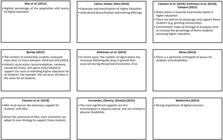
In Figures 3,4,5,6,7,8, to 9, after a review of the literature, some positive aspects and some points for reflection are highlighted regarding social inclusion and affirmative action policies for Brazilian and Portuguese higher education.

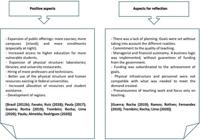
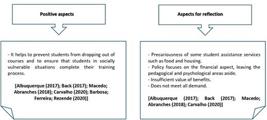
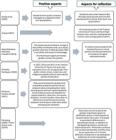
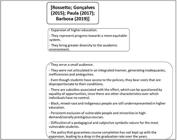
- Positive aspects and aspects for reflection regarding the inclusion action as a whole (Brazil)
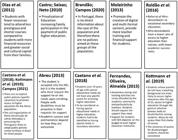
Since the 1970s, Portuguese higher education has increasingly included students from economically disadvantaged and less educated families. There has been a “democratization of access to higher education” (Dias et al., 2011), evidenced by the strong growth in the number of students enrolled in higher education, the increase in the number of public and private educational establishments, and their distribution across all regions of the country.
Despite the relative growth seen in recent decades, Portugal continues to have a percentage of people with higher education, compared to the total population, that is lower than the European Union average. According to Kottmann et al. (2019), the country has problems that are evident in the low participation in higher education, and which are also related to the education of the students’ parents. Thus, if the parents have higher education, their children are more likely to enter this stage of education, and at an earlier age. Access to higher education, and to more prestigious courses, is also influenced by students' economic conditions and the possibility of them having access to support outside of school, such as private tutoring or even attending quality private education during compulsory education.
Due to the lack of equity in access conditions, policymakers have increasingly taken legislative measures to promote access for new audiences. In the latest amendment to the legislation on access to Portuguese higher education (Ordinance 2023b), one of the main objectives presented was to increase the representation of vulnerable (especially economically) and underrepresented groups.
Nonetheless, after evaluating both the positive aspects and areas needing further reflection, it is clear that some measures still require further study and adaptation to fit specific contexts. Access to higher education needs to be coupled with initiatives that foster permanence and academic success, recognizing that a diverse student body necessitates enhanced monitoring and evaluation of these measures.
Additionally, as illustrated in Figures 3 4,5,6, to 7, despite various programs aimed at expansion and inclusion, we cannot yet claim full democratization of higher education in Brazil. The increase in educational supply has not translated into effective inclusion of lower-income groups, particularly in high-demand fields such as medicine and dentistry, which offer significant opportunities for social mobility. Moreover, the nation's expansion model is heavily oriented towards the private sector, resulting in adverse effects on the public system, notably evident in the unequal distribution of resources favoring private institutions. The most vulnerable populations remain underrepresented in higher education, while student support services fall short of meeting demand and existing services are often inadequate. This situation contributes to high dropout rates and negatively impacts student performance.
FINAL CONSIDERATIONS
Despite the differences in scale between Portugal and Brazil, both countries have followed a path with common objectives in recent decades regarding the development of higher education. In both cases, this education system began as an elitist system, concentrated in the main cities (capitals and/or other larger cities). With the extension of compulsory education and the improvement in the living conditions of the middle classes, the number of students applying for higher education has increased. At the same time, these higher education systems have expanded and diversified, beginning to reach new audiences and new regions. Some authors even consider that we can speak of the “democratization” of the system.
The paths taken to expand higher education systems in these countries were different. In Brazil (a country with greater income inequality and lower socioeconomic indicators than Portugal), despite the arrival of public education in several states, the expansion of the system was carried out mainly through the supply created by private institutions. This is contradictory, given the great disparity in income and socioeconomic conditions of its population. In Portugal, the increase in supply was based on public institutions.
With the massification of higher education, in addition to access conditions, it is essential to ensure that students from different cultural, social, regional, ethnic, and other backgrounds have the conditions to be successful in their respective academic paths. In this sense, implementing social inclusion actions, both to facilitate access and ensure permanence, is crucial for increasing the number of students who decide to continue higher education, and creating conditions that ensure success and completion of the course in the expected years.
In terms of social inclusion actions in higher education, in the case of Brazil, the measures prioritize equal access for different social and ethnic groups, with measures primarily for low-income students from public secondary schools and, subsequently, students who meet racial criteria. In the case of Portugal, the measures of differentiation and inclusion are for adults who are already integrated into the labor market, as well as young people who have completed vocational schooling. More recently, actions to include economically vulnerable individuals and people with disabilities have been implemented. In the case of policies aimed at continuing in higher education, the measures adopted in both countries generally involve financial support for students' stay.
For social inclusion initiatives to be effective in ensuring broader access to higher education for all interested individuals and promoting success at this level of education, it is essential to have well-established structures within higher education institutions (HEIs). These initiatives must also be validated by the agencies and ministries that govern higher education. While the success of these actions relies on legislative measures enacted by the state, it is the effective implementation and operationalization of these measures within HEIs that can truly foster inclusion for all. Therefore, it is crucial for regulatory authorities to issue standards that are incorporated into the accreditation processes for training programs and institutions, demonstrating their commitment to the vital goal of inclusion. The responsibility for promoting inclusion should not rest solely on the goodwill of HEIs or the increasingly limited resources available to them. Instead, it is imperative for the state to legislate on this matter and to identify economic and financial incentives that encourage all stakeholders to commit to facilitating access to and permanence in higher education for these students.
The growing importance of human resource qualifications for the knowledge society is not compatible with the exclusion of citizens from higher education, since the economic development of countries depends on the training of their citizens to participate in new forms of production and consumption, as well as on the ability to use digital media to exercise their citizenship. Thus, whether for the economic development or for the principles of justice and equity, higher education policies in Brazil and Portugal must continue to deepen social inclusion action measures, as well as affirmative action. This should occur through increasing the coverage of financial support for students to remain in higher education, and by offering pedagogical resources suited to the profiles of students with the greatest difficulties. Furthermore, given the underrepresentation of the most vulnerable in more prestigious courses in Brazil and Portugal, measures should be taken to allow more people from this group to access these courses.
On the other hand, the comparison made here also allows us to identify successful measures applied in one of the countries as being capable of being introduced in the other. For example, in Portugal, there are no quotas for access by ethnic groups or statistical information on ethnicity. In Brazil, the existence of information on ethnic groups and the existence of access quotas for them, given the positive discrimination practiced, has led to greater access by these groups to higher education. Another example is the legislation on access by older students in Portugal, which allows working students to enter higher education through a special competition. In Brazil, if a measure of this type existed, it could include people of a different age than the one considered most common for entry into higher education. It is also worth remembering the need for measures not only of an economic nature, but also of an educational and psychological nature for these groups.
Inclusion and affirmative action policies in higher education are becoming increasingly prominent. The threats posed by countries potentially losing their competitiveness in the knowledge economy, along with the growing income disparity among populations and the associated social cohesion issues, serve as compelling motivations for states to actively pursue affirmative action initiatives in higher education. Despite evidence of social action policies in both Portugal and Brazil, it can be argued that the democratization of higher education remains incomplete, particularly in Brazil. Both nations face significant challenges in ensuring access to and permanence in this level of education for their populations.
References
-
ABREU, Suzete Micaela Velosa Aleixo. Alunos com necessidades educativas especiais: Estudo exploratório sobre a inclusão no ensino superior. Dissertação (Mestrado em Psicologia da Educação). Funchal: Universidade da Madeira, 2013. Disponível em:<https://www.proquest.com/openview/f624ee5d971aaf947e264832806744f7/1?pq-origsite=gscholar&cbl=2026366&diss=y>. Acesso em:02/08/2023.
» https://www.proquest.com/openview/f624ee5d971aaf947e264832806744f7/1?pq-origsite=gscholar&cbl=2026366&diss=y -
ALBUQUERQUE, Larissa Cacalvanti de. Assistência estudantil como política de permanência na UFPB Dissertação (Mestrado em Educação). João Pessoa: Universidade Federal da Paraíba, 2017. Disponível em: <Disponível em: https://repositorio.ufpb.br/jspui/handle/tede/9919 >. Acesso em:02/08/2023.
» https://repositorio.ufpb.br/jspui/handle/tede/9919 -
ALMEIDA, Felipe Miranda de Souza; RODRIGUES, Cristina Tristão. Avaliação da política de cotas na Universidade Federal de Viçosa. Planejamento e Políticas Públicas, n. 53, p. 357-379, 2020. Disponível em:<Disponível em:https://www.ipea.gov.br/ppp/index.php/PPP/article/view/868 >. Acesso em:02/08/2023.
» https://www.ipea.gov.br/ppp/index.php/PPP/article/view/868 -
ALVES, Danúbia Fernandes. O impacto do Financiamento Estudantil - FIES nas metas 12 e 20 do Plano Nacional de Educação (2014-2024) Dissertação (Mestrado em Educação). Brasília: Universidade de Brasília, 2019. Disponível em:<Disponível em:https://repositorio.unb.br/handle/10482/38259 >. Acesso em:02/08/2023.
» https://repositorio.unb.br/handle/10482/38259 -
ALVES SANTANA, Luciana Alaíde; MEIRELES, Everson; CARVALHO, José Jorge de. Acesso às instituições federais de ensino superior brasileiras após a lei de cotas. Revista da FAEEBA -Educação e Contemporaneidade, v. 28, n. 55, p. 127-141, 2019. Disponível em: <Disponível em: http://educa.fcc.org.br/scielo.php?pid=S0104-70432019000200127&script=sci_arttext >. Acesso em:02/08/2023.
» http://educa.fcc.org.br/scielo.php?pid=S0104-70432019000200127&script=sci_arttext -
AMORIM, Priscilla Azevedo de; SANTOS, José Deribaldo Gomes dos; NOVAES, Marcos Adriano Barbosa de. Ensino Superior Brasileiro: notas sobre a origem e expansão. Universidade e Sociedade, n. 61, p. 156-165, 2018. Disponível em: <Disponível em: https://www.andes.org.br/img/midias/b2453145c8eb30241febcefe5e2f9729_1548264765.pdf >. Acesso em:02/08/2023.
» https://www.andes.org.br/img/midias/b2453145c8eb30241febcefe5e2f9729_1548264765.pdf -
ARAÚJO, Adriana Castro. Lei de cotas na Universidade Federal do Ceará (UFC): avaliação dos seus impactos. Tese (Doutorado em Educação). Fortaleza: Universidade Federal do Ceará, 2021. Disponível em: <Disponível em: https://repositorio.ufc.br/handle/riufc/56798 >. Acesso em:02/08/2023.
» https://repositorio.ufc.br/handle/riufc/56798 -
ARAÚJO, Antonia Amanda; BENEVIDES, Alesandra de Araújo; MARIANO, Franzisca Zilania; BARBOSA, Rafael Barros. Diferencial de desempenho dos estudantes cotistas no Exame Nacional de Desempenho de Estudantes: evidências sobre as instituições de ensino superior federais. Revista Brasileira de Educação, v. 25, e250064, 2020. Disponível em: <Disponível em: https://www.scielo.br/j/rbedu/a/sDcnBvg4kNMDsLnZZWMMX7R/?lang=pt&format=html >. Acesso em:02/08/2023.
» https://www.scielo.br/j/rbedu/a/sDcnBvg4kNMDsLnZZWMMX7R/?lang=pt&format=html -
BACK, Larissa Brand. Política de assistência estudantil: interfaces com o reconhecimento das diferenças e a promoção da equidade. Dissertação (Mestre em Ciências Humanas). Erechim: Universidade Federal da Fronteira Sul, 2017. Disponível em: <Disponível em: https://rd.uffs.edu.br/handle/prefix/1218 >. Acesso em:02/08/2023.
» https://rd.uffs.edu.br/handle/prefix/1218 -
BARBOSA, Alex Trindade; FERREIRA, Eric Batista; REZENDE, Marcelo Lacerda. Indicadores para avaliação do Programa Nacional de Assistência Estudantil (PNAES). Economia e Desenvolvimento, v. 32, n. 1, e8, 2020. Disponível em: <Disponível em: https://periodicos.ufsm.br/eed/article/view/39740 >. Acesso em:02/08/2023.
» https://periodicos.ufsm.br/eed/article/view/39740 -
BARBOSA, Maria Ligia de Oliveira. Democratização ou massificação do Ensino Superior no Brasil?Revista de Educação PUC-Campinas, v. 24, n. 2, p. 240-253, 2019. Disponível em: <Disponível em: http://educa.fcc.org.br/pdf/edpuc/v24n2/2318-0870-edpuc-24-2-240.pdf >. Acesso em:02/08/2023.
» http://educa.fcc.org.br/pdf/edpuc/v24n2/2318-0870-edpuc-24-2-240.pdf - BARRIAS, Pedro. A ação social e a democratização da frequência do ensino superior. In: RODRIGUES, Maria de Lurdes; HEITOR, Manuel; PATRÍCIO, Maria Teresa. 40 anos de políticas de ciência e de ensino superior Coimbra: Almedina, 2015, p. 671-675.
-
BASTOS, Eduardo Luiz Viegas de Miranda; CARVALHO, Matheus Ribeiro de. Análise crítica do ensino superior brasileiro com ênfase ao programa de financiamento estudantil (FIES) Trabalho de Conclusão de Curso (Engenharia de Produção). Rio de Janeiro: Universidade Federal do Rio de Janeiro, 2016. Disponível em: <Disponível em: http://repositorio.poli.ufrj.br/monografias/monopoli10017546.pdf >. Acesso em:02/08/2023.
» http://repositorio.poli.ufrj.br/monografias/monopoli10017546.pdf -
BAUER, Ana Paula Medeiros.; SALVÁ Maria Nair Rodrigues.; NASCIMENTO, Rejane Prevot. FIES, Política Pública de Inclusão. Para Quem? Uma Análise de Casos Múltiplos. In: CONGRESSO NACIONAL DE ADMINISTRAÇÃO E CONTABILIDADE-AD CONT, 2018, Rio de Janeiro. Anais eletrônicos[...]. Rio de Janeiro: Ad Cont, 2018, p. 1-15. Disponível em: <Disponível em: http://adcont.net/index.php/adcont/adcont2018/paper/viewFile/3019/948 >. Acesso em:02/08/2023.
» http://adcont.net/index.php/adcont/adcont2018/paper/viewFile/3019/948 -
BOTELHO, Vinícius; PESSOA, Samuel de Abreu. Financiamento estudantil no Brasil: como definir sustentabilidade? Radar: tecnologia, produção e comércio exterior, v. 46, p. 47-54, ago. 2016. Disponível em: <Disponível em: https://repositorio.ipea.gov.br/handle/11058/7081 >. Acesso em:02/08/2023.
» https://repositorio.ipea.gov.br/handle/11058/7081 -
BRANDÃO, Jessica Justina; CAMPOS, Margarida de Cássia. Ações afirmativas no ensino superior: os desafios da Universidade Estadual de Londrina. Formação(Online ), v. 27, n. 51, p. 113-130, 2020. Disponível em: <Disponível em: https://revista.fct.unesp.br/index.php/formacao/article/view/6892 >. Acesso em:02/08/2023.
» https://revista.fct.unesp.br/index.php/formacao/article/view/6892 - BRASIL. Decreto nº 6.096, de 24 de abril de 2007 Institui o Programa de Apoio a Planos de Reestruturação e Expansão das Universidades Federais - REUNI. Brasília, 2007.
- BRASIL. Decreto n.º 7.234, de 19 de julho de 2010 Dispõe sobre o Programa Nacional de Assistência Estudantil - PNAES. Brasília, 2010a.
- BRASIL. Decreto n.º 7.416, de 30 de dezembro de 2010 Regulamenta os arts. 10 e 12 da Lei n.º 12.155, de 23 de dezembro de 2009, que tratam da concessão de bolsas para desenvolvimento de atividades de ensino e extensão universitária. Brasília, 2010b.
- BRASIL. MEC. Lei n.º 9.394, de 20 de dezembro de 1996 Estabelece as Diretrizes e Bases da Educação Nacional. Brasília, 1996.
- BRASIL. Lei n.º 11.096, de 13 de janeiro de 2005 Institui o Programa Universidade para Todos - PROUNI, regula a atuação de entidades beneficentes de assistência social no ensino superior; altera a Lei n.º 10.891, de 9 de julho de 2004, e dá outras providências. Brasília, 2005.
- BRASIL. Lei n.º 12.711, de 29 de agosto de 2012 Dispõe sobre o ingresso nas universidades federais e nas instituições federais de ensino técnico de nível médio e dá outras providências. Brasília, 2012a.
-
BRASIL. Análise sobre a expansão das Universidades Federais de 2003-2012 Brasília: MEC, 2012b. Disponível em: <Disponível em: http://portal.mec.gov.br/index.php?option=com_docman&view=download&alias=12386-analise-expansao-universidade-federais-2003-2012-pdf&Itemid=30192 >. Acesso em:20/05/2021.
» http://portal.mec.gov.br/index.php?option=com_docman&view=download&alias=12386-analise-expansao-universidade-federais-2003-2012-pdf&Itemid=30192 - BRASIL. Lei n.º 13.409, de 28 de dezembro de 2016 Altera a Lei n.º 12.711, de 29 de agosto de 2012, para dispor sobre a reserva de vagas para pessoas com deficiência nos cursos técnico de nível médio e superior das instituições federais de ensino. Brasília, 2016.
-
BRASIL. Ministério da Fazenda. Diagnóstico Fies, Brasília, 2017a. Disponível em: <Disponível em: http://portal.mec.gov.br/index.php?option=com_docman&view=download&alias=66921-diagnosticofies-junho2017-pdf&category_slug=julho-2017-pdf&Itemid=30192 >. Acesso em:05/02/2021.
» http://portal.mec.gov.br/index.php?option=com_docman&view=download&alias=66921-diagnosticofies-junho2017-pdf&category_slug=julho-2017-pdf&Itemid=30192 - BRASIL, MEC. Decreto n.º 9.235, de 15 de dezembro de 2017 Dispõe sobre o exercício das funções de regulação, supervisão e avaliação das instituições de educação superior e dos cursos superiores de graduação e de pós-graduação no sistema federal de ensino. Brasília, 2017b.
- BRASIL. Portaria n.º 534, de 12 de junho de 2020 Dispõe sobre o Programa de Financiamento Estudantil - P-Fies, a partir do segundo semestre de 2020. Brasília, 2020.
-
CAETANO, Ana; LIMA, Benedita; SOBRAL, Catarina; FREIRE, Isabel; ALMEIDA, Marta; ROCHA, Natália; CAVACO, Caarmen. Inclusão no Ensino Superior em Portugal, Contributos para a identificação, Concepções, Políticas Públicas e Investigações. In: LOSS, Adriane Salete; VAIN, Pablo Daniel. Ensino Superior e Inclusão Curitiba: Editora CRV Ltda, 2018. Disponível em: <Disponível em: https://repositorio.ul.pt/handle/10451/39680 >. Acesso em:02/08/2023.
» https://repositorio.ul.pt/handle/10451/39680 -
CAMPOS, Maria de Cássia. Affirmative Action Policy in Higher Education for Roma Population in Portugal: Operational Programme for the Promotion of Education (OPRE). SISYPHUS - JOURNAL OF EDUCATION, v. 9, n. 1, p. 20-40, 2021. Disponível em: <Disponível em: https://revistas.rcaap.pt/sisyphus/article/view/19868 >. Acesso em:02/08/2023.
» https://revistas.rcaap.pt/sisyphus/article/view/19868 -
CARVALHO, Marinez de. A assistência estudantil no IFPR (2015-2019): avaliação da efetividade do PNAES, entre os estudantes em situação de vulnerabilidade socioeconômica no campus Palmas - PR. Dissertação (Mestrado em Educação). Cascavel: Universidade Estadual do Oeste do Paraná, 2020. Disponível em: <Disponível em: https://tede.unioeste.br/handle/tede/5146 >. Acesso em:02/08/2023.
» https://tede.unioeste.br/handle/tede/5146 -
CASTRO, Alda Maria Duarte Araújo; SEIXAS, Ana Maria; Cabral NETO, Antônio. Políticas educativas em contextos globalizados: a expansão do ensino superior em Portugal e no Brasil. Revista Portuguesa de Pedagogia, n. 44-1, p. 37-61, 2010. Disponível em: <Disponível em: http://flacso.org.br/files/2016/11/1270-3430-1-PB.pdf >. Acesso em:02/08/2023.
» http://flacso.org.br/files/2016/11/1270-3430-1-PB.pdf -
CASTRO-LOPEZ, Adrián; CERVERO, Antonio; GALVE-GONZÁLEZ, Celia; PUENTE, Javier; BERNARDO, Ana B. Evaluating critical success factors in the permanence in Higher Education using multi-criteria decision-making. Higher Education Research & Development, v. 41, p. 1-19, 2021. Disponível em: <Disponível em: https://www.tandfonline.com/doi/abs/10.1080/07294360.2021.1877631 >. Acesso em:02/08/2023.
» https://www.tandfonline.com/doi/abs/10.1080/07294360.2021.1877631 -
CERDEIRA, Luísa M.; ARAÚJO, Nataniel da Vera Cruz Gonçalves. A educação superior em portugal e no brasil: caminhos diferentes entre o público e o privado. Brazilian Journal of Development, v. 7, n. 3, p. 24469-24481, 2021. Disponível em: <Disponível em: https://ojs.brazilianjournals.com.br/ojs/index.php/BRJD/article/view/26113 >. Acesso em:02/08/2023.
» https://ojs.brazilianjournals.com.br/ojs/index.php/BRJD/article/view/26113 -
CISLAGHI, Juliana Fiuza. A trajetória histórica do ensino superior no B*rasil: expansão e privatização da ditadura aos governos do PT. Ser social, v. 21, n. 44, p. 134-151, 2019. Disponível em: <Disponível em: https://periodicos.unb.br/index.php/SER_Social/article/view/23485 >. Acesso em:02/08/2023.
» https://periodicos.unb.br/index.php/SER_Social/article/view/23485 -
CLARK, Giovani; NASCIMENTO, Samuel Pontes do; MOURA JUNIOR, Carlos Alberto da Silva. O financiamento estudantil no ensino superior privado: uma análise do fundo de financiamento estudantil (FIES) sob a ótica do direito econômico. Revista Jurídica Eletrônica da UFPI, v. 7, n. 1, p. 196-213, 2020. Disponível em: <Disponível em: https://comunicata.ufpi.br/index.php/raj/article/view/11746 >. Acesso em:02/08/2023.
» https://comunicata.ufpi.br/index.php/raj/article/view/11746 -
CORBUCCI, Paulo Roberto.; KUBOTA, Luis Claudio; MEIRA, Ana Paula Barbosa. Evolução da educação superior privada no Brasil: da reforma universitária de 1968 à década de 2010. Radar: tecnologia, produção e comércio exterior, v. 46, p. 7-12, ago. 2016a. Disponível em: <Disponível em: https://repositorio.ipea.gov.br/handle/11058/7066 >. Acesso em:02/08/2023.
» https://repositorio.ipea.gov.br/handle/11058/7066 -
CORBUCCI, Paulo Roberto.; KUBOTA, Luis Claudio; MEIRA, Ana Paula Barbosa. Reconfiguração Estrutural da Educação Superior Privada no Brasil: Nova Fase da Mercantilização do Ensino. In: Texto para discussão. Instituto de Pesquisa Econômica Aplicada Brasília. Rio de Janeiro: Ipea, 2016b, [s. p.]. Disponível em: <Disponível em: https://repositorio.ipea.gov.br/handle/11058/7336 >. Acesso em:02/08/2023.
» https://repositorio.ipea.gov.br/handle/11058/7336 -
COSTA, Matheus Felisberto.; MÜELLER, Rafael Rodrigo. A democracia racial como fábula e as ações afirmativas como forma de democratização do ensino superior. In: SEMINÁRIO DE EDUCAÇÃO, CONHECIMENTO E PROCESSOS EDUCATIVOS, 2019, Criciúma-SC. Anais Eletrônicos [...]. Criciúma: Ed. UNESC, 2019. Disponível em: <Disponível em: https://www.periodicos.unesc.net/ojs/index.php/seminarioECPE/article/view/5425 >. Acesso em:02/08/2023.
» https://www.periodicos.unesc.net/ojs/index.php/seminarioECPE/article/view/5425 -
DGEEC - Direção Geral de Estatísticas da Educação e Ciência. Ensino Superior 2021. Disponível em: <https://www.dgeec.mec.pt/np4/home>. Acesso em:10/09/2021.
» https://www.dgeec.mec.pt/np4/home -
DIAS, Diana; MARINHO-ARAÚJO, Claisy; ALMEIDA, Leandro; AMARAL, Alberto. The democratisation of access and success in higher education: The case of Portugal and Brazil. Higher Education Management and Policy, v. 23, n. 1, p. 1-20, 2011. Disponível em: <https://www.oecd-ilibrary.org/education/the-democratisation-of-access-and-success-in-higher-education_hemp-23-5kgglbdlrptg>. Acesso em:02/08/2023.
» https://www.oecd-ilibrary.org/education/the-democratisation-of-access-and-success-in-higher-education_hemp-23-5kgglbdlrptg - DIAS, Sonia Maria Barbosa; COSTA, Silvio Luiz da. A permanência no ensino superior e as estratégias institucionais de enfrentamento da evasão. Jornal de Políticas Educacionais, v. 9, n. 17/18, [s. p.], 2015. Disponível em: <https://revistas.ufpr.br/jpe/article/view/38650%3E>. Acesso em:02/08/2023.
-
DONAHOO, Saran. Reflections on race: Affirmative action policies influencing higher education in France and the United States. Teachers College Record, v. 110, n. 2, p. 251-277, 2008. Disponível em: <Disponível em: https://journals.sagepub.com/doi/epdf/10.1177/016146810811000205 >. Acesso em:02/08/2023.
» https://journals.sagepub.com/doi/epdf/10.1177/016146810811000205 - ENGRÁCIA, Patrícia; BAPTISTA, João Oliveira. Percursos no ensino superior: situação após quatro anos dos alunos inscritos em licenciaturas de três anos. Lisboa: Direção-Geral de Estatísticas da Educação e Ciência, 2018.
-
FAVATO, Maria Nilse.; RUIZ, Maria José Ferreira. REUNI: política para a democratização da educação superior?. Revista Eletrônica de Educação, v. 12, n. 2, p. 448-463, 2018. Disponível em: <Disponível em: https://www.reveduc.ufscar.br/index.php/reveduc/article/view/2365 >. Acesso em:02/08/2023.
» https://www.reveduc.ufscar.br/index.php/reveduc/article/view/2365 -
FEINBERG, Walter. Affirmative action and beyond: A case for a backward-looking gender-and race-based policy. Teachers College Record, v. 97, p. 362-399, 2000. Disponível em: <Disponível em: https://journals.sagepub.com/doi/abs/10.1177/016146819609700302 >. Acesso em:02/08/2023.
» https://journals.sagepub.com/doi/abs/10.1177/016146819609700302 - FERES JÚNIOR, J., CAMPOS, L.A., DAFLON, V.T., and VENTURINI, A.C. O conceito de ação afirmativa. In: Ação afirmativa: conceito, história e debates [online]. Rio de Janeiro: EDUERJ, 2018, pp. 13-25.
-
FERNANDES, Ana Claudia R.; OLIVEIRA, Maria Claudia S. Lopes de.; ALMEIDA, Leandro S.; Inclusão no ensino superior de atuação e contributos dos serviços de apoio em Portugal. Psicologia, Educação e Cultura, p. 89-105, 2015. Disponível em: <Disponível em: https://repositorium.sdum.uminho.pt/handle/1822/40586 >. Acesso em: 02/08/2023.
» https://repositorium.sdum.uminho.pt/handle/1822/40586 -
FERREIRA, Elsa Cristina da Costa. A importância das Instituições de Ensino Superior em Portugal Tese (Doutorado em Gestão). Évora: Universidade de Évora, Portugal, 2019. Disponível em: <Disponível em: https://www.proquest.com/openview/04afee68c1cb909232a2f700c14e87db/1?pq-origsite=gscholar&cbl=2026366&diss=y >. Acesso em:02/08/2023.
» https://www.proquest.com/openview/04afee68c1cb909232a2f700c14e87db/1?pq-origsite=gscholar&cbl=2026366&diss=y -
FREITAG, Bruna Elen Borcioni. Políticas para permanência discente: implementação e consolidação na UTFPR Campus Pato Branco. Dissertação (Mestrado em Desenvolvimento Regional). Pato Branco: Universidade Tecnológica Federal do Paraná, 2014. Disponível em: <Disponível em: http://repositorio.utfpr.edu.br/jspui/handle/1/814 >. Acesso em: 03/08/2023.
» http://repositorio.utfpr.edu.br/jspui/handle/1/814 -
GARCÍA-ROS, Rafael; PÉREZ-GONZÁLEZ, Francisco; CAVAS-MARTÍNEZ, Francisco; TOMÁS, Joseé M. Social interaction learning strategies, motivation, first-year students’ experiences and permanence in university studies. Psicologia Educacional, v. 38, n. 4, p. 451-469, 2018. Disponível em: <Disponível em: https://psycnet.apa.org/record/2018-18482-004 >. Acesso em:03/08/2023.
» https://psycnet.apa.org/record/2018-18482-004 -
GUERRA, Agercicleiton Coelho; ROCHA, Antônia Rozimar Machado e Rocha Machado Rocha. Reuni no contexto das universidades federais: números, avanços e retrocessos. Revista Praxis Pedagógica, Porto Velho, v. 2, n. 2, p. 139-157, 2019. Disponível em: <Disponível em: https://periodicos.unir.br/index.php/praxis/article/view/3306 >. Acesso em:03/08/2023.
» https://periodicos.unir.br/index.php/praxis/article/view/3306 - IBGE - Instituto Brasileiro de Geografia e Estatística. Censo Demográfico 2022 Rio de Janeiro: IBGE, 2023.
-
IBGE - Instituto Brasileiro de Geografia e Estatística. Panorama 2021 2021. Disponível em: <Disponível em: https://cidades.ibge.gov.br/brasil/panorama >. Acesso em:01/10/2021.
» https://cidades.ibge.gov.br/brasil/panorama -
INE - Instituto Nacional de Estatística. Statistics Portugal 2021 2021. Disponível em: <Disponível em: https://www.ine.pt/xportal/xmain?xpgid=ine_main&xpid=INE >. Acesso em:01/10/ 2021.
» https://www.ine.pt/xportal/xmain?xpgid=ine_main&xpid=INE -
INEP - Instituto Nacional de Estudos e Pesquisas Educacionais Anísio Teixeira. Censo da Educação Superior de 2019 2019. Disponível em: <Disponível em: https://www.gov.br/inep/pt-br/areas-de-atuacao/pesquisas-estatisticas-e-indicadores/censo-da-educacao-superior >. Acesso em:10/09/2021.
» https://www.gov.br/inep/pt-br/areas-de-atuacao/pesquisas-estatisticas-e-indicadores/censo-da-educacao-superior -
KOTTMANN, Andrea; VOSSENSTEYN, Hans; KOLSTER, Renze; VEIDEMANE, Anete; BLASKO, Zsuzca.; BIAGI, Federico; SANCHEZ-BARRIOLUENGO, Mabel. Social Inclusion Policies in Higher Education: Evidence from the EU. Overview of major widening participation policies applied in the EU 28. Luxembourg: Publications Office of the European Union, 2019. <https://doi.org/10.2760/944713>
» https://doi.org/10.2760/944713 -
LOMBARDO, Emanuela; KANTOLA, Johanna; RUBIO-MARIN, Ruth. De-democratization and opposition to gender equality politics in Europe.Social politics: international studies in gender, state & society, v. 28, n. 3, p. 521-531, 2021. <https://doi.org/10.1093/sp/jxab030>
» https://doi.org/10.1093/sp/jxab030 -
MACEDO, Juliana Cavalcanti; ABRANCHES, Ana de Fátima Sousa. Política de assistência estudantil: repercussões sobre a sua contribuição. Jornal de Políticas Educacionais, v. 12, [s. p.], 2018. Disponível em: <Disponível em: https://scholar.google.com/scholar?cluster=6481363175667055689&hl=pt-PT&as_sdt=0,5 >. Acesso em:03/08/2023.
» https://scholar.google.com/scholar?cluster=6481363175667055689&hl=pt-PT&as_sdt=0,5 -
MELO, Emilly C. P. de; SANTOS, Stefany A. dos; RODRIGUES, Janine M. C.; ARAGÃO, Wilson H. A. Reuni como política de expansão das universidades federais e os cortes do Governo Federal. Research, Society and Development, v. 9, n. 12, e39491211400, 2020. Disponível em: <Disponível em: https://rsdjournal.org/index.php/rsd/article/view/11400 >. Acesso em:03/08/2023.
» https://rsdjournal.org/index.php/rsd/article/view/11400 -
MOEHLECKE, Sabrina. Ação afirmativa no ensino superior: entre a excelência e a justiça racial. Educação & Sociedade, v. 25, p. 757-776, 2004. Disponível em: <Disponível em: https://www.scielo.br/j/es/a/b6k4Z7YXkxkyTQzzrpvcpfy/?format=pdf⟨=pt >. Acesso em:03/08/2023.
» https://www.scielo.br/j/es/a/b6k4Z7YXkxkyTQzzrpvcpfy/?format=pdf⟨=pt -
MOLEIRINHO, Marina. Contributos para a inclusão digital dos estudantes com necessidades educativas especiais no ensino superior a distância: um estudo exploratório. Dissertação (Mestrado em Pedagogia do Elearning). Lisboa: Universidade Aberta, 2013. Disponível em: <Disponível em: https://repositorioaberto.uab.pt/handle/10400.2/2930 >. Acesso em:03/08/2023.
» https://repositorioaberto.uab.pt/handle/10400.2/2930 -
MOREIRA, Gláucia de O. FERRARESI, Flávio H.; CARVALHO, Emanuel M.; AMARAL, Eliana. Inclusão social e ações afirmativas no ensino superior no Brasil: para quê? Revista Educação Superior, Campinas, [s. v.], [s. p.] 2017. Disponível em: <Disponível em: https://www.revistaensinosuperior.gr.unicamp.br/artigos/inclusao-social-e-acoes-afirmativas-no-ensino-superior-no-brasil-para-queij >. Acesso em:03/08/2023.
» https://www.revistaensinosuperior.gr.unicamp.br/artigos/inclusao-social-e-acoes-afirmativas-no-ensino-superior-no-brasil-para-queij -
MOREIRA, Ildeu C. A inclusão social e a popularização da ciência e tecnologia no Brasil. Inclusão social, v. 1, n. 2, [s. p.], 2006. Disponível em: <Disponível em: https://www.brapci.inf.br/_repositorio/2017/01/pdf_1bf3da3674_0000022387.pdf >. Acesso em:03/08/2023.
» https://www.brapci.inf.br/_repositorio/2017/01/pdf_1bf3da3674_0000022387.pdf -
NASCIMENTO, Paulo A. M. M.; LONGO, Gustavo F. Qual o custo implícito do Fies para o contribuinte brasileiro? Radar: tecnologia, produção e comércio exterior, v. 46, p. 13-21, 2016. Disponível em: <Disponível em: https://repositorio.ipea.gov.br/handle/11058/7067 >. Acesso em:03/08/2023.
» https://repositorio.ipea.gov.br/handle/11058/7067 -
NEVES, Rodrigo M. das; BANDEIRA, Denise L.; FARENZENA, Nalú. FIES: uma análise crítico-histórica. In: GUILHERME, Willian Douglas(Org.). Avaliação, políticas e expansão da educação brasileira Ponta Grossa: Atena Editora, 2019. p. 89-96. Disponível em: <Disponível em: https://www.brapci.inf.br/_repositorio/2017/01/pdf_1bf3da3674_0000022387.pdf >. Acesso em:03/08/2023.
» https://www.brapci.inf.br/_repositorio/2017/01/pdf_1bf3da3674_0000022387.pdf -
OECD - Organization for Economic Co-operation and Development. Education at a Glance 2019: Brazil. Paris: OECD Publishing, 2019a. Disponível em: <Disponível em: https://www.oecd.org/education/education-at-a-glance/EAG2019_CN_BRA.pdf >. Acesso em: 05/10/2021.
» https://www.oecd.org/education/education-at-a-glance/EAG2019_CN_BRA.pdf -
OECD - Organization for Economic Co-operation and Development. Education at a Glance 2019: Portugal. Paris: OECD Publishing , 2019b. Disponível em: <Disponível em: https://www.oecd.org/education/education-at-a-glance/EAG2019_CN_PRT.pdf >. Acesso em: 05/10/2021.
» https://www.oecd.org/education/education-at-a-glance/EAG2019_CN_PRT.pdf -
OECD - Organization for Economic Co-operation and Development. Policy Responses to new forms of work Paris: OECD Publishing , 2019c. Disponível em: <https://doi.org/10.1787/0763f1b7-en. Acesso em: 13/10/2021.
» https://doi.org/10.1787/0763f1b7-en. -
OECD - Organization for Economic Co-operation and Development. Education at a Glance 2021: OECD Indicators. Paris: OECD Publishing, 2021. Disponível em: <Disponível em: https://doi.org/10.1787/b35a14e5-en >. Acesso em: 13/10/2021.
» https://doi.org/10.1787/b35a14e5-en -
OLIVEIRA, Manuela; VIEIRA, Carlos; VIEIRA, Isabel. Explaining demand for higher education. In: CONFERÊNCIA INTERNACIONAL DE EDUCAÇÃO, PESQUISA E INOVAÇÃO, 2012, Madrid. Proceedings […]. Madrid, Spain: IATED, 2012. Disponível em: <Disponível em: https://dspace.uevora.pt/rdpc/handle/10174/7175 >. Acesso em: 05/10/2021.
» https://dspace.uevora.pt/rdpc/handle/10174/7175 -
OLIVEIRA, Mariana L.; SOARES, Swamy; DEUS, Ruy de; de NETO, Mello. Desigualdade e juventude: reflexões acerca de critérios adotados pelo plano nacional de assistência estudantil no Brasil. Revista Lusófona de Educação, n. 49, p. 115-134, 2020. Disponível em: <Disponível em: https://recil.ensinolusofona.pt/handle/10437/11668 >. Acesso em: 05/10/2021.
» https://recil.ensinolusofona.pt/handle/10437/11668 -
PAULA, Camila H. de; ALMEIDA, Fernanda M. de. O programa Reuni e o desempenho das Ifes brasileiras. Ensaio: Avaliação e Políticas Públicas em Educação, v. 28, p. 1054-1075, 2020. Disponível em: <Disponível em: https://www.scielo.br/j/ensaio/a/5pvgF4sGMQsn89ZYSYfWHsh/?format=pdf⟨=pt >. Acesso em:05/10/2021.
» https://www.scielo.br/j/ensaio/a/5pvgF4sGMQsn89ZYSYfWHsh/?format=pdf⟨=pt -
PAULA, Maria de F. C. de. Políticas de democratização da educação superior brasileira: limites e desafios para a próxima década. Avaliação: Revista da Avaliação da Educação Superior, v. 22, n. 2, p. 301-315, 2017. Disponível em: <Disponível em: https://www.scielo.br/j/aval/a/KYs6H9L5YpppTCZHpHGd8SK/?format=pdf⟨=pt >. Acesso em:05/10/2021.
» https://www.scielo.br/j/aval/a/KYs6H9L5YpppTCZHpHGd8SK/?format=pdf⟨=pt - PEREIRA, Cláudia; MILAGRE, Cristina; CRUZ, Alejandra. Política integrada e portugueses ciganos. O caso da educação de adultos de 2020-2022. In: CASA-NOVA, Maria Jose. Educação de Adultos e Comunidades Ciganas: Políticas e Processos. Lisboa: Estudos OBCIG, p. 47-87, 2022.
-
PINHEIRO, Daniel C.; PEREIRA, Rafael D.; XAVIER, Wescley S. Impactos das cotas no ensino superior: um balanço do desempenho dos cotistas nas universidades estaduais. Revista Brasileira de Educação, v. 26, e260020, 2021. Disponível em: <Disponível em: https://www.scielo.br/j/rbedu/a/pJbNpfcXxbkPtzwg3CWrSMD/?format=pdf⟨=pt >. Acesso em: 10/09/2021.
» https://www.scielo.br/j/rbedu/a/pJbNpfcXxbkPtzwg3CWrSMD/?format=pdf⟨=pt -
PNUD - Programa de Desenvolvimento das Nações Unidas. Perfis dos Países 2021 2021. Disponível em: <Disponível em: http://hdr.undp.org/en/countries >. Acesso em:10/09/2021.
» http://hdr.undp.org/en/countries -
PORDATA. Base de dados sobre Portugal contemporâneo. Educação 2021. Disponível em: <Disponível em: https://www.pordata.pt/Portugal >. Acesso em:10/09/2021.
» https://www.pordata.pt/Portugal -
PORTUGAL. Artigo 45.º do/a Lei Constitucional n.º 1/89- Lisboa: Diário da República, 1989. Disponível em: <Disponível em: https://dre.pt/web/guest/legislacao-consolidada/-/lc/337/202110131701/73938601/element/diploma >. Acesso em: 13/10/2021.
» https://dre.pt/web/guest/legislacao-consolidada/-/lc/337/202110131701/73938601/element/diploma -
PORTUGAL. Decreto de Aprovação da Constituição n.º CRP 1976 de 10-04-1976 Constituição da República Portuguesa. Lisboa: Diário da República Eletrônico, 1976. Disponível em: <Disponível em: https://dre.pt/legislacao-consolidada/-/lc/34520775/view >. Acesso em:13/10/2021.
» https://dre.pt/legislacao-consolidada/-/lc/34520775/view -
PORTUGAL. Decreto-Lei n.º 11/2020 Regulamenta a aplicação do estado de emergência decretado pelo Presidente da República. Lisboa: Diário da República Eletrônico, 2020. Disponível em: <Disponível em: https://dre.pt/pesquisa/-/search/150509308/details/maximized >. Acesso em: 13/10/2021.
» https://dre.pt/pesquisa/-/search/150509308/details/maximized -
PORTUGAL. Decreto-Lei n.º 43/2014 Cria os cursos técnicos superiores profissionais, como formação superior de curta duração não conferente de grau. Lisboa: Diário da República Eletrônico, 2014. Disponível em: <Disponível em: https://dre.pt/pesquisa/-/search/571937/details/maximized >. Acesso em: 13/10/2021.
» https://dre.pt/pesquisa/-/search/571937/details/maximized -
PORTUGAL. Decreto-Lei n.º 64/2006 Regulamenta as provas especialmente adequadas destinadas a avaliar a capacidade para a frequência do ensino superior dos maiores de 23 anos, previstas no n.º 5 do artigo 12.º da Lei n.º 46/86, de 14 de Outubro (Lei de Bases do Sistema Educativo). Lisboa: Diário da República Eletrônico, 2006. Disponível em: <Disponível em: https://dre.pt/home/-/dre/667773/details/maximized >. Acesso em:03/10/2021.
» https://dre.pt/home/-/dre/667773/details/maximized -
PORTUGAL. Decreto-Lei n.º 65/2018 Altera o regime jurídico dos graus e diplomas do ensino superior. Lisboa: Diário da República Eletrônico , 2018. Disponível em: <Disponível em: https://dre.pt/home/-/dre/116068879/details/maximized >. Acesso em: 03/10/2021.
» https://dre.pt/home/-/dre/116068879/details/maximized -
PORTUGAL. Decreto-Lei n.º 129/93 Estabelece os princípios da política de acção social no ensino superior. Lisboa: Diário da República Eletrônico, 1993. Disponível em: <Disponível em: https://diariodarepublica.pt/dr/detalhe/decreto-lei/129-1993-692654 >. Acesso em: 03/10/2021.
» https://diariodarepublica.pt/dr/detalhe/decreto-lei/129-1993-692654 -
PORTUGAL. Decreto Lei n.º 132/1980 Define os princípios gerais delimitadores da estrutura dos serviços sociais do ensino superior. Lisboa: Diário da República Eletrônico, 1980. Disponível em: <Disponível em: https://dre.tretas.org/dre/310/decreto-lei-132-80-de-17-de-maio >. Acesso em: 03/10/2021.
» https://dre.tretas.org/dre/310/decreto-lei-132-80-de-17-de-maio -
PORTUGAL. Despacho n.º 3163/2023-Regulamenta o processo de atribuição extraordinário e alojamento a estudantes extraordinários. Lisboa: Diário da República, 2023aDisponível em: <Disponível em: https://files.dre.pt/2s/2023/03/049000000/0008200084.pdf >. Acesso em: 03/10/2021.
» https://files.dre.pt/2s/2023/03/049000000/0008200084.pdf -
PORTUGAL. Lei n.º 5/1973 Aprova as bases a que deve obedecer a reforma do sistema educativo. Lisboa: Diário da República Eletrônico, 1973. Disponível em: <Disponível em: https://dre.pt/pesquisa/-/search/421823/details/maximized?perPage=50&q=educa%C3%A7%C3%A3o+f%C3%ADsica >. Acesso em: 10/09/2021.
» https://dre.pt/pesquisa/-/search/421823/details/maximized?perPage=50&q=educa%C3%A7%C3%A3o+f%C3%ADsica -
PORTUGAL. Lei n.º 46/1986 Lei de Bases do Sistema Educativo. Lisboa: Diário da República Eletrônico, 1986. Disponível em: < Disponível em: https://diariodarepublica.pt/dr/detalhe/lei/46-1986-222418 >. Acesso em: 03/10/2021.
» https://diariodarepublica.pt/dr/detalhe/lei/46-1986-222418 -
PORTUGAL. Portaria n.º 104/2023 Regulamenta o Concurso Nacional de Acesso e Ingresso no Ensino Superior Público para a Matrícula e Inscrição no Ano Letivo de 2023. Lisboa: Diário da República, 2023b. Disponível em: <Disponível em: https://files.dre.pt/1s/2023/04/07300/0000300031.pdf >. Acesso em: 03/10/2021.
» https://files.dre.pt/1s/2023/04/07300/0000300031.pdf -
RAMOS, Géssica P.; ROTHEN, José C.; FERNANDES, Maria Cristina da S. G. Mecanismos de avaliação e regulação da Universidade Federal Brasileira no REUNI: entre a proposta e o contrato. Revista Internacional de Educação Superior, v. 6, p. e020015-e020015, 2020. Disponível em: <Disponível em: https://periodicos.sbu.unicamp.br/ojs/index.php/riesup/article/view/8655096 >. Acesso em: 03/08/2023.
» https://periodicos.sbu.unicamp.br/ojs/index.php/riesup/article/view/8655096 - RAWLS, John. Justiça como equidade: uma reformulação. São Paulo: Martins Fontes, 2003.
-
ROLDÃO, Cristina; ALBUQUERQUE, Adriana; SEABRA, Teresa; MATEUS, Sandra. Afrodescendentes e oportunidades de acesso ao ensino superior. In: CONGRESSO PORTUGUÊS DA SOCIOLOGIA, 2016, Faro. Atas electronicas […]. Faro: Universidade do Algarve, 2016. Disponível em: <Disponível em: https://repositorio.iscte-iul.pt/bitstream/10071/23138/1/conferenceobject_33146.pdf >. Acesso em: 03/08/2023.
» https://repositorio.iscte-iul.pt/bitstream/10071/23138/1/conferenceobject_33146.pdf - ROSSETTO, Cristina B. De S.; GONÇALVES, Flávio de O. Equidade na educação superior no Brasil: uma análise multinomial das políticas públicas de acesso. Dados, v. 58, p. 791-824, 2015. Disponível em: <https://www.scielo.br/j/dados/a/KRjfSnXV87vpjDcGd8dtPDy/>. Acesso em: 03/08/2023.
-
SADOCCO, Rafael R. S.; MOREIRA, Lídia Marcelo; OLIVEIRA JUNIOR, Mariane; TEIXEIRA, Mariane. B. S.; FERRAZ, Elivelton L. S. Is the Quota Law (12.711/12) being effective, efficient and efficacious? An analysis followed by an evaluation proposal in light of the Theory of Managerial Public administration. Research, Society and Development, v. 10, n. 1, p. e51410112078, 2021. Disponível em: <Disponível em: https://rsdjournal.org/index.php/rsd/article/view/12078 >. Acesso em: 03/08/2023.
» https://rsdjournal.org/index.php/rsd/article/view/12078 -
SCHER, Aline J.; OLIVEIRA, Edson M. Acesso e permanência estudantil na Universidade Federal da Fronteira Sul-Campus Realeza/PR. Avaliação: Revista da Avaliação da Educação Superior, v. 25, p. 5-26, 2020. Disponível em: <Disponível em: https://www.scielo.br/j/aval/a/7nTzmXCjfKjffj6Cq3bPpfq/?format=pdf⟨=pt >. Acesso em: 03/08/2023.
» https://www.scielo.br/j/aval/a/7nTzmXCjfKjffj6Cq3bPpfq/?format=pdf⟨=pt -
SEKI, Allan K. Apontamentos sobre a financeirização do ensino superior no Brasil (1990-2018). Germinal: Marxismo e educação em debate. v. 13, n. 1, p. 48-71, 2021. Disponível em: <Disponível em: https://periodicos.ufba.br/index.php/revistagerminal/article/view/43866 >. Acesso em: 03/08/2023.
» https://periodicos.ufba.br/index.php/revistagerminal/article/view/43866 -
SILVA, Fernanda C.; CABRAL, Thiago L. O.; PACHECO, Andressa S. V. Evasão ou permanência? Modelos preditivos para a gestão do Ensino Superior. Archivos Analíticos de Políticas Educativas, v. 28, n. 149, p. 1-32, 2020. Disponível em: <Disponível em: https://epaa.asu.edu/index.php/epaa/article/view/5387 >. Acesso em: 03/08/2023.
» https://epaa.asu.edu/index.php/epaa/article/view/5387 - TINTO, Vicent. Leaving College: Rethinking the Causes and Cures of Student Attrition. 2. ed.Chicago: University of Chicago Press, 1993.
- TOMEI, Manuela. Ação afirmativa para a igualdade racial: características, impactos e desafios. Brasília: OIT, 2005.
-
TROMBINI, Michelle M. S. L.; ROCHA, Mônica A. da; LIMA, Fernando S. Avaliação do programa REUNI em universidades federais no Brasil. Humanidades & Inovação, v. 7, n. 6, p. 91-105, 2020. Disponível em: <Disponível em: https://revista.unitins.br/index.php/humanidadeseinovacao/article/view/2307 >. Acesso em: 03/08/2023.
» https://revista.unitins.br/index.php/humanidadeseinovacao/article/view/2307 -
WAINER, Jacques; MELGUIZO, Tatiana. Políticas de inclusão no ensino superior: avaliação do desempenho dos alunos baseado no Enade de 2012 a 2014. Educação e Pesquisa, v. 44, e162807, 2018. Disponível em: <Disponível em: https://www.scielo.br/j/ep/a/zJMDNRctDcpydfndzTsfq3C/?format=pdf⟨=pt >. Acesso em: 03 ago. /08/ 2023.
» https://www.scielo.br/j/ep/a/zJMDNRctDcpydfndzTsfq3C/?format=pdf⟨=pt
-
1
Article published with funding from theConselho Nacional de Desenvolvimento Científico e Tecnológico- CNPq/Brazil for editing, layout and XML conversion services.
-
2
Students as a percentage of the population of a specific age group.
-
3
In Brazil, the equivalent of 26.7% of enrolled students had their enrollments disassociated, and 15.4% had their enrollments suspended in 2019. That is, a total of 42.1% (INEP, 2019). In Portugal, overall, 29% of students dropped out of undergraduate courses with a theoretical duration of three years in 2014 and 2015 (Engrácia; Baptista, 2018).
-
FUNDING
The authors would like to acknowledge the financial support of the Coordenação do Aperfeiçoamento de Pessoal de Nível Superior (CAPES) (Brazil), through grants 88887.473852/2020-00 and 88887.818638/2023-00, and of the Fundação para a Ciência e Tecnologia (FCT) (Portugal), through research grant UIDB/04007. They would also like to thank the reviewers of Educação em Revista for their comments and suggestions.
History
-
Received
21 Aug 2023 -
Preprint posted on
16 Aug 2023
10.1590/SciELOPreprints.6557 -
Accepted
03 Jan 2025

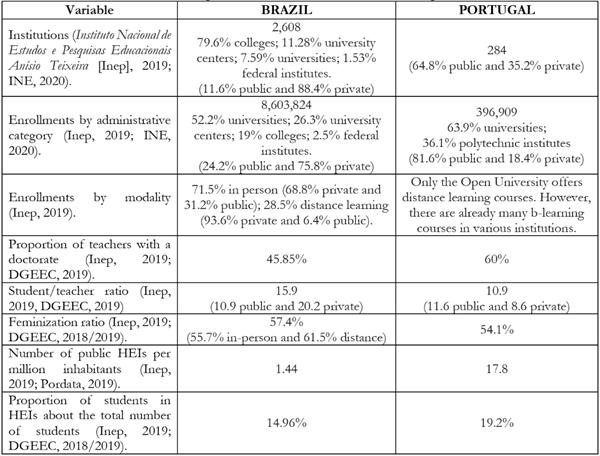 Source: prepared by the author based on Inep (
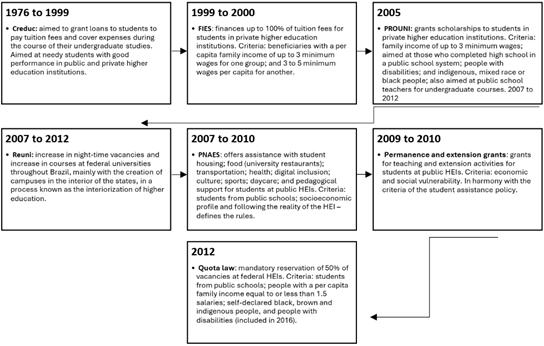 Source: own elaboration based in Brazil (
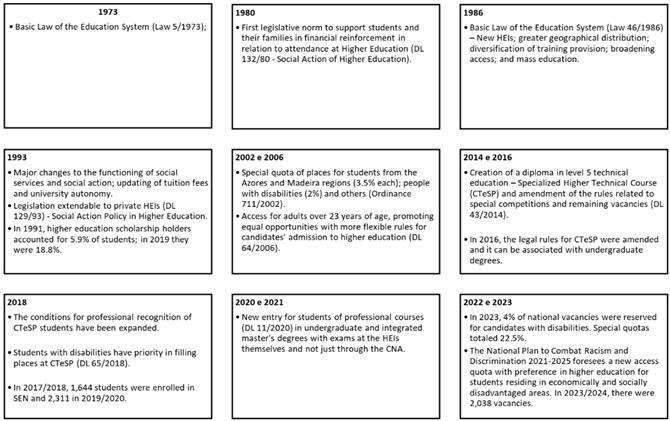 Source: prepared by the author based on DGEEC (
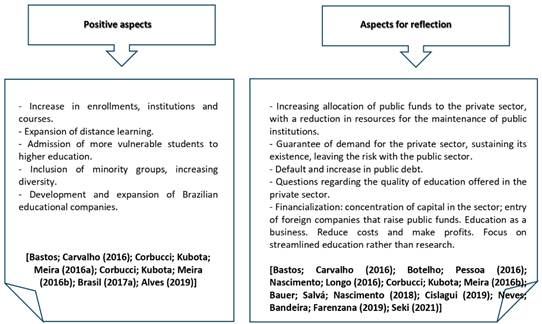 Source: our creation (2025).
 Source: our creation (2025).
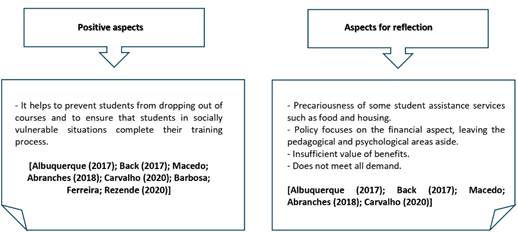 Source: our creation (2025).
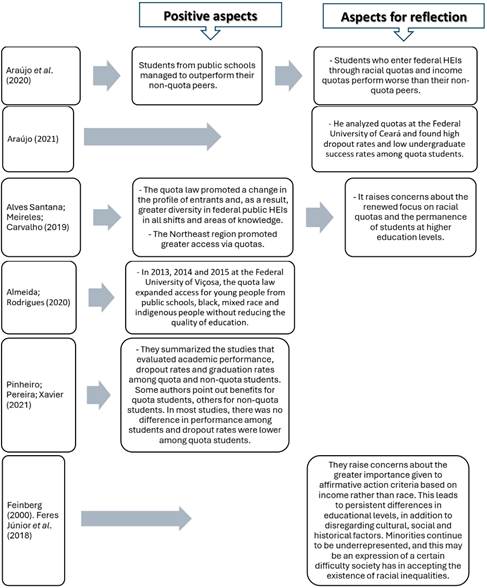 Source: our creation (2025).
 Source: our creation (2025).
 Source: our creation (2025).
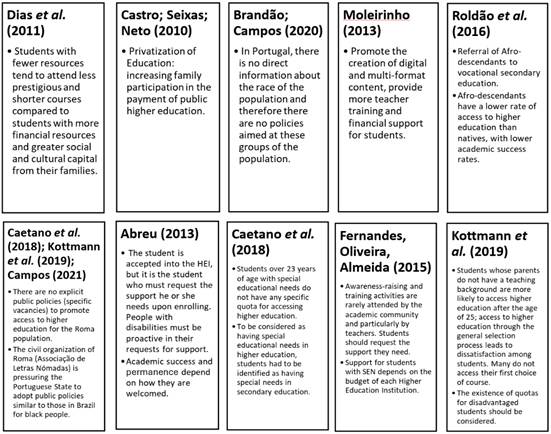 Source: our creation (2025).