
 PUBLIC ELEMENTARY SCHOOLING IN MARANHÃO DURING THE EMPIRE (1843-1870): THE RELATION BETWEEN ENROLLED CHILDREN AND "FIRST LETTERS" TEACHING PLACES
ABSTRACT:
This article analyzes the schooling process in the Imperial period in Maranhao, focusing on the tension between the number of public elementary school PLACES and the number of enrolled children, based on government reports and those from the public instruction inspectorate. The aim is to understand the extent to which the discourses of provincial presidents and inspectors resonated with the political and administrative actions taken to spread elementary schooling. This is achieved by cross-referencing official data grounded in the theoretical-methodological premises of cultural history, evaluating political/ideological discourses and distinct school practices through the lens of representations. This approach allows for a critical examination of the reports themselves, the context of their creation, the positions of key agents involved, and the schemes of perception and appreciation that shape how they classify, judge, and act. Representations are considered here as "ways of seeing" that guide actions and practices; as sites of tension and power struggles between groups vying to legitimize their worldviews; and as conduct and behaviors manifested in the differentiation of practices that generate inequalities. It is concluded that, although the province of Maranhão had seen an intensification of debates regarding compulsory public education—mandating, through specific regulations, the attendance of school-age children in the Elementary classes—the province's financial situation, the shortage of teachers, and difficulties in supervising instruction meant that maintaining teaching places and student enrollment numbers—despite improvements during the period—continued to pose a major challenge to the advancement of education.
Keywords:
Elementary schooling; organization of instruction; enrolled children; teaching places offered; Imperial Maranhão
Resumo:
Neste artigo analisa-se o processo de escolarização no Maranhão Imperial, tendo em vista a tensão entre o número de cadeiras públicas primárias e o computo de crianças matriculadas, segundo relatórios governamentais e da inspetoria da instrução pública. Objetiva-se compreendermos até que ponto os discursos de presidentes de província e inspetores ressoam nas ações políticas e administrativas de difusão da escola elementar, a partir do cruzamento de dados oficiais sustentado nos pressupostos teórico-metodológicos da história cultural, na medida em que discursos políticos/ideológicos e práticas escolares distintas são avaliados via representações, permitindo-nos questionar os relatórios em uso, a análise do contexto em que foram escritos, assim como as posições dos principais agentes envolvidos e os esquemas de percepção e apreciação a partir dos quais se classificam, julgam e agem. Consideram-se as representações, como “modos de ver” que orientam ações e práticas; tensões e disputas de poder entre grupos que lutam por legitimar a sua visão de mundo; condutas e comportamentos que se efetivam na diferenciação das práticas que geram desigualdades. Conclui-se que apesar da província maranhense demonstrar um adensamento nos debates sobre a instrução pública obrigatória, exigindo em regulamento próprio a presença de crianças em idade escolar nas aulas primárias, o estado financeiro da Província, a falta de professores e as dificuldades na fiscalização do ensino fizeram com que a manutenção de cadeiras e o quantitativo de alunos matriculados, mesmo com melhorias no período, continuassem a representar um grande desafio para o avanço do ensino.
Palavras-chave:
escolarização primária; organização da instrução; crianças matriculadas; cadeiras oferecidas; Maranhão Império
RESUMEN:
Este artículo analiza el proceso de escolarización en el Maranhão Imperio, considerando la tensión entre el número de plazas ofertadas en escuelas primarias públicas y el computo de niños matriculados, según informes gubernamentales y de la Inspección de Instrucción Pública. El objetivo es comprender hasta qué punto los discursos de los presidentes provinciales e inspectores resuenan en las acciones políticas y administrativas de difusión de la educación primaria, a partir del cruzamiento de datos oficiales respaldado por los fundamentos teóricos y metodológicos de la Historia cultural; discursos político-ideológicos y prácticas escolares distintas que se evalúan a partir de las representaciones em registro, lo que permite cuestionar los informes en uso, el análisis del contexto en el que fueron escritos, así como las posiciones de los principales agentes involucrados y los esquemas de percepción y apreciación desde los cuales clasifican, juzgan y actúan. Las representaciones se consideran “formas de ver” que guían acciones y prácticas; tensiones y disputas de poder entre grupos que luchan por legitimar su visión de mundo; conductas y comportamientos que se materializan en la diferenciación de prácticas que generan desigualdades. Se concluye que, a pesar de que la provincia de Maranhão intensificase los debates sobre la educación pública obligatoria, y exigiese en su propia normativa la presencia de niños en edad escolar en clases primarias; la situación financiera, la falta de professores y las dificultades para supervisar la educación contribuyeron para que el mantenimiento de las plazas escolares y del número de alumnos matriculados, incluso con las mejorías observadas durante el período, representasen un gran desafío para el avance de la educación en este nivel de enseñanza.
Palabras clave:
escolarización primaria; organización de la enseñanza; niños matriculados; plazas ofertadas; Maranhão Imperio
INTRODUCTION
Discussing the process of the Elementary schooling in the state of Maranhao during the 19th century means reflecting on a Brazilian educational project influenced by European models2 that viewed the principle of compulsory education as the means to guarantee instruction at this level for all children. The proposal to mandate school attendance for school-age boys and girls did not always enjoy broad support and was not implemented without tension, as it brought about significant changes to cultural practices and established relationships. Public education—which, since 18343, became the sole political and economic responsibility of the provincial authorities (Executive and Legislative), yet it also received administrative guidelines from the Central Government through reforms and projects proposed by provincial presidents appointed by the Emperor, who implemented educational goals outlined by the general government.
In this context, the issue here is an analysis of the extent to which the rhetoric of provincial presidents and public instruction inspectors — who had attributed a crucial role to Public Elementary Education by framing it as responsible for ordering social relations and disseminating rules of morality and civility to build a modernized national identity — resonated within the political and administrative actions aimed at spreading schooling through enrollment and class attendance. These actions resulted in the creation of a legal framework that established the legal foundations of the schooling process—a framework that proves indispensable for understanding this relationship, as it points to traces of school practices, initiatives, and debates on teaching, while simultaneously revealing the agents directly involved in the organization of education. Therefore, this study analyzes the mandatory school attendance in Imperial Maranhao, considering the tension between the number of public elementary school positions offered, and the number of enrolled children — as recorded in government reports — which sheds light on the respective roles played by the state, the school, and the family within this dynamic.
The study is grounded in the theoretical-methodological premises of cultural history (Chartier, 1990; Pesavento, 2012; Barros, 2017; Castellanos, 2022), aiming to decipher the reality of the past through recorded representations and to question and compare the inscribed materials. Furthermore, bibliographic and documentary research served as a foundation for interpreting the discursive and visual forms found in the documentation—manifested through school representations and practices. In the first part, we examine authors who analyze schooling in Maranhão during this time period, highlighting different conflicts between individuals and actions that guided the imposition of compulsory education, and how this process influenced the availability and maintenance of public elementary schools, as well as the number of school-age students in school (Oliveira, 2003; Vidal, Sá e Silva, 2013; Castellanos, 2019); the second part examines sources that helps us to understand how the regulations, laws, and decrees aimed at developing public elementary education, as well as the discussions, actions, behaviors, and diverse stances that shaped the drafting of legal provisions—drawing specifically from thirty-nine reports by provincial presidents and twenty-three reports from the public instruction inspectorate covering the period.
Thus, the text is organized into two parts: the first contrasts the legal mandate for compulsory schooling with the provision of public elementary school places, analyzing how the establishment of mandatory education was a necessary measure for ensuring that the creation of schools in cities, towns, and populous areas achieved the expected results4; the second examines the constraints on compulsory school attendance alongside the number of children enrolled in public elementary classes, discussing the intended target audience for mandatory education in Maranhão and how the prevailing public instruction regulations addressed the issue, while also analyzing the State's need to create accessible means for school-age children to attend and remain in school within this context.
Here, we observe how public elementary education took shape and gained prominence through discourses and mechanisms, even though the era was characterized by an apparent contradiction: a government that extolled the value of such education yet seemingly failed to prioritize it in its actions and stances. It was a period that, while idealizing compulsory education as an essential principle for the functioning of elementary classes and successful school attendance, enacted no specific law mandating it; instead, it merely incorporated the concept into the Regulations on Public Instruction. Nevertheless, the need for instruction and schooling proved to be a concern that extended beyond the State and elite representatives, as other actors—such as parents, guardians, teachers, and church leaders—mobilized various practices in this regard.
COMPULSORY SCHOOLING AND THE PROVISION OF PUBLIC ELEMENTARY EDUCATION
After the country's independence in 1822, the institutionalization of a free, compulsory public school system came to represent “an element of affirmation for Brazil’s new government” (Veiga, 2007, p. 131), as it evolved into a space that—beyond merely imparting knowledge and regulating individuals—would contribute to the formation of a national identity. The drafting of laws and regulations mandating school attendance across the provinces was a key measure in expanding access to schooling and “defining school age [...]” (Barbosa, 2012, p. 112); this initiative was aimed primarily at encouraging poor families to send their children to school, given that wealthier households relied on private elementary education or provided instruction within the home.
The idea of requiring all school-age children to attend classes for basic literacy— as Antonio Oliveira points out — met with considerable resistance, given the “large number of objections raised against compulsory education” (Oliveira, 2003, p. 72). Proponents of secular and free education opposed the State’s imposition of school attendance, arguing that “[...] a mandate would infringe upon the family structure” (Cury, 2009, p. 94) as well as “violate individual liberty and freedom of education” (Almeida, 2000, p. 136); furthermore, they observed “[...] that poor families derived a wage supplement from their children’s labor that was indispensable to them” (Almeida, 2012, p. 178). The educator and writer João Köpke (1852-1926), who has been considered a forerunner to Monteiro Lobato, also rejected the principle of mandatory schooling; instead of that, he had postulated — as the criterion for the legitimate systematization of public education — the “[...] free choice of school, that is, the freedom families have to entrust their children to a teacher” (Paulilo, 2004, p. 30). By other side, Carlos Leôncio de Carvalho — serving as Minister of Empire Affairs (1878-1879) and the architect of Brazil’s first major educational reform—advocated via decree for a form of mandatory schooling that was restricted in scope, insofar as it “prescribed schooling without exclusive State control”5 (Almeida, 2012, p. 177).
In contrast, for proponents of mandatory schooling, free education — envisioned as a means to instruct the populace and ensure social order — would become “nonsensical if not linked to compulsory schooling” (Vago, 2009, p. 31). This was because, as a general tendency, “people of higher social condition would keep on investing in education, while the economically less favored segment of society would continue to invest in labor” (Almeida, 2012, p. 178). Within this framework, the instruction of children was conceived as a pathway to resolving and restructuring labor relations following the abolition of slavery; “for this reason, the principle of mandatory elementary education for free children and youth was championed as a way to prepare for the future, molding workers and citizens who identified with and were committed to the nation’s ‘peaceful progress’” (Shueler, 1999, p. 8). Thus, while for Rui Barbosa “compulsory education would be the fight against ignorance” (Barbosa, 1947, p. 198) — given that an individual’s lack of schooling would lead to the unconscious failure to perceive its necessity — for Caetano José da Silva, inspector of public education in Maranhao (1854-1855), mandatory attendance was the “only way to fight and silence the friends of the people’s ignorance” (Maranhao, I. 1855, unpaginated), thereby enabling them to understand the rules and fulfill their duties.
In Maranhão, Luiz Antonio Vieira da Silva (inspector in charge) argued in his 1853 report for the necessity of mandatory schooling, citing the apparent lack of interest among the poor, who did not perceive education as a necessity; in other words—contrary to the stance of local elites—the “[...] majority of the [...] population [had] no education whatsoever, and [there was] nothing [...] to encourage them or [make] them aware of the advantages that could stem from it.” (Maranhão, I. 1853a, unpaginated). Faced with this situation, government officials mobilized policies aimed at raising public awareness to foster the development of a modern state populated by "civilized" individuals, and created regulatory mechanisms to provide the necessary conditions for implementation; in addition to mandating elementary education by law—as set forth in the Public Instruction Regulation of February 2, 1855—penalties were established for non-compliance with Article 36: parents, guardians, curators, or protectors “[...] who [had] in their care boys over the age of 7 with no physical or moral impediment, and [did] not provide them with at least first-level instruction, [would] incur a penalty of 10$000 to 60$000 *réis*, depending on the circumstances.” (Castro, 2009, p. 390).
This regulation underscores how the mandate for public elementary education in Maranhão mirrored the national dynamic—a government initiative that required reinforcement through coercive measures. For Antônio Oliveira (2003, p. 67), “compulsory education [was] the only means capable of universalizing instruction” and ought, as a matter of priority, to be enacted into law; According to Veiga (2013, p. 136), “it was an unprecedented event in the organization of Western societies and did not occur without tensions,” presenting many challenges to its implementation: “children did not go to school, parents did not send their children, inspectors could not enforce the law, and teachers did not receive their salaries due to student absenteeism, etc.” (Veiga, 2013, p. 136). However, regarding the issue of compulsory education, Faria Filho and Gonçalves (2004, p. 159) write that it not only mobilized "a very significant number of individuals" during the Western world's schooling process but also "appears as one of the elementary avenues for studying the most significant facets of the school" (Faria Filho & Gonçalves, 2004, p. 159)—among them, the relationship with the State, the family, and the world of work. Consequently, the working classes needed to be persuaded of the importance of education, countering the reluctance of many parents who prioritized manual labor as a means of subsistence.
Regarding the lack of access to school facilities, it is worth noting that—despite the legal mandate of the General Education Law of October 15, 1827 (which established the opening of elementary schools in cities, towns, and populous areas) and the autonomy granted to provinces regarding public instruction via the Additional Act of 1834 — a major obstacle to educational progress remained the lack of dedicated classrooms. Most classes were held in the teachers' own homes, and the distance between the capital and various rural parishes and towns hindered the timely receipt of resources needed for operations due to accessibility issues. Although the Additional Act (1834) encouraged the creation of policies tailored to each province's specific educational needs and mandated that "municipalities assume these costs to relieve the budget" (Souza, 2013, p. 154), this legislative requirement was not implemented for everyone simultaneously or universally.
Distance and communication issues affected oversight, as there was insufficient information regarding “enrollment, attendance, and priorities for the development of public education” (Castellanos, 2017, p. 303); furthermore, the impossibility at the time of compiling “more precise statistics on the number of enrolled students” (Castellanos, 2017, p. 303) further complicated this equation. To determine these figures, the study analyzed thirty-nine reports from provincial presidents—mandated by Article 8 of Law No. 16 of August 12, 18346 —which were to be presented to the Provincial Assembly as “summaries of other reports, statistical charts, official letters, and other official documents” (Bottentuit, 2016, p. 20); as well as twenty-three reports from the public instruction inspectorate, which drew upon “school charts based on enrollment, attendance, academic performance, and inspector correspondence” (Bottentuit, 2016, p. 19). Given the substantial number of documents involved, we chose to organize the data by decade to facilitate the visualization and understanding of the information, in addition to creating graphs.
Initially, the study proceeded from the premise that a mere increase in teaching places and educational institutions would result in a higher number of students in schools; however, it became evident that other factors—such as financial considerations—also played a role. In this regard, the provincial president Bandeira de Mello (1885-1886) highlights this necessity in light of Article 8 of the Additional Act7: he does not limit himself to recording the total number of elementary schools during the period and the resources required for their maintenance; he also points to the state's capacity to fund the salaries of new teachers and argues that measures aimed at expanding education should not be taken without a broader assessment of the factors involved, given that the state itself bore elementary responsibility for the teachers' inefficiency.
Bandeira (1886) believes that:
To assume that education is effectively disseminated simply by creating teaching places —while maintaining the current system governing them—is a disastrous illusion that is exacting a heavy price from this important province. Multiplying these places makes it impossible to raise teachers' salaries—an urgent and indispensable measure—while the ease with which the positions are filled attracts the inept who rely on patronage, preventing true vocation from revealing itself and being put to use (Maranhão, R. 1886, pp. 23-24; emphasis added).
In this context, policies promoting the creation of more teaching places (offering isolated teaching positions)—without the support of other necessary factors—could, according to Bandeira de Mello (1886), cause serious harm to public education and the quality of teacher training, as well as diminish interest in the teaching profession. Conversely, a report by Ambrósio Leitão da Cunha (president in 1863) called for the cancellation of an ongoing competitive selection process for several elementary education places that had recently been created, “[...] as there were no funds allocated for them in the current budget law” (Maranhão, R. 1863, p. 12); this underscores the need for adequate planning aimed at achieving concrete and satisfactory results.
In this regard, regarding the relationship between financial aspects, the opening of teaching places, and children's access to education, Oliveira (2003, p. 77) observes that “in matters of public education, no expense [was] a sacrifice,” given that individuals had to educate themselves through great personal effort; thus, “no state should [have] shrink[ed] from the monetary sacrifices required for the enlightenment of the people” (Oliveira, 2003, p. 77). Meanwhile, Faria Filho (2007)—discussing the many limitations faced by advocates of extending education to the majority of the population—points to “the extremely low investment capacity of the provinces, which sometimes spent over a quarter of their resources on education yet achieved meager results” (p. 135); in other words, the State’s limited involvement in education failed to provide the actual conditions needed to improve children's access to classes, let alone establish a sufficient number of teaching places. However, this relationship is also evident in documentation regarding education in the province of Paraná, which identifies the elementary obstacle to establishing compulsory education as “the insufficient number of schools available and the province’s inability to increase that number” (Souza; Anjos, 2013, p. 193).
In the following graph, out of the eight years analyzed during the 1840s, no records of public elementary school places were found for three of them (1843, 1845, and 1847)—a fact previously noted by Castelo Branco (2019), who stated that “[...] 66% of the sources consulted and analyzed [...] yielded viable answers and information [...]” (Castelo Branco, 2019, p. 112) when attempting to determine the number of schools in the province between 1834 and 1889.
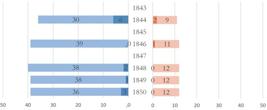
Number of public elementary school places for boys and girls in Maranhão according to Presidential Reports (1843-1850)
Regarding the number of schools and students—specifically concerning the absence of school-age children (starting elementary education at age seven) from the classroom—several perspectives were identified: 1) President Jerônimo Martiniano Figueira de Melo (1843-1844) offered a justification, noting that it was “[...] not possible at present to provide you with an exact chart of the number of students due to the fault of the teachers” (Maranhão, R. 1843, p. 52); 2) Vice-President Angelo Carlos Muniz (1844-1845), when presenting the total number of students of both sexes who had attended public classes during the year, acknowledged the inconsistency of the figures, noting that they revealed a “[...] number lower than the actual one because the charts for some classes in the interior were still missing” (Maranhão, R. 1845, p. 6); 3) Joaquim Franco de Sá (1846-1847) pointed out that the “[...] number of filled or vacant teaching places, of students attending them, and of those who made progress during the last school year [could be found only in] the Inspector of Instruction’s report” (Maranhão, R. 1847, p. 44)—a highly detailed document, although it has not been located.
It is clear that the creation of a new teaching post generally occurred through the appointment or hiring of a teacher. While a "vacant" status corresponded to a post being “[...] abandoned due to [...], transfer, retirement, or dismissal of the [teacher]” (Bottentuit, 2016, p. 111), a "filled" status referred to a elementary class that was fully operational with its assigned teacher. However, an established teaching post might not actually be in operation, in which case the class was considered vacant. Regarding the number of public elementary teaching places for boys, we observe fluctuations ranging from 36 positions in 1844 to 39 during most of the decade under review (1846, 1849, and 1850), with a peak of 40 places in 1848 (see Graph 1); however, regarding actual staffing, there were recurring fluctuations—except in 1846, when all teaching places were fully operational without any impediments. As for public elementary teaching places for girls, the disparity between provisions for girls and boys is stark; less than 25% of the offered places were designated for women, compounded by a constant lack of indicators—a recurring "absence of comparable demographic data for the entire period" (Silva, 2013, p. 215). Consequently, the situation of women and their integration into the schooling process during this decade (1843-1850) was limited; indicators point to only a slight increase in establishments—rising from 11 offered in 1844 (with 9 filled) to twelve public elementary places. This figure remained constant (in 1846, 1848, 1849, and 1850), with the exception of 1846, when one post remained vacant (see Graph 1).
This highlights the subordinate status of women regarding education for much of the 19th century. Generally speaking, while the education made available to them was restricted to the elementary level—alongside specific domestic activities such as cutting and sewing—the instruction and content aimed at men focused on technical skills intended, in theory, to ensure the construction of a progressive nation. On the other hand, the requirement for specific documentation—based on the applicant's status as a woman and necessitating statements from men (fathers and/or husbands) or proof of divorce—was a constant feature of the selection processes for teaching positions; these requirements reflect a differentiation in practices rooted in the social standing assigned to 19th-century women, a standing that underscored the inequalities inherent in such practices (Castellanos, 2017). Nevertheless, from the second half of the century onwards, changes driven by the influence of philosophical and scientific ideas—such as liberalism—and the dynamic nature of Brazil's sociocultural life became a constant. These ideological, political, and cultural transformations were accompanied by a vigorous exchange of ideas that had profound repercussions on the realm of education, which began to assume an unprecedented level of importance; such changes pointed to a need for women's education linked to the modernization of society (Alencastro, 2006).
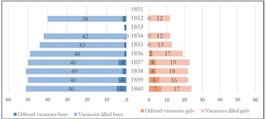
Number of public elementary school places for males and females in Maranhão according to Presidential Reports (1851-1860)
Indicators for the 1850s were gathered by considering data from only one report per year, given that information is often repeated.8 As the presidential reports from September 7, 1851, May 8, 1854, April 13, 1858, and October 19, 1858, lacked data, records from public education inspectors were cross-referenced to assist in the analysis; only the entry for September 7, 1851, remained incomplete. With these considerations in mind, Graph 2 shows a gradual increase in the number of public elementary school places offered to boys (except in 1859), ranging from 40 (38 of which were filled) to 51 (46 in operation); conversely, a gradual rise in the number of vacant places is evident (except in 1854 and 1858), going from two in 1852 to five in 1860. A comparison between the 36 public elementary school places for boys offered in 1844 and the 51 existing in 1860 reveals an approximate 42% increase in availability.
Various examples regarding this matter can be found, such as: 1) the report by President Eduardo Olímpio Machado (1851-1852), which points to incomplete student enrollment figures and notes that “1,433 [were] those attending the others, not including the *Casa dos Educandos*, where 127 [were] taught” (Maranhão, R. 1851, p. 24); 2) in the 1853 report, Olímpio Machado notes that “[...] this figure is far from exact, because it does not include the classes in Chapadinha, Santa-Helena, Rosario, Tutoya, Passagem Franca, and Riachão, whose teachers have not yet submitted the required reports” (Maranhão, R. 1853, p. 14); 3) Antonio Cândido da Cruz Machado (1855-1857), in turn, points out corrections to the information found in the 1856 document, noting that “[...] in addition to the 56 mentioned above, there are 7 more for males and 4 for females. [These] are not included in the total number of students attending these latter 11” (Maranhão, R. 1856, p. 26).
Thus far, it is evident that—even in the province of Maranhão, which had a large Black and enslaved population—there are no government records regarding any public school classes designated for the education of Black children of school age, nor is there evidence of such children attending other schools. Nevertheless, Castellanos (2017)—by highlighting readers in Maranhão newspapers who were not officially recognized or legitimized, such as “runaway slaves who knew how to read and write”—demonstrates that, despite prohibitions (such as the one published in the newspaper *O Conciliador do Maranhão* in 1822 by the Provisional Administrative Junta forbidding the admission of *ladino* slaves9 arriving from other Brazilian provinces with the aim of ensuring “control over subjects who were incommunicado due to language barriers” (Castellanos, 2017, p. 102)—and the Regulation of February 2, 1855, which prohibited the enrollment of enslaved people in public elementary classes—records of a different nature regarding this matter can still be found: 1) Domingos José Gonçalves de Magalhães, in his *Breves Reflexões acerca da Revolução da Província do Maranhão* (1858), states that a “reading and writing school” was being established within the *quilombo* of the Black man Cosme, in the judicial district of Brejo, at the Lagoa Amarela plantation (Magalhães, 1858, p. 118); 2) in *Políticas de ações negativas e aspirações de famílias negras pelo acesso à escolarização na província do Maranhão no século XIX* (2009), Cruz points out that, through brotherhoods such as the Asilo de Santa Tereza, the presence of Black women and enslaved women in public and private schools is recorded, even if not specified in government reports.
Graph 2 shows a gradual increase in public elementary school places for girls during that decade, expanding from 12 teaching locations in 1852 to 24 in 1860—a percentage growth exceeding that of classes for boys. Up to 1855, all girls' schools were fully staffed; however, starting in 1856—even as new educational institutions emerged10 —a growing trend of places took hold, with nearly 30% of teaching places left unfilled by 1860. However, President Benevenuto Augusto de Magalhães Taques (1857) highlighted the even greater difficulty regarding the education of girls—stemming from the creation of new schools without proper planning—insofar as “[...] the difficulties were even greater regarding the teaching places for girls, for which there were not many qualified individuals willing to dedicate themselves to the teaching profession” (Maranhão, R. 1857, p. 10); in other words,
While one might wish for an elementary school in every settlement, “given the circumstances under consideration, I deem the existence of certain teaching places a sheer waste of public funds,” and, “far from calling for the creation of new places, I consider it better to exercise the authority to relocate teachers to wherever it is most appropriate.”
Benevenuto Tanques (1857) addresses a sensitive aspect of the process of female schooling by highlighting problems encountered during his administration. Between 1851 and 1860—and particularly following the implementation of the Regulation of February 2, 1855—there was an increase in the educational opportunities available to girls; however, due to a lack of the necessary attention and support to sustain this growth, issues such as a shortage of qualified female teachers and insufficient funds to pay those willing to join the public service led to a rise in places for these new teaching places. The number of such vacant positions grew from two in 1856 to seven in 1860, indicating an attempt to expand educational provision that failed to achieve the desired results (see Graph 2).
The decade spanning 1861 to 1870 yields the most information in both presidential reports and those of public education inspectors. The number of schools available for boys ranged from 50 (in 1862 and 1863) to 61 (in 1869); however, for the majority of the decade (1865, 1866, 1867, 1868, and 1870), there were 60 schools in operation. Meanwhile, the number of vacant teaching places fluctuated, ranging from a low of one (in 1863 and 1868) to a high of five (in 1861, 1864, and 1865), with all places being filled only in 1862.
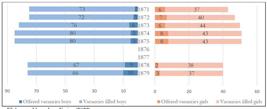
Number of public elementary school places for males and females in Maranhão according to Presidential Reports (1861-1870)
Comparing the evolution of the provision of public elementary education from 1843 to 1870, we observe growth of approximately 67%, representing a larger share of school-age children integrated into the school system, although this figure was far from encompassing the actual population. In his 1866 report, Dr. Lafayette Rodrigues Pereira (1865-1866) confirmed this situation, noting that the province had “[...] 28,571 school-age boys; yet only 4,132 attended elementary classes; thus, 24,439 [children] were growing up without basic literacy” (Maranhão, R. 1866, p. 22).
Consequently, certain observations made by the presidents serving between 1861 and 1870 are crucial for understanding the limitations of the existing measures—particularly those regarding the practice of submitting class reports, which was a routine part of educational administration. For President Major Francisco Primo de Souza Aguiar (1861-1862), the information on public education provided by Inspector Dr. Silveira de Souza (1858-1861) was well-structured; he therefore focused his own report solely on “[...] what had occurred since that time” (Maranhão, R. 1861, p. 25). Meanwhile, Vice-President Miguel Joaquim Aires do Nascimento (1864-1865) attributed the drop in the number of public school students compared to the previous year to the fact that “[...] not all reports from teachers in the interior regarding the months of January and February had yet been received” (Maranhão, R. 1864, p. 18), as well as the exclusion of students who had failed the year due to excessive absences. Finally, even though President Ambrósio Leitão da Cunha (1864-1865) received all the necessary sources to compile his report, he clarified that the information presented was based “[...] on the charts submitted by the teachers” (Maranhão, R. 1865, p. 13); however, there was a possibility that some data did not reflect reality—a limitation inherent to the records' perspective.
Another point of discussion concerns whether or not the number of public teaching places should be expanded. For Ambrosio Leitão da Cunha (president in 1863), it was essential to establish a teaching post in every settlement of the province of Maranhão—no matter how small—and to provide books, paper, and ink to poor children, as only then could the needs of public elementary education be fully met (Maranhão, R. 1863, p. 13). Here, we see that while advocating for the creation of schools throughout Maranhão, Leitão da Cunha proposed a necessary counterpart: the provision of textbooks and materials to all students unable to purchase them. This guarantee was already stipulated in the 1855 public instruction regulations, which assigned the government the duty of supplying school materials—even though Francisco Xavier Paes Barreto (president from 1857 to 1858) had noted that “[...] this measure, however, has proven unfeasible to date, as the provincial coffers could not bear such an expense” (Maranhão, R. 1858, p. 9), highlighting a major constraint on the support needed to maintain the new classes. Earlier, Benevenuto Augusto de Magalhães Taques (president in 1857) had emphasized the need to focus on teacher performance, noting that “[...] what matters is not merely having teaching places or public classes and paying teachers, but ensuring that they teach as they ought” (Maranhão, R. 1857b, p. 10). These were the circumstances under which Frederico José Correia (1869-1870), serving as interim inspector, made a statement that appeared to run counter to the views of those advocating for an expansion of educational provision.
The province already possesses a greater number of elementary schools than its needs required, because quite a few of them were created through mere patronage—solely to secure positions for protégés—and are located in desolate, uninhabited areas that happened to qualify for them, or in poorly chosen locations based on the convenience of the individuals intended to benefit (Maranhão, I. 1870, unpaginated, emphasis added).
By considering the presidential statements of Ambrósio Leitão da Cunha (1863), Francisco Xavier Barreto (1857-1858), and Benevenuto Augusto de Magalhães (1857)—as well as those of other executive heads and public education inspectors—one can understand why Frederico Correia (1869-1870) asserted in 1870 that Maranhão already possessed more elementary education places than necessary. This is despite the fact that other sources present seemingly contradictory data; for instance, Antônio Marques Rodrigues (1864-1865) illustrated the situation in the municipality of the Court in 1865—a region that received significant funding—by noting a scenario where there was “[...] therefore, one student for every 100 inhabitants” (Maranhão, I. 1865, unpaginated). In this context, Frederico Correia’s elementary concern was the province's finances; he perceived bad faith among certain administrators who, while ostensibly seeking to strengthen public education, were actually serving their own interests by establishing schools that lacked the means to sustain themselves or attract an ideal number of students. Given that only a small proportion of children were actually attending school, the selection of a location close to the children should have been a paramount factor in the process.
Regarding the steady increase in the number of places offered to girls, 40 school locations stood out in 1870, a figure approaching that of the places offered to boys; indeed, places for female education accounted for 40% of all public elementary education classes (see Graph 3). However, another evident aspect is the large number of vacant teaching positions—approaching 30% of the total offered—during three of those years (1865, 1866, 1867). Much of this place stemmed from a shortage of female teachers, pointing to a deficit in teacher training—possibly due to the lack of an institutionalized Normal School during that period (such a school was only established in the province in 1889, with the advent of the First Republic [1889-1930]11; when the commission tasked with reforming public education recommended its founding. Thus, in light of these obstacles, Oliveira (2003) asked: “How should one understand the assistance women can provide to education?” and answered: “[...] in two ways: by becoming promoters of education themselves, or by each attending to the education of her own children” (Oliveira, 2003, pp. 333-334).
This difficulty in finding female teachers was a legacy of mechanisms that excluded women from the teaching profession—mechanisms reflected in everything from the selection of a limited and differentiated school curriculum centered on domestic tasks to the establishment of the first teacher-training schools, which were initially designated for male candidates. Although Tanuri (2000) notes that this situation changed as female teaching became a socially legitimized profession—viewed as compatible with attributes associated with femininity and motherhood— More recent studies, such as those by Hahner (2011), Castanha (2015), and Warde and Rocha (2018), broaden this causal relationship by treating the feminization of the teaching profession as a multifactorial historical process. This process simultaneously involved the expansion of elementary schooling, the organization of public education systems, and gender relations—as well as teacher training, state policies, and remuneration—alongside social representations of motherhood and the strategies women themselves used to claim the profession.
Thus, while women's entry into teaching must be understood within the context of broader transformations in the organization of public education, it is equally necessary to consider the administrative mechanisms that regulated the existence and maintenance of teaching places. In this regard, certain questions are essential to understanding this relationship: 1) To what extent did the retention of a teaching position depend on figures indicating whether or not children were attending classes? 2) How was the organization of elementary public education conditioned by the number of registered students?
Among studies focused on understanding how these school indicators were produced—and why historical statistics require critical examination before being used as evidence—Gil (2009) argues that the consolidation of educational statistics was linked to the formation of an administrative apparatus. In this system, numbers came to function as "a specific representation of the school, which, to some extent, informs its social and physical construction" (Gil, 2009, p. 357), thereby guiding state actions. Consequently, indicators such as attendance, enrollment, or student numbers could justify or not the maintenance of a teaching position, the retention of a teacher, or the need to reorganize instruction—making this data a tool for the administrative management of the school environment.
CONSTRAINTS ON COMPULSORY SCHOOL ATTENDANCE AND THE NUMBER OF CHILDREN ENROLLED IN PUBLIC ELEMENTARY CLASSES
To whom was mandatory schooling directed? According to Vidal (2013, p. 16), “the answers to this question were numerous and shaped the nature of the schooled childhood in diverse ways.” Legislation establishing compulsory attendance was enacted across the country during the Imperial era, at different times and with varying restrictions regarding schooling. To analyze the specificities of the legal measures enacted in Maranhão for this purpose, we first highlight some of these initiatives in major Brazilian provinces during that period. In Minas Gerais and Pernambuco, for instance, despite the existence of some classes for girls, their laws initially restricted12 the obligation to attend school to boys only (Silva, 2013); conversely, in Paraná, legislation provided for compulsory education for both boys and girls from the outset13, with differences only regarding the age range for each gender (Souza & dos Anjos, 2013).
Lopes (2013, p. 17) outlines other restrictions regarding mandatory school attendance in the province of Piauí—such as "illness preventing boys from pursuing their studies" and family economic status—by exempting from fines for non-attendance "parents who did not qualify as voters" (Lopes, 2013, p. 17), given that a specific annual net income was required to attain voter status. Legislation in Rio de Janeiro restricted compulsory schooling exclusively to free individuals, as established in the 1824 Constitution—a restriction also maintained by several other provinces, such as Grão-Pará, Maranhão, and Espírito Santo, among others. Nevertheless, Vidal (2013) highlights exceptional cases, noting that "a ban on enslaved people attending public school did not always appear in provincial legal provisions" (Vidal, 2013, p. 18); indeed, despite the Constitution's mandate, their presence is evident in analyses of public school records in the city of São Paulo during the early decades of the 19th century (Vidal, 2008). Meanwhile, in Maranhão, during the period under review, the first caveats regarding the enrollment of enslaved children in elementary classes appear in Article 41 of the Public Instruction Regulation of February 2, 1855:
Art. 41. Admission for enrollment shall be denied to:
§1. Those under 5 and over 13 years of age;
§2. Those suffering from a contagious disease;
§3. Those who have not been vaccinated;
§4. Slaves. (Castro, 2009, p. 391)
Thus, the regulation of compulsory attendance in Maranhão14 Although school attendance was regulated in the province of Maranhão via the 1855 Regulation, it was never enacted into law during the 19th century (Castro, 2013, p. 112).] established criteria that barred enrollment in classes—conditions that reinforced constitutional mandates—such as: i) the requirement that the individual be free (although research by Cruz [2008] presents an official letter issued by Councilor José Tomás Babuco de Araújo to Provincial President Lafaiete Rodrigues Pereira on September 13, 1865, noting the presence in the provincial capital of “free Black people who could read passably well, and to whom ideas [...] favoring the emancipation of slaves were not foreign” [Cruz, 2008, p. 57]); ii) minimum and maximum age limits applicable to both boys and girls; and iii) factors related to the child's health status—ranging from preventive measures like vaccination to concerns regarding the school environment as a site where individuals gathered, thereby making it a place prone to the spread of contagious diseases. It is worth noting that the regulations did not impose restrictions directly linked to families' economic status or to the location of classes.
Identifying the restrictions on school attendance, combined with the statements of provincial presidents and education inspectors, sheds light on the intended target audience for compulsory education in Maranhão; this aids in understanding the number of children enrolled in elementary classes and in evaluating the interests of both parents and the State regarding the schooling process. In this regard, while Jerônimo Martiniano Mello (1843-1844) believed that “[...] some powerful cause kept boys away from elementary and preparatory education” (Maranhão, R. 1843, p. 51); for Joaquim Franco de Sá (1846-1847), the fact that the ratio of schoolchildren to the Province’s free population was “[...] so unsatisfactory” (Maranhão, R. 1847, p. 44) led him to point out the urgent need to increase the number of educational facilities and students. Honório Pereira de Azeredo Coutinho (president from 1849 to 1851) endorsed this premise, arguing that “[...] this result [was] not yet sufficiently satisfactory when comparing the number of students with the Province’s free population” (Maranhão, R. 1850, p. 27). On the other hand, José da Silva Maia (1857-1858) and Antonio Marques Rodrigues (1865-1868), serving as education inspectors, believed that despite observing some growth, a gradual and constant increase was still required: the former stated that “[...] although the number of students attending public elementary education classes [was] not discouraging compared to the previous year, it [was] nonetheless far from satisfactory in relation to the province’s free population” (Maranhão, I. 1857, unpaginated); the latter argued that, due to the lack of statistics offering the necessary accuracy up to that point, he “[...] was inclined to believe that the school-age population [was] much larger, promising a constant progression—something to be desired and applauded in a country with free institutions like ours” (Maranhão, I. 1867, unpaginated). The tension arising between the growth in enrollments and the number of free school-age children not attending school pointed to a failure to comply with the mandatory requirement that had been... ...required by the 1855 Regulation, due to structural issues left unresolved by incumbent governments or the negligence of poor families who viewed education as a secondary priority when weighed against farming as a means of subsistence.
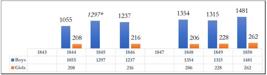
Number of students in public elementary schools in Maranhão according to Presidential Reports (1843-1850)
It is evident that various government officials and inspectors noted that access to education was a privilege enjoyed by only a small segment of the population, creating a need for major initiatives to expand access and facilitate the entry of out-of-school children into the school system. The issue of compulsory school attendance emerged within the broader debate on uniformity and school oversight—a process that became more systematic and frequent "from 1844 onwards, when the General Inspectorate of Public Instruction, created in 1841, began to operate more effectively" (Castro, 2013, p. 104). Thus, the number of students enrolled from 1843—the year inspection of public instruction in Maranhão was systematized—provides relevant indicators for analyzing policies aimed at encouraging school-age children to attend elementary classes (see Graph 4).
The data show a steady increase in the number of students during this period, rising from 1,055 boys and 208 girls in 1844 to 1,481 and 262, respectively, in 1850 (an increase of 40% for boys and 26% for girls); however, isolated exceptions were also recorded: in 1848, the number of girls enrolled was lower than in previous years, and a similar situation was observed for boys in 1849. In this regard, it is important to emphasize that the number of enrolled students—along with the acknowledged limitations inherent in the data collection process—does not accurately reflect either the number of children regularly attending elementary school classes or the corresponding percentage of the active school-age population; nevertheless, these records served as benchmarks for education policy decisions, thereby assigning an administrative function to these statistics. In this context, to what extent did enrollment and attendance rates—or even the sheer number of public elementary school seats and teachers—actually correspond to the phenomenon they ostensibly represented?
Thus, in analyzing the implications of education statistics for the Brazilian schooling process, Caldeira-Machado, Biccas, and Faria Filho (2013) move beyond the mere “reliability” of the data. They examine how political and administrative agents mobilize these indicators to lend “educational discourses a rhetoric of scientificity” (Caldeira-Machado, Biccas, & Faria Filho, 2013, p. 655), thereby transforming the data into essential tools for managing the schooling process. In doing so, they highlight not only the growth (or decline) of school networks and the numbers of students and teachers, for instance, but also “the enduring action of the social agents who organize the school within the configuration of the social world” (Caldeira-Machado, Biccas, & Faria Filho, 2013, p. 654).

Number of students in public elementary schools in Maranhão according to Presidential Reports (1851-1860)
The data in Graph 5, drawn from government reports and public education inspectors' records, allow for an analysis of the variation in student numbers during the period when compulsory schooling was regulated in Maranhão. The records for the 1851-1860 decade contain only two caveats: for the years 1851 and 1854, the figures represent the total number of students without a gender breakdown—indicated here in orange. The highest enrollment figure for boys in elementary classes was 2,170 (in 1859), compared to a low of 1,433 (in 1852); meanwhile, the peak for girls in schools during this period occurred in 1858, with 396 students, while the lowest number—299 students—was recorded in 1852. This decline corroborates the analysis regarding Graph 2 (see page 9), which suggests that merely opening new teaching places without the necessary support would not produce a proportional increase in the number of students; on the contrary, a decrease in numbers could actually occur, as seen with the number of girls in 1859 and with students of both genders in 1860.
By comparing the number of children enrolled between 1851 and 1860 (Graph 5) with the availability of public elementary classes during the same period (see Graph 2, p. 9), we can clearly see that simply increasing the number of teaching places was not, in itself, sufficient to drive growth in student enrollment. This is evidenced by the fact that in 1855, there were 44 places dedicated to boys' education (with only one vacant), serving 1,906 students, and 13 public elementary classes for girls (all filled), serving 333 students. However, in 1857—despite an increase in the number of teaching places, reaching 50 specific slots for boys' initial schooling (four of which were vacant) and 23 places for girls (four of which were unfilled)—the number of students actually dropped to 1,775 boys and 304 girls. These figures can be explained by the fact that for elementary education expansion efforts to succeed, it was necessary to create "accessible means and conditions for [children] to remain in school, with the State responsible for providing them" (Castro, 2013, p. 103). Seeking solutions to recurring problems—such as the need for teacher training, the lack of instructional resources, and the need to raise awareness among parents of school-age children—was crucial.
Consequently, calls for the State to take responsibility for keeping boys and girls in school were widespread, influencing the development of specific regulations for public education in Maranhão. The formulation of these regulations involved Eduardo Olímpio Machado (president from 1851 to 1855), who advocated for an urgent overhaul of education legislation, noting that "[...] given my assessment of public instruction in this province, it is no wonder that I maintain the need for reform" (Maranhão, R. 1851, p. 11). On the other hand, he emphasized that “[...] in the hands of this assembly lay the remedy for the ills plaguing public education, whether by decreeing its reform or by authorizing the government to carry it out” (Maranhão, R. 1853, p. 15). At another point, he voiced his frustration, asserting that “[...] on several occasions [he had] requested authorization from this assembly to reform the province's public education system, only to be met with a runaround” (Maranhão, R. 1855, p. 18)—a situation illustrating the legislators' delay in taking a stance due to other priorities; nevertheless, the Public Education Regulation of February 2, 1855, was promulgated by Eduardo Olímpio Machado himself (1854-1855), reorganizing elementary and secondary education and establishing mandatory schooling in Maranhão (Silva, 2018).
In this context, the Regulation brought about a series of advances for public education, “making the idea of an education system in Maranhão apparent for the first time” (Cruz, 2009, p. 79); it was a pioneering measure in instituting a legislated reorganization of elementary education in Maranhão (Castro; Castellanos; Coelho, 2015). Among the key contributions, we can highlight the following: 1) it better defined the role of inspectors, assigning them the responsibility of proposing the creation of elementary teaching places to the government (Art. 2, § 6, item 5)—a move that may have contributed to the increased availability of public classes in the Province; 2) it created the role of assistant teacher to provide support when regular teachers were unable to perform their duties (Art. 24), signaling an intention to fill vacant teaching places more swiftly; 3) regulated compulsory schooling by imposing fines on parents, guardians, and protectors who were negligent in ensuring the education of their children, wards, and charges (Art. 36).
Legislation that increasingly reinforces the process of organizing instruction. is increasingly present in the province through discourses linking the process of schooling and compulsory education to a modern, civilized State that required instruction to play a central role. A legal support structure was thus necessary, insofar as the law carried a pedagogical connotation: "to mold the character of the population, as well as to order social relations and civilize the indolence of the people" (Carvalho, 2011, p. 209); because the law, while constructing and deconstructing social meanings, could transform and even redefine concepts such as school, teacher, and teaching (Faria Filho, 2008).
The central role of public elementary instruction is frequently mentioned. While that in the vision of Miguel Joaquim Ayres do Nascimento (Vice-President from 1863 to 1864), "[...] the foremost need of a free people [...] [was] the instruction and education of childhood" (Maranhão, R. 1863, p. 11), and in accordance with José Silva Maia (1870) it was "[...] from education, as you know, that the regeneration of the country would result" (Maranhão, R. 1870, p. 14), for Antonio Joaquim Alvares do Amaral (President of the province from 1848 to 1849) and his successor Herculano Ferreira Pena (1849), problems persisted; for the former, "[...] Public Instruction had not yet seen any improvement" (Maranhão, R. 1848, p. 10), despite the increase in teaching posts and student numbers, while for the latter, "[...] the current state of Public Instruction [...] differed little from what had been described in the last Session" (Maranhão, R. 1849, p. 32). On the other hand, while Caetano de José de Souza (an inspector in 1855) argued that “[...] for man to know and be able to fulfill these duties, it [was] indispensable that his faculties receive a certain degree of culture—which is precisely what constitutes instruction” (Maranhão, I. 1855, unpaginated), Antonio Marques Rodrigues (1864-1865)—holding the same position—questioned, when discussing parents' freedom to recognize the importance of education: “[...] could one deny them the bread of the soul—[denying children] instruction—and render them incapable of grasping moral and religious concepts, leaving them with nothing but the name of ‘man’? No, a thousand times no” (Maranhão, I. 1865, unpaginated). He asserted that disregarding education would constitute a grave violation of a child's right to access knowledge.
Thus, the central role of education was underscored by the requirement for compulsory schooling—mandating that boys attend classes on the rudiments of learning at the behest and duty of their parents or guardians. Yet, although this matter was widely debated by various stakeholders, no laws were “promulgated to enforce its application; it appeared [only] in two or three articles within the Public Instruction Regulations of 1855 and 1874” (Castro, 2013, pp. 112-113). Oliveira (2003) confirms this situation, highlighting that the laws in the seven provinces where compulsory schooling had already been introduced remained a dead letter, “for although a fine was the only established penalty, the method of its enforcement was not specified” (Oliveira, 2003, p. 81)—let alone for families facing financial hardship who would be unable to pay such penalties.
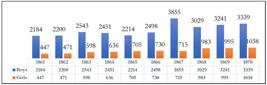
Number of students in public elementary schools in Maranhão according to Presidential Reports (1861-1870)
Ultimately, among the ten reports analyzed, the only one presenting divergent information is that submitted by Franklin de Meneses Américo Dória (president in 1867), who states that “[...] the province's public elementary classes were attended that year by 4,670 students—3,855 male and 715 female” (Maranhão, R. 1867, p. 14). This indicates an excessive increase in just six months—rising from 2,771 (in the previous report) to 3,885 (a 71% increase)—followed by a sharp drop (seven months later) without any convincing explanation: the number of enrolled students fell from 3,885 to 3,029 (see Graph 6). This unusual pattern is also evident in the figures for girls; the count shifted from 864 down to 715, then up to 983, without concrete justification—proportions we have yet to decipher through either the legislation or the literature consulted. On the other hand, we observe that the number of enrolled students between 1843 and 1870 jumped from 1,055 in 1844 to 3,339 in 1870—excluding the 3,855 recorded in the report dated October 28, 1867 (see Graph 6). This represents a 215% increase (an addition of 2,284 students), while the count of female students rose from 208 in 1844 to 1,038 in 1870—a 400% increase (an addition of 830 female students), a significant difference when considering the variables at play.
It is worth to highlight that, although they do not appear in official indicators—and despite the prohibition in the 1855 Education Regulation—enslaved people were indeed enrolled in public elementary classes. With the implementation of the new Public Education Regulation in 1874, official access to instruction was extended to them as well; this is evidenced by records found in the report *Breve Notícia sobre a Província do Maranhão* (Brief Account of the Province of Maranhão), presented by Commissioner Fábio Hostilio de Moraes at the National Exhibition on December 15, 1875. Castellanos (2017) notes that, at a time when the population of Maranhão was estimated at 359,040 inhabitants, 74,934 were enslaved, and “only 51 men and 21 women officially knew how to read and write” (Castellanos, 2017, p. 105). However, the reliability of this data is open to question, given that in previous decades, enslaved Black people—specifically runaways—were persecuted and hunted down for possessing such skills, with notices and denunciations appearing in newspapers. Therefore, even if they knew how to spell or decode letters, or even if they had mastered reading or writing, would they have risked “expressing their practices with total freedom, knowing they could be identified if they fled?” (Castellanos, 2017, p. 107). In this context, the following questions arise: 1) How did these individuals learn to read and write within a context of restricted access to education? 2) Who taught them, and what materials were used in the process of learning to read and/or write?
When weighing these specifications against the official figures for enslaved people enrolled in public elementary classes, we can conclude that there was some progress in the provision of public elementary education—and an increase in the number of students—despite certain records noting that only “[...] after 50 or 60 years would the province be equipped with the necessary number of these useful establishments” (Maranhão, I. 1865, unpaginated). According to the political and administrative agents responsible for managing the schooling process, economic factors often hindered any attempt to strengthen this sector, reinforcing the view in their discourse that “[...] the progress of public education [was] largely a matter of money” (Oliveira, 2003, p. 53). However, the “[...] greater or lesser degree of provincial school attendance” cannot be explained solely by economic aspects, “[...] since in some provinces [...] public figures took a greater interest in the issue of education than in others”; indeed, while the number of school-age individuals capable of receiving instruction nationwide was 1,190,000, only 104,025 were actually educated, compared to a population of 981,808 who were out of school. In other words, Imperial Brazil failed to serve “[...] even 9% of the school-age population calculated based on free inhabitants” (Paiva, 1987, p. 67). The elementary schooling process was characterized by diversity and inequality at the local, regional, and national levels; yet, this “[...] should not lead us to believe that the political-administrative decentralization brought about by the Additional Act of 1834 ultimately prevented the development of elementary education in Imperial Brazil” (Faria Filho, 2007, p. 138).
FINAL REMARKS
The spread of elementary schooling in Maranhão—following the establishment of the General Inspectorate of Public Instruction in 1843 and supported by the principle of compulsory education (enforced through fines on parents and guardians who failed to send school-age children to class, as mandated by Article 36 of the 1855 Regulations)—was a frequent topic in the speeches of provincial presidents and inspectors of public instruction, who highlighted the tension between the number of public elementary school places and the count of enrolled children. Despite signs of progress resulting from these initiatives, a specific law mandating compulsory schooling was never enacted in Maranhão during the 19th century.
Regarding the number of school-age children and the creation of public elementary school places, there was growth in both the student population and the availability of classes, though the scale remained far from meeting the needs of the total school-age population. Meanwhile, dropout rates remained high, and structural and locational issues persisted—particularly in the province's interior. Although the number of boys attending school was significantly higher, the proportional increase in enrolled girls reflects shifting views on women and their societal roles in the 19th century, pointing toward the broader process of schooling.
Public instruction was frequently extolled in various reports, with calls for it to be made compulsory due to the myriad benefits it would bring; however, significant obstacles hindered its implementation. Despite various tensions and actions taken, these barriers often prevented the adoption of measures recognized as beneficial for the sector's development. Furthermore, even given the evidence of the progress and advances such actions could yield in Maranhão, the province's financial state proved to be a decisive factor preventing the widespread implementation of these initiatives.
Thus, the limited budget and the constant lack of resources to provide even minimal school conditions were the issues most frequently reported by presidents and inspectors in their appeals to the Provincial Assembly; this lack of resources forced the closure of some educational institutions and prevented the creation of new ones—measures that would have been necessary to meet the demand for public schooling under at least minimally functional conditions. Indeed, the insufficiency of resources was a persistent reality throughout the period, extending well beyond mere official appeals and requests.
Ultimately, the province of Maranhão during this period was characterized by difficulties regarding the maintenance and development of public elementary education. Issues such as insufficient resources, low attendance among school-age children, high dropout rates, ineffective oversight of instruction, a lack of teacher training institutions, limited interest in the teaching profession, and a lack of educational organization—among other factors—prevented the establishment of effective legal mechanisms to improve school attendance and children's access to education, even when such measures were enacted into law.
References
- ALENCASTRO, Luiz Felipe de. História da Vida Privada no Brasil-Império: a corte e a modernidade nacional. SP: Companhia das Letras. 2006
- ALMEIDA, José Ricardo Pires de. Instrução Pública no Brasil (1500-1889) Trad. Antônio Chizotti. 2 ed. São Paulo: EDUC, 2000.
- ALMEIDA, Cíntia Borges. Entre a tiramnya cruel e a pedra fundamental: a obrigatoriedade do ensino primário como uma técnica do governo de Minas Gerais. Dissertação (Mestrado em Educação). Universidade do Estado do Rido de Janeiro, 2012.
- BARBOSA, Etienne Baldez Louzada Barbosa. Uma teia de ações no processo de organização da inspeção do ensino no Paraná (1854-1883) Dissertação (Mestrado em Educação). Universidade Federal do Paraná, 2012.
- BARBOSA, Rui. Reforma do ensino primário e várias instituições complementares da instrução pública In Obras Completas de Rui Barbosa, volume X, tomo I ao IV. Rio de Janeiro: Ministério da Educação e Saúde, 1947.
- BARROS, José d’Assunção. Teoria e formação do historiador Editora Vozes, 2017.
- BOTELHO, Ângela Vianna; REIS, Liana Maria. Dicionário histórico do Brasil Colônia e Império. Belo Horizonte: Autêntica, 2003.
- BOTTENTUIT, Aldimar Martins. Os discursos dos presidentes da província do Maranhão Império sobre a instrução pública primária no período de 1870 - 1889 Dissertação (Programa de Pós-Graduação em Educação) - Universidade Federal do Maranhão. São Luís, 2016.
-
BRASIL. Lei de 15 de outubro de 1827, sancionando Ato do Poder Legislativo. Manda criar escolas de primeiras letras em todas as cidades, vilas e lugares mais populosos do Império Coleção das Leis do Império do Brasil de 1827 - Primeira parte. Rio de Janeiro: Tipografia Nacional, 1878. Disponível em: Disponível em: http://www.camara.gov.br/Internet/InfDoc/conteudo/colecoes/Legislacao/Legimp-J_19.pdf Acesso em 10 jan 2026.
» http://www.camara.gov.br/Internet/InfDoc/conteudo/colecoes/Legislacao/Legimp-J_19.pdf -
CALDEIRA MACHADO, Sandra Maria; BICCAS, Maurilane de Souza; e FARIA FILHO, Luciano Mendes. Estatísticas educacionais e processos de escolarização no Brasil: Implicações. Cadernos de História da Educação v.12, n.2, jul./dez. 2013. Disponível em: Disponível em: https://repositorio.usp.br/item/003087142 Acesso em 26/08/2026.
» https://repositorio.usp.br/item/003087142 - CARVALHO, José Murilo de. A construção da ordem: teatro das sombras Rio de Janeiro: Civilização Brasileira, 2011.
-
CASTANHA, André Paulo. O processo de feminização do magistério no Brasil do século 19: coeducação ou escolas mistas. História da Educação [Online] Porto Alegre, v.19, n.47, set./dez., p.197-212, 2015. Disponível em: Disponível em: https://www.scielo.br/j/heduc/a/5TjtHjHWVxYtkVJhbFRqB8P/abstract/?lang=pt Acesso em: 26/08/2026.
» https://www.scielo.br/j/heduc/a/5TjtHjHWVxYtkVJhbFRqB8P/abstract/?lang=pt -
CASTELLANOS, Samuel Luís Velázquez; CASTRO, César Augusto. Uma instituição de ensino popular no Maranhão Império: A Sociedade Onze de Agosto. Revista HISTEDBR On-line Campinas, SP, v. 15, n.62, p.83-97, 2015. Disponível em: Disponível em: https://www.researchgate.net/publication/312658861_Uma_instituicao_de_ensino_popular_no_Maranhao_imperio_a_Sociedade_Onze_de_Agosto Acesso em 05/01/2025.
» https://www.researchgate.net/publication/312658861_Uma_instituicao_de_ensino_popular_no_Maranhao_imperio_a_Sociedade_Onze_de_Agosto - CASTELLANOS, Samuel Luís Velázquez. O livro escolar no Maranhão Império (1822-1889) São Luís: EDUFMA; Café & Lápis, 2017.
-
CASTELLANOS, Samuel Luís Velázquez. A instrução da criança desvalida no Maranhão oitocentista. Perspectiva (UFSC) On-line, v. 37, p.791-815, 2019. Disponível em: Disponível em: https://periodicos.ufsc.br/index.php/perspectiva/article/view/2175-795X.2019.e61993 Acesso em 05/01/2025.
» https://periodicos.ufsc.br/index.php/perspectiva/article/view/2175-795X.2019.e61993 - CASTELLANOS, Samuel Luís Velázquez. A circulação dos livros escolares franceses no Maranhão Império (1822-1889) São Luís, EDUFMA, 2022.
- CASTELO BRANCO, Joseílma Lima Coelho. Instrução Pública: história da escola primária no Maranhão oitocentista (1834 - 1889). Tese (Doutorado em Educação). Universidade Estadual Paulista Júlio de Mesquita Filho, Araraquara, 2019.
- CASTRO, César Augusto (Org.). Leis e regulamentos da instrução pública no Maranhão Império: 1835-1889. São Luís: EDUFMA, 2009.
- CASTRO, César Augusto. Os percursos da obrigatoriedade escolar no Maranhão. In: VIDAL, Diana Gonçalves; SÁ, Elizabeth Figueiredo de; SILVA, Vera Lúcia Gaspar (Orgs). Obrigatoriedade escolar no Brasil Cuiabá - MT. Edufmt, 2013.
-
CASTRO, César Augusto; CASTELLANOS, Samuel Luís Velázquez; COELHO, Josivan Costa. Inspetoria da Instrução Pública e profissão docente no Maranhão Império. Caderno de Pesquisa, São Luís, v. 22, n.1, jan./abr. 2015. Disponível em: Disponível em: https://periodicoseletronicos.ufma.br/index.php/cadernosdepesquisa/article/view/3394 Acesso em: 17/12/2024.
» https://periodicoseletronicos.ufma.br/index.php/cadernosdepesquisa/article/view/3394 - CHARTIER, Roger. A História Cultural: entre práticas e representações. Tradução Maria Manuela Galhardo. Lisboa: Difel, 1990.
-
CRUZ, Mariléia dos Santos. Políticas de ações negativas e aspirações de famílias negras pelo acesso à escolarização na província do Maranhão no século XIX. Revista Brasileira de História da Educação, n. 20, p. 73-104, maio/ago. 2009. Disponível em: Disponível em: https://educa.fcc.org.br/scielo.php?script=sci_arttext&pid=S2238-00942009000200004 Acesso em: 05/01/2025.
» https://educa.fcc.org.br/scielo.php?script=sci_arttext&pid=S2238-00942009000200004 - CURY, Carlos Jamil . In: VAGO, Tarcísio Mauro (org.). Intelectuais e escola pública no Brasil: séculos XIX e XX. Belo Horizonte: Mazza Edições, 2009.
- FARIA FILHO, Luciano Mendes de; GONÇALVES, Irlen Antônio. Processo de escolarização e obrigatoriedade escolar: o caso de Minas Gerais (1835-1911). In: FARIA FILHO, Luciano Mendes de (Org). A infância e sua educação: materiais, práticas e representações (Portugal e Brasil). Belo Horizonte: Autêntica, 2004, p.159-187.
- FARIA FILHO, Luciano Mendes de. Instrução elementar no século XIX. In: LOPES, Eliane Marta Teixeira; FARIA FILHO, Luciano Mendes; VEIGA, Cynthia Greive. 500 anos de educação no Brasil 3. ed. 1 reimp., Belo Horizonte: Autêntica, 2007.
- FARIA FILHO, Luciano Mendes de. O processo de escolarização em Minas Gerais: questões teórico-metodológicas e perspectivas de pesquisa. In: VEIGA, Cynthia Greive; LIMA, Thaís Nívia Fonseca de. História e historiografia da educação no Brasil Belo Horizonte: Autêntica, 2008. p. 77-98.
- FARIAS, Cláudio Magno Pereira. A Cultura Administrativa e sua influência na Instrução Pública Primária no Maranhão Império (1843-1870) São Luís: EDUFMA, 2022.
-
GIL, Natália de Lacerda. A produção dos números escolares (1871-1931): contribuições para uma abordagem crítica das fontes estatísticas em História da Educação. Revista Brasileira de História São Paulo, v.29, n.58, p.341-358, 2009. Disponível em: Disponível em: https://www.scielo.br/j/rbh/a/kXbMttMYtBH87TkzrNBmNgk/abstract/?lang=pt Acesso em 26/08/2026.
» https://www.scielo.br/j/rbh/a/kXbMttMYtBH87TkzrNBmNgk/abstract/?lang=pt -
HAHNER, June Edith. Escolas mistas, escolas normais: a coeducação e a feminização do magistério no século XIX. Estudos feministas Florianópolis, n.19(2): p.467-474, maio-agosto, 2011. Disponível em: Disponível em: https://www.scielo.br/j/ref/a/JMnCZPDYwLMHfDMD94HfWyC/abstract/?lang=pt Acesso em 26/08/2026.
» https://www.scielo.br/j/ref/a/JMnCZPDYwLMHfDMD94HfWyC/abstract/?lang=pt - LOPES, Antônio de Pádua Carvalho. A escolarização das crianças no Piauí: obrigatoriedade escolar, família e escola. In: VIDAL, Diana Gonçalves; SÁ, Elizabeth Figueiredo de; SILVA, Vera Lúcia Gaspar (Orgs). Obrigatoriedade escolar no Brasil Cuiabá - MT. EdUFMT, 2013.
- MAGALHÃES, Domingos José Gonçalves de. Breves reflexões acerca da revolução da Província do Maranhão São Luís: Tipografia do Progresso, 1858.
- MARANHÃO. Relatório que Jerônimo Martiniano Figueira de Mello, Presidente da Província do Maranhão, apresentou à Assembleia Legislativa da Província do Maranhão, na sessão de 3 maio 1843 Maranhão: Tipografia de I. J. Ferreira, 1843.
- MARANHÃO. Discurso que o Exmo Angelo Carlos Moniz, vice-presidente da Província do Maranhão, recitou à Assembleia Legislativa Provincial na sessão do dia 3 de maio de 1845 Maranhão: Tipografia Maranhense, 1845.
- MARANHÃO. Relatório que Joaquim Franco de Sá, Presidente da Província do Maranhão, apresentou na abertura da Assembléia Legislativa Provincial no dia 3 de maio de 1847 Maranhão: Tipografia Maranhense, 1847.
- MARANHÃO. Fala que recitou o Exmo. Presidente da Província do Maranhão Antônio Joaquim Alvares do Amaral na abertura da Assembleia Legislativa Provincial no dia 28 de julho de 1848 Maranhão: Tipografia de I. J. Ferreira, 1848.
- MARANHÃO. Fala do Exmo. presidente da Província do Maranhão Herculano Ferreira Penna à Assembleia Legislativa Provincial por ocasião de sua instalação no dia 14 de outubro de 1849 Tipografia de J.A.G. Magalhães.
- MARANHÃO. Fala dirigida pelo Exmo. Presidente da Província do Maranhão Honorio Pereira de Azeredo Coutinho, apresentou à Assembléia Legislativa Provincial por ocasião de sua instalação em no dia 7 de setembro de 1850 Tipografia da Temperança.
- MARANHÃO. Fala dirigida pelo Exmo. Presidente da Província do Maranhão, Eduardo Olímpio Machado, apresentou à Assembléia Legislativa por ocasião de sua instalação no dia 7 de setembro de 1851.
- MARANHÃO. Relatório que Eduardo Olímpio Machado, Presidente da Província do Maranhão, apresentou à Assembléia Legislativa Provincial, por ocasião do orçamento da receita em 1 de novembro de 1853 Maranhão: Tipografia da Temperança, 1853.
- MARANHÃO. Relatório que Eduardo Olímpio Machado do presidente da Província do Maranhão na abertura da Assembléia Legislativa Provincial. No dia 3 de maio de 1855. Acompanhado do Orçamento da Receita e Despesa para o anno de 1856, e mais documentos Maranhão: Tipografia constitucional Tipografia de I. J. Ferreira, 1855.
- MARANHÃO. Relatório que Antonio Cruz Machado, Presidente da Província do Maranhão recitou à abertura da Assembleia Legislativa em 9 de junho de 1856 Maranhão: Tipografia constitucional Tipografia de I. J. Ferreira, 1856.
- MARANHÃO. Relatório que Antonio Cândido da Cruz Machado, passou a administração da província em 24 de fevereiro de 1857 ao vice-presidente o exm. Barão do Coroatá Maranhão: Tipografia Maranhense, 1857a.
- MARANHÃO. Relatório que Augusto de Magalhães Taques, Presidente da Província do Maranhão, apresentou a Assembleia Legislativa da Província em 20 de agosto de 1857 Maranhão: Tipografia da Temperança, 1857b.
- MARANHÃO. Relatório que Francisco Xavier Paes Barreto, Presidente da Província do Maranhão, apresentou a Assembleia Legislativa Província em 13 de abril de 1858 Maranhão: Tipografia da Temperança, 1858.
- MARANHÃO. Relatório do presidente da Província do Maranhão, João Silveira de Sousa, apresentou na abertura da Assembléia Legislativa Provincial em 24 de março de 1861 Maranhão: Tipografia Constitucional de I. J. Ferreira, 1861.
- MARANHÃO. Relatório do presidente da Província do Maranhão, Ambrosio Leitão da Cunha, passou a administração da província em 24 de novembro de 1863 Maranhão: Tipografia Constitucional de I. J. Ferreira, 1863.
- MARANHÃO. Relatório do presidente da Província do Maranhão, Miguel J Ayress do Nascimento, apresentou à Assembleia Legislativa Provincial em 3 de maio de 1864 Maranhão: Tipografia Constitucional de I. J. Ferreira, 1864.
- MARANHÃO. Relatório do presidente da Província do Maranhão, Ambrosio Leitão da Cunha, passou a administração da província em 23 de abril de 1865 Maranhão: Tipografia Constitucional de I. J. Ferreira, 1865.
- MARANHÃO. Relatório do presidente da Província do Maranhão, Lafayete Rodrigues Pereira, apresentou à Assembleia Legislativa Provincial em 3 de maio de 1866 Maranhão: Tipografia de J. M. C de Frias, 1866.
- MARANHÃO. Relatório do presidente da Província do Maranhão, Franklin A. de Almeida Doria, passou a administração da província em 28 de outubro de 1867 Maranhão: Tipografia Constitucional de I. J. Ferreira, 1867.
- MARANHÃO. Relatório do presidente da Província do Maranhão, José da Silva Maya, apresentou à Assembleia Legislativa Provincial em 18 de maio de 1870 Maranhão: Tipografia de J. M. A. Serrão, 1870.
- MARANHÃO. Relatório do presidente da Província do Maranhão, João Capistrano Bandeira de mello, apresentou à Assembleia Legislativa Provincial em 13 de maio de 1886 Maranhão: Tipografia do Paiz, 1886.
- MARANHÃO. Inspetoria da Instrução Pública. (1853). Relatório que Luiz Antonio Vieira da Silva, Inspetor interino da Instrução Pública, apresentou para o Presidente da Província Eduardo Olímpio Machado, em 9 set. (Manuscrito).
- MARANHÃO. Inspetoria da Instrução Pública. (1855). Relatório que Caetano José de Souza, Inspetor da Instrução Pública, apresentou para o Presidente da Província Eduardo Olímpio Machado, em 11 abr. (Manuscrito).
- MARANHÃO. Inspetoria da Instrução Pública. (1857). Relatório que José da Silva Maya, Inspetor da Instrução Pública, apresentou para o Presidente da Província Augusto Magalhães Jaques, em 9 set. (Manuscrito).
- MARANHÃO. Inspetoria da Instrução Pública. (1865). Relatório que Antonio Marques Rodrigues, Inspetor da Instrução Pública, apresentou para o Presidente da Província Ambrósio Leitão da Cunha, em 01 abr. (Manuscrito).
- MARANHÃO. Inspetoria da Instrução Pública. (1867). Relatório que Antonio Marques Rodrigues, Inspetor da Instrução Pública, apresentou para o Presidente da Província Antonio Alves de Souza Carvalho, em 22 mar. (Manuscrito).
- MARANHÃO. Inspetoria da Instrução Pública. (1870). Relatório que Frederico José Correia, Inspetor da Instrução Pública, apresentou para o Vice-Presidente da Província José da Silva Maya, em 4 mar. (Manuscrito).
- OLIVEIRA, Antonio de Almeida. O ensino público Edições do Senado Federal, v. 4. Editorial, 2003.
- PAIVA, Vanilda P. Educação popular e educação de adultos São Paulo: Edições Loyola, 1987.
-
PAULILO, André Luiz. Projeto político e sistematização do ensino público brasileiro no século XIX. Caderno de Pesquisa, v. 34, n. 122, maio/ago. 2004. Disponível em: Disponível em: https://www.scielo.br/j/cp/a/XXQXcyCCfGmfgsGnNm8bpPd/abstract/?lang=pt Acesso em 05/01/2025.
» https://www.scielo.br/j/cp/a/XXQXcyCCfGmfgsGnNm8bpPd/abstract/?lang=pt - PESAVENTO, Sandra Jarahy. História. Reflexões. História & História Cultural 3. ed. Belo Horizonte: Autêntica, 2012.
-
SCHUELER, Alessandra Frota Martinez de. Crianças e escolas na passagem do Império para a República. Revista Brasileira de História, São Paulo, v.19, n. 37, p.59-84, 1999. Disponível em: Disponível em: https://www.scielo.br/j/rbh/a/vMTNCwp7KPSDyvPRdBvNjFr/?lang=pt Acesso em 12/12/2024.
» https://www.scielo.br/j/rbh/a/vMTNCwp7KPSDyvPRdBvNjFr/?lang=pt - SÁ, Elizabeth Figueiredo. Sertão e barbárie: o papel da obrigatoriedade do ensino em Mato Grosso (séc. XIX). In: VIDAL, Diana Gonçalves; SÁ, Elizabeth Figueiredo de; SILVA, Vera Lúcia Gaspar (Orgs). Obrigatoriedade escolar no Brasil Cuiabá - MT. EdUFMT, 2013.
- SILVA, Adriana Maria Paulo da. Notas para o estudo da obrigatoriedade da educação primária na província de Pernambuco. In: VIDAL, Diana Gonçalves; SÁ, Elizabeth Figueiredo de; SILVA, Vera Lúcia Gaspar (Orgs). Obrigatoriedade escolar no Brasil Cuiabá - MT. EdUFMT, 2013.
- SILVA, Alexandre Ribeiro e. “Este interessante ramo do serviço público”: produção de reformas da instrução pública no Maranhão Imperial (1838-1864). Dissertação de mestrado. Faculdade de Educação, USP, São Paulo, 2018.
- SOUZA, Gizele de; dos ANJOS, Juarez José Tuchinski. A criança, os ingênuos e o ensino obrigatório no Paraná. In: VIDAL, Diana Gonçalves; SÁ, Elizabeth Figueiredo de; SILVA, Vera Lúcia Gaspar (Orgs). Obrigatoriedade escolar no Brasil Cuiabá - MT. EdUFMT, 2013.
- SOUZA, Rosa de Fátima; SILVA, Vera Lucia Gaspar da; SÁ, Elizabeth Figueiredo de (organizadoras). Por uma teoria e uma história da escola primária no Brasil: investigações comparadas sobre a escola graduada (1870-1930). Cuiabá: EdUFMT, 2013.
-
TANURI, Leonor Maria. História da formação de professores. Revista Brasileira de Educação maio/ago., n.14, 2000. Disponível em: Disponível em: https://www.scielo.br/j/rbedu/a/HsQ3sYP3nM8mSGSqVy8zLgS/?lang=pt Acesso em: 20/11/2025.
» https://www.scielo.br/j/rbedu/a/HsQ3sYP3nM8mSGSqVy8zLgS/?lang=pt - VEIGA, Cynthia Greive. História da Educação São Paulo: Ática, 2007.
- VEIGA, Cynthia Greive. Obrigatoriedade escolar em Minas Gerais no século XIX: coerção externa e autocoerção. In: VIDAL, Diana Gonçalves; SÁ, Elizabeth Figueiredo de; SILVA, Vera Lúcia Gaspar (Orgs). Obrigatoriedade escolar no Brasil Cuiabá - MT. EdUFMT, 2013.
-
VIDAL, Diana Gonçalves. Mapas de frequência a escolas de primeiras letras: fontes para a história da escolarização e do trabalho docente em São Paulo na primeira metade do século XIX. Revista Brasileira de História da Educação, n. 17, maio/agosto, de 2008, p.41-68. Disponível em: Disponível em: https://periodicos.uem.br/ojs/index.php/rbhe/article/view/38576 Acesso em 26/08/2026.
» https://periodicos.uem.br/ojs/index.php/rbhe/article/view/38576 - VIDAL, Diana Gonçalves; SÁ, Elizabeth Figueiredo de; SILVA, Vera Lúcia Gaspar (Orgs). Obrigatoriedade escolar no Brasil Cuiabá - MT. EdUFMT, 2013.
- VIDAL, Diana Gonçalves. Faces da obrigatoriedade escolar: lições do passado, desafios do presente. In: VIDAL, Diana Gonçalves; SÁ, Elizabeth Figueiredo de; SILVA, Vera Lúcia Gaspar (Orgs). Obrigatoriedade escolar no Brasil Cuiabá - MT. EdUFMT, 2013.
-
WARDE, Mirian Jorge; ROCHA, Ana Cristina Santos Matos. Feminização do magistério e masculização do comando educacional: estudos no Teachers College da Universidade de Columbia (1927-1935). Educar em Revista. Curitiba, n.70, p.35-50, jul./ago., 2018. Disponível em: Disponível em: https://www.scielo.br/j/er/a/tHm7qYwTNp3ZMDyxMRWKDKw/abstract/?lang=pt Acesso em 27/08/2026.
» https://www.scielo.br/j/er/a/tHm7qYwTNp3ZMDyxMRWKDKw/abstract/?lang=pt

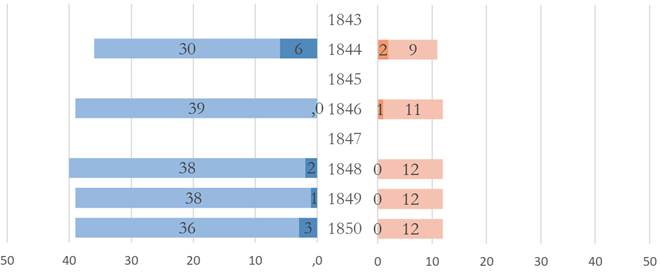 Source: Elaborated based on
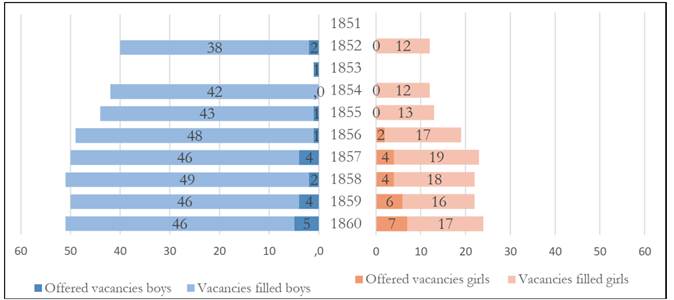 Source: Elaborated based on
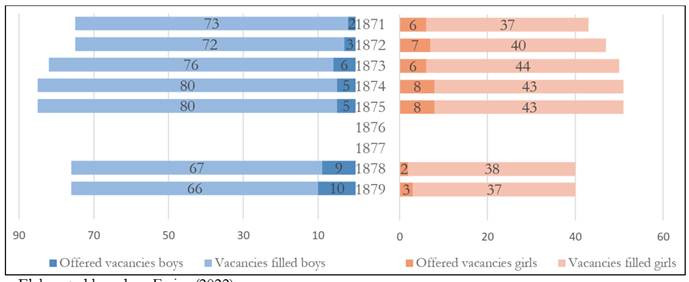 Source: Elaborated based on
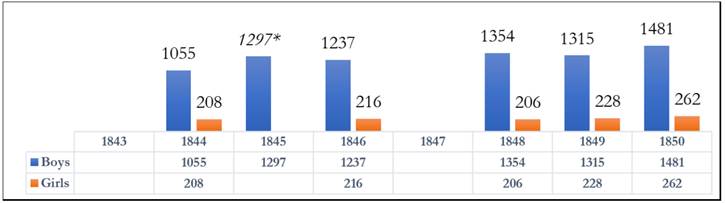 Source: Adapted from
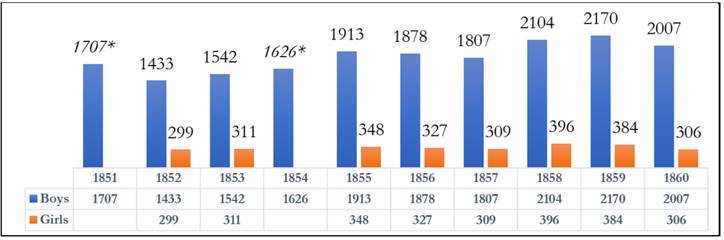 Source: Adapted from
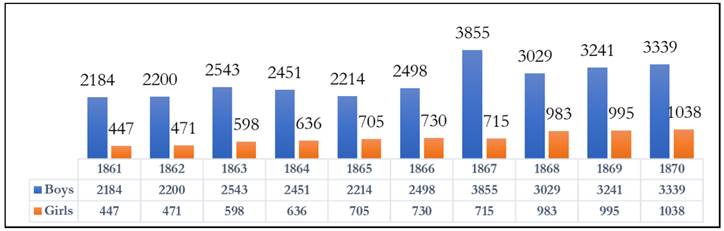 Source: Adapted from