
 Reading and Mathematical Skills and their Relationship with Problem-Solving Competencies
Abstract
Reading and mathematical skills are among the fundamental objectives of education at all levels, from Elementary to Higher Education. However, the increasing reliance on digital technologies for information processing and calculation may be altering how these essential abilities are cultivated and sustained. Mastery of these basic skills is also linked to the expression of other, more specialized professional competencies. This study aimed at characterizing the relationship between proficiency in reading and mathematics and the manifestation of administrative problem-solving competencies among Higher Education students. A total of 946 Administrative Sciences undergraduate students took part in the study. Reading, mathematical and administrative problem-solving competencies were assessed using standardized instruments developed and validated by expert judges. The results confirmed positive and significant correlations between mastery of basic academic skills and the manifestation of management-related problem-solving competencies.
Keywords:
reading skills; mathematical skills; management skills; administrative problem-solving competencies; higher education
Resumo
As habilidades de leitura e matemática estão entre os objetivos fundamentais da educação em todos os níveis, do ensino primário ao superior. No entanto, a crescente dependência das tecnologias digitais para o processamento de informações e cálculos pode estar alterando a forma como essas habilidades essenciais são desenvolvidas e mantidas. O domínio dessas competências básicas também está associado à manifestação de outras competências profissionais mais especializadas. Este estudo teve como objetivo caracterizar a relação entre a proficiência em leitura e matemática e a manifestação de competências administrativas de resolução de problemas entre estudantes do ensino superior. Participaram da pesquisa 946 estudantes de graduação em ciências administrativas. As habilidades de leitura, matemática e resolução de problemas administrativos foram avaliadas por meio de instrumentos padronizados, desenvolvidos e validados por juízes especialistas. Os resultados confirmaram correlações positivas e significativas entre o domínio das habilidades acadêmicas básicas e a manifestação de competências de resolução de problemas relacionadas à gestão.
Palavras-chave:
habilidades para leitura; competência matemática; gestão; tomada de decisão; educação superior
Resumen
Las habilidades de lectura y matemáticas figuran entre los objetivos fundamentales de la educación en todos los niveles, desde la escuela primaria hasta la educación superior. Sin embargo, la creciente dependencia de tecnologías digitales para el procesamiento de información y los cálculos puede estar modificando la forma en la que estas se desarrollan y mantienen capacidades esenciales. Dominar estas habilidades básicas también se asocia con la manifestación de otras competencias profesionales más especializadas. Este estudio tuvo como objetivo caracterizar la relación entre la competencia en lectura y matemáticas y la manifestación de habilidades administrativas para la resolución de problemas en estudiantes de educación superior. En la investigación participaron 946 estudiantes de grado en ciencias administrativas. Las habilidades de lectura, matemáticas y resolución de problemas administrativos se evaluaron mediante instrumentos estandarizados, desarrollados y validados por jueces expertos. Los resultados confirmaron correlaciones positivas y significativas entre dominar las habilidades académicas básicas y la manifestación de competencias de resolución de problemas vinculadas a la gestión.
Palabras clave:
habilidades de lectura; habilidades matemáticas; habilidades de gestión; habilidades de resolución de problemas; educación superior
Basic reading and mathematical skills have accompanied humanity throughout educational history. It is not precisely known when their introduction into educational systems began, or whether the first schools already considered them part of their teaching structure. Historical accounts indicate that early educational institutions were oftentimes focused on practical or philosophical training-preparing artisans, blacksmiths, musicians or philosophers-rather than on systematic literacy or numeracy. However, as education became formalized and generalized, writing, reading and calculation emerged as universal foundations for intellectual and professional development (Bruner, 1960; Piaget, 1972; Vygotsky, 1978). These abilities represent the earliest forms of symbolic reasoning and remain essential for acquiring and transmitting knowledge across generations.
These foundational abilities comprise the basis of cognitive development, as they activate abstraction, logical reasoning and memory consolidation processes. From a cognitive-psychology perspective, reading and mathematical learning foster the integration of linguistic and symbolic representations within working memory and executive control systems (Baddeley & Hitch, 1974; Miyake et al., 2000; Sternberg, 1985). Such mechanisms enable individuals to transfer basic academic skills to higher-order reasoning and problem-solving competencies.
Throughout history, humanity has continually sought to improve the means of processing and communicating information. Reading, writing and calculation have played central roles in these advances, enabling creation and refinement of technologies such as the printing press, the abacus and, later in time, mechanical and electrical calculators. The 20thcentury marked a revolution in information exchange, with the rise of mass media, computers and digital systems, which diversified the ways in which language, numbers and knowledge could be stored, represented and transmitted (Dehaene, 1997; Perfetti, 1985). These transformations exponentially increased calculation capabilities and democratized access to information for people worldwide.
However, the development of new technologies and ease of access to information have also brought new challenges. Many individuals now replace reading habits with online audiovisual content consumption, while heavy reliance on electronic devices has reduced opportunities for practicing mental arithmetic. Despite these trends, reading and mathematics continue to be recognized as the fundamental pillars of education, particularly at the Elementary and High School levels, serving as the basis to develop higher-order cognitive skills such as reasoning, abstraction and problem-solving (Sternberg, 1985; Sweller, 1988).
Consistently with this conception, multiple studies have explored the relationship between reading or mathematical mastery and broader academic competencies. For instance, a research study has addressed the importance of reading at the Higher Education level (Schüller-Zwierlein et al., 2022), the influence of reading habits on preservice teachers (Can & Biçer, 2021) and associations with musical perception (Partanen et al., 2022). Similarly, as for Mathematics, studies have examined its relationship with emotional control (Torppa et al., 2024) and with the development of linguistic and cognitive abilities (Al-Hrout et al., 2023).
Nevertheless, most of these studies focus on early education and general learning contexts, leaving unexplored how these foundational abilities relate to advanced professional competencies. There remains certain lack of empirical evidence connecting reading and mathematical proficiency to administrative or managerial skills, particularly problem-solving abilities that involve teamwork, communication and leadership in Higher Education settings. In particular, this research aimed at characterizing how mastery of these basic skills is associated with the manifestation of administrative problem-solving competencies expected in higher-level careers.
Literature Review
Multiple research studies are reported on the development of reading or mathematical skills in educational systems in different regions; however, it should be noted that a search carried out in the Scopus database for both variables identified a total of 7,300 related publications with reading and only 308 linked to mathematics in educational systems.
As can be seen, both topics are a research subject across all continents. Research on reading is reported in different geographical areas: Europe (Ferrara, 2023), America (Carvalho & Souza, 2023), Asia (Zahedi et al., 2022) and Africa (Phala & Hugo, 2022). A similar situation can be observed in research on mathematics, where results are also reported across different latitudes (Igarashi & Suryadarma, 2023).
From a cognitive-psychology perspective, reading performance is closely related to linguistic, metalinguistic and phonological-processing abilities, which depend on the efficiency of working memory and executive control (Perfetti, 1985; Baddeley & Hitch, 1974; Miyake et al., 2000; Stanovich, 1980). These mechanisms enable fluent decoding, semantic integration and inferential reasoning, linking reading proficiency to memory formation, critical thinking and higher-order problem-solving competencies.
Research on reading is developed from different perspectives, seeking to investigate the factors that condition their performance, among them those related to physical or psychological conditions, such as: fine motor skills (Buha et al., 2023); cerebral dominance (Li et al., 2022); presence of stuttering or deafness (Choo et al., 2023); or other conditioning characteristics of the environment, such as: household members’ literacy level, parents’ improvement mentality or genetic designs (Song et al., 2022; Wang et al., 2025).
Likewise, as for reading, its manifestation is explored in depth at different education levels, namely: Elementary School, High School or Higher Education; in addition to the influence exerted by the type of reading: biographical, historical or comics (Akhmetova et al., 2022; Sidhu et al., 2023; Talwar et al., 2023). Additionally, research is reported assessing the impact of reading on other skills, such as creativity, manifestation of highly talented students or musical skills (Bezerra et al., 2022; Kağan Keskin et al., 2022). In research on reading, measurement or diagnostic variables are used, such as fluency, vocabulary mastery, reading speed or time, or understanding (Persici et al., 2022; Sucena et al., 2022).
From a cognitive standpoint, mathematical reasoning activates overlapping memory and abstraction systems. Studies on numerical cognition demonstrate that learning mathematics engages working memory, visuospatial and executive processes that support analytical reasoning and problem-solving (Dehaene, 1997; Sweller, 1988). Therefore, mathematical competence can be interpreted as an applied expression of higher cognitive control and abstract thinking.
Regarding the development of mathematical skills, similarly, the variables that condition performance are delved into, namely: age, gender, manifestation of some type of disability (Pina et al., 2021). It is also delved into how these types of competencies can influence others, such as the development of musical skills (Spiller et al., 2023). Among the most evaluated variables to diagnose this type of ability, the most common is fluency in solving mathematical problems. Additionally, it is to be acknowledged that there are several research studies valuing mastery of reading and mathematical skills together (Spencer et al., 2022).
Specifically, regarding the analysis of the objective set for in this study, several surveys are reported that delve into aspects linking reading or mathematical skills to administrative sciences. In this sense, they highlight research assessing the influence of reading on the generation of leadership capacity, on the administrative skills of a minister and the ability to work in team (Peng et al., 2023), as well as the influence exerted by reading and mathematics on the ability to analyze, interpret and solve problems (Ruiz-Dotras & Lladós-Masllorens, 2022).
Administration as a science is generally defined based on two basic elements: the functions that comprise it (planning, organizing, leading and controlling) and the objectives intended to be achieved through the development of the administrative process. As a general rule, two types of fundamental objectives are recognized to which administrative processes are oriented: maintaining or improving what has been gained. To achieve either of these two goals, problem-solving techniques must be applied by identifying and analyzing the causes and the proposal and evaluation of improvement actions (García-Vidal et al., 2020). This process will be successful to the extent that it is the result of teamwork and of exercising leadership skills. These last aspects will be those that will be used to evaluate administrative competencies.
Method
The following steps were followed to carry out the research:
Sample
A total of 946 students related to Administrative Sciences from three Higher Education institutions were selected as sample, considering that the study was carried out with an exploratory scope. In all cases, it was ensured that the students had completed at least 50% of their study plan to guarantee basic knowledge about Administrative Sciences. Likewise, an equitable gender composition was ensured, with 50% representation of both genders. The entire sample was aged between 20 and 26 years old.
Instruments
Reading Skills. The measurement of reading skills began with two basic questions: On a scale from one to ten, To what extent do you consider you have the habit of reading?; and How many books, without considering those of a teaching nature, do you remember having read?
In addition to these initial questions, each of the subjects under study was offered a seven-page text and an excerpt from a universal literature book. They were requested to read them both aloud and in a low voice. After this reading, they were asked to prepare and read a summary of what they had read. The following variables were measured with this exercise: Reading time; Reading fluency; Reading intonation and respect for punctuation marks; Synthesis capacity; Text memory or retention; and Vocabulary mastery or breadth.
The last four variables were evaluated on a scale from 1 to 10 by the three of the research team members, taking the mean of all three assessments issued for each of the subjects under study as the total value.
For each individual, a general reading ability indicator was established, determined as the mean evaluation of each of the variables under analysis. To assess reading time in each individual, the determined variable was modified by normalizing the “time” variable and multiplying the value by 10 to equal the scale to that used in the rest of the variables.
Basic Mathematical Skills. In order to measure these skills, the subjects were presented with a battery of calculations with basic arithmetic operations containing figures from one to three digits. Additionally, a mathematical problem was presented that required constructing a system of two equations requesting the problem be modeled. Subsequently, the following variables were measured: Calculation time; Calculation precision; and Modeling effectiveness.
The same modification of the scale was used in the response time as in the reading habit. The other two variables were similarly assessed and averaged by the experts on a scale from 1 to 10. The comprehensive evaluation was constructed as the mean of the assessments of all three variables.
Skills in Administrative Sciences. In order to measure the basic Administrative Sciences skills, three general problems specific to these sciences were presented. Each of the participants was asked to perform an analysis of the causes that affected the desired state and, subsequently, to propose the solutions they considered relevant. The solution to the first problem was applied and evaluated individually; in turn, the solution to the other two problems was applied as a team. The teams consisted of 5 to 7 members. In the second problem, the teams were made up of individuals with similar evaluations in reading and mathematical skills (homogeneous groups). In the third problem, the teams had individuals with different evaluations regarding the skills under analysis (heterogeneous groups).
The following variables were measured in each of the problem-solving cases: Response time; Number of causes identified; Number of solutions proposed; Identification of relationships between causes; Relevance of the solutions; Feasibility of the solutions; Ability to present results; and Ability to defend proposals.
For the comprehensive evaluation of these variables, the same method as in the previous cases was applied. On this occasion, the same transformation method used for the “time” variable was applied to the “number of causes” and “number of solutions” variables.
In the cases where problems were analyzed in teams, it was identified who stood out as a leader in the analysis and who was selected to present the results. The same indicators were applied to all team analyses.
Administrative problem-solving competencies were intentionally assessed at the group level to reflect the authentic administrative practice dynamics, where most problem-solving activities take place in collaborative settings. This design allowed evaluating collective performance dimensions-leadership, coordination, communication and integration of diverse perspectives-that would not emerge in purely individual tasks. Therefore, the group-based analysis was not only methodological but also conceptual, aligning the assessment with real-world administrative functioning.
Procedure
Data Collection. In order to develop the measurements, a working group was assembled consisting of five PhDs in the Administrative Sciences field, all with more than 12 years of experience in teaching and research at Higher Education institutions. To carry out the measurements, participation of three of the members from the team assembled was ensured in all cases. This team was in charge of applying the instruments described, carrying out the exercises indicated with the students’ participation and, in addition, using the measurement scales explained above.
Data Analysis. The information collected was processed through the IBM SPSS Statistical Program for Social Sciences (version 25), starting at the descriptive level through the analysis of central tendency statistics (mean and median) and dispersion through standard deviations and ranges. In addition, the evaluation as for the existence of normal distribution through the asymmetry and kurtosis analysis was further complemented by applying the Kolmogorov-Smirnov normality test.
At the group level of the analysis, the Chi square test was applied to verify the existence of significant differences between the means of the groups assembled. At this level, Pearson’s r2 correlation coefficient was also evaluated to analyze the correlation between the three dimensions studied and a discriminant analysis with the dimensions that were assessed. The results of this process were also evaluated through the Chi test square across the groups.
Finally, the existence of relationships between the groups was evaluated through a Structural Equations Model to analyze the correlation level between the dimensions and variables under analysis. The different model fit evaluation indicators were considered to verify validity of the model.
Ethical Considerations
All ethical procedures for research involving human participants were duly adopted and respected throughout the study. Participation was limited to university students aged at least 18 years old. The research did not involve clinical procedures, biomedical experimentation, collection of biological samples or sensitive personal data processing. No confidential or personally identifiable information was collected, as the participants answered the questionnaires anonymously. All respondents participated voluntarily after being informed about the study purpose and accepting that the results would be published under anonymity conditions. AS the study was observational, non-interventional and involved minimal risk, formal ethical review was not required under the Ecuadorian regulatory framework applicable to research involving human participants. Nevertheless, all procedures were conducted in accordance with internationally recognized ethical principles, particularly those set forth in the Declaration of Helsinki (2013 revision), paying special attention to voluntary participation, privacy, confidentiality and data protection.
Results
From the two basic questions asked, it was possible to establish that only 22.3% of the study subjects stated having certain development degree as for the reading habit, where only 8.0% had read more than 10 books, 7.0% between 5 and 10 books and the rest, not more than 5 general culture books. The first-measurement results for each variable are shown in Table 1.
As can be seen, the skills evaluated are distributed throughout the entire scale applied, showing an average that ranges between 4.30 (Management skills) and 5.64 (Synthesis capacity), which is interpreted as acceptable behavior. Similarly, a representation of all values is observed in most ranges, except for Reading skills (7.34) and Management skills (5.80).
The asymmetry indicators signal that the distributions followed by the different variables tend to concentrate on the values on the left or right, without distinction. Similarly, the kurtosis values indicate no manifestation of normal distribution, showing values other than zero in all cases.
All the variables presented a behavior corresponding to leptokurtic kurtosis, as they had negative values in all cases. This indicates the existence of peaks higher than normal distribution and with scarce values in both tails. The manifestation of non-normal distributions was verified through the Kolmogorov-Smirnov test, where the significance of all variables was p < .001.
To further examine the influence of baseline abilities, the homogeneous groups were subdivided into two categories: (a) High-skill homogeneous groups, comprised by participants scoring one standard deviation above the overall mean in reading and mathematics, and (b) Low-skill homogeneous groups, with participants scoring one standard deviation below the mean. This subdivision enabled comparisons across three configurations-High-skill homogeneous, Low-skill homogeneous and Heterogeneous groups-allowing us to determine whether group composition or individual ability had a stronger association with collective performance. This design aimed at clarifying whether administrative performance was primarily determined by initial skill level or by the collaborative dynamics that arise in mixed-ability teams.
Table 2 presents the manifestation of administrative competencies across these three group configurations.
Administrative skills manifested in the Low-skill homogeneous, High-skill homogeneous and Heterogeneous groups (with exact Chi-square values)
The results show that the Low-skill homogeneous groups consistently achieved the lowest mean values across all indicators, whereas the High-skill homogeneous and Heterogeneous groups demonstrated higher, though statistically comparable, performance. These patterns indicate that heterogeneity benefits collective problem-solving by integrating complementary strengths among members with different skill profiles.
All Chi-square tests yielded statistically significant results (χ²=18.62-24.37, p < .001), confirming that both baseline ability and group composition significantly influence collective administrative performance.
During the group problem-solving sessions, participants who naturally emerged as leaders or communicators were identified in each team. In all cases, the ranking of each member’s mean reading and mathematical skill scores was considered, revealing that leaders and communicators typically occupied one of the top three positions-most frequently the first-within their respective groups.
These findings confirm that group heterogeneity enhances performance through collaborative dynamics and the interaction of individuals with diverse skill profiles, whereas homogeneous groups-particularly those with lower baseline abilities-tend to achieve weaker collective results.
Once the behavior of each variable in the skills evaluated was characterized (both individually and in groups), a correlation analysis was performed across the three dimensions assessed, as can be seen in Table 3. In this context, it is appreciated that both reading and mathematical skills present significant correlation levels with the development of administrative skills.
The previous results were validated through a canonical discriminant analysis, where the formation of two groups based on administrative skills (high and low performance) can be seen, based on the existence of both dimensions: Reading and Mathematics, each one represented by an axis or function. The Chi square test for this analysis continued to show significance at p < .001.
A canonical discriminant analysis (Figure 1) was performed to determine how the reading and mathematical skill dimensions differentiate between high- and low-performing administrative groups.
Two discriminant functions were obtained, jointly accounting for 87.3% of the total variance (Function 1: 65.2%; Function 2: 22.1%). As shown in the plot, the Low-skill homogeneous groups are clearly separated from the High-skill homogeneous and Heterogeneous groups, which occupy neighboring regions along the first canonical function. The analysis confirmed that both reading and mathematical proficiency significantly contributed to group separation (Wilks’ λ=0.412, χ²(4)=121.57, p < .001), validating that these dimensions reliably distinguish between performance levels in problem-solving tasks.
Finally, the Structural Equations Model was evaluated to assess the possible relationships among the three dimensions under analysis. The results are shown in Figure 2. As can be seen, correlation coefficients are presented between the dimensions under analysis, with slight predominance of reading skills over administrative skills, as reflected in the correlation degree between mathematical and administrative skills.
Table 4 shows the fit indicators for the model analyzed. In correspondence with which it can be stated that the relationships observed between the variables in analysis constitute a good model, considering that all adjustment indicators satisfy the parameters established, except for GFI (.821), which only achieves a permissible value (> .80), and RMSEA (.065), whose behavior is classified as moderate (.05-.10).
Discussion
The findings of this study align with foundational theories in Cognitive Psychology and Educational Science, which emphasize that mastery of reading and mathematical skills underpins higher-order thinking processes such as abstraction, inference and analytical reasoning. Classic perspectives from Piaget (1972), Burman (2021) and Vygotsky (1978) highlight that cognitive development and problem-solving capacity emerge from the interaction between linguistic and logical operations, both of which are reinforced through reading and mathematical practice (Stanovich, 1980). Likewise, Sternberg’s (1985) triarchic Theory of Intelligence, Sweller’s (1988) Theory of Cognitive Load and subsequent executive functioning (Miyake et al., 2000) and working memory (Baddeley & Hitch, 1974; Ericsson & Kintsch, 1995) models explain how individuals with stronger academic fluency and modeling skills exhibit more efficient information processing, enabling better reasoning and decision-making under complex conditions. Dehaene (1997) also established that numerical cognition is not only quantitative but conceptual, being part of the neural architecture that supports structured reasoning. Showing significant correlations between basic academic skills and administrative problem-solving competencies, the current results empirically support these theoretical models by demonstrating how foundational learning abilities remain central to advanced cognitive performance in Higher Education contexts.
These findings are also in line with Cognitive Psychology models which emphasize that reading and mathematical skills share a common foundation in working memory and executive functions. The efficiency of these systems eases information retention, abstraction and reasoning-core components of critical thinking and complex decision-making (Baddeley & Hitch, 1974; Miyake et al., 2000; Sternberg, 1985).
The associations identified in this study can be interpreted through the shared cognitive mechanisms that underlie linguistic and numerical processing. Reading and mathematical performance depend on the efficiency of working memory and executive control, which also support abstraction, inferential reasoning and analytical decision-making (Perfetti, 1985; Baddeley & Hitch, 1974; Miyake et al., 2000; Stanovich, 1980). These mechanisms help explain why higher proficiency in reading and mathematical is associated with stronger administrative problem-solving competencies, as all rely on the same cognitive architecture of controlled attention, reasoning flexibility and information integration.
Beyond corroborating previous findings, this research contributes a novel perspective by situating these associations within the context of Higher Education in Administrative Sciences. It demonstrates how basic academic abilities (typically studied in early learning) remain critical for the manifestation of professional competencies such as teamwork, leadership and decision-making. This applied approach extends cognitive theory into the management education domain, providing an integrative framework to understand the cognitive foundations of professional performance.
The current research contributes to the analysis of the association between reading and mathematical skills in Higher Education teaching, complementing previous studies conducted at this educational level (Sidhu et al., 2023; Talwar et al., 2023). The variables considered-such as fluency, vocabulary mastery, reading speed and comprehension-extend prior findings by demonstrating how these components jointly shape the efficiency of cognitive processing and the ability to synthesize and apply information. These dimensions correspond to mechanisms identified in the literature as essential for reading comprehension and problem-solving: fluency supports automatic decoding and processing speed; vocabulary breadth eases semantic integration and inferential reasoning; and comprehension links linguistic understanding to analytical decision-making (Miyake et al., 2000; Perfetti, 1985; Persici et al., 2022; Stanovich, 1980; Sucena et al., 2022). In this sense, the current study empirically situates these theoretical components within an applied, administrative context, revealing their association with teamwork, analytical reasoning and collective problem-solving.
These relationships should be interpreted as correlational rather than causal, as the study assessed existing competencies instead of longitudinal developmental processes. Accordingly, the interpretations herein presented aim at describing associative patterns between reading, mathematical and administrative skills, avoiding any inference of direct cause-effect relationships.
These explanatory mechanisms establish the cognitive basis for the relationships observed in this study, while the following section discusses how the analytical design applied empirically captured these associations.
Although regression-based approaches might estimate directional or predictive effects, the current research followed a correlational and exploratory design aimed at identifying associative relationships among existing competencies. The use of canonical discriminant analysis and Structural Equation Modeling (SEM) allowed for a multivariate examination of these associations, integrating the three skill dimensions-Reading, Mathematical and Administrative problem-solving-without implying any causality. These analytical techniques provided a comprehensive understanding of how cognitive and professional skills coexist and interact in group problem-solving contexts, consistently with the non-experimental nature of the data.
In methodological terms, regression analyses might indeed estimate predictive effects; however, the analytical framework of this study relied on canonical discriminant analysis and Structural Equation Modeling to examine the interdependence of competencies without assuming directional influence. SEM was preferred over traditional regression because it allows for a simultaneous estimation of multiple associative paths and captures shared variance among constructs, thereby offering a more comprehensive representation of the relationships observed.
The results achieved are in consonance to those presented by previous research relating reading and mathematical skills to competencies demanded in Administrative Sciences, such as creativity, leadership capacity, teamwork and the ability to analyze, interpret and solve problems (Bezerra et al., 2022; Peng et al., 2023; Ruiz-Dotras & Lladós-Masllorens, 2022). However, the manifestation of administrative competencies in group contexts may also depend on additional variables that were not directly examined in this study, including communication quality, social cohesion, leadership emergence and prior collaborative experience. These contextual factors might influence how groups integrate diverse individual abilities and should be addressed in future research to determine their relative contribution to administrative performance.
The results obtained in this research are derived from a specific sample that may not be representative of all contexts. Moreover, basic administrative functions such as planning, organization and control were not included as analysis dimensions. Similarly, sociodemographic variables like gender, socioeconomic background or area of residence were not explored either. These aspects represent important avenues for future studies aiming to expand the explanatory framework of administrative problem-solving.
Overall, the findings demonstrate consistent and positive associations between reading and mathematical skills and the manifestation of administrative problem-solving competencies. These relationships illustrate how fundamental academic abilities interact with higher-order cognitive and collaborative processes in group problem-solving contexts. This interpretation aligns with theoretical cognitive and educational development models, highlighting the integrative role of linguistic and mathematical proficiency in supporting analytical and organizational performance in Higher Education.
Interpretation of the findings is limited by the correlational and cross-sectional nature of the study. The relationships observed should not be understood as evidence of causality or developmental processes but as associations among existing competencies. Unmeasured factors such as motivation, teamwork experience or individual cognitive styles may also have influenced these patterns. Future studies should incorporate these variables to strengthen the explanatory framework.
Another limitation concerns the absence of general intelligence, logical reasoning or fluid cognitive ability measures, which could have provided a broader understanding of the shared variance among cognitive skills. Incorporating such indicators into future research would enable control for overarching cognitive factors and determine whether these mechanisms mediate or moderate the associations identified among reading, mathematical and administrative competencies.
Overall, the findings not only demonstrate consistent and positive associations among the competencies under study but also extend the existing evidence by linking cognitive mechanisms traditionally explored in early education to professional problem-solving contexts.
The study confirmed significant and positive associations between reading and mathematical skills and the manifestation of administrative problem-solving competencies among Higher Education students (r=.61-.69, p < .01). These findings bridge Cognitive Psychology and Management Education by empirically demonstrating that linguistic and numerical proficiency comprise the cognitive foundation of professional competencies in collaborative problem-solving contexts. Students with greater fluency, comprehension and modeling ability consistently presented stronger analytical reasoning, teamwork, leadership and communication abilities during group tasks.
The relationships identified in this research should be understood as associative patterns among existing competencies rather than as evidence of developmental or causal processes. The findings provide empirical support for cognitive and educational theories that connect linguistic and numerical proficiency to higher-order executive and collaborative functions.
From an applied perspective, these outcomes underscore the importance of strengthening foundational academic abilities within professional education programs in Administrative Sciences, where effective problem-solving depends on the integration of analytical and communicative capacities in team-based contexts.
Nevertheless, certain limitations must be acknowledged. The sample was restricted to students attending administrative programs, and relevant variables such as general intelligence, personality traits and communication quality were not included. Future research should employ longitudinal and multivariate designs to explore how basic cognitive abilities interact with contextual and interpersonal factors in shaping professional competencies.
References
-
Akhmetova, A., Imambayeva, G., & Csapó, B. (2022). Reading strategies and reading achievement in middle school: Kazakhstani young learners. SAGE Open, 12(3), 1-15. https://doi.org/10.1177/21582440221113843
» https://doi.org/10.1177/21582440221113843 -
Al-Hrout, M. A. E., Ababneh, S., Al-Swalha, A. S. M., Al Homran, M. K. M., & Eyadat, H. M. (2023). Effectiveness of reading & math initiative on the development of language & computational skills among early grade students: From teachers’ standpoint. International Journal of Education and Practice, 11(2), 207-217. https://doi.org/10.18488/61.v11i2.3301
» https://doi.org/10.18488/61.v11i2.3301 - Baddeley, A. D., & Hitch, G. (1974). Working memory. In G. A. Bower (Ed.), The psychology of learning and motivation (Vol. 8, pp. 47-89). Academic Press.
-
Bezerra, R. L. M., Alves, R. J. R., & Azoni, C. A. S. (2022). Creativity and its relationship with intelligence and reading skills in children: An exploratory study. Psicologia: Reflexao e Critica, 35, 17. https://doi.org/10.1186/s41155-022-00221-3
» https://doi.org/10.1186/s41155-022-00221-3 - Bruner, J. S. (1960). The process of education Harvard University Press.
-
Buha, N. S., Banković, S. M., & Gligorović, M. G. (2023). The relationship between reading skills and fine motor abilities in younger school-age children. Specijalna Edukacija i Rehabilitacija, 22(2), 149-165. https://doi.org/10.5937/specedreh22-41085
» https://doi.org/10.5937/specedreh22-41085 - Burman, J. T. (2021). The genetic epistemology of Jean Piaget. In W. Pickren, P. Hegarty, C. Logan, W. Long, P. Pettikainen, & A. Rutherford (Eds.), Oxford research encyclopedia of the history of modern psychology Oxford University Press.
-
Can, F., & Biçer, N. (2021). An examination of relationship between preservice teachers’ reading habits and critical reading skills. Journal of Language and Linguistic Studies, 17(1), 615-627. https://files.eric.ed.gov/fulltext/EJ1294709.pdf
» https://files.eric.ed.gov/fulltext/EJ1294709.pdf -
Carvalho, M. G. M., & Souza, A. C. (2023). Reading assessment in Brazil between the years 2014-2020: Instruments and skills. Educação e Pesquisa, 49, e259865. https://doi.org/10.1590/S1678-4634202349259865ENG
» https://doi.org/10.1590/S1678-4634202349259865ENG -
Choo, A. L., Greenberg, D., Li, H., & Talwar, A. (2023). Rate of stuttering and factors associated with speech fluency characteristics in adult struggling readers. Journal of Learning Disabilities, 53(1), 7-24. https://doi.org/10.1177/00222194221095265
» https://doi.org/10.1177/00222194221095265 - Dehaene, S. (1997). The number sense: How the mind creates mathematics Oxford University Press.
-
Ericsson, K. A., & Kintsch, W. (1995). Long-term working memory. Psychological Review, 102(2), 211-245. https://doi.org/10.1037/0033-295X.102.2.211
» https://doi.org/10.1037/0033-295X.102.2.211 -
Ferrara, D. (2023). Learning to read ancient greek at school: Where ancient language learning meets contemporary behaviourism. Boletim de Estudos Classicos, 68, 191-230. https://doi.org/10.14195/2183-7260_68_9
» https://doi.org/10.14195/2183-7260_68_9 -
García-Vidal, G., Sánchez-Rodríguez, A., Pérez-Campdesuñer, R., & Martínez-Vivar, R. (2020). Analysis of the interrelationships between KPIs in a small business through temporal causal models. International Journal of Advanced Operations Management, 12(1), 81. https://doi.org/10.1504/IJAOM.2020.107519
» https://doi.org/10.1504/IJAOM.2020.107519 -
Igarashi, T., & Suryadarma, D. (2023). Foundational mathematics and reading skills of Filipino students over a generation. International Journal of Educational Development, 96, 102688. https://doi.org/10.1016/j.ijedudev.2022.102688
» https://doi.org/10.1016/j.ijedudev.2022.102688 -
Kağan Keskin, H., Karadağ, Ö., & Serdar Köksal, M. (2022). Examining effectiveness of rapid automatized naming and reading skills in identifying gifted students. Journal of Cognitive Education and Psychology, 21(1), 64-79. https://doi.org/10.1891/JCEP-2021-0006
» https://doi.org/10.1891/JCEP-2021-0006 -
Li, S., Hanafiah, W., Rezai, A., & Kumar, T. (2022). Interplay between brain dominance, reading, and speaking skills in English classrooms. Frontiers in Psychology, 13, 798900. https://doi.org/10.3389/fpsyg.2022.798900
» https://doi.org/10.3389/fpsyg.2022.798900 -
Miyake, A., Friedman, N. P., Emerson, M. J., Witzki, A. H., Howerter, A., & Wager, T. D. (2000). The unity and diversity of executive functions and their contributions to complex “frontal lobe” tasks: A latent variable analysis. Cognitive Psychology, 41(1), 49-100. https://doi.org/10.1006/cogp.1999.0734
» https://doi.org/10.1006/cogp.1999.0734 -
Partanen, E., Kivimäki, R., Huotilainen, M., Ylinen, S., & Tervaniemi, M. (2022). Musical perceptual skills, but not neural auditory processing, are associated with better reading ability in childhood. Neuropsychologia, 169, 108189. https://doi.org/10.1016/j.neuropsychologia.2022.108189
» https://doi.org/10.1016/j.neuropsychologia.2022.108189 -
Peng, W., Li, W., & Hu, Y. (2023). Leader-generator net: Dividing skill and implicitness for conquering FairytaleQA. SIGIR ‘23: Proceedings of the 46th International ACM SIGIR Conference on Research and Development in Information Retrieval, 791-801. https://doi.org/10.1145/3539618.3591710
» https://doi.org/10.1145/3539618.3591710 - Perfetti, C. A. (1985). Reading ability Oxford University Press.
-
Persici, V., Majorano, M., Bastianello, T., & Hoff, E. (2022). Vocabulary and reading speed in the majority language are affected by maternal language proficiency and language exposure at home: A study of language minority bilingual children in Italy. International Journal of Bilingual Education and Bilingualism, 25(10), 3729-3744. https://doi.org/10.1080/13670050.2022.2076552
» https://doi.org/10.1080/13670050.2022.2076552 -
Phala, T. A., & Hugo, A. (2022). Difficulties in teaching Grade 3 learners with reading problems in full-service schools in South Africa. African Journal of Disability, 11 https://doi.org/10.4102/ajod.v11i0.906
» https://doi.org/10.4102/ajod.v11i0.906 - Piaget, J. (1972). The principles of genetic epistemology (W. Mays, Trans.). Routledge & Kegan Paul. (Original work published 1970)
-
Pina, V., Martella, D., Chacón-Moscoso, S., Saracostti, M., & Fenollar-Cortés, J. (2021). Gender-based performance in mathematical facts and calculations in two elementary school samples from Chile and Spain: An exploratory study. Frontiers in Psychology, 12 https://doi.org/10.3389/fpsyg.2021.703580
» https://doi.org/10.3389/fpsyg.2021.703580 -
Ruiz-Dotras, E., & Lladós-Masllorens, J. (2022). Entrepreneurial self-efficacy and financial and calculation skills can shape different profiles of venture intentions. Journal of Entrepreneurship, 31(1), 153-183. https://doi.org/10.1177/09713557211069319
» https://doi.org/10.1177/09713557211069319 -
Schüller-Zwierlein, A., Mangen, A., Kovač, M., & van der Weel, A. (2022). Why higher-level reading is important. First Monday, 27(9). https://firstmonday.org/ojs/index.php/fm/article/view/12770/11081
» https://firstmonday.org/ojs/index.php/fm/article/view/12770/11081 -
Sidhu, G. K., Ruofei, D., & Nawi, S. M. (2023). Enhancing postgraduate students’ reading skills via the Pedagogy-Andragogy-Heutagogy (PAH) continuum training programme. Asian Journal of University Education, 19(4), 728-742. https://doi.org/10.24191/ajue.v19i4.23985
» https://doi.org/10.24191/ajue.v19i4.23985 -
Song, Y., Barger, M. M., & Bub, K. L. (2022). The association between parents’ growth mindset and children’s persistence and academic skills. Frontiers in Education, 6, 791652. https://doi.org/10.3389/feduc.2021.791652
» https://doi.org/10.3389/feduc.2021.791652 -
Spencer, M., Fuchs, L. S., Geary, D. C., & Fuchs, D. (2022). Connections between mathematics and reading development: Numerical cognition mediates relations between foundational competencies and later academic outcomes. Journal of Educational Psychology, 114(2), 273-288. https://doi.org/10.1037/edu0000670
» https://doi.org/10.1037/edu0000670 -
Spiller, J., Clayton, S., Cragg, L., Johnson, S., Simms, V., & Gilmore, C. (2023). Higher level domain specific skills in mathematics; The relationship between algebra, geometry, executive function skills and mathematics achievement. PLoS ONE, 18(11), e0291796. https://doi.org/10.1371/journal.pone.0291796
» https://doi.org/10.1371/journal.pone.0291796 -
Stanovich, K. E. (1980). Toward an interactive-compensatory model of individual differences in the development of reading fluency. Reading Research Quarterly, 16(1), 32-71. https://doi.org/10.2307/747348
» https://doi.org/10.2307/747348 - Sternberg, R. J. (1985). Beyond IQ: A triarchic theory of human intelligence Cambridge University Press.
-
Sucena, A., Marques, C., Silva, A., & Carneiro, J. F. (2022). Reading fluency of higher education students. Paideia, 32, e3240. https://doi.org/10.1590/1982-4327e3240
» https://doi.org/10.1590/1982-4327e3240 -
Sweller, J. (1988). Cognitive load during problem solving: Effects on learning. Cognitive Science, 12(2), 257-285. https://doi.org/10.1207/s15516709cog1202_4
» https://doi.org/10.1207/s15516709cog1202_4 -
Talwar, A., Magliano, J. P., Higgs, K., Santuzzi, A., Tonks, S., O’Reilly, T., & Sabatini, J. (2023). Early academic success in college: Examining the contributions of reading literacy skills, metacognitive reading strategies, and reading motivation. Journal of College Reading and Learning, 53(1), 58-87. https://doi.org/10.1080/10790195.2022.2137069
» https://doi.org/10.1080/10790195.2022.2137069 -
Torppa, M., Aro, T., Eklund, K., Parrila, R., Eloranta, A.-K., & Ahonen, T. (2024). Adolescent reading and math skills and self-concept beliefs as predictors of age 20 emotional well-being. Reading and Writing, 37, 2075-2099. https://doi.org/10.1007/s11145-023-10461-z
» https://doi.org/10.1007/s11145-023-10461-z - Vygotsky, L. S. (1978). Mind in society: The development of higher psychological processes Harvard University Press.
-
Wang, Q., Ma, M., Shi, Y., Li, M., & Wang, T. (2025). Modeling the relationships among home literacy environment, reading interest, self-regulation, and reading ability of children with intellectual disabilities in China. International Journal of Developmental Disabilities, 71(2), 246-255. https://doi.org/10.1080/20473869.2023.2230411
» https://doi.org/10.1080/20473869.2023.2230411 -
Zahedi, S., Iyer, A., Jaffer, R., Shenoy, S., & Shourie, R. (2022). A systems approach to improving foundational reading skills at a preschool in India. Education Sciences, 12(12), 878. https://doi.org/10.3390/educsci12120878
» https://doi.org/10.3390/educsci12120878
-
Support:
This research received no external funding.
-
Data Availability
The datasets generated and/or analyzed during the current study are available from the corresponding author on reasonable request.
-
How to cite this article:
Pérez-Campdesuñer, R., Sánchez-Rodríguez, A., García-Vidal, G., Miguel-Guzmán. M., & Martínez-Vivar, R. (2026). Reading and Math Skills and Their Relationship with Problem-Solving Competencies. Paidéia (Ribeirão Preto), 36, e3612. https://doi.org/10.1590/1982-4327e3612
The datasets generated and/or analyzed during the current study are available from the corresponding author on reasonable request.

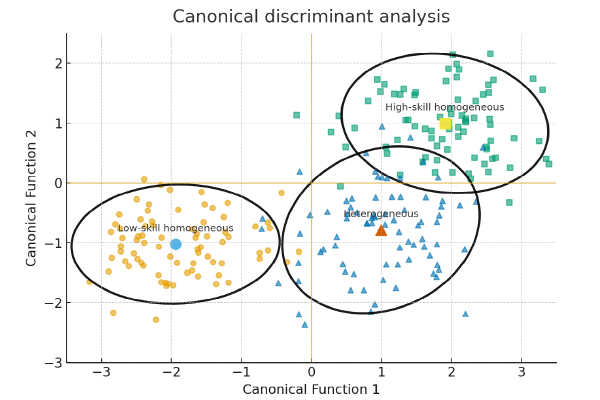 Note. Simulated canonical scores illustrating separation among the Low-skill homogeneous, High-skill homogeneous and Heterogeneous groups based on reading and mathematical proficiency. The ellipses depict 95% concentration regions around group centroids. Reported statistics in the text: Wilks’ λ=0.412, χ²(4)=121.57, p < .001.
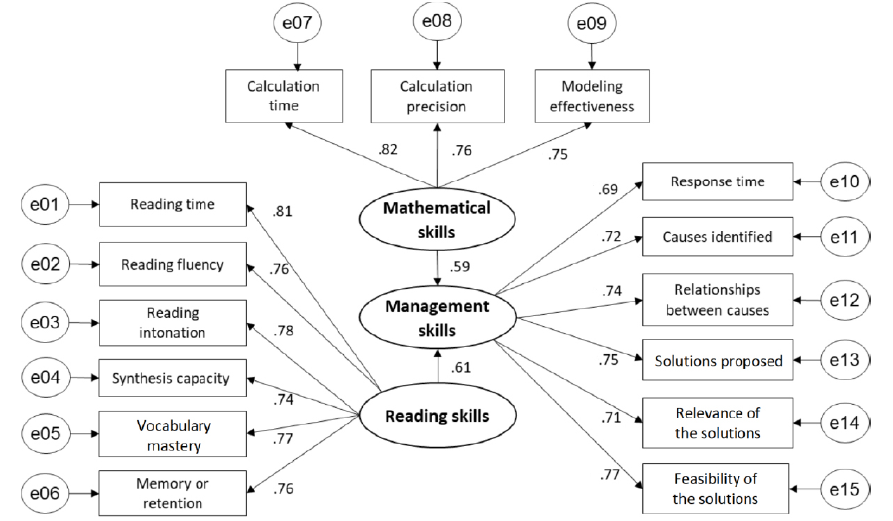 Note. Output from IBM SPSS AMOS 25 showing the relationships among reading, mathematical and administrative skills. All standardized paths were significant (p < .01), confirming adequacy of the model proposed (χ²/df=2.06; CFI=.896; AGFI=.821; RMSEA=.065).