 The non-invariant time and Lorentz-like transformations
Abstract
From the comparison of time in inertial frames, possible types of transformations between inertial frames are deduced. This elementary deduction directly relates the properties of time with the type of transformations. When all inertial frames measure the same time (time is absolute), the transformations are Galilean. When each inertial frame has its own time, different from the times of other inertial frames (time is not invariant) the transformations are Lorentz-like with the same positive parameter k. The parameter k is the supremum of possible velocities in an inertial frame, the same for all inertial frames. Einsteins postulate about the invariance of the speed of light says more: there is a uniform motion with the supremum k, which is exactly the motion of light in a vacuum. At the end of the article, attempts to reduce the special theory of relativity to the principle of relativity are criticized.
Keywords:
Time; Lorentz-like transformations; the relativity principle; the invariance of the speed of light
Resumo
Da comparação do tempo em referenciais inerciais, deduzem-se possíveis tipos de transformações entre referenciais inerciais. Esta dedução elementar relaciona diretamente as propriedades do tempo com o tipo de transformações. Quando todos os referenciais inerciais medem o mesmo tempo (o tempo é absoluto), as transformações são galileanas. Quando cada referencial inercial tem seu próprio tempo, diferente dos tempos de outros referenciais inerciais (o tempo não é invariante), as transformações são do tipo Lorentz com o mesmo parâmetro positivo k. O parâmetro k é o supremo das velocidades possíveis em um referencial inercial, o mesmo para todos os referenciais inerciais. O postulado de Einstein sobre a invariância da velocidade da luz diz mais: há um movimento uniforme com o supremo k, que é exatamente o movimento da luz no vácuo. No final do artigo, são criticadas as tentativas de reduzir a teoria da relatividade especial ao princípio da relatividade.
Palavras-chave:
Tempo; transformações do tipo Lorentz; o princípio da relatividade; a invariância da velocidade da luz
1. Introduction
Since its very birth [1], the special theory of relativity (STR) has captured attention and imagination with its unusual predictions that contradict our experiential and educationally learned understanding of reality. This primarily refers to the concepts of space and time. STR is based on three physical phenomena: the movement of free particles, the passage of time, and light. Einstein based STR on two postulates, the principle of relativity (the laws of physics are the same in all inertial frames) and the invariance of the speed of light (in a vacuum, light has the same uniform speed in all inertial frames). Since the postulates refer to inertial frames, in the logical deduction of the theory, assumptions about inertial frames must also be present. The standard assumptions are as follows. In each inertial frame (IF below), clocks can be synchronized, thus determining the time of the IF, while the space of the IF is Euclidean space. In each IF, free particles move uniformly in a straight line. In each IF, the laws of physics are invariant to time translation (time homogeneity), spatial translation (spatial homogeneity) and spatial rotation and reflection (spatial isotropy). Arguments for these assumptions about IFs are given in [2].1 In what follows, we will also need the invariance of the direction of time: the difference in the time coordinates of two events that are connected by the motion of a particle has the same sign in all IFs. Below we will distinguish between inertial frame and coordinate system. Inertial frame is a frame that allows us to identify events spatially and temporally. The same inertial frame can provide multiple coordinate systems for this identification.
In [1], Einstein deduced from his two postulates that transformations between IFs are Lorentz transformations. Later, Ignatowski [4] showed that from the very principle of relativity it can be deduced that the transformations between IFs are Galilean transformations or Lorentz-like transformations with some universal positive constant instead of the speed of light . From Ignatowski’s article until today, there has been a long series of articles in which the same result was derived in different ways and which in various ways deal with the role of the principle of relativity and invariance of the speed of light. One list of such articles can be found in [5, p. 1] or in the bibliography of [6]. Here I will provide an incomplete list that I will comment on in this article: [4, 5, 6, 7, 8, 9, 10, 11, 12, 13]. In these articles, the deductions are elementary, so they also have a pedagogical value. Moreover, some of these articles were written with a pedagogical value in mind [7, 8, 9, 10]. However, the authors mainly use these deductions as a basis for reducing the importance, even for eliminating, Einstein’s postulate on the invariance of the speed of light and giving priority to the principle of relativity [8, 9, 10, 12, 13]. Some authors are neutral on this issue, but only analyze what can be derived from the principle of relativity and how the resulting theory can be supplemented [4, 6, 10]. Analyzes in well-known books [14, 15, 16] also belong to this category. Some authors argue that such an approach is fundamentally incomplete in the sense that it lacks deeper principles that would complete the theory [5, 13]. The preoccupation with the question of the importance of the principle of relativity for STR is also reflected in the deductions themselves.
This article advocates an approach in which the invariance of the speed of light and the STR concept of time are central to the study and teaching of STR. In Section 2, we will deduce possible types of transformations between IFs by comparing times in IFs. Thus the deduction directly relates the properties of time with the type of transformations. The deduction is elementary, accessible to students who have mastered elementary algebra and calculus. Because it is based on the concept of time, the key characteristic of STR, and because of the aforementioned elementary nature, the deduction also has a pedagogical value. Searching the literature, I did not find a similar deduction. I assume that this is due to a different approach to the importance of the principle of relativity for STR. The deduction gives that it is the non-invariance of time that separates Galilean transformations from Lorentz-like transformations. The universal parameter that determines the Lorentz-like transformation is derived in a novel way. In the literature, it is usually intuitively accepted that the value of this constant cannot be deduced from the principle of relativity. At the end of the section, an informal proof from logic is given that this is indeed so. In Section 3, a critique of the attempts to reduce the theory of relativity to the principle of relativity is given.
2. The Deduction of Possible Types of Transformations Based on Time Comparison
We will deduce possible types of transformations between IFs by comparing times in IFs. In the deduction, we will use the above-mentioned assumptions about IF, the principle of relativity and the invariance of the direction of time. From the deduction follows the well-known result: the concept of time in STR — there is no absolute time, but each IF has its own time — separates Galilean transformations (absolute time of IFs) and Lorentz-like transformations (non-invariant time of each IF). We can express the non-invariance of time more precisely in several ways. Here we will express it as the statement that the time shown by a clock at rest in one IF is not equal to the time registered by (synchronized) clocks in another IF.
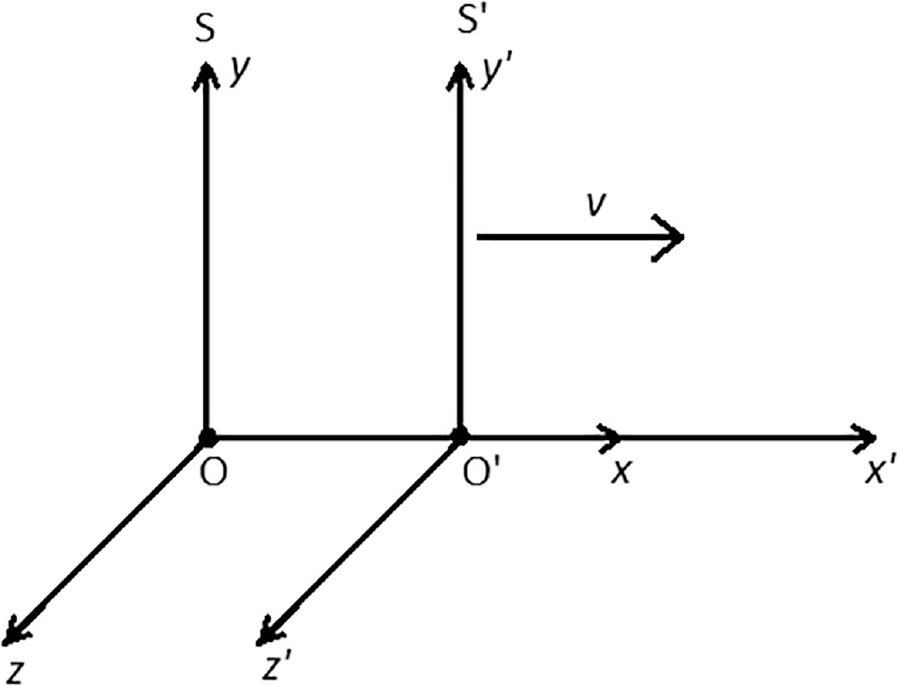
Due to the homogeneity of time, homogeneity and isotropy of space of each IF, without loss of generality we can choose for each IF a coordinate system so that they are simply connected, and consider only the transformations between them. We will choose the Cartesian coordinate systems in one IF and in the other IF in which the time measurement is chosen such that at the common zero moment their origins a well as coordinate axes coincide (Fig. 1).
The system moves with respect to in the positive direction of the x-axis at the speed v. For a given event, we are interested in how its coordinates in the system and in the system S are related.
From the coincidence of the coordinate axes at the common zero moment, space and time symmetries, and the principle of relativity, it can be obtained that and and that these coordinates do not affect the relationship between the remaining coordinates and (see e.g. [17, p. 58]). The relationship between and will be deduced below.
Considering that the free particle in each IF moves uniformly in a straight line (or is at rest), its equations of motion are linear equations in each IF. Since coordinate transformations map linear equations into linear equations, they themselves must be given by linearequations:
Given that the systems and are set so that their origins and x = 0 coincide at the moment , by putting these values in the equations, we get . Thus, the equations have the form
Let’s observe the motion of the origin of the system . For its spatial coordinates, in the system and in the system . Putting these expressions into Eq. (2) we will get
Let be the ratio of the time of the duration of the motion of the origin measured in the system and the elapsed time measured in the system by the clock at the origin :
It follows from the assumption of the direction of time invariance that . Putting the expression (4) in (3) we get
By dividing the equations by (which is not equal to zero except at the initial moment), we get two coefficients:
So now the equations of the coordinate transformations are of the form
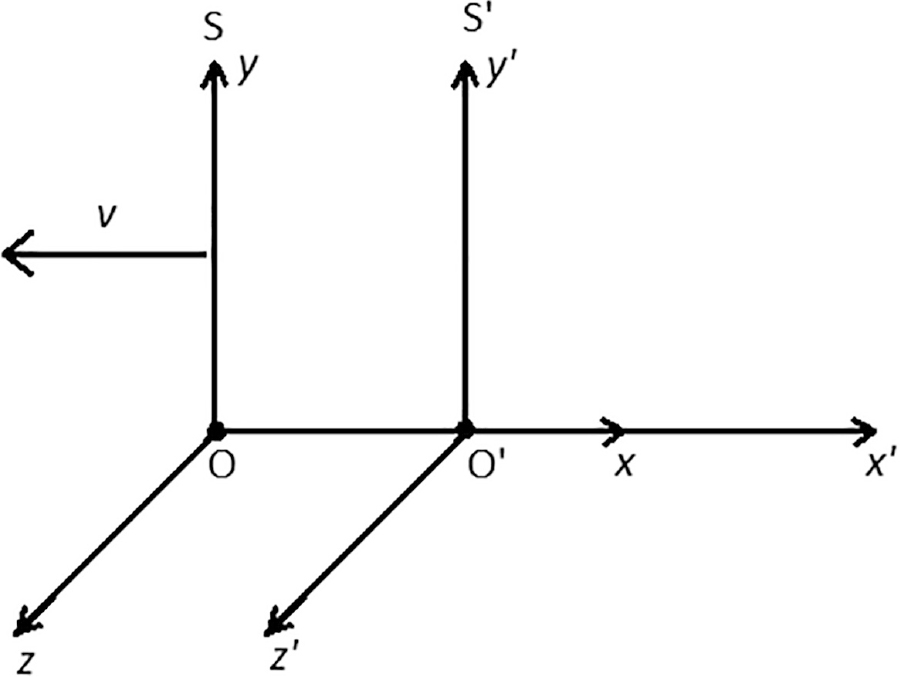
The remaining coefficients A and C will be obtained in a similar way by observing the motion of the origin O of the system S. According to the principle of relativity and isotropy of space, the system S moves in relation to the system at the same speed v with which the system moves in relation to the system S (Fig. 2).
For the spatial coordinates of the origin O, in the system and in the system . Putting these expressions into the equations of the coordinate transformations (7) we get
According to the principle of relativity and isotropy of space, the ratio of the time of the duration of the motion of the origin O measured in the system and the elapsed time measured in the system S by the clock at the origin O is equal to the ratio of time of the duration of the motion of the origin measured in the system and the elapsed time measured in the system by the clock in the origin :
Putting this expression in (8) we get
By dividing the equations by t (which is not equal to zero except at the initial moment), we get, after simplifying the equations, the remaining two coefficients:
Thus, we obtained the equations of the coordinate transformations in which only the mutual speed of motion v of the systems S and and the time ratio are present:
If we look at any clock in the system at a place and two moments and are read on it, in the system S these readings happened in moments
By subtracting these equations we get
Thus, we see that is the factor by which we must multiply the elapsed time measured at any clock in one IF in order to obtain the elapsed time measured in the other IF. Due to the homogeneity of space and time of IFs, is a constant for two IFs.
If (all IFs show the same absolute time) then (12) are classical Galilean transformations:
Thus, in the following, we will deal with another possibility: (each IF has its own time that differs from the time of other IFs).
The universal parameter that determines the transformations between IFs, as well as the expression for using this parameter, can be obtained by comparing the transformations between three IFs. This lucid argument originates from Ignatowski [4] and most authors later reproduce it in various ways [6, 7, 10, 11, 12].2 In the following, the existence of the universal parameter, its meaning, and the corresponding formula for will be derived in a novel way, by comparing the motion of particles in two IFs.
Let’s look at the uniform motion of a particle with speed in the system so that at the moment it was at the origin and moves in the positive direction of the axis. After the elapsed time the particle is at the location . According to (12), the elapsed time t measured in system S is
From the assumption that in every IF the change of time during particle motion has the same sign (invariance of the direction of time) it follows that . So,
If we repeat this consideration for a particle that moves uniformly with velocity in the system so that at the moment it was at the origin and moves in the negative direction of the axis (), we will get
that is,
Multiplying this inequality with the inequality (17) we get
that is,
This inequality shows that all velocities of uniform motions in the system are bounded from above. Then there is a supremum k of the set of all velocities of uniform motions in the system . According to the principle of relativity, this number must be the same for all IFs. It is an universal constant. According to the definition of instantaneous speed of motion, it is also the supremum of all instantaneous speeds of motion. Let’s call it the limit speed of motion. Based on the above considerations, we cannot claim that there is a uniform motion at that speed, but we have shown that there is no motion with a speed higher than the limit speed. Given that we can associate an IF with each free material (massive) particle, it follows from the well-known expression for derived below (equation 24) that the speed of the material particle is necessarily lower than the limit speed. Thus, motion with the limit speed, if it exists, must be motion of some special type.
From the equations of coordinate transformations (12), we can easily obtain an expression for the transformation of the speed of a movement in the system into its speed u in the system S:
By calculating the derivative with respect to of the right-hand side, we can easily see that this derivative is always positive, that is, that the right-hand side is an increasing function with respect to . This means that we will get the supremum of the right-hand side by putting the limit speed k in the right-hand side instead of . But k is also the supremum of the left side of the equation. Thus, applying the supremum for all speeds to the equation (22), we get
Solving this equation for we get that the solution exists only for . Therefore, (So far we only knew that is a positive number different from 1). For the solution is
We see that the factor between the two IFs depends only on their relative velocity.
Now we can simplify transformations between coordinates because the above expression for gives us that
Thus we have a final expression for the coordinate transformations – we have obtained Lorentz-like transformations:
The conclusion of the above deduction is that from the above-mentioned assumptions about IF, the principle of relativity and the invariance of the direction of time, it follows that the transformations between IF are Galilean or Lorentz-like transformations with the same positive parameter k. Transformations are Galilean precisely when all IFs measure the same time (time is absolute), and Lorentz-like precisely when each IF has its own time, different from the time of other IFs (the non-invariance of time).
The deduction also gives us that the constant positive parameter k in Lorentz-like transformations is the supremum of possible velocities in any IF. Thus, motions with a speed greater than k are not possible, and it is possible that there is a motion with a speed of k. Einstein’s postulate on the invariance of the speed of light says that there is a motion with a speed of k: it is precisely the motion of light (k is equal to the speed of light).3
It should be noted here that Einstein’s postulate is an idealization of experimental results. Experimental measurements of the speed of light, if for nothing else then at least due to the interaction with the experimental equipment, can only be performed in conditions that are close to a perfect vacuum but not in a perfect vacuum. Thus, the limit speed of motion k = c can be characterized as the supremum of experimentally determined speeds of light.
The above deduction shows that, with the mentioned background assumptions, the statement about the non-invariance of time is equivalent to the statement that the transformations between IF are Lorentz-like transformations with some positive parameter . This means that every choice of a positive parameter k gives a mathematical model in which the background assumptions are fulfilled and in which time is not IF-invariant. Einstein’s postulate on the invariance of the speed of light (as well as any other choice of a positive value for the universal constant ) determines only one of these models. We know from the definition of logical consequence in logic that this means that, with the background assumptions, Einstein’s postulate on the invariance of the speed of light (as well as any other choice of a positive value for ) does not follow from the assumption of the non-invariance of time, while the non-invariance of time follows from Einstein’s postulate on the invariance of the speed of light (as well as from any other choice of a positive value for ). Simply put, with the background assumptions, Einstein’s postulate on the invariance of the speed of light (as well as any other choice of a positive value for ) is a stronger condition than the non-invariance of time.
3. A Critique of Attempts to Reduce Special Theory of Relativity to the Principle of Relativity
As already mentioned in the introductory section, starting with the article by Ignatowski [4] there is a lasting series of articles dealing with the question of what can be derived from the principle of relativity alone. In these articles, the logical connections of various statements are more or less correctly established. However, the authors use this approach as a basis for reducing the importance, even for eliminating, Einstein’s postulate on the invariance of the speed of light. The following quote [7] is illustrative of such an approach:
[] I intend to criticise the overemphasized role of the speed of light in the foundations of special relativity, and to propose an approach to these foundations that dispenses with the hypothesis of the invariance of . By establishing special relativity on a property of the speed of light, one seems to link this theory to a restricted class of natural phenomena, namely, electromagnetic radiations. However, the lesson to be drawn from more than half a century is that special relativity up to now seems to rule all classes of natural phenomena,[]
[]
We believe that special relativity at the present time stands as a universal theory describing the structure of a common space-time arena in which all fundamental processes take place. All the laws of physics are constrained by special relativity acting as a sort of “super law”, and electromagnetic interactions here have no privilege other than a historical and anthropocentric one. Relativity theory, in fact, is but the statement that all laws of physics are invariant under the Poincaré group (inhomogeneous Lorentz group).
The following comment by Pauli [18, p. 11] illustrates a different view:
Nothing can naturally be said about the sign, magnitude and physical meaning of [ for Galilean transformations and for Lorentz-like transformations in the notation of this article]. From the group-theoretical assumption, it is only possible to derive the general form of the transformation formulae, but not their physical content.
Giving priority importance to the principle of relativity is also reflected in the approach to teaching STR. In [8, p. 119], Mermin writes: “There are pedagogical as well as conceptual advantages to eliminating light through its central role in relativity theory”. Sen [9, p. 157] states that the postulate about the invariance of the speed of light “appears to be counter-intuitive, almost magical, to most beginning students”, and that approaches via the principle of relativity are “philosophically more satisfying”. Of course, giving conceptual and philosophical priority to the principle of relativity in teaching STR is a consequence of the position of these authors that the principle of relativity is far more important than the invariance of the speed of light. Pedagogical reasons are more understandable and may be a reaction to the excessive emphasis on the revolutionary nature of STR, which Bondi [19, p. 225] has already warned against:
At first, relativity was considered shocking, anti-establishment and highly mysterious, and all presentations intended for the population at large were meant to emphasize these shocking and mysterious aspects, which is hardly conducive to easy teaching and good understanding. They tended to emphasize the revolutionary aspects of the theory whereas, surely, it would be good teaching to emphasize the continuity with earlier thought.
As for the deduction of Lorentz transformations, it should be noted that both the principle of relativity and electromagnetism are used to a very limited extent. The principle of relativity was applied only to uniform motions and to the behavior of clocks, while all we need from electromagnetism is the phenomenon of light. However, the principle of relativity itself tells us that the transformations between IFs are Galilean transformations or Lorentz-like transformations, but it cannot give us an answer to the key question: which of these transformations is the transformation between IFs? This fact devalues the claims of the authors that they have shown that the postulate of the existence of invariant speed is redundant, and especially the claim that the postulate of the invariance of the speed of light is redundant. For example, in [7] it is claimed that the principle of relativity gives “an almost unique solution to the problem”. Of course, the problem is in the word almost which leaves the possibility that the transformation is Galilean. In [8] it is claimed: “Thus, Einstein’s second postulate is a consequence of his first, if it is stated generally in terms of an invariant velocity rather then specifically in terms of the behaviour of light”. This claim includes the possibility that invariant speed can also be infinite speed, which is a term that has no meaning. In [9] it is claimed: “The kinematic results of the special theory of relativity are derived using only the first (Galilean) postulate and the results of one simple thought experiment.”. The theory presented in the article is not capable of separating the special theory of relativity from classical Galilean relativity. In [10] it is claimed: “Special relativity theory is traditionally established on the basis of the relativity postulate—the equivalence of inertial frames—together with Albert Einstein’s postulation of the constancy of the velocity of light. It is not widely appreciated that this ’second postulate’ is redundant.”. This claim from the abstract of the article is not proven in the article. In [12] it is claimed: “The existence of an invariant speed is not a necessary assumption and in fact is a consequence of the principle of relativity”. The fact is that this claim from the abstract of the article is not proven in the article. Against the aforementioned unproven claims about the redundancy of the postulate of invariant speed, even of the invariance of the speed of light, in [13] it is argued that the choice between two possibilities (Galilean versus Lorentz-like transformations) is not negligible but is “on the level of a postulate and that until we assume one or the other, we have an incomplete structure that leaves many fundamental questions undecided, including basic prerequisites of experimentation.”. It follows from the deduction in this article that the choice of Lorentz-like transformations is precisely the choice of non-invariance of time, the characteristic law of STR.
I believe that the insistence on the principle of relativity stems from the fact that the principle of relativity and the invariance of the speed of light together with the non-invariance of time are epistemologically fundamentally different. The principle of relativity is a universal principle that places limits on the laws of physics, while the invariance of the speed of light and the non-invariance of time are substantive laws of physics. This epistemological difference can be given an even more drastic formulation. The principle of relativity is our almost a priori tool by which we successfully understand nature, while the invariance of the speed of light and the non-invariance of time are a posteriori truths of nature. In defense of this understanding of the principle of relativity, I will refer to the authority of Herman Weyl [20, p. 126]: “As far as I see, all a priori statements in physics have their origin in symmetry.”. In [2], an analysis of the concept of inertial frame is given, which, based on the assumption of the existence of free particles, shows that inertial frames are our idealized constructions in which it is possible and desirable to set the conditions of space-time symmetries and the principle of relativity to the laws of physics. This almost a priori nature of the principle of relativity explains why the principle of relativity is understandable and acceptable to us. Attempts to base STR on the principle of relativity are thus attempts to base it on something comprehensible. That is why the path to STR through the principle of relativity is also pedagogically acceptable. Given that it also applies to classical Newtonian physics, it enables an easier transition in the learning of STR. However, precisely because of this universality, this principle is not characteristic of STR! It only gets a new form in STR, as a requirement of invariance to Lorentzian and not to Galilean transformations. What is characteristic of STR are the substantive physical laws of the invariance of the speed of light and the non-invariance of time. They express deep and still incomprehensible properties of nature. The main challenge of STR is to try to understand these properties. Transferring to students the thrill of the incomprehensibility of these properties of nature is, in my opinion, just as important and perhaps even more important than transferring the comprehensibility of the principle of relativity.
References
- [1] A. Einstein, Annalen der Physik 3220, 891 (1905).
- [2] B. Čulina, Science and Philosophy 10, 41 (2022).
- [3] W. Rindler, Relativity: Special, General, and Cosmological (OUP Oxford, Oxford, 2006), 6 ed.
- [4] W.V. Ignatowski, Phys. Zeits. 21, 891 (1910).
-
[5] S. Gao, Relativity without light: A further suggestion, available in: https://philsci-archive.pitt.edu/13220/1/rwl%202017.pdf
» https://philsci-archive.pitt.edu/13220/1/rwl%202017.pdf - [6] W.N. Mathews Jr., American Journal of Physics 88, 269 (2020).
- [7] J.M. Lévy-Leblond, Am. J. Phys. 21, 271 (1976).
- [8] N.D. Mermin, Am. J. Phys. 52 119 (1984).
- [9] A. Sen, Am. J. Phys. 62, 157 (1994).
- [10] P.B. Pal, European Journal of Physics 24, 315 (2003).
- [11] B. Coleman, European Journal of Physics 240, 301 (2003).
- [12] A. Pelissetto and M.Testa, American Journal of Physics 83, 338 (2015).
- [13] A. Drory, Studies in History and Philosophy of Science Part B: Studies in History and Philosophy of Modern Physics 51, 57 (2015).
- [14] Y. Terletskii, Paradoxes in the Theory of Relativity (Springer, New York, 1968).
- [15] W. Rindler, Essential Relativity: Special, General, and Cosmological (Van Nostrand Reinhold Company, New York, 1977).
- [16] R.U. Sexl and H.K. Urbantke, Relativity, Groups, Particles: Special Relativity and Relativistic Symmetry in Field and Particle Physics (Springer Vienna, Vienna, 2001).
- [17] R. Resnick, Introduction to Special Relativity (Wiley, New Jersey, 1968).
- [18] W. Pauli, Theory of Relativity (Pergamon, Oxford, 1958).
- [19] H. Bondi, Physics Education 1, 223 (1966).
- [20] H. Weyl, Symmetry (Princeton University Press, New Jersey, 1952).
-
1
It is insufficiently known that the principle of relativity can be derived from these space and time invariances of the laws of physics [3, p. 40].
-
2
Moreover, some of the authors [10, 11], as well as [8], make the same mistake. By comparing the speeds between the three IFs, they obtain an addition law for the mutual speeds of the IFs. Putting the universal constant k in that expression, they conclude that it is an invariant speed of motion. However, they derived this expression only for the mutual velocities of IFs and can only put in it the mutual velocities of IFs. The conclusion about the invariant speed k can be obtained in this way only if they assume that there is an IF moving at such a speed. But this assumption is in contradiction with the other statement which can be derived from the principle of relativity, that the IF speed is always less than k. For example, for k equal to the speed of light, this would mean that the photons form an IF.
-
3
According to equation (24), all massless particles have the limit speed k=c. So far, it is only experimentally accepted for photons that they are massless particles. Gluons and hypothetical gravitons are also predicted to be massless particles. Experimentally confirmed gravitational waves also travel at the speed of light.