
 On the electric field at the surface of a uniformly-charged cylindrical shell
Abstract
In some recent papers, I have shown that the electric field at the surface of a uniformly-charged spherical shell (or a conducting sphere, since the charge distribution is the same) evaluates to half the field discontinuity across its surface. For a cylindrical shell, however, only a simple application of Gauss’s law for infinitely long shells is found in textbooks, which yields a field that is null inside the shell and, outside it, decays with the inverse of the distance to the central axis. Nothing is said for points located exactly at the shell. For those points, the amount of charge surrounded by a Gaussian surface coinciding with the shell is undefined, which makes the application of Gauss’s law inconclusive. In this note, by treating a cylindrical shell as a collection of identical charged rings, I derive that electric field in terms of elliptic integrals and then I show that, for very long shells, it reduces to half the field discontinuity across the shell.
Keywords:
Electric fields; Gauss’s law; Cylindrical shell
1. Introduction
In physics, on seeking for a deeper understanding of a topic we often formulate simple questions which, though not realizable in practice, should be satisfactorily answered. For instance, what exactly is the electric field at the surface of a uniformly-charged shell? It is of course impossible to build a perfectly-shaped object; even the surface of a well-polished pure metal, which seems smooth, reveals a number of roughnesses in a microscope [1, Chap. 2]. Despite this practical impossibility, the electric field on the surface of a perfect charged cylindrical shell with no end caps can, a priori, be determined mathematically. In fact, the derivation of the field due to a uniformly-charged cylindrical shell of radius a in electrostatic equilibrium is treated in introductory physics textbooks (see , e.g., [2, pp. 631–632], [3, Problem 2.16], and [4, p. 719]), but only a simple model for infinitely long shells is presented in which the field strength leaps from a null value inside the shell to a maximum of 2 k λ/a = σ/ϵ0, attained just outside it, as follows from Gauss’s law (see, e.g., Ex. 24 of Chap. 23 in Ref. [4]).1 Here, λ is the charge per unit of length along the shell, k = 1/ (4π ϵ0) is the Coulomb constant, and σ is the areal charge density. However, Gauss’s law, namely ∮S E · dA = Qin/ϵ0, is inconclusive for points located exactly at the shell because the amount of charge Qin surrounded by the Gaussian surface S chosen as the surface of the cylinder whose lateral surface coincides with the shell itself is undefined (it could be anything between zero and σ Alat, where Alat is the lateral area of the corresponding cylinder).
In this note, by treating a uniformly-charged cylindrical shell of finite length as a collection of a large number of charged rings, I derive the exact expression for the electric field on the shell in terms of elliptic integrals. From this solution, I show how the field of a very long shell can be determined effortlessly.
2. Electric Field on a Cylindrical Shell
Consider a uniformly-charged, right circular cylindrical shell with no end caps, with charge Q, radius a, and a finite length L = 2ℓ > 0, whose central axis is chosen as the z-axis, for which we choose the origin O, where z = 0, at the center of the shell, as illustrated in Fig. 1, below. In what follows, is the radial unit vector in cylindrical coordinates and λ = Q/L = 2πa σ is the charge per unit length. On treating this shell as a collection of charged rings, one finds the following result.
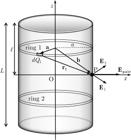
A cylindrical shell with radius a, charged with a constant areal density σ, is cut into a large number of identical circular rings, each one with an electric charge dQ = σ (2πa dz). The rings 1 and 2 are equidistant from P, a point on the shell, for which z = 0. The electric field due to these two rings is .
Theorem 1 Given a cylindrical shell with radius a and finite length L, uniformly charged with an areal density σ, in electrostatic equilibrium, the electric field at the points of the shell belonging to its intersection with a transversal plane that passes by its center is
where is the complete elliptic integral of the first kind. 2
Proof. Let P be any point where the cylindrical shell intersects the transversal plane z = 0, as seen in Fig. 1. Without loss of generality, choose the x-axis on the radial line coming from O and passing by P. On treating the shell as a collection of identical circular rings with radius a and charge dQ = σ (2πa dz), we begin deriving the electric field in P due to a pair of charged rings centered at ±z, as shown in Fig. 1. By symmetry, it is clear that this field points along the x-axis direction, so , where
Here, is an element of charge in ring 1, as indicated in Fig. 1, being its charge per unit length, and θ is the azimuthal angle on the plane of ring 1, which locates dQ1 with respect to the x-axis. From the vectors in Fig. 1, clearly , so . Then, the field due to the pair of rings is given by
Since , one has3
On substituting κ2 ≡ z2/(4a2) and then c = 1 + 2 κ2 in the last integral, one finds
where is the complete elliptic integral of the second kind [5, Chap. 17]. From Eq. (3), one finds
With this result in hands, we can derive the field EP created at P by the entire cylindrical shell by integrating dEpair over all pairs of rings composing the shell. This results in
where dQ = σ (2πa) dz is the charge on each ring. This leads to
where we have substituted z = 2 a κ in the last step. On substituting u = 1/κ in the last integral, which moves the singular point at κ = 0 to infinity, one finds
Finally, the identities
and
as given in Eqs. (17.4.17) and (17.4.18) of Ref. [5], respectively, reduce the integral in Eq. (8) to
From the integral definition of K(m), one has
which completes our proof. □
From the above theorem, it is easy to deduce that
Corollary 1 (Long cylindrical shell) For a uniformly-charged cylindrical shell with radius a, length L ≫ a, and charge density σ in electrostatic equilibrium, the electric field at any point on it (far from the ends) is
Proof. This promptly follows from our Theorem 1 by taking into account the limit
3. Conclusion
Since only macroscopic models make sense in classical electrostatics, the theorem proved in the previous section for the electric field at the surface of a uniformly-charged cylindrical shell is unassailable. Note that the absence of the first derivative of the electric potential at a point P does not necessarily imply that the field is undefined at P, as it can be discontinuous there at that point. This is just what we have found for the field at the surface of an infinitely-long cylindrical shell, which leaps from zero to σ/(2 ϵ0) when we pass from inside the shell to any point on it, and then it leaps to σ/ϵ0 for points just outside the shell.4 Interestingly, our half-factor also arises in more elaborate microscopic (quantum-mechanical) models, in a scale in which both the charge distribution and the electric field change continuously from inside to just outside a charged conductor [7, pp. 19–22]. According to those models, a thin transition slab with extension of a few atomic diameters is formed within which the field strength increases smoothly from nearly zero, inside the conductor, to its maximum value σ/ϵ0, attained at a point about 4Å outside, as seen in Fig. I.5 of Ref. [7]. There in that figure, the field at the surface reads just 0.5 (in units of σ/ϵ0), which fully agrees with our Corollary 1.
In summary, though Gauss’s law promptly yields a discontinuous electric field which leaps from zero to σ/ϵ0 when we cross the surface of an infinitely-long, uniformly-charged cylindrical shell, it does not provide a definite result for the field at the surface, and certainly this is why it has not been discussed in textbooks. In order to fill this gap, I have shown, within the rigour of calculus, that this field evaluates to half the field discontinuity across the shell. In comparison to a spherical shell [8, 9], our proof for the cylindrical shell is more complex, involving elliptic integrals, so it seems more appropriate for advanced courses of electromagnetism.
-
1
Of course, the electric field due to an infinitely-long, uniformly-charged cylindrical shell (both inside and outside it) is the same as that of a massive conducting cylinder with the same radius, as follows from the fact that, in a conductor, the free charge always accumulates on its surface.
- 2
-
3
Note that, for θ = 0, the integrand becomes an undeterminate form of the kind ‘0/0’ when we take the ‘last’ pair of rings at z = 0, so the integral in Eq. (3) is improper in this case. In fact, this is the only pair of rings for which the denominator is null and we shall proceed with its regularization soon after Eq. (7).
-
4
Though the potential V(r) is a continuous function of r everywhere, it is not differentiable at r = a. This prevents us from calculating the electric field E by taking the gradient of V at points with r = a (i.e., those points located at the shell).
References
- [1] D.J. Whitehouse, in Handbook of Surface and Nanometrology (CRC Press, Boca Raton, 2011), 2 ed.
- [2] R.A. Serway and J.W. Jewett Jr., Physics for Scientists and Engineers (Cengage Learning, Boston, 2019), 10 ed.
- [3] D.J. Griffiths, Introduction to Electrodynamics (Pearson, New York, 2013), 4 ed.
- [4] D. Halliday, R. Resnick and J. Walker, Fundamentals of Physics (Wiley, New York, 2022), 12 ed.
- [5] M. Abramowitz and I.A. Stegun, in Handbook of Mathematical Functions (Dover, New York, 1972).
- [6] I.S. Gradshteyn and I.M. Ryzhik, Table of Integrals, Series, and Products (Academic Press, New York, 2015), 8 ed.
- [7] J.D. Jackson, Classical Electrodynamics (Wiley, New York, 1999), 3 ed.
- [8] F.M.S. Lima, Resonance 22, 1215 ( 2018 ).
- [9] F.M.S. Lima, Rev. Bras. Ens. Fís. 42, e20200182 (2020).

