 Nurses’ decision-making style in hospital settings
ABSTRACT
Objectives: to analyze nurses’ decision-making styles in hospital settings and to associate their sociodemographic and occupational profiles with their decision-making styles.
Methods: this is a quantitative, analytical study conducted with 181 nurses from a public university hospital in southern Brazil. A sociodemographic and occupational data collection instrument and the Melbourne Decision-Making Questionnaire were used.
Results: the vigilant decision-making style was widely practiced, while hypervigilant, procrastinating, and buck-passing were less frequent. Nurses who self-identified as black, brown, and yellow were more likely to adopt the vigilance style. Working the afternoon shift was more likely to be associated with the procrastination style.
Conclusions: the decision-making process can be affected by participants’ personal and occupational variables, as well as by situational aspects in which nurses are inserted, both in the work and social environments.
Descriptors:
Decision Making; Nurses; Hospitals; Nursing; Professional Competence
RESUMO
Objetivos: analisar o estilo de tomada de decisão dos enfermeiros no ambiente hospitalar e associar o perfil sociodemográfico e ocupacional dos enfermeiros ao estilo de tomada de decisão.
Métodos: estudo quantitativo, analítico, realizado com 181 enfermeiros de um hospital público universitário do sul do Brasil. Utilizaram-se um instrumento para coleta de dados sociodemográficos e ocupacionais e o Melbourne Decision Making Questionnaire.
Resultados: o estilo de tomada de decisão vigilante foi amplamente praticado, enquanto hipervigilante, procrastinador e buck passingbuck-passing foram menos frequentes. Enfermeiros autodeclarados pretos, pardos e amarelos apresentaram maior chance de adotar o estilo vigilante. O turno vespertino apresentou maior chance de associação com o estilo procrastinador.
Conclusões: o processo decisório pode ser afetado por variáveis pessoais e ocupacionais dos participantes, bem como por aspectos situacionais em que os enfermeiros estão inseridos, tanto no ambiente de trabalho quanto no social.
Descritores:
Tomada de Decisões; Enfermeiras e Enfermeiros; Hospitais; Enfermagem; Competência Profissional
RESUMEN
Objetivos: analizar los estilos de toma de decisiones de enfermeras en entornos hospitalarios y relacionar sus perfiles sociodemográficos y ocupacionales con dichos estilos.
Métodos: estudio cuantitativo y analítico realizado con 181 enfermeras de un hospital universitario público del sur de Brasil. Se utilizó un instrumento de recolección de datos sociodemográficos y ocupacionales y el Melbourne Decision-Making Questionnaire.
Resultados: el estilo de toma de decisiones vigilante fue ampliamente practicado, mientras que el hipervigilante, la procrastinación y la elusión de responsabilidades fueron menos frecuentes. Las enfermeras que se autoidentificaron como negras, morenas y asiáticas mostraron mayor probabilidad de adoptar el estilo vigilante. Trabajar en el turno de tarde mostró mayor probabilidad de estar asociado con el estilo procrastinador.
Conclusiones: el proceso de toma de decisiones puede verse afectado por variables personales y ocupacionales de los participantes, así como por aspectos situacionales en los que se desenvuelven las enfermeras, tanto en el entorno laboral como en el social.
Descriptores:
Toma de Decisiones; Enfermeras y Enfermeros; Hospitales; Enfermería; Competencia Profesional
INTRODUCTION
Professional competences are tools that emerge from the application of knowledge, skills, and attitudes(1). According to the Brazilian National Curriculum Guidelines for the Undergraduate Nursing Course, it is established that nursing training must be based on the achievement of various competences, such as healthcare, decision-making (DM), communication, leadership, administration and management, and continuing education(2). When combined, these competences serve as a basis for training qualified, ethical, and critical-reflective professionals(1).
DM stands out as one of the most relevant expected for care management(3). This occurs, among other factors, due to the aptitude and responsibility that nurses have to occupy leadership positions in teams(2,3), linked to the fact that it is a competence recognized worldwide as essential for nursing(4).
Thus, DM is defined in the administrative context as a process that aims to analyze and choose something from available alternatives, in order to establish the path to be followed(5). For nursing, more specifically, the DM process can be described as “the art of making choices and developing plans to promote a process of change”(6).
As a competence, DM is seen as an acquired skill(7), which can be improved throughout nurses’ academic and professional experiences(8) and which, when practiced, favors skills linked to critical reasoning, problem-solving, priority selection, and communication(9). It is also essential to emphasize that nurses’ decision-making is part of their routine work process, due to the managerial and assistance contexts of care(10).
Depending on the complexity of care required by patients, the nurses’ work process within hospitals requires immediate and short-term DM(10). Furthermore, it is also the nurses’ responsibility to assume the role of a coordinating professional within the team, basing care on scientific information that supports assertive decision-making processes(11).
To understand this issue, the Decisional Conflict Theory stands out, which establishes DM as a situation arising from stressful events that provoke conflict in each individual. Thus, DM is influenced by three factors: knowledge of the risks of each alternative; hope of choosing the most appropriate alternative; and the notion of sufficient time to assess and select the option that best suits the circumstances(12).
Decisional Conflict Theory describes DM from a coping perspective, which refers to the strategies employed to deal with stress generated in situations of uncertainty. This theory has been described as suitable for use in business management, government policies, and numerous other contexts that require DM(12). Given this scenario, the application of the Melbourne Decision Making Questionnaire (MDMQ), whose development is based on the aforementioned Decisional Conflict Theory, is justified in the context of Brazilian nursing(12).
The MDMQ has been widely used in different areas of knowledge, including psychology, management, and health(13). Adapted to languages such as French(14), Italian(15), Spanish(16), Swedish(17), and Turkish(18), this instrument proves to be largely assertive for the proposed purpose(13). However, there is a gap in national literature regarding the application of this instrument specifically with Brazilian nurses, which reinforces the relevance of the present investigation.
Considering the above, and with a view to contributing to the improvement of clinical and managerial practices in nursing, this study arises from the relevance of the topic for nursing professionals and aims to answer the following research questions: what is the DM style of nurses working in hospital settings? Are sociodemographic and occupational profiles associated with nurses’ DM style?
OBJECTIVES
To analyze nurses’ DM style in hospital settings, and the specific objective is to associate the sociodemographic and occupational profile of nurses with DM style.
METHODS
Ethical aspects
The research complied with the standards of Brazilian Resolution 466/2012 and was approved by the Research Ethics Committee. All participants were informed of the details of the research and voluntarily agreed to participate by signing the Informed Consent Form, in compliance with the aforementioned National Health Council resolution.
To ensure information reliability and confidentiality and facilitate data tabulation, participants were identified by Arabic numerals according to their entry into the survey.
Study design, period and location
This is a quantitative study with an analytical design, conducted at a public tertiary-care university hospital. Located in southern Brazil, the hospital serves as a referral center for approximately two million individuals with highly complex medical conditions.
Data collection took place in the self-administered modality from February to June 2024. The STrenthening the Reporting of OBservational studies in Epidemiology(19) recommendations guided the study design.
Sample, inclusion and exclusion criteria
Nursing professionals work daytime shifts of six or 12 hours at the institution studied, while night shifts are exclusively 12x36 hours. It is also noteworthy that, in the local context, nurses referred to as “fixed-term” are professionals employed through temporary service contracts, unlike nurses who have a permanent employment relationship or a permanent public position.
To identify the population, we used a Microsoft Excel® list provided by the institution containing the names of all nurses from the three work shifts, totaling 466 professionals. An initial review of the published list revealed that 58 nurses had been dismissed or transferred to other services, resulting in a total of 408 professionals eligible for the study.
Based on this quantity, a sample size calculation was performed to estimate the minimum number of individuals to be interviewed. To this end, a 95% Confidence Interval and a maximum error of 5% (p < 0.05) were adopted, resulting in a sample of 181 nurses.
Participants who worked in both department management and patient care management and who had been in this role for more than six months were included. Nurses who were on vacation or on leave for any reason during the data collection period, as well as clinical nurses who work exclusively in direct patient care, were excluded from the study(20).
The sample was determined using simple random probability. Participants were selected through digital drawings on the online platform “Sorteador”. In cases of refusal, new participants were selected at random.
Study protocol
Two questionnaires were used for this stage of the research. The first included sociodemographic, occupational, and professional training-related data. Developed by the authors, the questionnaire was assessed by three nurses with doctoral degrees and expertise in instrument validity and/or management. Nurses contributed by suggesting modifications to the wording of three questions. All considerations were considered by the authors and assessed to develop the final version of the instrument.
The second questionnaire was used to assess DM style. It is a Likert-type scale called MDMQ, which was adapted and validated for Brazilian Portuguese in 2018(13). The MDMQ has 18 questions and distinguishes the results obtained between four DM styles: vigilance, characterized by a systematic and analytical process of information search, aiming for a rational and well-founded decision; hypervigilance, associated with high levels of anxiety and urgency, resulting in hasty decisions; procrastination, defined by the tendency to postpone and indecisiveness, often related to insecurity and error avoidance; and buck-passing, which, in Portuguese, can be understood as “passar o bastão” (pass the baton), in which individuals avoid taking responsibility for the decision, transferring it to others(12,13).
Nurses eligible for participation in the study were contacted in person during their work shift. Those who expressed interest were given the option to complete the questionnaire in the presence of the researcher or at a later date.
Analysis of results and statistics
Of the 181 study participants, two did not complete the instruments completely, resulting in 179 instruments used for analysis. Considering the above, the collected data were compiled into a spreadsheet structure in Microsoft Excel®, with subsequent transcription into the Statistical Package for the Social Sciences (version 27.0) software, and subjected to descriptive statistics calculations using measures of central tendency (mean and median), measures of dispersion (standard deviation), and measures of location (percentiles).
Dependent variables (DM styles) were dichotomized at the median level, being classified as: vigilance at a lower level (up to 21 points) and higher level (> 21 points); hypervigilance at a lower level (up to 7 points) and higher level (> 7 points); procrastination at a lower level (up to 9 points) and higher level (> 9 points); and buck-passing at a lower level (up to 8 points) and higher level (> 8 points).
The significance level of the test (α) was set at p < 0.05. Pearson’s chi-square test was used to assess the associations between the dependent and independent variables. Considering the independent variables that were significantly associated with the others, the direction of the association was verified by calculating the Odds Ratio (OR) and its respective interval, with 95% confidence.
The graphical analyses presented in this study were developed in the R Statistical Environment, and for this purpose, the ggplot2 and DescTools packages were used.
RESULTS
Data related to sociodemographic and occupational characteristics are presented below (Table 1).
It was observed that 40 nurses (22.1%) had another employment relationship, totaling an average weekly workload of 74.6 hours (standard deviation (SD)=11.3) and a median of 77 hours. In relation to the 141 nurses with only one employment relationship (77.9%), an average weekly workload of 42.5 hours (SD=5.6) was observed, with a median of 42 hours. As for length of experience in the nursing area, we found an average of 12 years (SD=9.8).
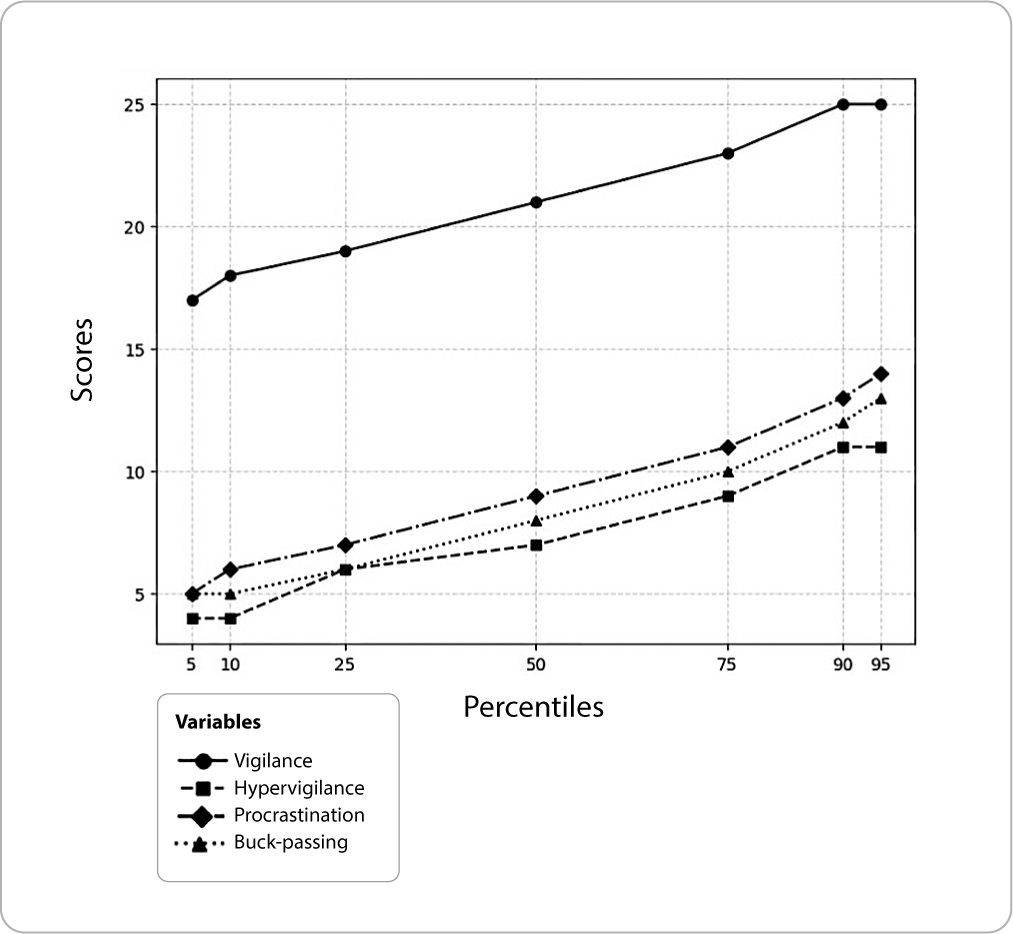
In relation to the descriptive analysis of the DM style scores, assessed by the MDMQ, it was observed that the vigilance DM style was widely adopted, presenting an average of 21.0 points and scores concentrated in the moderate to high range, as demonstrated below (Table 2).
Description of vigilance, hypervigilance, procrastination, and buck-passing scores according to the Melbourne Decision Making Questionnaire, Londrina, Paraná, Brazil, 2024
On the other hand, the hypervigilance DM style was less prevalent, with a mean of 7.43 points (SD=2.34), with most participants having low scores. The procrastination DM style had a mean of 9.44 points (SD=2.87). These results suggest a relatively broad distribution of procrastination scores, which may indicate that a significant proportion of nurses face difficulty making decisions.
The last DM style, buck-passing, had an average of 8.36 points (SD=2.80), with low levels also observed among participants. These data indicate that this style, although present, also tends to be more widely distributed among participants, demonstrating lower levels of this practice (Figure 1).
Percentage distribution curves of decision-making style scores according to the Melbourne Decision Making Questionnaire, Londrina, Paraná, Brazil, 2024
Nurses demonstrated a clear preference for the vigilance DM style, while less adaptive strategies, such as hypervigilance and buck-passing, were less frequent. The procrastination DM style, on the other hand, presented a challenge for some professionals, with significant variations in scores.
Table 3 presents the statistical summary of the sociodemographic and occupational variables with the DM styles that presented statistical significance, analyzed by Pearson’s chi-square association test.
Statistical summary of Pearson’s chi-square test of association between sociodemographic and occupational variables and nurses’ decision-making styles, Londrina, Paraná, Brazil, 2024
Since Pearson’s chi-square test does not indicate the direction of association of the variables, OR tests were performed (Table 4).
Statistical summary of the Odds Ratio between sociodemographic and occupational variables and nurses’ decision-making styles, Londrina, Paraná, Brazil, 2024
OR analysis revealed significant associations between sociodemographic and occupational variables and the DM styles practiced by nurses. Regarding the vigilance DM style, self-reported race showed a significant association (p=0.045). Nurses who self-reported as White were less likely to adopt the vigilance DM style (OR=0.5; 95%CI: 0.27–0.99), while those belonging to other races were almost twice as likely to adopt this style (OR=1.9; 95%CI: 1.01–3.67).
In relation to the buck-passing DM style, there was a significant association with the current position (p=0.046). Participants working in team management were less likely to adopt this style (OR=0.5; 95%CI: 0.21–0.99), while care managers were more than twice as likely to adopt it (OR=2.2; 95%CI: 1.01–4.87). Furthermore, the type of employment relationship also demonstrated a significant influence on the buck-passing DM style (p=0.019), with statutory nurses being less likely to adopt this style (OR=0.4; 95%CI: 0.16–0.85), while fixed-term nurses were significantly more likely (OR=2.7; 95%CI: 1.18–6.27). However, in the hospital where this study was conducted, certified nurses are assigned to care management positions, which may impact the presentation of these results. We suggest that this finding be supported by other studies that address a homogeneous sample regarding nurses’ employment status.
In the procrastination DM style, a significant association was observed with work shift (p=0.044). Nurses who worked the morning shift were less likely to adopt high levels of the procrastination DM style (OR=0.5; 95%CI: 0.23–0.93), while those who worked the afternoon shift were more than twice as likely to adopt this style (OR=2.1; 95%CI: 1.09–4.18). No significant associations were found for night and full-time shifts in this DM style.
These results suggest that variables such as self-reported race, current position, employment status, and shift influence the DM styles practiced by nurses. It should be noted that the hypervigilance DM style did not present statistical significance with the variables in this study.
DISCUSSION
The vigilance DM style was the most predominant in the study. This style is the only one with an adaptive character(12), i.e., in vigilance, decision-makers make their choice based on rational solutions, seeking to make the decision cautiously when analyzing the different alternatives(21).
Considering this, it is worth highlighting that nurses’ role in hospital settings encompasses different specificities and articulations that are inseparable from their practice, making the management of decisions and scientific improvement give this professional a role of notable importance in care(22). Considerably more assertive and rapid decisions are required in hospitals(10).
Regarding the relationship between the vigilance DM style and self-declared color variable, it is observed in the literature that the results of this study demonstrate not only a cut of the institution researched, but the reflection of a cultural, political and social history permeated by various inequalities(23).
Data from the latest census conducted by the Federal Nursing Council in Brazil showed that nursing professionals who self-identify as black are in less favorable conditions compared to their white counterparts. The national survey highlights that nurses who self-identify as brown or black made up 53% of the country’s professional contingent at the time, representing the largest portion of the workforce(24).
Nurses who self-identified as black and brown were significantly more likely to adopt the vigilance DM style, an observation that may possibly be associated with the racist experiences to which professionals are subjected, permeating from their training throughout their professional careers. It is important to emphasize, however, that the scenario briefly described is circumscribed within a broader perspective, in which the country’s historical aspects are considered important for understanding the current impacts observed in Brazilian nursing(23).
Findings from a study conducted in Brazil in 2024 support the observed phenomenon. The experience of institutional racism, especially in healthcare settings, poses constant challenges that require these professionals to be alert and cautious when dealing with adverse situations and potential biases in the workplace(25).
Such continuous exposure to discrimination can foster a decision-making pattern characterized by a systematic and careful search for information(25), which is in line with the vigilance DM style(12). Thus, the adoption of this style may reflect an adaptive mechanism to reduce risks and ensure greater safety in clinical practice.
The procrastination DM style proved to be a challenge in the sample studied. In the literature, this style, considered avoidant, corresponds to the behavioral pattern related to postponing decisions(12-21), a fact that can imply undesirable consequences in the most diverse functions in which nursing is involved.
In this style, shift work stands out, which is the organization in which several teams take turns with the aim of ensuring that patient care is offered uninterruptedly(26). Thus, professionals who work shifts are more exposed to working hours in a sometimes stressful environment(27), a fact that also impacts DM.
An observational study conducted in Intensive Care Units of a tertiary hospital demonstrated that, among nursing shifts, the morning period concentrates a greater direct workload, a period in which nurses dedicate most of their time to care activities(28). These findings highlight the intense dynamics of the beginning of the morning shift, marked by the need for frequent communication, carrying out procedures and coordination between team members, which requires agile and effective DM professionals(10).
Regarding the hypervigilance DM style, it is observed that decision-makers perform impulsive, quick, and uncritical actions, accepting any available alternative in a desperate and anxious attempt to end stress arising from the decision-making situation(12,13). It should be noted, however, that the study in question did not present statistical representation in relation to this style.
Finally, the buck-passing DM style unfolds in this context from perspectives related to employment relationship and current position. In this style, characterized by “passing the baton”, professionals assign responsibility for the decision to third parties(21). Therefore, responsibility shifting is also described by theorists as an avoidant style of DM(12,13).
The findings regarding the buck-passing style in care managers and fixed-term nurses demonstrated aspects already explored in the literature. A multicenter case study conducted in hospitals in Brazil, Portugal, and Spain found that some university hospitals tend to have more than one type of employment relationship, such as statutory and fixed-term hospitals. Furthermore, the same study highlights that nurses’ decision-making processes are affected by their employment relationship(29), although this is not related to the DM styles in the present study.
A study carried out with 180 nurses in the Philippines reveals the topic and indicates that, eventually, fixed-term nursing professionals had some or no participation in the decision-making process(29), data that corroborate the greater probability of transferring responsibility on the part of fixed-term nurses.
As for these professionals’ preparedness for DM, a recent study discusses the disagreement regarding this skill among novice nurses and those with more experience and expertise. According to this framework, more experienced nurses were able to observe patients in their entirety with greater clarity, a practice that influences safe and effective direct DM with patients(30).
Study limitations
The findings of this study should be interpreted in light of some limitations, particularly the heterogeneous nature of the sample. It is important to consider that, in this study, a large portion of the statutory nurses are assigned to team management positions, while the majority of fixed-term professionals occupy positions directly related to patient care management. In short, the disparate distribution of functions and employment relationships is a limiting factor, fostering a tendency toward erroneous generalizations that may not apply to other contexts and hospital institutions.
Contributions to nursing and health
Concerning contributions to nursing, this study advances scientific knowledge, as it addresses DM styles in hospital settings, where the need for assertive and rapid decisions is part of the nurses’ work process.
The findings explored here may offer theoretical support for the development and planning of strategies applicable from graduation to professional practice, encouraging more adaptive DM practices to be carried out by these professionals.
In short, the scarcity of studies using this scale for nursing is evident. However, it is clear that, for nursing practice, understanding DM styles is a key differentiator for improving the skills required for hospital nurses(10).
CONCLUSIONS
The results indicate that the nurses surveyed preferred to adopt vigilant practices regarding their DM style, with a lower prevalence of less adaptive styles, such as hypervigilance, procrastination, and buck-passing. Variables such as self-reported race, current position, employment status, and shift significantly influenced DM styles.
The present study indicates that the decision-making process can be affected by personal and occupational variables of participants, as well as by situational aspects of the work and social environment in which nurses were inserted at the time of the research.
The findings support the scientific production on the topic and also suggest future studies that investigate samples with a more homogeneous character in relation to employment relationship and position, while investigating cultural and institutional contexts that may mediate such associations, filling existing gaps and expanding knowledge on the topic.
AVAILABILITY OF DATA AND MATERIAL
The research data are available in a repository: https://doi.org/10.48331/scielodata.MRZUKV.
REFERENCES
-
1 Montezano L, França JV, Santos UAS, Silva KIB, Isidro A. Panorama de duas décadas da literatura sobre certificação de competências profissionais em saúde. Recape. 2023;13(1):33-54. https://doi.org/10.23925/recape.v13i1.54912
» https://doi.org/10.23925/recape.v13i1.54912 -
2 Conselho Nacional de Saúde (CNS). Resolução nº 573, de 31 de janeiro de 2018 [Internet]. Brasília (DF): CNS; 2018 [cited 2024 Dec 1]. Available from: https://www.gov.br/conselho-nacional-de-saude/pt-br/acesso-a-informacao/legislacao/resolucoes/2018/resolucao-no-573.pdf
» https://www.gov.br/conselho-nacional-de-saude/pt-br/acesso-a-informacao/legislacao/resolucoes/2018/resolucao-no-573.pdf -
3 Facião BH, Aroni P, Haddad RM, Silva MMT, Carvalho BMF, Rossaneis MA, et al. Instrumentos para avaliação das competências de liderança em enfermagem: revisão de literatura. Enfermeria (Montev.). 2022;11(2):e2801. https://doi.org/10.22235/ech.v11i2.2801
» https://doi.org/10.22235/ech.v11i2.2801 -
4 Marques FM, Pinheiro MJ, Alves PV. O julgamento clínico e a tomada de decisão nos estudantes do Curso de Licenciatura em Enfermagem. Ciênc Saúde Colet. 2022;27(5):1731–40. https://doi.org/10.1590/1413-81232022275.23142021
» https://doi.org/10.1590/1413-81232022275.23142021 - 5 Chiavenato I. Administração em novos tempos: os novos horizontes em administração. 4ª ed. São Paulo: Atlas; 2020.
- 6 Ciampone MHT, Tronchin DMR, Melleiro MM. Planejamento e processo decisório como instrumentos do trabalho gerencial. In: Kurcgant P, coordenador. Gerenciamento em Enfermagem. 4ª ed. Rio de Janeiro: Guanabara Koogan; 2023. p. 32-48.
-
7 Löbler ML, Reis E, Nishi JM, Tagliapietra RD. Inventário de estilos de tomada de decisão: validação de Instrumento no contexto brasileiro. Rev Adm UNIMEP[Internet] 2019 [cited 2024 Dec 1];17(1)l. Available from: https://www.academia.edu/91181299/Invent%C3%A1rio_de_Estilos_de_Tomada_de_Decis%C3%A3o_Valida%C3%A7%C3%A3o_de_Instrumento_no_Contexto_Brasileiro#loswp-work-container
» https://www.academia.edu/91181299/Invent%C3%A1rio_de_Estilos_de_Tomada_de_Decis%C3%A3o_Valida%C3%A7%C3%A3o_de_Instrumento_no_Contexto_Brasileiro#loswp-work-container -
8 Ribeiro NM, Leal LA, Ferreira MVF, Chaves LDP, Ignácio DS, Henriques SH. Managerial Decision-Making of Nurses in Hospitals: creation and validation of a simulation scenario. Rev Latino-Am Enfermagem. 2023;31:e3768. https://doi.org/10.1590/1518-8345.6149.3768
» https://doi.org/10.1590/1518-8345.6149.3768 -
9 Duarte HMS, Dixe MACR. Clinical Decision-Making in Nursing Scale (CDMNS-PT©) in nursing students: translation and validation. Rev Bras Enferm. 2021;74(Suppl 6):e20210032. https://doi.org/10.1590/0034-7167-2021-0032
» https://doi.org/10.1590/0034-7167-2021-0032 -
10 Leal LA, Henriques SH, Castro FFS, Ribeiro NM. Reflecting on decision-making as a competence of the hospital nurse. Rev Enferm UERJ [Internet]. 2022 [cited 2024 Dec 1];30(1):e69420. Available from: https://www.e-publicacoes.uerj.br/enfermagemuerj/article/view/69420
» https://www.e-publicacoes.uerj.br/enfermagemuerj/article/view/69420 -
11 Bicalho CSS, Figueiredo KC, Beltran RIL, Pol TAS, Souza GP. Estratégias de coping e liderança autêntica: atuação do enfermeiro em 2021 durante a pandemia de covid-19. Esc Anna Nery. 2023;27:e20220192. https://doi.org/10.1590/2177-9465-EAN-2022-0192pt
» https://doi.org/10.1590/2177-9465-EAN-2022-0192pt -
12 Janis IL, Mann L. Decision making: a psychological analysis of conflict, choice, and commitment [Internet]. 1977 [cited 2024 Oct 19]. Available from: https://psycnet.apa.org/record/1978-00284-000
» https://psycnet.apa.org/record/1978-00284-000 -
13 Cotrena C, Branco LD, Fonseca RP. Adaptation and validation of the Melbourne Decision Making Questionnaire to Brazilian Portuguese. Trends Psychiatry Psychother. 2018;40(1):29–37. https://doi.org/10.1590/2237-6089-2017-0062
» https://doi.org/10.1590/2237-6089-2017-0062 -
14 Bailly N, Ilharragorry-Devaux M-L. Adaptation et validation en langue Française d’une échelle de prise de décision. Can J Behav Sci. 2011;43(3):143-9. https://doi.org/10.1037/a0021031
» https://doi.org/10.1037/a0021031 -
15 Nota L, Soresi S. Adattamento italiano del Melbourne Decision Making Questionnaire. G Ital Psicol Orientamento [Internet]. 2000 [cited 2025 Aug 27];3:38-52. Available from: https://www.research.unipd.it/handle/11577/2428985?mode=full
» https://www.research.unipd.it/handle/11577/2428985?mode=full -
16 Sáez de Heredia RA, Laca Arocena F, Valencia Gárate J. Decision-making patterns, conflict styles, and self-esteem. Psicothema [Internet]. 2004 [cited 2025 Aug 27];16:110-6. Available from: https://www.psicothema.com/pdf/1169.pdf
» https://www.psicothema.com/pdf/1169.pdf -
17 Isaksson U, Hajdarevic S, Jutterström L, Hörnsten Å. Validity and reliability testing of the Swedish version of Melbourne Decision Making Questionnaire. Scand J Caring Sci. 2014;28:405-12. https://doi.org/10.1111/scs.12052
» https://doi.org/10.1111/scs.12052 -
18 Deniz ME. Investigation of the relation between decision making self-esteem, decision making style and problem solving skills of university students. Eurasian J Educ Res [Internet]. 2004 [cited 2025 Aug 27];15:23-35. Available from: https://www.researchgate.net/publication/284193437_Investigation_of_the_relation_between_decision_making_self-esteem_decision_making_style_and_problem_solving_skills_of_university_students
» https://www.researchgate.net/publication/284193437_Investigation_of_the_relation_between_decision_making_self-esteem_decision_making_style_and_problem_solving_skills_of_university_students -
19 Malta M, Cardoso LO, Bastos FI, Magnanini MMF, Silva CMFP. STROBE initiative: guidelines on reporting observational studies. Rev Saúde Pública 2010;44(3). https://doi.org/10.1590/s0034-89102010000300021
» https://doi.org/10.1590/s0034-89102010000300021 -
20 Carlos AMM, Kuiava IB, Nogueira MM, Menegon FHA, Andrade SR, Santos JLG. Liderança no ambiente hospitalar: diferenças entre enfermeiros assistenciais e enfermeiros gerentes. Enferm. Foco. 2019;10 (6):143-8. https://doi.org/10.21675/2357-707X.2019.v10.n6.2900
» https://doi.org/10.21675/2357-707X.2019.v10.n6.2900 -
21 Aluja A, Balada F, García O, García LF. Psychometric Study of Two Decision-Making Measures: The Melbourne Decision-Making Questionnaire versus the General Decision-Making Style Questionnaire. Psychiatry Int. 2024;5(3):503–14. https://doi.org/10.3390/psychiatryint5030036
» https://doi.org/10.3390/psychiatryint5030036 -
22 Menegon FHA, Santos JLG, Gonçalves N, Vargas MAO, Klock P, Amestoy SC. Nurse involvement in decision making in the hospital environment: integrative literature review. J Nurs Health [Internet]. 2022 [cited 2024 Dec 1];12(1).Available from: https://periodicos.ufpel.edu.br/index.php/enfermagem/article/view/21653
» https://periodicos.ufpel.edu.br/index.php/enfermagem/article/view/21653 -
23 Silva LSAH, Tavares CMM, Paiva LM, Silva TN. A cor do preconceito ou preconceito de cor? revisando racismo e cuidado decolonial na enfermagem. Rev Pol Públ[Internet]. 2024 [cited 2025 Dec 1];28(1):33-51. Available From: https://periodicoseletronicos.ufma.br/index.php/rppublica/article/view/23960
» https://periodicoseletronicos.ufma.br/index.php/rppublica/article/view/23960 -
24 Machado MH, Oliveira E, Moyses NMN, Costa ALS, Lemos W, Ribeiro LA, et al. Perfil da enfermagem no Brasil: relatório final: Brasil[Internet]. Rio de Janeiro: Fiocruz. 2017[cited 2024 Dec 1]; 748 p. Available from: https://www.cofen.gov.br/perfilenfermagem/pdfs/relatoriofinal.pdf
» https://www.cofen.gov.br/perfilenfermagem/pdfs/relatoriofinal.pdf -
25 Souza STH, Castro ACG, Fernandes FECV, Pereira RCLF, Santos JMA, Melo RA. Vivência de Racismo Institucional por Mulheres Negras em Serviços de Saúde. PSSA. 2024;16(2):e16282568. https://doi.org/10.20435/pssa.v16i1.2568
» https://doi.org/10.20435/pssa.v16i1.2568 -
26 Estrela MCL, Sousa MNA. Influência do turno de trabalho na qualidade do sono e da vida de enfermeiros da assistência terciária. Biamah [Internet]. 2023 [cited 2024 Dec 1];3(1):16-30. Available from: https://www.biamah.com.br/index.php/biomah/article/view/64
» https://www.biamah.com.br/index.php/biomah/article/view/64 -
27 Antoniolli L, Souza SBC, Macedo ABT, Pai DD, Magalhães AMM Magnago TSBS. Efeitos do trabalho em turnos e coping em profissionais de enfermagem hospitalar. Rev Cuidarte [Internet]. 2021 [cited 2024 Dec 1];12(2). Available from: https://revistas.udes.edu.co/cuidarte/article/view/1169
» https://revistas.udes.edu.co/cuidarte/article/view/1169 -
28 Han B, Li Q, Chen X, Zhao G. Workflow for Intensive Care Unit Nurses: a time and motion study. Sage Open Nurs. 2020;6:1–8. https://doi.org/10.1177/2158244020947433
» https://doi.org/10.1177/2158244020947433 -
29 Silva GTR, Santos IAR, Conceição MM, Góis RMO, Santos AS, Amestoy SC, et al. Fatores influenciadores do processo decisório de enfermeiros em hospitais universitários ibero-americanos. Rev Latino-Am Enfermagem. 2022;30:e3563. https://doi.org/10.1590/1518-8345.5648.3563
» https://doi.org/10.1590/1518-8345.5648.3563 -
30 Lourenço IL, Gonçalves MS, Sequeira MS, Melo MF, Gouveia MJ. A tomada de decisão na gestão de cuidados em enfermagem: uma revisão narrativa da literatura. Gestão Desenvolv [Internet], 2022 [cited 2024 Dec 1];(30):557-78. Available from: https://revistas.ucp.pt/index.php/gestaoedesenvolvimento/article/view/11696
» https://revistas.ucp.pt/index.php/gestaoedesenvolvimento/article/view/11696
Edited by
-
EDITOR IN CHIEF
Dulce Barbosa
-
ASSOCIATE EDITOR
Alexandre Balsanelli