 Barriers to publishing in international journals: evidence and recommendations from a mentoring program in Political Science
Introduction: Postgraduate education in Political Science in Brazil has undergone significant institutional expansion in recent decades, yet student research output continues to have limited international visibility. The growing volume of research has not been matched by increased publication in English-language journals, pointing to structural inequalities in the global circulation of knowledge. This article examines why doctoral students continue to face persistent barriers to publishing internationally.
Materials and methods: The analysis draws on application data from 92 candidates to the first cohort of the Writing Academy (WA), a mentoring program funded by the British Academy for doctoral students in Political Science in Brazil. As part of the application process, candidates ranked seven potential barriers to publishing in international English-language journals. The analysis focuses on the proportion of respondents who ranked each barrier first.
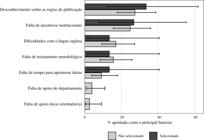
Results: The main barriers are informational and institutional: limited familiarity with international publishing conventions (28%) and lack of institutional incentives (25%). English proficiency was identified as the primary barrier by only 16% of respondents.
Discussion: The article's central finding is the shift from language-related explanations to institutional and informational barriers. The exclusion of Global South scholars from international publishing venues does not stem from differences in individual ability, but from unequal access to tacit rules in a field structured by longstanding asymmetries. In response, the article seeks to help reduce this information gap by offering practical guidance on preparing manuscripts for submission to international English-language journals.
Keywords
geopolitics of knowledge; epistemic hierarchies; graduate education; scholarly publishing; survey research
 Thumbnail
 Thumbnail
 Fonte: elaborada pelos autores com dados de survey coletados no âmbito da Writing Academy (N = 92), 2025.
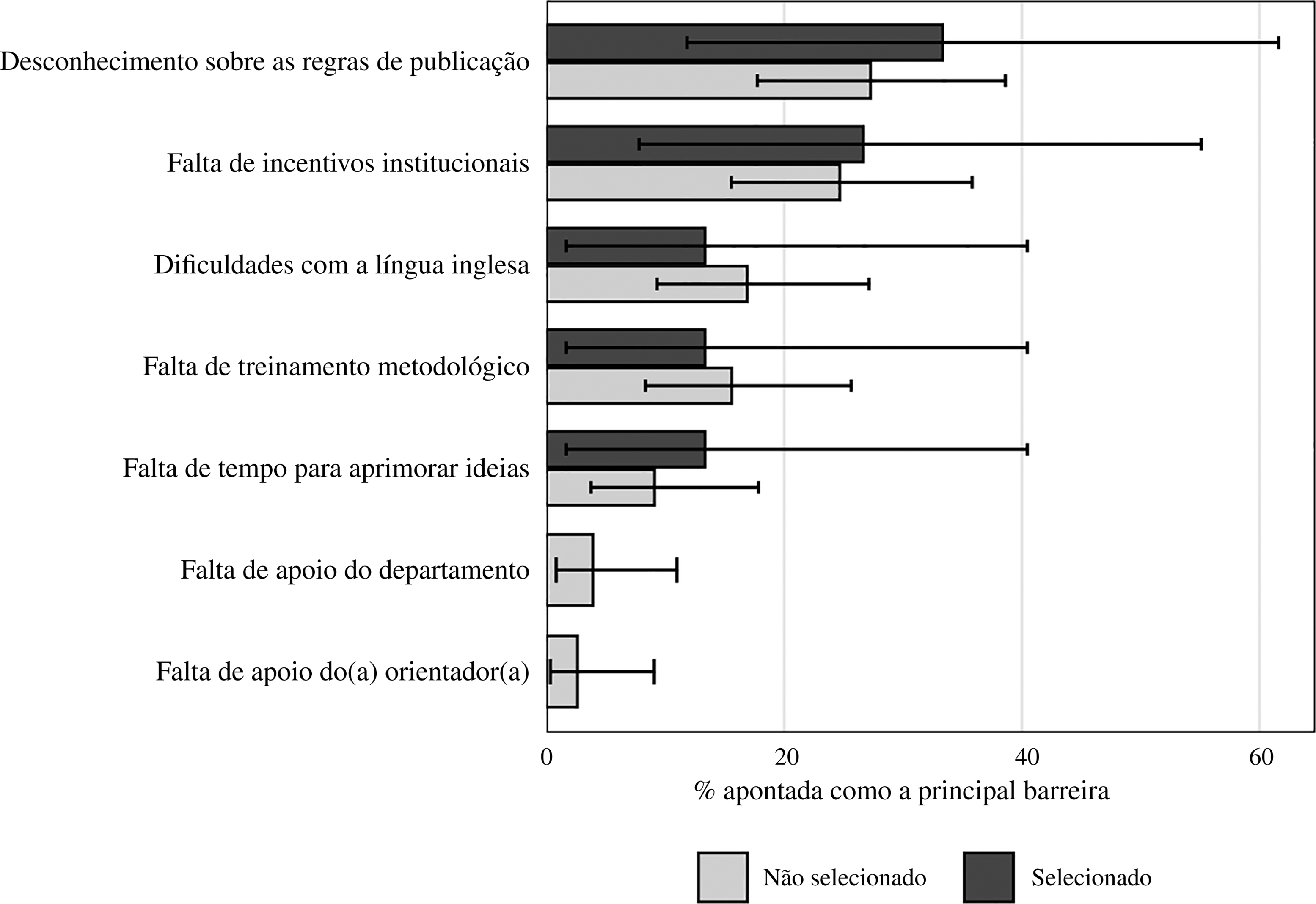 Nota: o eixo X exibe a porcentagem de respondentes (selecionados e não-selecionados para o programa) que escolheram cada uma das sete barreiras como a principal (primeira colocada) para a publicação em periódicos internacionais de língua inglesa. O traço sobreposto indica intervalo de confiança no nível de 95%.Fonte: elaborada pelos autores com base em dados de survey coletados no âmbito da Writing Academy (N = 92), 2025.