 The use of mesenchymal stem cells adhered to the suture filament in the closure of rat aponeurosis
Background: Abdominal wall hernia is a common disease, with an incidence of around 20%. Recent studies have shown the benefits of using stem cells, especially mesenchymal ones, to improve tissue healing.
Aims: Evaluate the use of mesenchymal stem cells derived from adipocytes adhered to a suture filament to enhance tensile strength and collagen formation in aponeurosis.
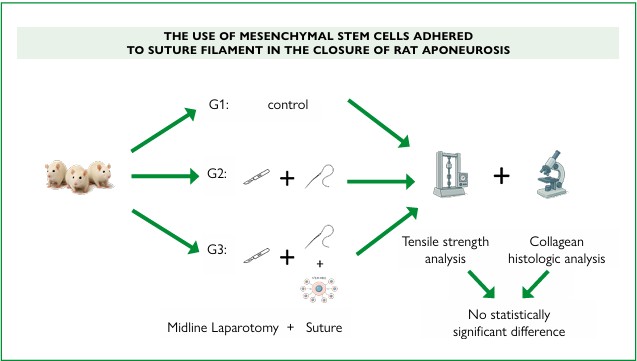
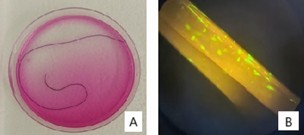
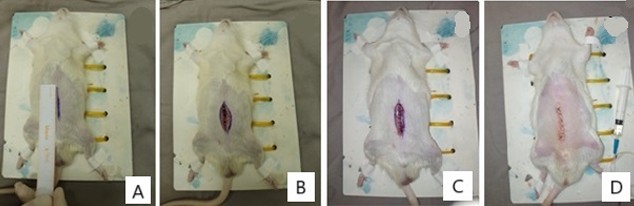
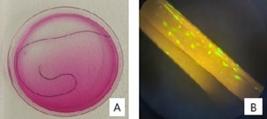
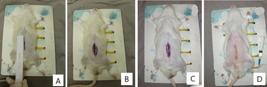
Methods: Human stem cells derived from adipocytes were adhered to a suture filament. Thirty-seven rats of the species Sprague Dawley were divided into three groups: Group 1 was the control group, Group 2 used only a regular suture filament to close abdominal aponeurosis, and Group 3 used a suture filament with stem cells. These animals were evaluated seven, 14, and 56 days after the intervention.
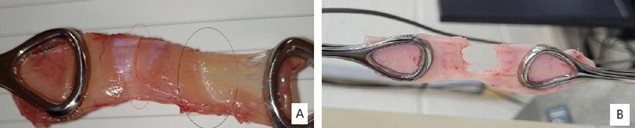
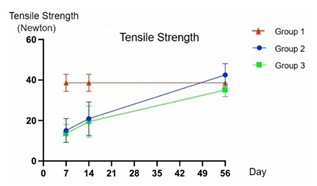
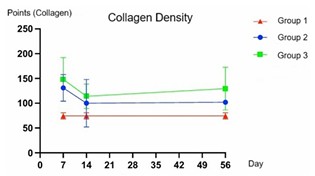
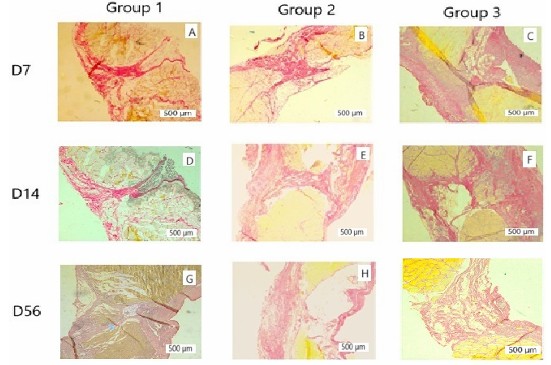
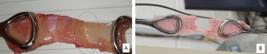
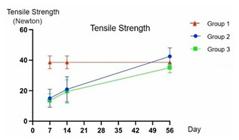
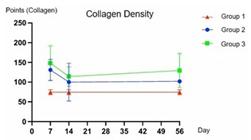
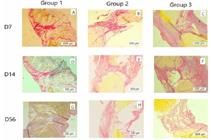
Results: Rupture occurred at the semilunar line and the midline. All animals from Groups 2 and 3, submitted to incision and closure, evaluated at D7 and D14, showed a rupture in the midline. However, all animals evaluated at D56 (all groups) ruptured at the semilunar line. Furthermore, tensile strength was significantly lower at D7 in Groups 2 and 3 compared to Group 1 (p<0,001). On D14, Groups 2 and 3 showed a similar increase in tensile strength, but still inferior to the one observed in Group 1 (p<0,05). On D56, all groups reached similar values (p=0,074, p>0.05). Collagen histologic analysis showed that animals from Group 3 had the highest values in all time points, and Group 2 had higher values than Group 1 in all time points (p>0,05). In graphical analysis, Groups 2 and 3, on D7, had an increase in collagen, but on D14 showed a decrease, with a similar level on D56 (p>0,05).
Conclusions: This study do not support the use of mesenchymal stem cells to improve the healing of a midline abdominal incision in healthy subjects. However, an option for future studies is to employ this filament, combined with matrices for reconstructive purposes, in areas requiring extensive repair, such as large hernias where the aponeurosis is insufficient for defect correction.
Keywords:
Incisional hernia; Aponeurosis; Mesenchymal stem cells; Tensile strength; Collagen
Abdominal wall hernia is a globally prevalent disease, with its subtype, incisional hernia, occurring in 10 to 20% of patients after any surgical incision involving the abdominal wall.
Stem cells have been studied for cellular therapy, as drug targets and as sources for generating different tissues for drug testing.
Specifically, adipose-derived mesenchymal stem cells have shown excellent cellular proliferation and differentiation capacity, making them excellent candidates for therapeutic use.
Use of a suture filament with adhered mesenchymal stem cells in the healing of an abdominal incision is an option in the future.
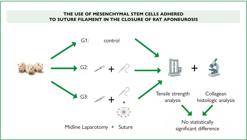
CENTRAL MESSAGE This research aimed to use mesenchymal stem cells derived from adipocytes, attached to a suture thread, to increase tensile strength and collagen formation in the abdominal aponeurosis of rats. Human stem cells derived from adipocytes were attached to a polyglactin 910 suture thread. Thirty-seven Sprague Dawley rats were used, divided into three groups. We concluded that the use of stem cells did not provide any benefit in improving tensile strength or the amount of collagen formed at the site. Future research could be conducted to evaluate whether there would be any benefit in situations of fragility, such as malnutrition, cancer, immunosuppression, or medication use.
PERSPECTIVES The use of stem cells did not show any benefit in improving tensile strength or the amount of collagen formed at the site. However, it is possible that further studies could evaluate the use of this filament, combined with matrices for reconstructive purposes, in areas requiring extensive repairs, such as large hernias where the aponeurosis is insufficient to correct the defect. Furthermore, research could be conducted to assess whether there might be any benefit in situations of fragility, such as malnutrition, cancer, immunosuppression, or medication use.
 Thumbnail
 Thumbnail
 Thumbnail
 Thumbnail
 Thumbnail
 Thumbnail