 What drives digital technology adoption in cattle farming? A systematic literature review
ABSTRACT:
This article identified the digital technologies adopted by cattle farmers and analyzed the main factors influencing this adoption, based on the available international empirical evidence. A systematic literature review was conducted, resulting in the analysis of 25 articles. Twenty-nine digital technologies were identified. Technologies associated with “Automation, Control and Robotics” and “Data Acquisition and Communication” were identified most frequently, notably those applied in dairy production, such as automated feeding, automated washers, robotic milking, and milk and mastitis sensors. In beef cattle farming, herd monitoring and management technologies stood out, such as radio frequency identification, pasture biomass sensors, and management software. Seventy-six factors influencing adoption were identified, highlighting farm and herd characteristics, producer characteristics, and factors associated with technology, innovation, and information; production scale, age, education level, prior use of technology, and ease of use being the most frequent. It was observed that younger producers, with higher levels of education and managing larger farms, are more likely to adopt digital technologies.
Key words:
cattle farming; dairy farming; precision agriculture; digital technologies; SLR
RESUMO:
Esse artigo tem como objetivos identificar as tecnologias digitais adotadas por bovinocultores e analisar os principais fatores que influenciam essa adoção. Para isso, uma revisão sistemática da literatura foi realizada, resultando na análise de 25 artigos. Nesses artigos. foram identificadas 29 tecnologias digitais Tecnologias associadas à “Automação, Controle e Robótica” e “Aquisição e Comunicação de Dados” foram identificadas com maior frequência, notadamente aquelas com aplicação na produção leiteira, como alimentação automatizada, lavadoras automatizadas, ordenha robotizada e sensores de leite e mastite. Além disso, na pecuária de corte, destacaram-se tecnologias de monitoramento do rebanho e de gestão, como a identificação por radiofrequência, sensores de biomassa de pastagem e software de gestão. Ao total, foram identificados 76 fatores que influenciam a adoção de tecnologias digitais por bovinocultores, destacando-se características da fazenda, do rebanho, do produtor e fatores associados à tecnologia, inovação e informação. Os fatores associados à tecnologia, inovação e informação foram a escala de produção, a idade, o nível de escolaridade, o uso anterior da tecnologia e a facilidade de uso os de maior frequência. Portanto, observou-se que produtores mais jovens, com maior nível de escolaridade e administrando fazendas maiores, têm maior chance de adotar tecnologias digitais.
Palavras-chave:
gado de corte; gado de leite; pecuária de precisão; tecnologias digitais; RSL
INTRODUCTION
In Brazil, the livestock industry not only supplies food, income, and jobs domestically but also plays a vital role in supporting exports and generating foreign exchange revenues. The country is the world’s third-largest producer of milk and the leading commercial exporter of beef (ABIEC, 2024; IBGE, 2021). The scale of the national livestock industry presents the challenge of achieving more sustainable production systems with reduced environmental impact. Digital technologies have the potential to achieve this objective by enhancing efficiency and generating added value, while simultaneously fostering more sustainable production practices.
Digital technologies in agriculture encompass a wide range of innovations, including information and communication technologies, cloud computing, artificial intelligence, big data analytics, mobile applications, and remote sensing platforms. These technologies play a critical role in collecting, processing, and analyzing data to support farm management and enhance decision-making processes. Examples included farm management software, satellite imagery, and AI-based systems for crop disease detection. Digital technologies are increasingly adopted in livestock farming to optimize operational efficiency and performance. Precision livestock farming integrates sensors, automation, data analytics, and information systems to improve productivity and promote animal welfare. By enabling more accurate, data-driven decision-making, these technologies contributed to sustainable and ethically responsible livestock management (MORRONE et al., 2022).
Despite their advantages, the adoption and diffusion of digital technologies within livestock production systems remain constrained. Evidence from the broader literature on agricultural technology adoption suggests that uptake is contingent upon a diverse set of determinants, encompassing socioeconomic, production-related, technological, and systemic factors. These determinants encompass producer characteristics, farm-level attributes, perceptions of the benefits and complexity of the technology, as well as wider environmental and institutional contexts (GEROSKI, 2000). Both empirical and literature review studies have examined various factors that impact the adoption of digital technologies in agriculture (BARNES et al., 2019; GIUA et al., 2022; MOZAMBANI et al., 2023; TEY & BRINDAL, 2012; 2022; VINHOLIS et al., 2017). However, no comprehensive literature review has focused specifically on digital technology adoption in the cattle farming industry.
This article undertakes a systematic review of the literature with two primary objectives: (i) to identify the digital technologies currently adopted by cattle farmers, and (ii) to analyze the key factors influencing their adoption. Understanding the current landscape of digital technology adoption in cattle production, along with the determinants that shape this process, is essential for designing targeted strategies and formulating effective public policies to foster wider diffusion. As with all systematic reviews, this study is subject to certain limitations related to sources and language. The review draws exclusively on articles retrieved from two databases and published in English. Consequently, the findings cannot be generalized to suggest that these technologies are widely implemented on a global scale. Nevertheless, they are expected to provide insights into future research on technology adoption in livestock farming and may also contribute to the development of policies and strategies aimed at accelerating the diffusion of digital technologies within cattle production systems.
MATERIALS AND METHODS
This study employed a Systematic Literature Review (SLR) methodology, which aimed to identify, evaluate, and synthesize all available evidence related to a specific research question in a rigorous, unbiased, and comprehensive manner. The review followed the PRISMA protocol (Preferred Reporting Items for Systematic Reviews and Meta-Analyses) as proposed by MOHER et al. (2010).
Based on the insights gained from an initial scoping review, two research questions were formulated to guide the study as shown in table 1. The sources selected for this review were the Scopus and Web of Science (WoS) databases, which were chosen for their global relevance and academic credibility. Searches were conducted across article titles, abstracts, and keywords, using search strings designed for each construct. Inclusion criteria were limited to peer-reviewed journal articles written in English. Book chapters, conference proceedings, and other non-peer-reviewed materials were excluded. The literature search included all articles accessible up to December 31, 2024, irrespective of journal impact factor or open access classification.
The initial search returned 1,035 documents from Scopus database and 702 from WoS. After removing non-peer-reviewed publications, 561 and 492 articles remained, respectively. Filtering for English-only publications yielded 510 articles from Scopus and 483 from WoS. Duplicate entries (n = 380) were eliminated, resulting in 613 unique records for initial screening.
Based on title and abstract screening, 556 articles were excluded for lacking relevance to the research theme. The remaining 57 studies underwent full-text analysis, where introductions, methodologies, and conclusions were reviewed to determine alignment with the research questions. Ultimately, 21 articles met all inclusion criteria.
To increase the sample size and capture additional relevant works, a snowball sampling technique was applied, yielding four additional articles. Thus, the final sample consisted of 25 peer-reviewed studies. Descriptive statistics and graphical representations were generated using the R statistical software (R CORE TEAM, 2024).
The final set of 25 articles selected for this review was identified as highly relevant to the research topic and is summarized in table 2. To ensure that the analysis was specific to cattle production systems, 76% of the selected studies focused exclusively on cattle farming, offering targeted insights for dairy and/or beef producers. The remaining 24% included broader samples in crop farming but still provided disaggregated data relevant to cattle farming.
In terms of geographic distribution, the United States accounted for the largest number of studies (five), followed by Italy and New Zealand, each contributing three articles. The Italian studies were conducted primarily in the Cremona and Lombardy regions, while the U.S. studies focused on states such as Oklahoma, New Mexico, Tennessee, Texas, and Wisconsin. Brazil, Australia, Canada, and Germany were each represented by two studies. The remaining studies originated from various countries, each contributing one empirical investigation. Although, the evidence is geographically concentrated in a limited number of countries, the reviewed studies provide valuable insights into adoption patterns and determinants in technologically advanced cattle production systems.
To address objective (i) (the identification of digital technologies), the classification framework proposed by MORENO et al. (2024) was employed in the review process. Within this framework, technologies are organized into four categories: (I) Automation, Control, and Robotics (technologies related with automatic control, automation, robotics and autonomous systems); (II) Data Acquisition and Communication (technologies related with data integration, data pre-processing, data storage and image acquisition and remote sensing technologies); (III) Data Science and Artificial Intelligence (technologies related with Artificial Intelligence (AI), Big Data and Blockchain); and (IV) Information Systems (technologies related with Software, Geo-informatics, Information and Communication Technologies (ICTs)). The classification criterion adopted by the authors was the primary functionality of each technology. Although, certain technologies may be applicable to multiple categories, they are classified according to the domain most closely aligned with their principal function.
RESULTS AND DISCUSSION
The results and discussion are presented in the following two sections. The first subsection identifies the digital technologies evaluated across the articles, thereby addressing objective (i) outlined in the introduction. The second subsection examines the factors influencing adoption, fulfilling objective (ii).
Identification of adopted technologies
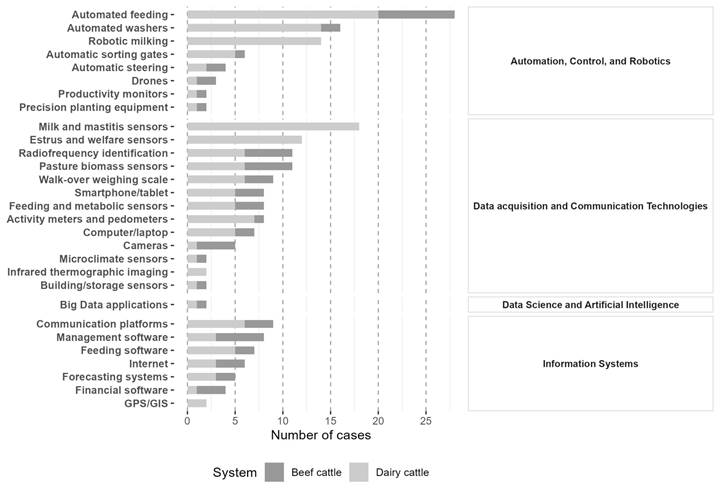
Figure 1 displays the 29 digital technologies identified through review, along with the frequency of their occurrence across the articles. These technologies are grouped into four categories, as proposed by MORENO et al. (2024), and their distribution within dairy and beef cattle systems is also reported. While most studies concentrate on individual technologies, it is noteworthy that many of them are complementary, and farms often implement multiple technologies across categories.
It is noteworthy that 60% of the articles focused exclusively on dairy cattle producers, 28% incorporated samples from both dairy and beef cattle production systems, and 12% examined beef cattle producers alone. One plausible explanation for the predominance of articles focusing on dairy farming is that this sector typically requires more frequent and detailed monitoring of production parameters, such as daily milk yield, feed intake, and animal health, which generates a stronger demand for technological solutions to collect and analyze indicators (RUTTEN et al., 2013; CAJA et al., 2016). Productive, economic, and health indicators used for zootechnical and sanitary monitoring require continuous data collection and analysis. Integration of operational digital technologies into these routines can yield rapid productive and economic outcomes (BORCHERS & BEWLEY, 2015; LOVARELLI et al., 2020). In contrast; although, beef production systems also benefit from data-driven management, measurable outputs tend to manifest less immediately, thereby reducing incentives for adoption and; consequently, limiting the research focus in this domain (BANHAZI et al., 2012; WOLFERT et al., 2017).
Studies focusing on dairy farming primarily examined technologies within the categories of Data Acquisition and Communication (47.8%) and Automation, Control, and Robotics (36.9%). Within these domains, the most frequently identified technologies included automated feeding, automated washers, robot milking, and milk and mastitis sensors. DELA RUE et al. (2019) observed greater investments in automation compared to data acquisition, with most funds allocated to rotary (carousel) milking parlors. GARGIULO et al. (2018) reported that the technologies most frequently adopted by larger producers were automated milking-parlor cleaning systems and robotic calf feeders. Regardless of herd size, the most widely adopted technologies in both herringbone and rotary systems included automatic milking cup removers, management software, and automated cleaning systems (GARGIULO et al., 2018). Despite the prevalence of automation in milking routines, the adoption of robotic milking systems (RMS) remains limited due to their high initial cost (GARGIULO et al., 2018; SILVI et al., 2021; VRCHOTA et al., 2022). Within the Data Acquisition category, the most frequently adopted tools were activity meters for lactating cows and milk yield monitoring systems (ABENI et al., 2019; BIANCHI et al., 2022; GARGIULO et al., 2018; SILVI et al., 2021).
Beyond their technical functions, digital technologies in dairy farming also have significant implications for labor management. Automation tools such as robotic milking systems, automated calf feeders, sorting gates, and cleaning systems reduce manual workload by streamlining repetitive and time-consuming tasks. This labor optimization allows producers to reallocate time from operational to strategic decision-making roles, which would be particularly beneficial for family-run and small-scale operations (DELA RUE et al., 2019; LEE et al., 2024).
In studies focusing on beef cattle, the most frequently adopted technologies fell within the category of Data Acquisition and Communication (43.8%), including radio frequency animal identification, sensors integrated into automatic weighing scales, image use through drones for herd counting and inventory or cameras for body condition scoring. The adoption of Information Systems (28.1%) was also observed, such as software or cloud-based digital platforms for operational and economic management of production. Within the category of Data Science and Artificial Intelligence, the adoption of big data tools was found to be complementary to the use of sensor-based technologies (PIÑA et al., 2023). BIANCHI et al. (2022) and GARGIULO et al. (2018) reported the adoption of animal activity sensors, including RFID devices for monitoring and tracking (BOYER et al., 2024), whereas PIÑA et al. (2023) documented the adoption of big data tools for data storage and analysis. Smartphone utilization was primarily associated with weather forecasting, followed by internet browsing and communication with other producers (DREWRY et al., 2019; GABRIEL & GANDORFER, 2023; MARESCOTTI et al., 2021; MENDES et al., 2023; RAJCHAMAHA & MAKARARPONG, 2023).
Factors influencing adoption
Across the reviewed studies, the predominant analytical approach to evaluating factors influencing adoption was quantitative, with logistic and probit regression models being the most frequently employed methods, appearing in approximately 40% of the articles (see Table 2). Most studies were based on primary data collected through survey or case studies. Only three articles utilized secondary data (GILLESPIE et al., 2014; JELINSKI et al., 2020; LEE et al., 2024). In nearly all studies, the respondents were producers themselves. Exceptions include MAKINDE et al. (2022), which also involved veterinarians, and GARGIULO et al. (2018), which included service providers. A notable outlier is VRCHOTA et al. (2022), where the respondents were company managers, rather than producers.
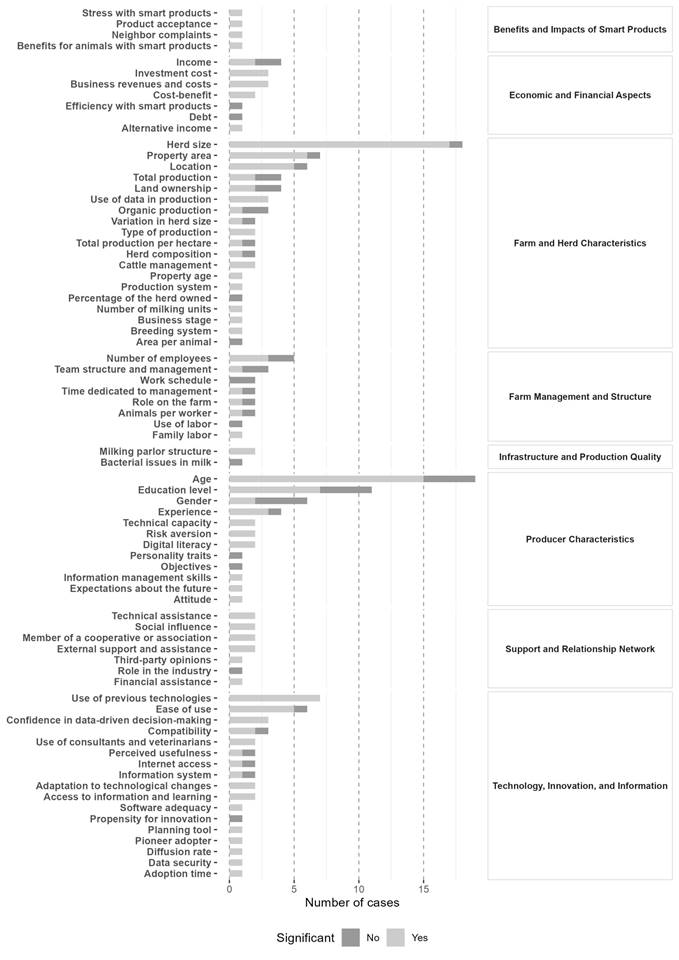
Figure 2 depicts the frequency with which each factor was identified as significant across the reviewed studies. In total, 76 distinct factors were identified. Factors were classified as significant if they satisfied a 10% statistical threshold in quantitative analyses (e.g., generalized linear models, multivariate analyses, or descriptive statistics) or if they were highlighted as important through qualitative approaches, such as case studies and interviews. The maximum frequency corresponds to the total number of studies included in the review (n = 25). The factors influencing adoption were organized into eight thematic categories: (1) Producer Characteristics (sociodemographic profile, training and skills, decision-making, and behavior); (2) Farm and Herd Characteristics (farm structure, herd size and management, type of production); (3) Farm Management and Structure (team structure and management, labor use, work schedule, and time dedicated); (4) Technology, Innovation, and Information (technology adoption and adaptation, access and use of technology, digital infrastructure, data use and information); (5) Support and Relationship Networks (external support, participation in networks); (6) Economic and Financial Factors (farm revenue and costs, efficiency, and productivity); (7) Benefits and Impacts of Smart Products (perception of smart products); (8) Infrastructure and Production Quality (milking infrastructure, sanitary issues).
Farm size and production scale, usually measured by herd size, emerged as the most robust and frequently significant variable across the reviewed studies, with positive effects on digital technology adoption reported in 90% of the quantitative analyses (ALVAREZ & NUTHALL, 2006; BOYER et al., 2024; DELA RUE et al., 2019; EDWARDS et al., 2014; GABRIEL & GANDORFER, 2023; GARGIULO et al., 2018; GILLESPIE et al., 2014; GROHER et al., 2020; LEE et al., 2024; MARESCOTTI et al., 2021; PALMA-MOLINA et al., 2023; PIÑA et al., 2023; SILVI et al., 2021; STEENEVELD & HOGEVEEN, 2015). Larger producers demonstrated lower levels of technological aversion (MARESCOTTI et al., 2021) and a greater propensity to adopt digital technologies (GROHER et al., 2020).
The age of the decision-maker was also among the most frequently examined variables, appearing in 19 of the 23 quantitative studies. Younger farmers were consistently found to be more inclined toward adoption, whereas older producers, often described as technophobic (MARESCOTTI et al., 2021), were less likely to implement digital solutions (ALVAREZ & NUTHALL, 2006; BATTE, 2005; DREWRY et al., 2019; GROHER et al., 2020; LEE et al., 2024; MARESCOTTI et al., 2021; PALMA-MOLINA et al., 2023). Younger age was particularly associated with the adoption of cameras, big data platforms, feeding behavior sensors, milk quality sensors, and mastitis detection systems (BIANCHI et al., 2022; BOYER et al., 2024; PIÑA et al., 2023).
The educational level of the decision-maker was widely tested (ALVAREZ & NUTHALL, 2006; BATTE, 2005; BOYER et al., 2024; DREWRY et al., 2019; GABRIEL & GANDORFER, 2023; GILLESPIE et al., 2014; MARESCOTTI et al., 2021; MENDES et al., 2023; PALMA-MOLINA et al., 2023; PIÑA et al., 2023; RAJCHAMAHA & MAKARARPONG, 2023). However, only about half of these studies identified a significant and positive association between higher education and digital technology adoption (ALVAREZ & NUTHALL, 2006; BATTE, 2005; DREWRY et al., 2019; MARESCOTTI et al., 2021; MENDES et al., 2023).
The adoption of digital technologies in cattle farming is driven by both economic motivations and regulatory requirements. Conversely, producers are incentivized to adopt technologies that improve production processes such as heat detection, labor management, animal health, and welfare (BIANCHI et al., 2022; SCHUKAT & HEISE, 2021), as well as those that increase profitability and complement existing tools (ABENI et al., 2019; NEWTON et al., 2020; STEENEVELD & HOGEVEEN, 2015; PALMA-MOLINA et al., 2023). On the other hand, adoption may also be stimulated by government mandates, such as the compulsory use of radio-frequency identification (RFID) systems in New Zealand (EDWARDS et al., 2014; MARESCOTTI et al., 2021). Similar policy-driven incentives can be observed in other countries as well, such as Brazil, where the adoption of RFID technologies is promoted through the National Program for Individual Identification of Cattle and Buffaloes (PNIB) (MAPA, 2024).
Among all factors, perceived usefulness and ease of use were consistently associated with adoption decisions (SILVI et al., 2021). However, certain technologies, particularly activity sensors, lack these attributes and therefore exhibit lower adoption rates, largely due to the complexity involved in data interpretation (PALMA-MOLINA et al., 2023). Technological complexity and lack of digital literacy may discourage adoption among producers with limited access to training or technical support (MARESCOTTI et al., 2021; BOYER et al., 2024). LEE et al. (2024) further highlighted that, despite improved labor efficiency observed in small farms, some producers remain hesitant to fully rely on automation technologies due to unfamiliarity and lack of trust in their operation. Several studies reported a lack of clarity regarding how to interpret and apply the collected data (BIANCHI et al., 2022; DELA RUE et al., 2019). This issue was often linked to limited technical knowledge and the perceived complexity of certain digital tools (BOYER et al., 2024; LEE et al., 2024; MAKINDE et al., 2022), which represented a significant barrier to adoption. Some producers expressed concerns that the time lag between data collection and the generation of actionable information could limit the benefits of digital technologies for production management (ABENI et al., 2019; BIANCHI et al., 2022; DELA RUE et al., 2019). Additionally, uncertainty regarding the compatibility of new technologies with existing farm software and platforms was identified as a major limiting factor in some studies (DREWRY et al., 2019; RAJCHAMAHA & MAKARARPONG, 2023). BOYER et al. (2024) further noted that many producers considered seeing the technology in operation on another farm a crucial step before making an adoption decision.
High capital costs and the need for facility upgrades, especially in farms with traditional herringbone systems, pose considerable challenges (EDWARDS et al., 2014). The most frequently cited obstacles were high upfront investment costs, especially for technologies requiring facility upgrades, and uncertainty regarding return on investment (ABENI et al., 2019; BIANCHI et al., 2022; BOYER et al., 2024; STEENEVELD & HOGEVEEN, 2015; MARESCOTTI et al., 2021; MAKINDE et al., 2022). GABRIEL & GANDORFER (2023) suggested that the availability of low-cost and easy-to-use digital tools may help stimulate the adoption of more advanced systems.
In dairy farming, the type and condition of milking facilities played an important role in technology adoption. Newer installations, particularly those equipped with rotary milking systems, facilitated the use of automation (DELA RUE et al., 2019; EDWARDS et al., 2014; GARGIULO et al., 2018). Automation provided efficiency gains compared to the herringbone milking system (DELA RUE et al., 2019). PALMA-MOLINA et al. (2023) emphasized that encouraging the adoption of technology bundles, rather than isolated tools, may be an effective strategy for expanding adoption in dairy systems.
PALMA-MOLINA et al. (2023) pointed out that high labor costs were a strong driver of automation-related technology adoption. Milking-related automation tools, particularly those improving labor efficiency and hygiene, were perceived as offering a favorable cost-benefit ratio and were regarded as desirable even by non-adopters (EDWARDS et al., 2014). LEE et al. (2024) found that implementing milking automation significantly improved labor efficiency in small-scale or family-run farms; although, this effect was less evident in large farms, possibly because small farms can be relatively more flexible in integrating new technologies into their existing routines.
Internet access and connectivity issues were reported inconsistently. While BOYER et al. (2024) did not consider them a major barrier in the United States, MARESCOTTI et al. (2021) identified poor connectivity as a key constraint in mountainous regions of Italy. GROHER et al. (2020) also found that topographic conditions significantly influenced adoption rates, with lower adoption observed in mountain areas compared to valleys. These findings underscore the importance of regional context when evaluating structural barriers to adoption.
Additional factors influencing adoption were also identified in the review. BATTE (2005) observed that farmers engaged in off-farm employment were more likely to adopt computers for farm management. Concerns regarding data privacy, particularly in relation to cloud-based or local data storage systems, were especially pronounced among older producers, who exhibited greater resistance to big data technologies (DREWRY et al., 2019; PIÑA et al., 2023). Social influence likewise played a role in adoption decisions; for instance, LEE et al. (2024) and SCHUKAT & HEISE (2021) reported that neighbor complaints about manure management significantly motivated the adoption of automated cleaning systems. DREWRY et al. (2019) examined gender and reported that female decision-makers were more likely to utilize the internet as well as agricultural laptops or tablets; however, this association was not substantiated by other studies (JELINSKI et al., 2020; GROHER et al., 2020).
CONCLUSION
The systematic review revealed that a wide range of digital technologies has been adopted in cattle farming and identifies key factors influencing this process. Most studies rely on quantitative methods and are based on samples from a limited number of countries, mainly the United States and Europe. Research output is considerably higher in dairy production than in beef cattle farming, likely reflecting the greater need for continuous monitoring and the faster feedback of economic and technical outcomes in dairy systems. This imbalance indicated a potential research gap in beef production, although publication volume alone does not imply a more advanced diffusion of digital technologies in dairy farming.
Overall, 29 digital technologies were identified and classified into four categories. Technologies related to “Automation, Control, and Robotics” and “Data Acquisition and Communication” were most frequently reported, particularly in dairy production, where applications such as automated feeding, robotic milking, and health and milk sensors support labor optimization and productivity gains. In beef cattle systems, technologies were predominantly associated with “Data Acquisition and Communication” and “Information Systems”, mainly supporting herd monitoring and production management through tools such as radio frequency identification, pasture sensors, and management software.
The review identified 76 factors influencing technology adoption, grouped into eight categories. Farm and herd characteristics emerged as the most influential, with scale playing a central role. Producer characteristics, especially age and education level, were also widely examined. These barriers include high initial investment costs, uncertainty regarding cost-benefit ratios, concerns over data privacy, and limited technical knowledge required for the operation of complex digital tools. In certain cases, inadequate internet connectivity, software incompatibility, and the need for structural adaptations further constrain the adoption process.
ACKNOWLEDGMENTS
The research was supported by Fundação de Amparo à Pesquisa do Estado de São Paulo (FAPESP) [grant number 2022/02967-5 and 2023/14466-3] and Empresa Brasileira de Pesquisa Agropecuária (Embrapa) [projects SEG 40.19.03.060.00.00 e 40.24.00.066.00.00]. The authors thank the Fundação Coordenação de Aperfeiçoamento de Pessoal de Nível Superior (CAPES) for providing access to the Journal Portal (CAFe/RNP), which facilitated the literature review for this research.
REFERENCES
-
ABENI, F. et al. A survey of Italian dairy farmers’ propensity for precision livestock farming tools. Animals, v.9, n.5, p.202, 2019. Available from: <Available from: https://doi.org/10.3390/ani9050202 >. Accessed: Jan. 13, 2025. doi: 10.3390/ani9050202.
» https://doi.org/10.3390/ani9050202.» https://doi.org/10.3390/ani9050202 -
ABIEC - Associação Brasileira das Indústrias Exportadoras de Carnes. Brasil beef report, 2023. 2024. Available from: <Available from: https://www.abiec.com.br/catpub/impressos/ >. Accessed: Jan. 13, 2025.
» https://www.abiec.com.br/catpub/impressos/ -
ALVAREZ, J.; NUTHALL, P. Adoption of computer based information systems: The case of dairy farmers in Canterbury, NZ, and Florida, Uruguay. Computers and Electronics in Agriculture, v.50, n.1, p.48-60, 2006. Available from: <Available from: https://doi.org/10.1016/j.compag.2005.08.013 >. Accessed: Jan. 13, 2025. doi: 10.1016/j.compag.2005.08.013.
» https://doi.org/10.1016/j.compag.2005.08.013.» https://doi.org/10.1016/j.compag.2005.08.013 -
BANHAZI, T. M. et al. Precision livestock farming: an international review of scientific and commercial aspects. International Journal of Agricultural and Biological Engineering, v.5, n.3, p.1-9, 2012. Available from: <Available from: https://ijabe.org/index.php/ijabe/article/view/599/0 >. Accessed: Jan. 26, 2026.
» https://ijabe.org/index.php/ijabe/article/view/599/0 -
BARNES, A. P. et al. Exploring the adoption of precision agricultural technologies: A cross regional study of EU farmers. Land Use Policy, v.80, p.163-174, 2019. Available from: <Available from: https://doi.org/10.1016/j.landusepol.2018.10.004 >. Accessed: Apr. 05, 2025. doi: 10.1016/j.landusepol.2018.10.004.
» https://doi.org/10.1016/j.landusepol.2018.10.004.» https://doi.org/10.1016/j.landusepol.2018.10.004 -
BATTE, M. T. Changing computer use in agriculture: evidence from Ohio. Computers and Electronics in Agriculture, v.47, n.1, p.1-13, 2005. Available from: <Available from: https://doi.org/10.1016/j.compag.2004.08.002 >. Accessed: Jan. 13, 2025. doi: 10.1016/j.compag.2004.08.002.
» https://doi.org/10.1016/j.compag.2004.08.002.» https://doi.org/10.1016/j.compag.2004.08.002 -
BIANCHI, M. C. et al. Diffusion of precision livestock farming technologies in dairy cattle farms. Animal, v.16, n.11, p.100650, 2022. Available from: <Available from: https://doi.org/10.1016/j.animal.2022.100650 >. Accessed: Jan. 13, 2025. doi: 10.1016/j.animal.2022.100650.
» https://doi.org/10.1016/j.animal.2022.100650.» https://doi.org/10.1016/j.animal.2022.100650 -
BORCHERS, M. R.; BEWLEY, J. M. An assessment of producer precision dairy farming technology use, prepurchase considerations, and usefulness. Journal of Dairy Science, v.98, n.6, p.4198-4205, 2015. Available from: <Available from: https://doi.org/10.3168/jds.2014-8963 >. Accessed: Mar. 30, 2025. doi: 10.3168/jds.2014-8963.
» https://doi.org/10.3168/jds.2014-8963.» https://doi.org/10.3168/jds.2014-8963 -
BOYER, C. N. et al. Influence of risk and trust on beef producers’ use of precision livestock farming. Computers and Electronics in Agriculture, v.218, p.108641, 2024. Available from: <Available from: https://doi.org/10.1016/j.compag.2024.108641 >. Accessed: Jan. 13, 2025. doi: 10.1016/j.compag.2024.108641.
» https://doi.org/10.1016/j.compag.2024.108641.» https://doi.org/10.1016/j.compag.2024.108641 -
CAJA, G. et al. Engineering to support wellbeing of dairy animals. Journal of Dairy Research, v.83, n.2, p.136-147, 2016. Available from: <Available from: https://doi.org/10.1017/S0022029916000261 >. Accessed: Jan. 25, 2026. doi: 10.1017/S0022029916000261.
» https://doi.org/10.1017/S0022029916000261.» https://doi.org/10.1017/S0022029916000261 -
DELA RUE, B. T. et al. New Zealand dairy farmers preference investments in automation technology over decision-support technology. Animal Production Science, v.60, n.1, p.133-137, 2019. Available from: <Available from: https://doi.org/10.1071/AN18566 >. Accessed: Jan. 13, 2025. doi: 10.1071/AN18566.
» https://doi.org/10.1071/AN18566.» https://doi.org/10.1071/AN18566 -
DREWRY, J. L. et al. Assessment of digital technology adoption and access barriers among crop, dairy and livestock producers in Wisconsin. Computers and Electronics in Agriculture, v.165, p.104960, 2019. Available from: <Available from: https://doi.org/10.1016/j.compag.2019.104960 >. Accessed: Jan. 13, 2025. doi: 10.1016/j.compag.2019.104960.
» https://doi.org/10.1016/j.compag.2019.104960.» https://doi.org/10.1016/j.compag.2019.104960 -
EDWARDS, J. P. et al. Evaluating rates of technology adoption and milking practices on New Zealand dairy farms. Animal Production Science, v.55, n.6, p.702-709, 2014. Available from: <Available from: https://doi.org/10.1071/AN14065 >. Accessed: Jan. 13, 2025. doi: 10.1071/AN14065.
» https://doi.org/10.1071/AN14065.» https://doi.org/10.1071/AN14065 -
GABRIEL, A.; GANDORFER, M. Adoption of digital technologies in agriculture-an inventory in a european small-scale farming region. Precision Agriculture, v.24, n.1, p.68-91, 2023. Available from: <Available from: https://doi.org/10.1007/s11119-022-09931-1 >. Accessed: Jan. 13, 2025. doi: 10.1007/s11119-022-09931-1.
» https://doi.org/10.1007/s11119-022-09931-1.» https://doi.org/10.1007/s11119-022-09931-1 -
GARGIULO, J. I. et al. Dairy farmers with larger herd sizes adopt more precision dairy technologies. Journal of Dairy Science, v.101, n.6, p.5466-5473, 2018. Available from: <Available from: https://doi.org/10.3168/jds.2017-13324 >. Accessed: Jan. 13, 2025. doi: 10.3168/jds.2017-13324.
» https://doi.org/10.3168/jds.2017-13324.» https://doi.org/10.3168/jds.2017-13324 -
GEROSKI, P. A. Models of technology diffusion. Research Policy, v.29, n.4-5, p.603-625, 2000. Available from: <Available from: https://doi.org/10.1016/S0048-7333(99)00092-X >. Accessed: Feb. 10, 2025. doi: 10.1016/S0048-7333(99)00092-X.
» https://doi.org/10.1016/S0048-7333(99)00092-X.» https://doi.org/10.1016/S0048-7333(99)00092-X -
GILLESPIE, J. et al. The adoption of technologies, management practices, and production systems in US milk production. Agricultural and Food Economics, v.2, n.1, p.17, 2014. Available from: <Available from: https://doi.org/10.1186/s40100-014-0017-y >. Accessed: Jan. 13, 2025. doi: 10.1186/s40100-014-0017-y.
» https://doi.org/10.1186/s40100-014-0017-y.» https://doi.org/10.1186/s40100-014-0017-y -
GIUA, C. et al. Smart farming technologies adoption: Which factors play a role in the digital transition?. Technology in Society, v.68, p.101869, 2022. Available from: <Available from: https://doi.org/10.1016/j.techsoc.2022.101869 >. Accessed: May, 21, 2025. doi: 10.1016/j.techsoc.2022.101869.
» https://doi.org/10.1016/j.techsoc.2022.101869.» https://doi.org/10.1016/j.techsoc.2022.101869 -
GROHER, T. et al. Digital technology adoption in livestock production with a special focus on ruminant farming. Animal, v.14, n.11, p.2404-2413, 2020. Available from: <Available from: https://doi.org/10.1017/S1751731120001391 >. Accessed: Jan. 13, 2025. doi: 10.1017/S1751731120001391.
» https://doi.org/10.1017/S1751731120001391.» https://doi.org/10.1017/S1751731120001391 -
IBGE - Instituto Brasileiro de Geografia e Estatística. Pesquisa Pecuária Municipal. Instituto Brasileiro de Geografia e Estatística. 2021. Available from: <Available from: https://www.ibge.gov.br/estatisticas/economicas/agricultura-e-pecuaria/9107-producao-da-pecuaria-municipal.html >. Accessed: Jan. 13, 2025.
» https://www.ibge.gov.br/estatisticas/economicas/agricultura-e-pecuaria/9107-producao-da-pecuaria-municipal.html -
JELINSKI, M. D. et al. Factors associated with the adoption of technologies by the Canadian dairy industry. The Canadian Veterinary Journal, v.61, n.10, p.1065, 2020. Available from: <Available from: https://pubmed.ncbi.nlm.nih.gov/33012822/ >. Accessed: Jan. 13, 2025.
» https://pubmed.ncbi.nlm.nih.gov/33012822/ -
LEE, Y. G. et al. Effects of smart farming on the productivity of korean dairy farms: A case study of robotic milking systems. Sustainability, v.16, n.22, 2024. Available from: <Available from: https://doi.org/10.3390/su16229991 >. Accessed: Jan. 13, 2025. doi: 10.3390/su16229991.
» https://doi.org/10.3390/su16229991.» https://doi.org/10.3390/su16229991 -
LOVARELLI, D. et al. A review on dairy cattle farming: Is precision livestock farming the compromise for an environmental, economic and social sustainable production?. Journal of Cleaner Production, v.262, p.121409, 2020. Available from: <Available from: https://doi.org/10.1016/j.jclepro.2020.121409 >. Accessed: Mar. 08, 2025. doi: 10.1016/j.jclepro.2020.121409.
» https://doi.org/10.1016/j.jclepro.2020.121409.» https://doi.org/10.1016/j.jclepro.2020.121409 -
MAKINDE, A. et al. Investigating perceptions, adoption, and use of digital technologies in the Canadian beef industry. Computers and Electronics in Agriculture, v.198, p.107095, 2022. Available from: <Available from: https://doi.org/10.1016/j.compag.2022.107095 >. Accessed: Jan. 13, 2025. doi: 10.1016/j.compag.2022.107095.
» https://doi.org/10.1016/j.compag.2022.107095.» https://doi.org/10.1016/j.compag.2022.107095 -
MARESCOTTI, M. E. et al. Smart farming in mountain areas: Investigating livestock farmers’ technophobia and technophilia and their perception of innovation. Journal of Rural Studies, v.86, p.463-472, 2021. Available from: <Available from: https://doi.org/10.1016/j.jrurstud.2021.07.015 >. Accessed: Jan. 13, 2025. doi: 10.1016/j.jrurstud.2021.07.015.
» https://doi.org/10.1016/j.jrurstud.2021.07.015.» https://doi.org/10.1016/j.jrurstud.2021.07.015 -
MENDES, J. J. et al. Adoption and impacts of messaging applications and participation in agricultural information-sharing groups: an empirical analysis with Brazilian farmers. Journal of Agribusiness in Developing and Emerging Economies, v.14, n.4, p.676-693, 2023. Available from: <Available from: https://doi.org/10.1108/JADEE-09-2022-0194 >. Accessed: Jan. 13, 2025. doi: 10.1108/JADEE-09-2022-0194.
» https://doi.org/10.1108/JADEE-09-2022-0194.» https://doi.org/10.1108/JADEE-09-2022-0194 -
MAPA - Ministério da Agricultura e Pecuária. Plano Nacional de Identificação Individual de Bovinos e Búfalos - PNIB: Plano estratégico 2025-2032. 2024 Brasília, DF. Available from: <Available from: https://www.gov.br/agricultura/pt-br/assuntos/pnib > Accessed: Jan. 13, 2025.
» https://www.gov.br/agricultura/pt-br/assuntos/pnib -
MOHER, D. et al. Preferred reporting items for systematic reviews and meta-analyses: the PRISMA statement. International Journal of Surgery, v.8, n.5, p.336-341, 2010. Available from: <Available from: https://doi.org/10.1371/journal.pmed.1000097 >. Accessed: Jan. 05, 2025. doi: 10.1371/journal.pmed.1000097.
» https://doi.org/10.1371/journal.pmed.1000097.» https://doi.org/10.1371/journal.pmed.1000097 -
MORENO, J. C. et al. A pending task for the digitalisation of agriculture: A general framework for technologies classification in agriculture. Agricultural Systems, v.213, p.103794, 2024. Available from: <Available from: https://doi.org/10.1016/j.agsy.2023.103794 >. Accessed: Aug. 05, 2025. doi: 10.1016/j.agsy.2023.103794.
» https://doi.org/10.1016/j.agsy.2023.103794.» https://doi.org/10.1016/j.agsy.2023.103794 -
MORRONE, S. et al. Industry 4.0 and precision livestock farming (PLF): an up to date overview across animal productions. Sensors, v.22, n.12, p.4319, 2022. Available from: <Available from: https://doi.org/10.3390/s22124319 >. Accessed: May, 18, 2025. doi: 10.3390/s22124319.
» https://doi.org/10.3390/s22124319.» https://doi.org/10.3390/s22124319 -
MOZAMBANI, C. I. et al. Adoption of precision agriculture technologies by sugarcane farmers in the state of São Paulo, Brazil. Precision Agriculture, v.24, n.5, p.1813-1835, 2023. Available from: <Available from: https://doi.org/10.1007/s11119-023-10019-7 >. Accessed: Jun. 25, 2025. doi: 10.1007/s11119-023-10019-7.
» https://doi.org/10.1007/s11119-023-10019-7.» https://doi.org/10.1007/s11119-023-10019-7 -
NEWTON, J. E. et al. Farming smarter with big data: Insights from the case of Australia’s national dairy herd milk recording scheme. Agricultural Systems, v.181, p.102811, 2020. Available from: <Available from: https://doi.org/10.1016/j.agsy.2020.102811 >. Accessed: Jan. 13, 2025. doi: 10.1016/j.agsy.2020.102811.
» https://doi.org/10.1016/j.agsy.2020.102811.» https://doi.org/10.1016/j.agsy.2020.102811 -
PALMA-MOLINA, P. et al. Factors associated with intensity of technology adoption and with the adoption of 4 clusters of precision livestock farming technologies in Irish pasture-based dairy systems. Journal of Dairy Science, v.106, n.4, p.2498-2509, 2023. Available from: <Available from: https://doi.org/10.3168/jds.2021-21503 >. Accessed: Jan. 13, 2025. doi: 10.3168/jds.2021-21503.
» https://doi.org/10.3168/jds.2021-21503.» https://doi.org/10.3168/jds.2021-21503 -
PIÑA, R. et al. Big data technology adoption in beef production. Smart Agricultural Technology, v.5, p.100235, 2023. Available from: <Available from: https://doi.org/10.1016/j.atech.2023.100235 >. Accessed: Jan. 13, 2025. doi: 10.1016/j.atech.2023.100235.
» https://doi.org/10.1016/j.atech.2023.100235.» https://doi.org/10.1016/j.atech.2023.100235 -
R CORE TEAM. R: A language and environment for statistical computing. R Foundation for Statistical Computing, Vienna, Austria, 2024. Available from: <Available from: https://www.R-project.org/ >. Accessed: Sept. 10, 2025.
» https://www.R-project.org/ -
RAJCHAMAHA, K.; MAKARARPONG, D. Dairy farmers’ intention to use high-precision area-level weather warning technology in dairy farms in Thailand through an application on mobile Phones. International Journal of Interactive Mobile Technologies, v.17, n.18, 2023. Available from: <Available from: https://doi.org/10.3991/ijim.v17i18.41265 >. Accessed: Jan. 13, 2025. doi: 10.3991/ijim.v17i18.41265.
» https://doi.org/10.3991/ijim.v17i18.41265.» https://doi.org/10.3991/ijim.v17i18.41265 -
RUTTEN, C. J. et al. Invited review: Sensors to support health management on dairy farms. Journal of Dairy Science, v.96, n.4, p.1928-1952, 2013. Available from: <Available from: https://doi.org/10.3168/jds.2012-6107 >. Accessed: Jan. 25, 2026. doi: 10.3168/jds.2012-6107.
» https://doi.org/10.3168/jds.2012-6107.» https://doi.org/10.3168/jds.2012-6107 -
SCHUKAT, S.; HEISE, H. Smart products in livestock farming-An empirical study on the attitudes of German farmers. Animals, v.11, n.4, p.1055, 2021. Available from: <Available from: https://doi.org/10.1016/j.compag.2004.08.002 >. Accessed: Jan. 13, 2025. doi: 10.1016/j.compag.2004.08.002.
» https://doi.org/10.1016/j.compag.2004.08.002.» https://doi.org/10.1016/j.compag.2004.08.002 -
SILVI, R. et al. Adoption of precision technologies by Brazilian dairy farms: The farmer’s perception. Animals, v.11, n.12, p.3488, 2021. Available from: <Available from: https://doi.org/10.3390/ani11123488 >. Accessed: Jan. 13, 2025. doi: 10.3390/ani11123488.
» https://doi.org/10.3390/ani11123488.» https://doi.org/10.3390/ani11123488 -
STEENEVELD, W.; HOGEVEEN, H. Characterization of Dutch dairy farms using sensor systems for cow management. Journal of Dairy Science, v.98, n.1, p.709-717, 2015. Available from: <Available from: https://doi.org/10.3168/jds.2014-8595 >. Accessed: Jan. 13, 2025. doi: 10.3168/jds.2014-8595.
» https://doi.org/10.3168/jds.2014-8595.» https://doi.org/10.3168/jds.2014-8595 -
TEY, Y. S.; BRINDAL, M. Factors influencing the adoption of precision agricultural technologies: a review for policy implications. Precision Agriculture, v.13, n.6, p.713-730, 2012. Available from: <Available from: https://doi.org/10.1007/s11119-012-9273-6 >. Accessed: Feb. 12, 2025. doi: 10.1007/s11119-012-9273-6.
» https://doi.org/10.1007/s11119-012-9273-6.» https://doi.org/10.1007/s11119-012-9273-6 -
TEY, Y. S.; BRINDAL, M. A meta-analysis of factors driving the adoption of precision agriculture. Precision Agriculture, v.23, n.2, p.353-372, 2022. Available from: <Available from: https://doi.org/10.1007/s11119-021-09840-9 >. Accessed: Feb. 12, 2025. doi: 10.1007/s11119-021-09840-9.
» https://doi.org/10.1007/s11119-021-09840-9.» https://doi.org/10.1007/s11119-021-09840-9 -
VINHOLIS, M. M. B. et al. Adoption of beef cattle traceability at farm level in São Paulo State, Brazil. Ciência Rural, v.47, n.9, p.e20160759, 2017. Available from: <Available from: https://doi.org/10.1590/0103-8478cr20160759 >. Accessed: Mar. 14, 2025. doi: 10.1590/0103-8478cr20160759.
» https://doi.org/10.1590/0103-8478cr20160759.» https://doi.org/10.1590/0103-8478cr20160759 -
VRCHOTA, J. et al. Precision agriculture technologies for crop and livestock production in the Czech Republic. Agriculture, v.12, n.8, p.1080, 2022. Available from: <Available from: https://doi.org/10.3390/agriculture12081080 >. Accessed: Jan. 13, 2025. doi: 10.3390/agriculture12081080.
» https://doi.org/10.3390/agriculture12081080.» https://doi.org/10.3390/agriculture12081080 -
WOLFERT, S. et al. Big data in smart farming-a review. Agricultural Systems, v.153, p.69-80, 2017. Available from: <Available from: https://doi.org/10.1016/j.agsy.2017.01.023 >. Accessed: Jan. 26, 2026. doi: 10.1016/j.agsy.2017.01.023.
» https://doi.org/10.1016/j.agsy.2017.01.023.» https://doi.org/10.1016/j.agsy.2017.01.023
Edited by
-
ASSOCIATE EDITOR:
Rudi Weiblen (0000-0002-1737-9817)
-
SCIENTIFIC EDITOR:
José Victor Isola (0000-0002-3168-3188)
Not applicable.