
 THE INCLUSION OF AUTISTIC STUDENTS IN PHYSICAL EDUCATION CLASSES WITHIN BASIC EDUCATION: A SYSTEMATIC REVIEW
ABSTRACT:
Introduction: Autism Spectrum Disorder (ASD) is classified as a neurodevelopmental condition that significantly impacts individuals' behavior, communication abilities, and social interactions. Objective: To analyze the process of including students with Autism Spectrum Disorder (ASD) within the pedagogical practices of Physical Education teachers in basic education settings. Methodology: This study employs a systematic review conducted in adherence to the PRISMA guidelines. The literature search was carried out using databases such as the Coordination for the Improvement of Higher Education Personnel (CAPES), the Latin American and Caribbean Literature on Health Sciences (LILACS), and the ERIC platform. Results: The database searches yielded a total of 46 articles. Following the screening process, six articles met the established eligibility criteria and were subsequently selected for evaluation and critical analysis. Discussion: The analysis of the studies included in this systematic review revealed significant discussions and relevant insights concerning the inclusion of students with Autism Spectrum Disorder (ASD) in Physical Education classes within the context of basic education. Conclusions: The analysis of the selected studies indicates the existence of research addressing the inclusion of students with Autism Spectrum Disorder (ASD) in Physical Education classes within elementary education. However, there remains a notable need for studies that provide a more comprehensive examination of the methodological strategies that teachers can employ to create a genuinely inclusive school environment.
Keywords:
student; autism; school-based physical activity; participation
RESUMO:
Introdução: O Transtorno do Espectro Autista (TEA) é um distúrbio do neurodesenvolvimento que afeta os indivíduos nas áreas relacionadas ao comportamento, à comunicação e à interação social. Objetivo: compreender como ocorre a inclusão do aluno com Transtorno do Espectro Autista (TEA) na prática pedagógica do professor de Educação Física no ensino básico. Metodologia: revisão sistemática conduzida em conformidade com as diretrizes do PRISMA, com buscas nas bases de dados em periódicos como a Coordenação de Aperfeiçoamento de Pessoal de Nível Superior (CAPES), a Literatura Latino-Americana e do Caribe em Ciências da Saúde (LILACS) e a Plataforma ERIC. Resultados: com as buscas nas bases de dados, foram selecionados 46 artigos e, com o processo de triagem, 6 artigos atenderam aos critérios de elegibilidade e foram incluídos para avaliação e análise crítica. Discussão: com a análise dos estudos incluídos nesta revisão sistemática foi perceptível que estes trouxeram discussões, apontamentos pertinentes para o ensino básico no âmbito da inclusão dos alunos com TEA nas aulas do componente curricular de Educação Física. Conclusões: a partir dos estudos analisados, constatou-se que existem pesquisas relacionadas à inclusão de alunos com TEA nas aulas de Educação Física no ensino básico. No entanto, vê-se a necessidade de pesquisas que busquem um olhar mais acentuado quanto às estratégias metodológicas que os professores podem viabilizar em sala de aula para que, de fato, o ambiente escolar seja inclusivo.
Palavras-chave:
discente; autismo; atividade física escolar; participação
RESUMEN:
Introducción: El Trastorno del Espectro Autista (TEA) es una condición del neurodesarrollo que impacta de manera significativa áreas relacionadas con el comportamiento, la comunicación y la interacción social de los individuos. Objetivo: Analizar el proceso de inclusión de estudiantes con Trastorno del Espectro Autista (TEA) en las prácticas pedagógicas de los docentes de Educación Física en el ámbito de la educación básica. Metodología: Se realizó una revisión sistemática siguiendo los lineamientos establecidos por PRISMA. Las búsquedas se llevaron a cabo en bases de datos de revistas científicas, tales como la Coordinación para el Perfeccionamiento del Personal de Educación Superior (CAPES), la Literatura Latinoamericana y del Caribe en Ciencias de la Salud (LILACS), y la plataforma ERIC. Resultados: Las búsquedas en las bases de datos identificaron un total de 46 artículos. Tras el proceso de selección y cribado, seis de ellos cumplieron con los criterios de elegibilidad y fueron incorporados para su evaluación y análisis crítico. Discusión: El análisis de los estudios incluidos en esta revisión sistemática permitió identificar discusiones y aportes relevantes para la educación básica, específicamente en el contexto de la inclusión de estudiantes con Trastorno del Espectro Autista (TEA) en las clases de Educación Física. Conclusiones: Los estudios analizados evidencian la existencia de investigaciones relacionadas con la inclusión de estudiantes con TEA en las clases de Educación Física en el nivel de educación básica. No obstante, se destaca la necesidad de realizar investigaciones que profundicen en las estrategias metodológicas que los docentes pueden emplear en el aula, con el fin de garantizar un ambiente escolar verdaderamente inclusivo.
Palabras clave:
estudiantes; autismo; actividad Física Escolar; participación
INTRODUCTION
Autism Spectrum Disorder (ASD) is a disability that impacts cognitive development, leading to verbal and motor delays and social interaction. Individuals with ASD often wish for friendship alongside a fear of being excluded. In the school environment, this frequently results in students withdrawing from participating in activities, such as Physical Education classes (Lee et al., 2022).
According to Lee et al. (2022), autism is being discussed within mainstream schools to foster social engagement. This ensures that students with disabilities are accepted by their non-disabled peers, facilitating progress in their learning process.
The term “autism” for Cunha (2012) originates from the Greek autós, meaning “of oneself.” The author notes that this term was first used in 1911 by the Swiss psychiatrist E. Bleuler to describe the withdrawal from reality and social isolation observed in patients with schizophrenia. Thus, Cunha (2012) further states that autism is understood through observing a set of behaviors in a triad: communication difficulties, challenges in social interaction, and restricted, repetitive activities.
Based on this, Almeida (2022), in line with Cunha (2012), affirms that Autism Spectrum Disorder (ASD) is a pervasive developmental disorder characterized by difficulties in communication and social interaction, as well as restricted, stereotyped patterns of behavior.
According to Fiorini and Manzini (2021), some education professionals see the inclusion of students with disabilities as a challenging task. One of the difficulties cited by them involves the learning limitations of students with disabilities, specifically children with Autism Spectrum Disorder, in Physical Education classes. This scenario will be discussed in this study.
Fiorini and Manzini (2021) report that studies indicate physical education teachers struggle to work with students with ASD because they lack the proper training to meet these students' unique needs. Consequently, it is essential to successfully include them in classes and activities through the use of specific strategies that foster their acceptance among their peers without disabilities. This ensures they avoid embarrassing situations and the perception they are disrupting the class, which could otherwise lead to discomfort and withdrawal from activities.
Literature indicates that, historically, school-based Physical Education has been associated with selective practices, particularly when influenced by biologistic perspectives and a focus on motor performance. However, recent pedagogical approaches have redefined this aspect, expanding its scope beyond just performance. These new methods value the development of motor skills and the promotion of social interaction among students with ASD. In this context, the role of the Physical Education teacher is vital in fostering bonds, allowing teachers to build a relationship based on trust with their students (Miyashiro; Salerno, 2021).
From this perspective, Physical Education offers significant possibilities for developing inclusive educational practices, particularly by engaging different forms of body language and pedagogical strategies that expand students' modes of participation (Garozzi; Chicon, 2021). However, this potential must be understood in conjunction with other areas of knowledge, within an interdisciplinary framework.
Thus, the role of the physical education teacher becomes significant in the process of including students with ASD in the school setting. It is up to this professional to plan and facilitate challenging learning situations that align with the students' needs, fostering knowledge construction and active participation in the proposed activities (Almeida, 2022).
Working in pairs or groups stands out among the possible pedagogical strategies as it can foster social interaction and develop cooperative relationships among students. However, its implementation requires planning and prior preparation of the class to avoid practices that are patronizing or potentially segregating. The teacher must act as a mediator of interactions, promoting horizontal and respectful relationships among the students.
The presence of an assistant teacher can significantly help address specific educational needs and support the lead teacher. This collaboration fosters the participation of students with Autism Spectrum Disorder (ASD) in activities, while also promoting their motor and social development (Miyashiro & Salerno, 2021). However, it is important to recognize that this support is not available in all schools. This highlights the need to invest in teacher training and to develop pedagogical strategies adaptable to diverse educational contexts, ensuring the effective implementation of inclusive practices.
These reflections contribute to the development of this research. This topic was chosen to foster social interaction in the educational setting, enabling students with Autism Spectrum Disorder (ASD) to participate actively in Physical Education classes.
Interest in this topic arose from discussions involving studies in the field of education. The subject matter was developed and supported based on studies selected and analyzed in this Systematic Literature Review (SLR), which are relevant to our research. To this end, the study addressed the following research question: How does the inclusion of students with Autism Spectrum Disorder (ASD) take place in Physical Education classes within basic education? Consequently, the study aimed to understand how the inclusion of students with Autism Spectrum Disorder (ASD) occurs within the pedagogical practice of Physical Education teachers in basic education.
Therefore, this research aims to systematically synthesize studies regarding the inclusion of students with ASD in Physical Education classes, seeking a foundation that enhances Physical Education professionals' knowledge on how to implement inclusion for students with Autism Spectrum Disorder. The goal is to provide a positive response that enables these students to interact and overcome the barriers preventing them from maximizing their motor, social, and affective development. The study then seeks to foster reflection and discussion, generating research insights and relevant information regarding the inclusion process in Physical Education, while also encouraging a re-examination of the established knowledge and practices within this field.
METHODS
This study is grounded in a systematic literature review focusing on the inclusion of students with Autism Spectrum Disorder (ASD) in Physical Education classes within basic education. It followed the following stages: 1) definition of the research question based on the PEO strategy (Population, Exposure, Outcomes); 2) selection of the databases for the research, specifically the Periódicos da Coordenação de Aperfeiçoamento de Pessoal de Nível Superior CAPES (Coordination for the Improvement of Higher Education Personnel) journals portal, Latino-Americana e do Caribe em Ciências da Saúde LILACS (Latin American and Caribbean Health Sciences Literature), and the ERIC platform; 3) creation of keywords and search strategies using search equations; 4) location of the scientific articles in the databases according to inclusion criteria; 5) selection of studies based initially on titles, followed by reading abstracts, and finally reading the full texts; and 6) collection of data from the full-text articles, as well as synthesizing, evaluating, and critically analyzing the findings. The methodological process was guided by the Preferred Reporting Items for Systematic Reviews and Meta-Analyses (PRISMA, 2020) recommendations, aiming for greater rigor and transparency in conducting the review. Although the review protocol was structured in advance by the authors, it was not registered on specific platforms.
The database search was conducted between March and April 2024, using a search strategy involving Boolean operators and wildcards (Table 1).
Table 1 shows that the search strategies were structured by combining equivalent descriptors in Portuguese and English, considering the specific indexing characteristics of each database. Truncated terms such as “Alun*”, “Autis*”, and “Inclu*” were used to broaden the retrieval of studies, capturing variations such as “aluno”/“alunos” (student/students), “autismo”/“autista” (autism/autistic), and “inclusão”/“inclusivo” (inclusion/inclusive). For international databases (LILACS and the ERIC platform), English-language descriptors such as “student*”, “autism”, and “inclusion” were used in combination with the term “physical education” to ensure a more comprehensive search for studies indexed on these platforms.
During the identification phase, searches across the databases yielded 46 studies: 23 from CAPES, 5 from LILACS, and 18 from the ERIC platform. Searches within these databases adhered to the following inclusion criteria: full-text works (articles) addressing the topic under investigation; languages including Portuguese, English, and Spanish; articles published within the last five years (2019-2024), a period during which Autism Spectrum Disorder was classified as a disability in the Brazilian Demographic Census following Law 13.861 (Brazil, 2019); studies covering stages of basic education (Early Childhood Education, Elementary Education, and High School); and qualitative research.
The exclusion criteria included: incomplete works; abstracts; reviews; monographs; undergraduate capstone projects; master's dissertations; doctoral theses; book chapters; articles falling outside the five-year publication timeframe; studies unrelated to the topic under investigation; and studies that, despite addressing the topic, focused on other educational stages or modalities, such as higher education or youth and adult education.
The researchers conducted the study selection process rigorously, involving the review of titles, abstracts, and full texts. In cases of uncertainty or disagreement about study inclusion, decisions were made by consensus to ensure greater reliability in the selection process.
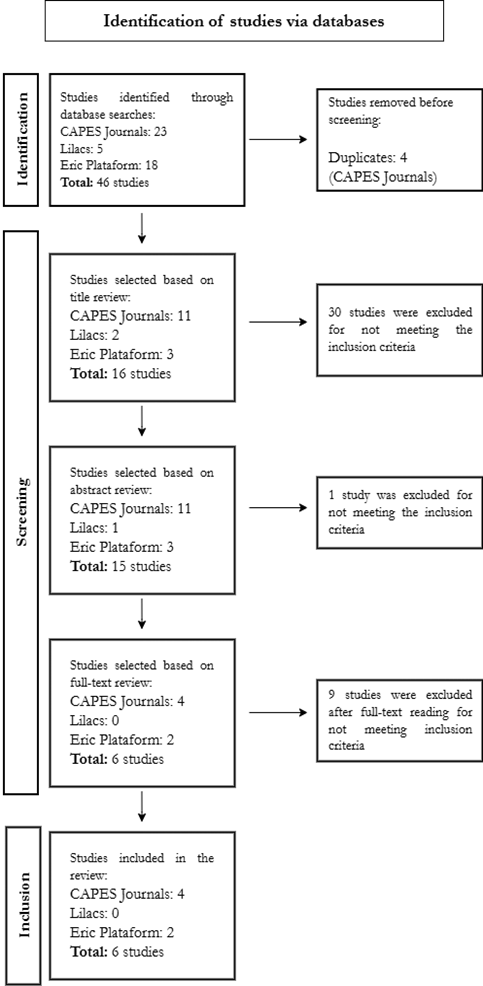
A total of forty-six articles were selected, as shown in the flowchart (Figure 1), using the descriptors in the CAPES Journals database. Four of these articles met the inclusion criteria and were analyzed. No articles were selected from LILACS after applying the study scope criteria, while two articles were considered from the ERIC database. Thus, the organization of information from the database searches and the stages described in the methods section was systematized following the methodological recommendations based on the Preferred Reporting Items for Systematic Reviews and Meta-Analyses (PRISMA, 2020).
The flowchart above (Figure 1) shows that during the search process on the three databases, a total of 46 studies were identified: 23 from CAPES Periodicals, 5 from LILACS, and 18 from the ERIC platform. At this search stage, four studies were excluded due to duplication; these duplicates were found within CAPES Journals.
During the screening process, studies were selected based on the following stages: 1st - Title reading (16 studies selected in total: 11 from CAPES Journals, 2 from LILACS, and 3 from the ERIC platform). At this stage, 30 studies were excluded for failing to meet the inclusion criteria established in the systematic review protocol; 2nd - Abstract reading (15 studies selected in total: 11 articles from CAPES Journals, 1 from LILACS, and 3 from the ERIC platform). At this stage, 1 study was excluded as it did not meet the inclusion criteria; 3rd - Full-text reading (6 studies selected in total: 4 from CAPES Journals and 2 from the ERIC platform). At this stage, 9 studies were excluded for failing to meet the inclusion criteria established in the systematic review protocol; 4th - Studies included for review analysis (6 studies selected in total: 4 from CAPES Journals and 2 from the ERIC platform).
Schematic representation of the identification, screening, and inclusion of systematic review studies, adapted from PRISMA (2020)
The studies included in the systematic review underwent a critical appraisal of their methodological quality using the scale developed by Letts et al. (2007), the Critical Review Form for Qualitative Studies. This scale comprises 21 items that, in accordance with Sarmento, Saavedra, and Rosado (2024), evaluate the following criteria: 1) objective (item 1); 2) literature review (item 2); 3) study design (items 3, 4, 5); 4) study sample (items 6, 7, 8, 9); 5) data collection (items 10, 11, 12); 6) data analysis (analytical rigor: items 14 and 15; auditability: items 16 and 17; theoretical connections: item 18); 7) overall rigor (item 19); and 8) conclusion/implications (items 20 and 21). This procedure allowed for the identification of methodological rigor and potential limitations within the included studies, in accordance with the risk-of-bias assessment recommended for systematic reviews.
The critical appraisal was conducted using the Critical Review Form for Qualitative Studies (Letts et al., 2007). The analysis revealed that the studies had an excellent methodological quality, with scores exceeding 75%. For this analysis, we adopted the classifications proposed by Faber et al. (2016) and Wierike et al. (2013), categorizing the articles as follows: (1) low methodological quality (score ≤ 50%); (2) good methodological quality (score between 51% and 75%); and (3) excellent methodological quality (score > 75%).
In response to this, the authors of this systematic review conducted a rigorous analysis of the included studies. They met multiple times to discuss, take note, and deliberate on each study. To better organize the data collected, a flowchart was created to summarize the search process and the tables detailing relevant information, such as title, authors, objectives, methods, results, conclusions, publication databases, location, and research participants. Also, a data extraction tool was developed to systematize information from the included studies, ensuring greater organization and reliability in the analysis.
RESULTS
This section covers the research results. The tables below present relevant information for each study included in the systematic literature review.
Table 2 shows the studies selected for the systematic literature review covering the period from 2019 to 2024, listing the authors, year of publication, research location, publication source (CAPES, LILACS, or ERIC), and study title.
As shown in the table above, this systematic review includes four studies conducted in Brazil, one in Sweden, and one in China. All of them share a convergent overarching research theme: “the inclusion of students with Autism Spectrum Disorder in Physical Education classes.” The results of these studies are presented in the following sections of this article.
Based on the studies conducted, this article presents structured data from the research included in the systematic review in the tables below, detailing their objectives, methods, results, and conclusions.
Article information - student with visual impairment and autism: a case study of interactions in Physical Education classes (Miyashiro; Salerno, 2021)
Article information - The deaf autistic student in Physical Education classes (Ferreira; Vilela; Braz, 2022)
Article information - Strategies for the participation of students with Autism Spectrum Disorder in Physical Education classes (Fiorini; Manzini, 2021)
Article information - Students with Autism Spectrum Disorder in mainstream schools: accounts from Physical Education teachers (Maia; Bataglion, 2020)
Article Information - What Physical Education Becomes When Students with Neurodevelopmental Disorders Are Integrated: A Transactional Understanding (Thoren; Quennerstedt; Maivorsdotter, 2021)
Article Information - Using cooperative physical activities in inclusive settings to improve social interactions among preschool-aged children with Autism Spectrum Disorder in China (Lee; He; Xu, 2022)
The research associated with this study focuses on students and teachers affiliated with basic education. To provide a general overview of these teachers and students, Table 9 is presented below. It details the titles of the researched studies, the number of participating students and teachers, their ages, and the students' grade levels. Where data is missing, the corresponding column and/or row is left blank.
DISCUSSION
After analyzing the studies included in the systematic review, we found that they address the importance of socially including students with ASD, or any other disability, within the school environment. In this context, social inclusion in the educational settings, according to Almeida (2022):
[...] goes beyond the placement of students with disabilities within mainstream educational institutions. Inclusion entails a deeper shift, not only regarding content and teaching methods but also concerning the emotions and the worldviews and conceptions of the human being held by the individuals interacting in that space. For this to occur, the context of inclusive education must be grounded in flexibility (Almeida, 2022, p. 18).
Based on the statement above, we understand that school inclusion goes beyond merely placing students in educational institutions. It needs to ensure they have the opportunity to actively participate in activities within that setting, interact with everyone, and share knowledge and learning experiences.
In this context, and in line with the literature, while discrimination against and rejection of students with disabilities exist in schools, there is also cooperation and empathy, and the teacher plays a fundamental role (Miyashiro; Salerno, 2021). Thus, the teachers should seek, within their pedagogical practice, to “[...] achieve equity and promote opportunities for all learners” (Garozzi; Chicon, 2021, p. 32). We recognize that the teacher plays a crucial role in effectively fostering the inclusion of all students within the educational setting, providing valuable opportunities for the learning process.
Ferreira et al. (2022) conclude that the Physical Education teacher needs to identify and intervene, considering the students' needs. Thereby, they need to foster interaction, communication, and the development of physical capabilities. For this conclusion, the study relied on the observation and recording of Physical Education classes involving two students, aged 5 and 7, in 2017. For the analysis conducted, the students had deafness and ASD.
The inclusive process within the school environment begins with the teacher, specifically, with their attitudes and willingness to rethink daily pedagogical practice. They seek ways to adapt their lessons while considering the difficulties and characteristics of each student, whether or not they have a disability (Tonello, 2007).
Physical Education classes occur in environments characterized by collective interaction. In this context, Maia et al. (2020) emphasize that students with ASD benefit from interactions with both classmates who have disabilities and those who do not. Such interactions serve as strategies for inclusion within this curricular subject. These interactions are particularly facilitated when activities involve object manipulation and routine sequencing. These observations align with Almeida (2022), who emphasizes that the teacher needs to “[...] be sensitive and attentive to the student's expressions, since people with autism interact differently, and sometimes this interaction is so subtle that it can only be perceived by an observant eye” (Almeida, 2022, p. 29).
Lee et al. (2022) address the role of interactions and the Physical Education teaching environment. Their study shows that the presence of inappropriate interactions is not ruled out. However, there is a greater incidence in appropriate processes, with a decrease in the proportion of inappropriate interactions in two children in the PE environment, and for all three children that covered the authors' study. The aforementioned authors bring ideas that are similar in terms of interaction processes, highlighting possibilities in relation to the teacher's understanding of the individuality of the student with ASD and targeted and free physical activities.
When considering the central role of interactions in the teaching process, the challenges in pedagogical practice also appear. In this context, evidence presented by Obrusnikova and Dillon (2011) reinforces that teaching students with ASD involves significant challenges related to hyperactive behaviors, difficulties with social interaction, task comprehension, and emotional regulation. These aspects directly impact the dynamics of Physical Education classes, requiring teachers to use planning, constant mediation, and pedagogical strategies that foster participation and interaction while minimizing situations of isolation or exclusion.
The physical education teacher plays a fundamental role in identifying possibilities for the inclusion of students with ASD. Fiorini and Manzini (2021) show four strategies used by teachers, based on identification and description during observation: pre-instruction; explanation and support during the activity; teacher response or action; and the student's emotional conduct.
The research by Maia, Bataglion, and Mazo (2020) also presents findings regarding strategies teachers use in their pedagogical practice to foster inclusion in Physical Education classes. These strategies involve the interaction between students with and without ASD, the exploration of objects within a routine-based context, group activities, and a peer-tutoring approach that facilitates interaction and communication.
Based on this, we need to mention that when teachers employ diverse methodological strategies in their pedagogical practice, adapting activities to suit students' specific needs, they enable genuine inclusion within the educational context. Almeida highlights that:
Teachers need to employ various resources that foster the students' desire to participate in the lesson; the proposed activities should be creative and dynamic. Students should have the opportunity to handle objects, play, sing, and engage in diverse activities, allowing them to progress daily and address any potential deficits. It is up to the teacher to be prepared to reflect on these deficits and how to address them, ensuring students have the opportunity to grow and overcome potential barriers (Almeida, 2022, p. 26).
Considering the aforementioned author, it is evident that teachers need to be prepared to use pedagogical and didactic resources so that Physical Education classes become more than merely inclusive, creating an environment where teachers and students learn, exchange knowledge, and foster enjoyable, dynamic experiences within the educational process.
Regarding the teaching-learning process in teaching practice, the renowned educator Paulo Freire (1996) explains that “there is no teaching without learning; the two explain each other, and the individuals involved, despite the differences that distinguish them, are not reduced to the status of objects in relation to one another. Those who teach learn by teaching, and those who learn teach by learning” (Freire, 1996, p. 13). Based on this author's observations, one can see the significance of both the teacher and the student within the educational context. In a horizontal relationship, devoid of a hierarchy of knowledge, both parties acquire learning and exchange insights and knowledge.
In the studies analyzed in this systematic review, inclusion exists alongside persisting exclusion; in other words, there is an antagonistic relationship between processes that converge within social contexts. In this scenario, while the term “inclusion” appears in the findings of all the research discussed here, references to “exclusion” are infrequent.
Regarding inclusion in the school environment, Garozzi and Chicon (2021) highlight the importance of developing an inclusion project grounded in the recognition of differences within the school context to promote equity regarding opportunities for access, retention, and learning. The authors further note that such a project fosters a committed practice designed to enable the participation of all students in activities and in the construction of knowledge.
Having presented the results of the studies comprising this systematic literature review, it is relevant to note that the research conducted by Miyashiro and Salerno (2021) and Ferreira et al. (2022) involved populations presenting, in addition to ASD, another disability (visual and auditory, respectively), constituting a case of multiple disabilities. Consequently, analyses addressing the descriptors "inclusion" and "autism" are implicitly enriched by analogies and understandings that take these specificities into account.
Although the previously listed authors address the subject using this approach, incorporating the factor of a “second” disability, the six studies included in the systematic review highlight the role of the Physical Education teacher in inclusive practices for students diagnosed with Autism Spectrum Disorder. Within this framework, Almeida (2022) points out that:
The inclusive teacher needs to provide the learner with an environment that is both challenging and enjoyable, as the setting must be adapted to the children's psychological and pedagogical capabilities. It is important to emphasize that the school needs to adapt to its learners, and not the other way around (Almeida, 2022, p. 24).
It is evident that, to be inclusive within the educational context, a teacher needs to provide students with a welcoming environment that takes into account each individual's specific characteristics, enabling everyone to participate actively in the teaching-learning process.
International literature reinforces that effective inclusion relies on collaborative and structured actions within the school environment. Grenier et al. (2020) highlight that collaboration between general and special education teachers enhances access to the curriculum, facilitates knowledge exchange, and promotes the development of shared pedagogical strategies. Continuous communication, joint planning, and the alignment of educational goals are also essential. Furthermore, the authors demonstrate that collaborative practices help overcome barriers such as a lack of teacher training and insufficient support, expanding opportunities for students with disabilities to participate in Physical Education classes.
The study by Thoren et al. (2021) identifies four Physical Education practices in which school inclusion and exclusion were observed: organizing, cooperating, sweating, and winning. Among the cited practices, "organizing" stands out as it is a primary resource for inclusion strategies, interacting with the possibilities of cooperation, competition, and physical exertion.
In this context, Assis et al. (2023) strongly emphasize the feasibility of practical activities that can be carried out with children diagnosed with Autism Spectrum Disorder, given that:
[...] ASD does not prevent the individual from engaging in activities that support their health, development, well-being, and quality of life; generally, these activities simply require adaptations. Consequently, for such adjustments to be effective, teachers, professionals from other fields, and parents and/or guardians must be familiar with the individual's strengths, capabilities, and deficits. Therefore, they must observe and understand the individual's sensory organization, the stimuli they already process and those they require, their level of motor maturation, and their degree of introspection, among other characteristics inherent to individuals with ASD (Assis et al., 2023, p. 20, authors' emphasis).
According to the authors mentioned earlier, children diagnosed with ASD can engage in and participate in various practical activities developed by teachers during Physical Education classes. This can be achieved when teachers consider each child's unique characteristics, enabling significant progress in human development, health, quality of life, and well-being.
Based on the discussions surrounding the studies included in this systematic review, which provided valuable insight into the importance of including students with ASD in the school environment and, consequently, in Physical Education classes, we highlight certain gaps present in these studies. From this perspective, the study by Miyashiro and Salerno (2021) fails to mention the types of strategies that could be developed or the specific activities students were best able to perform. We also noted that the presentation of the graphs, covering the teacher's practice, the content taught, the activities, and the interaction between students with and without disabilities, could have been explored and explained in greater depth. Although the authors provide some discussion immediately below the graphs, further clarification regarding each item observed and plotted would have been beneficial.
In the study by Ferreira, Vilela, and Braz (2022), we observed that the results and discussions lacked a more robust theoretical foundation linking autism and Physical Education.
The study by Fiorini and Manzini (2021) noted that the authors employed a microgenetic analysis technique on data collected from three teachers of students in grades 1 through 5 of elementary education. However, this analysis technique could have been explained more clearly so that the reader could understand how it was conducted.
While the study by Maia, Bataglion, and Mazo (2020) offers insights into the inclusion of students with ASD in Physical Education classes and the strategies used by the participating teachers, it does not clearly specify the educational stage at which the research was conducted (early childhood education or the early or final years of elementary/middle school).
The study by Thoren et al. (2021) also notes the age of the participating students but does not specify their grade level. In the study by Lee et al. (2022), the cooperative activities were led by an instructor. This raises questions regarding their practical application by Physical Education teachers in the classroom setting, given that the teacher is responsible for managing pedagogical practice.
Therefore, the studies analyzed contributed to basic education by offering pertinent discussions regarding the inclusion of students with Autism Spectrum Disorder in the school environment, specifically within Physical Education classes, fostering the engagement of all students throughout the various stages of the lessons. By using inclusive strategies in their pedagogical practices, teachers facilitate learning in a way that takes into account individual differences and specific needs within the teaching-learning process.
FINAL CONSIDERATIONS
This study aimed to analyze the methodological strategies used by elementary school physical education teachers when having students with Autism Spectrum Disorder, contributing to the development of inclusive education.
Recognizing that the interaction fostered by the physical education teacher between students with and without Autism Spectrum Disorder and the significance and developmental potential of pedagogical contact with peers contributes to inclusion, this study sought to aid in the professional development of physical education teachers and to improve pedagogical activities that support learning for students with ASD.
The school environment, from early childhood education through high school, is the setting where the inclusion of all students, both with and without disabilities, should take place. The aim is to foster the development of skills appropriate for each age group and to facilitate learning by building upon the students' existing strengths. This highlights the importance of inclusive education practices in the developmental process of individuals.
A review of database studies reveals the existence of research regarding the inclusion of students with Autism Spectrum Disorder in Physical Education classes. However, there is a need for further, in-depth research into the methodological strategies that teachers can employ to ensure the school environment is truly inclusive and welcoming.
We look forward to future research involving individuals with Autism Spectrum Disorder within the elementary school setting, focusing on the design of physical activities for Physical Education classes and investigating the potential to foster these individuals' psychomotor, social, and affective development. Another research would be to examine whether the inclusion of individuals with Autism Spectrum Disorder occurs in higher education and how this process unfolds from the perspectives of both faculty and students.
This study was based on a systematic review and can be a resource for future research focusing on the inclusion of students with Autism Spectrum Disorder in Physical Education classes within the basic education system. We emphasize that individuals diagnosed with this disorder must be guaranteed the right to inclusion in the school environment and active participation in classes. Schools and teachers need to adapt to the specific needs of every student, with or without disabilities, to facilitate a teaching-learning process that enables everyone to learn and develop the skills essential for their respective age groups and educational stages. In this context, we highlight the importance of implementing and effectively carrying out inclusive public policies that support the continuing education of teachers through accessible pedagogical resources, addressing the diversity found within the school environment and fostering both access and retention.
References
-
ALMEIDA, Flávio Aparecido de. TEA: os desafios da inclusão escolar. Guarujá-SP: Científica Digital, 2022. E-book. Disponível em: <Disponível em: https://downloads.editoracientifica.com.br/books/978-65-5360-045-4.pdf >. Acesso em: 25/05/2024.
» https://downloads.editoracientifica.com.br/books/978-65-5360-045-4.pdf -
ASSIS, Renata Machado de; DIAS, Jennifer Sabino; SOUZA, Jessica Rezende; SANTOS, Núbia Gonçalves dos; RODRIGUES, Pamylla Cristina Gonçalves; GONÇALVES, Viviane Oliveira. Possibilidades de atividades físicas e recreativas para pessoas com transtorno de espectro autista Ponta Grossa - PR, 2023. Disponível em: <Disponível em: https://unigra.com.br/arquivos/possibilidades-de-atividades-fisicas-e-recreativas-para-pessoas-com-transtorno-de-espectro-autista-.pdf >. Acesso em: 30/05/2024.
» https://unigra.com.br/arquivos/possibilidades-de-atividades-fisicas-e-recreativas-para-pessoas-com-transtorno-de-espectro-autista-.pdf -
BRASIL. Lei nº 13. 861, de 18 de julho de 2019 Altera a Lei nº 7.853, de 24 de outubro de 1989, para incluir as especificidades inerentes ao transtorno do espectro autista nos censos demográficos. Disponível em: <Disponível em: https://www.planalto.gov.br/ccivil_03/_ato2019-2022/2019/lei/l13861.htm >. Acesso em: 30/07/2024.
» https://www.planalto.gov.br/ccivil_03/_ato2019-2022/2019/lei/l13861.htm -
BRAZ, R. M.; FERREIRA, A. T. S.; VILELA, I. P. O discente surdo autista nas aulas de Educação Física. Caminhos da Educação diálogos culturas e diversidades, (S. l.), v. 4, n. 1, p. 01-16, 2022. <https://doi.org/10.26694/caedu.v4i1.2645>.
» https://doi.org/10.26694/caedu.v4i1.2645 - CUNHA, Eugênio. Autismo e inclusão: psicopedagogia práticas educativas na escola e na família. 4. ed. Rio de Janeiro: Wak Ed., 2012.
-
FIORINI, Maria Luiza Salzani; MANZINI, Eduardo José. Estratégias para participação de alunos com transtorno de Espectro Autista em aulas de Educação Física. Revista Teias, v. 22, n. 66, 2021. Seção temática programas e práticas pedagógicas na educação especial e inclusiva. <https://doi.org/10.12957/teias.2021.56939>.
» https://doi.org/10.12957/teias.2021.56939 - FREIRE, Paulo. Pedagogia da autonomia: saberes necessários à prática educativa. São Paulo: Paz e Terra, 1996.
-
GAROZZI, Gabriel Vighini; CHICON, José Francisco. Educação Física escolar: inclusão da criança com autismo na aula. Campos dos Goytacazes, RJ: Encontrografia Editora, 2021. Disponível em: <Disponível em: https://unigra.com.br/arquivos/educacao-fisica-escolar:-inclusao-da-crianca-com-autismo-na-aula-.pdf >. Acesso em: 28/05/2024.
» https://unigra.com.br/arquivos/educacao-fisica-escolar:-inclusao-da-crianca-com-autismo-na-aula-.pdf -
GRENIER, Michelle; PATEY, Matthew; LIEBERMAN, Lauren; BRIAN, Ali. A collaborative approach for engaging students with severe disabilities in physical education. International Journal of Environmental Research and Public Health, v. 17, n. 16, p. 1-22, 2020. Disponível em: <Disponível em: https://eujapa.upol.cz/artkey/euj-202002-0006_a-collaborative-approach-for-engaging-students-with-severe-disabilities-in-physical-education.php >. Acesso em: 02/04/2026.
» https://eujapa.upol.cz/artkey/euj-202002-0006_a-collaborative-approach-for-engaging-students-with-severe-disabilities-in-physical-education.php -
LEE, Gabrielle T.; HE, Li; XU, Sheng. Usando atividades físicas cooperativas em ambientes inclusivos para melhorar as interações sociais de crianças em idade pré-escolar com transtorno do espectro do autismo na China. Jornal de comportamento positivo intervenções, v. 24, n. 3, p. 236-249, 2022. <https://journals.sagepub.com/doi/10.1177/10983007211035135>.
» https://doi.org/10.1177/10983007211035135 -
LETTS, L.; WILKINS, S.; LAW, M.; STEWART, D.; BOSCH, J.; WESTMORLAND, M. Critical Review Form: Qualitative Studies (Version 2.0). McMaster University, 2007. Disponível em: <Disponível em: https://www.unisa.edu.au/contentassets/72bf75606a2b4abcaf7f17404af374ad/7b-mcmasters_qualreview_version2-01.pdf >. Acesso em: 10/08/2024.
» https://www.unisa.edu.au/contentassets/72bf75606a2b4abcaf7f17404af374ad/7b-mcmasters_qualreview_version2-01.pdf -
MAIA, Juliana; BATAGLION, Giandra Anceski; MAZO, Janice Zarpellon. Alunos com transtorno do espectro autista na escola regular: relatos de professores de educação física. Rev. Assoc. Bras. Ativ. Mot. Adapt Marília, v. 21, n. 1, p. 15-30, 2020. <https://doi.org/10.36311/2674-8681.2020.v21n1.02.p15>.
» https://doi.org/10.36311/2674-8681.2020.v21n1.02.p15 -
MIYASHIRO, Nayane Vieira de Lima; SALERNO, Marina Brasiliano. Aluno com deficiência visual e autismo: um estudo de caso das interações nas aulas de Educação Física. Rev. Assc. Bras. Ativ. Adapt Marília, v. 22, n. 1, p. 127-142, 2021. <https://doi.org/10.36311/2674-8681.2021.v22n1.p127-142>.
» https://doi.org/10.36311/2674-8681.2021.v22n1.p127-142 -
OBRUSNIKOVA, Iva; DILLON, Suzanna R. Challenging Situations When Teaching Children With Autism Spectrum Disorders in General Physical Education. Adapted Physical Activity Quarterly, v. 28, n. 2, p. 113-131, 2011. Disponível em: <Disponível em: https://pubmed.ncbi.nlm.nih.gov/21757784/ >. Acesso em: 02/04/2026.
» https://pubmed.ncbi.nlm.nih.gov/21757784/ -
PRISMA. Diagrama de fluxo Disponível em: <Disponível em: https://www.prisma-statement.org/prisma-2020-flow-diagram >. Acesso em: 30/05/2024.
» https://www.prisma-statement.org/prisma-2020-flow-diagram -
PRISMA. Checklist Disponível em: <Disponível em: https://www.prisma-statement.org/prisma-2020-checklist >. Acesso em: 08/04/2026.
» https://www.prisma-statement.org/prisma-2020-checklist -
PRISMA. Abstracts Disponível em: <Disponível em: https://www.prisma-statement.org/abstracts >. Acesso em: 08/04/2026.
» https://www.prisma-statement.org/abstracts - SARMENTO, Hugo; SAAVEDRA, Néstor Ordonez; ROSADO, António. Revisão Sistemática da Literatura (recurso eletrônico) - Mossoró, RN: Edições UERN, 2024.
-
SARMENTO H; ANGUERA MT; PEREIRA A; ARAÚJO D. Talent Identification and Development in Male Football: A Systematic Review. Sports Med, v. 48, n. 4, p. 907-931, 2018. Disponível: <Disponível: https://pubmed.ncbi.nlm.nih.gov/29299878/ >. Acesso em: 12/08/2024.
» https://pubmed.ncbi.nlm.nih.gov/29299878/ -
THOREN, Anna; QUENNERSTEDT, Mikael; MAIVORSDOTTER, Ninitha. O que a educação física se torna quando alunos com transtornos do neurodesenvolvimento são integrados: uma compreensão transacional. Educação Física e Pedagogia do Esporte, v. 26, n. 6, p. 578-592, 2021. Disponível em: <Disponível em: https://eric.ed.gov/?q=Autism+AND+%e2%80%9cPhysical+education%e2%80%9d+AND+Inclusion+&ff1=dtySince_2020&ff2=pubJournal+Articles&id=EJ1312225 >. Acesso em: 22/05/2024.
» https://eric.ed.gov/?q=Autism+AND+%e2%80%9cPhysical+education%e2%80%9d+AND+Inclusion+&ff1=dtySince_2020&ff2=pubJournal+Articles&id=EJ1312225 - TONELLO, Maria Georgina Marques. Inclusão nas aulas de Educação Física: aspectos conceituais e práticos. In: SCARPATO, Marta (Org.). Educação Física: como planejar as aulas na educação básica. São Paulo: Avercamp, 2007, p. 157-180.
The content in the research text is contained within the manuscript.
History
-
Received
31 Jan 2025 -
Preprint posted on
09 Jan 2025
10.1590/SciELOPreprints.10997 -
Accepted
14 Apr 2026

 Source: Created by the authors, adapted from PRISMA (