 Research approaches in the latin american scientific literature on agave mezcalero
ABSTRACT:
Mezcal production experienced significant growth over the past decade, accompanied by a surge in related research that has not been systematically analyzed using quantitative methods. The Scielo database, composed primarily of Latin American, and particularly Mexican, publications, reflects this increased interest. Therefore, this study identified trends in scientific knowledge through a bibliometric analysis of international publications indexed in Scielo. Using the software VOSviewer, a dataset of 107 articles published between 2005 and 2024 was processed. The analysis considered the following elements: (1) keyword co-occurrence and text mining of title and abstract terms; (2) co-author groupings; and (3) the resulting links in references and the institutions with the highest number of published documents. Six thematic clusters were identified, corresponding to the following topics: the use of substrates for agave nursery production; wild species; fermentation and mezcal production processes; biodiversity and species distribution; agave reproduction via seed and in vitro methods; and soil studies and agave nutrition. No dominant collaboration network was observed among co-author groups. Through bibliographic coupling analysis, the most influential agronomic studies were identified based on total link strength. The Interdisciplinary Research Center for Regional Integral Development, Oaxaca Unit of the Instituto Politécnico Nacional, was found to be the most prominently engaged in agave-mezcal research. The analysis concluded that the predominant research approaches have focused on the study of wild agave species, improvement of distillation processes, socio-economic studies on traditional knowledge, the use of substrates, and agave nutrition.
Key words:
mezcal production; biodiversity; in vitro reproduction; fermentation; agronomic management
RESUMO:
A produção de mezcal experimentou um crescimento significativo na última década, acompanhado por um aumento nas pesquisas relacionadas que ainda não foram analisadas sistematicamente por meio de métodos quantitativos. A base de dados Scielo, composta principalmente por publicações da América Latina, em especial do México, reflete esse interesse crescente. Neste sentido, o objetivo deste estudo foi identificar tendências no conhecimento científico por meio de uma análise bibliométrica de publicações internacionais indexadas na Scielo. Para isso, foi utilizado o software VOSviewer e foi processado um conjunto de dados composto por 107 artigos publicados entre 2005 e 2024. A análise considerou os seguintes elementos: (1) coocorrência de palavras-chave e mineração de texto dos termos do título e do resumo; (2) agrupamentos de coautores; e (3) os vínculos resultantes nas referências e as instituições com maior número de documentos publicados. Por meio das análises, foram identificados seis agrupamentos temáticos, correspondentes aos seguintes tópicos: uso de substratos para a produção de mudas de agave; espécies silvestres; processos de fermentação e produção de mezcal; biodiversidade e distribuição das espécies; reprodução do agave por sementes e métodos in vitro; e estudos de solo e nutrição do agave. Não foi observada uma rede de colaboração dominante entre os grupos de coautores. Além disso, por meio da análise de acoplamento bibliográfico, foram identificados os estudos agronômicos mais influentes com base na força total dos vínculos. Tal como, o Centro de Pesquisa Interdisciplinar para o Desenvolvimento Regional Integral, Unidade Oaxaca do Instituto Politécnico Nacional, foi identificado como a instituição com maior destaque na pesquisa sobre agave-mezcal. Portanto, a análise concluiu que as abordagens de pesquisa predominantes têm se concentrado no estudo de espécies silvestres de agave, no aprimoramento dos processos de destilação, em estudos socioeconômicos sobre o conhecimento tradicional, no uso de substratos e na nutrição do agave.
Palavras-chave:
produção de mezcal; biodiversidade; reprodução in vitro; fermentação y manejo agronômico
INTRODUCTION
The agave mezcalero (AM) is the second most important raw material to produce distilled beverages in Mexico, after the tequila agave. These species are used for the production of mezcal and tequila, respectively (INEGI-CAJ, 2019). AM refers to all agave species cultivated for mezcal production, and this classification is used to quantify its production in Mexico. MARTÍNEZ-JIMÉNEZ et al. (2019) compiled a list of 18 AM species used for mezcal production. In 2024, the leading producer of AM in Mexico was the state of Oaxaca, accounting for 90.7% of the mezcal certified by the “Consejo Mexicano Regulador de la Calidad del Mezcal A.C.” (COMERCAM, 2025). However, in recent years, states such as Durango, Michoacán, Puebla, and Guanajuato have experienced notable growth in this industry (MICHEL-CUELLO et al., 2017; COMERCAM, 2025).
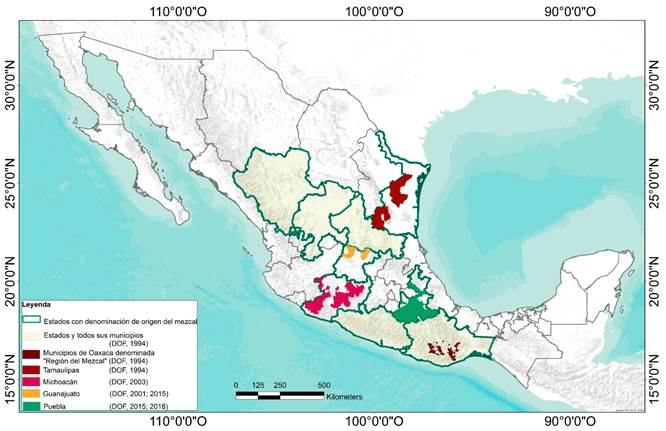
The Designation of Origin for Mezcal (DOM) is a geographical distinction that promotes mezcal production in Mexico (PÉREZ-AKAKI et al., 2021). The DOM encompasses nine states officially recognized under this legal protection (Figure 1) (DOF, 2015; INEGI-CAJ, 2019). States such as Aguascalientes, Estado de México, Morelos, and Sinaloa have requested inclusion under the protected DOM; however, their admission remains under litigation and is therefore not shown in Figure 1. Although, the DOM has driven economic and social development in certain municipalities and local communities (AGUILAR-ÁVILA et al., 2024), it has also been subject to critical analysis. Critics point to the exclusion of specific regions and the limited economic benefits within the designated areas, benefits that have not been equitably distributed across all population sectors (RODRÍGUEZ-GÓMEZ, 2007).
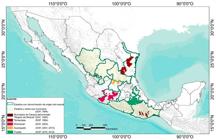
Mexican states with the Designation of Origin for Mezcal. Source: DOF (2015); INEGI-CAJ (2019).
The mezcal industry has maintained steady growth for at least the past twelve years (COMERCAM, 2025). However, the price of raw material from mezcal agave (AM) has exhibited fluctuations and high volatility (CRUZ-RAMIREZ et al., 2023; VALENCIA-SANDOVAL et al., 2023). In this context, the global push to enter agave-based spirit production presents a challenge to the value chain of AM and mezcal. Countries such as the United States (specifically California), Brazil, and Australia have initiated and expanded their own agave cultivation and distillation efforts (DAVIS et al., 2021). The overproduction of AM (CRUZ-RAMIREZ et al., 2025) also carries the risk of undermining traditional production methods in favor of efficiency driven by industrial modernization (ARELLANO-PLAZA et al., 2022).
The extraction of inulin (VALENCIA-SANDOVAL et al., 2020) could help sustain the growth of Mexico’s agave value chain (MELLADO-MOJICA & LÓPEZ-PÉREZ, 2013). One practical use for the land planted with AM is its conversion into balanced animal feed (PINOS-RODRÍGUEZ et al., 2009). The harvesting of fibers from agave leaves (AGUILAR-JUÁREZ et al., 2014) is another byproduct of growing interest among producer organizations and scientific researchers alike (SANJUAN-RAYGOZA & JASSO-GASTINEL, 2009). Mezcal production has historically taken place in indigenous communities across Mexico, such as the Zapotec communities of the Central Valleys and southern Sierra of Oaxaca (GROSS, 2014).
In recent years, there has also been a global increase in the number of studies on AM and mezcal. This trend highlighted the need for a quantitative analysis of the contributions made by scientific research to this value chain. The Scielo database includes articles predominantly from Latin American countries, especially Mexico. Therefore, the objective of this study was to identify trends and evaluate the contributions to scientific knowledge through a bibliometric analysis of international publications on AM in the Scielo database.
MATERIALS AND METHODS
The bibliometric analysis was conducted using VOSviewer, a software tool designed for the construction and visualization of bibliometric networks in scientific literature (VAN ECK & WALTMAN, 2010). The analyses carried out during the scientific mapping included the following components: keyword co-occurrence, term co-occurrence (text mining), co-authorship, bibliographic coupling, and institutional analysis. The search expression used in the SciELO Citation Index database was:
agave or maguey (Topic) and (mezcal OR mezcalero OR mescal OR “angustifolia haw” OR potatorum OR karwinskii OR duranguensis OR cupreata OR rhodacantha) (Topic) and 2005 or 2006 or 2007 or 2008 or 2009 or 2010 or 2011 or 2012 or 2013 or 2014 or 2015 or 2016 or 2017 or 2018 or 2019 or 2020 or 2021 or 2022 or 2023 or 2024 (Publication Years) and Research Article (Document Types).
Accordingly, the analysis was performed using the generic term AM, which encompasses name variants for the main species used in mezcal production. All available scientific articles published between 2005 and 2024 were included. The downloaded database was cleaned by developing a thesaurus to consolidate word variants with equivalent meanings. After completing the data collection and cleaning process, seven records were removed, resulting in a final dataset comprising 107 documents.
The methodological process followed the document of MATOREVHU (2024) and was structured into the following four steps:
1) The dataset was initially processed using VOSviewer to analyze bibliometric networks (VAN ECK & WALTMAN, 2010) and to identify the necessary corrections to the database.
2) The corrected dataset was reprocessed in VOSviewer. Key themes and author collaboration groups were identified and described through analyses of keyword co-occurrence, term co-occurrence, co-authorship, bibliographic coupling, and the identification of institutions relevant to the study of AM.
3) A quantitative and qualitative analysis was conducted based on the results of the bibliometric analysis. The quantitative analysis involved the visualization of network graphs and numerical analysis of clusters, citations, documents, links, and total link strength (HAUNSCHILD et al., 2016). The qualitative analysis was performed with content analysis techniques (HSIEH & SHANNON, 2005). This included the review of the most relevant articles identified through bibliographic coupling, topic identification and labeling, and keyword interpretation. The authors’ expertise and knowledge of the subject matter assisted the labeling of clusters in the qualitative component.
RESULTS AND DISCUSSION
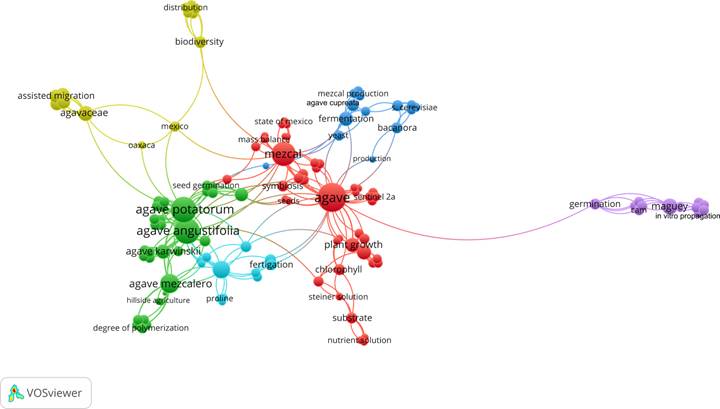
Network analysis, based on word co-occurrence, identified six thematic axes (Figure 2). The central red cluster included studies on substrates used in nursery plant production, plant growth, the use of Sentinel imagery, and research related to seed-based reproduction of various agave species (MARTÍNEZ-JIMÉNEZ et al., 2019). The green cluster indicated the AM group, along with the three main agave species employed in mezcal production: Agave karwinskii, Agave angustifolia and Agave potatorum (DELGADO-LEMUS et al., 2014b), as well as studies for seed germination. The dark blue cluster presented studies on the fermentation with mezcal production (ARELLANO-PLAZA et al., 2022) and the application of geomatics techniques to identify Agave cupreata planted area (OLVERA-VARGAS et al., 2022). This cluster also included connections with other distilled spirit such as “bacanora”.

Co-occurrence of keywords in the literature on Agave mezcalero, based on author-assigned keywords from the SciELO database (2005-2024).
In the yellow cluster, studies related to biodiversity, assisted migration in the Agavaceae family, and species distribution predominated, highlighting research conducted in the state of Oaxaca, Mexico (VAN VLEET et al., 2016). The purple cluster, positioned almost independently from the other identified groups, focused on research concerning in vitro propagation and seed germination, which demonstrated the importance and application of biotechnology within this value chain (GONZÁLEZ-ÁLVAREZ et al., 2015). Lastly, the cyan-blue cluster encompassed studies related to the fertigation of agaves (GARCÍA-MARTÍNEZ et al., 2020). Notably, the red and green clusters stood out due to the number of nodes and the position in the graph center.
Through the analysis of terms (words) extracted from the titles and abstracts of the articles, six thematic groups were identified (Figure 3). This analysis enriched previous findings derived from the authors’ keywords. The red cluster revealed the presence of socio-economic studies addressing topics related to traditional knowledge (LARA-ÁVILA & ALPUCHE-SOLÍS, 2016), as well as the strategies and risks associated with agave and mezcal production (ANTONIO & SMIT, 2012).
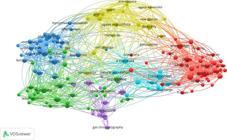
Term co-occurrence network based on titles and abstracts from the SciELO database (2005-2024) related to Agave mezcalero.
The yellow cluster grouped research on biodiversity and the state of Michoacán, with notable studies focusing on Agave karwinskii and Agave angustifolia (VÁZQUEZ-PÉREZ et al., 2020). The cyan-blue cluster emphasized the importance of Agave cupreata populations (AGUIRRE-DUGUA & EGUIARTE, 2013) and the conservation-utilization of wild species as an adaptation strategy to climate change. It is worth noting that this agave species is primarily cultivated in the state of Guerrero (OLVERA-VARGAS et al., 2022).
The royal-blue cluster separated studies related to Agave potatorum (DELGADO-LEMUS et al., 2014a), focusing on its sustainable use as a non-timber forest product, as well as aspects of fertilization, plant height, and root volume. The green cluster encompassed biotechnological research on in vitro cultivation (MORENO-VILET et al., 2014), the acclimatization challenges of plants produced through this technique, and the substrates evaluated in their production. Finally, the purple cluster included terms addressing the transformation of agave raw material, such as the use of agave juices, volatile compounds, biogas production (ZELAYA-BENAVIDEZ et al., 2022) and fermentation processes in mezcal production (MOLINA-GUERRERO et al., 2007). The yellow cluster exhibited the highest number of links, significantly surpassing the purple group.
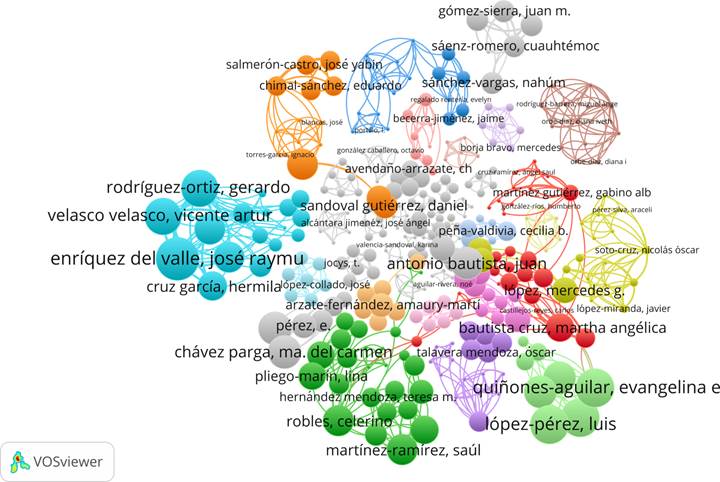
In the author analysis (Figure 4), national-level collaboration networks were identified in Mexico. Noteworthy, among them was Antonio Juan (grey cluster), who held a central position in the complex authorship network and authored the most highly cited document. Similarly, in the red cluster, Martha Angélica Bautista Cruz and Gabino Alberto Martínez Gutiérrez stood out as key authors within that group.

Co-authorship network in the literature on Agave mezcalero, from the SciELO database (2005-2024).
Also notable was José Raymundo Enríquez del Valle, affiliated with the Instituto Tecnológico del Valle de Oaxaca (cyan-blue cluster). From the Instituto Politécnico Nacional, in addition to the authors mentioned in the red cluster, Robles Celerino (green cluster) was highlighted. This citation-based analysis revealed a complex network of small collaborative groups, with no single dominant author identified in the field of study, at least according to the available data. Other prominent figures included Saúl Martínez-Ramírez (green cluster), Evangelina Esmeralda Quiñonez-Aguilar (light green cluster), and Cuauhtémoc Sáenz-Romero (grey cluster).
Bibliographic Coupling Results
Through bibliographic coupling analysis, documents of thematic relevance were identified that could not be detected via traditional citation analysis available through journal platforms or databases such as SciELO. By selecting the five articles deemed most relevant within the thematic network, based on the bibliographic coupling analysis, studies emerged that addressed agronomic topics and agave reproduction. These studies focused on technologies with practical applications for producers. The predominant themes included agronomic management, fertilization, irrigation, biotechnology, and productivity (Table 1).
Selection of the five most influential articles in the scholarly network on agave mezcalero, identified through bibliographic coupling analysis from the SciELO database (2005-2024).
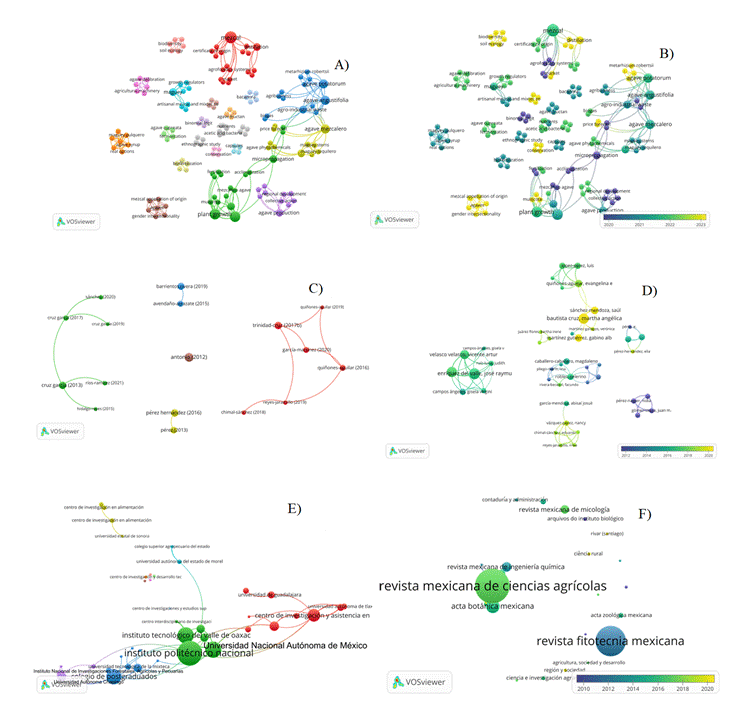
Figures 5A and 5B illustrate the research trends on AM over the past five years. Prominent terms included “mezcal appellation of origin”, “price forecast”, (CRUZ-RAMÍREZ et al., 2023) and “gender intersectionality”. The most frequently cited document was ANTONIO & SMIT (2012), which focused on sustainability in AM cultivation, as shown in Figure 5C. Figure 5D presents the network of the 50 most prolific authors and the average year of their publications. In this network, yellow nodes represent authors with publications after 2020.
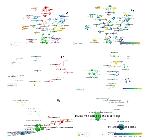
A) Thematic clusters in Agave mezcalero research (2020-2024); B) Research trends in Agave mezcalero (2020-2024); C) Fifty documents with more than one citation; D) Fifty most-published authors, with average year of publication; E) Fifty institutions with more than one citation; F) Thirty most-cited journals.
Regarding institutional analysis based on co-authorships and published documents (Figure 5E), the most prominent institutions, ranked by the number of published works, were as follows: Instituto Politécnico Nacional, Universidad Nacional Autónoma de México, Instituto Tecnológico del Valle de Oaxaca, Colegio de Postgraduados, Centro de Investigación y Asistencia en Tecnología y Diseño del Estado de Jalisco A.C., and Universidad Autónoma Chapingo. The Instituto Nacional de Investigaciones Forestales, Agrícolas y Pecuarias (INIFAP) ranked tenth out of the 75 institutions analyzed in the database. These findings align with the author analysis, which highlighted the predominant participation of the Instituto Politécnico Nacional, particularly through its Interdisciplinary Research Center for Regional Integral Development (CIIDIR), Oaxaca Unit.
Finally, the publication trends throughout the entire study period (2005-2024) revealed overall growth through 2022 (13 publications), followed by a decline in 2023 (6) and 2024 (3). Figure 5F displays the average publication year for the 30 journals with the highest citation counts. Among the most highly cited journals were the Revista Mexicana de Ciencias Agrícolas, published by INIFAP, and Revista Fitotecnia Mexicana. The three journals with the most recent publications were RIVAR (2020), Entreciencias: Diálogos en la Sociedad del Conocimiento (2020) and Ciência Rural (2023).
CONCLUSION
Among the trends identified in the scientific literature on agave mezcalero stood out agronomic topics, plant nutrition, in vitro reproduction, the predominance of traditional knowledge, and the conservation of both cultivated and wild agaves. Notable studies focused on Agave karwinskii, Agave potatorum, and Agave angustifolia. Research on Agave cupreata was also identified, less frequent but of significant importance. Additionally, studies examined byproducts of the mezcal industry, such as the use of bagasse-based substrates for plant nutrition in horticulture.
Prominent authors identified in the analysis include Martha Angélica Bautista Cruz, Gabino Alberto Martínez Gutiérrez, and Robles Celerino, affiliated with CIIDIR-IPN in Oaxaca. José Raymundo Enríquez del Valle stood out as a contributor from the Instituto Tecnológico del Valle de Oaxaca. Antonio Juan was notable for both his citation count and his central position within the co-authorship network.
The co-authorship network analysis revealed many small collaborative groups, indicating the need to foster greater cohesion among research teams. Based on the keywords assigned by co-authors, the following themes emerged as particularly relevant: biodiversity and species distribution; improvement of mezcal quality; plant nutrition; substrate use; and the conservation and reproduction of wild species. Term analysis within the network further highlighted the significance of socio-economic studies related to traditional knowledge and practices.
ACKNOWLEDGMENTS
The authors thank the Instituto Nacional de Investigaciones Forestales, Agrícolas y Pecuarias (INIFAP) for the support and resources provided to carry out this research.
REFERENCES
- AGUILAR-ÁVILA, M. J. et al. Caracterización de las Organizaciones Involucradas en la Industria del Mezcal en Oaxaca. In: Aspectos socio-económicos del Agave-Mezcal. Tepic, Nayarit, México: Universidad Tecnocientífica del Pacifico. Chap. 1. p.11-37, 2024.
-
AGUILAR-JUÁREZ, B. et al. El estado actual de Agave salmiana y A. mapisaga del Valle de México. Revista Mexicana de Agroecosistemas, v.1, n.2, p.106-120, 2014. Available from: <Available from: https://revistaremaeitvo.mx/index.php/remae/article/view/288 >. Accessed: Mar. 10, 2025.
» https://revistaremaeitvo.mx/index.php/remae/article/view/288 -
AGUIRRE-DUGUA, X.; EGUIARTE, L. Genetic diversity, conservation and sustainable use of wild Agave cupreata and Agave potatorum extracted for mezcal production in Mexico. Journal of Arid Environments, v.90, p.36-44, 2013. Available from: <Available from: https://www.sciencedirect.com/science/article/abs/pii/S0140196312002893 >. Accessed: Mar. 20, 2025. doi: 10.1016/j.jaridenv.2012.10.018.
» https://doi.org/10.1016/j.jaridenv.2012.10.018.» https://www.sciencedirect.com/science/article/abs/pii/S0140196312002893 -
ANTONIO BAUTISTA, J.; SMIT, M. Sustentabilidad y agricultura en la “región del mezcal” de Oaxaca. Revista mexicana de ciencias agrícolas, v.3, n.1, p.5-20, 2012. Available from: <Available from: https://cienciasagricolas.inifap.gob.mx/index.php/agricolas/article/view/1477 >. Accessed: Mar. 15, 2025. doi: 10.29312/remexca.v3i1.1477.
» https://doi.org/10.29312/remexca.v3i1.1477.» https://cienciasagricolas.inifap.gob.mx/index.php/agricolas/article/view/1477 -
ARELLANO-PLAZA, M. et al. Mezcal production in Mexico: between tradition and commercial exploitation. Frontiers in Sustainable Food Systems, v.6, p.1-16, 2022. Available from: <Available from: https://www.frontiersin.org/journals/sustainable-food-systems/articles/10.3389/fsufs.2022.832532/full >. Accessed: Mar. 12, 2025. doi: 10.3389/fsufs.2022.832532.
» https://doi.org/10.3389/fsufs.2022.832532.» https://www.frontiersin.org/journals/sustainable-food-systems/articles/10.3389/fsufs.2022.832532/full -
COMERCAM. Informe estadístico 2025. Oaxaca de Juárez: Consejo Mexicano Regulador de la Calidad del Mezcal A.C, 2025 (Informe estadístico 2025). Available from: <Available from: https://comercam-dom.org.mx/wp-content/uploads/2025/06/INFORME_PUBLICO2025.pdf >. Accessed: Jun. 04, 2025.
» https://comercam-dom.org.mx/wp-content/uploads/2025/06/INFORME_PUBLICO2025.pdf -
CRUZ-RAMÍREZ, A. S. et al. Price trends of Agave Mezcalero in Mexico using multiple linear regression models. Ciência Rural, v.53, n.2, 2023. Available from: <Available from: https://www.scielo.br/j/cr/a/yq94345DDvyt7kPMnk6sMMy/?lang=en >. Accessed: Apr. 20, 2025. doi: 10.1590/0103-8478cr20210685.
» https://doi.org/10.1590/0103-8478cr20210685.» https://www.scielo.br/j/cr/a/yq94345DDvyt7kPMnk6sMMy/?lang=en -
CRUZ-RAMÍREZ, A. S. et al. Comparison of models for estimating the planted area of Agave spp. for mezcal production in Mexico. Agro Productividad, v.18, n.7, 2025. Available from: <Available from: https://revista-agroproductividad.org/index.php/agroproductividad/article/view/3234 >. Accessed: Sept. 17, 2025. doi: 10.32854/6q7dtw68.
» https://doi.org/10.32854/6q7dtw68.» https://revista-agroproductividad.org/index.php/agroproductividad/article/view/3234 -
DAVIS, S. C. et al. Expanded potential growing region and yield increase for Agave americana with future climate. Agronomy, v.11, p.1-11, 2021. Available from: <Available from: https://www.mdpi.com/2073-4395/11/11/2109 >. Accessed: Apr. 02, 2025. doi: 10.3390/agronomy11112109.
» https://doi.org/10.3390/agronomy11112109.» https://www.mdpi.com/2073-4395/11/11/2109 -
DELGADO-LEMUS, A. et al. Distribution, abundance and traditional management of Agave potatorum in the Tehuacán Valley, Mexico: bases for sustainable use of non-timber forest products. Journal of Ethnobiology and Ethnomedicine, v.10, p.1-12, 2014a. Available from: <Available from: https://link.springer.com/article/10.1186/1746-4269-10-63 >. Accessed: Feb. 02, 2025. doi: 10.1186/1746-4269-10-63.
» https://doi.org/10.1186/1746-4269-10-63.» https://link.springer.com/article/10.1186/1746-4269-10-63 -
DELGADO-LEMUS, A. et al. Vulnerability and risk management of Agave species in the Tehuacán Valley, México. Journal of Ethnobiology and Ethnomedicine, v.10, p.1-15, 2014b. Available from: <Available from: https://link.springer.com/article/10.1186/1746-4269-10-53 >. Accessed: Feb. 05, 2025. doi: 10.1186/1746-4269-10-53.
» https://doi.org/10.1186/1746-4269-10-53.» https://link.springer.com/article/10.1186/1746-4269-10-53 - DOF. Diario Oficial de la Federación. Resolución por la que se modifica la declaración general de protección de la denominación de origen Mezcal, México: p.1-5, 2015.
-
ENRÍQUEZ DEL VALLE, J. R. et al. Fertigation in nursery plants of Agave potatorum Zucc micropropagated acclimatized. Revista mexicana de ciencias agrícolas, v.7, n.5, p.1167-1177, 2016. Available from: <Available from: https://cienciasagricolas.inifap.gob.mx/index.php/agricolas/article/view/240 >. Accessed: Jun. 13, 2025. doi: 10.29312/remexca.v7i5.240.
» https://doi.org/10.29312/remexca.v7i5.240.» https://cienciasagricolas.inifap.gob.mx/index.php/agricolas/article/view/240 -
GARCÍA-MARTÍNEZ, L. I. et al. Combination of mycorrhizal fungi and phosphorus fertilization in the growth of two wild agaves. Terra Latinoamericana, v.38, n.4, p.771-780, 2020. Available from: <Available from: https://www.terralatinoamericana.org.mx/index.php/terra/article/view/702 >. Accessed: Mar. 05, 2025. doi: 10.28940/terra.v38i4.702.
» https://doi.org/10.28940/terra.v38i4.702.» https://www.terralatinoamericana.org.mx/index.php/terra/article/view/702 -
GONZÁLEZ-ÁLVAREZ, M. et al. In vitro evaluation of antifungal activity of Agave (Agave scabra, Salm Dyck) extracts against post-harvest mushrooms. Phyton-International Journal of Experimental Botany, v.84, n.2, p.427-434, 2015. Available from: <Available from: https://www.techscience.com/phyton/v84n2/37176 >. Accessed: May, 05, 2025. doi: 10.32604/phyton.2015.84.427.
» https://doi.org/10.32604/phyton.2015.84.427.» https://www.techscience.com/phyton/v84n2/37176 -
GROSS, T. Mezcal and mexicanness: the symbolic and social connotations of drinking in Oaxaca. Folklore: Electronic journal of folklore, n.59, p.7-28, 2014. Available from: <Available from: https://www.ceeol.com/search/article-detail?id=279683 >. Accessed: Mar. 10, 2025.
» https://www.ceeol.com/search/article-detail?id=279683 -
HAUNSCHILD, R. et al. Climate change research in view of bibliometrics. PloS one, v.11, n.7, p.1-19, 2016. Available from: <Available from: https://journals.plos.org/plosone/article?id=10.1371/journal.pone.0160393 >. Accessed: May, 25, 2025. doi: 10.1371/journal.pone.0160393.
» https://doi.org/10.1371/journal.pone.0160393.» https://journals.plos.org/plosone/article?id=10.1371/journal.pone.0160393 -
HSIEH, H.-F.; SHANNON, S. E. Three approaches to qualitative content analysis. Qualitative health research, v.15, n.9, p.1277-1288, 2005. Available from: <Available from: https://journals.sagepub.com/doi/abs/10.1177/1049732305276687 >. Accessed: Apr. 28, 2025. doi: 10.1177/1049732305276687.
» https://doi.org/10.1177/1049732305276687.» https://journals.sagepub.com/doi/abs/10.1177/1049732305276687 - INEGI-CAJ. Conociendo la industria del tequila y el mezcal. Aguascalientes, Aguascalientes, México: Instituto Nacional de Estadística y Geografía, 37 p., 2019. (Colección de estudios sectoriales y regionales).
-
LARA-ÁVILA, J. P.; ALPUCHE-SOLÍS, Á. G. Análisis de la diversidad genética de agaves mezcaleros del centro de México. Revista fitotecnia mexicana, v.39, n.3, p.323-330, 2016. Available from: <Available from: https://revfitotecnia.mx/index.php/RFM/article/view/224 >. Accessed: Feb. 23, 2025. doi: 10.35196/rfm.2016.3.323-330.
» https://doi.org/10.35196/rfm.2016.3.323-330.» https://revfitotecnia.mx/index.php/RFM/article/view/224 -
MARTÍNEZ-JIMÉNEZ, R. et al. Wild and cultivated agaves used in the elaboration of mescal in Sola de Vega, Oaxaca, Mexico. Tropical and Subtropical Agroecosystems, v.22, n.2, p.477-485, 2019. Available from: <Available from: https://www.revista.ccba.uady.mx/ojs/index.php/TSA/article/view/2750 >. Accessed: Apr. 23, 2025.
» https://www.revista.ccba.uady.mx/ojs/index.php/TSA/article/view/2750 -
MARTINEZ-RAMIREZ, S. et al. Seedling growth of two mezcal species as affected by soil type and fertilization rate. Revista fitotecnia mexicana, v.36, n.4, p.387-393, 2013. Available from: <Available from: https://www.scielo.org.mx/scielo.php?pid=S0187-73802013000400004&script=sci_abstract&tlng=en >. Accessed: Jun. 14, 2025.
» https://www.scielo.org.mx/scielo.php?pid=S0187-73802013000400004&script=sci_abstract&tlng=en -
MARTINEZ RAMIREZ, S. et al. Growth and soluble solids of Agave potatorum Zucc. induced by irrigation and fertilization. Revista fitotecnia mexicana, v.35, n.1, p.61-68, 2012. Available from: <Available from: https://www.scielo.org.mx/scielo.php?pid=S0187-73802012000100009&script=sci_abstract&tlng=en >. Accessed: Jun. 12, 2025.
» https://www.scielo.org.mx/scielo.php?pid=S0187-73802012000100009&script=sci_abstract&tlng=en - MATOREVHU, A. Bibliometrics: Application Opportunities and Limitations. In: (Ed.). Bibliometrics-An Essential Methodological Tool for Research Projects: IntechOpen, Chap. 1. p.1-17, 2024.
-
MELLADO-MOJICA, E.; LÓPEZ-PÉREZ, M. G. Análisis comparativo entre jarabe de agave azul (Agave tequilana Weber var. azul) y otros jarabes naturales. Agrociencia, v.47, n.3, p.233-244, 2013. Available from: <Available from: https://www.scielo.org.mx/scielo.php?script=sci_arttext&pid=S1405-31952013000300003 >. Accessed: May, 13, 2025.
» https://www.scielo.org.mx/scielo.php?script=sci_arttext&pid=S1405-31952013000300003 -
MICHEL-CUELLO, C. et al. Importance of Agave salmiana metabolism in technological innovations to mezcal agroindustry sustainability. Progress in Industrial Ecology, an International Journal, v.11, n.4, p.297-313, 2017. Available from: <Available from: https://www.inderscienceonline.com/doi/abs/10.1504/PIE.2017.092712 >. Accessed: May, 19, 2025. doi: 10.1504/PIE.2017.092712.
» https://doi.org/10.1504/PIE.2017.092712.» https://www.inderscienceonline.com/doi/abs/10.1504/PIE.2017.092712 -
MOLINA-GUERRERO, J. et al. Compuestos volátiles en el mezcal. Revista mexicana de ingeniería química, v.6, n.1, p.41-50, 2007. Available from: <Available from: https://www.redalyc.org/pdf/620/62060106.pdf >. Accessed: Jun. 03, 2025.
» https://www.redalyc.org/pdf/620/62060106.pdf -
MORENO-VILET, L. et al. In vitro assessment of agave fructans (Agave salmiana) as prebiotics and immune system activators. International journal of biological macromolecules, v.63, p.181-187, 2014. Available from: <Available from: https://www.sciencedirect.com/science/article/abs/pii/S0141813013005837 >. Accessed: Jun. 05, 2025. doi: 10.1016/j.ijbiomac.2013.10.039.
» https://doi.org/10.1016/j.ijbiomac.2013.10.039.» https://www.sciencedirect.com/science/article/abs/pii/S0141813013005837 -
OLVERA-VARGAS, L. A. et al. Detección de Agave angustifolia y Agave cupreata con técnicas geomáticas en Guerrero, México. Ciencia y Tecnología Agropecuaria, v.23, n.2, p.1-19, 2022. Available from: <Available from: https://revistacta.agrosavia.co/index.php/revista/article/view/2241 >. Accessed: Jun. 15, 2025. doi: 10.21930/rcta.vol23_num2_art:2241.
» https://doi.org/10.21930/rcta.vol23_num2_art:2241.» https://revistacta.agrosavia.co/index.php/revista/article/view/2241 -
PÉREZ-AKAKI, P. et al. Designation of origin distillates in Mexico: value chains and territorial development. Sustainability, v.13, n.10, p.5496, 2021. Available from: <Available from: https://www.mdpi.com/2071-1050/13/10/5496 >. Accessed: Jan. 15, 2025. doi: 10.3390/su13105496.
» https://doi.org/10.3390/su13105496.» https://www.mdpi.com/2071-1050/13/10/5496 -
PÉREZ HERNÁNDEZ, E. et al. Revisión del agave y el mezcal. Revista Colombiana de Biotecnología, v.18, n.1, p.148-164, 2016. Available from: <Available from: https://revistas.unal.edu.co/index.php/biotecnologia/article/view/49552 >. Accessed: Jun. 12, 2025. doi: 10.15446/rev.colomb.biote.v18n1.49552.
» https://doi.org/10.15446/rev.colomb.biote.v18n1.49552.» https://revistas.unal.edu.co/index.php/biotecnologia/article/view/49552 -
PINOS-RODRÍGUEZ, J. et al. Effects of maturity and ensiling of Agave salmiana on nutritional quality for lambs. Animal Feed Science and Technology, v.152, n.3-4, p.298-306, 2009. Available from: <Available from: https://www.sciencedirect.com/science/article/abs/pii/S0377840109001837 >. Accessed: Mar. 30, 2025. doi: 10.1016/j.anifeedsci.2009.05.002.
» https://doi.org/10.1016/j.anifeedsci.2009.05.002.» https://www.sciencedirect.com/science/article/abs/pii/S0377840109001837 -
RODRÍGUEZ-GÓMEZ, G. La denominación de origen del tequila: pugnas de poder y la construcción de la especificidad sociocultural del agave azul. Nueva antropología, v.20, n.67, p.141-171, 2007. Available from: <Available from: https://revistas-colaboracion.juridicas.unam.mx/index.php/nueva-antropologia/article/view/15903/14224 >. Accessed: Jan. 30, 2025.
» https://revistas-colaboracion.juridicas.unam.mx/index.php/nueva-antropologia/article/view/15903/14224 -
SANJUAN-RAYGOZA, R. J.; JASSO-GASTINEL, C. F. Efecto de la fibra de agave de desecho en el reforzamiento de polipropileno virgen o reciclado. Revista mexicana de ingeniería química, v.8, n.3, p.319-327, 2009. Available from: <Available from: https://www.redalyc.org/pdf/620/62016349011.pdf >. Accessed: Feb. 28, 2025.
» https://www.redalyc.org/pdf/620/62016349011.pdf -
SANTACRUZ-RUVALCABA, F. et al. Micropropagation of Agave maximiliana Baker by axillary shoot proliferation. Polibotánica, n.54, p.139-151, 2022. Available from: <Available from: https://polibotanica.mx/index.php/polibotanica/article/view/1014 >. Accessed: Jun. 12, 2025. doi: 10.18387/polibotanica.54.9.
» https://doi.org/10.18387/polibotanica.54.9.» https://polibotanica.mx/index.php/polibotanica/article/view/1014 -
VALENCIA-SANDOVAL, K. et al. Innovación agroindustrial del agave (Agave tequilana Weber var. azul): valoración financiera para la obtención de inulina. Agro Productividad, v.13, n.3, 2020. Available from: <Available from: https://www.revista-agroproductividad.org/index.php/agroproductividad/article/view/1632 >. Accessed: Feb. 12, 2025. doi: 10.32854/agrop.vi.1632.
» https://doi.org/10.32854/agrop.vi.1632.» https://www.revista-agroproductividad.org/index.php/agroproductividad/article/view/1632 -
VALENCIA-SANDOVAL, K. et al. Innovación en Negocios Tradicionales: El Caso del Agave, Más Allá del Tequila. Innovaciones de Negocios, v.1, n.1, p.18-31, 2023. Available from: <Available from: https://revistainnovaciones.uanl.mx/index.php/revin/article/view/442 >. Accessed: Mar. 12, 2025. doi: 10.29105/revin1.1-442.
» https://doi.org/10.29105/revin1.1-442.» https://revistainnovaciones.uanl.mx/index.php/revin/article/view/442 -
VAN ECK, N.; WALTMAN, L. Software survey: VOSviewer, a computer program for bibliometric mapping. scientometrics, v.84, n.2, p.523-538, 2010. Available from: <Available from: https://akjournals.com/view/journals/11192/84/2/article-p523.xml >. Accessed: Jan. 22, 2025. doi: 10.1007/s11192-009-0146-3.
» https://doi.org/10.1007/s11192-009-0146-3.» https://akjournals.com/view/journals/11192/84/2/article-p523.xml -
VAN VLEET, E. et al. Knowing but not knowing: Systematic conservation planning and community conservation in the Sierra Norte of Oaxaca, Mexico. Land Use Policy, v.59, p.504-515, 2016. Available from: <Available from: https://www.sciencedirect.com/science/article/abs/pii/S0264837715301587 >. Accessed: Feb. 22, 2025. doi: 10.1016/j.landusepol.2016.09.010.
» https://doi.org/10.1016/j.landusepol.2016.09.010.» https://www.sciencedirect.com/science/article/abs/pii/S0264837715301587 -
VÁZQUEZ-PÉREZ, N. et al. Traditional knowledge and management of Agave karwinskii in southern Mexico. Botanical Sciences, v.98, n.2, p.328-347, 2020. Available from: <Available from: https://botanicalsciences.com.mx/index.php/botanicalSciences/article/view/2421 >. Accessed: Mar. 15, 2025. doi: 10.17129/botsci.2421.
» https://doi.org/10.17129/botsci.2421.» https://botanicalsciences.com.mx/index.php/botanicalSciences/article/view/2421 -
ZELAYA-BENAVIDEZ, E. A. et al. Use of mezcal vinasses to produce methane by co-digestion with bovine manure. Biotecnia, v.24, n.2, 2022. Available from: <Available from: https://biotecnia.unison.mx/index.php/biotecnia/article/view/1501 >. Accessed: Mar. 15, 2025. doi: 10.18633/biotecnia.v24i2.1501.
» https://doi.org/10.18633/biotecnia.v24i2.1501.» https://biotecnia.unison.mx/index.php/biotecnia/article/view/1501
-
CR-2025-0362.R1
-
DATA AVAILABILITY STATEMENT
The data that supports the findings of this study are available from the corresponding author upon reasonable request by e-mail.
-
DECLARATION OF USE OF ARTIFICIAL INTELLIGENCE
The authors declare that no artificial intelligence (AI) tools were used to generate the manuscript’s content, including the abstract, keywords, hypotheses, or conclusions. AI tools (specifically ChatGPT, developed by OpenAI) were used exclusively for English language review.
Edited by
-
ASSOCIATE EDITOR:
Leandro Souza da Silva (0000-0002-1636-6643)
-
SCIENTIFIC EDITOR:
Alberto Cargnelutti Filho (0000-0002-8608-9960)
The data that supports the findings of this study are available from the corresponding author upon reasonable request by e-mail.