 Seroreactivity for leptospirosis in pigs with poor reproductive performance in Espirito Santo state, Brazil
ABSTRACT:
Leptospirosis is a significant cause of reproductive losses in the pig industry worldwide, affecting reproductive efficiency and resulting in substantial economic losses. In Brazil, many studies on pig infections focus on serosurveys of random populations, independent of reproductive efficiency, and many regions, such as the state of Espírito Santo, remain poorly studied. Therefore, this study conducted a leptospirosis serosurvey in sow herds with poor reproductive performance from different regions of Espírito Santo, Brazil. Blood samples for serology (Microscopic Agglutination Test - MAT) were collected from 131 sows with poor reproductive performance from 13 herds. A seroreactivity rate of 29.8% (39/131) sows were revealed, and all the tested herds had at least one seroreactive animal. The most common serogroups were Autumnalis 43.8% (17/39), Icterohaemorrhagiae 30.8% (12/39), and Australis 15.4% (6/39). Thus, the study highlighted the importance of leptospirosis for the pig industry in that region, leading to significant economic impacts due to reproductive problems, and reinforcing the importance of specific prevention and control measures.
Key words:
reproductive disorders; epidemiology;
Leptospira
; pigs; serology
RESUMO:
A leptospirose é uma das principais causas de perdas reprodutivas na suinocultura mundial, prejudicando à eficiência reprodutiva e causando altas perdas econômicas. No Brasil, muitos estudos sobre à infecção em suínos focam em inquéritos sorológicos de populações aleatórias, independentes da eficiência reprodutiva, e muitas regiões, como o estado do Espírito Santo, ainda são pouco estudadas. Desse modo, este estudo teve como objetivo realizar um inquérito sorológico para leptospirose em rebanhos de porcas com baixo desempenho reprodutivo de diferentes regiões do Espírito Santo, Brasil. Para isso, amostras de sangue para sorologia (Teste de Aglutinação Microscópica - SAM) foram coletadas de 131 porcas com baixo desempenho reprodutivo de 13 rebanhos. As amostras coletadas revelam uma taxa de sororeatividade de 29,8% (39/131) das porcas, e todos os rebanhos testados apresentaram pelo menos um animal sororeagente. Os sorogrupos mais comuns foram Autumnalis 43,8% (17/39), Icterohaemorrhagiae 30,8% (12/39) e Australis 15,4% (6/39). Assim, o estudo destaca à importância da leptospirose para a suinocultura naquela região, levando à impactos econômicos significativos devido a problemas reprodutivos, e reforçando à importância de medidas específicas de prevenção e controle.
Palavras-chave:
distúrbios reprodutivos; epidemiologia;
Leptospira
; suínos; sorologia
Leptospirosis is a major zoonosis caused by pathogenic bacteria of the genus Leptospira sp. and affects various animal species, such as cattle, horses, dogs, pigs, small ruminants, and wild animals (SYKES et al., 2022; MAES et al., 2023). In livestock, it is a major cause of reproductive problems worldwide, causing significant economic losses (OSPINA-PINTO & HERNÁNDEZ-RODRÍGUEZ, 2021). In pigs, acute forms occur as outbreaks and are uncommon, usually caused by the incidental strains of the Icterohaemorrhagiae serogroup. Conversely, the chronic infection of pig herds is commonly reported to be caused by strains of the serogroups Australis and Pomona, which are adapted to pigs and are responsible for determining reproductive disorders and subclinical infections. The most common reproductive disorders are abortions, embryonic reabsorption, birth of weak piglets, reduction in litter size, and stillbirths (PETRI et al., 2021).
Despite the economic importance of the pig industry in Brazil, data on incidence in the different regions of Brazil are still scarce. A study conducted in the Southern region of the country assessed the occurrence and risk factors associated with leptospirosis in 1,393 pigs, and the predominant serogroups were Icterohaemorrhagiae and Pomona (SANTOS et al., 2023). In Northern Brazil, pigs were evaluated as genital carriers of Leptospira spp., and the most prevalent serogroups were Australis and Bataviae (ARAÚJO et al., 2023).
However, few studies focused on diagnosing leptospirosis specifically in animals or herds presenting poor reproductive performance (MAES et al., 2023). Besides, the scarcity of specific data on swine leptospirosis in herds from Espirito Santo State highlighted the need for more in-depth studies to understand the extent and reproductive impact of this disease on local swine herds. Therefore, this study conducted a leptospirosis serosurvey in sow herds with poor reproductive performance from different regions of Espírito Santo, Brazil.
The study was performed on samples sent for diagnosis in the Laboratory of Veterinary Bacteriology of Universidade Federal Fluminense, Brazil. After collection, samples were stored in a -20 ºC freezer until processing.
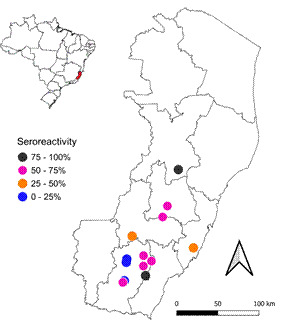
We studied 13 herds (totaling 4,800 pigs) that reported reproductive disorders such as subfertility, repeated heat, abortion, reduction in litter size, and mummified fetuses. Herds were in different regions of the state of Espírito Santo (Central Serrana, Central South, Midwest, Metropolitan, Northwest, and Southwest Serrana), and all of them reported the presence of rodents around the facilities, mainly in the feed depot. A total of 131 non-vaccinated sows aged >2 years old of commercial lineages with Landrace and Large White bloodlines and with poor reproductive performance from those herds were randomly selected (Figure 1 and Table 1). The blood samples were collected by veterinarians by venous puncture and sent to the Veterinary Bacteriology Laboratory for diagnosis.
Distribution of seroreactivity in pigs against Leptospira spp. in regions of Espirito Santo state, Brazil.
Sows with poor re1productive performance tested for leptospirosis in Espirito Santo state, Brazil.
Using the microscopic agglutination test (MAT), serum samples were tested for antibodies against Leptospira. Serial dilutions were performed, and a panel of live antigens was selected, represented by eight reference strains. The selected live antigen panel included the most common in Brazil in pigs (PINTO et al., 2016), namely: Leptospira interrogans serovar Copenhageni (strain M20), Pomona (strain Pomona), Canicola (strain Hund Utrecht), Bratislava (strain Jez Bratislava), Australis (strain Ballico), Autumnalis (strain Akiyami A), Grippotyphosa (strain Moskva V), and Leptospira santarosai serovar Guaricura (strain FV52). Results were analyzed considering a cut-off point of 200, as suggested for endemic regions (MARTINS & LILENBAUM, 2017). The probable infecting serogroup was that presenting the highest titer, and a herd was considered positive when at least one animal was seroreactive.
Out of the 13 tested herds, all of them presented at least one seroreactive sample, and it was possible to observe a high seroreactivity (greater than 50%) in 61.5% (8/13) of the tested herds. At the individual level, 29.8% of the sows were seroreactive (39/131). The most common serogroups were Autumnalis 43.8% (17/39), Icterohaemorrhagiae 30.8% (12/39), and Australis 15.4% (6/39). Other less prevalent serogroups were Pomona (7.6%; 3/39) and Canicola (2.4%; 1/39).
We detected a relevant seroreactivity for leptospirosis in sows with poor reproductive performance, for the first time in the Espirito Santo State, in Southeastern Brazil. This result agreed with a meta-analysis in pigs, which demonstrated a worldwide seropositivity rate of 22%, ranging from 13.30% in Europe to 36.4% in South America (ARAUJO et al., 2023). In Brazil, seroprevalence rates of 15.8% (SANTOS et al., 2023) and 40% (FERNANDES et al., 2020) were reported.
Different leptospiral strains are known to cause infection in pigs (SOTO et al., 2007). A recent study performed in Southern Brazil reported Pomona, Icterohaemorrhagiae, and Tarassovi as the most common serogroups (SANTOS et al., 2023), while in Northern Brazil, a predominance of Icterohaemorrhagiae and Sejroe serogroups was reported (LEITE et al., 2018). It contrasts with the outcomes of another study conducted in Northern Brazil, which reported Icterohaemorrhagiae, Pomona, and Shermani as the most common serogroups associated with infection in pigs (SANTOS et al., 2023). We must consider that each study has its own inclusion criteria and sampling strategies, so results cannot always be compared. The cited reports contrast with our results, possibly not only due to regional and climatic differences but also to the inclusion criterion (poor reproductive performance) that we considered in the present study.
Unlike most studies on seroprevalence in pigs, our findings demonstrated a high prevalence of serovar Autumnalis (43.8%). Although, it is not often reported as one of the most prevalent serovars, it has been reported as an increasing trend (STRUTZBERG-MINDER, 2018). Furthermore, our studies confirmed the important role of Icterohaemorrhagiae strains, which are common on pig herds from Latin America (PINTO et al., 2017). The high occurrence of this serogroup is usually associated with direct or indirect contact with rodents, mainly Rattus norvegicus, which are the reservoirs of those strains and represent a major concern in Public Health. Noteworthy is that all the herds had reported the presence of rodents around the facilities.
Although, strains of the Australis serogroup are known to be adapted to pigs, as Australis and Bratislava, most studies did not include them as antigens in MAT, which certainly represented a bias. Importantly, Australis strains have been isolated from the urine of a pig in Southeastern Brazil (HAMOND et al., 2015).
Studies on swine leptospirosis in Brazil are important for both animal health and public health. The high prevalence of the disease represents a challenge, compromising productivity. Besides, leptospirosis is a highly relevant zoonosis (SYKES et al., 2022), with pigs acting as reservoirs and contributing to the spread of the bacterium to humans, especially rural workers and pig farming professionals (MAES et al., 2023). In this context, we demonstrated an important occurrence of anti-Leptospira antibodies among herds with poor reproductive performance in Espirito Santo state, Brazil.
We recognized the limitations of the present study. Samples were sent for diagnosis and do not represent a calculated sample size or distribution that adequately represents the swine population of the state. Besides, we understand that seroreactivity alone does not represent a diagnosis of infection, and confirmatory direct methods such as PCR are often required. Despite those limitations, this is the first report of leptospirosis in herds with poor reproductive performance in the region, and although the epidemiological data presented here are still limited, they shall be reported.
ACKNOWLEDGMENTS
The authors are thankful to Juliana Pedrosa for her assistance in the laboratory. The authors would like to thank Instituto de Defesa Agropecuária e Florestal do Espírito Santo (IDAF), Cariacica, Espírito Santo, Brasil, for technical support and Fundação de Amparo à Pesquisa e Inovação do Espírito Santo (FAPES) and Secretaria Estadual de Agricultura, Abastecimento, Aquacultura e Pesca (SEAG) for financial support in Project 2020-KGDK1. The project was partially financed by the Coordenação de Aperfeiçoamento de Pessoal de Nível Superior (CAPES), Brazil - Finance code 001.WL is a Conselho Nacional de Desenvolvimento Científico e Tecnológico (CNPq) and Fundação de Amparo à Pesquisa do Estado do Rio de Janeiro (FAPERJ) fellow. JL and DM are CAPES fellows.
REFERENCES
-
ARAÚJO, H. et al. Global seropositivity of swine leptospirosis: systematic review and meta-analysis. Tropical Medicine and Infectious Disease, v.8, n.3, p.158, 2023. Available from: <Available from: https://www.mdpi.com/2414-6366/8/3/158 >. Accessed: Nov. 15, 2024. doi: 10.3390/tropicalmed8030158.
» https://doi.org/10.3390/tropicalmed8030158.» https://www.mdpi.com/2414-6366/8/3/158 -
FERNANDES, J. et al. High frequency of seropositive and carriers of Leptospira spp. in pigs in the semiarid region of northeastern Brazil. Tropical Animal Health and Production, v.52, p.2055-2061, 2020. Available from: <Available from: https://link.springer.com/article/10.1007/s11250-020-02203-y >. Accessed: Nov. 10, 2024. doi: 10.1007/s11250-020-02203-y.
» https://doi.org/10.1007/s11250-020-02203-y.» https://link.springer.com/article/10.1007/s11250-020-02203-y -
HAMOND, C. et al. First isolation and characterization of Leptospira interrogans serogroup Australis from swine in Brazil. Pesquisa Veterinária Brasileira, v.35, n.1, p.6-8, 2015. Available from: <Available from: https://www.scielo.br/j/pvb/a/SMJv8TgQq8PBtbQG44JJrYp/?lang=en >. Accessed: Oct. 15, 2024. doi: 10.1590/S0100-736X2015000100002.
» https://doi.org/10.1590/S0100-736X2015000100002.» https://www.scielo.br/j/pvb/a/SMJv8TgQq8PBtbQG44JJrYp/?lang=en -
LEITE, A. et al. Epidemiological characterization of leptospirosis in pig herds reared under poor technical condition in the Brazilian semiarid. Pesquisa Veterinária Brasileira, v.38, n.4, p.613-619, 2018. Available from: <Available from: https://www.scielo.br/j/pvb/a/tVYCP8ck5LWRyNLqWvSSMGM/?lang=pt >. Accessed: Oct. 20, 2024. doi: 10.1590/1678-5150-pvb-4389.
» https://doi.org/10.1590/1678-5150-pvb-4389.» https://www.scielo.br/j/pvb/a/tVYCP8ck5LWRyNLqWvSSMGM/?lang=pt -
MAES, D. et al. Abortion and fetal death in sows. Reproduction in Domestic Animals, v.58, suppl. 2, p.125-136, 2023. Available from: <Available from: https://onlinelibrary.wiley.com/doi/10.1111/rda.14436 >. Accessed: May, 15, 2025. doi: 10.1111/rda.14436.
» https://doi.org/10.1111/rda.14436.» https://onlinelibrary.wiley.com/doi/10.1111/rda.14436 -
MARTINS, G. Lilenbaum W. Control of bovine leptospirosis: Aspects for consideration in a tropical environment. Research in Veterinary Science, v.112, p.156-160, 2017. Available from: <Available from: https://www.sciencedirect.com/science/article/abs/pii/S0034528816305446?via%3Dihubhttps >. Accessed: Oct. 20, 2024. doi: 10.1016/j.rvsc.2017.03.021.
» https://doi.org/10.1016/j.rvsc.2017.03.021.» https://www.sciencedirect.com/science/article/abs/pii/S0034528816305446?via%3Dihubhttps -
OSPINA-PINTO, M. C.; HERNÁNDEZ-RODRÍGUEZ, P. Identification of Leptospira spp. in the animal-environment interface (swine-water) in pig production cycle. Tropical Animal Health and Production, v.53, p.155, 2021. Available from: <Available from: https://link.springer.com/article/10.1007/s11250-021-02567-9 >. Accessed: Nov. 15, 2024. doi: 10.1007/s11250-021-02567-9.
» https://doi.org/10.1007/s11250-021-02567-9.» https://link.springer.com/article/10.1007/s11250-021-02567-9 -
PETRI, F. A. et al. Cross-sectional study of Leptospira spp. in commercial pig farms in the state of Goiás, Brazil. Tropical Animal Health and Production, v.53, p.13, 2021. Available from: <Available from: https://link.springer.com/article/10.1007/s11250-020-02457-6 >. Accessed: May, 04, 2025. doi: 10.1007/s11250-020-02457-6.
» https://doi.org/10.1007/s11250-020-02457-6.» https://link.springer.com/article/10.1007/s11250-020-02457-6 -
PINTO, P. et al. A systematic review of leptospirosis on dogs, pigs, and horses in Latin America. Tropical Animal Health and Production, v.49, p.231-238, 2017. Available from: <Available from: https://link.springer.com/article/10.1007/s11250-016-1201-8 >. Accessed: Oct. 05, 2024. doi: 10.1007/s11250-016-1201-8.
» https://doi.org/10.1007/s11250-016-1201-8.» https://link.springer.com/article/10.1007/s11250-016-1201-8 -
SANTOS, G. et al. Prevalence and risk factors of Leptospira spp. infection in backyard pigs in the state of Paraná, Brazil. Tropical Medicine and Infectious Disease, v.8, p.468, 2023. Available from: <Available from: https://www.mdpi.com/2414-6366/8/10/468 >. Accessed: Oct. 06, 2024. doi: 10.3390/tropicalmed8100468.
» https://doi.org/10.3390/tropicalmed8100468.» https://www.mdpi.com/2414-6366/8/10/468 -
SOTO, F. R. M. et al. Swine leptospirosis: a review. Arquivos do Instituto Biológico, v.74, n.4, 2007. Available from: <Available from: https://www.scielo.br/j/aib/a/hpVc58MSrcPhkYNZxpJkLYH/?lang=pt >. Accessed: May, 04, 2025. doi: 10.1590/1808-1657v74p3792007.
» https://doi.org/10.1590/1808-1657v74p3792007.» https://www.scielo.br/j/aib/a/hpVc58MSrcPhkYNZxpJkLYH/?lang=pt -
STRUTZBERG-MINDER, K. et al. Passive surveillance of Leptospira infection in swine in Germany. Porcine Health Management, v.4, p.10, 2018. Available from: <Available from: https://porcinehealthmanagement.biomedcentral.com/articles/10.1186/s40813-018-0086-5 >. Accessed: May, 04, 2025. doi: 10.1186/s40813-018-0086-5.
» https://doi.org/10.1186/s40813-018-0086-5.» https://porcinehealthmanagement.biomedcentral.com/articles/10.1186/s40813-018-0086-5 -
SYKES, J. et al. A global One Health perspective on leptospirosis in humans and animals. Journal of the American Veterinary Medical Association, v.260, p.1589-1596, 2022. Available from: <Available from: https://doi.org/ 10.2460/javma.22.06.0258 >. Accessed: May, 04, 2025. doi: 10.2460/javma.22.06.0258.
» https://doi.org/10.2460/javma.22.06.0258.» https://doi.org/ 10.2460/javma.22.06.0258
BIOETHICS AND BIOSECURITY COMMITTEE APPROVAL
-
CR-2025-0272.R2
-
The study was performed on samples sent for diagnosis in the Laboratory of Veterinary Bacteriology of Universidade Federal Fluminense, Brazil, so no Ethics Committee authorization is required.
-
DATA AVAILABILITY STATEMENT
Not applicable.
-
DECLARATION OF USE OF ARTIFICIAL INTELLIGENCE
The authors state that no artificial intelligence was used.
Edited by
-
ASSOCIATE EDITOR:
Rudi Weiblen (0000-0002-1737-9817)
-
SCIENTIFIC EDITOR:
Juliana Felipetto Cargnelutti (0000-0002-3160-3643)
Not applicable.