 Use of Peritoneal Flap with Pericranium Graft in Gender Reassignment Surgery: Technical Description
ABSTRACT
Objective: To describe a hybrid vaginoplasty technique using an autologous pericranial graft combined with a robotic-assisted peritoneal flap as an alternative for gender-affirming surgery patients with insufficient penoscrotal tissue.
Methods: Case report of a 28-year-old transgender woman with a history of prior penile inversion vaginoplasty who developed stenosis and loss of vaginal canal depth. The patient underwent revision vaginoplasty using the hybrid technique. The procedure consisted of harvesting a pericranial graft to create a tubular structure, which was then anastomosed to a robotic-assisted peritoneal flap to create the neovaginal canal.
Results: The procedure was successfully performed without intraoperative complications. The patient had a good healing process, and after six months of follow-up, maintained an 18-cm neovaginal canal that was epithelialized, adequately lubricated, and without evidence of stenosis. Patient satisfaction with both functional and aesthetic outcomes was high.
Conclusion: Hybrid vaginoplasty using a pericranial graft combined with a robotic-assisted peritoneal flap may represent a viable and promising alternative for gender reassignment patients with insufficient penoscrotal tissue, particularly in revision surgeries, providing a vaginal canal with satisfactory depth and tissue quality and low donor-site morbidity.
Keywords:
Vaginoplasty; Sex Reassignment Surgery; Peritoneal Flap; Pericranium Graft
RESUMO
Objetivo: Descrever uma técnica de vaginoplastia híbrida, utilizando enxerto autólogo de pericrânio associado a um retalho peritoneal robótico, como alternativa para pacientes de redesignação sexual com insuficiência de tecido penoescrotal.
Métodos: Relato de caso de uma paciente transexual de 28 anos, com histórico de vaginoplastia prévia por inversão peniana que evoluiu com estenose e perda de profundidade do canal. A paciente foi submetida a uma vaginoplastia de revisão utilizando a técnica híbrida. O procedimento consistiu na coleta de um enxerto de pericrânio para formar um tubo, que foi então anastomosado a um retalho de peritônio avançado por via robótica para constituir o novo canal vaginal.
Resultados: O procedimento foi realizado com sucesso, sem complicações intraoperatórias. A paciente evoluiu com boa cicatrização e, após 6 meses de acompanhamento, mantinha um canal neovaginal com 18 cm de profundidade, epitelizado, com lubrificação adequada e sem sinais de estenose. A satisfação da paciente com os resultados funcionais e estéticos foi classificada como alta.
Conclusão: A vaginoplastia híbrida com enxerto de pericrânio e retalho peritoneal robótico demonstrou A vaginoplastia híbrida utilizando retalho peritoneal robótico com enxerto de pericrânio pode representar uma alternativa viável e promissora para pacientes de redesignação sexual com tecido penoescrotal insuficiente, especialmente em cirurgias de revisão, proporcionando um canal de profundidade e qualidade tecidual satisfatórias com baixa morbidade do sítio doador.
Palavras-chave:
Vaginoplastia; Redesignação Sexual; Retalho Peritoneal; Enxerto de Pericrânio
INTRODUCTION
Gender-Affirming Surgery (GAS) is a critical component in the management of individuals with gender incongruence, and vaginoplasty remains one of the most complex procedures, significantly impacting quality of life.1 The gold-standard technique, penile skin inversion, has well-documented outcomes but relies heavily on the availability of sufficient penile and scrotal tissue to achieve adequate neovaginal depth and diameter.2 In patients with genital hypoplasia, prior circumcision, early pubertal suppression, or those undergoing revision surgery, limited local tissue presents significant challenges.3
In such cases, alternative approaches using peritoneal flaps or intestinal segments have become important reconstructive options4.The peritoneal flap, particularly with the advent of robotic-assisted surgery, has emerged as a leading alternative, offering hairless autologous tissue with intrinsic lubrication potential and lower stenosis rates compared with skin grafts5. Studies demonstrate that robotic peritoneal vaginoplasty achieves a mean neovaginal depth exceeding 13 cm, with favorable functional and sexual outcomes6,7.However, peritoneal dissection and advancement may be technically limited, especially in revision cases, and the learning curve associated with robotic techniques must be considered8.
To address limitations in peritoneal flap advancement and enhance structural support, reinforcement tissues have been explored. The autologous pericranial graft, widely used in neurosurgery and craniofacial reconstruction, represents a promising option due to its mechanical strength, favorable tissue integration, and low donor-site morbidity9. Other alternatives, including acellular dermal grafts, free jejunal mucosal grafts, and xenografts (e.g., fish skin), are also under investigation for complex primary or revision vaginal reconstruction10,11.
This study describes the combined (hybrid) use of a pericranial graft and robotic-assisted peritoneal flap in a transgender patient undergoing revision vaginoplasty, detailing the surgical technique and initial outcomes.
METHODS
This is a case report of a 28-year-old transgender woman (ACB) who underwent gender-affirming surgery at a specialized center in Santa Catarina, Brazil. The patient had previously undergone primary penile inversion vaginoplasty with scrotal grafting approximately six months earlier at another institution. Postoperatively, she developed a rectovaginal fistula, which prevented adherence to the dilation regimen, resulting in severe stenosis and complete loss of vaginal canal depth. After a thorough evaluation and considering the failure of the primary technique, revision vaginoplasty using the hybrid approach was performed.
The patient and her family were informed of the innovative nature of the procedure and provided written informed consent for both the surgery and publication of clinical data.
Surgical Technique
The procedure was performed by a multidisciplinary team and divided into four main stages.
Stage 1: Pericranial Graft Harvest
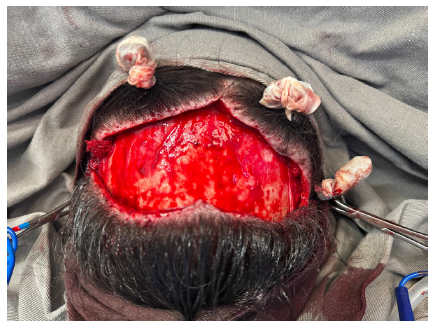
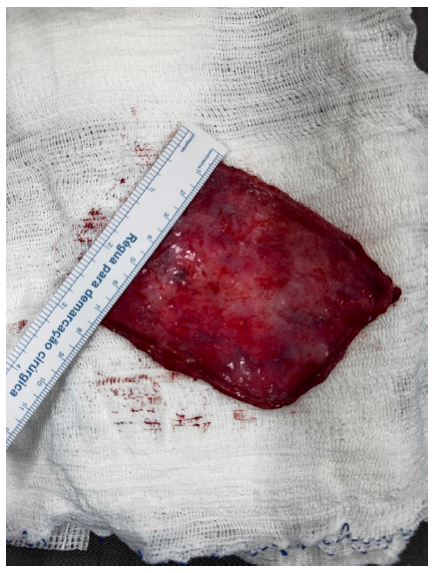
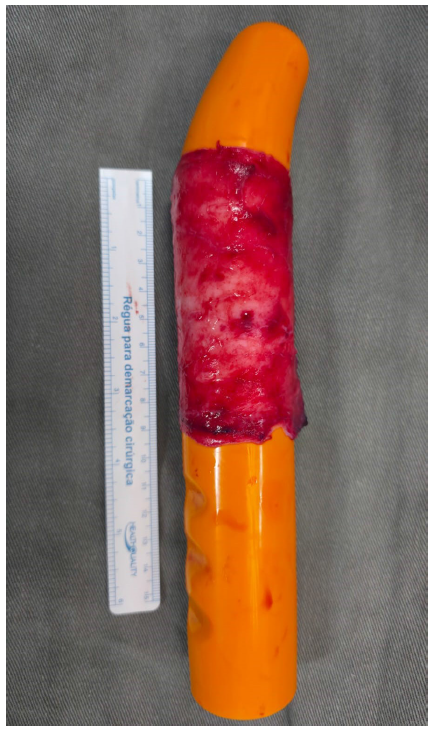
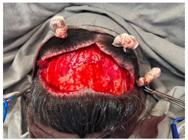
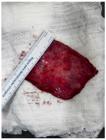
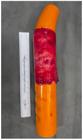
With the patient in the supine position, a coronal scalp incision was performed, extending along the long axis of the auricle. After infiltration with vasoconstrictive anesthetic solution, a pericranial flap measuring approximately 10 × 8 cm was dissected from the calvarium using electrocautery and harvested (Figure 1 and Figure 2). The graft was immediately fashioned into a tubular structure over a rigid vaginal dilator, with the vascularized surface oriented inward, and sutured using 3-0 absorbable Monocryl to create a pericranial tube (Figure 3).
Stage 2: Robotic-Assisted Peritoneal Flap Creation
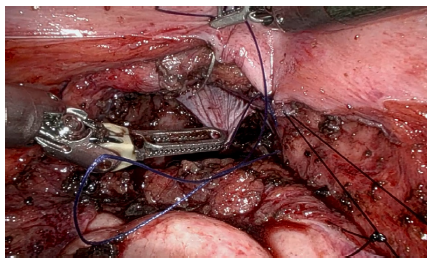
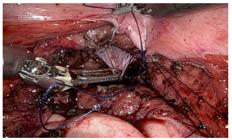
Simultaneously, the general surgery team initiated the abdominal stage. Using the Da Vinci X® robotic system, pneumoperitoneum was established and the abdominal cavity accessed. A peritoneal flap was dissected from the anterior abdominal wall based on the inferior epigastric vessels and advanced toward the pelvis. The dissection was performed widely to ensure a long, mobile pedicle, allowing the flap to reach the perineum without tension (Figure 4).
Stage 3: Neovaginal Canal Creation and Tissue Integration
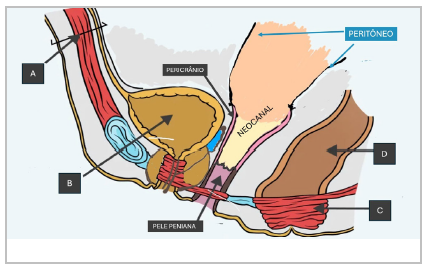
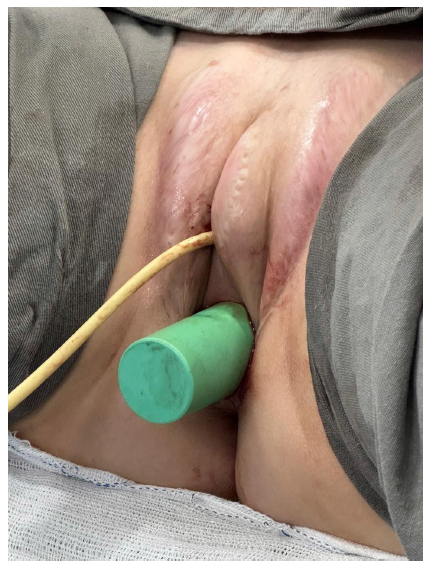
The neovaginal space was recreated via blunt dissection between the prostate, urethra, and rectum. The pericranial tube was then introduced into the created space using guide sutures at its cranial portion for intra-abdominal traction and to prevent torsion. The distal end of the pericranial tube was sutured to the previously deepithelialized vaginal introitus (Figure 5).
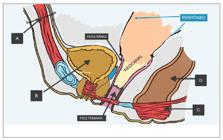
Illustration of the final configuration of the neovaginal canal. A - Abdominal wall; B - Bladder; C - Rectum; D - Colon.
Stage 4: Peritoneal Flap Suturing
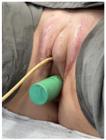
The peritoneal flap, positioned within the pelvis, was sutured cranially to the proximal margin of the pericranial tube using continuous 3-0 barbed suture. This anastomosis created a composite neovaginal canal lined distally by pericranium and proximally (at the apex) by peritoneum. At the conclusion of the procedure, the neovaginal canal reached a depth of 18 cm (Figure 6).
RESULTS
Postoperative recovery was uneventful. Total operative time was six hours, with estimated blood loss of 200 ml. The patient was discharged on postoperative day three. A dilation regimen was initiated during the first postoperative week and maintained three times daily.
At 6 months of follow-up, the neovaginal canal was fully epithelialized, well-lubricated (attributable to the peritoneal segment), and showed no signs of stenosis or contracture. The intraoperative depth of 18 cm was preserved. The patient reported high satisfaction with both functional outcomes, including the ability to engage in sexual intercourse, and aesthetic results.
DISCUSSION
Neovaginal reconstruction in gender-affirming surgery remains a complex and evolving field, with multiple techniques described, each presenting distinct advantages and limitations12. Although penile inversion vaginoplasty is the most commonly performed technique, it may be insufficient in up to 30% of cases, particularly in revision settings or when tissue availability is limited, potentially resulting in suboptimal aesthetic and functional outcomes13.
Intestinal vaginoplasty techniques, such as sigmoid colon vaginoplasty, provide excellent vaginal depth and spontaneous lubrication but are associated with higher morbidity, including risks of fistula formation, paralytic ileus, peritonitis, and excessive mucus production with characteristic odor14. In contrast, robotic peritoneal flap vaginoplasty has emerged as an elegant alternative with lower morbidity and promising outcomes. Contemporary studies report mean depths exceeding 13-14 cm and favorable sexual function, with reoperation rates ranging from 4% to 12%6,7. However, structural fragility and apical stenosis remain reported complications15 (Table 1).
Our proposed hybrid technique aims to combine the advantages of both worlds: the depth and self-lubrication of the peritoneum with the mechanical strength and structural support of the pericranium. The pericranial graft functions as a vascularized and mechanically robust bridge between the vaginal introitus and the delicate peritoneal flap. Theoretically, this intermediate structure may enhance canal stability, reduce stenosis risk at the tissue junction, and provide a scaffold that facilitates epithelialization and integration of the peritoneal flap. Extensive experience with pericranial grafts in reconstructive surgery supports their safety and predictability9.
This approach aligns with the growing trend toward individualized solutions for complex reconstructive cases. While other innovative methods, including free jejunal grafts and xenografts, also address tissue deficiency, our technique relies exclusively on autologous tissue, thereby eliminating immunologic risks associated with heterologous materials10,11.
Limitations include technical complexity, the need for a multidisciplinary team with expertise in advanced robotic and reconstructive surgery, and potentially longer operative time. Harvesting the pericranium introduces a second surgical site, albeit with minimal morbidity and a concealed scar. As a novel technique, the absence of long-term and larger cohort data necessitates further investigation to evaluate durability and late complications, such as graft contraction.
CONCLUSION
Hybrid vaginoplasty using a robotic-assisted peritoneal flap combined with an autologous pericranial graft may represent a viable and promising alternative for transgender patients with insufficient penoscrotal tissue, particularly in revision surgery. This technique leverages the unique biological properties of both tissues to construct a neovagina with adequate depth, potential for self-lubrication, and low donor-site morbidity. This case report demonstrates procedural feasibility and favorable early outcomes, which should be validated in future studies involving larger patient cohorts and long-term follow-up.
REFERENCES
-
1 da Silva GVM, Lobato MIR, da Silva DC, et al. Male-to-Female Gender-Affirming Surgery: 20-Year Review of Technique and Surgical Results. Front Surg. 2021;8:639430. doi: 10.3389/fsurg.2021.639430.
» https://doi.org/10.3389/fsurg.2021.639430 -
2 Papadopulos NA, Zavlin D, et al. Combined vaginoplasty technique for male-to-female sex reassignment surgery: Operative approach and outcomes. J Plast Reconstr Aesthet Surg. 2017;70(10):1431-1435. doi: 10.1016/j.bjps.2017.05.040.
» https://doi.org/10.1016/j.bjps.2017.05.040 -
3 Review of Complication Rates of Gender-Affirming Procedures in the Context of Analogous Procedures in Cisgender Patients: Gender-Affirming Vaginoplasty. Transgend Health. 2024. doi: 10.1089/trgh.2024.0134.
» https://doi.org/10.1089/trgh.2024.0134. -
4 Selvaggi G, Djordjevic M. Gender Affirming Vaginoplasty. Elsevier; 2023. doi: 10.1016/c2023-0-00038-3.
» https://doi.org/10.1016/c2023-0-00038-3. -
5 Bernal Riquelme J, Falcon Naser N, Barros Puertas J, et al. Gender affirmation surgeries in transgender women: Aesthetic, sexual, and urinary results of an initial series of vaginoplasties. Actas Urol Esp. 2021;45(3):192-199. doi: 10.1016/j.acuroe.2021.02.002.
» https://doi.org/10.1016/j.acuroe.2021.02.002 - 6 Haile E, Agrawal S, Fascelli M. Robotic peritoneal vaginoplasty in gender diverse patients: a narrative review. Curr Obstet Gynecol Rep. 2024;13:136-143.
-
7 Blasdel G, Hemal K, Dubach-Reinhold C, et al. Gender-affirming vaginoplasty using robotic peritoneal flap: long-term outcomes of 500 cases. Ann Surg. 2025. doi: 10.1097/SLA.0000000000006621.
» https://doi.org/10.1097/SLA.0000000000006621. -
8 Hemal K, et al. Quantifying the Learning Curve in Robotic Peritoneal Flap Vaginoplasty. Ann Plast Surg. 2025;94(4S Suppl 2):S139-S144. doi: 10.1097/SAP.0000000000004265.
» https://doi.org/10.1097/SAP.0000000000004265 -
9 Chiapasco M, Autelitano L, Rabbiosi D, Zaniboni M. The role of pericranium grafts in the reduction of postoperative dehiscences and bone resorption after reconstruction of severely deficient edentulous ridges with autogenous onlay bone grafts. Clin Oral Implants Res. 2013;24(8):898-906. doi: 10.1111/j.1600-0501.2012.02485.x.
» https://doi.org/10.1111/j.1600-0501.2012.02485.x -
10 Cho E, et al. Free Jejunal Graft Vaginoplasty in Gender Affirmation Surgery: A Novel Technique. Aesthetic Plast Surg. 2025. doi: 10.1007/s00266-025-05201-3.
» https://doi.org/10.1007/s00266-025-05201-3. -
11 Tabei S, et al. Gender Affirming Revision Vaginoplasty Utilizing Decellularized Fish Skin Xenograft: Surgical Technique and Outcomes. Int Braz J Urol. 2025;52(1):e20250340. doi: 10.1590/S1677-5538.IBJU.2025.0340.
» https://doi.org/10.1590/S1677-5538.IBJU.2025.0340 -
12 Horbach S, et al. Outcome of vaginoplasty in male-to-female transgenders: a systematic review of surgical techniques. J Sex Med. 2015;12(6):1499-1512. doi: 10.1111/jsm.12915.
» https://doi.org/10.1111/jsm.12915 -
13 Salibian AA, Schechter LS, Kuzon WM, et al. Vaginal canal reconstruction in penile inversion vaginoplasty with flaps, peritoneum, or skin grafts: where is the evidence? Plast Reconstr Surg. 2021;147(4):634e-643e. doi: 10.1097/PRS.0000000000007779.
» https://doi.org/10.1097/PRS.0000000000007779 -
14 Suwajo P, Ratanalert S, Sooksatian K, et al. Pedicled Peritoneal Flap Vaginoplasty in Male-to-Female Gender Affirmation Surgery: A Case Report. Female Pelvic Med Reconstr Surg. 2020;26(8):e23-e26. doi: 10.1097/SPV.0000000000000888.
» https://doi.org/10.1097/SPV.0000000000000888 -
15 Peters BR, Martin LH, Butler C, Dugi D, Dy GW. Robotic peritoneal flap vs. perineal penile inversion techniques for gender-affirming vaginoplasty. Curr Urol Rep. 2022;23(10):211-218. doi: 10.1007/s11934-022-01106-9.
» https://doi.org/10.1007/s11934-022-01106-9
Datasets related to this article will be available upon request to the corresponding author.